How to complete the IGNOU MGGL 004 Practical on your own
The IGNOU MGGL 004 Practical asks you, as an MSCGG learner, to plan one field survey of a village or town ward, run it yourself and write it up as a field survey report. This guide follows that work in the order you actually do it.
The whole survey in one box
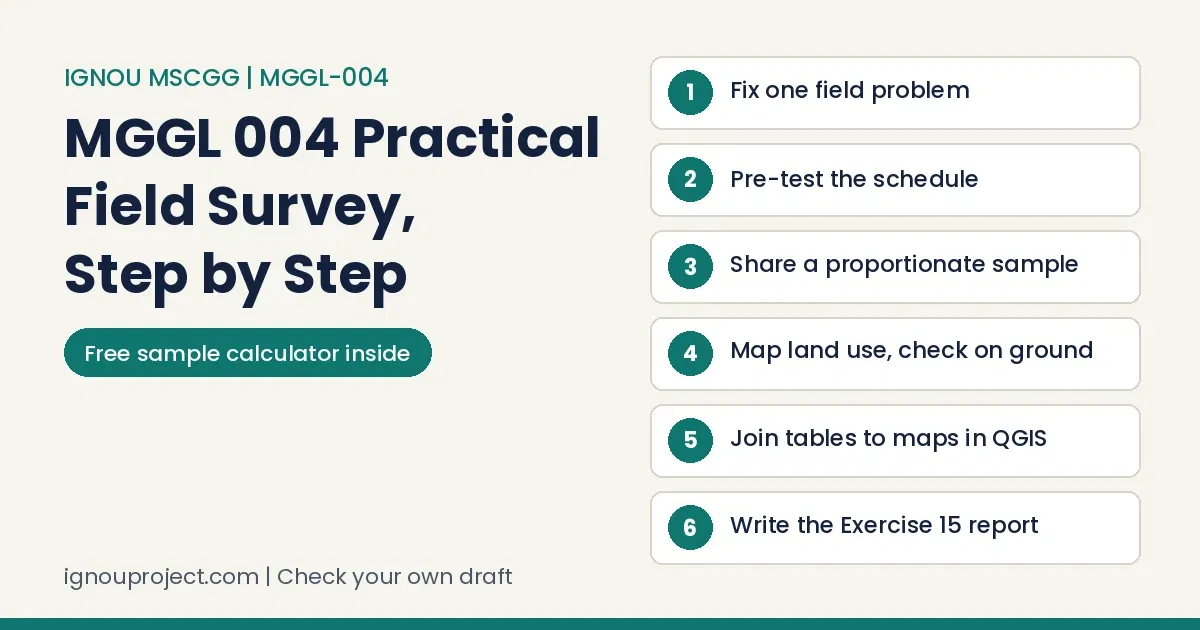
The IGNOU MGGL 004 Practical runs in seven moves: fix one field problem, pre-test a household schedule, share your sample across every locality in proportion, map land use from the FCC image and check it on the ground, survey and clean schedules each evening, join tables to maps in QGIS, then write the Exercise 15 report.
MGGL-004 Field Survey Methods: Physical and Socio-Economic is the 4-credit laboratory course of the third MSCGG semester: 15 exercises in 14 days, 26 sessions, two a day, with a counsellor. Each exercise feeds the next, and Exercise 15 gathers them into one report.
Step 1: turn a local walk-through into one field problem
Everything in the IGNOU MGGL 004 Practical hangs on the problem, so Exercise 2 starts on foot. Walk a local area noting land use, construction, environmental damage and local complaints, then cut that list to one focused problem by severity, impact and whether you can collect data on it.
Pick spots showing different sides of it (badly affected, being addressed, a control site) and justify each in two lines. Exercise 15 adds a limit: a simple topic close to home that fits your days, travel, stay, food, people’s cooperation and budget. Turn it into achievable objectives and research questions; Exercise 1 marks hypotheses “if required”.
An illustrative narrowing: “water problems in my village” is too loose. “Distance to the main drinking water source across the four tolas of one village, by household income group” gives a universe, a measurable variable and a pattern to map.
Step 2: draft and pre-test your household schedule
Exercise 4 asks you to develop a structured questionnaire for conducting a socio-economic household survey in your area. Exercise 7 explains the choice: the respondent fills a questionnaire, you fill a schedule face to face, and a schedule works even with people who cannot read or write. For a village or ward in the IGNOU MGGL 004 Practical, a schedule is usually the sensible tool.
- Order it as Exercise 4 lists: a familiarity part, general household details, sub-heads per theme, then specific questions, simple before complex.
- One issue per question: nothing double-barrelled, leading or full of jargon, and no overlapping answer categories.
- Place sensitive questions late; Exercise 7 names health, family planning and stigma topics as ones to ask with care.
- Generally keep it to 20 to 30 minutes; 45 minutes only where setting and topic allow.
- Code closed answers on the form and leave space for open replies and remarks.
- Record by observation what you can see: house type (katcha, pacca or semi pacca), electricity, water connection, toilet.
Pre-test it on a small, varied group. Reword or drop questions with little variation or many “don’t know” replies, check the answer spaces and time one interview. Pre-test respondents are not surveyed again.
Step 3: proportionate sampling across every tola, with a worked plan
For the IGNOU MGGL 004 Practical, Exercise 7 lets you take the whole village, or one town ward, as the universe. Once you know roughly how many households live in each locality, share the planned sample proportionately across the tolas, mohallas and habitations, then choose households at random with judgment from field realities. Hamlets behind a stream, hill or valley must be included.
The book shows proportionate sampling as 15, 7 and 26 percent of 50 giving 8, 4 and 13, and the systematic interval as I = N/n, so 1000 households and a sample of 50 means every 20th after a random start.
Illustrative village: 60 households across four tolas
Invented counts for practice; yours come from the house listing, the patwari or the panchayat. N = 600 households, n = 60.
| Locality | Households | Exact share (60 x Nh / 600) | To survey | Interval |
|---|---|---|---|---|
| Main abadi | 312 | 31.2 | 31 | about 10 |
| East tola | 148 | 14.8 | 15 | about 10 |
| Riverside tola | 87 | 8.7 | 9 | about 10 |
| Hill hamlet | 53 | 5.3 | 5 | about 11 |
| Total | 600 | 60.0 | 60 | 10 overall |
The whole numbers 31, 14, 8 and 5 make 58, so the two spare households go to the largest leftovers, 0.8 (East tola) and 0.7 (Riverside tola). In East tola, take a random start from 1 to 10, say 3, and survey listed houses 3, 13, 23 and onwards. Put this table in your methodology.
Proportionate sample calculator
Enter households per locality, separated by commas, and your sample size. It shares the sample, rounds by largest leftover and shows each interval. Without it, follow the worked plan by hand.
Step 4: map land use from the FCC image, then check it on the ground
The physical half of the IGNOU MGGL 004 Practical is the Exercise 6 land use land cover map, traced by hand on transparent sheet or butter paper. Its seven stages:
- Take the False Colour Composite image from your study centre laboratory.
- Trace the village or ward boundary, or a grid over the area.
- Build an interpretation key for your area from the standard keys; keys vary by place and season.
- Classify up to Level II of the National Remote Sensing Centre system, whose nine Level I classes run from built-up land and agriculture to water bodies and snow or glacial areas.
- Interpret the image and finalise the classes you actually found.
- Visit the doubtful features (GPS helps), mark each right or wrong and note the true class.
- Correct the map and finish it with proper symbols.
Keep that ground-check list for your methodology. For a physical problem such as stream-bank erosion, place measurement points on a transect or quadrats, as Exercise 6 teaches.
Step 5: run the socio-economic household survey, the focus group and the evening check
Exercise 7 of the IGNOU MGGL 004 Practical sets out the field days as fourteen tasks. First get a boundary map: the District Census Handbook block map, the patwari or karmchari’s map, the municipal ward map or a printed Google map marked with ward members.
In the field, build trust, sketch land use and services, learn roughly how many households of each group live where, fix the number per locality, and only then start the socio-economic household survey. At each door, explain the purpose simply, keep answers confidential, make no false promises and thank the family.
A diary line such as “Visited East tola, filled six schedules” proves only that you went. Across practical courses we see entries like this day after day, with no method in them. For MGGL-004 a stronger line reads: “East tola: all six houses katcha, recorded by observation as Exercise 7 advises; the handpump nearest the hill hamlet was dry, which explains the long water trips three families reported.”
Every evening, reread the day’s schedules and clear unclear entries from memory, returning to a house if needed. Code unexpected answers, photograph from first day to last, and collect local records from the patwari or panchayat.
For the focus group (Exercise 10): 6 to 12 people of all genders and ages, not mostly relatives, a neutral moderator, about 1 to 1.5 hours, in a common place that is not the site under discussion. Brief the issue, explain confidentiality, take consent, record views without arguing, then summarise and thank everyone. In the write-up, code points in the margin and report them in relative words (“most participants felt”), not percentages.
Step 6: join your tables to the map in QGIS and finish the layout
Exercises 12 to 14 of the IGNOU MGGL 004 Practical turn tables into maps; each can also be done manually under your academic counsellor.
- Add the map: Layer, Add Layer, Add Vector Layer, then MappingExercise.shp (or your traced boundary).
- Match IDs: give every polygon and table row the same unique ID. The book joins on State_ID; for a village, codes like T01 and T02 work, spelt identically in both files or the join leaves empty cells.
- Join: layer Properties, Joins, add a new join, set Join Field and Target Field to the ID, OK, Apply; confirm with Open Attribute Table.
- Keep it: save the project for a logical join, or Export, Save Features As for a new shapefile.
- Classify: Symbology, Graduated, your variable and colour ramp, Equal Interval or Natural Breaks (Jenks), Classify, Apply; click the Values bar for descending order.
- Layout: Project, New Print Layout (the book used QGIS 3.28); A4 or A3 to suit your centre’s printer; add map, scale, grid, legend, neatline, titles, north arrow and scale bar; lock items; Export as Image or Print.
Step 7: field survey report format, and what to write in each part
Exercise 15 of the IGNOU MGGL 004 Practical fixes the sequence, so spend your effort on what each part says. Front matter first: an unnumbered title page, the certificate from the teacher or course in-charge who supervised the survey, acknowledgements, contents and the lists of tables and figures.
- Introduction: problem, rationale, objectives, database and methodology, choice of study area, background, organisation of materials, limitations. In methodology, narrate the chain you followed: tools, data entry, digitising, tables, integration and the statistical and cartographic methods.
- Literature review: critical, showing the gap your survey fills, arranged by issue then year, broad subject to narrow, India to your state to your village.
- Findings and discussion: one section per theme, themes linked, with tables, maps, sketches, diagrams, photographs and any notable case.
- References: books, papers, reports and theses; date every online source.
- Appendix: schedule, field sketch, field notes, extra photographs, ethnographic notes.
Students often ask us whether a report “really” needs every part, and the parts dropped are usually core ones such as objectives or methodology. For MGGL-004, tick your Introduction against the eight parts Exercise 15 names; hypotheses only where your design needs them.
In many reports we read, the review cites studies missing from the references, or the list carries works the review never discusses. For MGGL-004, match every author in the review to the reference list that follows findings and discussion.
Seven mistakes in MGGL-004 work and how to fix them
Seven mistakes and their fixes
| Mistake | Fix |
|---|---|
| A problem as wide as a district | Shrink it to one village or ward, the universe Exercise 7 accepts. |
| All households from the main abadi | Share the sample across every tola, hamlets included. |
| Asking about things you can see | Observe house type and amenities; shorten the schedule. |
| Schedules unchecked until you are home | Clean them the same evening. |
| A diary written in one sitting afterwards: across practical courses it gives itself away with repeated lines, entries on days with no work and no change from first day to last. | Write each MGGL-004 entry at the evening schedule check. |
| Findings on figures nobody collected: some reports we see analyse assumed numbers with no survey behind them. | Exercise 15 makes your field data the report’s database; analyse only what you gathered. |
| A thematic map with empty polygons or no scale | Check the joined table for blanks; confirm legend, scale bar, north arrow, title and source. |
Twelve checks on your finished IGNOU MGGL 004 Practical report
The course book asks you to prepare the IGNOU MGGL 004 Practical report but does not say where it goes or how it is marked, so ask your counsellor about your centre’s route. Run these checks first.
Across practical courses, the written part is where marks slip most, and also the easiest part to put right. For MGGL-004 that part is the Exercise 15 field survey report, so an hour with this list is well spent.
Before you close the file: twelve checks
Turning your own survey into term-end paper answers
The IGNOU MGGL 004 Practical ends in a written paper of 3 hours and 50 marks: seven 10-mark questions, any five answered, so about 36 minutes each. Practise from the four papers of June 2025 to June 2026:
- Redraw your own study-area map with your data; June 2025 Set-I asked for it with interpretation.
- Write out the land use mapping stages and Level II classes; June 2025 Set-II gave imagery to map and interpret.
- Draw hythergraphs in degrees Fahrenheit and inches (June 2025 Set-II) and in degrees Celsius and millimetres (June 2026). Exercise 5 covers this, but its pages were missing from our copy, so get it from your study centre.
- Rebuild your schedule quickly; household schedules appeared in three of the four papers.
- List the join steps and layout elements with small diagrams, frame five focus group questions, and outline the report structure, which papers call a “project report”.
The July 2026 Common Prospectus sets the practical examination fee at Rs 300 for a course of 4 credits or fewer; it goes in with the exam form and is not returned if you miss the paper.
Send your own draft for a check
Once you have drafted your field survey report, schedule or map layout, you can send your own file on WhatsApp through our correction service page. We read it against the Exercise 15 order and the steps above and return marked corrections. Charges are printed on that page. You remain the author of the survey, data and report, and IGNOU’s evaluator alone decides marks.
Questions about doing the field survey
Can I do the IGNOU MGGL 004 Practical maps by hand instead of in QGIS?
Yes. Exercises 12 to 14 each allow manual work under your academic counsellor, and the Exercise 6 land use map is hand-traced anyway. Ask which route your centre follows.
How many households should my MGGL 004 field survey cover?
The book fixes no number. Exercise 7 asks you to set it after learning your village or ward’s household profile, adjust it in the field and share it across localities. Pick a number you can survey properly.
Should the appendix hold blank or filled schedules?
Some students we work with bind every filled schedule at the back. Exercise 15 of MGGL-004 lists the schedule in the appendix without saying blank or filled; one blank copy is common practice, so keep filled forms safe and ask your counsellor.
Finishing the IGNOU MGGL 004 Practical well
Learners who finish practical work smoothly start early, confirm rules with their own centre, write a dated record daily, collect signatures while the signer is around and can explain every page themselves. In MGGL-004 that means a pre-tested schedule before the field days, an evening diary and the supervising teacher’s certificate requested in time.
The IGNOU MGGL 004 Practical also prepares you for the next task: the prospectus asks MSCGG learners to settle the MGGP-001 project topic and synopsis in this same third semester, and our MGGP-001 project guide covers it. For printed study guides, see the reference material for this course on our publication site.
Official documents used for this guide
Every rule in this IGNOU MGGL 004 Practical guide comes from:
- Course book, Field Survey Method: Physical and Socio-Economic (MGGL-004), IGNOU School of Sciences, printed July 2025; Exercises 1, 2, 4, 6, 7, 10 and 12 to 15
- IGNOU Common Prospectus, July 2026: MSCGG section 3.54 and the practical fee rule
- Question paper, June 2025, Set-I
- Question paper, June 2025, Set-II
- Question paper, December 2025, Set-I
- Question paper, June 2026, Set-I
Documents read in November 2026: the MGGL-004 course book (July 2025 print), the July 2026 Common Prospectus and the four term-end practical papers listed above. The drafting was AI-assisted, each rule was checked against those sources, and BK Sahni publishes this guide under his editorial responsibility.
ignouproject.com is an independent service and is not affiliated with, authorised by or endorsed by IGNOU. We check and correct the learner’s own work; the learner remains the author of the survey, the schedules, the maps and the report.

BK Sahni iD 0009-0005-8092-459X
Founder, Shri Chakradhar Publication Pvt. Ltd. & ignouproject.com — helping IGNOU distance-learning students since 2010 (5,00,000+ students supported across MBA, MCom, MA & more). Author of IGNOU exam guides, solved assignments & project reference books.
Disclosure: Shri Chakradhar Publication Pvt. Ltd. and ignouproject.com are independent third-party study-help services — not the official IGNOU website. Always verify final dates and rules on ignou.ac.in.