
Serving IGNOU distance learners since 2010
IGNOU project help since 2010: synopsis and report preparation, approved guides, printing and free guides
Give us your topic, or take one we recommend from your programme’s guidelines. We prepare your synopsis by the next working day and, once IGNOU approves it, the full project report in 8 to 10 days, both to your course’s guidelines. You edit, finalise and submit; corrections your guide or IGNOU asks for are made free. Free guides cover results, assignment and project status, submission dates and 132 programme projects.
Independent service; not affiliated with IGNOU. The University’s official website is ignou.ac.in. IGNOU’s evaluator decides approval.
How it works, start to finish
- Topic. Yours, or one we recommend from your programme’s guidelines.
- Synopsis. Rs 1,000. Email and hard copy the next working day after payment.
- Guide. Your own, or an IGNOU-approved guide, quoted on WhatsApp.
- Approval. You finalise, sign with your guide and submit to your Regional Centre or School.
- Project report. Rs 2,000. Written to the approved synopsis and its comments in 8 to 10 days.
- Print, bind, upload. Final copy, and the report saved as one PDF per course; IGNOU’s own fee (Rs 300 or 500) goes to the University with the TEE form.
- Corrections. Every change your guide or IGNOU asks for, included.
You review and finalise every draft; IGNOU’s evaluator decides approval.
An IGNOU project is the project, dissertation or internship course inside your programme, such as MMPP-001 in the MBA, MESP-001 in MA Education or MLIP-002 in MLIS. It runs in two stages: a synopsis that must be approved first, then a report written on that approved synopsis. What changes from course to course is the office the synopsis goes to, the papers that travel with it, the report length and the fee slab, so your own course’s guidelines decide.
- 2 to 3 monthsMMPP-001: written approval or non-approval after the proposal reaches the Regional Centre
- 6 monthsMMPP-001: after this long from registration, the Regional Centre is not responsible for timely disposal of the proposal
- 5 learnersMMPP-001: the most one guide may supervise at a time
- 18,000 wordsMMPP-001: about the upper limit of the report, appendices excluded
- 8 detailson page one of the report PDF, per the June 2026 portal page
- 2 open guidesBK Sahni’s methodology guides for MMPP-001 and MCOP-001, on Zenodo
- The synopsis does not go to the same office in every course. MMPP-001 sends it to the Regional Director of your own Regional Centre; MLIP-002 sends it to the Programme Coordinator, MLIS, at SOSS in Maidan Garhi.
- In the MMPP-001 guidelines, 31 May and 30 November close result windows. They are not last dates: a report can be sent at any time of the year.
- MMPP-001 does state a decision period. Approval or non-approval is sent in writing within two to three months of the proposal reaching the Regional Centre.
- The approved MMPP-001 proposal is bound into the report. A report with the proposal only stapled in is not accepted.
- For the June 2026 cycle IGNOU did not consider reports sent by e-mail, yet the MLIS Programme Guide lets an MLIP-002 synopsis go as a soft copy by e-mail, hard copy or soft copy but not both.
IGNOU प्रोजेक्ट दो चरणों में होता है: पहले सिनॉप्सिस की स्वीकृति, फिर उसी स्वीकृत सिनॉप्सिस पर रिपोर्ट। सिनॉप्सिस कहाँ जाएगा, यह कोर्स पर निर्भर है: MMPP-001 में अपने क्षेत्रीय केंद्र के रीजनल डायरेक्टर को, जबकि MLIP-002 में SOSS, मैदान गढ़ी के प्रोग्राम कोऑर्डिनेटर को। जून 2026 के ऑनलाइन पोर्टल पर पूरी रिपोर्ट एक कोर्स की एक PDF में अपलोड करनी थी, और ईमेल से भेजी रिपोर्ट मान्य नहीं थी। प्रोजेक्ट शुल्क 4 क्रेडिट तक 300 रुपये और उससे ऊपर 500 रुपये है, जो TEE फॉर्म के साथ जमा होता है।
Start here
Three reasons students open this page
Most visitors want one of three things. Pick yours and skip the rest.
Is this IGNOU’s official website? No.
ignouproject.com is a private educational publisher’s website. It is not owned by, affiliated with or endorsed by Indira Gandhi National Open University. If you came here looking for the University, use the official addresses on the right. What this site adds is explanation: what those pages ask for, in what order, and what goes wrong.
संक्षेप में: ignouproject.com एक स्वतंत्र वेबसाइट है, जिसे श्री चक्रधर पब्लिकेशन प्राइवेट लिमिटेड, नई दिल्ली चलाती है और जो 2010 से IGNOU के दूरस्थ शिक्षार्थियों की सहायता कर रही है। यह IGNOU की आधिकारिक वेबसाइट नहीं है; विश्वविद्यालय की साइट ignou.ac.in है। यहाँ रिज़ल्ट, असाइनमेंट और प्रोजेक्ट स्टेटस के मुफ़्त गाइड हैं, और आपके अपने सिनॉप्सिस और रिपोर्ट की जाँच, सुधार, प्रिंटिंग और बाइंडिंग की सशुल्क सेवा है। प्रोजेक्ट मूल्यांकन शुल्क 4 क्रेडिट तक 300 रुपये और उससे ऊपर 500 रुपये है, जो TEE फॉर्म के साथ जमा होता है (कॉमन प्रॉस्पेक्टस जुलाई 2026)।
Official IGNOU addresses
ignou.ac.in gradecard.ignou.ac.in onlineproject.ignou.ac.in egyankosh.ac.in
Project queries after submission go to your Regional Centre’s email or to projects@ignou.ac.in (online project portal guidelines, June 2026, point 9). The University’s postal address and phone numbers are on the IGNOU head office page.
What an IGNOU Project Is: Seven Stages From Topic to Result
Every IGNOU project moves through the same seven stages, whatever the programme. The order is fixed; the offices, forms, limits and deadlines inside each stage come from your own course’s guidelines.
- Course registrationThe project course appears in your programme, for example MMPP-001 in the MBA or MLIP-002 in MLIS.
- Topic and guideYou choose a topic your course allows and a guide who meets its eligibility rules.
- Synopsis and proformaYou write the proposal and fill the approval proforma; you and your guide sign and date it.
- ApprovalAn evaluator approves or returns the synopsis, often with comments to work into the report.
- Study and reportYou collect the data the approved synopsis describes and write the report on it.
- Submission and feeThe report goes by the route the cycle’s notice sets; the evaluation fee is paid with the term-end examination form.
- Evaluation and vivaThe report is evaluated; a viva follows where your course or Regional Centre holds one.
What counts as IGNOU project work
IGNOU project work is any course in your programme that is evaluated on a written study rather than a term-end paper: a project, a dissertation, an internship report or a field file. The names differ, and so do the documents. MLIP-002 is a full 4-credit course with no assignment and a 50 percent pass mark, while MMPP-001 counts for 8 credits in the MBA.
Working Back From the Result Window
The cleanest way to plan an IGNOU project is backwards, from the term-end result you want. The MMPP-001 guidelines tie the result to the date the report is received: 1 December to 31 May for the June results, 1 June to 30 November for the December results. Those dates close result windows; the guidelines say the report can be sent at any time.
| Working back from the result window | MMPP-001 figure | What it means for your calendar |
|---|---|---|
| Report reaches SED | By 31 May for June results; by 30 November for December results | Post or upload a week early; the portal also removes incomplete reports after its last date |
| Study and writing | Not fixed; the guidelines aim to leave at least eight to nine months before the fourth semester ends | Plan two to three months of data collection and writing after approval |
| Approval decision | Two to three months after the proposal reaches the Regional Centre | Send the synopsis at least five to six months before your target window closes |
| Proposal sent | Within six months of registering for MMPP-001 | Later than that, the Regional Centre does not take responsibility for timely disposal |
A planning aid built from the MMPP-001 timing rules. Other courses publish their own timings; the June 2026 portal page had a last date of 15 June 2026 for that cycle.
One University, Different Doors: Where Each IGNOU Project Goes
The single most expensive mistake in an IGNOU project is sending a correct synopsis to the wrong office. IGNOU’s June 2026 portal page says synopsis approval is sought by forwarding the proposal to the concerned School or Regional Centre, and that synopses are not uploaded to the project portal. Which of the two applies is written in your course’s own document.
| Course | Synopsis goes to | Sent with it | Final report goes to |
|---|---|---|---|
| MMPP-001 (MBA family) | Regional Director of your own Regional Centre; envelope marked MMPP-001; MBA (Online) through the LMS | Proforma signed and dated by you and the guide; guide’s bio-data signed in original, unless the guide is an approved counsellor | Registrar (SED), Maidan Garhi, marked PROJECT REPORT-MMPP-001, or the cycle’s online portal |
| MESP-001 (MA Education) | Regional Director, as note (ii) on the Appendix IX proforma says, or your Regional Centre’s announced route | Cover page and Appendix IX proforma signed and dated by you and the guide; no bio-data asked | As the cycle’s notice directs |
| MLIP-002 (MLIS) | Programme Coordinator, MLIS, SOSS, Maidan Garhi; hard copy or soft copy, not both | Guide’s bio-data signed by the guide | Registrar (SED), Maidan Garhi, one copy, or the cycle’s online portal |
Built from the MMPP-001 guidelines, the MLIS Programme Guide, RC Delhi-3’s MAEDU guidelines and the June 2026 portal page, read in October 2026. For any other course, read its own guidelines from the programme guides further down this page.
Packet builder: what goes where, for your course
Built line by line from the MMPP-001 guidelines, the MLIS Programme Guide, RC Delhi-3’s MAEDU guidelines, the June 2026 project portal page and the Common Prospectus July 2026, read in October 2026. It does not predict approval.
This tool needs JavaScript. If this line stays after the page loads, the script was blocked; the table above gives the same answers.
How it decides. Each course answer repeats what that course’s document says about the office, the papers, the envelope, the timing and the traps. For a final report it adds the June 2026 portal rules (one PDF per course, eight details on page one, the signed documents, the fee receipt, no e-mail) and the fee slab from the Common Prospectus: Rs 300 up to 4 credits, Rs 500 above. “Another course” returns only those shared rules, because a route we have not read is a route we do not state.
Which Papers Are IGNOU’s and Which Are Study Reference
Students mix official IGNOU project guidelines with samples found online, then follow the sample. The map below keeps the two apart: the left column is what IGNOU issues and what your evaluator applies; the right column is what our desk made to help you read the left.
Issued by IGNOU
- Online submission page for the June 2026 TEEStudent Evaluation Division; one PDF per course, first-page details, fee receipt, no e-mail
- MMPP-001 project guidelinesSchool of Management Studies; synopsis contents, proforma, guide rules, report length
- MLIS Programme Guide (MLIP-002 section)School of Social Sciences; synopsis to the Programme Coordinator
- MESP-001 Handbook on Dissertation WorkSchool of Education; sixteen proposal components, Appendix IX proforma
- Common Prospectus July 2026Project evaluation fee and Regional Centre addresses
- Your own course’s guidelinesOpen your programme’s guide on this site; each one links its official document
Made by our desk for study
- Sample synopsis with a course crosswalk (PDF)One study shown under MMPP-001, MESP-001 and MLIP-002 headings; brackets for your facts; not for submission
- Report format template (PDF)Page order, chapter table, empty table shells and sentence frames; no results
- Research methodology guide for MMPP-001BK Sahni, Zenodo, CC BY 4.0
- Research methodology guide for MCOP-001BK Sahni, Zenodo, CC BY 4.0
If a sample and your IGNOU project guidelines disagree, the guidelines win. That includes our own files.
The Approval Proforma, Box by Box
The Proforma for Approval of Project Proposal is the form an evaluator reads first. Each programme prints its own version, so the field map below compares the boxes of two versions, MMPP-001’s (read this month) and MESP-001’s Appendix IX (from our September 2026 reading of the Handbook), and says what to watch in each.
| Box | Who fills it | MMPP-001 | MESP-001 (Appendix IX) | What to watch |
|---|---|---|---|---|
| Proposal number | Regional Centre | Project Proposal No., office use | Dissertation Proposal No., office use | Leave it blank; quote it later in every letter |
| Enrolment number | Student | Yes | Yes | Use the number on your current ID card; an approval on an old number after re-admission needs fresh approval (MMPP-001) |
| Study centre and Regional Centre | Student | Yes | Yes | Write the codes as well as the names |
| Subject area | Student | Six printed options, from HRM and OB to Any Other | Not on the form | Tick one; it should match the title |
| Name, address, e-mail, phone | Student | Name, address, e-mail | Name, address, e-mail, telephone | The decision is posted or mailed here |
| Title of the study | Student | Topic | Title | Never blank; the final report must carry this title word for word |
| Guide’s name and address | Student and guide | Yes, with counsellor status and the number of learners currently being guided | Yes | Official address; MMPP-001 caps a guide at five learners at a time |
| Signatures and dates | Student and guide | Both, with dates | Both, with dates | Original signatures; an undated box is a common return reason |
| Evaluator’s decision | Evaluator | Synopsis and supervisor each marked Approved or Not Approved, with comments | Approved or Not approved, with designation and stamp | Under MMPP-001 a sound synopsis can still fail on the supervisor box |
| Counter-signature | Regional Director or Assistant Regional Director | Yes | Regional Director’s signature and stamp | Your copy of the approved form is bound into the report |
A Topic Your Evaluator Has Not Seen Ten Times
Good IGNOU project topics are narrow: one variable, one group, one place, and where records are used, one period. The MMPP-001 proforma lists six subject areas, not titles, so no course document we read asks you to pick a printed topic word for word. The fastest test of a topic is whether you could collect its data yourself after approval.
Title sharpener
A planning aid, not an IGNOU rule: IGNOU sets no title formula. It joins your theme, group, place and period into three title patterns and flags common weak spots.
This tool needs JavaScript. If this line stays after the page loads, the script was blocked; the passage below explains the same checks.
How it decides. The tool writes your words into three patterns: theme among group in place, the same with the study type, and “A Study of” form. It flags a missing place, a missing period, words that widen the study beyond one group in one place (India, all, various), “impact” in a survey title, one-word themes, and the risk of copying a title that already circulates. It stores nothing and sends nothing.
Who May Guide an IGNOU Project, Course by Course
Before you think about how to find a guide for an IGNOU project, read who your course allows. The rules are specific, and the evaluator checks them: under MMPP-001 the proforma has a separate Approved or Not Approved box for the supervisor.
| Course | Who may guide | Limit and papers |
|---|---|---|
| MMPP-001 | Management faculty of SOMS at headquarters; approved academic counsellors of the Management Programme with relevant experience; management faculty with five years of postgraduate teaching; or professionals with a master’s degree in management or an allied discipline and at least five years in the relevant area | At most five learners at a time; bio-data signed in original, except for approved counsellors |
| MESP-001 | A guide approved by the School of Education; RC Delhi-3 says the study centre holds the list | No bio-data on the Appendix IX proforma |
| MLIP-002 | PhD in Library and Information Science, or a master’s in it with library, information centre or LIS teaching work; in either case at Assistant Professor scale or Pay Level 10 | Bio-data signed by the guide goes with the synopsis |
More detail, including what the guide signs at each stage, is in our guide eligibility explainer.
IGNOU Synopsis Components Compared Across Three Courses
An IGNOU synopsis is judged against its own course’s list of parts, and the lists are not the same. A proposal that is complete for one course can be incomplete for the next.
| Part | MMPP-001 | MESP-001 (Handbook Table 1) | MLIP-002 |
|---|---|---|---|
| Introduction and rationale | Introduction; rationale | Context and rationale; statement of the problem | Not itemised in the Programme Guide |
| Review of literature | Not itemised for the synopsis; the report’s introduction carries it | Review of related literature | Not itemised |
| Objectives and questions | Objectives, worded neutrally (to study, to explore, to analyse, to investigate) | Research questions; objectives | Not itemised |
| Hypotheses | Not listed | Important in experimental studies; may not be needed in fact-finding studies | Not itemised |
| Method | Design, nature and source of data, sample and technique, tools, data collection, statistical tools | Methodology, population, sample, tools, procedure, data analysis | Not itemised |
| Other parts | Limitations | Operational definitions; delimitations; implications | Guide’s signed bio-data with the synopsis |
The sample synopsis with a course crosswalk shows one fresh study, on PM SVANidhi loans among street vendors, written under these headings, with brackets wherever your own facts belong. For a fuller walk-through of a single proposal, see our proposal and synopsis guide.
Have a Draft? Get It Back Marked Against Your Course’s Rules
Most approvals we see come with correction or modification points, and the one that recurs most is a review of literature that needs bringing up to date. Approval also tends to arrive with comments the student must work into the report, and many students skip them. A marked copy of your own draft, checked against your course’s document before it travels, saves a round of that.
In your synopsis we mark
- Every part your course’s list asks for, in its order
- Objectives a method can actually answer, worded neutrally
- Sample, tools and statistics tied to each objective
- Proforma boxes, both signatures and dates, title box filled
- Bio-data where your course asks for it
In your report we mark
- Title identical to the approved title
- Evaluator’s comments worked in, chapter by chapter
- Approved proposal, proforma and bio-data bound in, not stapled
- Originality certificate signed and dated by you and your guide
- Page one details and single-PDF order for the portal
See how the correction service works
The correction marks your own draft against your course’s documents. IGNOU’s evaluator decides approval.
Featured service
Your synopsis by the next working day, your project report in 8 to 10 days
Most synopses come back for paperwork and wording, not for the idea: an objective nobody could measure, a proforma without both signatures and dates, a title that changes between synopsis and report. So we build both documents from your course’s own guidelines and from the reasons Regional Centres give for returning work, and we revise them free whenever your guide or IGNOU asks.
What the synopsis contains
- Every component your course’s proposal format asks for: problem, objectives, hypotheses where the design needs them, method, sample, tools, chapter plan and references.
- Objectives worded so that the method can actually answer them.
- The proforma filled in full, ready for you and your guide to sign and date; the guide’s bio-data in original where the course requires it (MMPP-001 guidelines).
- Your enrolment number checked as current: an approval on an old number after re-admission needs fresh approval (MMPP-001 guidelines).
What the project report contains
- The title as approved, word for word, and every chapter written to the approved synopsis and its comments.
- The approved proforma, synopsis and guide bio-data placed for binding, not stapling, with the originality certificate page ready for both signatures and dates (MMPP-001 guidelines).
- Chapter order, tables, citations and references in your course’s format.
- A first page with the eight particulars the online portal requires, in the order for one PDF per course (portal guidelines, June 2026).
You review and finalise every draft before it is submitted, and you sign the originality certificate with your guide. IGNOU’s evaluator decides approval; every correction your guide or IGNOU asks for is made without charge.
Fixed charges
Synopsis by email and hard copy the next working day after payment. Project report in 8 to 10 days once your synopsis is approved, written to it and to any comments it received.
Prices as of September 2026. Full refund if the work is not delivered in the promised time. Corrections asked for by your guide or by IGNOU are included. Approved-guide assistance is quoted separately on WhatsApp.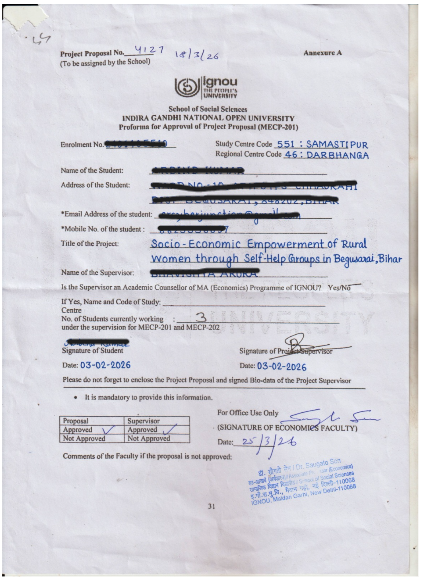
Services and prices
What we charge, and what is included
Every price on this site in one place. IGNOU’s own project evaluation fee, Rs 300 up to 4 credits and Rs 500 above, is paid to the University with the TEE form, never to us.
Prices as of 28 September 2026. The full list with procedures is on the Pricing and procedures page; a quote on WhatsApp is confirmed in writing before you pay.
Before you pay
Send your programme code, course code, enrolment number and topic on WhatsApp, or ask for a topic. The fee is confirmed in writing and the timeline runs from payment. You review and finalise every draft, the originality certificate is signed by you and your guide, and IGNOU’s evaluator decides approval.
How it works
Six stages of an IGNOU project, and who does what
Six stages in the order IGNOU’s guidelines put them, and what each side does at every one. You stay in charge of the topic and the final edit, and you sign the originality certificate with your guide; we do the data collection, drafting, formatting, printing and every correction in between.
- TopicYou: tell us your programme, course code and any topic you have in mind.We: recommend a topic your programme’s guidelines and your access to data can support, and fix it with you before writing starts.
- SynopsisYou: confirm the topic and pay; get the guide’s signature and bio-data, or ask us for an approved guide.We: prepare the synopsis with its proforma in your course’s format; email and hard copy by the next working day.
- Data and analysisYou: tell us where the study is set: the organisation, respondents or records your synopsis names, and anything you have already gathered.We: collect the data your synopsis promises, fresh for your study alone, and present the analysis, tables, tests and interpretation the way your course expects.
- ReportYou: review the report, make your final edits, and sign and date the originality certificate with your guide.We: write the report to the approved synopsis and its comments in 8 to 10 days; print and bind the final copy; prepare the portal-ready PDF order.
- SubmissionYou: pay the fee with the TEE form; upload one PDF per course, or submit as your programme directs.We: explain the current cycle’s route and dates; the free checker below does the package check.
- After submissionYou: track status; attend the viva your Regional Centre arranges.We: free status and result guides; every correction your guide or IGNOU asks for, made without charge.
From the official documents
Six facts most IGNOU project pages miss
Each one is taken from an IGNOU document read on 28 September 2026 and named beside it.
Your synopsis does not go to the online project portal. The June 2026 portal notice says candidates must not upload TEE assignments or synopses there; the proposal goes to your Regional Centre or School as your programme guidelines direct (portal guidelines, notes and point 6).
The report is one PDF per course with eight particulars on page one: title, your name, programme code, enrolment number as on the ID card, Regional Centre code, course code, mobile number and email (portal guidelines, point 7). A report not in order is not considered, and no communication is sent.
The fee is Rs 300 up to 4 credits and Rs 500 above, paid with the Term-End Examination form, and a copy of the receipt goes with the report (Common Prospectus July 2026, fee section; portal guidelines, point 10).
The guide signs the bio-data in original, unless the guide is an approved academic counsellor, in which case no bio-data is needed (MMPP-001 guidelines). If you have no eligible guide, approved-guide assistance is quoted on WhatsApp.
The proforma marks synopsis and supervisor separately, each as Approved or Not Approved, so a good synopsis can still come back if the guide does not meet the course’s eligibility rules (MMPP-001 handbook proforma, verified September 2026).
After upload, your Regional Centre is your contact: queries go to its email or to projects@ignou.ac.in, and the viva is arranged by the Regional Centre (portal guidelines, points 8 and 9).
Free tools
Two free tools: check your upload package, find your next step
The first encodes only two official documents. The second is a navigation aid for a site with more than 900 pages.
Tool 1 of 2OFFICIAL-RULE
IGNOU’s own project fee (paid to the University) and upload checker
The Rs 300 or Rs 500 shown here is the University’s own evaluation fee, paid to IGNOU with your exam form. It is not our charge; our prices are in Services and prices above. Rules from two IGNOU sources read on 28 September 2026: the June 2026 online project portal guidelines and the Common Prospectus July 2026. It does not predict approval or marks.
How it decides. Fee: up to 4 credits Rs 300, above 4 credits Rs 500, paid with the Term-End Examination form, applicable from the January 2023 admission cycle (Common Prospectus July 2026, fee section; portal guidelines point 10). Package: the portal guidelines require the approved proforma in original, the synopsis, the guide’s bio-data and the originality certificate signed and dated by both (point 4), one PDF per course with a first page carrying the learner’s particulars (point 7), clear scans in one orientation (point 5), and the fee receipt copy (point 10). Synopses are not uploaded to this portal (portal note 2); they go to the Regional Centre or School as your programme guidelines say. DECE-04 has a separate link. If your report is not in order, the portal states that it will not be considered and no communication will be sent.
Tool 2 of 2PLANNING-AID
Where are you stuck? IGNOU project router
Answer two or three questions and get the one page to open next, the official link for that stage, and what to keep ready. This is a navigation aid built by ignouproject.com; IGNOU does not prescribe this sequence.
How it decides. Each answer maps to one destination on ignouproject.com and one official IGNOU page: results and assignment status to the assignment result guide and the IGNOU grade card portal; project status to the project status guide and the official status page; starting a project to the programme guide for your level, which carries that course’s guidelines and proforma; synopsis and report help to the synopsis and project report page; submission to the submission guide and the online project portal; study material to the books, notes and guess paper pages. The “keep ready” list repeats what the official page for that stage asks for.
Approval, Comments and the Months of Silence
Once the synopsis is posted, an IGNOU project waits on an evaluator. The MMPP-001 guidelines promise a written decision within two to three months of the proposal reaching the Regional Centre, with a Project Proposal number on acceptance. For MAEDU, RC Delhi-3 says the Regional Centre communicates approval, non-approval or suggested modifications.
Our project status guide explains how to check where a report stands and what each message means. For a report already submitted, the June 2026 portal page sends queries to your Regional Centre’s e-mail or to the Student Evaluation Division’s project section at projects@ignou.ac.in.
If the synopsis comes back
MMPP-001 asks for a revised proposal, a fresh proforma, a copy of the rejected proposal and its proforma with the evaluator’s comments, and the PP number. A change of guide is treated as a new proposal.
AI Drafts, Copied Material and the Originality Certificate
The June 2026 portal page lists a certificate of originality, signed and dated by the student and the guide, among the items a report must carry wherever the course applies it, and the MMPP-001 guidelines say plagiarism is dealt with under the University’s own policy. Whatever tools you use, the data and the analysis have to come from your own study.
Two Open Methodology Guides by BK Sahni
Research method is where an IGNOU project report most often goes thin. BK Sahni has published two methodology guides on Zenodo, the open research repository run by CERN, under a CC BY 4.0 licence, each with its own DOI. Both say plainly that they are references for your own work, not ready-made reports.
Research Methodology for IGNOU MBA Projects (MMPP-001): Research Design, Objectives and Data Methods
Version 1.0, 18 June 2026. Covers measurable objectives, exploratory, descriptive and causal designs, sampling, primary and secondary data, and analysis with percentages, cross-tabulation and correlation, plus validity, limitations and referencing. DOI 10.5281/zenodo.20748477
Research Methodology for IGNOU MCom Projects (MCOP-001): Designs, Data Sources and Analysis
Version 1.0, 18 June 2026. Covers commerce research objectives, the choice of design, secondary and primary data, ratio and trend analysis, and validity and limitations. DOI 10.5281/zenodo.20748782
The IGNOU Project Report and Dissertation: Format and Length
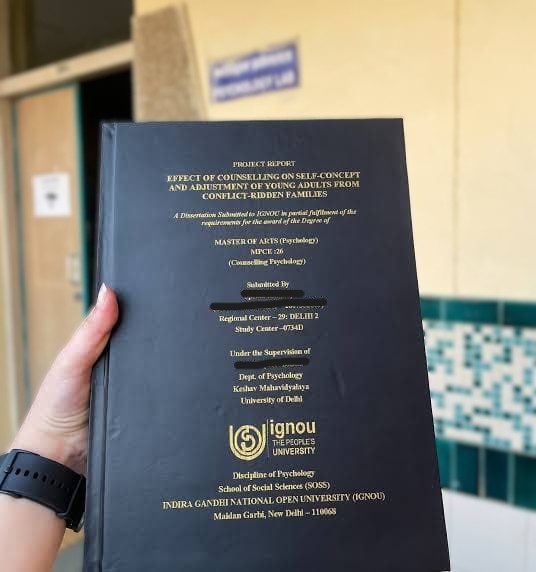
An IGNOU project report is written on the approved synopsis, and its format is the one your course prints. Length is where courses differ most: the MMPP-001 report runs about 50 to 60 double-spaced typed pages, not more than about 18,000 words excluding appendices, while the MESP-001 Handbook sets no word limit and no font for an IGNOU dissertation in MA Education.
| MMPP-001 report order | MLIP-002 report order (Programme Guide) |
|---|---|
| Introduction with literature review and organisation details | Certificate, acknowledgements, table of contents, preface |
| Research methodology, with reliability and validity of tools | Introduction, review of literature |
| Results and discussion | Objectives, methodology |
| Summary and conclusion; recommendations | Findings, conclusion |
| Limitations and further research (optional); references; annexures including the questionnaire | Bibliography, index, appendices |
The report format template lays out the page order, a chapter table with a page budget, empty table shells and sentence frames for findings, with a column showing where courses differ. It contains no results.
Data, Analysis and the Questionnaire
The MMPP-001 synopsis has to state the nature and source of data, the sample and its technique, the tools and the statistical methods. Tie each one to an objective, even though the guidelines do not say it in those words, because that is how an evaluator reads a method. The report then has to deliver on them: results and discussion in tables or charts with interpretation, and the questionnaire among the annexures.
What Gets Bound Into the IGNOU Project File
A finished IGNOU project file carries more than chapters. The MMPP-001 guidelines ask for the approved proposal, the approved proforma and the guide’s bio-data bound into the report, not stapled, plus a certificate of originality signed and dated by the student and the guide. The June 2026 portal page lists the same papers wherever a course applies them, and adds a copy of the fee receipt.
- First page with your particulars (for the portal: title, name, programme code, enrolment number as on the ID card, Regional Centre code, course code, mobile, e-mail)
- Approved proforma in original and the approved synopsis
- Guide’s bio-data, where your course asks for it
- Certificate of originality, both signatures and dates
- Contents with page numbers, chapters, references, annexures
- Copy of the project fee receipt
IGNOU Project Submission: Portal Rules for the Final Report
For the June 2026 term-end cycle, IGNOU project submission for final project, dissertation and internship reports ran through onlineproject.ignou.ac.in, with a last date of 15 June 2026 and a separate link for DECE-04. The portal page’s rules are worth reading in full because they are blunt: a report that does not meet them is not considered, and no communication is sent.
| Rule on the June 2026 portal page | What it means for you |
|---|---|
| Scan the original report as a single PDF for one course | One file per course; clear pages, in sequence, one orientation |
| First page carries the learner’s particulars | Title, name, programme code, enrolment number as on the ID card, Regional Centre code, course code, mobile and e-mail |
| Approved proforma in original, synopsis, guide’s bio-data, originality certificate signed and dated | Wherever your course applies them |
| Fee paid with the term-end examination form; receipt copy with the report | No fee, no evaluation |
| Reports received by e-mail are not considered | Upload; do not e-mail |
| Incomplete submissions are removed after the last date | They must be uploaded again in the next session |
| TEE assignments and synopses are not uploaded here | The synopsis goes to your School or Regional Centre |
Portal paths change each cycle. Dates and steps for the December 2026 cycle are tracked on our December 2026 submission page, and the general route on the project submission guide.
Rs 300 or Rs 500, and Whether a Viva Applies
The project evaluation fee depends on the credits of your course: Rs 300 for project work up to 4 credits and Rs 500 above 4 credits, paid with the term-end examination form, not to any private site (Common Prospectus July 2026). So MLIP-002 at 4 credits is Rs 300, while MMPP-001 at 8 credits and MESP-001 at 10 credits are Rs 500. The MMPP-001 guidelines also carry a footnote that project fees from the January 2023 admission cycle are Rs 500 per course.
A viva is not universal. The MMPP-001 guidelines hold one only if the evaluator recommends it; the June 2026 portal page says a viva is conducted by the concerned faculty at the Regional Centre and asks students to contact their Regional Centre; the MLIS Programme Guide describes none for MLIP-002.
Programme guides
Project guides for 132 IGNOU programmes
Each guide is built around that course’s own documents: the programme guide or project handbook, the approval proforma, the return and rejection triggers, submission route, fee and viva, with topic directions and a sample synopsis where the course’s format has been verified. The hub page IGNOU projects by programme holds the same list with descriptions.
Master’s degree project guides (68)
- MCOM topics (MCOP-001)
- MCOM project guide (MCOP-001)
- MBA, new syllabus (MMPP-001)
- MBA (MS-100, older syllabus)
- MBA HR (MMPP-001 / MS-100)
- MBA Finance (MMPP-001 / MS-100)
- MBA Marketing (MMPP-001 / MS-100)
- MBA Operations (MMPP-001 / MS-100)
- MBF Banking and Finance (MMPP-001)
- MBAFM (MMPP-001)
- MBAHM (MMPP-001)
- MBAMM (MMPP-001)
- MBAOM (MMPP-001)
- MBAOL (MMPP-001)
- MBACN (MMPNP-001)
- MBALS (MMPLP-001)
- MBAABM (MAMP-060)
- MBAHCHM (MHHP-021)
- MAPC Psychology (MPCE-16, 26, 36)
- MPCE-16 Clinical Psychology
- MPCE-26 Counselling Psychology
- MPCE-36 Industrial Psychology
- MAPC practical (MPCL-007)
- MAEDU Education (MESP-001)
- M.Ed. (MESP-068)
- MLIS Library Science (MLIP-002)
- MTTM Tourism (MTTM-016)
- MSCDFSM Dietetics (MFNP-012)
- MSCFSQM (MVPP-002, 003, 004)
- MAAN Anthropology (MANP-001)
- MARD Rural Development (MRDP-001)
- MAEOH (MEVP-001)
- MAJEM (MNMP-001 / MJMP-120)
- MAJMC (MJMP-020)
- MAJDM (MNMP-012)
- MADJ (MDJP-004)
- MATS (MTT-022)
- MSCCFT (MCFTP-002)
- MEC and MAEC Economics (MECP-001, 101, 102)
- MAEC Economics, new syllabus (MECP-201, 202)
- MAEVS (MEVP-012)
- MAER (MERP-001, 002)
- MSCENV (MEVP-011)
- MAGD (MGSP-001, 002)
- MAWGS (MWGP-001)
- MACSR (MEDSP-051)
- MAUS (MEDSP-045)
- MADP (MVA-029)
- MSCGG (MGGP-001)
- MSCZOO (MZOP-001)
- MSCHSC (MHCP-001, 002)
- MADE (MDEP-520)
- MSCBCH (MBCP-001)
- MSCAST (MSTP-011)
- MASS (MSDP-018)
- MAAE Adult Education (MAEP-001)
- MADVS (MDVP-117)
- MAWGSR (MWGP-101)
- MSCRWEE (MRWP-002)
- MGPS (MGPE-017)
- MAMIDI (MDIP-001)
- MSCGI (MGYP-031)
- MSCMACS (MMTP-001)
- MSW Social Work (MSWP-001)
- MPA Public Administration (MPAP-002)
- MPS Political Science (MPSE-010)
- MSCIS (MSEP-028, 038)
- MAFCS (MFCP-005)
Bachelor’s degree project guides (18)
- BTS Tourism (PTS-001, 002, 004, 005, 006)
- PTS-004 Indian Culture
- PTS-005 Ecology and Tourism
- PTS-006 Tourism Marketing
- BTSOL topics
- BATS (BTSP-001, 002)
- BSCAEY (BEYP-028, 029)
- AHE Human Environment (AHE-001)
- BSCANH (BANE-154)
- BAPCH Psychology (BPCE-144)
- BAVTM Tourism Management (BTMP-142)
- BAFSM (BFOP-001)
- BAVMSME (BERGP-171)
- BAPFHMH Hindustani Music (BHMCP-109)
- BAJDM (BNMP-021, 022)
- BBA (BMPP-001)
- BLIS internship report (BLII-230)
- AMT Mathematics Teaching (AMT-001)
PG Diploma and PG Certificate project guides (30)
- PGDRD (RDD-005 / MRDP-205)
- PGDEMA (MESP-049)
- PGDLAN (MLIP-008)
- PGDT Translation (MTTP-006)
- PGDDM Disaster Management (MPAP-001)
- PGDHE Higher Education (MESP-105)
- PGDPPED Pre-Primary Education (MESP-085)
- PGDFSQM (MVPP-001)
- PGDIS Information Security (MSEP-028)
- PGDEOH (MEVP-001)
- PGDCJ Criminal Justice (MLEP-017)
- PGDHHM (PGDHHM-006)
- PGDCSR (MEDSP-051)
- PGDET Educational Technology (MESP-135)
- PGDSS Sustainability Science (MSDP-018)
- PGDUPDL Urban Planning (MEDSP-045)
- PGDFCS Folklore (MFCI-005)
- PGDWGS (MWGP-001)
- PGCINDS (MISP-021)
- PGDINDS (MISP-021)
- PGDDC (MCDP-007)
- PGDIDM Digital Media (MNMP-011)
- PGCPP Patent Practice (MIRP-001)
- PGDBP Book Publishing (MBPP-001)
- PGDAB (MAMP-058)
- PGDAIC (MNMP-021)
- PGCIPWS (MWRP-001)
- PGDMIDI (MDIP-001)
- PGDECFE (MCDP-001, 002)
- PGDDRRM (MPAP-031)
Diploma and Certificate project guides (16)
- DNHE Nutrition (DNHE-004)
- DECE Early Childhood (DECE-004)
- DPLAD (BPAP-004)
- DTS Tourism (PTS-006)
- DWM (BNRP-108)
- DIPP Paralegal (BLEP-001)
- DSCDM Smart City (MIOP-001)
- DAQ (BAQP-001)
- CCP Consumer Protection (CPIP-104)
- CES Environmental Studies (PES-001)
- CAHT Anti Human Trafficking (BLEP-034)
- CPSCM Peace Studies (BGPP-001)
- CSWATT (BWAP-001)
- CETM (OEYP-004)
- CHCWM (BHMP-101)
- CIHL Humanitarian Law (BLEP-038)
Older course codes (for example MS-100 for the MBA project) are explained inside the guide that replaced them.
Free guides
The IGNOU guides students use most
Paperwork
Three documents every IGNOU project depends on
Proforma for approval of the project proposal
The form that travels with your synopsis. It carries your enrolment details, the title, the subject area, the guide’s details, and both signatures with dates; the evaluator marks synopsis and supervisor separately. It is printed in your programme’s guidelines or handbook, and each programme’s version differs. Your programme guide links the official copy and explains every box.
Guide and guide bio-data
Who may guide you is set by your School. For MMPP-001 there are four routes: management faculty at headquarters, approved academic counsellors of the programme, faculty with five years of postgraduate teaching, or professionals with a master’s degree and five years in the field; each guide may take at most five students, and only approved counsellors are exempt from signed bio-data. For MESP-001 the guide is approved by the School of Education. We explain the rules for your course and, if you have no eligible guide, connect you with an IGNOU-approved guide; ask on WhatsApp.
Certificate of originality
Bound into the final report and signed and dated by you and your guide, it states that the work is your own. The online portal lists it among the items a report must carry, wherever the course applies it (portal guidelines, point 4). Its wording and annexure number come from your programme’s guidelines.
Reference material
Books, solved assignments and guess papers
Our sister site shrichakradhar.com publishes the reference material; this site explains what each product is for. None of it is meant to be submitted as your own work.
Printed books are also on our Amazon store and at shrichakradhar.com.
About us
Who runs ignouproject.com
ignouproject.com is published by Shri Chakradhar Publication Private Limited, a company registered in New Delhi in 2019 (CIN U22213DL2019PTC352185), with its own printing press and an in-house editorial team that writes the help books and guess papers and prepares learners’ synopses and project reports. The work behind it began in 2010, when its founder started helping IGNOU distance learners with project paperwork and study material. The company also publishes shrichakradhar.com, and its Facebook and Instagram business accounts are Meta Verified.
By BK Sahni. Last updated: .
Research note: this page states IGNOU rules only from documents read on 28 September 2026: the fee section of the Common Prospectus July 2026, the June 2026 online project portal guidelines, and the MMPP-001 project guidelines on ignou.ac.in. Counts, guarantees and testimonials that cannot be verified are not published. If something here is wrong or a notice has changed, tell us on WhatsApp or by email and it is corrected with a dated note.

BK Sahni (Bhavya Kumar Sahni), founder. Independent educational publisher in New Delhi, publishing since 2010, and founder of Shri Chakradhar Publication Pvt. Ltd. He reads the University’s guidelines and Regional Centre notices for every page on this site: each guide is checked against the current Programme Guide, Project Handbook or eGyanKosh document for its course code, and University requirements are cited to their source. His research methodology guides for the IGNOU MBA (MMPP-001) and MCom (MCOP-001) projects are published open access on Zenodo under CC BY 4.0. He holds no IGNOU appointment, and the site does not claim otherwise.
ORCID 0009-0005-8092-459X. Full profile at bksahni.com; research on Zenodo.
 Watch the 49-second introduction on our YouTube channel (opens YouTube).



Topic recommendation, synopsis and project report preparation to your course’s guidelines, approved-guide assistance, corrections without charge, printing and binding, reference material.
Promise approval or marks, reuse one student’s data, synopsis or report for another, or submit on your behalf.
Full refund if we fail to deliver the service you paid for within the agreed time.
Your drafts, data, enrolment details and messages are not shared with anyone outside the team working on your project.
Reviews
Reviews of ignouproject.com are collected on Trustpilot, where anyone can write one and we cannot edit or remove them. If we helped you, a review there helps the next student judge us. If we let you down, say so there too, and write to us so we can put it right.
Official IGNOU sources used on this page
- IGNOU Common Prospectus July 2026, fee section, read 28 September 2026.
- Guidelines for online submission of project reports, June 2026 TEE, onlineproject.ignou.ac.in, read 28 September 2026.
- MMPP-001 Project Course guidelines, School of Management Studies, ignou.ac.in, verified September 2026.
- MESP-001 dissertation handbook and Regional Centre notices, as verified for the MAEDU guide in September 2026.
FAQ
Questions students ask
Can I buy an IGNOU project online and submit it?
You can find sites selling ready-made files, and IGNOU rejects work that is copied or repeated: you and your guide sign an originality certificate. Our service differs in the way that matters. Your synopsis and report are prepared for you alone, on your topic and to your course’s guidelines, and you review, edit and finalise them before you sign and submit. Nothing is reused for another student.
What is the proforma for approval of a project proposal?
It is the approval form that accompanies your synopsis: enrolment details, title, subject area, guide’s details, and the signatures and dates of student and guide, with space for the evaluator to approve or reject the synopsis and the supervisor separately. Each programme prints its own version in its guidelines or handbook; your programme guide on this site links to it.
How do I find a guide for my IGNOU project?
Ask your Study Centre or Regional Centre first: approved academic counsellors of your programme usually qualify and do not need to supply bio-data. Otherwise, your programme’s guidelines list who is eligible; for MMPP-001 that includes management faculty with five years of postgraduate teaching and professionals with a master’s degree and five years’ experience, with a limit of five students per guide. The guide must sign your proforma and bio-data in original. If you have no eligible guide, we connect you with an IGNOU-approved guide; ask on WhatsApp for the quote.
What is the IGNOU project fee, and where is it paid?
Rs 300 for a project course of up to 4 credits and Rs 500 above 4 credits, applicable from the January 2023 admission cycle. It is paid with the Term-End Examination form, and a copy of the receipt goes with the report; a report without the fee is not evaluated (Common Prospectus July 2026; portal guidelines, June 2026).
Where do I submit the synopsis, and where the final report?
The synopsis goes to your Regional Centre or School as your programme’s guidelines direct; it is not uploaded to the project portal. The final report for a term-end cycle is uploaded as one PDF per course on onlineproject.ignou.ac.in before that cycle’s last date (15 June 2026 for the June 2026 cycle), unless your programme directs otherwise. Check the submission guide for the current route.
How do I check my project or synopsis status?
Project status is shown on IGNOU’s student pages by enrolment number and programme code; synopsis approval is communicated by the Regional Centre or School. The project status guide shows both routes and what each status means.
What goes on the first page of the report PDF?
The portal requires the title, your name, programme code, enrolment number as on your ID card, Regional Centre code, course code, mobile number and email on the first page of the single PDF (portal guidelines, June 2026, point 7). The synopsis front page follows your programme’s format; see your programme guide.
Whom do I contact about a report I have already submitted?
Your Regional Centre’s email, or the Student Evaluation Division’s project section at projects@ignou.ac.in (portal guidelines, point 9). The viva is arranged by the Regional Centre.
Do you write assignments or projects for students?
We prepare synopsis and project report drafts to your course’s guidelines (Rs 1,000 and Rs 2,000), which you review, edit and submit as the author, and we make every correction your guide or IGNOU asks for without charge. Reference material, solved assignments and handwritten assignments are marked as reference. IGNOU’s evaluator decides approval.
Is ignouproject.com IGNOU’s official website?
No. It is an independent site of Shri Chakradhar Publication Private Limited, New Delhi. IGNOU’s official website is ignou.ac.in.
Do you provide a project guide or supervisor?
Yes, as a separate paid service quoted on WhatsApp. The guide is an IGNOU-approved guide who meets your course’s eligibility rules and signs the proforma and bio-data in original. If your Study Centre already has an approved academic counsellor for your programme, that route is free; otherwise send us your programme and course code.
What happens after I pay for the synopsis?
Send your programme code, course code, enrolment number and topic on WhatsApp; if you have no topic we recommend one from your programme’s guidelines. After payment the synopsis with its proforma goes to your email and a hard copy is dispatched the next working day. You make your final edits, get the guide’s signatures and submit it to your Regional Centre or School. Once it is approved, the project report follows in 8 to 10 days of your order, written to the approved synopsis and any comments; corrections from your guide or IGNOU are made free. The synopsis and project report page has a sample.
How long should the synopsis and the project report be?
Your programme’s guidelines set the length, and it differs by course; a single figure for all of IGNOU does not exist, and many word counts repeated online appear in no official document. Your programme guide on this site quotes the figure from that course’s guidelines or handbook.
Do you do the statistical analysis or supply data for my project?
Yes. The data is collected fresh for your study alone, from the organisation, respondents or records your synopsis names, and is never shared with or matched to another student’s report. We then prepare the analysis, tables, tests and interpretation the way your course’s format expects, including SPSS or Excel output where the design needs it.
How long does IGNOU take to approve a synopsis?
The portal guidelines give no fixed period. Approval is communicated by your Regional Centre or School, and it is shown against your enrolment number as explained in the project status guide. If you hear nothing, write to your Regional Centre with your enrolment number and programme code rather than resubmitting.
Questions About IGNOU Project Paperwork
Are IGNOU projects the same in every programme?
No. Every IGNOU project has a synopsis stage and a report stage, but the office and the papers change from course to course, and so do the limits. MMPP-001 sends the synopsis to the Regional Director with the guide’s bio-data; MLIP-002 sends it to the Programme Coordinator at SOSS; MESP-001’s Appendix IX proforma asks for no bio-data at all.
Is an IGNOU dissertation different from a project?
Mostly in name. MESP-001 in MA Education is called a dissertation and MMPP-001 in the MBA a project, yet both run on an approved proposal and a written report. What differs is each course’s own list of components, its length and its route, which is why the course code matters more than the label.
Where are the official IGNOU project guidelines for my course?
IGNOU project guidelines sit in your programme guide or in a separate project handbook on ignou.ac.in or eGyanKosh. Our programme guides further up this page link the official document for each course, and the document map above lists the ones we read for this page.
What should I keep when I send the synopsis?
A full copy of what you sent and proof of sending: the post or courier receipt, or the acknowledgement e-mail. Many students forget to take a receipt, and without one there is little to show when an approval does not arrive.
My synopsis was not approved. What do I send again?
Under MMPP-001: the revised proposal, a fresh proforma, a copy of the rejected proposal and its proforma with the evaluator’s comments, and the PP number. When asked to resubmit, many students forget the original rejected synopsis, and the packet comes back incomplete.
Do I need a receipt for the final report too?
Yes. Some students skip it at the report stage. For a posted report keep the post office receipt; for an upload keep a screenshot or the confirmation, and keep the project fee receipt, a copy of which the June 2026 portal page asks to accompany the report.
Can I change the topic after approval?
The MMPP-001 guidelines lock the final report to the approved title, and a change of guide is treated as a new proposal. Our page on changing a topic after approval covers the options.
A Last Check Before You Start
Before your IGNOU project leaves your hands, run five checks: the right office for your course, the proforma complete with both signatures and dates, a guide your course allows, a title that will not change, and a copy of everything you send. The packet builder above lists what to check for the first three under MMPP-001, MESP-001 and MLIP-002.
For IGNOU project help on your own draft, our correction desk marks a synopsis for Rs 1,000 and a project report for Rs 2,000, and the team answers on WhatsApp at +91 93546 37830, Monday to Saturday, 9 am to 6 pm.
Sources read for these sections
- Indira Gandhi National Open University, Student Evaluation Division. (2026). Online submission of final project, dissertation and internship reports, June 2026 TEE. onlineproject.ignou.ac.in/PROJECTJUN26. Read October 2026.
- Indira Gandhi National Open University, School of Management Studies. (n.d.). MMPP-001: Project course. Guidelines for submission of synopsis and project report. ignou.ac.in. Read October 2026.
- Indira Gandhi National Open University, School of Social Sciences. (n.d.). Master of Library and Information Science (MLIS) programme guide, MLIP-002 section. ignou.ac.in. Read October 2026.
- IGNOU Regional Centre Delhi-3. (n.d.). Guidelines for MAEDU dissertation proposal. rcdelhi3.ignou.ac.in. Read October 2026.
- Indira Gandhi National Open University, School of Education. (2009). MESP-001: Handbook on dissertation work. eGyanKosh. Read September 2026 from a third-party copy; eGyanKosh refuses automated access.
- Indira Gandhi National Open University. (2026). Common Prospectus, July 2026, project evaluation fee. ignou.ac.in.
- Sahni, B. K. (2026). Research methodology for IGNOU MBA projects (MMPP-001): Research design, objectives and data methods (Version 1.0). Zenodo. https://doi.org/10.5281/zenodo.20748477
- Sahni, B. K. (2026). Research methodology for IGNOU MCom projects (MCOP-001): Designs, data sources and analysis (Version 1.0). Zenodo. https://doi.org/10.5281/zenodo.20748782
ignouproject.com is an independent service of Shri Chakradhar Publication Private Limited and is not affiliated with or endorsed by Indira Gandhi National Open University. IGNOU’s official website is ignou.ac.in.
Our blog
Our latest stories
Here we share all the new topics related to IGNOU Projects and IGNOU Courses.
Read all posts-

-
-
-
IGNOU Handwritten Assignment
IGNOU BAFSK Handwritten Assignment: Every BSKC Code, Both SOH Due Dates And The Code Conflicts
-
-
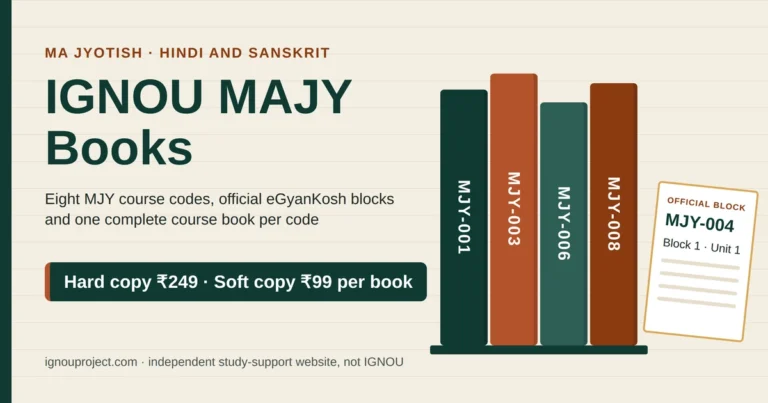
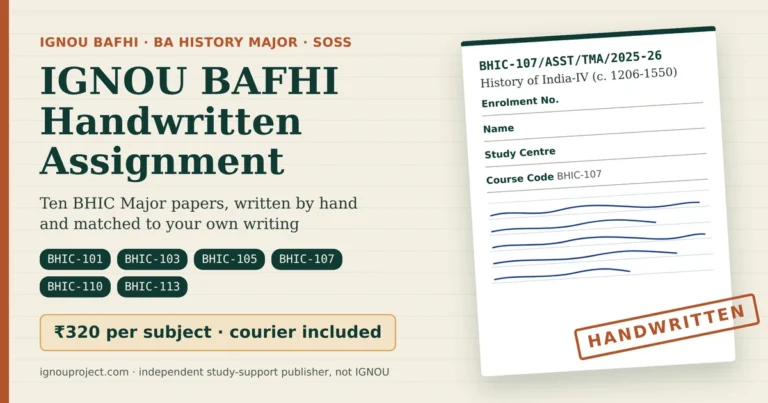
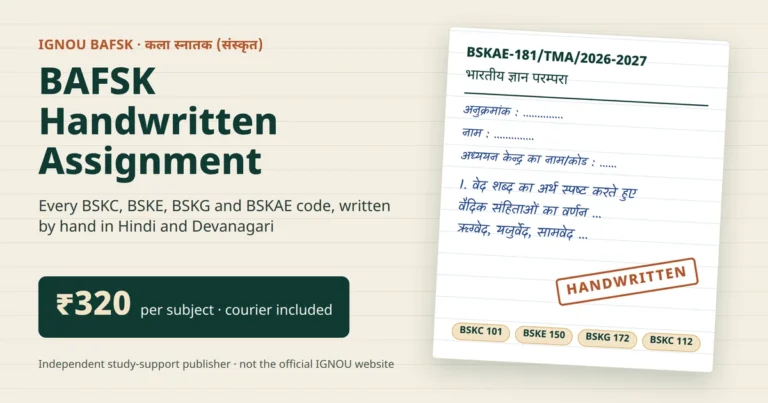
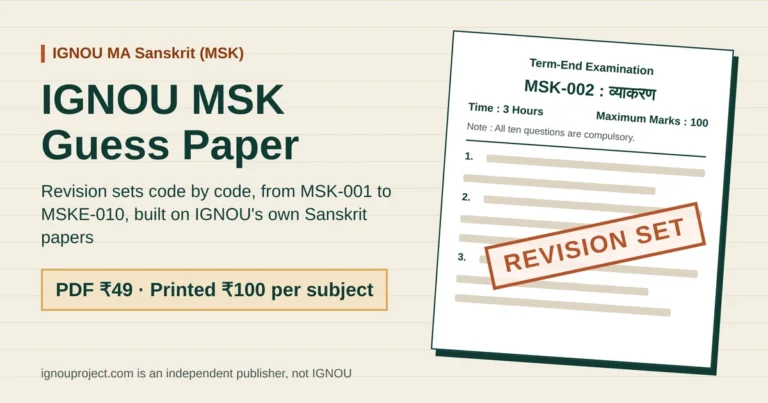
Live from ignouproject.com: the six newest posts, updated as each new post is published. Page 1 of 122.
Contact
Talk to us
WhatsApp, phone, email
WhatsApp +91 93546 37830 for project work, or call +91 99589 47060 for orders, printing and delivery, Monday to Saturday, 9 am to 6 pm.
Email sales@shrichakradhar.com.
Two offices in New Delhi
Shri Chakradhar Publication Private Limited
Project and content team at Tilak Nagar; head office with the printing press at Dwarka. Both are on the maps below.
Send a message with the form below and we reply on WhatsApp or email within one working day.
ignouproject.com is an independent service and is not affiliated with or endorsed by Indira Gandhi National Open University. Rules, fees and dates are stated as of the documents named above and can change; confirm the current notice on ignou.ac.in or with your Regional Centre before you act.