Research note: written after reading the MSDP-018 Handbook on Project Work (IGNOU, May 2016, all 26 pages), the IGNOU Common Prospectus July 2026, and the MSDP-018 Project Work, Formats and proforma pages on IGNOU’s official MASS site, all read in October 2026. Where they disagree, this page says so and tells you which one governs.
QUICK ANSWER
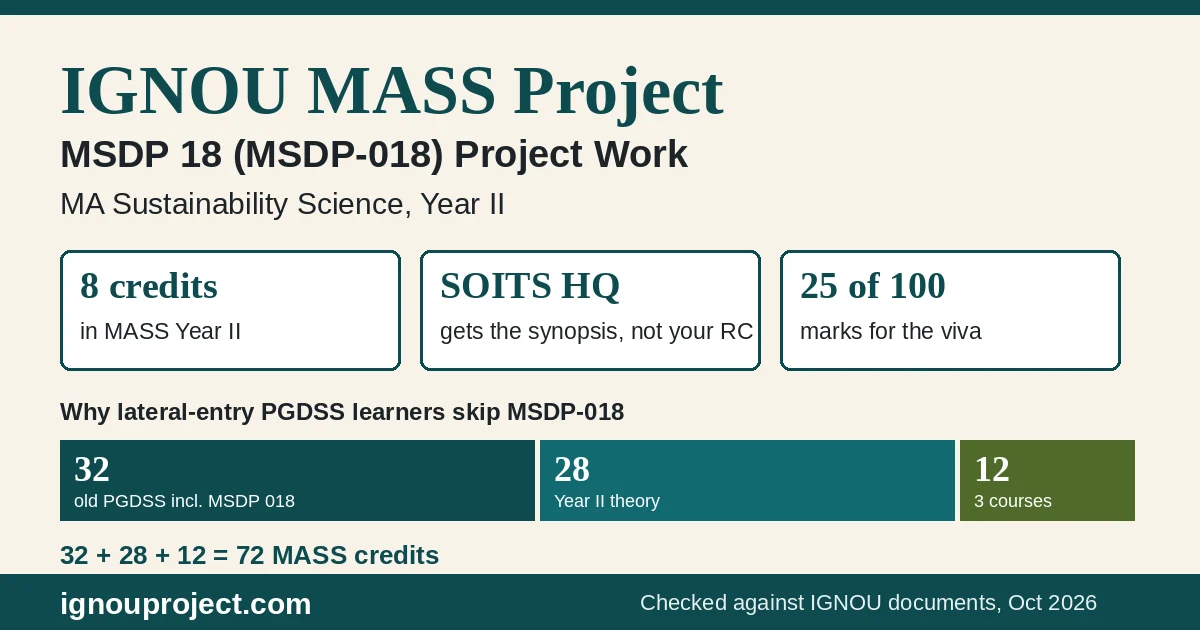
The IGNOU MASS project is MSDP-018 (printed “MSDP 18” in the prospectus), an 8-credit Project Work course in Year II of the MA in Sustainability Science. You send a proposal with the SOITS proforma, your supervisor’s signed bio-data and an I-card scan to the Programme Coordinator at SOITS, IGNOU headquarters, not to your Regional Centre. After approval you post one bound report to the Registrar (SED). It carries 100 marks, 25 of them for the viva.
Facts most MSDP-018 pages miss
- The code is MSDP-018, and there is no MSD-018. No MASS or PGDSS assignment booklet we read lists an MSD-018; the number 18 is carried by the project. IGNOU’s own MASS web page prints it as “MSDP-011”, and the MASSOL page prints both “MSDP-011” and “MDSP-018”; the prospectus and the MASS site use MSDP-018.
- It is 8 credits, not 4. The handbook most sites copy says 4 credits because it was written in May 2016 for the old one-year PGDSS. MASS lists MSDP 18 at 8 credits in Year II (Prospectus July 2026, p. 96).
- Current PGDSS has no project. It is nine theory courses, 36 credits (p. 294). PGDSS learners registered July 2017 to July 2022 who finish MASS by lateral entry take MSD 019, MSD 020 and MEVE 016 in place of MSDP 018.
- The proposal goes to SOITS headquarters, not your Regional Centre. The current proforma even comes pre-filled with “Regional Centre: HQ, IGNOU”. The report goes to the Registrar, Student Evaluation Division.
- The viva is part of the scheme, not an extra. The 2016 Handbook gives 75 per cent to the report and 25 per cent to the viva. The MASS site’s six marking rows add up to 95, although its printed total is 100.
- An incomplete bio-data stops the proposal at the door. The proforma says a proposal without the supervisor’s complete, signed bio-data “will not be entertained”, even when the supervisor is a PGDSS counsellor.
Learning about IGNOU MASS Project (MSDP 18)
MSDP-018 Project Work is the only project course in the Master of Arts (Sustainability Science), MASS, run by the School of Interdisciplinary and Trans-disciplinary Studies (SOITS). MASS is a 72-credit, two-year programme (maximum four years) in English, with year-wise examinations and admission in January and July; the fee is ₹8,200 a year, ₹16,400 in total (Common Prospectus July 2026, p. 39). The project carries 8 of the 36 credits in Year II.
| MASS Year II course | Title | Credits |
|---|---|---|
| MEV 25 | Climate Change and Society | 4 |
| MSD 21 | Mountain and Hill Ecosystem | 4 |
| MSD 22 | Aquatic Ecosystem | 4 |
| MEDS 51 | Fundamentals of CSR | 6 |
| MSD 23 | Social Ecology, Globalisation and Sustainability | 4 |
| MEDS 44 | Monitoring and Evaluation of Projects and Programmes | 6 |
| MSDP 18 | Project Work | 8 |
Source: IGNOU Common Prospectus July 2026, section 3.41, p. 96. Year I is MSD 11 to MSD 17, MSD 19 and MSD 20 (36 credits).
Is there an MSD-018 course, and what is the MSDP full form?
No. There is no MSD-018 theory course. No MASS or PGDSS assignment booklet we read lists an MSD-018, and the 2023 first-year booklet goes straight from MSD-017 to MSD-019; the number 18 is carried by the project, MSDP-018. IGNOU does not publish an expansion of “MSDP”. Read it as a code: MSD is the prefix of the sustainability science courses, P marks a project, and 018 is the course number. It is unrelated to the government scheme MsDP, the Multi-sectoral Development Programme of the Ministry of Minority Affairs, which was restructured and renamed Pradhan Mantri Jan Vikas Karyakram from 2018.
हिंदी में सार
इग्नू MASS (एमए सस्टेनेबिलिटी साइंस) में MSDP-018 प्रोजेक्ट वर्क दूसरे वर्ष का 8 क्रेडिट का कोर्स है। प्रोजेक्ट प्रपोज़ल (सिनॉप्सिस) प्रोफॉर्मा, सुपरवाइज़र के हस्ताक्षरित बायो-डेटा और आई-कार्ड की प्रति के साथ SOITS, इग्नू मुख्यालय, नई दिल्ली के प्रोग्राम कोऑर्डिनेटर को भेजा जाता है, रीजनल सेंटर को नहीं। प्रोजेक्ट रिपोर्ट रजिस्ट्रार (SED), इग्नू, मैदान गढ़ी को भेजी जाती है; 1 दिसंबर से 31 मई के बीच भेजी गई रिपोर्ट का परिणाम जून टीईई के साथ और 1 जून से 30 नवंबर के बीच भेजी गई रिपोर्ट का परिणाम दिसंबर टीईई के साथ आता है। कुल 100 अंकों में से 25 अंक वाइवा के हैं। वर्तमान PGDSS में यह प्रोजेक्ट शामिल नहीं है।
Two Handbooks, One Course Code
Students searching for the “MASS project PDF” usually find one handbook and assume it is current. It was written for a different programme in 2016. Use this map to see which document is official and which files are only study reference.
OFFICIALIGNOU documents
- Common Prospectus July 2026 (IGNOU): MASS structure p. 96, fee p. 39, project fee p. 27, PGDSS p. 294.
- MSDP-018 Handbook on Project Work (eGyanKosh): written for PGDSS, May 2016, re-badged to SOITS in 2017.
- MSDP-018 Project Work page on IGNOU’s MASS site (SOITS): credits, supervisors, addresses, marking.
- Formats page (SOITS): proposal proforma (Annexure II), Certificate of Originality, Final Project Report Format.
- MASS programme page (IGNOU): note the “MSDP-011” misprint.
STUDY REFERENCEignouproject.com files, not for submission
- Sample MSDP-018 synopsis (PDF): “Role of User Groups in the Upkeep of Amrit Sarovar Ponds”, laid out on the seven official components, with your facts left in [brackets].
- MSDP-018 report format template (PDF): the official page order with empty table shells and sentence frames. No results.
- Both files are watermarked study reference. IGNOU needs your own original proposal and report.
What changed between the 2016 handbook and the MASS site
| Point | 2016 Handbook (PGDSS) | MASS site, read October 2026 |
|---|---|---|
| Written for | One-year PGDSS: 7 theory courses plus MSDP 018 | MASS (72 credits): 15 theory courses, with MSDP 018 in Year II |
| Credits | 4 | 8 |
| School named | School of Agriculture in the text and on the proforma; SOITS on the 2017 cover | SOITS throughout |
| Where the proposal goes | “Coordinator (PGDSS), School of Agriculture” in the text; a 2017 box says Programme Coordinator (PGDSS), SOITS, Room No. 21A, Block 1 | “Coordinator (MASSS), School of Interdisciplinary and Transdisciplinary Studies, Swami Vivekanand Bhawan, IGNOU, Maidan Garhi, New Delhi-110068” (the extra S is on the page) |
| Topic criterion | “Relevance of the topic to the urban planning and development”, a leftover from another programme’s handbook | Relevance to sustainable development |
| Proforma | School of Agriculture header | SOITS version; Study Centre “SOITS, IGNOU, New Delhi” and Regional Centre “HQ, IGNOU” pre-filled; I-card scan as page 2 |
| Report length | About 40 to 50 double-spaced pages, about 10,000 words, plus or minus 10 per cent | Not stated on the pages we could read |
| Marking | 75 per cent report, 25 per cent viva; 50 per cent to pass | Six rows (10, 10, 10, 30, 10, viva 25) adding to 95; printed total 100 |
Rule of thumb: for a MASS learner, the MASS site and the prospectus govern credits, addresses and forms; the 2016 Handbook still supplies the detailed procedure (bio-data contents, resubmission, report order, result windows) because nothing newer replaces it. IGNOU’s MASS site also hosts its own handbook file (“MSDP-018 MASS.pdf”), which we could not open; read it before you fix your report length.
Why PGDSS No Longer Has MSDP-018
PGDSS was once a one-year programme of seven theory courses (MSD-011 to MSD-017) plus MSDP 018 at 4 credits; the 2021 PGDSS assignment booklet still lists exactly those seven courses. From the 2023 booklets onward, PGDSS and MASS Year I share nine theory courses, MSD-011 to MSD-017 plus MSD-019 and MSD-020, and the current prospectus shows PGDSS at 36 credits with no project (p. 294). The project moved to MASS Year II and doubled to 8 credits.
That change is why older PGDSS holders who join MASS by lateral entry do not repeat MSDP-018. The prospectus says PGDSS learners registered from July 2017 to July 2022 (ODL and Online) “will have to complete” MSD 19, MSD 20 and MEVE 16 “in place of MSDP 018: Project Work”. The arithmetic shows why:
32 + 28 + 12 = 72, exactly the MASS total. Our calculation from the prospectus course list. The WEAS MASS page prints the lateral-entry window as July 2017 to January 2022; if you registered between February and July 2022, confirm with mass@ignou.ac.in.
Guidelines and Format of IGNOU MASS Project
OFFICIAL-RULEEvery rule below is quoted or summarised from a document named in the source column. Nothing here is a third-party convention.
| Stage | What the documents say | Source |
|---|---|---|
| Proposal contents | Title, Introduction, Objectives, Problem Statement, Research Methodology (with locale, sampling, instruments and statistical tools), Limitations if any, References | Handbook pp. 17, 20; Proposal Format |
| Proposal package | Filled proforma signed by student and supervisor; signed supervisor bio-data; one copy of the proposal; keep a copy; “MSDP-018” on the envelope | Handbook pp. 18 to 20; proforma |
| Proposal address | Coordinator (MASS), SOITS, Swami Vivekanand Bhawan, IGNOU, Maidan Garhi, New Delhi-110068 | MASS site, Project Work page |
| When to send | The Handbook suggests 30 April (January session) and 31 October (July session) for PGDSS, but proposals are accepted throughout the year | Handbook p. 18 |
| Approval | Written approval or non-approval within six weeks of receipt, by e-mail and post | Handbook p. 18 |
| Resubmission | Revised proposal with a revised proforma, a copy of the rejected proposal, the proforma bearing the evaluator’s comments, and the P.P. No. | Handbook p. 19 |
| Report format | English; A-4; typed in double space; in a bound volume | Handbook p. 20 |
| Report address | Registrar (Student Evaluation Division), IGNOU, Maidan Garhi, New Delhi-110068, by Registered or Speed post | Handbook pp. 19, 20; MASS site |
| Result window | Posted 1 December to 31 May: June TEE result. Posted 1 June to 30 November: December TEE result | Handbook p. 19 |
| Fee | ₹500 project evaluation fee for projects above 4 credits, with the TEE form | Prospectus p. 27 |
| Marking | 100 marks; 25 for viva; 50 per cent to pass | Handbook p. 21; MASS site |
Font, margin, page numbering style and binding colour are not specified in any MSDP-018 document we read. For general formatting advice see our IGNOU project report format guide and the cross-programme IGNOU project guidelines.
Selection of IGNOU MASS Project Guide Supervisor
Your supervisor must meet one of five routes. The same five appear in the 2016 Handbook (pp. 17, 18) and on the MASS site:
- Faculty at the Headquarters.
- Academic Counsellors of the PG Diploma in Sustainability Science with relevant experience.
- Teachers or researchers in the area of Sustainable Development.
- A Ph.D. in Environmental Science or Studies, Economics, Sociology, Anthropology or a related discipline.
- A Master’s or M.Phil. in those disciplines with 2 years of research or teaching experience.
The MASS site names SOITS faculty available for supervision: Dr Y. S. C. Khuman, Dr V. Venkata Ramanan, Dr Deeksha Dave, Dr Shachi Shah, Dr Sadananda Sahoo, Dr Shubhangi Vaidya and Prof. Nandini Sinha Kapur. If the School does not accept your proposed supervisor, or you change supervisor later, you submit afresh on a new proforma signed by the new supervisor, and it is treated as a new proposal. If your supervisor is an academic counsellor, state the courses they counsel, since when, and the study centre name and code.
The University, not the student, pays the supervisor a token honorarium (₹300 per student in the 2016 Handbook, revisable). The Handbook also lists the supervisor’s duties, including an authorisation letter for data collection, which your study centre or regional centre can also issue.
Supervisor bio-data checklist
| Bio-data must show | Why it matters |
|---|---|
| Date of birth | Listed in the Handbook’s enclosure note (p. 19) |
| Full office and residential addresses | Same note |
| Contact telephone numbers | Same note |
| Academic qualifications with year of passing | Shows which eligibility route applies |
| Work experience with designation and name of the organisation | Needed for the Master’s or M.Phil. route (2 years) |
| Supervisor’s own signature | Without a complete, signed bio-data the proposal “will not be entertained” |
More on eligibility across programmes: who can be an IGNOU project guide.
Choosing Your IGNOU MASS Project Topic (MSDP-18)
The Handbook asks you to weigh seven points before choosing: suitability of the topic; its relevance to sustainable development (the 2016 text says “urban planning and development”, corrected on the MASS site); the time available; whether data can be collected within that time; the challenges in collecting it and how you will meet them; the cost of data collection; and communication facilities and local language. Annexure I then lists 18 sample topics, which “are just sample topics” and do not limit your choice.
PLANNING-AIDThe table links each official sample topic to the MASS course that prepares you for it and a method that suits it. The course link and method are our planning suggestion, not IGNOU’s.
| Annexure I sample topic | Course that prepares you | Method that suits it |
|---|---|---|
| Survey on status of biodiversity of your local forest or park and its management | MSD 12, MSD 21 | Survey with an observation checklist |
| Case study of any government plan or programme on livelihood improvement | MEDS 44, MSD 15 | Case study |
| Dynamic lifestyle and its impact on the environment | MSD 23 | Survey |
| Rapid urbanisation and issues of migrant labour | MSD 17, MSD 20 | Personal survey |
| Case study on corporate social responsibility of a company and its impact on the livelihood of a target community | MEDS 51 | Case study |
| Economic value of conserving a park | MSD 14 | Survey of park users |
| Role of NGOs in rural livelihood | MSD 15, MEDS 44 | Case study |
| Developing a village knowledge centre of your region | MSD 16 | Case study |
| Case study on a culture-based conservation practice | MSD 13 | Case study |
| Study on the carbon budget of your office or home | MEV 25 | Records and measurement |
| Traditional knowledge and its status | MSD 13 | Case study with interviews |
| Women’s healthcare status | MSD 20 | Personal survey |
| Issues of climate change and your locality | MEV 25 | Survey |
| A study on socio-economic conditions of nomads | MSD 13, MSD 20 | Survey plus case study |
| A historical analysis of any city or town | MSD 23 | Documents and records |
| A case study on a city solid waste management system | MSD 17, MEDS 44 | Case study |
| A survey on SHGs | MSD 15 | Personal survey |
| Paperless governance and its efficiency | MSD 15 | Case study |
Case study or survey?
The Handbook spends most of its pages on these two methods. A case study suits “how” and “why” questions about one unit studied in depth: a programme that succeeded or failed, a group in transition, an NGO. A survey suits quantifiable facts about a community, a dispersed population and comparisons across people, but it “does not easily prove a cause-and-effect relationship”. Many good MSDP-018 projects combine the two, as our sample synopsis does. Topic help across programmes: how to choose an IGNOU project topic; tool design: questionnaire and data collection.
Writing your IGNOU MASS Project Synopsis
The MSDP-018 proposal (synopsis) has seven parts and no prescribed page count. The Handbook and the current Proposal Format list the same seven:
| Part | What it must do |
|---|---|
| Title | Name the unit, the issue and the locale; make no claim about the result. It must match the proforma word for word. |
| Introduction | Say what the topic is about, how it emerged and why you took it up. |
| Objectives | State what you will study, examine or assess. Avoid wording that assumes the answer. |
| Problem Statement | Turn the topic into one clear research question. |
| Research Methodology | State the locale, the sampling, the instruments and the statistical tools. All four are named in the Handbook. |
| Limitations, if any | Constraints of sample, season, access or self-reported data. |
| References | APA style, alphabetical, only what you read. |
Writing objectives: how to write IGNOU project objectives. General synopsis layout: IGNOU synopsis and proposal guide. Then run your package through the checker before you post it.
OFFICIAL-RULEMSDP-018 Proposal Package Checker
This tool needs JavaScript. If you can still read this line after the page has loaded, use the checklist in the paragraph below the tool.
How it decides. The route question applies the Common Prospectus July 2026: lateral entrants registered in PGDSS from July 2017 to July 2022 take MSD 019, MSD 020 and MEVE 016 instead of MSDP 018, and current PGDSS has no project. For MASS learners every unticked box becomes a gap, each tied to its source: the seven proposal parts (Handbook p. 17), the proforma signatures and I-card page (current SOITS proforma), the six bio-data details (Handbook pp. 19, 20), the counsellor details (p. 18), the envelope marking and retained copy (pp. 18, 19), and the five supervisor routes (pp. 17, 18). The only rule that is ours is “one title everywhere”. It checks completeness, not quality, and it cannot predict approval.
Before You Post: Get Your MSDP-018 Draft Checked
The SOITS proforma states that a proposal without the supervisor’s complete, signed bio-data “will not be entertained”, and a supervisor the School does not accept means starting again on a new proforma. Each returned proposal costs you roughly another six weeks of waiting.
What we check in your MSDP-018 synopsis
- All seven parts present, with locale, sampling, instruments and statistical tools each stated
- Objectives worded so they do not assume the result, and matched to an analysis
- Title identical on proforma and proposal
- Bio-data has all six details and a signature; counsellor details if needed
- Proforma signed and dated by both; I-card page in place
What we check in your report
- Handbook page order, from title page to appendices
- Approved proforma, approved proposal and bio-data bound in; originality certificate signed by both
- Results in tables and graphs, discussed against earlier studies
- APA references, alphabetical, matching every citation
- The Handbook’s case-study cautions: dramatising, projecting your own values, conclusions drawn from theory instead of data
Get my synopsis or report checked
You remain the author of your proposal and report; we review the draft you wrote and return corrections. Approval is decided by the School, and the report is marked by IGNOU’s examiner.
The SOITS Proforma, Box by Box
The Proforma for Approval of Project Proposal (MSDP-018) is Annexure II. The current version on the MASS site’s Formats page is issued by SOITS; the 2016 Handbook’s version carries a School of Agriculture header. Use the current one.
| Box | Who fills it | What to watch |
|---|---|---|
| Project Proposal No. | The School | Leave blank; you will quote this P.P. No. on any resubmission |
| Enrolment No. | Student | Current enrolment number, matching your I-card |
| Study Centre | Pre-filled | Printed as “SOITS, IGNOU, New Delhi” on the current form |
| Regional Centre | Pre-filled | Printed as “HQ, IGNOU”: the project is handled at headquarters |
| Name and address of the student | Student | Full postal address; the approval letter is sent by post as well as e-mail |
| E-mail and phone | Student | Both marked compulsory |
| Title of the project | Student | Identical to the proposal title |
| Name and address of the supervisor | Student | Same as on the bio-data |
| Is the supervisor an Academic Counsellor of PGDSS? | Student | Yes or No; the form still says PGDSS |
| If yes, name and code of study centre | Student | Give both |
| Signature and date of student | Student | Original signature and a date |
| Signature and date of supervisor | Supervisor | Original signature and a date |
| Page 2 | Student | Scanned copy of your IGNOU I-card |
| Project Proposal: Approved or Not approved | Office | Decided separately from the supervisor |
| Supervisor: Approved or Not approved | Office | A rejected supervisor means a new proposal |
| Comments or suggestions | Office | Keep this page; it goes with any resubmission |
| Signature of faculty | SOITS | The 2016 form says School of Agriculture |
| Resume of the Supervisor | Supervisor | The bio-data described above |
How long approval takes across programmes, and what to do while you wait: IGNOU synopsis approval process. If you must change your topic later, read changing an IGNOU project topic after approval first.
From Approval to Posting: Your MSDP-018 Fieldwork Calendar
The Handbook gives no project timetable, but it does give survey timings, and IGNOU’s result windows are fixed. The calendar below joins the two so you can see whether your plan reaches the result session you want.
PLANNING-AIDMSDP-018 Fieldwork Calendar
This tool needs JavaScript. If you can still read this line after the page has loaded, use the result-window table below the tool.
How it decides. Approval is assumed six weeks after your proposal reaches SOITS (Handbook p. 18) plus one week of post. Two weeks are allowed to pilot your tool. Fieldwork then follows the Handbook’s own sequences where it gives them: for a mail survey, an advance letter two weeks before mailing, a reminder postcard about a week after, a follow-up letter three weeks after the first mailing, and a 60 to 90 per cent return treated as satisfactory (p. 16); for a telephone survey, six to seven calls per number in local surveys (p. 13). Case-study and personal-survey durations, and 45 days for analysis and writing, are our assumptions. The plan is then tested against the result windows: posted 1 December to 31 May, June result; posted 1 June to 30 November, December result (p. 19). IGNOU prescribes none of the buffers.
| Report posted between | Result declared with |
|---|---|
| 1 December and 31 May | June term-end examination |
| 1 June and 30 November | December term-end examination |
Writing your IGNOU MASS Project Dissertation Report
The report follows a fixed order, the same in the 2016 Handbook (pp. 20, 21) and the Final Project Report Format on the MASS site:
| Order | Part | What goes in it |
|---|---|---|
| 1 | Title page | Title of the project, name of the student, address, enrolment number and year |
| 2 | Originality Certificate | Signed by the student and the supervisor, with place and date (Annexure III of the Handbook) |
| 3 | Acknowledgement | One page |
| 4 | Table of Contents | With page numbers |
| 5 | Introduction | The problem, how the topic emerged, why you took it up, objectives and rationale |
| 6 | Review of the Literature | Earlier work in books, journals and articles that shaped your questions |
| 7 | Methodology | Sample, tests or tools, and statistical analysis |
| 8 | Result and Discussion | Findings in tables and graphs, discussed against existing studies, with implications |
| 9 | Conclusion | What the findings add up to |
| 10 | Limitations | Constraints of the research |
| 11 | Suggestions for Further Work | Research that could follow |
| 12 | References | APA style, listed alphabetically |
| 13 | Appendices | Interview schedule or questionnaire; approved proforma, approved proposal and supervisor bio-data |
How many pages should the MSDP-018 report be?
The only figure in an MSDP-018 document we could read is in the 2016 Handbook: about 40 to 50 double-spaced typed pages, not exceeding about 10,000 words excluding appendices and exhibits, with 10 per cent variation either side. That was set when the project carried 4 credits. MASS doubled it to 8 credits, and the MASS site’s own handbook file may set a different length, so confirm with the Programme Coordinator before you finalise. Cross-programme comparison: IGNOU project word limits and page counts.
How MSDP-018 is marked
| Component (MASS site) | Marks |
|---|---|
| Introduction (with objectives and rationale) | 10 |
| Review of the literature | 10 |
| Methodology | 10 |
| Results and Discussion | 30 |
| Conclusions | 10 |
| Viva voce | 25 |
| Printed total | 100 (the rows add up to 95) |
The 2016 Handbook puts it more simply: 75 per cent for the report, 25 per cent for the viva, and a minimum of 50 per cent to pass the project. The external examiner is chosen by the Student Evaluation Division from a list approved by the School. Results and Discussion carries the most weight on either reading.
Seven cautions the Handbook prints for case studies
- Errors in perception of what is seen and heard
- Falsification of memory
- Unconscious omissions
- A tendency to dramatise
- Projecting your own ideas, attitudes and values into the report
- Attention to striking incidents at the cost of small details that matter
- Generalisations drawn from theory instead of from the data
Submission process of IGNOU MASS Project (MSDP-018)
- Bind one typed copy on A-4, double spaced, in a bound volume, with the approved proforma, the approved proposal and the supervisor’s bio-data inside and the originality certificate signed by both of you.
- Post it to the Registrar (Student Evaluation Division), IGNOU, Maidan Garhi, New Delhi-110068 by Registered or Speed post. When SED opens its online upload portal for a cycle, follow that notice instead; our IGNOU project submission guide tracks the current route and the December 2026 project last date.
- Mark the envelope. The 2016 Handbook asks for “PROJECT REPORT-PGDSS (MSDP-018)” because it was written for PGDSS. MASS learners should keep MSDP-018 prominent and confirm the programme label with the Programme Coordinator.
- Keep your own copy. The report is not returned. On receipt SED allots a P.R. No.; quote it in all correspondence.
- Pay the ₹500 project evaluation fee with your term-end examination form (Prospectus p. 27).
- Track it. Use the steps in checking your IGNOU project status.
Proposals do not go to SED, and reports do not go to your Regional Centre or to SOITS.
Viva Voce: 25 of 100 Marks
Unlike some IGNOU projects where a viva happens only if the evaluator asks for one, MSDP-018 builds the viva into the marks: 25 of 100 on both the Handbook and the MASS site. The documents we read do not say where or how the viva is held, so watch your registered e-mail and the announcements on IGNOU’s MASS site.
Practice prompts, one per part of your report (our suggestions, not an IGNOU list):
- Why this topic and this locale, and how does it relate to sustainable development?
- Read out one objective: which table in your report answers it?
- Why a case study, a survey, or both? What could your method not show?
- How did you choose your sample, and how many people did you reach?
- Explain your most important table and the statistic you used on it.
- Which earlier study does your finding agree or disagree with?
- What would you do differently with another season in the field?
More practice across programmes: IGNOU project viva questions.
Watch: MSDP-18 Project Video Guide
A walk-through from our YouTube channel. Where the video and this page differ, follow this page; it was updated in October 2026 against the prospectus and the MASS site.
Questions Students Ask About MSDP-018
Is MSDP-018 compulsory in MASS?
Yes. It is listed in the MASS Year II structure as MSDP 18 Project Work, 8 credits, within the 72 credits needed for the degree (Prospectus July 2026, p. 96). The exception is PGDSS learners registered July 2017 to July 2022 who finish MASS by lateral entry: they take MSD 19, MSD 20 and MEVE 16 instead.
Why was MSDP-18 removed from PGDSS?
PGDSS was restructured. The old PGDSS had seven theory courses plus MSDP 018 at 4 credits; the current PGDSS has nine theory courses (adding MSD 19 and MSD 20), 36 credits and no project, and the project moved to MASS Year II at 8 credits (Prospectus pp. 96 and 294).
What is the MSDP full form?
IGNOU does not publish one. MSDP-018 is a course code: MSD for the sustainability science series, P for project, 018 for the course number. It has nothing to do with the government’s Multi-sectoral Development Programme (MsDP).
Is there a course called MSD-018?
No. The sustainability science theory courses run MSD-011 to MSD-017 and then MSD-019 onward; number 18 is carried by the project, MSDP-018.
Where do I send my MASS project synopsis?
To the Coordinator (MASS), School of Interdisciplinary and Transdisciplinary Studies, Swami Vivekanand Bhawan, IGNOU, Maidan Garhi, New Delhi-110068, as printed on IGNOU’s MASS site in October 2026, with “MSDP-018” on the envelope. Not to your Regional Centre. Confirm the address with mass@ignou.ac.in before posting.
How many pages should the MSDP-018 report be?
The 2016 Handbook says about 40 to 50 double-spaced pages and about 10,000 words, plus or minus 10 per cent, excluding appendices. That figure dates from the 4-credit version; confirm the current length for the 8-credit MASS project with the Programme Coordinator.
What is the MSDP-018 marking scheme?
100 marks with 25 for the viva. The MASS site lists Introduction 10, Review of literature 10, Methodology 10, Results and Discussion 30, Conclusions 10 and Viva 25 (these add to 95). The 2016 Handbook gives 75 for the report and 25 for the viva, with 50 per cent needed to pass.
When will my MSDP-018 result come?
A report posted between 1 December and 31 May is declared with the June term-end results; one posted between 1 June and 30 November is declared with the December results. You can post at any time of the year.
Can I change my supervisor after approval?
Yes, but you must submit the proposal afresh on a new proforma signed by the new supervisor, and it is treated as a new proposal (Handbook p. 18).
Does MASS Online (MASSOL) have the same project?
IGNOU’s MASSOL page also lists an 8-credit Project Work in Year II, though it misprints the code as both “MSDP-011” and “MDSP-018”, and the WEAS page says MSDP018 is supported by the same SOITS team. Confirm the submission route for online learners with the Programme Coordinator.
Official Sources Used
- IGNOU, Handbook on Project Work for PGDSS, MSDP-018, May 2016 (SOITS overlay 2017). All 26 pages read in October 2026.
- IGNOU, Common Prospectus July 2026, pp. 27, 39, 48, 95 to 96, 294.
- SOITS, IGNOU MASS site: MSDP-018 Project Work and Formats (proposal proforma, Final Project Report Format), read October 2026.
- IGNOU, MASS programme page and MASSOL programme page, read October 2026.
- IGNOU, WEAS MASS page (lateral entry), read October 2026.
- IGNOU assignment booklets: PGDSS 2021, MASS and PGDSS Year I 2023, MASS Year II 2025.
Other MASS help on this site: MASS handwritten assignments. Related SOITS project guides: MAEVS project (MEVP-12) and MSc Climate Change project (MEVP-033). All IGNOU project guides: IGNOU projects hub.
ignouproject.com is an independent service and is not affiliated with or endorsed by IGNOU. Rules, addresses and fees can change; confirm with SOITS (mass@ignou.ac.in) or on ignou.ac.in before you post anything. The sample synopsis and report template on this page are study reference and must not be submitted as your own work.

BK Sahni iD 0009-0005-8092-459X
Founder, Shri Chakradhar Publication Pvt. Ltd. & ignouproject.com — helping IGNOU distance-learning students since 2010 (5,00,000+ students supported across MBA, MCom, MA & more). Author of IGNOU exam guides, solved assignments & project reference books.
Disclosure: Shri Chakradhar Publication Pvt. Ltd. and ignouproject.com are independent third-party study-help services — not the official IGNOU website. Always verify final dates and rules on ignou.ac.in.