Research note: built line by line from the official MTTM-16 Dissertation Guide (SOTHSSM, IGNOU, March 2017, 26 pages, Annexures A to C), the MTTM_NEW programme page on ignou.ac.in, the IGNOU Common Prospectus July 2026 (pages 27 and 90), the MTTM second-year assignment booklet 2026 and SED notifications of September and October 2026, all read in October 2026. Where a rule is not in these documents, this page says so.
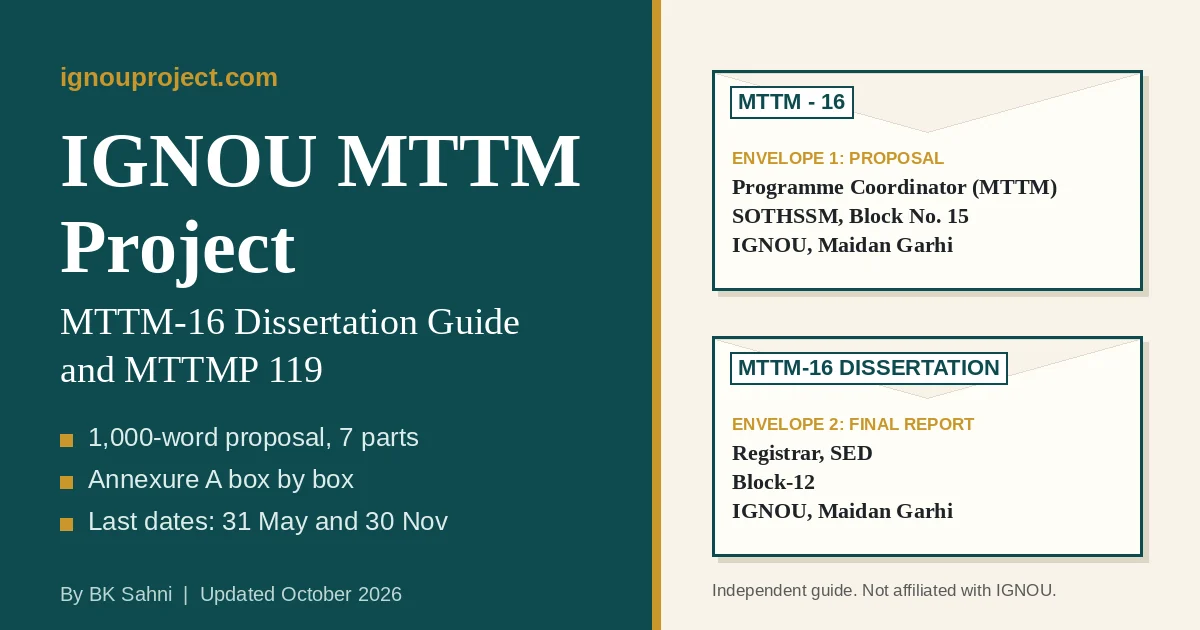
The IGNOU MTTM project is the 8-credit dissertation of the Master of Tourism and Travel Management: MTTM-16 in the older MTTM programme and MTTMP-119 in MTTM_NEW. Under the MTTM-16 Dissertation Guide you write a proposal of not more than 1,000 words, get Annexure A signed by your supervisor and post it to the Programme Coordinator (MTTM), SOTHSSM, Block 15. After approval you submit a 10,000 to 15,000-word report by 31 May or 30 November and need at least 40 per cent.
Facts most pages miss
- The proposal goes to the School, not to your Regional Centre: one copy by Registered Post to the Programme Coordinator (MTTM), SOTHSSM, Block No. 15, with MTTM - 16 on the envelope. The final report goes to a different block, the Registrar, SED, Block-12. (Guide pp. 10, 19)
- The proposal is capped at 1,000 words and has seven parts. Two are often left out: the chapter outline and the preliminary bibliography. (Guide p. 9)
- The guide describes no viva and no 70 to 30 marks split. It sends the report to an examiner and sets a 40 per cent minimum. (Guide pp. 6, 19)
- For MTTM-16, 31 May and 30 November are real last dates: a report received on 1 June is evaluated with the December TEE. (Guide pp. 19, 20)
- In the older MTTM, the 2026 assignment booklet lists MTTM 16 under Semester III. In MTTM_NEW, MTTMP-119 sits in Semester IV, after MTTM-113 Research Methodology in Semester III. (Booklet 2026; programme page)
- For the December 2026 TEE, SED takes the project fee separately on the IGNOU Samarth portal, last date 30 November 2026. (SED notification, 18 September 2026)
हिंदी में सारांश
IGNOU MTTM प्रोजेक्ट पुराने MTTM कार्यक्रम में MTTM-16 और नए MTTM_NEW कार्यक्रम में MTTMP-119 कहलाता है; दोनों 8 क्रेडिट के हैं। MTTM-16 गाइड के अनुसार प्रस्ताव (सिनॉप्सिस) 1,000 शब्दों से अधिक नहीं होना चाहिए और उसमें सात भाग होते हैं। सुपरवाइज़र से हस्ताक्षरित Annexure A प्रोफॉर्मा को पहले पेज पर लगाकर एक प्रति रजिस्टर्ड पोस्ट से Programme Coordinator (MTTM), SOTHSSM, Block 15, IGNOU, मैदान गढ़ी, नई दिल्ली 110068 को भेजें। अंतिम रिपोर्ट 10,000 से 15,000 शब्दों की होती है, जो जून TEE के लिए 31 मई और दिसंबर TEE के लिए 30 नवंबर तक पहुँचनी चाहिए; पास होने के लिए कम से कम 40 प्रतिशत अंक चाहिए।
Overview of IGNOU MTTM Project (MTTM 16)
MTTM-16 is the compulsory dissertation course of IGNOU’s Master of Tourism and Travel Management, offered by the School of Tourism and Hospitality Services Sectoral Management (SOTHSSM). The MTTM-16 Dissertation Guide calls it “a preliminary form of research”: an investigation of a topic under a broad subject area that is largely your own work, from the first idea to the final report, with a supervisor to guide you. MTTM stands for Master of Tourism and Travel Management.
The code has changed twice, and the course you register for decides which code you write on every form:
| Code | Programme | Status | Source |
|---|---|---|---|
| MTM-16 | Master of Arts (Tourism Management), MTM | Earlier code. The guide’s course team page reads “MTM-16 (Now MTTM-16)” | Guide p. 2 |
| MTTM-16 | Master of Tourism and Travel Management (MTTM, Category I and II) | Offered under the MTTM name from the July 2016 cycle; still examined in 2026 for enrolled learners | Assignment booklets 2021, 2026 |
| MTTMP-119 | MTTM_NEW (semester programme) | Dissertation Work, 8 credits, Semester 4, for learners admitted to MTTM_NEW | Programme page; Prospectus p. 90 |
If you searched for the “MTTM 16 dissertation guide”, it is the 26-page booklet issued by SOTHSSM in March 2017 and hosted on eGyanKosh; the next section links it directly and maps what is inside. One caution: Uttarakhand Open University also uses strings such as “MTTM-16” for unrelated batches and courses, so check that any document you download carries IGNOU’s name.
Two Codes, One Guide, Three Annexures: the Document Map
Keep official documents and study reference files apart. Only the first group carries IGNOU’s rules; the second shows format and must never be submitted as your own.
| Document | What it is | Issuer and date | Group |
|---|---|---|---|
| MTTM-16 Dissertation Guide (PDF) | The full rule book: proposal, supervisor, methodology hints, writing, submission, evaluation | SOTHSSM, IGNOU, March 2017 | OFFICIAL-RULE |
| Annexure A: Dissertation Proposal Proforma | First or covering page of your proposal, signed by your supervisor | In the Guide, p. 22 | OFFICIAL-RULE |
| Annexure B: Cover Page of Dissertation Report | Cover of the final report | In the Guide, p. 23 | OFFICIAL-RULE |
| Annexure C: First Page of the Dissertation Report | Your declaration and the supervisor’s certificate | In the Guide, p. 24 | OFFICIAL-RULE |
| MTTM_NEW programme page | MTTMP-119 course details, fee, duration, coordinator | ignou.ac.in, read October 2026 | OFFICIAL-RULE |
| Common Prospectus July 2026 | Course list (p. 90) and project evaluation fee (p. 27) | IGNOU, July 2026 | OFFICIAL-RULE |
| SED announcements | December 2026 project fee notice (18 September 2026) and other TEE notices | Student Evaluation Division | OFFICIAL-RULE |
| Sample synopsis (PDF) | Worked example of the seven proposal parts on a carrying-capacity topic, with your facts left in brackets | ignouproject.com, October 2026 | STUDY REFERENCE |
| Report format template (PDF) | Page order, Annexure B and C fields, empty table shells, checklist; no data | ignouproject.com, October 2026 | STUDY REFERENCE |
The two study reference files are watermarked “sample for study reference, not for submission”. The guide disqualifies material copied from other dissertations or websites, and the learner then has to do the dissertation again (Guide p. 17).
IGNOU MTTM Project Guidelines and Eligibility
Every learner registered for MTTM-16 must complete it: the guide states that the award of the degree is subject to successful completion of the dissertation. The rules below are the guide’s own; the right-hand column shows the page.
| Rule | What the guide says | Page |
|---|---|---|
| Status | Compulsory dissertation component of MTTM, worth 8 credits | 6 |
| Time | About 240 study hours | 6 |
| Pass mark | Minimum 40 per cent (Grade D) | 6, 19 |
| Length | 10,000 to 15,000 words or more, depending on the topic | 6, 18 |
| Form | Typed or word-processed; a typed and bound copy preferred; pages numbered at bottom-centre | 6, 18 |
| Language | Dissertation report in English only | 25 |
| Approval first | Begin the dissertation only after the Letter of Approval from the Programme Coordinator, MTTM | 10 |
| Originality | Copied or downloaded material is disqualified and not evaluated | 17, 20 |
| Evaluation | Sent to an examiner; reports evaluated twice a year, with the June and December TEE | 19 |
When to start depends on your programme. In the older MTTM, the 2026 second-year assignment booklet places MTTM 16 with MTTM 09 to 11 under Semester III. In MTTM_NEW, MTTMP-119 is a Semester 4 course and follows MTTM-113 Research Methodology for Tourism and Hospitality in Semester 3, so learners on the new syllabus meet research methods before the dissertation. The guide does not set a minimum number of completed courses before you submit the proposal.
How to Choose your IGNOU MTTM Project Topic
The guide draws one line most students miss: a theme is not a topic. “Use of Technology in tourism” is a theme; “Technology in hotel marketing: A case study of ITDC” or “Impact of technology on small travel agencies: A case study of travel agencies in Lucknow” are topics (Guide p. 11). It gives sample themes under four heads and says you may go beyond them. It adds a practical test: choose an area you can visit or experience, close by or within your travelling range, on which data will be available (Guide pp. 7, 9).
Theme heads from the guide, with narrowed directions PLANNING-AID
| Guide head | Sample themes in the guide | Narrowed direction (put your own place in the brackets) |
|---|---|---|
| Tourism Management | Carrying capacity of sites; host guest relationship and visitor management; safety and security; HRD policies | Peak-hour crowding at [a ticketed monument]; front-office staff turnover in [budget hotels of a town] |
| Tourism Resources and Products | Fairs and festivals; crafts and craftsmen; museums; religious and pilgrimage tourism | Visitor spending at [a district fair]; how craftsmen in [a craft cluster] sell to tourists |
| Tourism Marketing | Distribution channels; destination branding; tourist satisfaction; technology in marketing | How [homestays in a hill town] receive bookings; satisfaction of visitors to [a state tourism unit] |
| Tourism Impacts | Environmental impacts in your locality; community perception; economic impacts | Residents’ views of tourism growth in [a village near a sanctuary]; jobs created by [a new circuit] |
Planning aid: the directions in the third column are examples written by ignouproject.com, not IGNOU topics. Check each against your access and your supervisor’s advice.
Tourism Theme-to-Topic Narrower PLANNING-AID
This tool needs JavaScript. The plain-text method below the tool gives the same steps.
Themes are listed in the MTTM-16 Guide, section 16.4.
For example: Visitor crowding, Online bookings, Staff training needs.
For example: Visitors and Site Staff, Homestay Operators, Local Residents.
How it decides: the tool lists only the sample themes printed in section 16.4 of the MTTM-16 Guide. It joins your focus, place and group into one working title in the pattern “focus in place: a study of group”, which narrows a theme the way the guide’s own examples do. If you cannot visit the place, it repeats the guide’s warning against topics you cannot visit or experience. Every “No” in the readiness check returns the advice printed beside that question in the guide. IGNOU does not prescribe a title pattern; this is a planning aid, and your supervisor and the Programme Coordinator decide.
1,000 Words, Seven Parts: the IGNOU MTTM Project Proposal
After choosing the topic, the guide asks for a proposal (synopsis) of not more than 1,000 words, prepared in consultation with your supervisor. It is “essentially a description of what you propose to do and how you intend to go about it” (Guide p. 9). It must contain these seven parts:
| No. | Part | What the guide asks for |
|---|---|---|
| 1 | Title | Title of the proposed dissertation |
| 2 | Rationale | Why you have chosen the topic |
| 3 | Objectives | State clearly what you intend to achieve or find out |
| 4 | Review of relevant literature | Evaluation of previous research, to identify the research gap and give a theoretical base |
| 5 | Research plan and methods | An outline of the plan and the methods you will use |
| 6 | Chapter outline | Tentative chapters, with a brief outline of each |
| 7 | Preliminary bibliography | Sources you referred to while preparing the proposal |
The guide adds three practical points: if you plan to study an organisation, seek its approval at the proposal stage; choose a geographical area you know and can reach; and discuss the proposal with your supervisor, counsellor and people who know the field. It does not prescribe font, line spacing or page count for the proposal. Our sample synopsis shows the seven parts in 790 words on a carrying-capacity topic.
MTTM-16 Proposal and Report Packet Checker OFFICIAL-RULE
This checker needs JavaScript. The plain checklist below the tool shows the same rules.
The guide caps the proposal at 1,000 words.
How it decides: every tick box is one requirement printed in the MTTM-16 Dissertation Guide, with its page shown in the result. For the proposal, it flags any of the seven parts you leave unticked, a word count above 1,000, a supervisor outside the four routes the guide recognises, a missing bio-data for a teacher or industry supervisor, and missing organisation approval. For the report, it flags fewer than 10,000 words and works out which TEE a given arrival date falls into: 1 December to 31 May goes with the June TEE, 1 June to 30 November with the December TEE. It does not predict approval or marks.
Plain checklist: seven parts; not more than 1,000 words; Annexure A signed by the supervisor as the first page; bio-data if the supervisor is not an IGNOU counsellor; organisation approval if needed; two copies; full address with PIN; Registered Post; envelope marked MTTM - 16.
Before It Goes to Block 15: Get Your MTTM-16 Draft Checked
An MTTM-16 proposal is posted to New Delhi and an answer comes back by Speed Post, normally within a month. A missing chapter outline, an unsigned proforma or a supervisor without bio-data can cost you that month. At the report stage the guide is stricter: a report without the Letter of Approval may be returned, and copied material is not evaluated at all.
What we check in your synopsis
- All seven parts present, inside 1,000 words
- Objectives that say what you will study, not what you expect to find
- A topic narrowed from a theme, on a place you can reach
- Literature review that actually shows a gap
- Annexure A complete, supervisor route and bio-data in order
What we check in your report
- Title identical to the approved proposal
- Page order: Annexure B, Annexure C, approval letter, contents, lists, acknowledgement
- Methodology stated at the start, findings tied to your own data
- Bibliography under separate heads, tables and figures numbered
- Length within 10,000 to 15,000 words or more, in English
Annexure A Box by Box: the MTTM-16 Proposal Proforma
The proforma on page 22 of the guide must be “filled up in all respect including the signature of your supervisor” and should “invariably be the first or covering page” of the proposal (Guide p. 10). Here is every box, who fills it and what to watch.
| Box | Who fills it | What to watch |
|---|---|---|
| Date | You | Date you sign the packet |
| Name | You | As in your IGNOU records |
| Programme Code | Printed: MTTM | Leave as printed, also for MTTM/MTM learners on the old code |
| Course Code | Printed: MTTM-16 | MTTMP-119 learners: confirm the current form with SOTHSSM |
| Enrolment No. | You | Nine boxes, one digit each |
| Regional Centre | You | Name of your Regional Centre |
| Complete Postal Address | You | Include the PIN code: the Letter of Acknowledgement and Comment comes by Speed Post, and the guide says letters come back when addresses are incomplete |
| Study Centre | You | Name of your study centre |
| Study Centre Code | You | Four boxes |
| Mobile No. | You | A number you will answer |
| Email ID | You | Checked regularly |
| Title of the Dissertation | You | Same wording as the enclosed proposal; it becomes the title the final report must carry |
| Letter/Certificate of Approval: dissertation entitled | Supervisor | Must match your title word for word |
| by (Candidate’s Name) | Supervisor | Your name as above |
| Certification text | Printed | The supervisor approves the proposal and agrees to supervise it till completion |
| Signature of the Supervisor | Supervisor | Original signature; the packet is incomplete without it |
| Name, Designation, Address | Supervisor | For a teacher or industry supervisor, these should agree with the bio-data you enclose |
The proforma has no office-use approval box; approval comes as a separate Letter of Acknowledgement and Comment from the Programme Coordinator, which you later bind into the report.
Selection of IGNOU MTTM Project Guide Supervisor
Your dissertation is guided by a supervisor recognised by IGNOU. The guide allows four routes (Guide pp. 6 to 7):
| Supervisor | Condition in the guide | Extra paper |
|---|---|---|
| MTTM counsellor at your study centre | All counsellors of the MTTM programme are recognised supervisors; the list is with your Study Centre Coordinator | None |
| IGNOU tourism faculty | Delhi-based learners may approach the faculty; the guide advises a supervisor you can easily access | None stated |
| University or college teacher | At least three years of teaching experience | Brief bio-data with the proposal, for approval by the Programme Coordinator |
| Tourism industry professional | Rank of Manager or above | Brief bio-data with the proposal, for approval by the Programme Coordinator |
The MTTM-16 guide does not require a master’s degree in tourism for the supervisor, a separate consent letter or a cap on the number of learners per supervisor. For general guide eligibility across IGNOU programmes, see our IGNOU project guide eligibility page; for MTTM-16 the four routes above are the rule.
Step-by-Step Guide to do IGNOU MTTM Project
The guide closes with a four-stage chart (Guide p. 21). In order:
- Stage 1: read the guide, develop and screen ideas, narrow them, assess feasibility, select one topic and prepare the proposal with your supervisor.
- Stage 2: send the proposal to the Programme Coordinator, wait for approval and include any modifications suggested.
- Stage 3: plan, organise and carry out data collection, field visits and questionnaires to a time schedule, discussing with your supervisor throughout.
- Final stage: analyse, write Draft 1, show it to your supervisor, incorporate suggestions in Draft 2, format the final report in two copies and send one to SED.
The two posted packets go to two different offices:
SOTHSSM, Block No. 15, 2nd Floor
IGNOU, Maidan Garhi, New Delhi 110068
Registered Post only. Annexure A on top, proposal, bio-data if needed.
Reply: Letter of Acknowledgement and Comment by Speed Post, normally within a month (Guide p. 10).
Block-12
IGNOU, Maidan Garhi, New Delhi 110068
One of two copies; keep the other. Approval letter bound in.
Last dates: 31 May (June TEE), 30 November (December TEE) (Guide p. 19).
If the proposal is not approved, you receive comments. Resubmit the revised proposal in the proper format with a copy of the rejection letter that carries the Programme Coordinator’s comments (Guide p. 11). Recent cycles have also used an SED online upload for final reports; when the SED notice for your TEE opens an upload, follow its instructions.
Is Primary Research mandatory for MTTM 16 Project?
The MTTM-16 guide does not use the words “primary data is mandatory”, but it plainly expects field-based work. It says the dissertation should give you field experience and exposure to the working methods of the tourism industry, that you should never take a topic for an area you cannot visit or experience, and that a dissertation built on bookish knowledge defeats its purpose (Guide pp. 4, 6, 9). Its methodology section names both kinds of data: primary data from observation, interviews, questionnaires, surveys and focus groups, and secondary data from published or unpublished sources, journals and newspapers (Guide p. 15).
In practice, plan some first-hand data: a questionnaire, interviews or structured observation at a place you can reach, supported by secondary sources. A purely desk-based compilation sits badly with the guide’s stated aims. Your supervisor decides the mix for your topic.
How do you find relevant research materials for the IGNOU MTTM dissertation?
Start with what IGNOU already gives you. The MTTM course blocks on eGyanKosh cover the guide’s themes (markets, impacts, planning, products), and MTTM_NEW learners have MTTM-113 Research Methodology for Tourism and Hospitality, which covers research design, literature review, sampling, data collection and analysis. Our eGyanKosh guide explains how to find course blocks.
The guide then lists the material a tourism dissertation draws on: written records, articles, rules and regulations, recorded interviews, your own diary, observations, questionnaires, government documents, newspaper clippings and minutes of group meetings (Guide p. 16). Two habits it insists on are worth adopting from day one: note the date and place of every interview, and keep separate files for different kinds of sources. When sources disagree, record both and keep facts apart from opinions, so other people’s judgements do not appear as your own.
For context data on Indian tourism, the Ministry of Tourism publishes India Tourism Statistics; for international comparison, UN Tourism (formerly UNWTO) publishes reports and indicators. Use the latest editions and cite them under separate heads in your bibliography.
Cover, First Page, Approval Letter: the MTTM-16 Report Page Order
The guide fixes the order of material in the report (Guide p. 18):
| Order | Part | Format |
|---|---|---|
| 1 | Cover page | Annexure B: title; under the supervision of (supervisor’s name); submitted to IGNOU for the award of MTTM; student name, enrolment number, study centre, regional centre |
| 2 | First page | Annexure C: your declaration of original work, signed and dated, and the certificate by the supervisor recommending evaluation |
| 3 | Letter of Proposal/Synopsis Approval | From the Programme Coordinator, MTTM, New Delhi |
| 4 | Table of Contents | With page numbers |
| 5 | List of Figures/Tables | Numbered |
| 6 | Acknowledgement | Your own words |
| 7 | Main text | Chapters, bibliography and appendices |
What the guide leaves open: line spacing, margins and citation style are not specified, and it calls Times New Roman “more or less standard” rather than compulsory. Annexure C’s printed declaration refers to the “Masters Degree in Tourism Management”; leave the official wording as printed. Our report format template lays out the pages with empty table shells and sentence frames.
IGNOU MTTM 16 Project Submission Deadlines
The guide sets last dates only for the final report. The proposal can go at any time; plan for about a month for the reply, since you may begin only after approval.
| Report reaches IGNOU | Evaluated with | Rule |
|---|---|---|
| 1 December to 31 May | June TEE | Last date 31 May of the same year as the June TEE |
| 1 June to 30 November | December TEE | Last date 30 November of the same year as the December TEE |
| After a last date | The next TEE | The guide’s example: a report submitted on 1 June is evaluated in December, not June |
Two current points sit outside the 2017 guide. First, the project evaluation fee is Rs 500 for projects above 4 credits under the Common Prospectus July 2026 (p. 27); for the December 2026 TEE, SED’s notification of 18 September 2026 takes this fee separately through your IGNOU Samarth portal login, with 30 November 2026 as the last date. Second, SED announces extensions and online upload windows each cycle, so check the notice for your TEE. Our December 2026 project submission page tracks those notices.
The guide’s re-do rule: if you score below 40 per cent you do the dissertation again. The 2017 guide asked for a demand draft of Rs 600 with the new dissertation; fees have since moved to the Samarth portal, so follow the current SED notice before paying anything.
MTTMP 119: What Is Confirmed for the New IGNOU MTTM Project
Learners admitted to MTTM_NEW do the IGNOU MTTM project as MTTMP-119 Dissertation Work. The programme page confirms it is a project course of 8 credits in Semester 4, coordinated by Dr. Tangjakhombi Akoijam, who is also the programme coordinator. Its stated aim is to build research competence through independent research on real-world tourism issues. MTTM_NEW is open to any graduate, in English, for 24 to 48 months, at Rs 9,100 per year (Rs 18,200 for the full programme), with exam fees extra.
What is not yet confirmed: as of October 2026 we did not find a separate published MTTMP-119 dissertation guide or proforma. The MTTM-16 guide is the latest SOTHSSM dissertation document we could read, and Dr. Akoijam is on its revision team, but that does not make its rules official for MTTMP-119. Before you prepare your packet, confirm the current instructions with SOTHSSM. Our MTTMP 119 page follows the new course as instructions are published.
What are some resources available to help you with the IGNOU MTTM Project Dissertation?
| Need | Where to go | Source |
|---|---|---|
| Academic query on the dissertation | Programme Coordinator, MTTM, SOTHSSM, Block-15, IGNOU, Maidan Garhi, New Delhi 110068; telephone 011-29571756; e-mail mtm@ignou.ac.in | Guide p. 14; telephone also in Prospectus July 2026 |
| MTTM_NEW and MTTMP-119 | Dr. Tangjakhombi Akoijam, akoijam@ignou.ac.in | Programme page, October 2026 |
| List of recognised supervisors | Coordinator of your study centre | Guide p. 7 |
| Query on a submitted report | SED Project Section, projects@ignou.ac.in, or your Regional Centre | SED upload instructions |
| Status after submission | How to check your IGNOU project status | ignouproject.com |
ignouproject.com provides customised project guidance, topic refinement, methodology support, review and correction of learner-written synopses and reports, formatting and citation support, reference material, printing and binding, and project status and result guidance. You remain the author of your dissertation, its data and its signed declarations. Prices for each service are on our services and charges page.
Stuck on your MTTM-16 or MTTMP-119 topic or proposal? Send your draft or your question on WhatsApp and we reply with what the guide asks for and what to fix.
Message us on WhatsAppVideo: IGNOU MTTM Project, topic to submission
Video by BK Sahni. Where any detail in a video differs from the MTTM-16 Dissertation Guide, follow the guide: it describes no viva and no marks split.
Frequently Asked Questions (FAQs)
What is MTTM 16 in IGNOU?
MTTM-16 is the compulsory 8-credit dissertation course of IGNOU’s Master of Tourism and Travel Management, earlier coded MTM-16. You choose a tourism topic, get a proposal approved by the Programme Coordinator, MTTM, and submit a dissertation of 10,000 to 15,000 words or more.
What is the full form of MTTM?
MTTM stands for Master of Tourism and Travel Management. IGNOU offers it through the School of Tourism and Hospitality Services Sectoral Management; the current semester version is coded MTTM_NEW.
Is MTTMP 119 the same as MTTM 16?
Both are 8-credit MTTM dissertations, but they belong to different programmes. MTTM-16 is in the older MTTM; MTTMP-119 is Dissertation Work in MTTM_NEW, in Semester 4. Use the code printed for your own registration, and confirm MTTMP-119 instructions with SOTHSSM.
Where can I get the official MTTM-16 dissertation guide PDF?
From eGyanKosh: MTTM-16 Dissertation Guide (PDF). It contains the rules, the sample themes and Annexures A, B and C. Copies on other sites may be incomplete or altered.
What is the word count for the IGNOU MTTM 16 project report?
Between 10,000 and 15,000 words, or more depending on the topic (Guide pp. 6, 18). The proposal is separate and capped at 1,000 words.
Is there a viva or a marks split for MTTM-16?
The MTTM-16 guide describes neither. It says the dissertation is sent to an examiner and that you need at least 40 per cent (Grade D). If you are called for a viva, follow that letter. For general practice, our IGNOU project viva questions page may help.
What happens if my MTTM-16 synopsis is rejected?
You receive comments on reformulating it. Submit the revised proposal in the proper format with a copy of the rejection letter bearing the Programme Coordinator’s comments (Guide p. 11).
Is synopsis approval mandatory for the MTTM 16 project?
Yes. The guide says to begin the dissertation only after the Letter of Approval arrives, to keep that letter safe and to attach it to the final report; the University may return a report submitted without it (Guide p. 10).
Can I choose my own topic for the MTTM 16 project?
Yes. The guide’s themes are samples only and you may go beyond them, but a theme must be narrowed into a topic, on an area you can visit, with data available. Settle it with your supervisor.
Can I use a solved MTTM 16 project?
Not as your submission. The guide states that material copied from other projects or dissertations, or downloaded from websites, is disqualified and not evaluated, and the learner has to do the dissertation again. Use samples only to understand format.
How do I write the synopsis itself?
Follow the seven parts listed above, inside 1,000 words. For a general walk-through of IGNOU synopsis writing, see our IGNOU synopsis and proposal guide.
Official Sources Used for the IGNOU MTTM Project Guide
- MTTM-16 Dissertation Guide, School of Tourism and Hospitality Services Sectoral Management, IGNOU, March 2017 (26 pages, Annexures A to C). Read in full, October 2026.
- MTTM_NEW programme page, ignou.ac.in, read 06 October 2026: MTTMP-119, fee, duration, coordinator.
- IGNOU Common Prospectus July 2026: p. 90 (MTTM_NEW course list) and p. 27 (project evaluation fees).
- MTTM second-year assignment booklet 2026, SOTHSSM: MTTM 16 listed under Semester III.
- IGNOU announcements: SED notification on project, internship and practical fees for the December 2026 TEE (18 September 2026).

BK Sahni is the founder of Shri Chakradhar Publication Pvt. Ltd., New Delhi, which has served IGNOU distance learners since 2010 and publishes IGNOU help books and guess papers from its own printing press. He is the author of Mind Loop.
Method for this page: every rule above was read from the MTTM-16 Dissertation Guide or a current IGNOU page in October 2026, with the page cited; where the documents are silent, the page says so.
ignouproject.com is an independent study-help service run by Shri Chakradhar Publication Pvt. Ltd. It is not affiliated with or endorsed by IGNOU. Rules, fees and dates change; confirm them on ignou.ac.in or with SOTHSSM before you act.
BK Sahni iD 0009-0005-8092-459X
Founder, Shri Chakradhar Publication Pvt. Ltd. & ignouproject.com — helping IGNOU distance-learning students since 2010 (5,00,000+ students supported across MBA, MCom, MA & more). Author of IGNOU exam guides, solved assignments & project reference books.
Disclosure: Shri Chakradhar Publication Pvt. Ltd. and ignouproject.com are independent third-party study-help services — not the official IGNOU website. Always verify final dates and rules on ignou.ac.in.