IGNOU MGGL 002 Practical: what you actually do in the lab block
What the course asks, in five lines
The IGNOU MGGL 002 Practical is a 4-credit, semester-two MSCGG lab course with 18 exercises, worked in a 14-day block at your Learner Support Centre. For each one, copy the data, write the formula, build a step table, compute, interpret and label any diagram, then hand it to your Academic Counsellor.
The course is Methods of Geographical Analysis: Quantitative and Qualitative. Its course book (July 2024, on eGyanKosh) runs from descriptive statistics through sampling, tests, correlation and regression to a focus group discussion and participatory action research, using a scientific calculator and Excel.
Across practical courses, we see learners who pass their theory papers easily lose their footing on the lab side. For MSCGG, that arrives in semester two as MGGL-002, beside MGG-005, MGG-006, MGG-007 and MGG-010, whose assignments our MSCGG handwritten assignment guide covers.
Many learners notice a practical inside their programme only when the session is half over. The July 2026 prospectus lists MGGL-002 as a semester-two Practical, so plan for it from the first week of that semester.
Behind most lab trouble we see three causes: notices arrive late and vary by centre, the course assumes time that working learners rarely have, and the write-up is treated as formatting instead of proof that you can use the method.
Three things to confirm with your Learner Support Centre first
Before the IGNOU MGGL 002 Practical block opens, settle these, because none can be fixed once the dates pass.
- Batch dates. The book plans Day 1 for orientation and Exercise 1, Exercises 2 to 9 at two a day, then Exercises 10 to 18 at one a day. Your centre fixes the dates.
- Attendance. Ask what your centre expects across the 14 days.
- Kit. Scientific calculator, laptop with Excel, graph paper, ruler, colour pencils and one folder.
Lab blocks run on fixed dates, and batch notices usually appear on the Regional Centre or study centre website. Learners who do not check them can miss the slot and wait a whole cycle; for MGGL-002 that holds up the semester-two result.
A friend at another centre may describe a different routine. Attendance and the way exercises are collected can differ between centres, so take your MGGL-002 answers from your own centre.
Most learners we hear from juggle a job, a family or both, and a full-day lab block is the hardest thing to fit in. The MGGL-002 block runs on fixed dates, so book leave as soon as they appear.
How to do MGGL 002 practical exercises: six parts to every entry
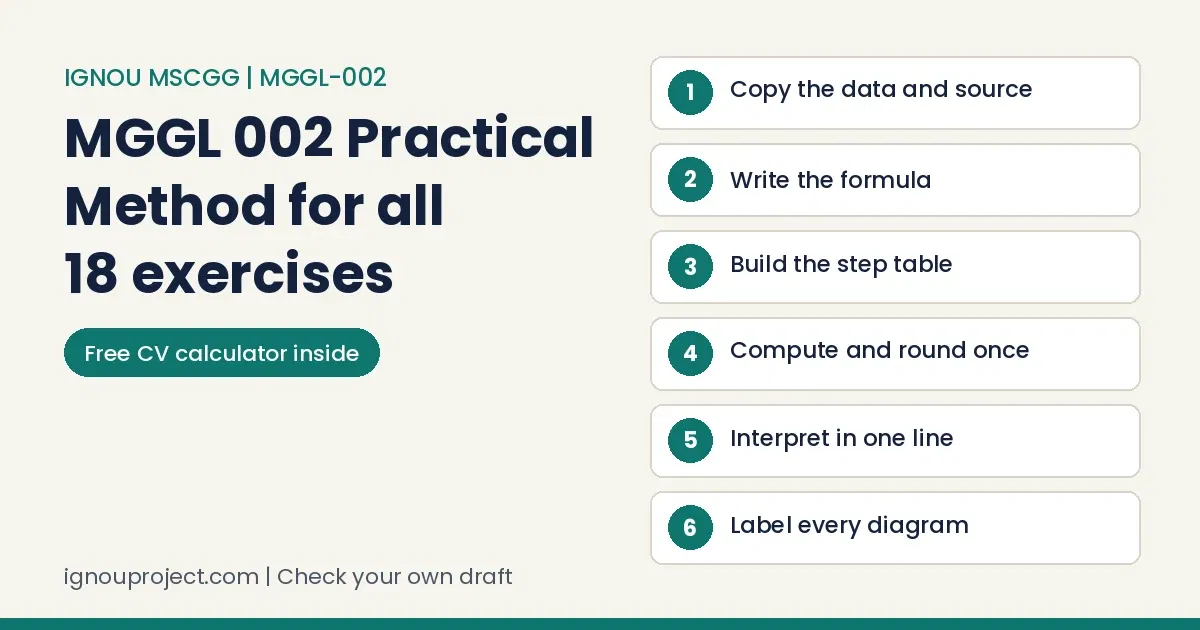
Every exercise in the IGNOU MGGL 002 Practical can be written up in the same six parts, in this order.
Six parts, in this order
- Aim: exercise number and the measure or test applied.
- Data: the table copied with its number and source, such as Table 3.3.
- Formula: the book’s equation number (Eq. 3.5 for SD, Eq. 3.6 for CV) with every symbol defined.
- Step table: one column per stage, with a totals row.
- Result: totals substituted, units shown, rounding only at the last line.
- Meaning and diagram: two lines on what the figure says; title, axes, units, key and source on any graph or map.
The same six parts carry over to the later QGIS labs, as our MGGL 005 remote sensing practical guide shows.
Learners often hold three formats at once: the book’s, the counsellor’s and a senior’s. For MGGL-002, follow the course book first and your centre’s written instruction second; a senior’s file is neither.
Weak entries only report what was done. An MGGL-002 entry earns its marks in part 6, where the figure is tied to the concept, such as relative dispersion in Exercise 3.
The written working is where practical marks slip most easily and also where they are easiest to win back; in MGGL-002 the usual repair is a missing step table or interpretation line.
Worked IGNOU MGGL 002 Practical example: rainfall dispersion in Delhi
Exercise 3 asks for measures of dispersion on Delhi’s monthly rainfall for 2019 (Table 3.3) and what the coefficient of variation shows.
Exercise 3 worked by hand from Table 3.3
| Month | x (mm) | x minus mean | Squared |
|---|---|---|---|
| Jan | 52.0 | -19.5 | 380.25 |
| Feb | 70.8 | -0.7 | 0.49 |
| Mar | 10.2 | -61.3 | 3,757.69 |
| Apr | 5.7 | -65.8 | 4,329.64 |
| May | 45.4 | -26.1 | 681.21 |
| Jun | 31.2 | -40.3 | 1,624.09 |
| Jul | 283.9 | 212.4 | 45,113.76 |
| Aug | 227.0 | 155.5 | 24,180.25 |
| Sep | 17.4 | -54.1 | 2,926.81 |
| Oct | 41.0 | -30.5 | 930.25 |
| Nov | 7.4 | -64.1 | 4,108.81 |
| Dec | 66.0 | -5.5 | 30.25 |
| Total | 858.0 | 0.0 | 88,063.50 |
- Mean: 858.0 / 12 = 71.5 mm; the deviations add to zero, which confirms it.
- Range (Eq. 3.1): 283.9 minus 5.7 = 278.2 mm.
- Quartiles: median (41.0 + 45.4) / 2 = 43.2 mm; Q1 13.8 mm and Q3 68.4 mm by halves, or 12.0 mm and 69.6 mm by (n + 1) / 4 interpolation. Name your method.
- SD (Eq. 3.5): sqrt(88,063.50 / 12) = 85.67 mm. The book divides by N, as in its BMI example (2,683.21 / 29, giving 9.62).
- CV (Eq. 3.6): (85.666 / 71.5) x 100 = 119.81 percent. Rounding the SD to 85.67 first gives 119.82, which is exactly the slip to avoid.
Meaning: a CV near 120 percent shows extremely uneven rainfall; July and August gave 510.9 of the 858.0 mm. The book’s BMI example, at 16.76 percent, is far more consistent.
Weak lab write-ups lack an observation table, stop a calculation halfway, leave a graph unlabelled or say nothing on error. In Exercise 3, the error line states whether you divided by N or n minus 1, and why.
Check your MGGL 002 coefficient of variation with this calculator
Use this only after working the IGNOU MGGL 002 Practical figures by hand. Paste any column, such as your centre’s table.
Dispersion checker for any data column
For these values: n 12, mean 71.50, SD by N 85.67, CV 119.81 percent; SD by n minus 1 89.47, CV 125.14 percent.
If your hand answer matches the n minus 1 line, go back to Eq. 3.5 before the counsellor sees it.
Tests and regression: conclusions the numbers can carry
In its testing exercises, the IGNOU MGGL 002 Practical asks you to decide, not only to calculate. Write each test in one order: null hypothesis, significance level, degrees of freedom, calculated value, table value, decision naming the variables.
Exercise 9 tries five fertilizers on four potato plots. The fertilizer F of 2.032 is below the table value of 3.26 at 4 and 12 degrees of freedom, so it is not significant; the plot F of 1.676 against 3.49 is not significant either. Say so in words.
For regression, write Y on X with slope and intercept, predict Y for each district, and take residuals as Y minus Yc with signs. Exercise 13 pairs population density with cropping intensity (Assam), literacy with urban share (West Bengal) and in-migrants with urban share (Assam); group residuals into classes before shading the map. These habits return in the dissertation, as our MSCGG project guide for MGGP 001 shows.
Practical write-ups expect a fixed sequence, and a missing part costs marks. In MGGL-002 that sequence is the test order above; jumping from the F value to "not significant" skips two parts.
In test-based practicals we often see the wrong reference table read, or a conclusion that contradicts the figure. In Exercise 9, read the F table at 4 and 12 degrees of freedom, not 12 and 4.
MGGL 002 Spearman rank correlation, practised on a June 2025 question
Question 3 of the June 2025 Set-I paper gives eight pairs of X and Y. Rank each from the highest value down.
Ranks and differences for the eight pairs
| X | Rank X | Y | Rank Y | D | D squared |
|---|---|---|---|---|---|
| 53 | 8 | 47 | 1 | 7 | 49 |
| 98 | 1 | 25 | 8 | -7 | 49 |
| 95 | 2 | 32 | 6 | -4 | 16 |
| 81 | 3 | 37 | 5 | -2 | 4 |
| 75 | 4 | 30 | 7 | -3 | 9 |
| 61 | 5 | 40 | 3 | 2 | 4 |
| 59 | 6 | 39 | 4 | 2 | 4 |
| 55 | 7 | 45 | 2 | 5 | 25 |
| Total | 0 | 160 | |||
With no ties, rho = 1 minus (6 x 160) / (8 x 63) = 1 minus 960 / 504 = -0.905: a strong negative correlation. The D column adding to zero confirms the ranks.
MGGL 002 focus group discussion: running and recording Exercise 17
Exercise 17 of the IGNOU MGGL 002 Practical asks you to hold a focus group discussion yourself: 6 to 12 participants, a moderator, a neutral venue, a briefing with consent and confidentiality, and notes by pen or recorder. The book suggests health problems in your area as a theme.
FGD write-up sequence
- Issue and aim.
- Date, venue and why the venue was neutral.
- Participants coded P1, P2 and so on, never named.
- Each question, with its responses grouped beneath.
- Interpretation in relative terms ("most participants").
- The summary read back to the group, and the limits.
Moderating and note-taking return in the third-semester household survey in our MGGL 004 field survey guide.
We have seen write-ups built on a discussion that never happened, with responses assumed. Exercise 17 asks you to conduct the FGD, so every response must come from people you actually gathered.
Copied practical files do the rounds with only the name and enrolment number changed, and matching pages from one centre are spotted at once. An MGGL-002 FGD record cannot be borrowed anyway: its date, venue and participants are yours.
MGGL 002 participatory action research: Exercise 18 in your own words
Exercise 18 asks for written answers on participatory action research (PAR). Cite one published participatory study, show how the community took part at each stage, and link the method to your own research interest. The June 2025 paper set PAR for rural and farming communities as a 10-mark question, so write at that length.
Some learners paste an AI-written answer unchanged, which is why identical wording keeps appearing. In Exercise 18, the link to your own research interest is the part no tool can supply.
Many learners lift PAR material from websites without checking whose words they are. Name the study you use and put its ideas in your own sentences.
Learners from Hindi-medium schooling often find technical English the hardest part. The prospectus gives English as the MSCGG medium, so keep PAR sentences short and define each term once.
Mistakes in IGNOU MGGL 002 Practical working, and the repair for each
Working slip and its repair
| Slip | Repair |
|---|---|
| SD divided by n minus 1 in Exercise 3 | Divide by N, as Eq. 3.5 does |
| Final answer only | Add the step table and substituted formula |
| Rounding at every line | Carry three decimals; round once |
| No interpretation | Two lines on what the figure means |
| Residuals without signs | Write Y minus Yc, signs kept |
| Exercise 12 Excel output with no hand working | Hand method first, Excel as the check |
| FGD responses in one block | Group them under each question |
| All 18 exercises written in one late sitting, with repeated sentences and no progress | Write each on its own lab day |
Eleven ticks before your counsellor signs
Run this on your IGNOU MGGL 002 Practical folder before each signature. Nothing is uploaded.
Eleven ticks before the counsellor signs
Unsigned counsellor certificates are a gap we meet often. Ask for each MGGL-002 signature on the lab day, not at the end.
We often see a wrong enrolment number or centre code on the first page; copy the MGGL-002 details from your ID card.
We also see attendance sheets left without a countersignature. The MGGL-002 book does not list one, so ask whether your centre keeps one.
For how a related course lays out each lab entry, see our MANL 101 practical record guide.
Preparing for the IGNOU MGGL 002 Practical term-end paper
The June 2025 Set-I paper for the IGNOU MGGL 002 Practical ran three hours for 50 marks: seven 10-mark questions, any five to attempt. It covered a grouped rainfall mean, a grouped SD, Spearman's rank correlation, both regression equations, the normal probability curve, a paired t-test and PAR.
Practice plan for the three-hour paper
- Drill grouped data until each question fits in the 36 minutes it allows.
- Rehearse one 10-mark descriptive answer (PAR, FGD or the normal curve) against the clock.
- The book does not say whether Excel is allowed in the exam, so practise by calculator.
For the theory papers beside it, see our MSCGG guess paper for December 2026.
Learners often confuse the Rs 300 and Rs 500 fees. The July 2026 prospectus sets Rs 300 for practicals of up to 4 credits, so MGGL-002 is Rs 300, paid with the Term-End Examination form and not refundable.
Many learners are unsure whether a viva applies. The MGGL-002 documents we read describe a written three-hour paper and name no viva; confirm with your centre.
In our records, 70 to 80 percent of learners start only in the final month before a deadline. For MGGL-002, the deadline is the examination form date IGNOU notifies online, so file early.
Have your own MGGL-002 working looked at
For a second look at your IGNOU MGGL 002 Practical working, send photos or a scan on WhatsApp at +91 93546 37830 (Monday to Saturday, 9 am to 6 pm). We mark wrong divisors, missing steps and weak interpretation lines, and you make the corrections. A practical check is quoted on WhatsApp; see our services and charges page. We never supply worked exercises, and IGNOU's evaluator decides the marks.
Questions about the IGNOU MGGL 002 Practical method
Does the IGNOU MGGL 002 Practical book divide by N or by n minus 1?
By N. Eq. 3.5 divides by the total number of observations, as the BMI example does.
My centre gave a different rainfall table for Exercise 3. Is my answer wrong?
No. The book lets the study centre change the Exercise 3 data. Cite the table you were given and use the same six parts.
Can I do every exercise in Excel?
No. Exercises 6 and 7 use random numbers in Excel and Exercise 12 wants regression by hand and in Excel, but the hand working shows your method.
Finishing MGGL-002 well
Work the IGNOU MGGL 002 Practical one exercise per lab day and keep your FGD notes until the result is out. Our MGGL 001 cartography practical guide covers the map skills the residual maps use, and the MGGL 003 geospatial analysis guide is the next lab. Printed and soft copy sets are listed as reference material for this course on our publication site.
Without a receipt you have nothing to show if marks go missing. Save the MGGL-002 exam form payment receipt and a photo of each signed page.
Practical marks often reach the grade card after theory marks. If MGGL-002 shows pending while your MGG courses are in, wait for the practical award before raising a query.
Learners who do well begin early, check rules with their own centre, keep a dated record, collect signatures along the way and can explain each page aloud. For MGGL-002, that is 18 exercises over 14 days, each understood.
Papers and pages read for this guide
Sources read in the week of this update
- IGNOU course book, MGGL-002, July 2024, on eGyanKosh.
- IGNOU MSCGG programme page
- MGGL-002 (Set-I) term-end practical paper, June 2025
- IGNOU Common Prospectus, July 2026: section 3.54 and the practical fee rules.
Method: the course book, the June 2025 paper, the programme page and the July 2026 prospectus were read in November 2026; drafting was AI-assisted, every rule and figure was checked against those sources, and the guide is published under BK Sahni's editorial responsibility.
ignouproject.com is not affiliated with, authorised by or endorsed by IGNOU. We check the learner's own work; the learner remains the author of every exercise and answer.

BK Sahni iD 0009-0005-8092-459X
Founder, Shri Chakradhar Publication Pvt. Ltd. & ignouproject.com — helping IGNOU distance-learning students since 2010 (5,00,000+ students supported across MBA, MCom, MA & more). Author of IGNOU exam guides, solved assignments & project reference books.
Disclosure: Shri Chakradhar Publication Pvt. Ltd. and ignouproject.com are independent third-party study-help services — not the official IGNOU website. Always verify final dates and rules on ignou.ac.in.