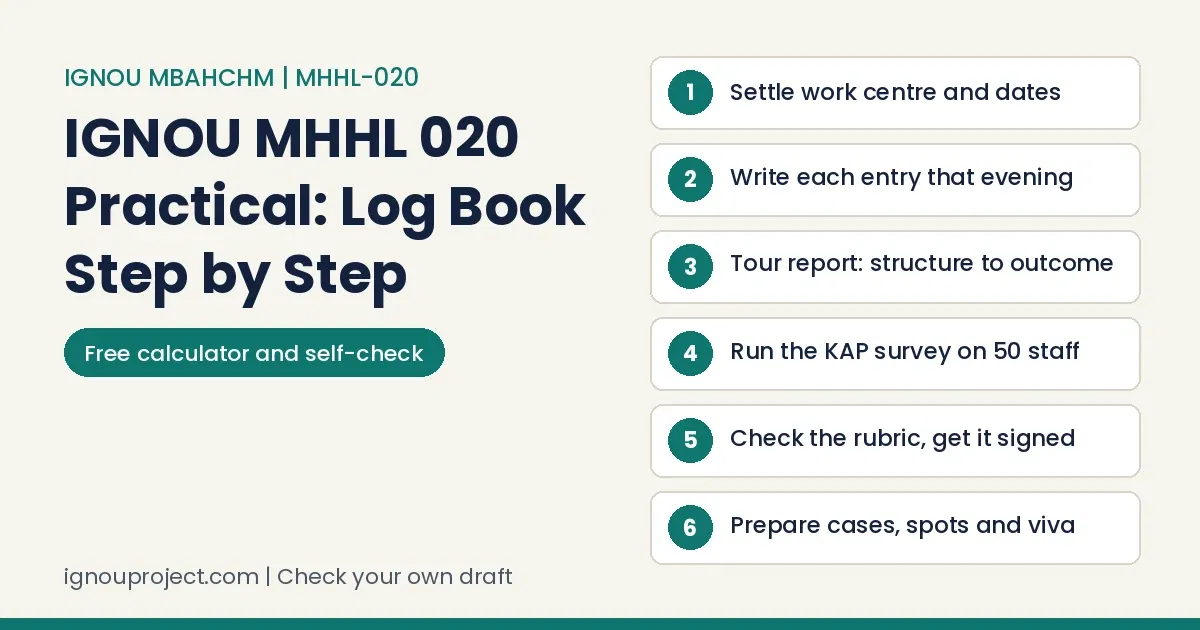
The IGNOU MHHL 020 Practical from start to finish
The IGNOU MHHL 020 Practical is the 6-credit practicum in the third semester of the MBA (Health Care and Hospital Management), MBAHCHM, and this guide shows how to do each part yourself: the ten-day contact spell, the log book entries, the surveys, the calculations and the practical exam.
In short, for MBAHCHM learners
For the IGNOU MHHL 020 Practical you attend all ten days at your work centre, write each activity in the Block 5 Log Book on the day, get it signed by a counsellor, pass the 50-mark internal assessment, pay Rs 500 with the exam form, then sit a 50-mark exam with cases, spots and a viva.
Six things to settle before the first session
Most of what goes wrong in the IGNOU MHHL 020 Practical starts before the contact spell, so settle these points first.
Before the first session: six checks
- Re-register for Semester III. The 2026 MBAHCHM Programme Guide says the practical cannot be done without it.
- Find your work centre. Appendix B of the guide lists them by Regional Centre; use your own Regional Centre’s centre if it has one, or choose from the list, subject to seats.
- Ask for the spell dates. The work centre runs the ten days as one spell or as two five-day spells, so write to it as soon as you re-register.
- Fill the Block 5 cover: name, enrolment number and address.
- Plan the own-time visits. Laundry, Dietary Services, Pharmacy and Radiology may be covered at your workplace or a nearby hospital, and the Sub Centre or Health and Wellness Centre, PHC and CHC visits at your convenience. Read each proforma before you go.
- Draft the KAP questionnaire early. It needs 15 to 20 items and 50 respondents.
Students often ask us whether a slip on the cover page really matters. In the practical records we see, the first page is a common home for a mistyped enrolment number or wrong programme detail, so check your three Block 5 cover entries against your IGNOU ID card.
In our records, 70 to 80 percent of learners act only in the month before something falls due. Here the fixed point is the spell date the work centre sets, and a late request can push you to a later batch.
Running the IGNOU MHHL 020 Practical day by day
Each day of the IGNOU MHHL 020 Practical has three supervised sessions, and full attendance on every day is compulsory: it is what makes you eligible for the term-end practical exam. If you miss your batch, the guide lets you join a later batch’s spell.
One evening, one entry
- Note the date, session and counsellor’s name in a rough notebook.
- During a tour or exercise, jot what you see under three words: structure, process, outcome.
- The same evening, write the log book entry and the discussion points; the guide asks for daily recording.
- Next morning, show the entry to the counsellor and get it signed.
- Carry the log book to the centre every day; it also goes with you to the exam.
A quick test on the last day: does each entry carry its own date and one detail only that day could have given you? A log filled in one sitting after the event repeats itself, shows dates when the centre was shut, and its tenth entry is no deeper than its first.
How to fill MHHL 020 log book entries, one type at a time
Every page you fill for the IGNOU MHHL 020 Practical belongs to one of six entry types.
- Short questions (3.1 on the spot map, 7.1 on types of fire): answer in your own words from the matching unit of Volume 1, with one example from a hospital you know.
- Checklist proformas (disaster plan 6.1, fire audit 7.3, the primary health care visits in section 12): fill the header fields first (hospital name and date of visit, location, beds, specialities), then a remark against every row. A “No” without a remark tells the counsellor nothing.
- Case exercises and drafts (What-If table 5.3, FMEA 5.5, disaster manual 6.2, fire evacuation plan 7.4, OPD automation 8.1): state your assumptions, fill every blank cell and end with recommendations.
- Field studies (KAP 4.1, patient and staff surveys 8.5 and 8.6, laboratory visit 10.5, ABC analysis 17.1): method, sample, data, findings, with the blank tool kept alongside.
- Calculations (14.2 to 14.4, 16.2, 16.3, 17.3): formula, substitution, result with unit, and one line on what it means.
- Tour reports (section 18): the structure, process and outcome headings printed for each department.
Inside any entry, keep this order: activity number and title as printed; date and place; what you did; what you found; analysis naming the manual idea it applies; recommendations; counsellor’s signature and date.
Worked example: an MHHL 020 conducted tours report for the Blood Bank
The LSC runs the conducted tours during the spell, and for each department the IGNOU MHHL 020 Practical log book prints its own structure, process and outcome headings. The hospital and findings below are invented to show the layout; your entry must describe the Blood Bank you actually visit.
Illustrative Blood Bank entry, three headings
Structure. Separate rooms for donor screening, collection and component separation; two blood bank refrigerators with temperature charts; barcode labels on every bag; a generator line for storage; donor records in software. Staff on the day: one medical officer, three technicians, one donor counsellor.
Process. Donor eligibility is checked on a printed form and consent signed before collection. Units are screened and cross-matched before issue, stock is rotated so the oldest unit goes first, and each issue is entered against the requesting ward.
Outcome. The department tracks units discarded on expiry and the time from request to issue. Staff said discards rise after large camps.
Recommendation. Plan camps against monthly issue figures and share a weekly stock list with high-use wards.
Before and after, from the kind of entries we see. Before: “Visited the blood bank and observed the activities.” After: “Stock is rotated so the oldest unit is issued first; discards still rise after camps, which points to camp planning, not storage, as the gap.” The second ties what was seen to the outcome idea of the course.
Running the MHHL 020 KAP study in four steps
The hand hygiene and biomedical waste KAP survey is field work you run yourself in the IGNOU MHHL 020 Practical, and the log book sets it out in four steps.
- Design. Write 15 to 20 questions in Knowledge, Attitude and Practice sections on a Likert scale, Strongly Agree to Strongly Disagree. The rubric rewards items covering all five WHO moments and the BMW rules, balanced across the three sections.
- Plan. Target 50 healthcare workers (doctors, nurses, paramedics), sampled at random or by convenience, online or offline, and record which sampling you chose and why.
- Analyse. Code answers in Excel (5 for Strongly Agree down to 1) and calculate the percentage of correct knowledge, positive attitude and good practice. Decide before entry which answers count as positive, and reverse the scoring of negatively worded items such as “Is it difficult to follow waste disposal protocols during busy shifts?”
- Present. Name the gaps, summarise findings and suggest interventions (training, reminders, posters, supervision) in a one-page report.
KAP report on one page (suggested layout)
Title and setting; sample (number, staff groups, sampling, mode); three result lines for knowledge, attitude and practice with one chart; the two or three largest gaps, each tied to a moment or a BMW rule; interventions with who acts and how often.
Across practical courses, a report that skips one part of its expected order loses marks for it. This task sets its own order, so let the one-page report run design, collection, analysis, presentation.
Calculation tasks in the IGNOU MHHL 020 Practical: method with practice figures
The calculation exercises in the IGNOU MHHL 020 Practical use formulas from Volume 1, Units 12, 14 and 15. The figures below are practice numbers, not your log book’s, so learn the method here and then work your own tasks.
- Break-even point. Contribution per unit = price minus variable cost; break-even units = fixed cost divided by contribution. Practice: fixed costs Rs 3,00,000 a month, Rs 600 per physiotherapy session, Rs 200 variable cost: contribution Rs 400, break-even 750 sessions or Rs 4,50,000 of revenue.
- Composite P/V ratio. Total contribution divided by total revenue; composite break-even revenue = fixed cost divided by that ratio.
- Cash break-even. Remove depreciation, a non-cash cost, from the costs before dividing, wherever the task includes it.
- Utilisation coefficient. Hours used divided by hours available, times 100. Practice: a dialysis machine available 24 hours and used 14 a day gives 58.33 percent.
- Downtime index. Downtime hours divided by service hours, times 100. Practice: an X-ray unit scheduled 60 hours a week and down 3 hours gives 5 percent.
- EOQ. Square root of (2 x annual demand x cost per order, divided by carrying cost per unit per year). Practice: 2,400 glove boxes a year, Rs 500 per order, 20 percent carrying cost on a Rs 125 box (Rs 25): the square root of 96,000, about 310 boxes.
Two traps: monthly consumption must become annual demand before it enters EOQ, and a carrying cost given as a percentage must become rupees per unit.
Practice calculator: BEP, utilisation, downtime, EOQ
Fill one row and press its button. Without JavaScript, use the formulas above.
Result appears here.
Check each entry against its rubric before the counsellor signs
Each activity in the IGNOU MHHL 020 Practical log book is scored on a printed rubric whose criteria run from Excellent (5) to Poor (1), and the internal half of the grade rests on these scores. Run this check on every entry before asking for a signature.
Entry check before signature
Seven log book mistakes and how to repair them
These slips most often pull an IGNOU MHHL 020 Practical log book down.
| Mistake | Repair |
|---|---|
| Entries written after the spell ends | Write each one the same evening from rough notes. |
| An activity without a counsellor’s signature | A missing signature is a gap we meet often in practical records; here an activity not duly signed is left out of internal assessment, so get each page signed before you leave that day. |
| Tour notes that only say what was “seen” | Write under the printed structure, process and outcome headings and add a recommendation. |
| KAP questionnaire missing a section or the Likert scale | Keep 15 to 20 items across all three sections on the five-point scale. |
| EOQ worked on monthly figures | Convert to annual demand and rupee carrying cost first. |
| Formulary or antibiotic policy too short | The task asks for 30 or more medicines and 10 or more antibiotics, drafted against the WHO list, ICMR guidelines and NABH standards. |
| Seminar and webinar pages left blank because no marks row carries them | Fill sections 19 and 20 as the sessions happen. |
Preparing the long case, spots and MHHL 020 viva questions
The exam half of the IGNOU MHHL 020 Practical is 50 marks: one long case for 20 or two short cases of 10 each, five spots for 10, and a viva-voce for 20. The Programme Guide does not describe what the cases or spots contain, so ask your counsellor near the end of the spell how they are set at your centre.
Practice questions for the viva
Self-practice questions drawn from your own log book tasks, not a list issued by IGNOU:
- What is a spot map, and how did it help in your outbreak exercise?
- Why did you choose random or convenience sampling for the KAP study, and how many workers answered?
- Which row of your fire audit was a “No”, and what would you correct first?
- What happens to the break-even point when variable cost per unit rises?
- How does the utilisation coefficient differ from the downtime index?
- Why combine ABC and VED analysis instead of using one?
- Which outcome measure did the department you toured actually track?
- Which step of the OPD workflow would your automation plan change first, and why?
Learners often ask us whether the viva is a formality once the log book is done. It usually carries real weight, here 20 of the 50 exam marks; a tidy book helps little if its owner cannot explain aim, method and findings, while those who did the tours and surveys themselves answer most easily.
Some learners we see write survey findings with no survey behind them. Your KAP percentages must come from the workers you actually asked, and the viva is where you may be asked about them.
Exam form week: Rs 500, two last dates and what to carry
To sit the IGNOU MHHL 020 Practical exam you need the completed spell with the log book submitted, a pass in the internal assessment, and the practical fee paid with the online term-end exam form. The July 2026 Common Prospectus fixes Rs 500 for a practical above 4 credits, which covers this 6-credit course, and a paid exam fee is neither refunded nor adjusted. The Programme Guide names 31 March and 30 September as the closing dates (they may be extended) and asks you to pay in the semester of your contact session, since the fee cannot be carried forward. Take the log book to the exam; you get it back at the end.
When marks go missing, the learners we can help least are those with no proof of payment. Save the exam form confirmation page as a PDF on the day you pay.
Have your own log book entries checked
If you have written your entries for the IGNOU MHHL 020 Practical and want a second reading before the counsellor scores them, send scans of your own pages. We read them against the printed proformas and rubrics and point out empty cells, missing headings and calculation slips; you make the changes yourself. This check is quoted on WhatsApp at +91 93546 37830, as listed on our services and charges page. You stay the author of every entry, and your counsellors and examiners decide the marks.
Questions learners raise about the IGNOU MHHL 020 Practical
Four questions, answered from the course documents
Can I complete the log book after the contact spell is over?
No. The 2026 Programme Guide asks for daily recording of activities and discussions, and the counsellors sign activities during the spell.
What if a counsellor has not signed one of my activities?
For the IGNOU MHHL 020 Practical, an activity without a due counsellor signature does not count for internal assessment, which lowers your internal score.
Must I pass the internal assessment separately?
Yes. It is a condition for the term-end practical exam. Overall you need a C grade or better across both halves, and a component graded E is repeated.
Do theory results affect my practical exam?
No. The guide states that theory results are not a prerequisite for the term-end practical examination.
Finishing the IGNOU MHHL 020 Practical well
The IGNOU MHHL 020 Practical rewards steady habits more than last-minute polish: fix the work centre and dates early, write each entry the same evening, survey real respondents, show your working, check each page against its rubric and collect the signature before you leave. For printed study guides on the semester’s four theory papers, see the third-semester reference material on our publication site.
Official documents used for these steps
Documents behind these steps
- The MHHL-020 practical manual (Volume 1, all four sections), SOHS, IGNOU
- The MHHL-020 Block 5 Log Book (Volume 2), SOHS, IGNOU, printed in 2025
- MBAHCHM Programme Guide 2026, School of Health Sciences
- IGNOU Common Prospectus, July 2026: practical examination fee
ignouproject.com is not affiliated with, authorised by or endorsed by IGNOU. We check and comment on log book entries the learner has written; the learner remains the author of the log book, its surveys and its calculations.

BK Sahni iD 0009-0005-8092-459X
Founder, Shri Chakradhar Publication Pvt. Ltd. & ignouproject.com — helping IGNOU distance-learning students since 2010 (5,00,000+ students supported across MBA, MCom, MA & more). Author of IGNOU exam guides, solved assignments & project reference books.
Disclosure: Shri Chakradhar Publication Pvt. Ltd. and ignouproject.com are independent third-party study-help services — not the official IGNOU website. Always verify final dates and rules on ignou.ac.in.