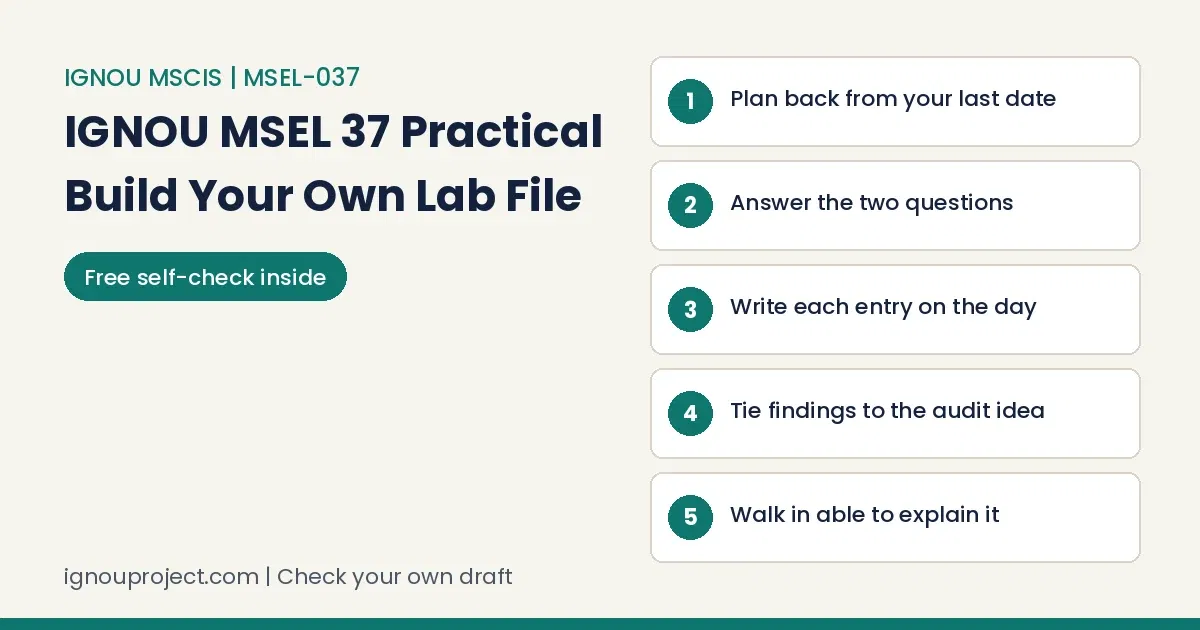
The IGNOU MSEL 37 Practical is the Semester IV lab of MSCIS. This guide takes you through doing it yourself: planning the work back from your last date, answering the two questions, writing each lab record entry so it reads as real audit work, and walking into the viva able to explain every page.
What the IGNOU MSEL 37 Practical asks you to produce
Before you open a single tool, it helps to see the whole deliverable. The IGNOU MSEL 37 Practical (course code MSEL-037, in the MSCIS fourth semester) is not a written paper you sit in a hall. It is a set of things you build and then defend: answers to two practical questions, a lab record for that work, and a viva where an examiner asks you to account for it. The manual draws the lab from four auditing areas: web application audit, mobile application audit, malware detection and mitigation, and IoT device auditing, and it states that the practical rests on the MSE-033, MSE-034 and MSE-035 courses.
So the job in front of you is three pieces of evidence, not one essay. The two answers show you can carry out an audit task. The record shows you did it session by session. The viva shows the work is yours. Everything below is about producing those three pieces in a way that holds together.
Plan the MSEL 037 practical back from your last date
The IGNOU MSEL 37 Practical rewards an early start more than almost anything else, because the record is meant to grow across sessions rather than be written in one night. Fix your last date first. The January-session cut-off prints as 31 March and the July-session one as 31 October, and the booklet tells you to confirm the current date on the IGNOU site. The practical fee follows the credit slab: because MSEL-037 carries four credits, it falls in the lowest band, set at Rs 300 in the July 2026 prospectus, paid with your term-end examination form and not returned once paid.
A point worth clearing up early: the amount is Rs 300, not Rs 500. The higher Rs 500 band belongs to work carrying more than four credits, so a four-credit code like this one sits at Rs 300. Count the weeks between today and your last date, then give each audit area its own block rather than leaving the record for the final week. The small planner below does the counting for you.
Weeks-to-last-date planner
Pick your submission last date. This shows the weeks you have and a rough block for each of the four audit areas. It runs in your browser and saves nothing.
How to answer the two MSEL 037 assignment questions
The assignment booklet sets the shape of the written part plainly. It carries two questions, you answer both, and each is worth 20 marks, so the two answers together carry 40 of the 100 marks. The booklet also invites illustrations and diagrams, lets you state reasonable assumptions, and asks you to run the task and then hand in the logic of the program, one worked input with its output, and the notes that explain it. Each session draws its two MSEL 037 assignment questions anew from the lab's audit themes, so answer the set printed in your own booklet rather than one copied off an older year.
Treat each answer as a short audit write-up, not a textbook paragraph. State what you set out to check, show the steps and the tool you used, paste the actual input and output you got, and close with what the result means. Keep the data real: an answer built on numbers you assumed, rather than output you actually produced, comes apart the moment the examiner asks you to run it again. Where you had to assume something, say so in a line, which is exactly what the booklet allows.
Writing each MSEL 037 lab record entry so it ties to the audit idea
The lab record is where the IGNOU MSEL 37 Practical gives up another 40 marks, 20 for each question's recorded work, and it is the part most within your control. The practical manual tells you to store every session's result on its own and to have each exercise marked the moment you complete it, which signals that the record is meant to grow through the sessions, not be assembled at the end.
The single habit that lifts a record is tying each entry to the audit idea behind it. A line that only says you ran a scan and saw some results reads as a description; a line that says what you were testing for, what the tool reported, and why that finding matters reads as audit work, and that is what the examiner is scoring. It also shows when a record is written in one sitting at the end: the entries repeat, carry no sense of progress from the first session to the last, and sometimes land on dates when no session ran. A dated line written on the day avoids all of that. For a computer practical the usual loss is a record whose programs print no output, whose output does not match the code shown, or whose code will not run; the booklet's instruction to include the program logic alongside a worked input and output exists to shut exactly that gap.
A workable MSEL 037 practical file format
There is no secret layout, but a consistent MSEL 037 practical file format makes the IGNOU MSEL 37 Practical easy to mark and easy to defend. Keep the four audit areas as four parts, and inside each part give every session the same short frame. The manual's own reporting guidance points the way: it asks that every issue carry the five C's, Criteria, Condition, Cause, Consequence, and Corrective action, and that an audit report state its scope and objectives, findings, recommendations and conclusion.
A frame that works for one entry:
- Aim and scope: what this session set out to check.
- Tool and setup: the tool used and the environment it ran in.
- Steps: what you did, in order, briefly.
- Observation and evidence: the output you got, with a screenshot or a pasted result.
- The five C's: the finding stated as criteria, condition, cause, consequence and corrective action.
- Date and signature line: so the entry can be signed off as you finish it.
Use the same frame for every session across all four areas. The repetition is a feature: it lets you, and the examiner, move through the file without hunting for where the finding is.
A worked entry, shown as a model
Here is one entry written to that frame, kept general so you can see the shape rather than copy the content. Your own entry carries your own tool, your own output and your own finding.
Aim and scope: Check a test web application for weak points in how it handles user input, on a sandbox set up for this session only.
Tool and setup: An automated web scanner run against the local test application, with a note of the version and the date.
Steps: Point the scanner at the test site, let it map the pages, run the scan, and read the report by severity.
Observation and evidence: The report flagged a set of findings; a screenshot of the summary and the severity list is pasted here.
The five C's: Criteria, the standard the app should meet; Condition, what the scan found; Cause, why it happens; Consequence, what it risks; Corrective action, what to fix and in what order.
Date and signature: the session date, left for sign-off.
Notice that the finding is never left as a raw tool dump. Every entry turns the output into a judgement, which is the audit skill the practical is testing.
Check your own MSEL 037 record before you hand it in
Run your finished IGNOU MSEL 37 Practical file past a short list. The self-check below is a set of plain questions; nothing is sent anywhere, and the ticks live only in your browser for this one visit.
Twelve-point record self-check
Common MSEL 037 mistakes that cost marks, and the fix
Most lost marks on the IGNOU MSEL 37 Practical come from a short list of avoidable slips. Each has a fix you can apply before you submit.
- A record written all at once. Fix: write each entry on the day of the session and date it, so the file shows real progress.
- Findings left as tool output. Fix: end every entry with the five C's, so the output becomes a judgement.
- Code with no output. Fix: paste the sample input and output beside the logic, as the booklet asks.
- Wrong or missing cover details. Fix: put your complete enrolment number, name, full address, signature and date on the first page, exactly as the booklet sets out.
- Work drafted straight out of an AI tool and handed in as it stands. Fix: do the sessions yourself, because the viva asks how the output was produced and a borrowed file leaves you with nothing to say.
- On an upload route, a half-finished file, or a scatter of separate uploads where one tidy set belongs. Fix: assemble one complete file and check it opens before you send it.
Getting ready for the IGNOU MSEL 37 Practical viva
The MSEL 037 viva is a real part of the IGNOU MSEL 37 Practical, carrying 20 of the 100 marks, so a record you cannot discuss hands back a fifth of the total before anything else counts. It is also the point at which a copied file collapses, since someone who never ran the sessions has no answer when an examiner asks about its purpose, its steps or its results. Prepare by talking through your own file out loud: for each session, be ready to say what you were checking, which tool you used, what it found, and what you would fix. If you can do that for any page the examiner opens, the viva is straightforward.
Where and how the IGNOU MSEL 37 Practical is examined
The exam for this code is unusual, and knowing that saves you chasing something that does not exist. On its practical schedules the Student Evaluation Division notes that the two MSCIS lab codes, MSEL-032 and MSEL-037, carry no question paper, and it lets each Regional Centre pick whatever exam date suits it. So there is no shared slot to track and no paper to hunt down; your Regional Centre decides the arrangement, and some cycles have run it online. Guard the sessions themselves: many on this degree juggle a job or a household beside it, and although a theory counselling class can be missed at little cost, a skipped practical batch can set a whole session back. The one dependable step is to settle the date, the mode and the hand-in point with your own study centre, not with a friend at another one, since the handling varies between centres.
Send us your own MSEL 037 draft to check
If you have built your own IGNOU MSEL 37 Practical record and want a second read before you submit, we check the learner's own draft against the course's requirements and send back corrections and comments. We do not write the record for you, and the file stays your own work. For a practical record the check is quoted on WhatsApp rather than at a fixed price, so tell us what you have and we will tell you what the review covers.
Questions MSCIS learners ask while building the record
Do I need to track down a question paper for this practical?
No. The practical schedules issued by the Student Evaluation Division say these two MSCIS codes have no paper set and that each Regional Centre fixes its own date. Your marks come from the lab work, the file and the viva, so there is nothing to revise from in the usual paper sense.
How are the 100 marks of the IGNOU MSEL 37 Practical split?
Your answers to the two questions carry 40 marks, 20 each; your lab records carry 40 marks, 20 for each question's recorded work; and the viva voce carries the last 20. The assignment also weighs 30 percent of the course.
Does the MSEL 037 viva really count?
Yes. The MSEL 037 viva is worth 20 of the 100 marks and is where the examiner checks the work is yours, so it is not a formality you can walk in unprepared for.
Can I learn how to make MSEL 037 practical work from an old solved copy?
A solved copy can show you the shape of an answer, but it works as something to compare your own attempt against, not as a file you submit. The marks come from the record you build and defend yourself, so use any sample only to test your own approach.
Reading and reference for the four MSCIS audit areas
The four audit areas in this lab rest on the theory you study in the same MSCIS fourth semester, so the study material for those papers is the natural background reading. If you want the course identity, the rule summary and the printed reference sets for this code, the reference material for this course on our publication site covers that side. The ones who finish this lab smoothly tend to do the same things: get going early, settle the rules with their own centre first, enter each session's work the day it happens, and stay familiar enough with the file to speak to any page an examiner opens.
Official documents read for this guide
Each fact in this guide comes from the documents below, all consulted in November 2026:
- The MSE-037 Practical Manual (SOVET, IGNOU) on Web and Mobile Applications and IoT Security, used for the four audit areas, the session tasks and the reporting frame.
- The MSCIS MSEL-037 assignment booklet, January 2026, from SOVET, for the two questions, the hundred-mark split, the weightage and the submission date.
- The July 2026 IGNOU Common Prospectus, MSCIS entry 3.68, for the programme shape, its four credits and the practical examination fee.
- The Student Evaluation Division Schedule of Term-End Practical Examination, for the point that these two MSCIS codes run without a paper on a date the Regional Centre sets.
- A copy of the MSCIS Programme Guide, for the practical attendance expectation and the split between continuous and term-end weightage.

BK Sahni iD 0009-0005-8092-459X
Founder, Shri Chakradhar Publication Pvt. Ltd. & ignouproject.com — helping IGNOU distance-learning students since 2010 (5,00,000+ students supported across MBA, MCom, MA & more). Author of IGNOU exam guides, solved assignments & project reference books.
Disclosure: Shri Chakradhar Publication Pvt. Ltd. and ignouproject.com are independent third-party study-help services — not the official IGNOU website. Always verify final dates and rules on ignou.ac.in.