IGNOU BHCL 122 Practical, start to finish: what you will actually do
The short answer for BAFHSC learners
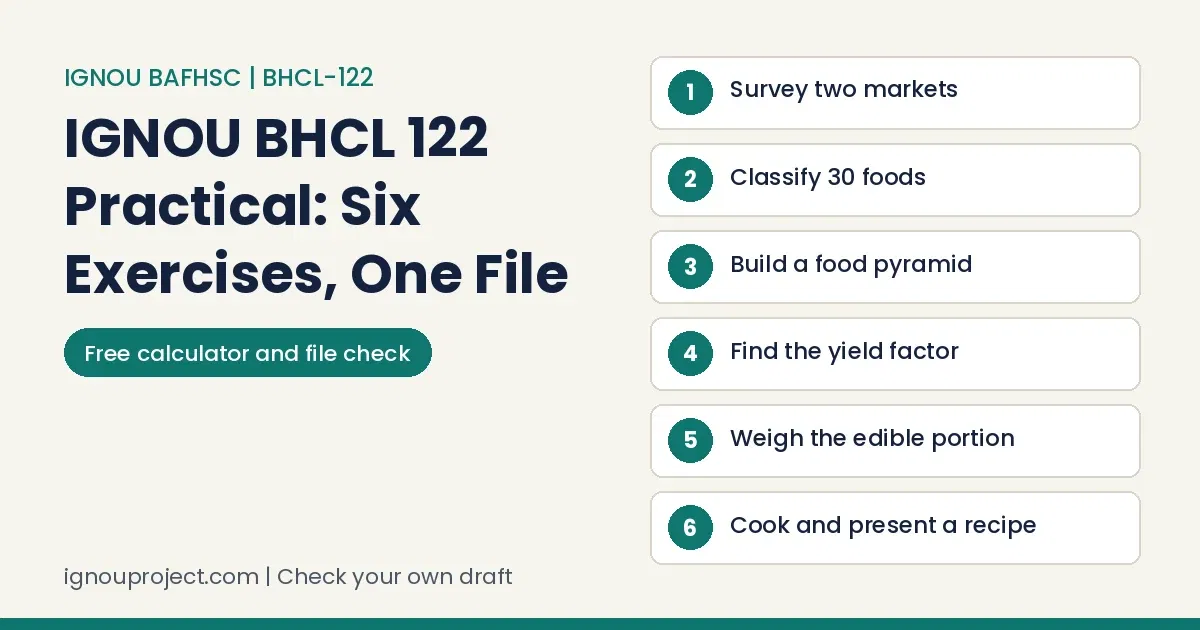
The IGNOU BHCL 122 Practical is the 2-credit Fundamentals of Food and Nutrition practical in BAFHSC semester 2. You complete at least five of six handbook exercises under your Academic Counsellor, file each worksheet with its table and reflection, then sit a three-hour practical exam followed by a viva.
This guide turns the December 2025 handbook into steps you can carry out yourself, with a calculator, a file check and viva practice along the way.
Eight steps, in the order the semester runs
- Meet your Academic Counsellor and ask how each report should be written.
- Do the market survey early, while vendors’ answers are fresh.
- Fill the 30-food table with your BHCC-122 blocks open.
- Make the food pyramid aid and show it to your counsellor.
- Run Exercises 4 and 5 in your kitchen on one scale.
- Cook, record and present your recipe for Exercise 6.
- Hand in the file with the certificate, then correct and resubmit what the counsellor marks.
- Fill the term-end exam form with the practical fee and prepare for the exam and viva.
Internally you can earn 30: 10 for attendance and 20 from your best four exercises. The exam adds 70: 50 for the practical and answer sheet, 20 for the viva. Doing all six exercises leaves room if one scores low.
Your first counselling session: settle these before the market visit
The IGNOU BHCL 122 Practical handbook asks you to meet your counsellor before any exercise, because the report format changes from one exercise to the next. Take this list and note the answers:
- The BHCL-122 session dates at your Learner Support Centre.
- When the file is due, since the handbook prints no date.
- Your Exercise 6 recipe, and how many dishes the counsellor expects.
In our records, 70 to 80 percent of learners begin work only in the final month before a date that matters to them. BHCL-122 asks for two separate market visits and a cooked dish shown to your counsellor, so put dates for both in your diary now.
Can a work shift excuse a missed session? Many people who write to us juggle employment and a household, and practical sessions are where their time gives out. For BHCL-122 the prospectus treats practical attendance as compulsory, and the handbook awards 10 internal marks for attendance alone.
Ask where notices appear. Across practical courses, learners who stop checking lose their slot and wait for the next cycle. The prospectus says the Learner Support Centre provides the practical schedule.
How to make BHCL 122 practical file: a page order that works
The handbook fixes what goes inside each exercise but sets no binding, page count or overall order for the IGNOU BHCL 122 Practical file. This order is our suggestion; follow your counsellor if they set another.
Suggested page order for the file
- The appendix certificate. We often find a wrong enrolment number or a blank centre on certificate pages, so copy the enrolment number, Learner Support Centre and Regional Centre from your admission records.
- A contents page with page numbers.
- Each exercise in handbook order, its parts in the printed sequence: title, aim, introduction, tools or materials, procedure, Part II table or form, Part III reflection.
- For Exercise 3, the counsellor’s remark box, and a photo of your aid if you choose (optional).
- For Exercise 6, the recipe details, summary row and the counsellor’s remarks.
Answer every question the worksheet prints. The counsellor judges accuracy, hygiene, interpretation of data and the quality of reflections.
Leave the counsellor’s signature space clear and ask for it at evaluation; across practical files, an unsigned counsellor box is a gap we meet again and again.
Exercise 1: the BHCL 122 market survey, from choosing markets to the reflection
In the IGNOU BHCL 122 Practical, this is the exercise done among shops and stalls. Work in this order:
- Pick two markets of different kinds: a local or weekly one (haat, kirana, sabzi mandi) and a costlier one (supermarket or branded store).
- Choose three of the nine listed food groups and at least two items in each: six items or more.
- Price each item in the same unit in both markets. A 500 g pack against a loose 1 kg price is not a comparison.
- Ask the vendor whether stock is farm-fresh or stored, local or from another state, whether branded or imported versions are sold, and when the price climbs or drops.
- Note quality, packaging (loose or branded) and whether the item is plentiful or scarce.
- Fill the vendor profile, the eight-column table, then the reflection.
Table and reflection carry 2.5 marks each. The reflection should explain why the markets differ, how the season changes supply, how a family can eat well for less, and what you learned about food in your area.
A caution before the first row: we sometimes meet survey tables filled from memory or a friend’s notes, with no market visited. The BHCL-122 handbook asks for the survey in your own local area and marks its filled sample as an example not to be copied.
Classifying 30 foods and building the pyramid aid (Exercises 2 and 3)
Both IGNOU BHCL 122 Practical tasks here are desk work. In Exercise 2 the 30 foods are printed, from egg and spinach to tur dal and broccoli. Write each food’s group, tick “rich in nutrients” where it applies, then tick only among protein, iron, calcium, vitamin A and vitamin C, leaving the rest blank. Keep the BHCC-122 first block or a nutrition chart beside you.
Tip: count the ticks in each nutrient column. That count answers the reflection’s first question, which nutrient appears most and least.
For Exercise 3, your visual aid can be chart paper, a poster in A3 or A2 size, or a three-dimensional model. Plan four or five levels: cereals and millets at the base, then vegetables and fruits, then milk, pulses, meat, fish and eggs, with fats, oils and sugars at the top. Put 3 to 5 foods on each level, label each level’s main nutrients, colour every level differently, and head a chart “FOOD PYRAMID”. The counsellor’s 2.5-mark remark gives 1 for creativity, 1 for classifying foods correctly and 0.5 for neatness; your reflection carries another 2.5.
Exercise 4: weighing raw and cooked food for the BHCL 122 yield factor
- Choose everyday foods such as rice, moong dal and potato.
- Weigh each raw food in grams and measure it in a cup or spoon.
- Cook all of them by one method, boiling or steaming, with no salt or oil.
- Weigh and measure each cooked food again.
- Yield factor = cooked weight (g) / raw weight (g).
Write the scale type (digital or manual) and the cooking method at the top of the sheet. Weigh an empty bowl first and subtract it, so the cooked weight is food only. The reflection asks which foods gained or lost weight, why, and how this helps you plan portions.
Exercise 5: finding the BHCL 122 edible portion with three weighings
- Clean the digital scale and set it to zero; wash and dry each food.
- Weigh the whole food (W1).
- Peel and remove seeds, bones or other waste.
- Weigh the edible part (W2) and the discarded part (W3).
- EP% = W2 / W1 x 100; NEP% = W3 / W1 x 100, or 100 minus EP%.
The samples are a potato, banana, mango, whole fish and papaya, and local foods may replace them. Part II also records your market place and whether the shop was a pushcart, retailer or wholesaler.
A worked example, and a calculator for your own weights
Here is how the two IGNOU BHCL 122 Practical kitchen formulas look with numbers. These figures are ours, for illustration; your file must carry your own weighings.
Illustrative figures, not a handbook sample
| Food | Readings | Result |
|---|---|---|
| Rice (Ex 4) | 60 g raw, 174 g boiled | 174 / 60 = 2.9 |
| Masoor dal (Ex 4) | 50 g raw, 125 g boiled | 125 / 50 = 2.5 |
| Methi leaves (Ex 4) | 80 g raw, 30 g steamed | 30 / 80 = 0.38 |
| Orange (Ex 5) | W1 220 g, W2 160 g, W3 58 g | EP 72.7%, NEP 26.4% |
Notice the orange: W2 plus W3 is 218 g, not 220 g, because juice ran off while peeling, so NEP% from W3 (26.4) and 100 minus EP% (27.3) differ slightly. Name the gap in your reflection; the handbook accepts small differences from uneven peeling or the scale when you explain them.
In experiment-style practicals we often see a formula worked with the wrong figure, or a conclusion the readings do not support. For BHCL-122 Exercise 5, EP% always divides W2 by W1, so check each percentage against the weights in its own row.
Yield factor and edible portion calculator
Weights in grams. Yield factor = cooked / raw; EP% = W2 / W1 x 100; NEP% = W3 / W1 x 100. Without JavaScript, apply these by hand.
Raw Cooked
W1 W2 W3
Exercise 6: cooking, recording and presenting your recipe
The last IGNOU BHCL 122 Practical task puts nutrition on a plate. Cook one of the ten sample recipes (pulao, idli, arhar dal and egg curry among them) or another standard recipe, including a traditional one, with your counsellor’s guidance. The handbook does not settle the dish count: its introduction mentions five food groups, its procedure lists several, and the summary table has one row. Use your counsellor’s answer.
- Revise methods of cooking in Unit 3 of BHCC-122 and name your dish’s method and principle.
- Write title and aims, a short introduction, ingredients with quantities and numbered steps.
- Give the portion size for one person and approximate nutrients, worked out with the ICMR-NIN food composition tables.
- Fill the summary row: name, food group, ingredients, method, portion, major nutrients and micronutrients, remarks.
- Cook with clean hands, washed produce and an apron, then present the dish to your counsellor.
The write-up carries 2.5 marks; the counsellor’s remarks (2.5 + 2.5) cover taste, texture, colour and appeal, nutritional balance, and hygiene and safety.
Writing reflections that answer the printed questions
Copy each printed guide question as a sub-heading, answer it in two or three sentences, and use one number from your own table in each answer.
Many reflections we read only retell the steps, when an evaluator looks for the link to a course concept. “I weighed the foods and found the edible portion” says nothing new. Compare: “The orange lost about a quarter of its weight as peel and seeds, so 1 kg gives roughly 730 g to eat, which changes how many I buy.”
An AI tool will write a reflection, but it reads like everyone else’s and cannot know your vendor’s answer or your own weights. Write each BHCL-122 reflection from your notebook.
Common mistakes in the IGNOU BHCL 122 Practical file, with fixes
Mistake and repair
| Mistake | Repair |
|---|---|
| Prices in different units | Convert both markets to one unit. |
| Ticks for fibre or energy in Exercise 2 | Use only the five named nutrients. |
| Yield factor as cooked minus raw | Divide cooked weight by raw weight. |
| Two cooking methods in one Exercise 4 table | One method for every food. |
| A worksheet part missing; across practicals, reports drop marks when one part of the sequence is absent | Tick off each printed part of every BHCL-122 exercise. |
| Counsellor’s comments noted but not acted on, which we see often | The handbook expects corrections made and the work handed in again. |
Check your IGNOU BHCL 122 Practical file before hand-in
Before you hand the file to your counsellor
Read your reflections one after another. Practical writing done in one sitting at the end shows in repeated sentences; each BHCL-122 worksheet prints its own questions, so no two of yours should open alike.
The three-hour exam and BHCL 122 viva questions to practise
The IGNOU BHCL 122 Practical exam is a three-hour sitting of its own, apart from the theory paper. Regional Centres hold it at study centres, and every candidate answers the same paper, set by the programme coordinators at the IGNOU head office. You perform the practical, record findings on the answer sheet for the internal examiner, then face a viva with the internal and external examiner or course coordinator. Bring your practicum notebook. The handbook says the viva may also be online; ask your centre.
For a practical of up to 4 credits the prospectus fee is Rs 300, submitted along with the exam form for each June or December term-end exam, and it is not refundable.
Does a neat file carry you through? Across practicals we see tidy files score poorly when the learner cannot explain the aim or method. In BHCL-122 the viva carries 20 of the 70 external marks.
Six questions to practise aloud
Our practice prompts, not an IGNOU list:
- Why did one item cost more in one of your markets?
- Name two foods from your table rich in iron and two rich in vitamin C.
- Why are cereals at the base of the pyramid and fats at the top?
- How did you get the yield factor of rice, and why is it above 1?
- Why might fish give a lower EP% than potato?
- Which cooking method did your recipe use, and which nutrients does it supply?
Want a second look at your own file?
Send us your own filled BHCL-122 worksheets before the counsellor sees them. We check that every printed part is present, that each calculation follows from your weights, that reflections answer the printed questions and that the certificate is complete, and return comments for you to act on. We do not fill worksheets or write reflections, and the counsellor and examiners decide marks. The check is quoted on WhatsApp at +91 93546 37830; see our services and charges.
Questions learners ask while doing the exercises
Can I do the IGNOU BHCL 122 Practical exercises at home?
Exercises 2 to 6 are desk and kitchen work and Exercise 1 takes you to two markets, all under your counsellor’s guidance at your Learner Support Centre.
Is a photo of my food pyramid compulsory?
No. The photo is optional; you show the aid itself to your counsellor for the remark.
My rice yield factor is not 3.0 like the handbook sample. Is that wrong?
Not by itself. The sample shows the method; your figure depends on your rice and cooking. Check it is your cooked weight over your raw weight, and comment on it.
Finishing the IGNOU BHCL 122 Practical with a file you can explain
The IGNOU BHCL 122 Practical rewards work you did yourself: prices you heard, weights you read and a dish your counsellor tasted. Every number in the file should be one you can talk about in the viva.
The learners who finish practicals calmly start early, confirm rules with their own centre, keep dated notes, collect signatures as they go, and can explain every page. For BHCL-122 that means market notes, kitchen weights and counsellor remarks gathered exercise by exercise.
For theory support on BHCC-122, see the reference material for this course on our publication site.
Where these steps come from
- Handbook on Fundamentals of Food and Nutrition Practical (BHCL-122), SOCE, IGNOU, December 2025, printed copy
- IGNOU Common Prospectus, July 2026
- IGNOU BAFHSC programme page
Method: prepared from the BHCL-122 handbook dated December 2025, the July 2026 IGNOU Common Prospectus and the IGNOU BAFHSC programme page, read in November 2026. Drafting was AI-assisted, every rule was checked against these sources, and the guide is published under BK Sahni’s editorial responsibility.
ignouproject.com is not affiliated with, authorised by or endorsed by IGNOU. We check and comment on the learner’s own work; the file, its data and its reflections belong to the learner, who remains the author.

BK Sahni iD 0009-0005-8092-459X
Founder, Shri Chakradhar Publication Pvt. Ltd. & ignouproject.com — helping IGNOU distance-learning students since 2010 (5,00,000+ students supported across MBA, MCom, MA & more). Author of IGNOU exam guides, solved assignments & project reference books.
Disclosure: Shri Chakradhar Publication Pvt. Ltd. and ignouproject.com are independent third-party study-help services — not the official IGNOU website. Always verify final dates and rules on ignou.ac.in.