How to do the IGNOU MJML 220 Practical, start to finish
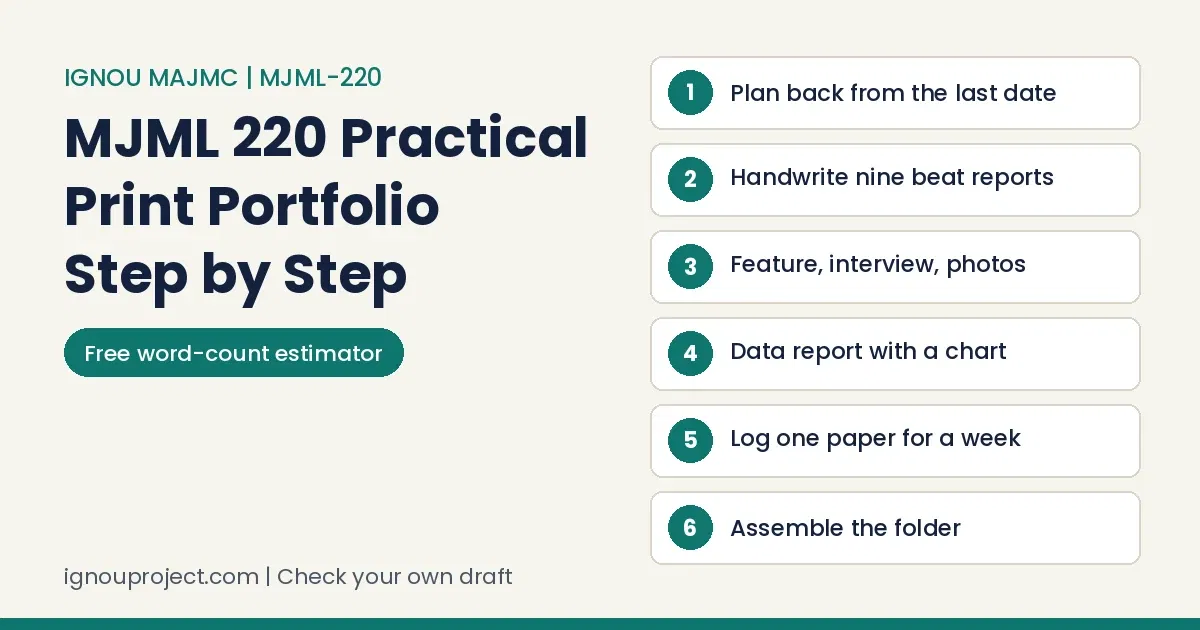
The IGNOU MJML 220 Practical is done in seven moves: read the nine-page manual, plan backwards from the last date, report and handwrite nine beat stories, add a feature and an interview, shoot four news photographs, build one data story with a printed chart, and log a week of one newspaper before you assemble the folder.
MJML-220 in a paragraph
The IGNOU MJML 220 Practical is a handwritten print portfolio of 15 items for MAJMC, marked out of 100 with no viva. Write each piece by hand within its word range, attach printed charts only to item 13, file the cover page, ID card, fee receipt and activity table first, and hand it to your study centre.
MJML-220 Practical: Print is one of three first-year IGNOU MAJMC practical courses on the programme page, with MJML-221 and MJML-023, each of 6 credits. This guide covers the work itself: what to write, in what shape and order, and how to check it.
A ten-week plan that ends before the last date
Two dates anchor the IGNOU MJML 220 Practical: the work is due at your study centre by 30 June for a June examination or by 31 December for a December one, and you may appear only a year after registration (a July 2025 admission, for instance, sits first in June 2026). Being a 6-credit course, it carries a Rs 500 practical fee, paid with your term-end form. A paid fee counts only for that one examination, so pay when the work is nearly done.
Learners who leave a file to the last weeks often find no hours left to do it themselves. In MJML-220 every story, caption and log entry is in your own hand, so the plan below starts ten weeks out.
Ten weeks, working back from the last date
| Week | Work |
|---|---|
| 1 | Read the manual and your MJM-021 and MJM-022 notes; fix the medium, the newspaper and a working notebook |
| 2 | Items 1 to 3: political, legal or court, sports |
| 3 | Items 4 to 6: health, education, local governance |
| 4 | Items 7 to 9: crime, business, lifestyle or fashion or films |
| 5 | Item 10: meet people for the feature, draft it, cut it to 700 to 1,000 words |
| 6 | Item 11 interview; item 12 photographs, shot at events you are already reporting |
| 7 | Item 13: data set, figures, chart printout, handwritten report |
| 8 | Item 15 log from Monday to Sunday; item 14 analysis written at the end of that week |
| 9 | Fair copies, word counts, captions under each print |
| 10 | Cover page, ID card, fee receipt, activity table, folder; hand in and keep a copy |
Week 1 starts around 21 April for 30 June and around 22 October for 31 December. Starting in November, write a beat story every second day and run the data report in the week of the newspaper log, which still needs one full Monday to Sunday run.
Before item 1: medium, newspaper and a working notebook
Three early choices settle much of the IGNOU MJML 220 Practical before you write a word.
- Medium. The manual names no language; MAJMC runs in English, Hindi and Tamil. Confirm yours with the study centre, then write all 15 items in it.
- The newspaper. Choose the item 15 paper now and begin on a Monday. Using the same paper for item 14 lets the week of counts support your analysis.
- A working notebook. For every story, note date, place, people, exact words and the source of every number. Rough work stays there; the portfolio gets fair copies.
- Paper. The manual sets no sheet size or binding, only a folder. Use one size of ruled sheet, number the pages, and head each piece with its item number and beat.
Many learners tell us they asked an AI tool for a draft before reading the course document, and the result did not fit. The MJML-220 manual runs to nine pages; its table of 15 items and four preparation instructions are your plan.
MJML 220 news report format, worked on a local governance story
In the IGNOU MJML 220 Practical, nine of the 15 items are beat news reports of 300 to 500 words, 5 marks each, 45 marks together. Each one reports something that happened, on its named beat, with facts you gathered.
Not knowing what shape a written piece should take is a question many learners bring to us. For MJML-220 the manual gives each report a beat and a word range but no layout, so the form comes from your first-year reporting course (MJM-021) and your print writing and editing course (MJM-022).
A standard newsroom shape that fits the MJML 220 news report format, most important facts first:
- Headline: six to ten words, present tense, naming the action.
- Byline and dateline: your name; place and date of the event.
- Intro: 30 to 40 words on who did what, when and where.
- Second paragraph: why it happened or how.
- Quotes: at least two named sources, each with role and attribution.
- Background: earlier events and figures that explain the news.
- Other side and next step: a reaction, then what happens next.
A worked beat report, item 6
Illustrative only: the ward, figures and people are invented to show structure. Do not reuse them.
| Part | What goes in | Words |
|---|---|---|
| Intro | Desilting of 14 drains in Ward 23 will finish before the monsoon, the ward councillor told residents at a meeting on Tuesday. | 40 |
| Why now | Last year’s waterlogging on two named lanes and the complaints that followed | 60 |
| Quotes | The councillor on the schedule; a resident on last year’s flooding | 80 |
| Background | Budget sanctioned, contractor, number of drains, length in metres, as stated at the meeting | 100 |
| Other side | A shopkeeper doubting the deadline; the engineer’s reply | 70 |
| Next step | Inspection date and whom residents can call | 50 |
Total: 400 words, inside the 300 to 500 range.
Across practical files, the weakest pages only list what happened; evaluators look for the method behind them. Before: “Officials held a meeting about drains.” After: an intro naming the ward, the day, the work ordered and who said it.
The frame fits every beat: a hearing for court, a match for sports, a health camp, an admission drive. On crime and court stories, report only what is on record and leave out the names of minors and victims.
Handwritten word-count estimator
Count the words on five full lines of your fair copy, then the lines the piece fills. Estimate = words on five lines, divided by 5, times the lines.
Example: 42 words on five lines across 48 lines gives about 403 words, inside 300 to 500.
How to write MJML 220 practical items 10 and 11: feature and interview
Item 10, the feature (700 to 1,000 words, 10 marks). The issue is yours to pick; choose one near you, with people you can meet. Open on one person or scene, say why the issue matters now, run three or four sections mixing voices with facts, and close on the opening person. Every claim still needs a source in your notebook.
Item 11, the interview (500 to 700 words, 10 marks). The manual names five kinds of local subject: a politician, a sports person, an artist, a social worker or an academician. Say the interview is for your IGNOU coursework, prepare ten to twelve questions, note answers as spoken and read key quotes back. Write it for a newspaper: a short introduction on who the person is and why now, then questions and answers or a narrative round the best quotes, with the date and place at the end.
Four news photographs and their captions
Item 12 of the IGNOU MJML 220 Practical asks you to click and print four photographs with news value and write their captions, using any type of camera, including a mobile phone; it carries 10 marks. A news photograph shows an event, its people and some action; shoot at events you are already reporting, so each picture has facts behind it.
- Each caption answers who, what, where and when in one or two sentences, then carries a credit line with your name.
- The manual sets no print size; use the same size for all four.
- Captions are written work, so the safe course is to write them by hand under each print.
Writing the MJML 220 data-based news report
Item 13 is the only place in the IGNOU MJML 220 Practical where a computer comes in: the 300 to 500 word report is handwritten, and at least one data visualisation is made on a computer, printed and attached to it. It carries 10 marks.
- Start with a reader’s question, such as how school enrolment in your state has changed.
- Take the figures from a government data set or one from a well-known national or international body, such as the Census of India, the Reserve Bank of India or the World Bank.
- Note publisher, title, year and table number before you copy any figure.
- Work out one or two figures. Percentage change = (new value minus old value) divided by old value, times 100. Illustrative: 1,240 rising to 1,488 is 248 divided by 1,240, times 100, which is 20 percent.
- Make the chart in a spreadsheet, label both axes, add a title and a source line, and print it.
- Build the handwritten intro on the strongest number and add a voice from someone it affects.
In many reports we see, the sources are cited in no fixed format and do not match the figures actually used. For item 13 of MJML-220, name the publisher, data set, year and table under the chart and again in the text, the same way both times.
Items 14 and 15: reading one newspaper closely
Item 14 (5 marks) is your judgement of a newspaper or magazine you like, good points and bad, with no length printed. Say why you read it, then give two or three of each, every one tied to a dated example: an exclusive, photo use, local coverage, errors or thin follow-up.
Item 15 (10 marks) is the counting task of the IGNOU MJML 220 Practical. Record name and language once, then each day’s total pages, pages for sports, business and international news, and images in the news content (photographs, cartoons, illustrations; no advertisements). Write your rule for half pages and supplements at the top.
Item 15 log, one row per day
| Day | Total pages | Sports | Business | International | Images in news |
|---|---|---|---|---|---|
| Monday | |||||
| Tuesday to Sunday | one row each, filled on the day the paper arrives | ||||
Seven mistakes in the IGNOU MJML 220 Practical and their fixes
The written pages are where practical files lose the most marks, and they are also where the loss is easiest to repair. MJML-220 has no viva-voce component, so nothing said aloud can make up for a weak or missing page.
Mistakes and what to do instead
- Typed stories. Fix: write every piece by hand; only the item 13 charts are printed from a computer.
- An essay in place of news. Fix: give the health or education piece a dated event, named sources and a news intro.
- Outside the word range. Fix: run the estimator above on every fair copy.
- A data report with no named source or no chart. Fix: publisher, data set, year and table in the text, and at least one printed visualisation attached.
- A week log written in one sitting. Logs filled in at the end give themselves away with repeated lines and days that look alike. Fix: item 15 asks for every day separately, so fill each row on the day the paper comes.
- Building to the older list. Fix: follow the MJML-220 manual; a news website, a lab journal page or a disc belongs to the MJML-120 manual, not this one.
- Borrowed photographs. Fix: click all four yourself; the manual asks you to make your own portfolio and not copy from anywhere.
When many learners draw on the same widely shared material, the same subjects keep turning up in one file after another. MJML-220 lets you choose the feature’s issue and asks for an interview with a local person, so stories from your own area keep the portfolio yours.
Put the folder together and check it
The IGNOU MJML 220 Practical goes in as one file: cover page, IGNOU identity card, MJML 220 fee receipt, the manual’s 15-activity table, then the 15 activities. The cover carries your name and enrolment number, MAJMC and MJML-220 as programme and course codes, the study centre code, the Regional Centre’s name and code, and your email, phone and address. Ask the study centre whether an ID card photocopy will do.
Many learners ask us how many copies to make and where they go. MJML-220 wants one file at your study centre (the LMS for online programmes), with a copy kept by you.
Some learners hand work in without taking any receipt. Ask the study centre for a dated acknowledgement and keep it with your copy and the Rs 500 fee receipt.
Hand-in check, sixteen points
0 of 16 checked.
Send your own draft pages for a check
If you have drafted part of the IGNOU MJML 220 Practical and want a second reader before the fair copies, send clear photos or scans of your own pages on WhatsApp at +91 93546 37830. We read each item against the manual (beat, word range, news shape, data source and chart, the seven daily rows, cover details) and send back comments; you make every change in your own hand. The check of a practical file is quoted on WhatsApp; see our services page for how our services work. IGNOU’s evaluator alone decides the marks.
FAQ: IGNOU MJML 220 Practical, questions on doing the work
Can I type the IGNOU MJML 220 Practical and print it?
No. Every written piece is handwritten. The only computer output allowed is the item 13 chart, printed and attached to its handwritten report.
Can the item 12 photographs come from a newspaper or the internet?
No. Item 12 asks you to click the four photographs yourself, and the manual warns against copying from anywhere. A mobile phone camera is fine.
Do the nine news reports have to be about real events?
Yes in practice: each is a news report on a named beat, so cover events you saw or gathered facts on, with named sources traceable to your notebook. The manual does not ask for publication.
Finishing the IGNOU MJML 220 Practical in your own hand
A finished IGNOU MJML 220 Practical is fifteen pieces of your own reporting, counted, captioned and filed in the order the manual sets, handed in before 30 June or 31 December with a copy kept at home. A score of 40 out of 100 completes the course. If you still need the theory books for MJM-021 or MJM-022, see the MAJMC first-year books on our publication site.
Official documents read for this guide
- MJML-220 Practical Manual (Practical: Print), SOJNMS
- IGNOU programme page, M.A. in Journalism and Mass Communication (MAJMC)
- IGNOU Common Prospectus July 2026: practical examination fee rules
- Programme Guide, M.A. in Journalism and Electronic Media (MAJEM)
- MJML-120 Practical Manual (Practical: Print and Online)
ignouproject.com is not affiliated with, authorised by or endorsed by IGNOU. We read and comment on the learner’s own drafts; the learner remains the author of every item in the MJML-220 portfolio.

BK Sahni iD 0009-0005-8092-459X
Founder, Shri Chakradhar Publication Pvt. Ltd. & ignouproject.com — helping IGNOU distance-learning students since 2010 (5,00,000+ students supported across MBA, MCom, MA & more). Author of IGNOU exam guides, solved assignments & project reference books.
Disclosure: Shri Chakradhar Publication Pvt. Ltd. and ignouproject.com are independent third-party study-help services — not the official IGNOU website. Always verify final dates and rules on ignou.ac.in.