How to do the IGNOU MJML 222 Practical from start to finish
The IGNOU MJML 222 Practical is done in four moves: read the MJM-031 units the manual names, pick one research topic, complete the eight activities in a sensible order, and compile them in one folder for your study centre. This guide walks through each activity with a worked example, the slips we see most, and two free tools you can use on your own file.
MJML-222 in brief
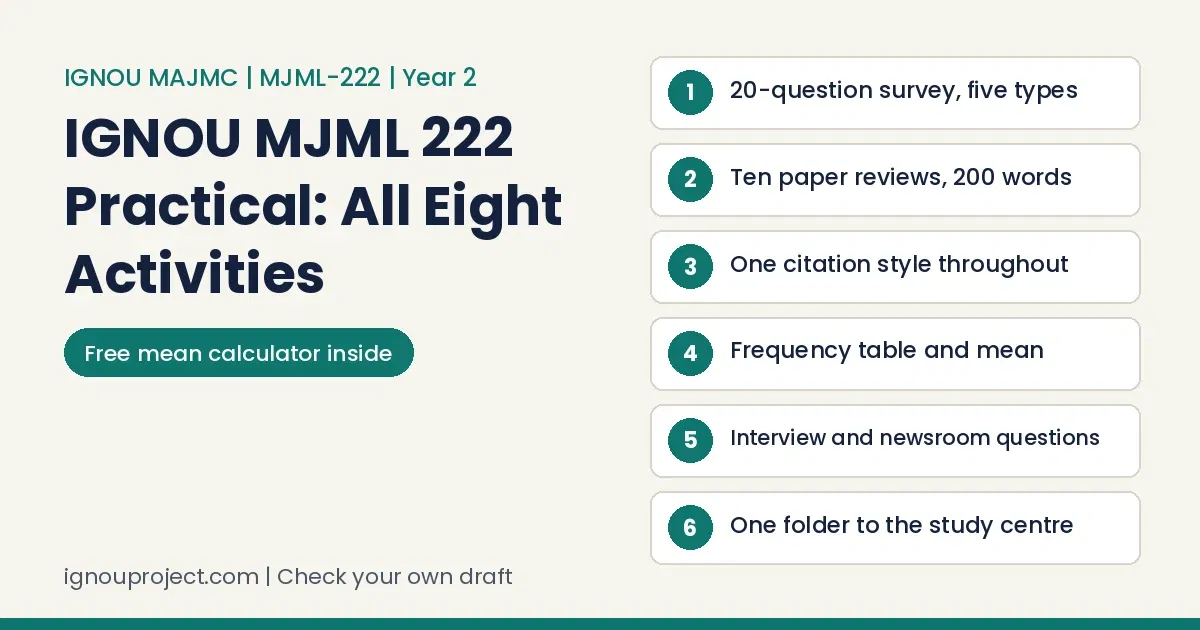
To complete the IGNOU MJML 222 Practical, write a 20-question survey questionnaire, review ten research papers, list their references, draw a sampling infographic, survey 30 people for a frequency table and mean, plan semi-structured interviews, order a research report and frame eight newsroom observation questions. Typed work is accepted; marks come from the file alone.
MJML-222 is a 6-credit MAJMC second-year course taken instead of the MJMT-021 Internship. The file is marked out of 100, with no viva; 40 percent completes the course.
An eight-week plan for the IGNOU MJML 222 Practical
The IGNOU MJML 222 Practical has two last dates a year: 30 June (June exams) and 31 December (December exams). Count eight weeks back from the date you are aiming for and give each week one block of work. Activity 5 needs other people’s time, so start collecting those answers in week one. Learners who ask us how to make MJML 222 practical work fit around a job usually need a calendar more than anything else.
Eight weeks to the last date
| Week | Work | MJM-031 unit open beside you |
|---|---|---|
| 1 | Read the units, fix your topic, start asking 30 people about social media hours | Units 4, 5, 7 |
| 2 | Activity 1, the questionnaire | Unit 7 |
| 3 and 4 | Activity 2, find and review ten papers | Unit 5 |
| 5 | Activity 3 references; activity 5 table and mean | Units 16, 14 |
| 6 | Activity 4 infographic; activity 7 report order | Units 4, 16 |
| 7 | Activity 6 interviews; activity 8 newsroom questions | Units 10, 12 |
| 8 | Compile, run the file check below, fill the exam form, hand in | None |
The fee is paid with the term-end examination form. The July 2026 prospectus charges Rs 500 for practicals above 4 credits, and MJML-222 has 6; confirm the amount your form shows. A fee counts only for the exam it was paid for, so pay when the file is nearly done.
In our records, 70 to 80 percent of learners begin work only in the final month ahead of a deadline. Against a 31 December date, that is a December start: roughly four weeks for all eight MJML-222 activities.
Practical work finished in one sitting gives itself away: the same sentences turn up again and again, and nothing improves from the first page to the last. MJML-222 has no daily log, but its eight separate activities show the same signs when they are written over one weekend.
Set up the topic and the folder before activity 1
Activities 1 and 2 of the IGNOU MJML 222 Practical each ask for a research topic of your choice, and activity 3 lists the papers from activity 2. Choosing one topic for activities 1 and 2 means your reading for the reviews also sharpens the questionnaire. Keep it narrow: “how college students in one city use YouTube for news” beats “the impact of social media”.
Then make one folder, one document per activity, and a cover page with the nine details the manual lists.
Some learners still write their research work out by hand because they assume typing is not allowed. The MJML-222 manual settles it: students may use a computer, and typed submissions are acceptable.
When many learners draw on one widely circulated sample, their files tend to share a topic too. In MJML-222 the topic is yours to choose, and the manual warns that practical work may be rejected if copying is found.
MJML 222 survey questionnaire: twenty questions, five types
The first task in the IGNOU MJML 222 Practical carries 20 marks: a questionnaire of at least 20 questions that uses all five types the manual names. Decide how many questions of each type you need before you write any of them, then write them in the order a respondent would answer: profile first, easy questions next, open questions near the end.
Twenty questions, five types (illustrative)
| Type | How many | One sample on the YouTube-news topic |
|---|---|---|
| Closed-ended | 6 | Do you watch news on YouTube at least once a week? (Yes / No) |
| Multiple-response | 3 | Which kinds of news do you watch there? Tick all that apply: politics, sports, local, business, entertainment |
| Ranking | 3 | Rank these news sources from 1 (most used) to 4: YouTube, TV, newspaper, news app |
| Rating-scale | 5 | How far do you trust news from YouTube channels? (1 = not at all, 5 = completely) |
| Open-ended | 3 | What makes you stop watching a news video before it ends? |
Ask one thing per question, avoid leading words such as “Don’t you agree”, and keep answer options from overlapping. Open with two lines on the purpose and confidentiality.
We often see research drafts produced with ChatGPT or another AI tool before the brief was read, so the result misses what the course asked for. For this questionnaire the brief is precise: at least 20 questions, covering closed-ended, open-ended, multiple-response, ranking and rating-scale types.
MJML 222 research paper review: a 200-word pattern
Activity 2 of the IGNOU MJML 222 Practical asks you to identify at least ten research papers on your topic and review each in about 200 words. Find peer-reviewed papers through Google Scholar or a library and read the full text, not only the abstract.
A 200-word review, part by part
| Part | About | What it says |
|---|---|---|
| Heading line | not counted | Authors, year and title, matching the activity 3 entry |
| Aim | 30 words | The question the paper set out to answer |
| Method and sample | 50 words | Survey, interviews, content analysis or experiment; who and how many |
| Findings | 60 words | Two or three main results, in your own sentences |
| Your comment | 60 words | A strength, a limit, and what it means for your own topic |
The comment is where a review stops being a summary: say what the paper adds to your topic or leaves open. Order the ten reviews by theme or year.
A caution on originality: reviews generated by AI and pasted in unchanged tend to read alike across learners. The manual asks every MJML-222 learner to make their own Practical File, so read each paper and write its review yourself.
Activity 3: one citation style for every reviewed paper
The reference list is worth 10 marks and covers all the papers reviewed in activity 2. The manual lets you choose any standard style, naming APA, MLA, Chicago and Harvard as examples. Pick one and apply it to every entry. In APA style, a journal article follows this pattern:
Surname, A. A., & Surname, B. B. (Year). Title of the article in sentence case. Journal Name, Volume(Issue), first page-last page. https://doi.org/number
Arrange entries alphabetically by first author, with a hanging indent. Ten reviews means ten entries.
In many reviews we read, the papers discussed and the papers listed are not the same set. MJML-222 ties the two together: the activity 3 list is for the papers reviewed in activity 2.
MJML 222 frequency table and mean, worked through
Activity 5 of the IGNOU MJML 222 Practical is a small survey of your own: put one question about daily social media hours for entertainment to at least 30 people you know, such as relatives, classmates, friends or colleagues. Fix the wording first, for example “On a normal day, how many hours do you spend on social media for entertainment?”, and note each answer with initials and date.
Answers usually come in whole or half hours. List each value once (x), count the people who gave it (f), multiply (fx), then divide total fx by total f.
Thirty answers worked through (illustrative)
| Hours (x) | People (f) | fx |
|---|---|---|
| 0.5 | 2 | 1.0 |
| 1 | 5 | 5.0 |
| 1.5 | 3 | 4.5 |
| 2 | 6 | 12.0 |
| 2.5 | 3 | 7.5 |
| 3 | 5 | 15.0 |
| 3.5 | 2 | 7.0 |
| 4 | 2 | 8.0 |
| 4.5 | 1 | 4.5 |
| 5 | 1 | 5.0 |
| Total | 30 | 69.5 |
Mean = total fx divided by total f = 69.5 / 30 = 2.32 hours a day (rounded to two decimals). These figures only show the method; your table must come from the answers you collect. If your answers spread widely, group them in classes written as “0 to under 1”, “1 to under 2” and so on, so that no value falls in two classes, then multiply each class mid-point by its frequency.
Mean and frequency table calculator
Type the hours your respondents gave, separated by commas or spaces. It builds the x, f, fx table and the mean so you can check your hand working. Nothing leaves your browser.
Activities 4 and 7: the sampling infographic and the report sequence
Activity 4 (5 marks) asks you to present the types of sampling methods through infographics. Take the list from Unit 4 and split it into two branches: probability sampling (such as simple random, systematic, stratified and cluster) and non-probability sampling (such as convenience, purposive, quota and snowball). Give each method a one-line definition, a small icon and a media example, such as picking every tenth reader from a subscriber list for systematic sampling.
Activity 7 (5 marks) asks for the major components of a research report in the correct sequence. Take the order from Unit 16, the unit the manual names. A report commonly runs from the title page and preliminary pages through the introduction, review of literature, methodology, data analysis and findings, to the conclusion, references and appendices; if Unit 16 orders or names a part differently, follow Unit 16. Number the list and add one line per part.
Activities 6 and 8: interview questions and newsroom observation
Activity 6 of the IGNOU MJML 222 Practical (15 marks) comes in two parts, in this order. First write one or two research objectives that need depth from people who know the subject. An illustrative objective: “To understand how district reporters verify information received on WhatsApp before filing a story.” Then write at least ten open questions that serve it.
- Walk me through what you do when a tip reaches you on WhatsApp.
- Which sources do you call first to confirm it, and why those?
- Tell me about a time a forward turned out to be false. What gave it away?
Plenty of research plans we see skip the objectives and go straight to questions. Activity 6 of MJML-222 asks for the research objective or objectives first, and the interview questions after them.
Activity 8 (10 marks) asks for at least eight questions you would keep in mind while observing a television newsroom. These are questions for your own eyes, so frame them around what you can watch: Who decides which story leads the bulletin, and at which meeting? How does a story move from the field reporter to the desk to air? What changes when breaking news arrives? How are visuals and facts checked before broadcast? Spread your eight across roles, news flow, deadlines, technology and verification.
Seven slips that cost marks, and the fix for each
- Twenty questions of one kind. Fix: plan the five types first.
- Reviews that copy the abstract. Fix: use the aim, method, findings and comment pattern.
- Mixed citation styles. Fix: one style for every entry.
- A mean with no working, or fewer than 30 answers. Fix: show the x, f, fx table and the division.
- Overlapping classes such as 1-2 and 2-3. A value of 2 then sits in both. Fix: write “1 to under 2”.
- Interview questions that can be answered yes or no. Fix: start with “how”, “why” or “tell me about”.
- Newsroom questions that ask for opinions. Fix: frame each around something you can see.
File check before the IGNOU MJML 222 Practical leaves your hands
Run this check on your own IGNOU MJML 222 Practical once all eight activities are in the folder; each line comes from the manual.
File check, thirteen points
Handing in the IGNOU MJML 222 Practical and following the marks
The IGNOU MJML 222 Practical goes to your study centre for evaluation; if the centre gives you trouble, the manual tells you to contact your Regional Centre. Online programme learners use the LMS, unless their Regional Centre or Programme Coordinator says otherwise. The examiner records your marks out of 100 on an award list that is sent to the Registrar, SED, IGNOU. Queries on practical marks go to practicalsed@ignou.ac.in or 011-29572212, the contacts printed in the July 2026 prospectus.
Some learners email their work to an IGNOU address in place of using the course’s route. For MJML-222 the route is the study centre, or the LMS for online programmes.
“How many copies, and where?” comes up with nearly every submission. The MJML-222 manual asks for the practical file at the study centre and a copy of the whole file kept with you.
Some learners walk away from the counter without any acknowledgement. Ask the study centre to sign or stamp a receipt for your MJML-222 file the same day.
Send your own draft for a check
If you have drafted your activities, we can review your own work: your questionnaire item by item, your paper reviews and reference list, your frequency table and mean, and the order of your file. You stay the author; we point out what to fix and why, and IGNOU’s examiner decides the marks. These checks are quoted on WhatsApp; see our services and charges page for what each service covers.
Questions learners ask while doing the practical
Can one topic carry activities 1, 2 and 3?
Yes. The manual leaves both topics to you and does not require one topic, but sharing it lets your ten papers inform your questions. Activity 3 lists the activity 2 papers either way.
How should the mean be shown in the IGNOU MJML 222 Practical?
The manual asks only for a frequency table and the mean. Show the x, f and fx columns, the two totals and the division, and round to two decimals with the unit: hours a day.
What if my study centre wants something the manual does not list?
The manual tells learners to stay in touch with their study centre and Regional Centre for updates, so ask for that requirement in writing and add it to your folder.
Finishing the IGNOU MJML 222 Practical well
A strong IGNOU MJML 222 Practical uses each MJM-031 method rather than describing it: a planned question mix, reviews that judge papers, one citation style, real data with visible working, and questions shaped by objectives. Start eight weeks out and keep your receipt and copy. For the MJM-031 study material, see the reference books for this course on our publication site.
Official documents used
- MJML-222 Practical Manual (Practical: Research Methodology), SOJNMS, available on eGyanKosh; read in November 2026 for the activity table, instructions, submission list, evaluation and the award list.
- IGNOU Common Prospectus, July 2026: MAJMC programme structure, practical examination fee and the practical marks contact.
- MAJMC Programme Guide: MJM-031 unit titles and the manual being digital only.
- IGNOU MAJMC programme page: second-year courses and credits for the IGNOU MJML 222 Practical.
ignouproject.com is not affiliated with, authorised by or endorsed by IGNOU. Our service checks and corrects the learner’s own work; the learner remains the author of every activity in the practical file.

BK Sahni iD 0009-0005-8092-459X
Founder, Shri Chakradhar Publication Pvt. Ltd. & ignouproject.com — helping IGNOU distance-learning students since 2010 (5,00,000+ students supported across MBA, MCom, MA & more). Author of IGNOU exam guides, solved assignments & project reference books.
Disclosure: Shri Chakradhar Publication Pvt. Ltd. and ignouproject.com are independent third-party study-help services — not the official IGNOU website. Always verify final dates and rules on ignou.ac.in.