IGNOU MSCPH · M.Sc. (Physics) · December 2026 term-end examination
Two-hour MPH papers, one joint sitting, fifteen exam dates: the MSCPH set built on what IGNOU actually prints
Fourteen IGNOU question papers for MPH-001 to MPH-005, compared question by question, turned into revision sets for every MSCPH theory code.
- 17 theory codes, 60 theory credits
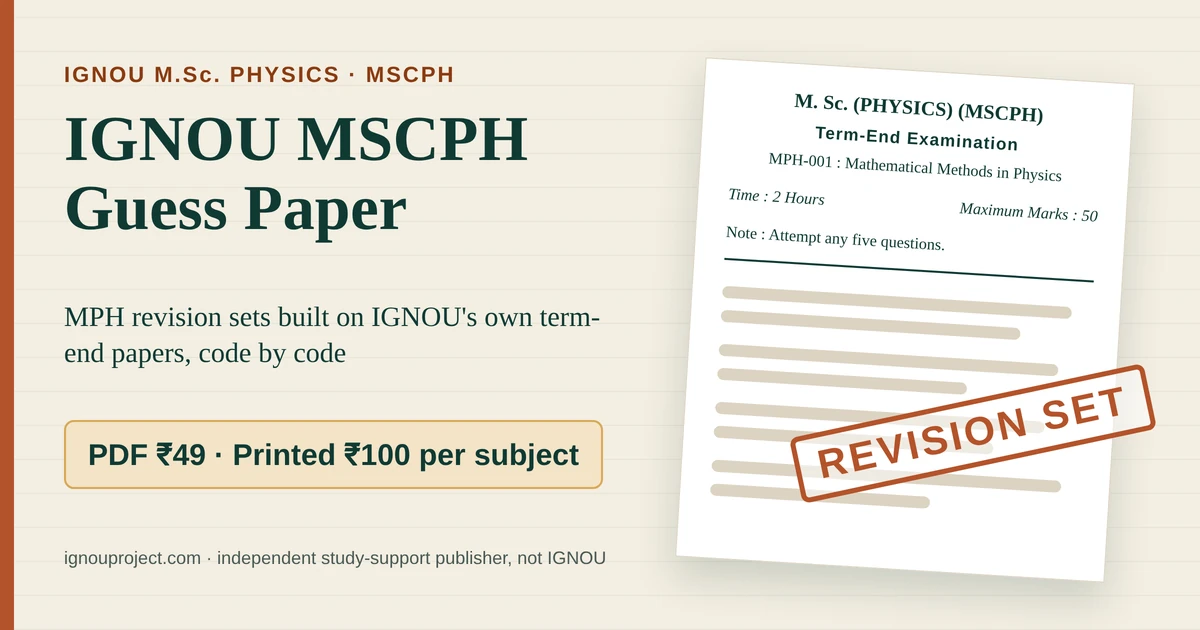
- MPH-001, 004, 005: 2 hours, 50 marks
- MPH-002 and MPH-003 share one sitting
- First paper Thu 26 Nov 2026
- Papers set in English only
- 14 IGNOU papers compared
One subject or ten, same rate per format. Send the codes from the exam form; the format is confirmed against the latest IGNOU paper before payment.
Quick answer. An IGNOU MSCPH guess paper is a revision set of recurring questions and model answers for one M.Sc. (Physics) course code, such as MPH-004 Quantum Mechanics I, built from IGNOU’s past papers and the syllabus. The December 2026 MSCPH papers run from MPH-001 on Thursday 26 November to MPHE-027 on Thursday 31 December 2026, inside IGNOU’s 25 November 2026 to 14 January 2027 cycle. MPH-001, MPH-004 and MPH-005 are 2-hour, 50-mark papers with any five of eight questions, while MPH-002 and MPH-003 share one 3-hour sitting at 25 marks and 1.5 hours each. A set costs ₹49 per subject code as a PDF or ₹100 per subject code as a printed copy, plus a one-time ₹100 courier charge per printed order. IGNOU examines MSCPH in English only, so sets are written in English, and no one outside IGNOU knows the questions in advance.
MSCPH Theory Papers in December 2026: Fifteen Dates, None Back to Back
MSCPH learners sit their first paper on Thursday 26 November 2026 and the last on Thursday 31 December 2026, per IGNOU’s date sheet for the December 2026 term-end examination, dated 30 October 2026.
First MSCPH paper
MPH-001, Thu 26 Nov 2026, morning
Last MSCPH paper
MPHE-027, Thu 31 Dec 2026, morning
Sheet dated 30 October 2026, issued without the word tentative
The 17 MSCPH theory codes fall on 15 dates, because two pairs share a sitting. No two MSCPH dates are consecutive days, so even a learner carrying Semester 1 and Semester 3 papers together gets at least one clear day between papers. Every MSCPH paper sits in the first code block of its date, which the sheet heads as the morning session, 10 AM to 1 PM; the hall ticket confirms the session for each code. IGNOU’s earlier tentative sheet dated 21 September 2026 ended the cycle on 13 January 2027; the 30 October sheet moved the last day to 14 January 2027, so any calendar built on the September file is out by a day at the end.
Semester 1 Order: MPH-001, Then the Joint Sitting, Then Quantum and Electronics
First-semester papers run Thursday 26 November (MPH-001), Tuesday 1 December (MPH-002 with MPH-003), Saturday 5 December (MPH-004) and Thursday 10 December (MPH-005). That leaves four days before MPH-004, which is the longest gap in the first-semester run and the natural place for the heaviest derivation revision. The date sheet also prints a note that MPH-002 and MPH-003 “will be held together in 3 hours duration with separate question papers and answer scripts”, and the same note covers MPH-013 with MPH-014 on Tuesday 8 December.
Why the Run Looks Like Tuesday, Thursday, Saturday
Fourteen of the fifteen MSCPH dates are a Tuesday, a Thursday or a Saturday; only MPHE-026 Elements of Reactor Physics breaks the rhythm on Monday 28 December. A learner sitting a full semester can plan revision in two-day blocks. The site’s December 2026 date-sheet page and the IGNOU exam timing guide cover centre allocation and the two daily slots.
How Much of an MPH Course Grade the Term-End Paper Carries
The term-end examination carries 70 per cent of the final course result and assignments carry the remaining 30 per cent. The MPH-001 assignment booklet for 2026 prints the 30 per cent figure for continuous evaluation, and the MPH papers themselves print no weightage line. The same booklet says the examination form for a course cannot be filled until its assignment has been submitted, so an unsubmitted MPH assignment blocks the December paper as well.
In practice the 50-mark paper decides most of each MPH grade. A learner who writes five complete 10-mark answers in MPH-004 has covered the whole paper; there is no separate short-answer section to rescue a weak long answer. The pass rule for the term-end component is stated in the Programme Guide, and the IGNOU percentage calculator converts a final grade card into a percentage once results arrive.
MPH Guess Paper Versus Past Papers Versus Solved Papers: What Each Is For
A guess paper is a publisher’s revision set of important and recurring questions for one course code, such as MPH-004 Quantum Mechanics I, with model answers, built from IGNOU’s past papers and the syllabus; the labels important questions, expected questions and model paper describe the same product. A previous year question paper is the exact paper IGNOU set in an earlier term-end examination, such as the December 2025 MPH-004 paper, and it is free on IGNOU’s website. A solved question paper is one of those IGNOU papers with a publisher’s answers added.
| Question | MSCPH guess paper | Previous year question paper | Solved question paper |
|---|---|---|---|
| What it is | A revision set of recurring questions with model answers for one MPH code | The exact paper IGNOU set in an earlier session | That exact paper with a publisher’s answers |
| Who makes it | A publisher | IGNOU | A publisher |
| Cost | ₹49 PDF · ₹100 printed, per subject code | Free on IGNOU’s website | Varies by seller |
| Good for | Last-weeks revision of recurring derivations and numericals | Learning the exact format and timing | Checking how one past paper could be answered |
| Cannot do | Predict the coming paper | Explain answers or group themes | Cover themes that paper did not ask |
For MSCPH the past papers are unusually useful, because the format has barely moved since June 2024: practise at least two of them under a 2-hour clock. The site keeps its IGNOU solved question papers collection for learners who want a past paper worked through. A set earns its place in the last fortnight, when there is no time to rebuild a theme list from fourteen PDFs.
Built on 14 IGNOU papers. Themes come from MPH papers set between June 2024 and June 2026, not from a generic syllabus list.
Two-hour timing. Answers for MPH-001, MPH-004 and MPH-005 are sized for about 22 minutes each.
Joint sitting handled. MPH-002 and MPH-003 sets are kept separate, matching the two answer books.
Derivations in steps. Each derivation is broken into numbered steps, so a partly finished answer still shows working.
Numericals with units. Matter-wave, uncertainty and circuit numericals end with a boxed value and its unit.
Group theory covered. MPH-001 sets carry a full Q8-style group theory answer, since all five papers set one.
Constants checked. Quantum numericals use standard constants and flag the h-bar line in the December 2025 paper.
Circuit diagrams. MPH-005 answers are drawn first and explained second, in the order IGNOU’s questions run.
English, as examined. Written in English, the only language IGNOU sets MSCPH papers in.
Upcoming cycle. Each set targets the December 2026 term-end examination.
Per code, no minimum. One subject or ten, same rate per format.
Two formats. ₹49 PDF · ₹100 printed, per subject code; printed orders add one ₹100 courier charge.
Semester 1 sits first: MPH-001 is on 26 November
Sets for MPH-001 to MPH-005 are matched to the latest IGNOU paper for each code.
₹49 PDF · ₹100 printed, per subject code
Get MPH-001 to MPH-005 setsSeventeen Theory Codes, 72 Credits and Three Ways IGNOU Sets an MPH Paper
MSCPH has 17 theory codes worth 60 credits, and the programme totals 72 credits once its three laboratory courses are added, per section 3.56 of the July 2026 Common Prospectus. The semester totals check out at 16, 20, 20 and 16 credits. The remaining 12 credits are laboratory work with no term-end theory paper, so no guess paper exists for them. The IGNOU Common Prospectus page is the source for every title below, and each row gives the code’s December 2026 paper date.
Semesters 1 and 2: Eight Theory Codes
| Code | Course title (July 2026 Common Prospectus) | Credits | Semester | December 2026 paper |
|---|---|---|---|---|
| MPH-001 | Mathematical Methods in Physics | 4 | 1 | Thu 26 Nov 2026, morning |
| MPH-002 | Classical Mechanics I | 2 | 1 | Tue 1 Dec 2026, morning (joint sitting with MPH-003) |
| MPH-003 | Electromagnetic Theory | 2 | 1 | Tue 1 Dec 2026, morning (joint sitting with MPH-002) |
| MPH-004 | Quantum Mechanics I | 4 | 1 | Sat 5 Dec 2026, morning |
| MPH-005 | Electronics | 4 | 1 | Thu 10 Dec 2026, morning |
| MPH-006 | Classical Mechanics II | 4 | 2 | Tue 15 Dec 2026, morning |
| MPH-007 | Classical Electrodynamics | 4 | 2 | Sat 19 Dec 2026, morning |
| MPH-008 | Quantum Mechanics II | 4 | 2 | Thu 24 Dec 2026, morning |
Swipe the table sideways on a phone.
Semesters 3 and 4: Core Codes and the Three Electives
| Code | Course title (July 2026 Common Prospectus) | Credits | Semester | December 2026 paper |
|---|---|---|---|---|
| MPH-011 | Statistical Mechanics | 4 | 3 | Sat 28 Nov 2026, morning |
| MPH-012 | Condensed Matter Physics | 4 | 3 | Thu 3 Dec 2026, morning |
| MPH-013 | Optics | 2 | 3 | Tue 8 Dec 2026, morning (joint sitting with MPH-014) |
| MPH-014 | Computational Physics | 2 | 3 | Tue 8 Dec 2026, morning (joint sitting with MPH-013) |
| MPH-016 | Atomic and Molecular Physics | 4 | 4 | Sat 12 Dec 2026, morning |
| MPH-017 | Nuclear and Particle Physics | 4 | 4 | Thu 17 Dec 2026, morning |
| MPHE-025 | Materials Science | 4 | 3 or 4 | Tue 22 Dec 2026, morning |
| MPHE-026 | Elements of Reactor Physics | 4 | 3 or 4 | Mon 28 Dec 2026, morning |
| MPHE-027 | Nanoscience | 4 | 4 | Thu 31 Dec 2026, morning |
Swipe the table sideways on a phone.
Semester 3 takes one elective from MPHE-025 and MPHE-026; Semester 4 takes two of MPHE-025, MPHE-026 and MPHE-027, without repeating the Semester 3 choice. That is why MPHE-025 and MPHE-026 appear under both semesters in the prospectus.
Paper Anatomy, Code by Code
MPH-001, MPH-004 and MPH-005 are 2-hour, 50-mark papers in which candidates attempt any five of eight questions at 10 marks each, and IGNOU kept that format in all 11 papers of those three codes compared from June 2024 to June 2026. The 4-credit label does not mean a 3-hour, 100-mark paper here. The joint MPH-002 and MPH-003 sitting works differently: two 25-mark papers of 1.5 hours each, with internal choice rather than an any-five rule.
| Code | Latest IGNOU paper | Time, marks | Attempt rule | Note on the paper | Language |
|---|---|---|---|---|---|
| MPH-001 | June 2026 | 2 hours, 50 | Any five of eight, 10 marks each | Non-programmable calculator named since December 2025 | English |
| MPH-004 | December 2025 | 2 hours, 50 | Any five of eight, 10 marks each | Physical constants printed at the end | English |
| MPH-005 | June 2025 | 2 hours, 50 | Any five of eight, 10 marks each | Calculator allowed; circuit and block diagrams expected | English |
| MPH-002 | June 2025 | 1.5 hours, 25 (Part A of a 3-hour sitting) | Four compulsory questions, each with an either-part choice: 5, 5, 5 and 10 marks | Separate answer book from MPH-003 | English |
| MPH-003 | June 2025 | 1.5 hours, 25 (Part B of a 3-hour sitting) | Q1 any three of five parts at 5 marks; Q2 one of two at 10 marks | Separate answer book from MPH-002 | English |
Swipe the table sideways on a phone.
Disagreements and Archive Slips to Know About
Where IGNOU’s own files disagree, and what that means for revision
- MPH-003 has no file of its own. The joint paper is filed as MPH-002-MPH-003 for June and December 2024 and as MPH-002 for June 2025; IGNOU’s December 2025 session list shows MPH-002 and MPH-013-MPH-014 but no separate MPH-003 entry.
- Constants line, December 2025 MPH-004. The constants list prints 1.015 × 10⁻³⁴ J s on the h-bar line, where the June 2024, December 2024 and June 2025 papers print 1.05 × 10⁻³⁴ J s. The accepted value is about 1.055 × 10⁻³⁴ J s.
- Spelling slips. The June 2024 MPH-004 paper asks for the “concertainty principle” in Q1(b), and the June 2024 MPH-003 paper prints “forque” for torque.
- Two programme names on one course. MPH-004 papers for 2024 are headed “Master’s Degree Programme in Physics”; the 2025 papers say “M. Sc. (Physics)”. Both are MSCPH.
- Calculator wording changed. MPH-001 papers up to June 2025 said a calculator may be used; the December 2025 and June 2026 papers specify a non-programmable calculator.
- Prospectus wording. The prospectus fee table lists the examination mode as year-wise, while the programme details run four semesters with semester-wise theory papers.
- On this site. ignouproject.com has no separate MPH code pages and no programme page for MSCPH yet, and the guess paper hub does not list MPH sets; this page is the MSCPH reference until those exist.
Fourteen MPH Papers Side by Side: The Questions IGNOU Keeps Setting
Every MPH-001 paper from June 2024 to June 2026 closed with a group theory question as Q8, and every MPH-004 paper from June 2024 to December 2025 opened Q1 with an uncertainty-principle estimate beside a matter-wave numerical. Those are the two firmest patterns in IGNOU’s MSCPH archive. ignouproject.com compared 14 IGNOU MSCPH papers question by question on 6 November 2026; the counts below say how many of those papers carried each theme, with the question numbers.
MPH-001: Question 8 Has Been Group Theory Five Times Out of Five
Five broad MPH-001 themes appeared in all five papers: group theory, contour integration by residues, Laplace transforms, separation of variables and the special functions. The group theory question moved from permutation tables in June 2024 to equivalence classes in December 2025 and the S3 multiplication table in June 2026, but it never left Q8.
| Theme | June 2024 | December 2024 | June 2025 | December 2025 | June 2026 | n of N |
|---|---|---|---|---|---|---|
| Group theory (permutations, S3, Abelian or unitary groups, subgroups) | Q8 | Q8 | Q8 | Q8(b) | Q8 | 5 of 5 |
| Residue theorem or contour integration | Q6 | Q5 | Q5(a) | Q7 | Q5 | 5 of 5 |
| Laplace transform: initial value problem or inverse | Q7(a) | Q7 | Q6(b) | Q8(a) | Q6(b) | 5 of 5 |
| Separation of variables (Helmholtz, wave, Laplace or heat equation) | Q2(a) | Q2(a) | Q2 | Q1 | Q1(a), Q7 | 5 of 5 |
| Bessel, Legendre or Hermite functions from a generating function or series | Q1, Q2(b) | Q1, Q2(b) | Q1 | Q2, Q3 | Q1(b), Q2 | 5 of 5 |
| Eigenvectors and diagonalisation of a symmetric matrix | Q4 | Q3(b) | none | Q5(a) | Q4(a) | 4 of 5 |
| Fourier transform | Q7(b) | Q6(b) | Q7 | none | Q6(a) | 4 of 5 |
| Basis or linear independence of vectors | Q3(a) | none | Q3(a) | Q4(a) | Q3 | 4 of 5 |
| Harmonic function or Cauchy-Riemann equations | Q5 | none | Q4(b) | Q5(b) | none | 3 of 5 |
| Gamma function value | none | none | none | Q6(a) | Q4(c) | 2 of 5 |
MPH-004: Q1 Opens With Uncertainty and Matter Waves Every Time
MPH-004 is the most repetitive MSCPH paper compared. Six themes appeared in all four papers, and Q3 was a one-dimensional potential problem each time: a step in June 2024, a barrier in December 2024, a symmetric infinite well in June 2025 and a finite well in December 2025.
| Theme | June 2024 | December 2024 | June 2025 | December 2025 | n of N |
|---|---|---|---|---|---|
| Uncertainty-principle estimate (atom size, zero-point or minimum energy) | Q1(b) | Q1(b) | Q1(a) | Q1(b) | 4 of 4 |
| Matter waves: de Broglie wavelength, wave velocities or diffraction | Q1(a) | Q1(a) | Q1(b) | Q1(a) | 4 of 4 |
| One-dimensional potential: step, barrier, infinite or finite well | Q3 | Q3 | Q3 | Q3 | 4 of 4 |
| Simple harmonic oscillator | Q4, Q7 | Q4 | Q4, Q7 | Q5, Q7(b) | 4 of 4 |
| Spherically symmetric potential, rigid rotator or hydrogen | Q5 | Q5 | Q5 | Q4 | 4 of 4 |
| Angular momentum and spin | Q5, Q8 | Q2(b), Q8 | Q8 | Q8 | 4 of 4 |
| Hermitian operators, spectral form or projection operators | Q6(a) | none | Q2(a), Q6(b) | Q6(c) | 3 of 4 |
| Potential V(x) found from a given wave function | none | none | Q2(b) | Q2(a) | 2 of 4 |
| Stern-Gerlach experiment | none | Q8 | none | Q8(b) | 2 of 4 |
MPH-002 and MPH-003: Collisions, Orbits, Gauss and Dielectrics
Across the three joint papers, MPH-002 set a collision, a constrained Lagrangian, a central-force problem and a small-oscillation matrix question every time, and MPH-003 set a Gauss’s law field and a dielectric polarisation question every time. Three papers is a small base, and the internal choice means a learner never has to answer all of them.
| Theme | June 2024 | December 2024 | June 2025 | n of N |
|---|---|---|---|---|
| MPH-002: collision problem | Q2(b) | Q1(a) | Q1(a) | 3 of 3 |
| MPH-002: Lagrangian of a bead, rod or rolling cylinder | Q2(a) | Q3(a) | Q2(a) | 3 of 3 |
| MPH-002: central force, orbit, virial theorem or effective potential | Q3 | Q2(b), Q4(a) | Q3(b), Q4(b) | 3 of 3 |
| MPH-002: small oscillations with T and V matrices | Q4(b) | Q4(a) | Q4(a) | 3 of 3 |
| MPH-002: constraints, holonomic and non-holonomic | Q1(b) | none | Q1(b) | 2 of 3 |
| MPH-003: Gauss’s law for a line charge, cylinder or coaxial wires | Q1(a) | Q1(a) | Q1(a) | 3 of 3 |
| MPH-003: dielectric polarisation and bound charge | Q1(c) | Q1(b) | Q1(c), Q2(a) | 3 of 3 |
| MPH-003: Poisson’s equation for a line charge | Q1(b) | none | Q1(b) | 2 of 3 |
| MPH-003: magnetic vector potential | none | Q1(d) | Q2(b) | 2 of 3 |
| MPH-003: wave equation from Maxwell’s equations | none | Q1(e) | Q1(e) | 2 of 3 |
MPH-005: The Question Order Follows the Course Blocks
The two MPH-005 papers compared, June 2024 and June 2025, ran in the same order: devices in Q1 and Q2, amplifiers and op-amps in Q3 and Q4, power supplies in Q5, special circuits in Q6, converters in Q7 and microprocessors in Q8.
| Theme | June 2024 | June 2025 | n of N |
|---|---|---|---|
| Power diode | Q1(a) | Q1(a) | 2 of 2 |
| Op-amp circuits (feedback, precision rectifier, offset, Schmitt trigger) | Q4 | Q4 | 2 of 2 |
| Regulated supply (Zener shunt regulator; SMPS and buck converter) | Q5 | Q5 | 2 of 2 |
| PLL and op-amp astable multivibrator | Q6 | Q6 | 2 of 2 |
| Data converters (DAC resolution; successive-approximation ADC) | Q7 | Q7 | 2 of 2 |
| Microprocessor or microcontroller (8085 registers; 8051 and 8085) | Q8 | Q8 | 2 of 2 |
How the Counts Were Taken
The theme tables cover MPH-001, MPH-002, MPH-003, MPH-004 and MPH-005. Each count comes from IGNOU’s own files: five MPH-001 papers (June 2024 to June 2026), four MPH-004 papers (June 2024 to December 2025), three joint MPH-002 and MPH-003 papers (June 2024 to June 2025) and two MPH-005 papers (June 2024 and June 2025), each compared question by question by ignouproject.com on 6 November 2026. Matching is done at theme level and is a human judgement: a question on Hermite polynomials and one on Bessel functions both count as special functions. A count is never a probability. IGNOU’s June 2026 question paper page showed no files when checked, although a June 2026 MPH-001 paper is posted, and the December 2025 question paper page lists the December 2025 MSCPH files. For other MSCPH codes, the format is confirmed against the latest IGNOU paper on WhatsApp before a set is sent.
| Code | IGNOU files, by session | N |
|---|---|---|
| MPH-001 | MPH-001 June 2024, MPH-001 December 2024, MPH-001 June 2025, MPH-001 December 2025, MPH-001 June 2026 | 5 |
| MPH-004 | MPH-004 June 2024, MPH-004 December 2024, MPH-004 June 2025, MPH-004 December 2025 | 4 |
| MPH-002 and MPH-003 | combined paper, June 2024, combined paper, December 2024, combined paper, June 2025 (filed as MPH-002) | 3 |
| MPH-005 | MPH-005 June 2024, MPH-005 June 2025 | 2 |
How an MSCPH Set Is Written: Derivations First, Then Timing
- Check the latest IGNOU paper for the code. For MPH-001 that is June 2026; for MPH-004, December 2025. If the format has changed, the set follows the new one.
- List the themes with their counts. A theme that came in 5 of 5 papers gets a full model answer; one seen once gets a short note.
- Write derivations in numbered steps. Each step carries one idea, so the answer still earns marks if the final line runs out of time.
- Size every answer to the clock. A 10-mark answer in a 2-hour paper is written to fit about 22 minutes; a 5-mark MPH-003 part to about 17.
- Confirm the code and format on WhatsApp. The code is checked against the exam form before the PDF is shared or a printed copy is dispatched.
The Honest Reach of an MSCPH Set in a Derivation-Heavy Exam
A guess paper is a revision aid built from past IGNOU question papers and the syllabus. No one outside IGNOU knows the questions in advance, and no claim is made that any question in this set will appear in your examination.
Jobs a Set Does Well
A set shortens the route to the derivations IGNOU sets again and again: the S3 table for MPH-001 Q8, the oscillator ladder-operator steps for MPH-004, the T and V matrices for MPH-002. It also fixes timing, because every answer is written to the minutes a 2-hour or 1.5-hour paper allows.
Jobs Only the Blocks Can Do
A set cannot teach a method a learner has never met; a first contact with Hilbert-space notation belongs in the MPH-004 block, not in a revision PDF. It cannot cover a question IGNOU has not set before, and two MPH-005 papers are too few to promise that the block order will hold. Study the official IGNOU material for every course you are sitting; a guess paper supplements that material and does not replace it.
Revise it free first
The MSCPH blocks are free on eGyanKosh, and the Gyankosh guide gives the same blocks by another route. The IGNOU last-year papers cover past papers across programmes, the IGNOU study notes collect summaries, and the free IGNOU book downloads link to course books. A learner with three weeks and both past papers solved may need nothing else.
Free MSCPH Tools: Plan the Fifteen Dates, Then Time a Two-Hour Paper
Both tools run in the browser and use the 30 October 2026 date sheet and the paper formats in the tables above; nothing typed leaves the page.
Free tool 1
MSCPH Fifteen-Date Planner
Between 0.5 and 16, in steps of 0.5.
Send this paper plan on WhatsApp₹49 PDF · ₹100 printed, per subject code
This tool is guidance from ignouproject.com, not an IGNOU rule. Using it creates no obligation to order anything.
Free tool 2
MPH Ten-Mark Answer Clock
Pick the code; the clock uses the latest IGNOU paper format for it.
0 to 30 minutes. Leave blank for the default: 10 for a 2-hour paper, 5 for a 1.5-hour paper.
Ask for the set for this MPH code₹49 PDF · ₹100 printed, per subject code
This tool is guidance from ignouproject.com, not an IGNOU rule. Using it creates no obligation to order anything.
Second-year codes start on 28 November with MPH-011
Semester 3 and 4 sets cover MPH-011 to MPH-017 and the three MPHE electives.
₹49 PDF · ₹100 printed, per subject code
Order Semester 3 and 4 MPH setsWhere IGNOU Files MPH Papers, and Why MPH-003 Is Hard to Find
IGNOU posts MSCPH papers in three places: the older webservices archive (June 2024 papers sit under SOS, then MSCPH), session folders such as qpjune2025 and qpdec2025 on ignou.ac.in, and a general downloads folder that held the December 2024 papers without a session in the address. Always confirm the session printed on page 1.
- Open the session page on ignou.ac.in under Student Support, Downloads, Question Papers, and pick June or December of the year.
- Search the code with its hyphen, for example MPH-004. For MPH-003, search MPH-002 instead: the joint paper carries both.
- Check the header: the session, the code and the time line (2 hours for MPH-001, MPH-004, MPH-005; 3 hours for the joint paper).
- Check the date sheet for the coming cycle and its date line; the 30 October 2026 file replaced the 21 September one.
The IGNOU date sheet guide and the IGNOU hall ticket page explain the general routes for other programmes; the exam fee page carries the exam fee for a December sitting, and the online exam fee guide covers paying it online.
From Hall Ticket to Grade Card: The MSCPH Paperwork Around December
The hall ticket for the December 2026 cycle is issued before 25 November; the hall ticket download steps walks through the enrolment-number login. After the last MPH paper, term-end marks appear on IGNOU’s result portal, and the IGNOU result guide explains the session-wise release. Assignment marks show separately in the assignment result and grade card tracker, and the June 2026 result page covers recent result cycles in one place.
A learner unhappy with an MPH mark can apply through the re-evaluation process, then track the final grade card once every course is cleared. The IGNOU CGPA calculator converts grades for applications that ask for one.
MSCPH Assignments, Books and Notes That Pair With a Set
Most MSCPH learners pair a revision set with the assignment, because the booklet blocks the exam form until it is submitted. The IGNOU solved assignments covers typed answers, and the assignment cover page template shows the front page IGNOU expects. Printed course help is in the IGNOU guide books online and the IGNOU help books. Laboratory courses MPHL-009, MPHL-010 and MPHL-015 are handled at the Learner Support Centre, and the services and charges page lists other services and their charges.
Which Language the MPH Papers Use, and Which Session a Set Targets
Each set is prepared for the upcoming term-end examination, in every medium IGNOU examines that course in, and the medium for your course code is confirmed on WhatsApp before you pay. For MSCPH that medium is English: the July 2026 Common Prospectus lists English as the medium of instruction, and none of the 14 MPH papers compared carries a Hindi version. The current sets target the December 2026 cycle; a set prepared for June 2026 is not sent for a December sitting.
How an MSCPH Order Works: Two Prices, One Courier Charge, Next-Day Dispatch
The rate is ₹49 per subject code for a solved guess paper as a PDF, or ₹100 per subject code as a printed copy. Printed copies carry a one-time courier charge of ₹100 per order, whatever the number of subject codes; the PDF has no courier charge. The PDF is shared on WhatsApp once payment is confirmed. A printed copy is dispatched the next day after payment is confirmed, and the courier details are shared on WhatsApp. No arrival date is promised, because transit time depends on the courier and your location. There is no minimum order: one subject or ten, same rate per format.
- Send the MPH codes from the exam form to +91 93546 37830 on WhatsApp.
- Say PDF or printed; for printed, add the postal address with PIN code.
- The code, format and English medium are confirmed against the latest IGNOU paper.
- Pay the quoted total: for example four Semester 1 codes come to ₹196 as PDFs, or ₹400 printed plus ₹100 courier, ₹500 in all.
- Receive the PDF on WhatsApp, or the courier details after next-day dispatch.
₹49 PDF · ₹100 printed, per subject code
Start an MSCPH order on WhatsAppThe Three Kinds of Source on This MSCPH Page, and the Reviewer
IGNOU documents. Course codes, titles, credits and medium come from section 3.56 of the July 2026 Common Prospectus, and every paper format and question number comes from the 14 IGNOU MSCPH papers listed in the evidence section. Dates come from IGNOU’s 30 October 2026 date sheet, checked against the 21 September 2026 tentative sheet. The weightage and exam-form rule come from the MPH-001 assignment booklet for 2026.
Analysis by ignouproject.com. The theme counts, the minutes per answer and the observations on IGNOU’s file names are ignouproject.com’s own reading of those documents, compared question by question on 6 November 2026. Theme matching is a judgement, and the morning session is taken from each code’s column position on the sheet.
Commercial terms. Prices, courier charge, dispatch and medium policy are the publisher’s own terms and are not IGNOU’s.
MSCPH Guess Paper Questions, Answered Briefly
An IGNOU MSCPH guess paper is a revision set of recurring questions with model answers for one MPH course code. It costs ₹49 per subject code as a PDF or ₹100 per subject code as a printed copy, plus a one-time ₹100 courier charge per printed order. Sets are written in English.
The first MSCPH paper is MPH-001 Mathematical Methods in Physics on Thursday 26 November 2026, and the last is MPHE-027 Nanoscience on Thursday 31 December 2026, according to IGNOU’s date sheet dated 30 October 2026. The full December cycle runs from 25 November 2026 to 14 January 2027.
The MPH-001 paper runs 2 hours for 50 marks: candidates attempt any five of eight questions at 10 marks each. All five MPH-001 papers from June 2024 to June 2026 kept this format, and every one of them set a group theory question as Q8.
MPH-002 and MPH-003 are two separate papers written in one 3-hour sitting. Each carries 25 marks and 1.5 hours, with a separate answer book, per IGNOU’s date sheet note and the June 2024, December 2024 and June 2025 combined papers. A learner registered for only one answers only that part.
Six MPH-004 themes appeared in all four papers from June 2024 to December 2025: an uncertainty-principle estimate, a matter-wave numerical, a one-dimensional potential as Q3, the harmonic oscillator, a spherically symmetric problem and angular momentum or spin. Topic matching is a judgement made by ignouproject.com.
No. A previous year question paper is the exact paper IGNOU set in an earlier session and is free on IGNOU’s website. A guess paper is a publisher’s revision set built from those papers and the syllabus. It is not an IGNOU document and its questions are not IGNOU’s.
IGNOU’s past MPH papers come first, because they are free and show the real format. A guess paper helps when time is short, because it groups the recurring themes and gives worked model answers. Many learners use both: past papers for format, a set for revision.
No. IGNOU examines MSCPH in English only: the July 2026 Common Prospectus lists English as the medium, and all 14 MPH papers compared from June 2024 to June 2026 are English-only. A Hindi set would not match the paper, so MSCPH sets are prepared in English.
MPH-003 papers sit inside the combined MPH-002 file on IGNOU’s website. The June 2025 paper is filed as MPH-002.pdf, and IGNOU’s December 2025 session list shows MPH-002 but no MPH-003 entry. Searching the MPH-002 code finds both parts.
No one outside IGNOU knows the MSCPH questions in advance. A set is built from the themes IGNOU has set repeatedly, so it trains the answer types that recur. It does not reproduce a future paper, and no claim is made that any question will appear.
A printed MSCPH set is dispatched the next day after payment is confirmed, and the courier details are shared on WhatsApp. The PDF is shared on WhatsApp once payment is confirmed. No arrival date is promised, because courier transit depends on the location.
Usually not in the first term-end cycle. The July 2026 Common Prospectus says theory papers of the first and second semesters can first be taken one year after admission, and every six months after that. Check the exam form window for your enrolment.
In a 2-hour, 50-mark MPH paper, five 10-mark answers leave about 22 minutes each after 10 minutes of reading and choosing. Choose the five questions in the first 10 minutes, then hold to 22 minutes per answer. The free answer clock on this page does the arithmetic.
The June 2024 and June 2025 MPH-005 papers followed the same order: power diodes in Q1, op-amp circuits in Q4, power supplies in Q5, PLL and astable circuits in Q6, data converters in Q7 and microprocessors in Q8. Two papers is a small base, so the order is a pattern, not a rule.
IGNOU’s 30 October 2026 sheet replaced the tentative sheet dated 21 September 2026 and no longer carries the word tentative. It moved the last day of the cycle to 14 January 2027. The hall ticket remains the final word on centre and date.
Check five things in any MSCPH set: the current MPH code, the current 2-hour or joint-sitting format, the session it targets, answers written in exam form, and whether the seller claims accuracy. A percentage claim about questions coming is a reason for caution, because nobody can measure it.
Assignments carry 30 per cent and the term-end examination carries 70 per cent of each MSCPH course result. The MPH-001 assignment booklet for 2026 prints the 30 per cent figure and says the exam form for a course cannot be filled until its assignment is submitted.
Important Notice
ignouproject.com is an independent IGNOU study-support publisher. It is not the official website of Indira Gandhi National Open University, is not affiliated with, endorsed by or authorised by the university, and no page on this site should be treated as an official IGNOU communication.
Programme structures, course codes, examination dates, question-paper patterns and rules change, and only ignou.ac.in and your Regional Centre can confirm the current position for your enrolment.
A guess paper is a revision aid built from past IGNOU question papers and the syllabus. No one outside IGNOU knows the questions in advance, and no claim is made that any question in this set will appear in your examination.
Study the official IGNOU material for every course you are sitting; a guess paper supplements that material and does not replace it.
No claim is made about the marks you will receive, about how an evaluator will assess your answers, or about your result. Examination and evaluation are entirely a matter for IGNOU.
Fifteen MSCPH dates, one set per code
Send the MPH and MPHE codes from the exam form; each set is matched to the latest IGNOU paper for that code.
WhatsApp +91 93546 37830 · Written and reviewed by BK Sahni

BK Sahni iD 0009-0005-8092-459X
Founder, Shri Chakradhar Publication Pvt. Ltd. & ignouproject.com — helping IGNOU distance-learning students since 2010 (5,00,000+ students supported across MBA, MCom, MA & more). Author of IGNOU exam guides, solved assignments & project reference books.
Disclosure: Shri Chakradhar Publication Pvt. Ltd. and ignouproject.com are independent third-party study-help services — not the official IGNOU website. Always verify final dates and rules on ignou.ac.in.