How to complete the IGNOU MJML 221 Practical, start to finish
The IGNOU MJML 221 Practical is the audiovisual practical of the MAJMC first year: ten production activities, some handwritten and some recorded, put together in one file with a CD, DVD or pen drive and marked out of 100. Below, each stage comes in the order that wastes least time.
MJML-221 in four lines
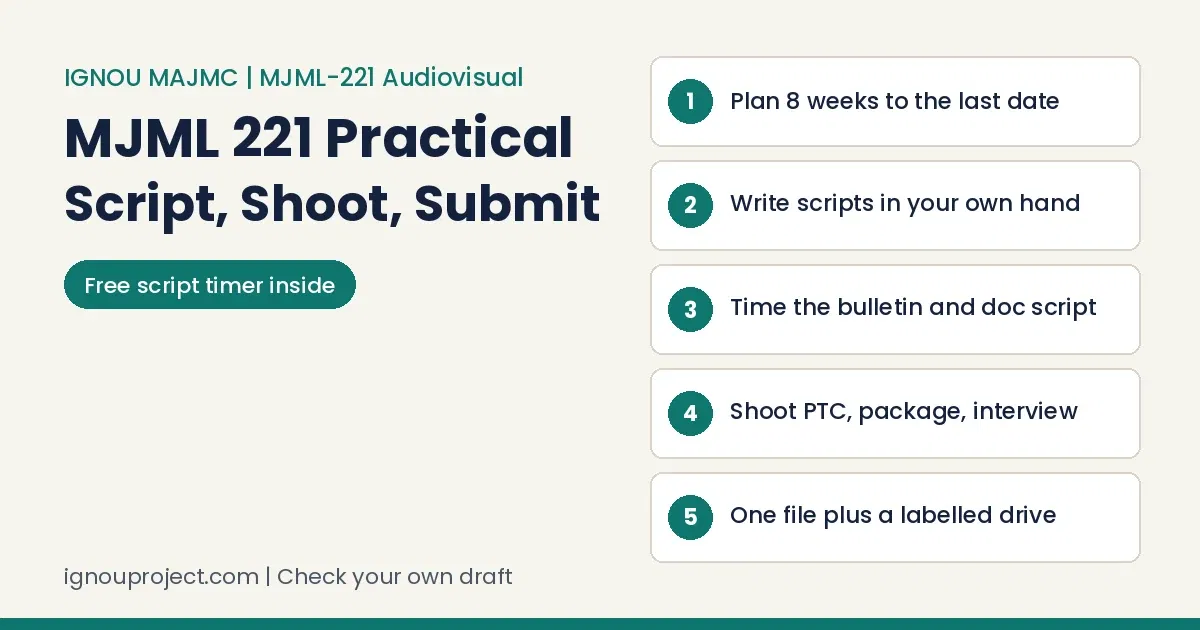
To finish the IGNOU MJML 221 Practical, handwrite items 1 to 4, 6 and 10, script and record item 5, record items 7, 8 and 9, place all ten in one file with a labelled drive, and hand it to your study centre by 30 June or 31 December. You need 40 of 100.
MJML-221 carries 6 credits and is one of three first-year practicals in MAJMC (with MJML-220 Print and MJML-023 Digital Media), of which the prospectus asks you to choose any two. The same prospectus lists MJML-221 in the PGJMC structure too. There are no face-to-face classes and no attendance rule.
Across practical courses, learners often arrive holding three task lists at once: a counsellor’s, a senior’s and an online sample’s. For this course, work only from the MJML-221 Practical Manual and any notice your own study centre issues; where an old sample differs, the manual decides.
Eight production weeks, counted back from the last date
Plan the IGNOU MJML 221 Practical backwards from your target date. The manual gives two last dates a year, 30 June for the June term-end examination and 31 December for the December one, and a floor: you can appear only after one year from registration (its example: January 2025 admission, December 2025 at the earliest).
The same pattern returns every cycle: in our records, between 70 and 80 percent of students only get going in the final month before a submission date. A re-shoot needs daylight, the location and the person you filmed, so give MJML-221 eight weeks.
Eight weeks, one block of work each
| Week | Work | Done when |
|---|---|---|
| 1 | Read the manual twice; pick topics for all ten items; list people to film | One page of topics and names |
| 2 | Rough drafts of items 1 to 4 | All four inside their limits |
| 3 | Research item 10; gather news and bites for item 6 | Both read aloud and timed |
| 4 | Write and record item 5 | Best take saved |
| 5 | Shoot and edit item 9 | A 2-minute export that plays |
| 6 | Make item 7; record and edit item 8 | Both files at the right length |
| 7 | Fair-copy every written item by hand; copy files to the drive | Drive tested on another computer |
| 8 | Fee receipt, cover page, activity table, assembly, submission | Acknowledgement in hand |
The fee is paid with the term-end examination form, and the manual warns it is valid only for the examination it was paid for, so pay in the cycle you will finish. The slab is in the IGNOU Common Prospectus, July 2026.
Learners regularly ask us whether this practical costs Rs 300 or Rs 500. The prospectus charges Rs 300 up to 4 credits and Rs 500 above 4 credits; MJML-221 has 6 credits, so it is Rs 500.
Kit and setup before the first recording
You do not need a studio for the IGNOU MJML 221 Practical. Most questions about how to make MJML 221 practical recordings look and sound clean come down to a few habits, set once for items 5, 7, 8 and 9.
- Phone: landscape, at the subject’s eye level, light falling on the face rather than from behind.
- Sound: a quiet room, the microphone within arm’s length, fans off.
- Steady shots: a table, a stack of books or a small tripod; hold each shot ten seconds.
- Editing: any free editor that cuts clips, adds a title and exports MP4.
- Paper and drive: sheets for handwritten fair copies, and a drive kept for MJML-221 only, backed up.
A question we hear often is whether a viva applies. The MJML-221 manual says evaluation has no viva-voce component and all 100 marks come from the portfolio, yet it also asks you to keep your audio and video files ready to show. The safe reading: keep every file playable, with a second copy at home.
Writing the four short pieces (items 1 to 4)
The four short written pieces of the IGNOU MJML 221 Practical carry 5 marks each. Stay inside each word limit and draft before the fair copy.
- Item 1, two radio public service announcements (up to 150 words each). Write for the ear: one idea, short sentences, the call to action said twice. Put speakers and sound effects (SFX) on separate lines; take two different contemporary issues.
- Item 2, film review (400 to 600 words). A recent film or an Indian classic: verdict, context, the story without the ending, two or three craft points each tied to a scene, and a judgement.
- Item 3, your favourite TV news anchor (300 to 500 words). The manual asks for your reasons, so reasons carry the piece. Back each with something you saw on air.
- Item 4, documentary analysis (400 to 600 words). One seen or heard this year on radio, TV or online: title and platform, subject, then strengths and weaknesses under separate headings.
Many learners get a first draft from ChatGPT or a similar AI tool before reading the course document, and the plan then misses what the item asks for: a review with no scene, an anchor piece with no reasons, an analysis with no weaknesses. Read the item line in the MJML-221 manual first, then write your own draft.
MJML 221 radio news bulletin: a five-minute running order (item 6)
Item 6 asks for a radio news bulletin script of about 600 words or 5 minutes with at least three sound bites, for 10 marks. It is written work; you hand in the script, not a recording. Pairing 600 words with 5 minutes gives a reading pace of about 120 words a minute, the pace to plan with.
Worked bulletin: five minutes, three bites
| Slot | Time | Words | Content (illustrative) |
|---|---|---|---|
| Opening and headlines | 0:00 to 0:30 | 60 | Station name, date, three headlines |
| Story 1 with bite 1 | 0:30 to 1:40 | 140 | Ward water supply shut for repairs; a resident speaks |
| Story 2 with bite 2 | 1:40 to 2:50 | 140 | Hospital OPD timings change; a hospital spokesperson speaks |
| Story 3 | 2:50 to 3:30 | 80 | State news, newsreader only |
| Story 4 with bite 3 | 3:30 to 4:20 | 100 | School athletics meet; a coach speaks |
| Weather and close | 4:20 to 5:00 | 80 | Forecast, headlines again, sign-off |
| Total | 5:00 | 600 | Three bites |
The table shows layout only; use real news from your area that week. Write each bite as a cue block (speaker and designation, duration, first three and last three words, then the words spoken), and take bites only from people you actually spoke to. Present tense, main fact first, numbers rounded for the ear, source before the claim.
Script timing calculator
Enter your word count; the default pace is the manual’s 600 words in 5 minutes.
600 words at 120 a minute run about 5 min 0 sec.
Targets: item 6 about 600 words; item 1 up to 150 words a PSA (about 75 seconds); item 10 narration well below 600 words.
Item 5: write the PTC, then record it on your phone
Item 5 of the IGNOU MJML 221 Practical (10 marks) has two parts, a written script and a video file: an opening piece to camera of about 2 minutes, recorded on a mobile phone, for an informative TV news feature on a contemporary issue (the manual suggests themes such as family values, water conservation, girl child education and public health), with a suitable title.
- Script first: a hook line, three sourced facts, why it matters locally, and a hand-over line. Two minutes at 120 words a minute is about 240 words; pieces to camera run slower, so aim for 200 to 230.
- Stand where the issue shows behind you; mid shot, phone at eye level, landscape.
- Record three full takes and keep the best; if one take is too long, break at a natural pause and join with a shot of the location.
- Add the title, export, and fair-copy the final script by hand.
MJML 221 TV news package on a local issue (item 9)
Item 9 carries 20 marks, joint highest with item 7. The manual wants a standard, finally edited news package for television of about 2 minutes on an issue pertinent to your area: voice-over, pictures, bites and sign-off cut together, not raw clips.
- Choose an issue you can film in one day, such as a broken road.
- Shot list: two wide, four mid, four close-ups, three cutaways.
- Two bites of 10 to 15 seconds from people who see the issue differently.
- A 10 to 15 second piece to camera at the spot.
- Write the voice-over against the pictures you shot; record it in a quiet room.
- Edit: voice-over 1, bite 1, voice-over 2, piece to camera, bite 2, voice-over 3, sign-off.
- Export MP4 and watch it on another device.
Time budget for the MJML 221 TV news package: three voice-over blocks of about 22 seconds, two bites of 15, a 15-second piece to camera and a 5-second sign-off come to just under 2 minutes.
Items 7 and 8: the photo story and the 7 to 8 minute interview
Item 7 is the other 20-mark item of the IGNOU MJML 221 Practical: a 2 to 3 minute video story on a theme from Indian culture, made from still photographs you took, with suitable background music, no voice-over, and a title. At about 5 seconds a picture, 2 minutes 30 seconds needs about 30 photographs; shoot three times that and choose. Order them as place, practice in detail, closing image, with music you have the right to use.
Ready-made practical files circulate online, and some are handed in with only the name and enrolment number changed; the same content from several learners at one centre stands out. The MJML-221 manual says portfolios may be rejected where copying or malpractice is found, and item 7 asks for photographs taken by you, so every frame should be yours.
Item 8 (10 marks) is a recorded interview of 7 to 8 minutes for radio or TV with a local politician, sportsperson, artist, social worker or academician. Prepare ten open questions, take consent, record about 12 minutes and edit down.
MJML 221 documentary script in two columns (item 10)
Item 10 (10 marks) is the script for the first five minutes of a documentary on an Indian freedom fighter or a great Indian scientist, researched, in proper format, with a title. For television that means two columns: VIDEO (shot by shot, with times) and AUDIO (narration, interview, music, effects).
Two-column layout, first rows (illustrative)
| Time | VIDEO | AUDIO |
|---|---|---|
| 0:00 to 0:20 | Open sea from a ship’s deck; slow tilt to the sky | MUSIC up. NARRATOR: “In 1921, on a voyage to Europe, an Indian physicist kept asking why the sea is blue.” |
| 0:20 to 0:35 | TITLE CARD: The Colour of Light | MUSIC holds, then dips |
| 0:35 to 1:20 | Archival photographs of C.V. Raman; old Calcutta streets | NARRATOR introduces Raman and his laboratory in Calcutta |
| 1:20 to 2:10 | Graphic: light passing through a liquid | NARRATOR: the discovery announced on 28 February 1928, now marked as National Science Day |
| 2:10 to 2:40 | A physics teacher in a classroom | SOUND BITE, about 20 seconds |
Rows continue to 5:00. Choose your own subject, source every fact, and keep narration well under 600 words, since music fills part of the time.
Seven slips in the IGNOU MJML 221 Practical, and their fixes
Each is easy to avoid in the IGNOU MJML 221 Practical once you look for it.
Slips and fixes, one line each
- Typed scripts. Fix: the manual wants all written work in your own handwriting.
- A 900-word bulletin. Fix: time it and cut to about 600 words.
- Voice-over in item 7. Fix: music and a title only; let the picture order tell the story.
- Internet photographs in item 7. Fix: only photographs you took.
- A 4-minute or 12-minute interview. Fix: edit item 8 to 7 to 8 minutes.
- Vertical, shaky or noisy video. Fix: landscape, a supported phone, the microphone close, a re-shoot.
- Unnamed files, or a drive that opens only on your laptop. Fix: rename (Item05_PTC.mp4 and so on) and test on another computer.
Final check before the IGNOU MJML 221 Practical file leaves home
The manual asks for a cover page, your IGNOU identity card, the MJML-221 fee receipt, its table of 10 activities, and all ten activities together in one file with the CD, DVD or pen drive. Submit at your study centre (your Regional Centre if a problem comes up); online-programme learners submit through the LMS. Keep a full copy.
Fourteen checks before you hand it in
- Cover: name, enrolment number, programme code, course code, study centre code, Regional Centre name and code, email, phone, address
- Programme code as registered (MAJMC, or PGJMC)
- Identity card included
- Fee receipt for this cycle included
- Ten-activity table before the items
- Items 1 to 4, 6, 10 and the item 5 script handwritten
- Every written item within its limit
- Item 5 about 2 minutes, titled
- Item 7: 2 to 3 minutes, own photographs, music, no voice-over, titled
- Item 8: 7 to 8 minutes
- Item 9: about 2 minutes, fully edited
- Files named by item number and tested elsewhere
- Your details on the drive, drive attached to the file
- A full copy kept at home
On practical files that reach us, small cover errors slip through: an enrolment number missing a digit, the wrong programme code, a blank study centre code. The MJML-221 manual asks for each on the cover, so check them against your identity card.
With online submission, we see partial uploads, several files in place of one, or a first page with wrong details, and an incomplete upload is generally not evaluated. If you submit MJML-221 through the LMS, upload the whole portfolio and check it opens.
Ask for a receipt or acknowledgement when you hand the file in; without one you have nothing to show if marks go missing.
Send your own draft scripts for a check
If you have written your own scripts and running orders for the IGNOU MJML 221 Practical and want a second reader before the fair copy, send photos or scans on WhatsApp at +91 93546 37830. We read them against the manual’s item lines, mark gaps and overruns, and send comments; you make the changes in your own hand. We do not produce items or recordings for you. The check is quoted on WhatsApp; see our services and charges.
Production questions, answered
Can I shoot the IGNOU MJML 221 Practical videos on a mobile phone?
For item 5, yes: the manual asks for the piece to camera to be recorded on a mobile phone. For items 7, 8 and 9 it names no device; a steady phone in landscape with clear sound does the job.
In what format should the video and audio files be?
The manual names none. MP4 and MP3 open on most computers; test the drive on another one.
Does item 6 need a recording?
No. The manual lists the radio news bulletin as written work, so the handwritten script with its three bites marked is what goes in.
Finishing the IGNOU MJML 221 Practical in good time
The IGNOU MJML 221 Practical rewards steady weeks more than one long night: four short pieces, two timed scripts, four recordings and a careful assembly, each in its own block.
Learners who do well in practicals share a few habits: an early start, rules confirmed with their own study centre, dated drafts, and a grasp of every page good enough to explain it unprompted.
Marks for practicals tend to appear on the grade card after the theory marks. If MJML-221 sits in your PGJMC final year, allow for that before any job or admission deadline that needs your result.
For the theory books behind these items, see the reference material for this course on our publication site.
Official documents behind this guide
- Practical Manual, Practical: Audiovisual (MJML-221), SOJNMS, IGNOU
- IGNOU Common Prospectus, July 2026
- MAJMC programme page, IGNOU
Method: documents read in November 2026 (the MJML-221 Practical Manual, the IGNOU Common Prospectus July 2026 and the MAJMC programme page); drafting was AI-assisted; rules were checked against these sources; published under BK Sahni’s editorial responsibility.
ignouproject.com is not affiliated with, authorised by or endorsed by IGNOU. We check and comment on the learner’s own work; the learner remains the author of every script and recording.
BK Sahni iD 0009-0005-8092-459X
Founder, Shri Chakradhar Publication Pvt. Ltd. & ignouproject.com — helping IGNOU distance-learning students since 2010 (5,00,000+ students supported across MBA, MCom, MA & more). Author of IGNOU exam guides, solved assignments & project reference books.
Disclosure: Shri Chakradhar Publication Pvt. Ltd. and ignouproject.com are independent third-party study-help services — not the official IGNOU website. Always verify final dates and rules on ignou.ac.in.