Doing the IGNOU BHCL 126 Practical yourself, start to finish
In the IGNOU BHCL 126 Practical, a BAFHSC learner in semester 4 works with real children, a real centre and a real weekly plan, then writes it up for the Academic Counsellor. Below: each exercise in working order, a worked record, a theme week and two free tools.
The route in brief, for BAFHSC fourth-semester learners
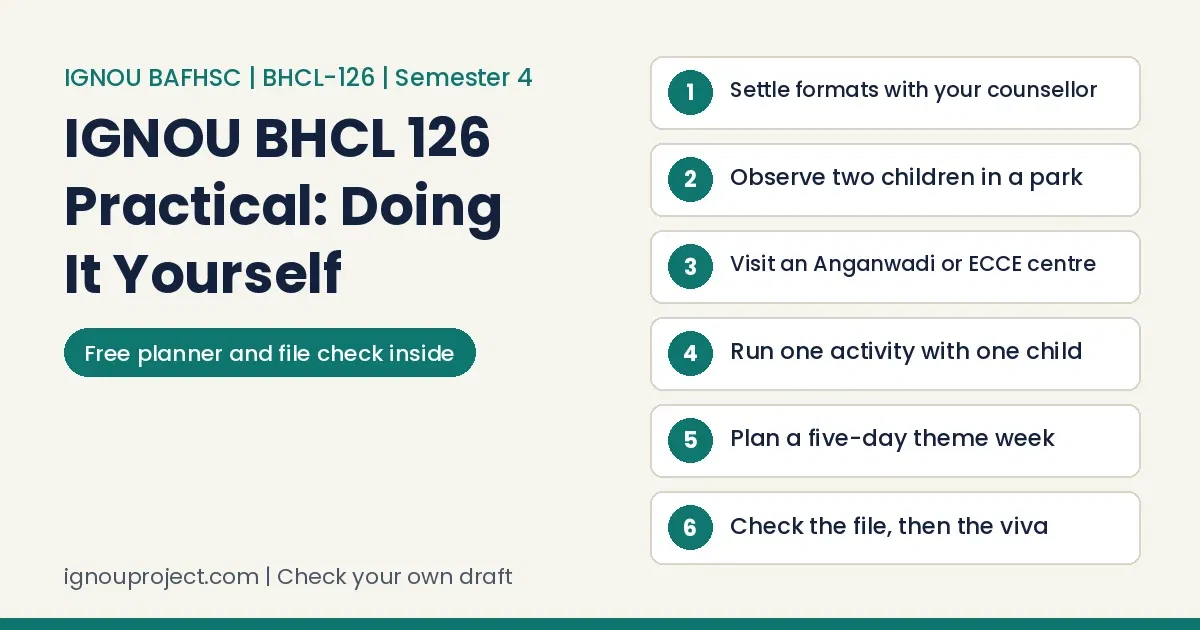
Settle formats with your counsellor, observe two children in a park (Exercise 1), visit an Anganwadi or ECCE centre (Exercise 2), run one activity from Exercises 3 to 7, plan a five-day theme week (Exercise 8), get the file evaluated, then sit the three-hour IGNOU BHCL 126 Practical exam and viva.
The June 2026 handbook gives 30 internal marks (10 attendance, 20 for your best four exercises) and 70 external (50 practical and answer sheet, 20 viva). The course carries 2 credits beside the BHCC-126 theory course.
Five questions to settle with your Academic Counsellor first
The handbook asks you to meet your counsellor at your Learner Support Centre before any exercise. Take these questions so your IGNOU BHCL 126 Practical file matches what your centre expects.
- Which of Exercises 3 to 7? One is compulsory; choose by the child you can reach.
- Which report format for each exercise? The handbook says it varies.
- When is the file due? The handbook prints no date.
- Which units does Exercise 8 mean? It cites “Units 7, 8 and 10 of BHCL-126”; the activity exercises cite BHCC-126 units.
- How is the certificate worded, and may you write in Hindi? The June 2026 certificate names “Fundamentals of Foods and Nutrition”, not this course; BAFHSC runs in English and Hindi.
“The handbook says one thing, my senior’s file shows another, and the counsellor explains a third. Which do I follow?” We hear this often across practical courses. For BHCL-126, the handbook itself sends you to your own counsellor to agree the report format before each exercise.
Is attendance at practical sessions optional if you work full time? Across practicals, missed sessions are a common way to lose a whole term. In BHCL-126, attendance is marked in its own right: 10 of the 30 internal marks.
A six-week order of work for the IGNOU BHCL 126 Practical
The IGNOU BHCL 126 Practical needs visits on separate days. Six weeks is our suggested pace, not an IGNOU rule; fit it to your counsellor’s due date.
Six-week planner from your start date
| Week | What to finish | Finish by |
|---|---|---|
| 1 | Counsellor meeting; pick your Exercise 3 to 7 domain; parent’s permission for the activity child | end of week 1 |
| 2 | Exercise 1: three park visits on three different days | end of week 2 |
| 3 | Exercise 2: centre visits | end of week 3 |
| 4 | Your activity; write Parts II and III the same day | end of week 4 |
| 5 | Exercise 8: the Monday to Friday table | end of week 5 |
| 6 | File check, certificate, hand the file in | end of week 6 |
In our records, 70 to 80 percent of learners become active only in the final month before a due date. With three park days and up to three centre days to fit in, BHCL-126 leaves little room for that habit.
Notes put together in a single evening after all the visits give themselves away: the same sentences recur, dates land on holidays, and the last visit reads like the first. Exercise 1 of BHCL-126 spans three days, so fill each day's schedule before you leave the park.
Filling the BHCL 126 observation schedule for Exercise 1
Exercise 1 is pure watching. In a safe park, pick two children of about 3 to 6 who are already playing and watch for about 20 to 30 minutes without joining in, talking to them or staring. Call them Child A and Child B; the handbook forbids names and personal details.
The BHCL 126 observation schedule starts with date, time, place and each child's approximate age, then six blocks: gross motor, fine motor, types of play, social interaction, emotional behaviour, and language. Each row has a Child A column, a Child B column and Remarks. Write a tick plus a few words of what you saw, and use Remarks to say what it shows about development.
In the play block, keep four types apart: solitary (alone), parallel (beside others, not together), associative (sharing, no common goal) and cooperative (one shared goal).
Across practical files we often meet entries such as "children played on the slide", repeated row after row, with nothing to tie them to development. Compare "Child A climbed the slide ladder four times, holding the rail with both hands", with Remarks "gross motor: coordination and growing confidence". In BHCL-126, every row of the schedule has a Remarks column for that link.
Writing the Anganwadi visit report for Exercise 2
For Exercise 2 of the IGNOU BHCL 126 Practical, any of three places works: an Anganwadi, an ECCE centre or a primary school. Visit on two or three days if you can, or make one detailed visit. Ask a parent whose child attends to introduce you, go in the morning for the preschool session, and take the worker's permission.
Your Anganwadi visit report then has four parts:
- Basic information: date, time, place, type of centre, area, number of children present, and the worker's name code, never her full name.
- Five tables with Yes/No/Notes and Remarks: the preschool session, food distribution, weighing and growth records, health and immunization, and what the worker does. If weighing is not on that day, you may ask her about it.
- Optional interview of 5 to 6 questions with the worker or a visiting mother, if the session could not be watched.
- Reflection of 10 to 12 lines: services seen, what impressed you, challenges, how well the system works and what you would improve.
A phone may note the time; photographs need permission.
Choosing and running one activity from Exercises 3 to 7 in the IGNOU BHCL 126 Practical
For this part of the IGNOU BHCL 126 Practical, pick the domain to suit the child you can reach: physical and motor (3), cognitive (4), language and literacy (5), socio-emotional and ethical (6), or aesthetic and cultural (7). The child, from birth to 3 or 3 to 6, can be a younger brother or sister, or a child from a related or neighbouring family.
- Tell the parent it is for your IGNOU practical, take permission and pick a time that suits the child.
- Watch briefly: what can the child already do?
- Choose one simple, playful idea from the handbook's list for that age, or a similar one of your own.
- Use materials that are safe for that age.
- Encourage without forcing, and let the child try alone.
- Record Part II: basic information, the plan, what you did step by step (Exercises 4 to 7 give nine numbered rows), three answers on why it suits the child, and the child's response.
- Write Part III: 8 to 10 lines for Exercises 4 to 7; Exercise 3 lists questions without a line count.
Worked example: an Exercise 4 record for a child of two years eight months
This record is invented to show the shape of the entries. Your file must describe the child you actually met, in your own words.
Illustrative Exercise 4 record: the big box, small box game
| Child and setting | 2 years 8 months; home courtyard |
| Objective | To sort familiar objects by size into a big box and a small box |
| Materials | Two cartons; six pairs of clean household objects in two sizes, none small enough to swallow |
| Steps 1 to 3 | Showed the boxes, saying "big" and "small"; let the child handle each object; placed one big spoon as a model |
| Steps 4 to 6 | Handed over one object at a time; asked "Which box?"; waited before helping |
| Steps 7 to 9 | Praised each try; let the child tip out and sort again; stopped when interest dropped |
| Why appropriate | Two-way size comparison suits this age; it is a game, not a test; it builds attention, comparison and words |
| Child's response | Interested for about ten minutes; sorted balls and bowls, mixed up the spoons; said "big ball" unprompted; laughed while tipping out |
Each step is something done, the difficulty is reported honestly, and the answers match the handbook's three questions.
Building a one week theme based curriculum for Exercise 8
Exercise 8 is compulsory planning work: one age group, one theme, Monday to Friday in a table with circle time, a main activity, movement, a creative activity and a story or closure each day. The handbook asks for several domains daily, low-cost local materials and flexible timing.
A quick way to build a one week theme based curriculum is to draft the days, then test coverage. An illustrative Transport week for 3 to 6 year olds: Monday, a talk on how each child came today; Tuesday, sorting toy vehicles into land, water and air; Wednesday, counting wheels on picture cards; Thursday, a traffic-light stop-and-go game; Friday, a carton bus and a goodbye song.
Domain check for an illustrative Transport week
| The week should include | Where it sits |
|---|---|
| Language | Monday talk; daily story |
| Cognitive | Tuesday sorting; Wednesday counting |
| Physical, outdoor, music and movement | Thursday game; Friday song |
| Socio-emotional | Turn-taking; building the bus together |
| Creative expression and free play | Carton bus; free play with toy vehicles |
| Routine care | Hand washing and snack time |
Trying the week with children is optional, because its observation table says "If implemented"; the plan, the three appropriateness answers and an 8 to 10 line reflection are not.
How to write BHCL 126 practical reflections that answer the handbook
Every exercise in the IGNOU BHCL 126 Practical ends with Part III questions. Give each a line, use one detail you saw, link it to an idea from BHCC-126, and end with what you would change. Keep to 8 to 10 lines for Exercises 1 and 4 to 8, and 10 to 12 for Exercise 2.
Reflection lines, weak and strong (illustrative)
Weak: "It was a good experience. The child enjoyed a lot. I learnt many things about DAP."
Stronger: "The child sorted balls and bowls quickly but mixed the spoons, whose sizes were close. Next time I would choose pairs with a bigger size gap. A just-right activity is one the child can finish with a little help."
Which part of a practical file can you improve in a single evening? Across practical courses, it is the writing, and that is also where most marks go. In BHCL-126, the counsellor's checklist names data interpretation and the quality of reflections.
Reflections pasted from an AI tool tend to read alike from file to file. Each BHCL-126 reflection asks about your own experience, such as how you felt while conducting the activity, which no tool can answer for you.
Common mistakes in the IGNOU BHCL 126 Practical file, with fixes
These slips most often weaken an IGNOU BHCL 126 Practical file, each with the handbook's remedy.
| Mistake | Fix |
|---|---|
| Real names of children or the worker | Child A, Child B; a name code for the worker |
| Joining or directing play in Exercise 1 | Naturalistic observation: watch and record only |
| Leaving out Exercise 8 because "four exercises" seemed enough | Exercises 1, 2 and 8 are compulsory, plus one of 3 to 7 |
| Going from the activity straight to the reflection | Box 1 sets three parts for every exercise; keep the Part II tables |
| An activity that feels like a lesson | Simple, playful and "just right" for what you saw the child do |
| We often find first pages with a wrong enrolment number or the wrong centre name | The certificate asks for enrolment number, Learner Support Centre and Regional Centre: copy them from your identity card |
| We often see practical files where the counsellor's side of the certificate is still unsigned | Learner and counsellor each sign, with place and date; check both |
| Counsellor's corrections left undone | The handbook asks you to make them and resubmit |
Self-check before you hand the file to your counsellor
Run this list on your IGNOU BHCL 126 Practical file the evening before you hand it in.
File check: twelve points before the counsellor sees it
Exam day and BHCL 126 viva questions to practise
On exam day the IGNOU BHCL 126 Practical runs as its own three-hour session, organised by the Regional Centre at a study centre, on one paper set by the programme coordinators for everyone. You gather the material, do the practical, write your findings in the answer sheet and give it to the internal examiner. Then comes the viva, with the internal examiner and an external examiner or the course coordinator. Carry your practicum notebook; the handbook says the viva may also be online, so confirm the mode with your centre.
The July 2026 Common Prospectus sets Rs 300 for practicals of up to 4 credits, paid with the Term-End Examination form and not refundable. IGNOU holds the TEE in June and December; your centre announces the practical date.
Say these aloud before the viva (our practice set)
- Why did Exercise 1 use naturalistic observation, and what did you avoid doing?
- How did you tell parallel play from associative play?
- Which Anganwadi services did you see yourself, and which did the worker describe?
- Why was your activity right for that child's age?
- What did the child find hard, and what did you do then?
- How did your theme week cover several domains of development?
- Why does the handbook ask for low-cost local materials?
- What would you change if you did the activity again?
Practice questions we suggest, not questions from IGNOU.
Have your own BHCL-126 pages checked
If you have written your exercises and want a second reader before your counsellor, send photos or a scan of your own pages on WhatsApp at +91 93546 37830. We check them against the three-part order, reflection lengths, certificate fields and clarity of English, and return comments for you to act on. The check is quoted on WhatsApp; see our services and charges page. We do not fill in observations, activities or reflections, and marks are decided by your counsellor and the examiners.
Questions about doing the exercises
Four questions learners ask while the work is in progress
Can the same child appear in Exercise 1 and in Exercises 3 to 7?
The handbook does not say, so ask your counsellor before planning around one child.
What if the Anganwadi Worker cannot let me observe?
Ask for a convenient time or a short talk after the session, come another day, or use the optional interview. An ECCE centre or primary school is also accepted.
Must the Exercise 8 week be run with children?
No. The plan, the appropriateness answers and the reflection are still required.
Is it worth doing more than four exercises in the IGNOU BHCL 126 Practical?
It can help: the counsellor evaluates every exercise handed in, and only the best four scores count towards the 20 marks.
Finishing the IGNOU BHCL 126 Practical with your own record
The IGNOU BHCL 126 Practical rewards learners who did each visit and activity themselves, because the viva asks about children and a centre you actually saw. Settle formats early, date every visit, keep the Part II tables, write reflections in your own words, and revise BHCC-126 before the exam. For theory reading, there is reference material for this course on our publication site. For the programme's written assignments, see our BAFHSC assignment guide; for the later project stage, our BAFHSC project and dissertation guide.
Sources read for this guide
- BHCL-126 practical handbook, School of Continuing Education, IGNOU, June 2026 edition (uploaded copy)
- IGNOU Common Prospectus, July 2026: BAFHSC course table, practical exam fee, TEE months
- IGNOU BAFHSC programme page
ignouproject.com is not affiliated with, authorised by or endorsed by IGNOU. We check and comment on work the learner has done; the learner remains the author of every observation, activity record and reflection in the file.

BK Sahni iD 0009-0005-8092-459X
Founder, Shri Chakradhar Publication Pvt. Ltd. & ignouproject.com — helping IGNOU distance-learning students since 2010 (5,00,000+ students supported across MBA, MCom, MA & more). Author of IGNOU exam guides, solved assignments & project reference books.
Disclosure: Shri Chakradhar Publication Pvt. Ltd. and ignouproject.com are independent third-party study-help services — not the official IGNOU website. Always verify final dates and rules on ignou.ac.in.