BAFHSC · School of Continuing Education
IGNOU BAFHSC Project and Dissertation: Complete Guide for BA (Home Science)
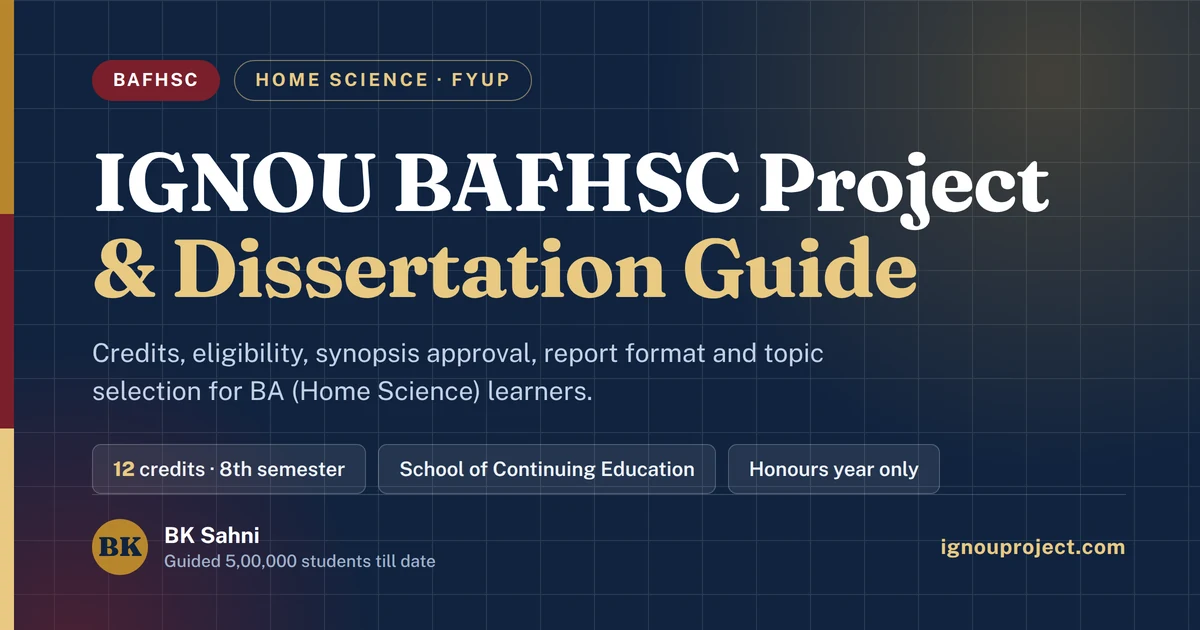
The IGNOU BAFHSC project is the 12-credit Project/Dissertation placed in the eighth semester of the four-year BA (Home Science) Honours track. Students who exit after three years with the Major degree never write it. Honours-year learners may take the dissertation or, instead, two or three Major-discipline courses worth the same 12 credits.
Quick definition
IGNOU BAFHSC Project refers to the Project/Dissertation component of the Bachelor of Arts (Home Science) programme, programme code BAFHSC, offered by IGNOU’s School of Continuing Education under the four-year undergraduate framework aligned with NEP 2020 and the UGC Curriculum and Credit Framework. According to the Common Prospectus for July 2026, the eighth-semester slot of the FYUP template carries a Project/Dissertation worth 12 credits, or alternatively two to three courses worth 12 credits drawn from the Major discipline. Learners who exit after three years and 120 credits receive a Degree with Major and are not required to submit a dissertation. Learners who finish four years and 160 credits receive the Degree with Honours, or Honours with Research when the dissertation route is chosen. The first six semesters build the research base through BHCC theory courses and paired BHCL practicals.
Programme basics
What exactly is the IGNOU BAFHSC project?
BAFHSC is the programme code for the Bachelor of Arts (Home Science) offered in Open and Distance Learning mode by the School of Continuing Education at IGNOU. The programme covers five working areas of Home Science: Human Development and Family Studies, Food and Nutrition, Community Resource Management, Extension and Communication, and Fabric and Apparel Sciences. Admission requires 10+2 in any stream, the medium is English and Hindi, and the programme runs on an annual fee of Rs. 5,500 with a minimum duration of 36 months.
The project is therefore not a small assignment attached to a single course. It is a supervised piece of applied research that asks the learner to take one problem from those five areas, study it in a real community or household setting, and present the findings as a formal report. Because Home Science is a field discipline, most BAFHSC studies involve people rather than laboratories: mothers of young children, adolescent girls, self-help groups, anganwadi workers, small food vendors, or local tailoring units.
| Item | Detail as per Common Prospectus, July 2026 |
|---|---|
| Programme code | BAFHSC — Bachelor of Arts (Home Science), Major / FYUP Honours |
| School | School of Continuing Education (SOCE) |
| Eligibility | 10+2 or its equivalent |
| Duration | 3 years (Major) or 4 years (Honours); maximum 6 / 8 years |
| Total credits | 120 for the Major degree, 160 for the Honours degree |
| Project weight | 12 credits, 8th semester, 4th year only |
| Alternative to project | 2 or 3 courses worth 12 credits from the Major discipline |
| Core course codes | BHCC-121 to BHCC-130 (theory, 4 cr each); BHCL-121 to BHCL-130 (practical, 2 cr each) |
Eligibility
Who actually has to do the BAFHSC dissertation?
Only learners who continue into the fourth year. This single point causes more confusion than any other part of the BAFHSC structure, so it is worth stating plainly. The programme has exit points after the first, second and third year. A student who leaves after three years and 120 credits walks away with a Degree with Major in Home Science and no dissertation obligation at all. The 12-credit Project/Dissertation appears only in the eighth semester, which belongs to the Honours year.
Even in the fourth year the dissertation is a choice rather than a compulsion. The FYUP template gives eighth-semester learners two routes worth the same 12 credits: the Project/Dissertation, or two to three additional courses from the Major discipline. Choosing the dissertation is what converts the qualification into Honours with Research, which matters for anyone planning a postgraduate degree such as the M.Sc. Home Science project (MHCP-001/002) route or a research-led career.
The BAFHSC Project/Dissertation belongs to the eighth semester of the Honours year, not to the three-year Major degree.
Course code
Has IGNOU released the BAFHSC project course code?
Not yet, and this is the one detail where accuracy matters more than a confident answer. The Common Prospectus for July 2026 lists the BAFHSC discipline-specific core courses only up to the sixth semester, from BHCC-121 with BHCL-121 through to BHCC-130 with BHCL-130. For the fourth year, the University states that the details of the courses will be provided subsequently. The FYUP template names the eighth-semester component as “Project/Dissertation (12 cr)” without attaching a course code to it for Home Science.
Verify before you act
Any website quoting a specific BAFHSC project course code today is guessing. Until IGNOU publishes the fourth-year course list, the safe practice is to confirm the code, the project manual and the submission address with the BAFHSC Programme Coordinators at SOCE or with your Regional Centre. Programme guides and project manuals for FYUP programmes are released on eGyanKosh, IGNOU’s digital repository, and on the programme page itself.
Topic selection
How should a BAFHSC student choose a project topic?
The strongest BAFHSC topics are narrow, local and measurable. A twelve-credit study is expected to show original data collection, not a library summary, so the test is simple: can the learner reach thirty to sixty respondents within travelling distance, and can the variable be measured with a questionnaire, a checklist, an anthropometric tool or a structured observation? If the answer to either question is no, the topic needs tightening.
Each of the five Home Science areas produces a different shape of study. The table below shows the kind of direction that stays feasible for a distance learner working alone.
| Area | Feasible study direction | Typical method |
|---|---|---|
| Human Development | School readiness of children attending an anganwadi centre | Observation checklist and caregiver interview |
| Food and Nutrition | Dietary diversity among adolescent girls in one ward | 24-hour recall and food frequency questionnaire |
| Resource Management | Time-use patterns of homemakers in dual-income households | Time-use diary and structured schedule |
| Extension and Communication | Reach of a nutrition awareness message through a local SHG | Pre and post awareness survey |
| Fabric and Apparel | Care-label literacy among buyers of readymade garments | Consumer survey with product observation |
Learners who have already handled a nutrition-linked study may find the topic patterns used for the DNHE-4 project a useful reference for scoping, since the data-collection scale is comparable. Sibling FYUP programmes follow the same eighth-semester structure, so the approach described for the BAFEDU project in BA Education maps closely onto BAFHSC as well.
Synopsis
What does the BAFHSC synopsis need before work begins?
Across IGNOU programmes the project starts with an approved synopsis, and the BAFHSC dissertation will follow the same administrative pattern. The synopsis is a short research proposal, usually built around a title, an introduction and rationale, a review of related literature, clearly numbered objectives, the research methodology with sample and tools, the expected outcome, a work schedule and references. It is prepared in consultation with the supervisor and submitted for approval before fieldwork starts.
Three documents normally travel together. The Proforma for Approval of the Project Proposal, signed and dated by both the learner and the guide. The bio-data of the guide, signed by the guide. The synopsis itself. A Certificate of Originality, signed by both parties, is attached when the final report is submitted. The full layout, including front-page structure, is covered in the site’s guide to the IGNOU synopsis format and proposal proforma.
Why synopsis approval decides the timeline
Fieldwork carried out before approval is wasted effort if the objectives are revised. BK Sahni, who has guided 5,00,000 students till date, notes that the most common reason a Home Science synopsis is returned is an objective that cannot be measured with the tool the student proposed — for example, promising to “study the impact of nutrition education” while attaching only a knowledge questionnaire with no baseline.
Supervision
Who can supervise a BAFHSC project?
IGNOU’s general rule across programmes is that a project guide must hold a relevant postgraduate qualification with teaching or professional experience in the subject area, and approved Academic Counsellors of the programme are accepted without a separate bio-data in several Schools. For a Home Science dissertation the practical shortlist is a postgraduate in Home Science, Food and Nutrition, Human Development, Extension Education or Textiles who teaches at a college, a Krishi Vigyan Kendra Subject Matter Specialist, an ICDS supervisor with the required qualification, or an approved counsellor at the learner’s Learner Support Centre.
Because eligibility conditions differ slightly between Schools, the wording published for the specific programme always wins over a general rule. The consolidated position for other programmes is set out in the site’s page on IGNOU project guidelines, and it is worth confirming the exact BAFHSC requirement with SOCE before finalising a guide.
Report format
What format should the BAFHSC project report follow?
The report is the deliverable that carries the marks, and IGNOU evaluates structure as strictly as content. A twelve-credit dissertation is substantially longer than a four-credit project. The chapter sequence below is the standard research format used across IGNOU field-based dissertations, and it is the safest structure until the BAFHSC project manual is published.
| Section | What it contains |
|---|---|
| Front matter | Title page, approval letter, certificate of originality, acknowledgement, table of contents, list of tables and figures |
| Chapter 1 | Introduction, background, statement of the problem, significance of the study |
| Chapter 2 | Review of literature, ending with the research gap the study fills |
| Chapter 3 | Objectives, hypotheses if any, research design, sample and sampling technique, tools, procedure, limitations |
| Chapter 4 | Results and discussion, with tables, percentages and charts interpreted in words |
| Chapter 5 | Summary, conclusion, recommendations and scope for further study |
| End matter | References in a consistent style, plus annexures such as the questionnaire and consent form |
Typing conventions used across IGNOU dissertations are A4 paper, a readable serif or sans-serif body face at 12 point, 1.5 line spacing, justified text and a left margin wide enough for binding. The broader conventions, including binding and annexure order, are explained on the site’s page covering IGNOU thesis, dissertation and project report format.
Stage four is a gate. Data collected before approval has to be repeated if the objectives change.
Timeline
What is a realistic BAFHSC project timeline?
A twelve-credit dissertation represents roughly 360 hours of study time under IGNOU’s credit definition of 30 hours per credit. Spread over a semester, that is a steady commitment rather than a last-month sprint. The sequence below keeps the work honest.
- Months 1 to 2 — scope and supervisor. Shortlist three topics, test each against the reachability question, and approach a qualified guide with a one-page concept note.
- Month 2 — synopsis and proforma. Draft the proposal, get both signatures on the proforma, attach the guide’s bio-data and send the set to the address confirmed by SOCE or your Regional Centre.
- Month 3 — approval and tool pilot. While approval is pending, pilot the questionnaire on five respondents and fix the wording. Do not begin the main sample yet.
- Months 4 to 5 — data collection. Collect from the full sample, record consent, and keep raw schedules safely because annexures must reproduce the actual tool.
- Month 6 — analysis and drafting. Tabulate, calculate percentages or simple statistics, then write the discussion chapter first because the rest follows from it.
- Before the deadline — submission. Pay the project evaluation fee with the term-end examination form, compile the signed report into one clear PDF and upload it through the official portal.
Costs and submission
What does BAFHSC project evaluation cost?
IGNOU charges a separate project evaluation fee, introduced from the January 2023 admission cycle and payable at the time of filling the term-end examination form. Per the IGNOU examination form portal for projects and practicals, the slabs are Rs. 300 per course for project work up to 4 credits and Rs. 500 per course for project work above 4 credits. A 12-credit BAFHSC dissertation therefore falls in the Rs. 500 slab. The online payment receipt is uploaded along with the project report.
Submission itself is online. The complete report, including the approval letter, certificates, synopsis, guide bio-data and annexures, is scanned in the correct order into a single clear PDF and uploaded through the project submission link announced on the IGNOU website. Naming the file with the enrolment number and course code keeps it traceable. The general mechanics, including file size discipline and page-order checks, are covered in the site’s IGNOU project submission guide.
Avoidable errors
Which mistakes delay a BAFHSC project the most?
- Treating the project as compulsory in the third year. It is not. Verify whether you are on the Major or the Honours track before spending a month on a proposal.
- Objectives written as ambitions. “To improve the nutritional status of children” is not an objective a student can deliver. “To assess the dietary intake of children aged 3 to 5 years in two anganwadi centres” is.
- Copying a topic from a different programme. A Home Science dissertation must sit inside the five BAFHSC areas. Borrowing a management or psychology topic invites rejection at approval stage.
- Missing signatures. An unsigned proforma, an undated bio-data or a missing certificate of originality is enough for a report to be returned without evaluation.
- Skipping the fee receipt. The project evaluation fee is separate from the theory examination fee and its receipt has to accompany the report.
- Leaving the viva unprepared. Learners who can defend their sampling choice usually score better; the patterns in these IGNOU project viva questions transfer directly to a Home Science defence.
For a BAFHSC-specific synopsis outline or a review of your objectives before you send them for approval, message the guidance desk on WhatsApp at +91 93546 37830.
FAQ
Frequently asked questions about the IGNOU BAFHSC project
Is the project compulsory for every BAFHSC student?
No. The Project/Dissertation appears only in the eighth semester of the four-year Honours track. Learners who exit after three years with 120 credits receive the Degree with Major and submit no dissertation. Even in the fourth year, the eighth-semester slot can be filled either with the 12-credit Project/Dissertation or with two to three Major-discipline courses worth 12 credits.
How many credits does the BAFHSC project carry?
Twelve credits. Under IGNOU’s credit definition of 30 study hours per credit, that works out to roughly 360 hours of learner effort. It also places the project in the higher project-evaluation fee slab of Rs. 500 per course, since the fee changes above 4 credits.
What is the course code for the BAFHSC project?
IGNOU has not published it yet. The Common Prospectus for July 2026 lists BAFHSC discipline-specific core courses only up to the sixth semester, BHCC-121 to BHCC-130 with the paired BHCL practicals, and states that fourth-year course details will be provided subsequently. Confirm the code with the BAFHSC Programme Coordinators at the School of Continuing Education or your Regional Centre rather than relying on unofficial lists.
Can a BAFHSC project be based only on secondary data?
It is not advisable. Home Science is an applied, field-oriented discipline and a 12-credit dissertation is expected to demonstrate original data collection through surveys, interviews, observation or measurement. A purely library-based review usually reads as a term paper rather than a dissertation, and supervisors commonly ask for a primary sample before signing the proforma.
Which areas can a BAFHSC dissertation topic come from?
Any of the five areas the programme covers: Human Development and Family Studies, Food and Nutrition, Community Resource Management, Extension and Communication, and Fabric and Apparel Sciences. The topic should stay inside these areas and should be answerable with a sample the learner can actually reach.
Written by BK Sahni — IGNOU project and assignment guidance, ignouproject.com. Guided 5,00,000 students till date. Facts in this guide are drawn from the IGNOU Common Prospectus (July 2026), the official BAFHSC programme page and the IGNOU examination portal. Last updated: 13 August 2026.

BK Sahni iD 0009-0005-8092-459X
Founder, Shri Chakradhar Publication Pvt. Ltd. & ignouproject.com — helping IGNOU distance-learning students since 2010 (5,00,000+ students supported across MBA, MCom, MA & more). Author of IGNOU exam guides, solved assignments & project reference books.
Disclosure: Shri Chakradhar Publication Pvt. Ltd. and ignouproject.com are independent third-party study-help services — not the official IGNOU website. Always verify final dates and rules on ignou.ac.in.