IGNOU MPCL 075 Practical from first session to signed notebook
The IGNOU MPCL 075 Practical is written up by you, one case at a time, in a practicum notebook that your Academic Counsellor corrects and marks at the Work Centre, so the way you record each session decides most of the result.
PGDRPC learners, in one paragraph
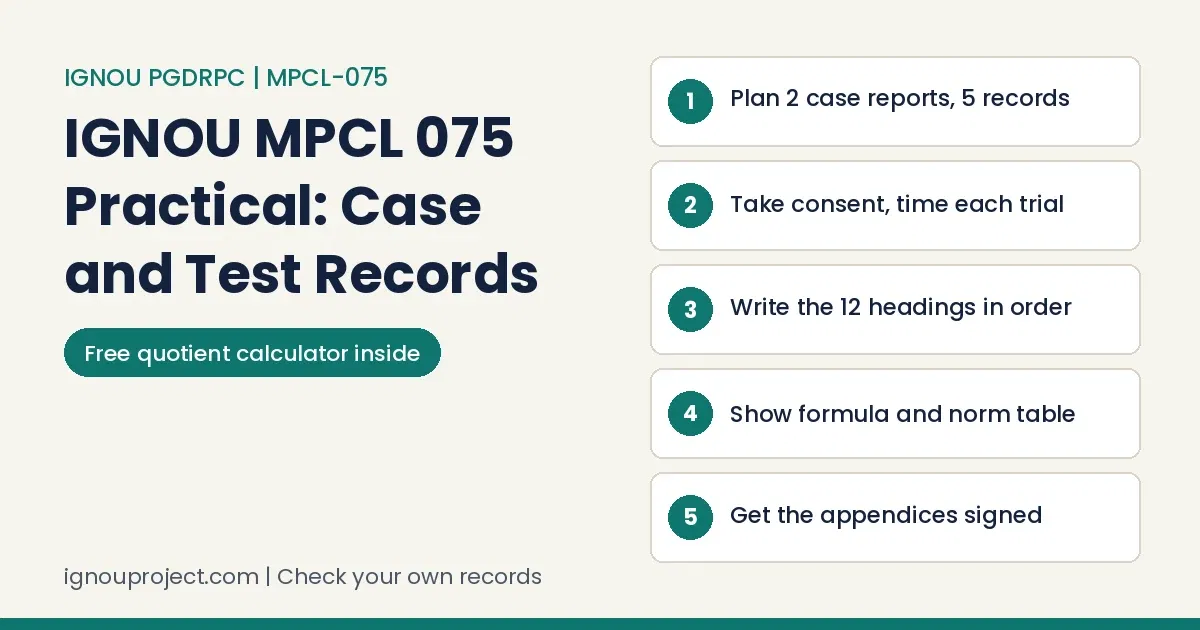
For the IGNOU MPCL 075 Practical, attend all eight 3-hour sessions, test real participants, and write two Part I case reports plus five Part II test records under the handbook’s twelve headings. The counsellor marks the notebook out of 100 across four 25-mark domains; 40 is the pass mark.
Fee and attendance rules shared by many lab courses sit in our IGNOU practical rules across programmes post.
Learners who sail through theory exams can freeze at the lab write-up. MPCL 075 earns that attention: at 8 credits it weighs as much as two MPC theory courses together.
Plenty of learners notice the practical side late. PGDRPC has two, MPCL 075 and MPCL 076, so begin this record in your first months, not after the theory papers.
Three causes recur: rules arrive late and vary by centre, lab work expects time and travel few distance learners have, and the record gets treated as formatting. MPCL 075 marks rest on how you ran and reported each test.
Plan seven write-ups before you meet a single participant
Before any test, map the whole IGNOU MPCL 075 Practical output on one sheet: two Part I case reports (history, interview, observation, and screening with the DST, PRASHAST, the NIMH schedules or Gesell’s schedules) and five Part II test records.
- Write the four marked domains across the top: developmental, intellectual, adaptive behaviour, and neuropsychological with vocational. Under each, note which case feeds it.
- Match each participant’s age to the tool’s printed range: MISIC stops at 15 years 11 months, the PGI battery covers 20 to 45 years (usable to 59), the Binet Kamat Test runs from 3 to 22.
- Ask your counsellor how the five records spread across domains; the handbook does not divide them.
- For informant-based tools (Vineland, BASIC-MR Part B), book a parent or caregiver for the same visit.
PGDRPC admits learners in the July cycle only; the IGNOU admission last date post lists the current windows.
In our records, 70 to 80 percent of learners get going only in the last month before something falls due. The handbook prints no collection date, so your dated plan of seven write-ups is the real deadline.
Learners often copy what a friend at another centre was told. PGDRPC runs through the Work Centre the University allots, and the prospectus calls that allotment final, so your own counsellor’s answer counts.
Lab dates are fixed and can fall some distance from home; miss them and your work may slide to a later batch. The handbook sends you to your WC Coordinator or In-charge for the timetable.
Session day: consent, rapport and the raw sheet
Each IGNOU MPCL 075 Practical session starts with the counsellor demonstrating a test; learners then give it to each other in pairs under supervision. Capture these on the day:
- Informed consent, the promise of confidentiality, and permission before any recording.
- Materials laid out: booklet, answer sheet, apparatus, stopwatch.
- Exact timings; on the Seguin board, all three trial times in seconds, noted without the participant’s knowledge.
- Raw responses item by item, and the introspective report the moment the test ends.
Consent habits are discussed further in consent and confidentiality in MAPC research.
Most learners we meet hold a job, run a home, or both, and skip counselling. The MPCL 075 handbook makes the practical classes and their counselling sessions compulsory, so plan leave for all eight.
Records drafted in one sitting at the end give themselves away: repeated sentences and no growth from first test to last. Write each record within a day or two of its session.
Learners schooled in Hindi medium often find English reports hard. PGDRPC is taught in English, and the handbook rules out a mental status examination when the person lacks the examiner’s language, so settle the interview language early.
Writing each test record in the IGNOU MPCL 075 Practical, heading by heading
Every test record in the IGNOU MPCL 075 Practical uses the same twelve headings in this order; it is the psychological test record format your counsellor introduces in class:
- Title as the manual prints it.
- Aims or Objectives in one or two lines.
- Introduction: the test’s background and the concept it measures, in your own sentences.
- Description of the Test: author, purpose, items, dimensions, time limit, reliability, validity, scoring.
- Materials Required.
- Participant’s Profile: age, gender, education, occupation; the name is optional.
- Procedure and Administration: Preparation, Rapport, Instructions (copied from the manual), Precautions.
- Introspective Report.
- Scoring and Interpretation: key, raw score, norm used.
- Discussion, read with the introspective report.
- Conclusion.
- References in APA style, alphabetical.
MAPC learners work through a similar order for other tests in our MPCL 7 testing practicum guide.
Lab reports are read against a fixed order, and one missing part lowers the mark. Skip Precautions or the Introspective Report and the counsellor sees the gap at once.
“The test was given and the score was noted” reports an event and stops. In the Discussion, tie the score to the concept your Introduction defined and to what the participant said.
Many learners paste a test’s history from a website unchecked. Write the Introduction in your own words and cite the manual you actually used.
MPCL 075 introspective report: getting the participant’s own words
The introspective report is the one heading in the IGNOU MPCL 075 Practical that no manual can supply: the participant’s feelings, overall experience and difficulties, in the first person only.
- When the answer sheet is collected, ask: How did you feel? Which part was hardest? Did anything distract you?
- Write the replies as “I” sentences, for example: “I was nervous when the watch started; the round blocks were easy, but the last two shapes took me longest.”
- For a young child or someone who speaks little, record what the person said or showed and who helped; the handbook is silent here, so ask your counsellor.
Some learners hand in AI-written records unchanged, one reason so many read alike. An introspective report is your participant’s account, and no tool knows what that person told you.
Ready-made lab files circulate online and go in with a new name on the cover; matching pages at one centre stand out. Here, the counsellor who watched you test also marks the record.
Some learners fill reports with assumed figures. Every age, raw score and quotation in your five test records must come from someone you tested yourself.
Worked example: Binet Kamat test scoring on practice figures
These practice figures for an IGNOU MPCL 075 Practical record are invented and belong to no real child.
Practice figures: one Binet Kamat sheet
Aim: find mental age (MA) and IQ. Chronological age (CA): 9 years 4 months = 112 months. Credits per passed item: 2 months up to year 10, then 4 months for each item at years 12, 14 and 16.
| Age level | Items passed | Months added |
|---|---|---|
| Year 7 (basal age) | All | 84 (the basal age) |
| Year 8 | 4 x 2 months | 8 |
| Year 9 | 3 x 2 months | 6 |
| Year 10 | 1 x 2 months | 2 |
| Year 12 (terminal age) | 0 | 0 |
Working: MA = 84 + 8 + 6 + 2 = 100 months (8 years 4 months). IQ = MA / CA x 100 = 100 / 112 x 100 = 89.3, recorded as 89.
Notebook line: write the formula, the months and the manual’s classification table beside the figure; the band name comes from the manual at your Work Centre.
Test the calculator below on the handbook’s own DST illustration (CA 98 months, developmental age 72 months): it should return the printed DQ of 73.
In test-based practicals we often see a correct raw score read off the wrong norm table. Name the table and age group in each record so the counsellor can retrace you.
Weak records drop the table, stop a calculation halfway and leave the profile unlabelled. This course wants each table or profile in pencil on a blank page, titled and numbered.
Quotient calculator for DQ, IQ and SQ
DST, Binet Kamat, Seguin and Vineland Social Maturity Scale scoring end in one ratio: the age the test yields, divided by chronological age, times 100. MISIC reports Verbal, Performance and Full-Scale IQ from its own tables, and BASIC-MR Part B rates behaviours 0, 1 or 2, so neither fits this ratio.
Quotient calculator: DQ, IQ, SQ
Without the script, divide by hand: test age in months / CA in months x 100.
Writing the two Part I reports in the MPCL 075 case report format
Part I of the IGNOU MPCL 075 Practical ends in two case reports, and the form at the back of the handbook sets this page order:
- Case number, date of interaction, and demographic details of the case and the parents or guardian.
- Presenting complaints in the informant’s words.
- Prenatal, natal and postnatal history; family history with a pedigree chart; development, school, play and occupational history.
- Behavioural observation: appearance, attention, comprehension, communication, activity.
- Purpose of assessment; screening or developmental tests with findings and profile analysis; then intellectual tests the same way.
- Clinical impression and recommendation, signed and dated, then the supervisor’s comment and signature.
Three cautions shape the wording: a doctor or paediatrician completes the immunisation history; the NIMH schedules screen rather than diagnose, so a concern becomes a referral; and no intellectual disability diagnosis is given below age 5. Clinical case history work is also covered in our MPCE 14 clinical practicum guide.
Learners tell us they juggle three formats: the handbook’s, the counsellor’s and a senior’s. The handbook lets the counsellor use a particular case history format, so follow that one and tick the handbook’s sections off against it.
Across lab courses we see supervisor boxes left empty. Show each case report to your counsellor while you can still answer questions about the case.
Behaviour Management Programme pages for a BASIC-MR case
If an IGNOU MPCL 075 Practical case is rated on BASIC-MR Part B, the handbook’s Behaviour Management Programme turns the ratings into a plan:
- Identify problem behaviours by observation or a parent interview, stated in observable, measurable terms.
- Rank five by need and severity, and choose three targets.
- List rewards and the child’s assets.
- Take a baseline by frequency or duration recording.
- Run a functional analysis (antecedents, behaviour, consequences), carry out the programme, then follow up.
The handbook’s sample baseline records minutes of thumb sucking in one morning hour across six days (9 to 11 minutes a day). Draw yours the same way, as a dated pencil table.
Record mistakes we see, and the fix for each
Each slip below that weakens an IGNOU MPCL 075 Practical notebook is matched to its handbook fix.
| What goes wrong | The fix |
|---|---|
| A quotient with no working | Formula, both ages in months, norm table |
| Instructions summarised | Copy them from the manual |
| Introspective report in the third person | Rewrite as the participant’s “I” account |
| Seguin IQ from the first trial | Best of three trials, then the chart |
| DST worked with a CA of 16 | Above 15 years, the DST takes 15 |
| Bender result written as a diagnosis | Report the Lacks sign count (five or more of 12 is indicative) beside other tests |
| Write-up is where lab marks slip most and where they are easiest to win back; this course is marked wholly on conduct and reporting. | |
| Enrolment number or centre name copied wrongly: Appendices II, III and IV carry these fields, so take the spelling from your admission record. | |
| Attendance proof left out: Appendix I is the attendance certificate, which the counsellor can sign at your last session. | |
The habit of showing every step of working is the one our MANL 101 lab entry guide builds for another lab.
IGNOU MPCL 075 Practical self-check before the counsellor marks it
Tick each line before the IGNOU MPCL 075 Practical file is collected; nothing is sent anywhere.
Before the counsellor signs: ten checks
Have your own records checked before they go in
We do not write any part of an IGNOU MPCL 075 Practical notebook. If you want a second reader, send photos or scans of the records you wrote; we check headings, arithmetic, norm citations and references against the handbook and mark what to fix, and you make the changes. A record check is quoted on WhatsApp; see our services and charges page.
Questions PGDRPC learners ask while writing up
Answers from the October 2025 handbook
Is there a viva or a separate exam for the IGNOU MPCL 075 Practical?
The handbook describes internal marking by the Academic Counsellor out of 100 and prints no viva or term-end practical exam.
Learners often ask us whether a viva applies to them. Here the notebook carries the marks, so prepare it as the thing assessed.
Which practical fee applies to an 8-credit course?
The handbook prints none. The July 2026 prospectus sets Rs 300 up to 4 credits and Rs 500 above, paid with the term-end exam form; check your PGDRPC exam form.
Learners at our desk often confuse the two amounts. An 8-credit course sits above the 4-credit line, so the higher slab applies if a fee is charged.
Can I email the notebook or post it to headquarters?
The handbook prints one route: hand it in at your Work Centre and take an acknowledgement.
Some learners email work that has a fixed route. The July 2026 PGDRPC assignment files also send theory work to the Work Centre coordinator, not headquarters.
Finishing the IGNOU MPCL 075 Practical file and handing it in
The last week of the IGNOU MPCL 075 Practical is paperwork. Put the title page, certificate and contents at the front. The counsellor signs the Appendix I attendance certificate and fills the Appendix III evaluation scheme; you and the counsellor both sign the Appendix IV completion certificate, where you write PGDRPC although the form prints PGDRP. Keep a photocopy, submit at your Work Centre, and get the Appendix II acknowledgement signed.
Marks show on IGNOU’s practical marks transmission status page only once transmitted. If yours stay missing, ask your Work Centre first; the prospectus contact for practical marks is practicalsed@ignou.ac.in (011-29572212). If you also want reference material for this course on our publication site, see the Shri Chakradhar course page.
With no receipt, a learner whose marks vanish cannot prove the file went in. Fill the Appendix II form at home and have it signed at the counter.
Practical marks often reach the grade card after theory marks, and the diploma waits. PGDRPC makes you eligible to apply to RCI as a registered Rehabilitation Counsellor, so chase a missing mark early.
Learners who do well start early, check rules locally, write each record soon after its session, collect signatures as they go and can explain every page: eight sessions, seven dated write-ups, every appendix signed.
Documents this guide rests on
- MPCL 075 Handbook on Identification and Assessment, October 2025 (78 pages)
- IGNOU Common Prospectus July 2026 (section 8.13, fee slabs, contact table)
- IGNOU PGDRPC programme page
- MPC 073 assignment file, July 2026 cycle
Method: the handbook, prospectus, programme page, MPC 073 assignment file and IGNOU status page listed above were read in November 2026. Drafting was AI-assisted, each rule was checked against those sources, and BK Sahni publishes this guide under his editorial responsibility.
ignouproject.com is not affiliated with, authorised by or endorsed by IGNOU. We check and comment on records you wrote; you remain the author of your notebook, and your Academic Counsellor’s evaluation decides the marks.

BK Sahni iD 0009-0005-8092-459X
Founder, Shri Chakradhar Publication Pvt. Ltd. & ignouproject.com — helping IGNOU distance-learning students since 2010 (5,00,000+ students supported across MBA, MCom, MA & more). Author of IGNOU exam guides, solved assignments & project reference books.
Disclosure: Shri Chakradhar Publication Pvt. Ltd. and ignouproject.com are independent third-party study-help services — not the official IGNOU website. Always verify final dates and rules on ignou.ac.in.