
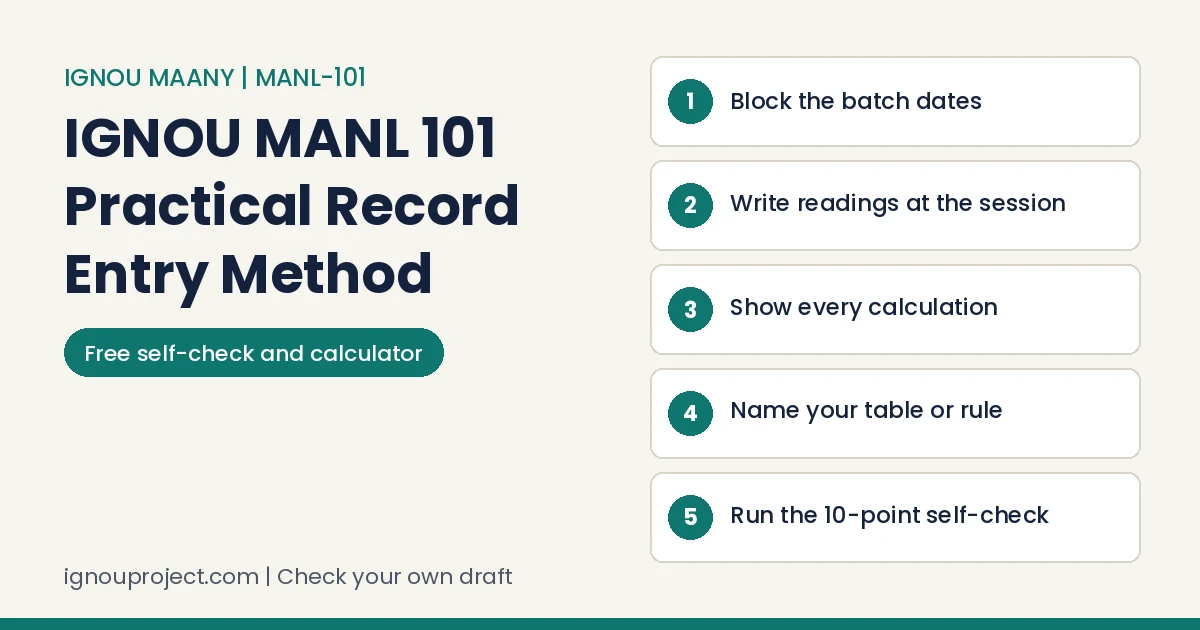
IGNOU MANL 101 Practical Record: What You Build Over the Sessions
An IGNOU MANL 101 Practical record is the set of dated entries a MAANY learner writes from measurements taken at the MANL-101 sessions, one entry for each exercise. Below: the layout, one worked calculation and a self-check for your own draft.
Short answer
Build the IGNOU MANL 101 Practical record one entry per exercise, written at the session: aim, instruments, method, a reading table with units, the calculation with working, a short discussion and precautions. At your first session, ask the counsellor whether your centre wants the file at the examination, and in which medium.
The course sits in the fourth semester of MAANY as a compulsory 8-credit practical, in the same semester as the 8-credit MANP-101 dissertation. The July 2026 Common Prospectus states that practical sessions are held at designated institutions on a schedule the Learner Support Centre provides, and that attendance at them is compulsory.
No IGNOU document read for this guide prescribes a record format, page count or exercise list for MANL-101, so the method below follows usual lab-record practice, and your counsellor’s instruction wins where it differs. One study centre’s practical page for the older MAAN codes asks learners to finish the write-up well in advance and present the file at the physical examination; it predates MANL-101, but the advice carries over.
Before the First Session: Four Steps That Make the Write-Up Easier
Much of the work on an IGNOU MANL 101 Practical record happens before the first entry, between Semester IV registration and the first batch.
- Find your batch dates and block them. Check your Regional Centre’s practical schedule page from the day you register, again a week before each batch, and apply for leave as soon as the dates appear.
“I opened the website after my batch had already met” is a line we hear on practical courses of every kind. Sessions fall on set dates, often full days in a row, and a missed slot usually means waiting for the next cycle. For MANL-101, the schedule comes from your Learner Support Centre, as the prospectus states.
- Settle the format question in writing.
Learners on practical courses often bring us three layouts for one file: the handbook’s, the counsellor’s, and one passed on by a senior or picked up online. For MANL-101, the documents read for this guide print no record format at all, so the layout to follow is the one your counsellor gives at the first session; write it down with the date.
- Revise the theory behind each area. MAN-102 Physical/Biological Anthropology, compulsory in Semester I, covers instruments, osteology, anthropometry, serology and dermatoglyphics. Genetics, physiological and forensic anthropology match the Group A electives MANE-101, MANE-103 and MANE-104; you took only two Group A courses, so read the material for any of these three you skipped.
- Prepare a rough reading sheet. Carry a dated plain sheet to every session and write each reading on it in ink as it is taken. The fair entry is copied from this sheet, never from memory.
How to Arrange a MANL 101 Practical File From Cover to Last Sheet
Use this order for the IGNOU MANL 101 Practical record unless your centre gives its own.
- Front page: your name, enrolment number, programme (MAANY), course code and title (MANL-101, Practical in Physical/Biological Anthropology), Learner Support Centre code and name, Regional Centre and session.
- Any certificate, attendance sheet or form your centre issues. The documents read for this guide print none for MANL-101, so use your centre’s own forms.
- An index with five columns: exercise number, title, session date, page number and a space for the counsellor’s initials.
- The entries, grouped in the order of the course areas: instruments, osteology, anthropometry, serology, dermatoglyphics, genetics, physiological anthropology (blood pressure included) and forensic anthropology.
- The rough reading sheets, in session order, in a pocket at the back.
Inside each entry, keep one fixed sequence every time; the worked example below shows a complete one.
Across practical reports, a gap in the expected run of parts (a discussion left out, or no result line) tends to pull the marks down. The MANL-101 outline lists anthropometry, serology, dermatoglyphics and blood pressure as practicals you demonstrate, so each of those entries has readings and a result that need their own place in the sequence.
Worked Example: Cephalic Index Calculation as One Complete Entry
Here is one anthropometry entry laid out as an IGNOU MANL 101 Practical record entry should read. The figures are invented to show the arithmetic; your entry carries your own readings.
Specimen entry with illustrative figures
Exercise and date: Anthropometry, exercise 3; the date of your session.
Aim: To measure the maximum head length and maximum head breadth of one adult subject and calculate the cephalic index.
Equipment: Spreading caliper with rounded (blunt) ends, the version meant for living subjects; the e-PG Pathshala chapter on somatometry lists the instrument in 25 cm and 60 cm sizes.
Procedure: Subject standing without shoes, head in the Frankfurt (ear-eye) plane. Head length taken from glabella to the farthest point at the back of the head (opisthocranion); head breadth taken as the greatest side-to-side width, between the euryons. Each measurement taken twice.
| Reading | Head length (mm) | Head breadth (mm) |
|---|---|---|
| First | 186 | 148 |
| Second | 187 | 148 |
| Mean | 186.5 | 148.0 |
Working: Cephalic index = (head breadth / head length) x 100 = (148.0 / 186.5) x 100 = 79.36, written as 79.4.
Result and interpretation: On the three-band table used in this example (below 75 dolichocephalic, 75 to 80 mesocephalic, above 80 brachycephalic), 79.4 is mesocephalic. Name the table you used, because published tables place the band edges differently and a value near 80 can change class from one table to another. For comparison, the e-PG chapter reports an Indian average of 76.06.
Precautions and sources of error: Caliper tips placed on the landmarks with light, even pressure; the two length readings differ by 1 mm, inside the 0.5 to 1.0 mm personal error the e-PG chapter allows for head measurements; a third reading would be taken if they differed by more. A head tilted out of the Frankfurt plane, or thick hair over a landmark, are the likely sources of error.
Wherever a practical turns readings into a score or an index, the slips we commonly find in drafts are faulty arithmetic, the wrong reference table, or a conclusion the numbers do not support. That is why the result line above names its table: in MANL-101 an anthropometric index is classified against a band table, and the class you write depends on which one you used.
On courses built around data, we sometimes see figures that were assumed rather than collected. In MANL-101 the reading table carries the whole entry, so it may hold only values you measured yourself at your session.
Free cephalic index calculator
Enter your own mean readings in millimetres. It applies (breadth / length) x 100, rounded to one decimal; without scripts, do the sum by hand.
Result appears here.
It gives the number only: classify it on your counsellor’s table and name that table in the entry.
Writing the Other Exercises: Prints, Blood Groups, Blood Pressure and Bones
The same entry discipline carries over to every other area of the IGNOU MANL 101 Practical record; only the shape of the readings changes.
Dermatoglyphics ridge count entries
The e-PG Pathshala chapter on dermatoglyphics gives the rules: an arch has neither core nor delta, a loop has one core and one delta, and a whorl has two deltas. The ridge count is the number of ridges that cut an imaginary straight line drawn from the core to the delta, and the core and the delta themselves are not counted.
Write one row per finger: hand, digit, pattern and count. For a whorl, record the count from each delta and state the rule you use for the finger’s value; for an arch, enter zero only if your counsellor’s scheme does. Keep the print with the entry, since a dermatoglyphics ridge count without its print cannot be checked.
Serology entries
Record the test (for example ABO and Rh grouping), the antisera used, what you saw with each (agglutination or none) and the group you read from it. Follow the host institution’s safety instructions throughout.
Blood pressure entries
Name the instrument, the subject’s posture, the arm used and each reading as systolic over diastolic in mmHg. Take more than one reading, time each, and interpret them against your MANE-103 or MAN-102 material.
Instruments and osteology entries
These are describing exercises. For an instrument, give its name, parts, the measurements it takes and one precaution in use (the somatometry chapter keeps the blunt-ended spreading caliper for living subjects and the sharp-ended one for skeletons). For a bone, give its name, how you decided the side and the features you identified, with a labelled sketch.
In anthropometry practical record entries taken on the body, state the side too: the e-PG chapter says measurements are generally made on the right side unless there is extra musculature, when the left is used. Genetics and forensic exercises follow the same entry sequence.
Eight Mistakes in an IGNOU Anthropology Practical File, With the Fix for Each
If one part of a practical course deserves extra hours, it is the write-up: in our experience it costs learners the most marks, and it is also the part easiest to put right.
The table lists what goes wrong in an IGNOU MANL 101 Practical record draft, and the change that fixes it before the examination.
| What goes wrong | The fix |
|---|---|
| Readings filled in at home from memory | Write them in ink at the session; copy the fair entry from that sheet. |
| An index with no working shown | Show the ratio, the x 100 step and the rounding. |
| A class written without naming its table | Name the band table and its source. |
| Core or delta counted into a ridge count | Count only the ridges that cross the core-to-delta line. |
| No side stated for a body measurement | Write the side measured, and the reason if it was the left. |
| Units missing, or centimetres and millimetres mixed | One unit per table, named in the heading. |
| An entry that says only “attended and observed” | We meet that line, repeated week after week, on many practical courses, while examiners look for each entry tied to a method or concept. In this course, name the landmark, the instrument and the index the reading feeds: “head breadth taken between the euryons with a spreading caliper” says what you did. |
| No precautions or sources of error | The weak lab records we see often drop this part, along with full tables and finished calculations. Every demonstrated MANL-101 practical yields readings, so close each entry with its precautions and at least one likely source of error. |
Free Self-Check: Ten Questions for Each MANL 101 Practical File Entry
Run this on every entry of your IGNOU MANL 101 Practical record before asking for the counsellor’s signature.
Entry self-check, ten points
0 of 10 ticked.
Any unticked item is your next fix.
One more test, for the file as a whole: does it read as if it grew session by session? A log produced in a single sitting gives itself away through phrasing that repeats, dates that land on Sundays or holidays, and no visible development from the first exercise to the last. A MANL-101 record dated to your actual batch days avoids all three.
Getting the IGNOU MANL 101 Practical Record Ready for the MAANY Practical Exam
The last fortnight before the MAANY practical exam is for checking the IGNOU MANL 101 Practical record, not for writing it.
Fee and dates. The Rs 500 practical examination fee (the prospectus slab above 4 credits) goes with the term-end examination form and is not refundable once paid. Your Regional Centre’s practical examination schedule names your venue and batch.
Signatures and the front page.
- Is every certificate your centre issues signed by the counsellor? Unsigned certificates are a gap we keep finding in practical files across programmes, and the easiest moment to close it is a session, while the counsellor is with you.
- Do the front-page details match your identity card? Enrolment numbers, programme names and study centre details are details we find wrong on the title pages of practical files. On this file the programme should read MAANY and the course MANL-101.
Explaining your own readings. The documents read do not say whether the examination includes a viva, so prepare a short spoken answer for each entry anyway: why the Frankfurt plane, why that side, how a ridge was counted.
Send Your Own Draft Entries for a Check
If you have written your IGNOU MANL 101 Practical record and want a second pair of eyes before the counsellor signs it, send scans of your own entries on WhatsApp at +91 93546 37830. We check the order of parts, the working, units, counting rules and front-page details against your counsellor’s format, and return comments for you to act on. We do not take readings, fill tables or draft entries; the measurements and words stay yours. Fee and turnaround are confirmed on WhatsApp first, and no marks or result is promised, since the examiner decides. See how our correction service works.
Questions MAANY Learners Ask While Writing Up MANL-101
Can I write the IGNOU MANL 101 Practical record after the last session?
The fair copy can come later, but the readings belong on the rough sheet at the session itself; copy from that sheet within a day or two.
Can the MANL 101 practical file be written in Hindi?
The prospectus gives the programme’s medium as English and Hindi, but the IGNOU programme page shows English alone, and no document read says which medium a practical file may use. Ask your counsellor, and keep instrument and landmark names consistent in whichever language you write.
Can I base my entries on a senior’s file?
Files passed down or downloaded do circulate on practical courses, and we have seen them handed in with nothing changed except the name and enrolment number; identical pages from several learners at one centre are easy to spot. A senior’s MANL-101 file holds a senior’s subjects and readings, so it can show you a layout, never your results.
How do I fit the practical around the MANP-101 dissertation?
Treat the MANL-101 batch dates as fixed and plan the dissertation fieldwork around them, since both sit in Semester IV. Our guide to the MAANY project and dissertation covers the MANP-101 side.
Finishing the IGNOU MANL 101 Practical Record Without a Last-Minute Rush
The learners we see finish practical courses cleanly share a short list of habits: they begin early, check the rules with their own centre, date each session’s entry, get signatures along the way, and can explain any page in their own words. Each of those habits applies to MANL-101 as it stands.
Put the IGNOU MANL 101 Practical record together as you go: readings at the session, working shown, tables and rules named, and the ten-point self-check before every signature. For theory revision across the eight areas, see the reference material for this course on our publication site.
Documents Read for This Guide
- IGNOU Common Prospectus, July 2026
- IGNOU MAANY programme page
- e-PG Pathshala, Techniques of Somatometry and Somatoscopy
- e-PG Pathshala, Dermatoglyphics
- PubMed Central article on cephalic index
Prepared from the MAANY section of the July 2026 Common Prospectus, the MAANY programme page, two e-PG Pathshala chapters, one PubMed Central article and one IGNOU study centre’s practical page, read in November 2026, plus the MANL-101 course outline seen in October 2026; drafting was AI-assisted, every rule here was checked against the listed sources, and BK Sahni publishes this guide under his editorial responsibility.
ignouproject.com is not affiliated with, authorised by or endorsed by IGNOU. Our service checks and comments on the learner’s own draft; the learner remains the author of every entry and every reading in the record.

BK Sahni iD 0009-0005-8092-459X
Founder, Shri Chakradhar Publication Pvt. Ltd. & ignouproject.com — helping IGNOU distance-learning students since 2010 (5,00,000+ students supported across MBA, MCom, MA & more). Author of IGNOU exam guides, solved assignments & project reference books.
Disclosure: Shri Chakradhar Publication Pvt. Ltd. and ignouproject.com are independent third-party study-help services — not the official IGNOU website. Always verify final dates and rules on ignou.ac.in.
