IGNOU MPCL 076 Practical: how to run five cases from the first session to the viva
The IGNOU MPCL 076 Practical (Practical II: Intervention) asks each PGDRPC learner to work five real cases in person, write each one in the handbook’s own format, and then explain them to an external examiner.
The route for PGDRPC learners
In the IGNOU MPCL 076 Practical you attend 8 three-hour sessions at your Work Centre, complete 2 behaviour modification cases and 3 counselling cases with signed consent, file them in the handbook formats, and sit a viva. The Academic Counsellor awards up to 30 marks, the external examiner up to 70, and 40 is the pass mark.
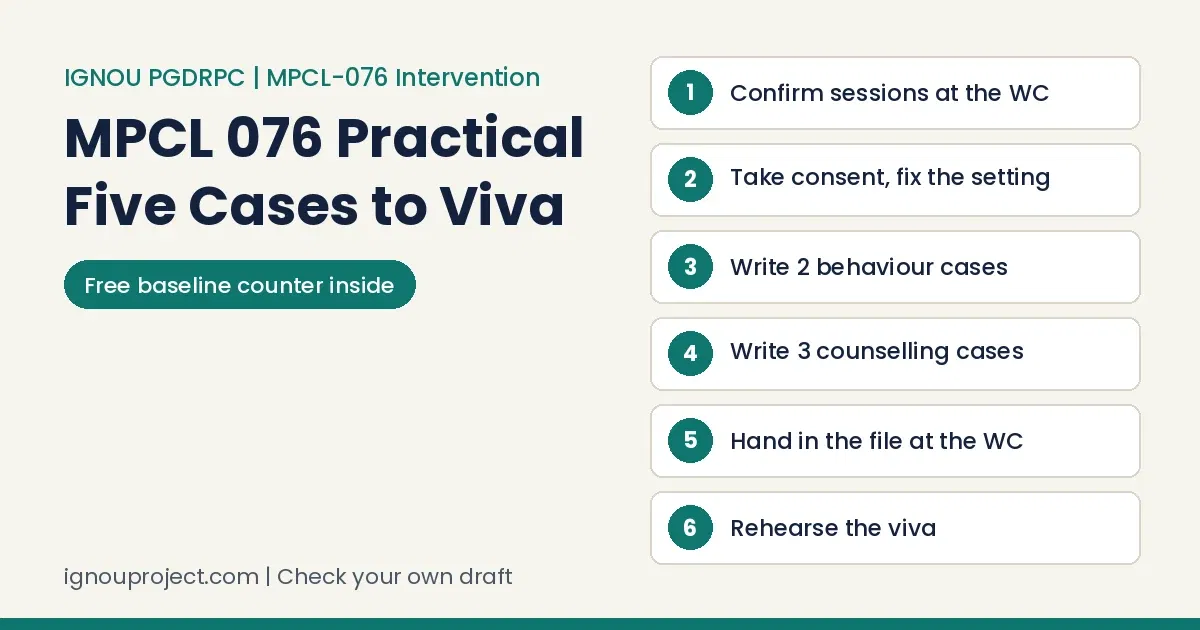
- Get session dates from your allotted Work Centre (WC).
- Confirm the host setting and supervisor; take consent.
- Run and write the two behaviour modification cases, Steps I to IX.
- Run and write the three counselling cases, session by session.
- Assemble the file and hand it in at the WC.
- Pay the fee with the exam form and rehearse each case.
The course belongs to the IGNOU PGDRPC programme. General rules for IGNOU practicals are in our IGNOU practical overview for every programme.
Across practical courses, learners who pass theory papers comfortably often get stuck on the practical part. This one is 8 of the diploma’s 32 credits.
Many learners realise late in the session that their programme has a practical part. PGDRPC carries two, and this one builds on MPCL-075.
Set up the Work Centre side before any client meets you
Most of the IGNOU MPCL 076 Practical runs through the WC the University allots. The handbook counts 8 sessions of 3 hours (24 hours), and section 4.0 makes attending them compulsory. There the Academic Counsellor (AC) explains the formats and demonstrates cases and tests.
- Ask the WC Coordinator or In-charge for the schedule.
- Start a rough notebook on day one; section 3.0 wants session observations there first.
- Have the AC sign the Appendix I attendance certificate when the sessions end.
Most learners who reach us work, run a home or both, and in many practicals missed sessions cost a whole cycle. Here the handbook itself makes them compulsory.
Practical dates are fixed, sometimes at a distant centre; stop checking and you can lose a batch. Save the WC Coordinator’s contact on day one.
Across programmes we have seen work refused because the supervisor lacked the set qualification. Here the WC Head or Coordinator confirms a Rehabilitation or Clinical Psychologist holding an M.Phil. of two years or more in one of those fields, per RCI guidelines.
Settle the host setting, consent and recording permission
In the IGNOU MPCL 076 Practical the three counselling cases come from an approved centre (a clinic, rehabilitation centre, hospital, special school or inclusive school) that allows follow-up and observation. If your WC has no clinical facility, the handbook says the WC will provide one.
- Explain the aim to the client or parent, say how the information stays confidential, and take signed consent before the first session.
- Ask separately before recording any session, and keep every signed form for the file.
Days at a clinic or school before it was confirmed often count for nothing. Ask your AC to confirm the setting before your first interaction there.
Host settings are often reluctant to accept distance learners or hand them only token tasks. If the WC lacks a clinical setting, arranging one is its job.
Some centres insist on a fixed number of supervisor meetings. MPCL-076 prints none, only regular contact through scheduled visits or consultations; date each one.
Behaviour modification case report: the nine steps as you will write them
Part I of the IGNOU MPCL 076 Practical is two behaviour modification cases. Section 7.1 sets nine steps; the blank format on printed pages 64 to 69 gives the headings.
- Identify problem behaviours with a standardised tool (the handbook names BASIC-MR or BASAL-MR for intellectual disability, and the CBCL), plus behaviours the parents report. The format asks you to select five.
- Rank them by need or severity.
- Choose targets: at most three at a time; one is allowed.
- List rewards, tangible (a liked food or toy) and social (praise).
- Record assets: what the person already does well and their functioning level.
- Take a baseline and name the method; the handbook’s example is baseline frequency recording by date and time slot.
- Write the ABC functional analysis: antecedents (why, when, where, with whom), the behaviour, the consequences, and the function you infer, such as a skill deficit.
- Build the package from section 7.2, such as extinction, time out, response cost or differential reinforcement to reduce a behaviour, and reinforcement, token economy, shaping or prompting to increase one.
- Follow up by counting the same behaviour the same way; change the technique if the count does not move.
On test manuals and scoring, compare the MPCL 7 testing practicum guide.
Mis-scored tests, the wrong norms table and conclusions the scores cannot carry are common in test-based practicals. Score your Step I tool by its own manual.
Reports that drop one stage of the expected order lose marks. Here the order is Step I to IX, and an 8-mark criterion checks stepwise writing.
Worked example: one target behaviour from baseline to follow-up
This example shows the arithmetic an IGNOU MPCL 076 Practical case needs at Steps VI and IX. The figures are invented for illustration; yours must come from your own client.
Illustration: hitting peers during group work
Target: an 8-year-old in an inclusive school hits a classmate during group activity. Method: frequency recording, one count per incident, 11 am to 12 noon.
| Phase | Day 1 | Day 2 | Day 3 | Day 4 | Day 5 | Total | Mean a day |
|---|---|---|---|---|---|---|---|
| Baseline | 4 | 6 | 5 | 7 | 3 | 25 | 5.0 |
| Follow-up, week 4 | 2 | 1 | 2 | 0 | 1 | 6 | 1.2 |
ABC: a peer takes the shared material; the child hits; the teacher hands the material back to the child. Inferred function: getting the item.
Package: differential reinforcement (praise and a sticker for saying “my turn”), one material set per pair, and a short time out after any hit.
Change: (5.0 minus 1.2) / 5.0 = 0.76, a 76 percent fall, under “Change in Behaviour”.
We have seen behaviour reports carrying counts nobody took. Every figure must come from watching your own client; the handbook sample leaves its last baseline row blank, so fill every row of yours.
Baseline and follow-up counter
Enter your own daily counts, comma-separated.
Baseline mean 5.0 a day, follow-up mean 1.2 a day: a fall of 76 percent.
Some learners file AI-written text as it stands. An AI tool never watched your client, and section 1.0 rejects any case sourced from elsewhere.
Many also copy web text without a plagiarism check. A pasted paragraph on time out says nothing about your client.
Counselling case format: from rough notebook to session write-up
Part II of the IGNOU MPCL 076 Practical is three counselling cases in the blank format on printed pages 70 to 74, with room for Session-1 to Session-4. The sample records the complaint in the parent's exact words.
Our suggestion (confirm with your AC) is to plan sessions on the three stages of Egan's skilled helper model that the handbook teaches: exploration first (rapport, open questions, SOLER attending), then understanding and goal setting (patterns, short and long-term goals), then action and review (the plan tried, what changed). Then turn each rough-notebook entry into a file entry:
| Weak entry | Entry that shows the work |
|---|---|
| Session-2: Counselled the parents about the child's behaviour. They were cooperative. | Session-2 (mother and father, [date]): Aim, agree home routines (goal setting). Reviewed the mother's behaviour notes; explained positive reinforcement; parents chose a morning picture schedule. Change seen: the father offered to take bedtime. Next aim: review the schedule. |
Name everyone present: the sample's Session-2 is headed "With Mother" though the father also speaks. For a similar session-by-session record in MAPC, see the MPCE 24 counselling practicum guide.
Entries reading "counselled the mother" session after session are common. Name the stage or technique, as the sample's Session-4 does with the sibling's breathing count and quiet corner.
A notebook written in one sitting shows: repeated sentences, Sunday or holiday dates, no change from first meeting to last. Write rough notes the same day.
Many learners hold three formats at once: the handbook's, a counsellor's and a senior's. Unless your AC says otherwise, use the printed blank formats.
Mistakes in the PGDRPC practical file and how to repair them
| Slip | Repair |
|---|---|
| Baseline with no recording method named | Write "frequency recording" (or your method) above the table, as Step VI asks. |
| Five targets at once | Select five behaviours, rank them, then target one to three. |
| Techniques not linked to the ABC | Say which antecedent or consequence each technique changes. |
| Treating the write-up as an afterthought | The written record is where most marks slip and the quickest part to fix: 22 of the 30 internal marks (presentation 8, notebook 8, documents 6) rest on paper. |
| Enrolment number or Work Centre differing across pages | Copy both once from your ID card; Appendices II, III and IV each ask for them. |
| English that hides what happened | Learners from Hindi-medium schooling often need extra time for technical English, and PGDRPC is taught in English; draft early in short sentences: who, what was done, what changed. |
Order the five cases and the appendices before the Work Centre takes them
No page order is printed for the IGNOU MPCL 076 Practical file; one layout to confirm with your AC: Appendices I and IV signed at the front; Cases 1 and 2 (behaviour modification) each with its filled format, assessment report and consent letter; Cases 3 to 5 (counselling) the same way; Appendices II and III left for the WC and AC to complete.
Before the file leaves your hands: six checks
Hand-over route and the acknowledgement you keep
Section 1.0 tells you to submit the IGNOU MPCL 076 Practical work to the WC. Appendix II, with your enrolment number and centre details, proves it arrived. No last date, copy count or binding is printed; ask your WC.
Learners are often unsure which office takes their work. For MPCL-076 the handbook names one place: your allotted Work Centre.
Some learners email a file in place of the course route; this handbook names the WC and says nothing of email.
With no receipt you have nothing to show if marks go missing. Have Appendix II signed when the WC takes your file, and photograph it.
MPCL 076 viva questions to rehearse with your own five cases
The viva holds 70 of the 100 marks in the IGNOU MPCL 076 Practical and is taken by an external examiner. Answer these aloud for each case; our project viva question list adds broader prompts.
- Which tool did you use in Step I, and how did you score it?
- Why these targets, and what did the baseline show?
- What function did the ABC point to, and which technique answers it?
- Which Egan stage was each counselling session in?
- What changed between the first session and the last, and what next?
- How did you take consent and protect confidentiality?
"Does this course end in a viva?" comes up often. For MPCL-076, yes: section 4.0 names the viva-voce as the Term-end Examination.
Many learners treat a viva as a formality, then cannot explain the aim or what changed. Here it outweighs the internal 30 marks more than twice over, and learners who ran their own cases answer most steadily.
A bought file with only the name and enrolment number changed tends to match others from the same centre and falls apart at the first "why". Section 1.0 rejects copied cases.
Paying Rs 500 and finding out your viva day
With 8 credits, the IGNOU MPCL 076 Practical takes the prospectus fee for practicals of more than 4 credits, Rs 500, which goes in with the Term-End Examination form you fill again for every June or December cycle. The fee is not refundable. Hall tickets appear online 7 to 10 days before exams; carry your IGNOU Student ID card.
The 30 October 2026 sheet sets the four theory papers on 4, 8, 11 and 14 December 2026 but has no MPCL row (see our December 2026 date sheet by course code), so ask your WC or Regional Centre for the viva date.
Learners mix up the Rs 300 and Rs 500 amounts. With 8 credits, Rs 500 is the figure for this practical.
In our records, between 70 and 80 percent of learners get going only in the final month before a date. Work back from the date your WC announces.
Advice from a friend at another centre can mislead. The handbook fixes cases and marks for everyone; the viva day comes from your own WC or Regional Centre.
Have your IGNOU MPCL 076 Practical write-ups read before the examiner does
Send your own completed case write-ups on WhatsApp at +91 93546 37830. We read them against the handbook formats, mark gaps (a baseline with no method, an ABC that does not lead to the technique, unsigned pages) and explain each point. You make the changes and remain the author. A practical file check is quoted on WhatsApp; see our services and charges page. Your AC and the external examiner decide the marks; no result is promised.
Three questions PGDRPC learners bring us about the IGNOU MPCL 076 Practical
Can I do the counselling cases where I work?
The handbook has no rule for or against your own workplace. It asks for an approved centre that allows follow-up and observation, under a supervisor with the stated qualification, so put your workplace to your AC for approval first.
Teachers and staff often ask this. For MPCL-076 the answer turns on approval and supervision, not on where you are employed.
Must every counselling case show four sessions?
The format prints slots for Session-1 to Session-4 and the sample uses all four, but the handbook sets no minimum. Ask your AC how many each case should show.
Where will my IGNOU MPCL 076 Practical marks show after the viva?
Use the IGNOU Assignment/Project/Practical Awards/Marks Transmission Status page with your enrolment number and PGDRPC; status appears only after centres transmit marks. For practical marks of all programmes the prospectus lists practicalsed@ignou.ac.in and 011-29572212.
Practical marks often reach the grade card after theory marks, which can hold up a job or an admission; the diploma needs these 8 credits.
Bringing the IGNOU MPCL 076 Practical together
The IGNOU MPCL 076 Practical rewards learners who run five real cases, write each as it happens and can explain every step. For the theory papers, see the reference material for this course on our publication site; if you also took the MAPC route, the MPCE 14 clinical practicum guide covers a related case record.
Three causes repeat across programmes: information arrives late and varies by centre, practicals assume time and presence distance learners rarely have, and the file is treated as formatting rather than applied learning.
The learners who finish well begin early, check rules with their own Work Centre, get the setting approved first, note each session the same day, gather signatures at the time and can explain every page unaided.
Official files behind this guide
- MPCL 076 Handbook on Intervention for PGDRPC, IGNOU School of Social Sciences, dated October 2025 (eGyanKosh copy)
- IGNOU Common Prospectus, July 2026: PGDRPC in 8.13, exam fees, hall tickets, contacts
- IGNOU PGDRPC programme page
- December 2026 Term-End Examination date sheet, 30 October 2026
Sources: the October 2025 MPCL 076 handbook, IGNOU's Common Prospectus of July 2026, IGNOU's PGDRPC page and the 30 October 2026 date sheet, all read in November 2026. Drafting was AI-assisted, every rule was checked against those sources, and BK Sahni publishes this guide under his editorial responsibility.
ignouproject.com is not affiliated with, authorised by or endorsed by IGNOU. We check and comment on the learner's own MPCL-076 case write-ups; we do not prepare cases or files, and the learner remains the author of every case.

BK Sahni iD 0009-0005-8092-459X
Founder, Shri Chakradhar Publication Pvt. Ltd. & ignouproject.com — helping IGNOU distance-learning students since 2010 (5,00,000+ students supported across MBA, MCom, MA & more). Author of IGNOU exam guides, solved assignments & project reference books.
Disclosure: Shri Chakradhar Publication Pvt. Ltd. and ignouproject.com are independent third-party study-help services — not the official IGNOU website. Always verify final dates and rules on ignou.ac.in.