What a practical means at IGNOU
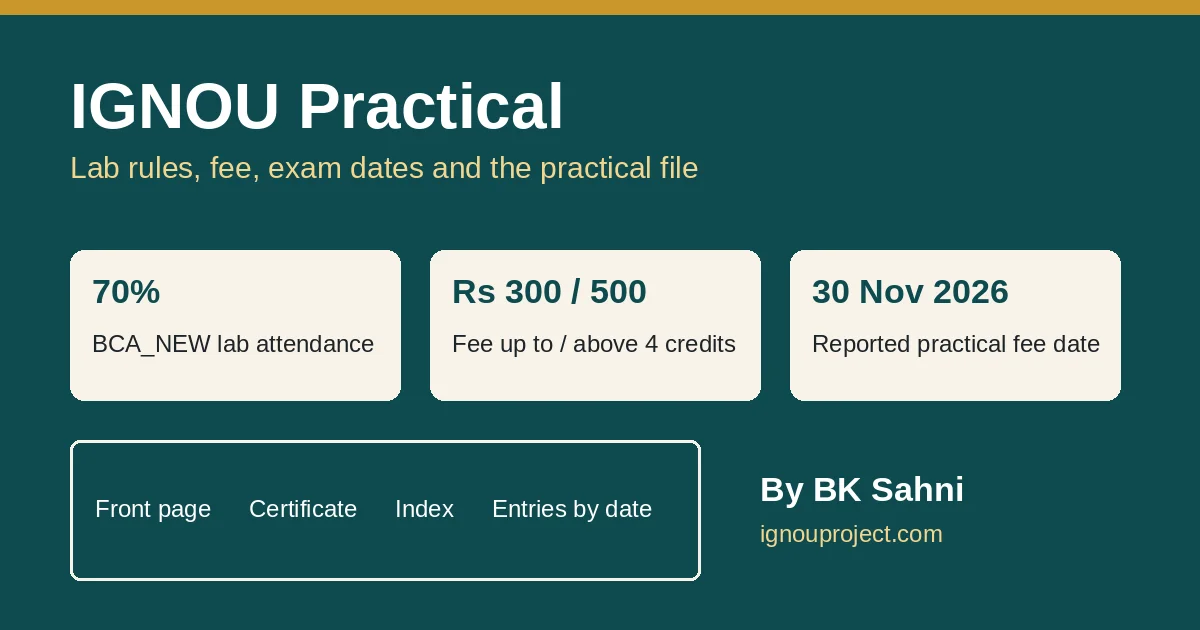
An IGNOU practical is any course your programme marks as a lab, practical or practicum: computer labs in BCA and MCA, science lab blocks in BSc, psychology practicums, journalism portfolios and clinical postings. Each runs on its own rules. Attendance is compulsory under the Prospectus, at 70 per cent in BCA_NEW labs. The exam fee is Rs 300 up to 4 credits and Rs 500 above, and reports of SED's notice put the December 2026 practical fee deadline at 30 November 2026.
Six lines from IGNOU's own papers on practicals
- The Prospectus calls attendance at practical sessions compulsory, and says the Learner Support Centre gives the schedule (p. 24).
- From the January 2023 admission cycle, the practical examination fee is Rs 300 up to 4 credits and Rs 500 above 4 credits, paid with the term-end examination form (p. 27).
- A practical examination need not be held at the centre where you attended counselling or practicals (p. 400).
- SED’s schedule for the December 2025 practicals ran from 16 January to 3 March 2026, in slots of one to three hours, and left four papers that have no question paper to the Regional Centres.
- The BSc (Multidisciplinary) guide still says there is no examination fee for practical courses at present, which the July 2026 Prospectus overrides for later admissions.
- The MJML-220 manual has no attendance rule at all: the practical is a portfolio of 15 activities, marked out of 100 with no viva.
IGNOU Practical Courses Come in Five Kinds
An IGNOU practical can mean a timed computer test, a week of experiments in a college laboratory, a notebook of psychological tests with a viva, a folder of news reports or a hospital posting. The Prospectus groups all of them under one evaluation head, the term-end practical examination (p. 26), but the papers that govern each kind read very differently. Find your kind first; every later section of this page follows it.
| Kind | Typical codes | Where the work happens | How it is examined | Rule source we read |
|---|---|---|---|---|
| 1. Computer and data lab with a set paper | BCSL, MCSL, CITL, MSTL, MGYL, MGGL; MSc (MACS) components such as MMT007P | Lab sessions at the Learner Support Centre (LSC) | Timed paper on SED’s practical schedule, in sets, one to three hours | BCA_NEW guide (May 2026); SED schedule (19.12.2025) |
| 2. Science lab block | BPHCL, BCHCL, BZYCL, BBYCL, BBCCL in BSc; MPHL, MCHL, MBCL in MSc and PGDAC | Consecutive lab days at the LSC or another LSC the University picks | Guided experiments marked as you go, plus an unguided experiment in the last session | BSc (Multidisciplinary) guide (2025); MSc (Biochemistry) guide (January 2024); Prospectus pp. 114, 157, 271 |
| 3. Psychology practicum | MPCL-007; MPCE-014, 024, 034; BPCL and BPCE practicums | Tests you administer, written up in a practicum notebook | Counsellor’s internal marks plus a viva by an external examiner | RC Bhubaneswar guidelines (January 2022, written for online conduct) |
| 4. Production portfolio | MJML courses of MAJMC and PGJMC | At home; no face-to-face classes | Portfolio marked out of 100; no viva | MJML-220 Practical Manual |
| 5. Clinical, studio or field practicum | Nursing practicals; MFAP studio courses | Hospital attached to the LSC, or a 15-day studio block at SOPVA | Set by the programme guide; MFAP learners cannot move up a semester until practicals are cleared | Prospectus pp. 125, 372 |
Built from the documents named in the last column, read in November 2026. Programmes we did not read are left out of the table.
Reading the Code: L Courses, P Components and the Pages for Single Courses
Most separate laboratory courses carry an L in the code, as BCSL-013 or MCHL-011 do, and the Prospectus prints their type as Lab or Practical next to the credits. An IGNOU practical can also sit inside a theory course: SED’s December 2025 practical schedule lists MSc (MACS) papers as MMT007P and MMT008P, the theory code with a P, because in that programme most courses carry a computer practical component (Prospectus, p. 110). The same schedule writes BPOI006(P) and BSSI014(P) with the P in brackets.
So an IGNOU lab course is easy to spot in a programme table, while a practical component is only visible on the exam schedule. Check both before you plan a semester. In BSc disciplines with laboratory work, each 6-credit subject is a 4-credit theory course plus a 2-credit lab course, and the two are taken together compulsorily (p. 157).
We publish separate guides for several single practical courses, and they go further than this page on the course itself: the MPCL-7 experimental psychology practicum, the MPCE-14 clinical practicum, the MPCE-24 counselling practicum, the MPCE-34 organisational practicum, the MGGL-001 cartography guide, the MGGL-002 guide for MSCGG, the MJML-023 digital media guide and the BHCL-121 notebook guide.
Attendance: 70 Per Cent, Every Session, or None at All
Attendance is where an IGNOU practical differs most from a theory course. The Prospectus states the general rule in one line: attendance at practical sessions is compulsory (p. 24). The programme papers then set the bar, and they set it at four different heights.
| Programme or course | Attendance rule | Where it is written |
|---|---|---|
| BCA_NEW lab courses | 70 per cent of the practical counselling sessions in each lab course, recorded course by course at the LSC | BCA_NEW Programme Guide, May 2026, section 2.5.2 |
| MSc (MACS) practical components | At least 70 per cent of the practical sessions prescribed for the course; a semester has 11 to 36 sessions | Prospectus, p. 110 |
| MSc (Biochemistry) labs | At least 70 per cent of each 14-day lab session | MSc (Biochemistry) Programme Guide, January 2024, section 3.4 |
| BSc lab courses | Every lab session; a 2-credit lab is about one week of full-time presence | BSc (Multidisciplinary) Programme Guide, 2025, section 6.9 |
| Nursing practicals (the QNM programme on p. 372) | Every practical session at the hospital attached to the LSC | Prospectus, p. 372 |
| MJML-220 portfolio | No attendance rule: there are no face-to-face classes | MJML-220 Practical Manual |
IGNOU practical counselling is the name the guides give to these lab sessions. In BCA_NEW each session is three hours long and the computer-to-student ratio is 1:2; the guide lists 20 sessions for most lab courses. In the BSc sample timetable, a 2-credit lab runs as 14 four-hour sessions over seven days, two a day: one introduction, 12 guided experiments and one unguided test.
Who Publishes the Schedule: SED, the Regional Centre or Your LSC
Three offices publish an IGNOU practical schedule, and which one applies depends on the kind of course. The Learner Support Centre gives the timetable of practical sessions (Prospectus, p. 24). The Student Evaluation Division (SED) publishes a dated schedule for the term-end practical papers of computer, statistics, geoinformatics and geography courses. For PGDLAN, BLIS and MLIS, SED’s December 2025 date sheet told students to contact their Regional Centre for the exact date and venue.
How an LSC announces a practical batch
Two 2026 notices of one Learner Support Centre under RC Delhi-2, Swami Shraddhanand College (code 0729), show what an IGNOU practical schedule looks like at the centre level for BSc labs. Each batch had a registration day, then three or four practical days, three sessions a day between 8:00 am and 8:00 pm. Registration was through an online form, only RC Delhi-2 students could apply, and students of other Regional Centres needed a no-objection certificate from RC Delhi-2. Both notices said attendance was compulsory and the identity card had to be brought; the June notice also told students to choose papers after checking their grade cards.
| Notice | Programmes | Registration and practical days | Conditions printed |
|---|---|---|---|
| Dated 4 January 2026 (session 2026/01) | BSCG, BSCM, BSCBCH | Three batches: registration on 10 January, 25 January and 14 February; practical days on the weekends that followed; exam slot 12:00 to 4:00 pm | RC Delhi-2 students only, NOC for others; no attendance without the practical examination fee |
| Dated 14 June 2026 (session 2026/04 B) | BSCG, BSCM, BSCBCH | Four batches from 20 June to 13 July | Same conditions; pick papers after checking the grade card |
IGNOU Practical Fee: Rs 300 or Rs 500, and the 30 November 2026 Date
The IGNOU practical fee depends only on the credits of the practical course. The Prospectus sets it for learners from the January 2023 admission cycle onwards: Rs 300 for a practical course of up to 4 credits and Rs 500 above 4 credits, submitted with the term-end examination form (p. 27). The theory examination fee is separate, Rs 200 per course, and fees once paid are neither refunded nor adjusted.
| Practical course | Credits | Fee slab |
|---|---|---|
| BCSL-013 Computer Basics and PC Software Lab (BCA_NEW) | 2 | Rs 300 |
| BPHCL or BCHCL lab paired with a BSc theory course | 2 | Rs 300 |
| MBCL-001 Biochemistry Lab I (MSCBCH) | 4 | Rs 300 |
| MJML-220 Practical: Print (MAJMC) | 6 | Rs 500 |
| MEVL 032 Climate Change Lab Course (MSCCC) | 8 | Rs 500 |
For the December 2026 session, IGNOU’s announcements page lists a Student Evaluation Division notice dated 18 September 2026 on the submission of the project, internship and practical course fee. We could read only its title there; education news reports of the notice give 30 November 2026 as the last date and say no fee is accepted after it. Pay through the link in your Samarth account well before that date.
The ignouproject.com exam fee guide covers the theory fee and late fees.
Check Your Lab Course Before Exam Day
The checker below applies the rules printed in IGNOU’s papers to your own figures: the fee slab, the attendance bar for your kind of practical, and the items that stop students at the door. It stores nothing and sends nothing.
Practical readiness and fee check
Built from pages 24, 27, 110 and 400 of IGNOU's Common Prospectus (July 2026), the BCA_NEW, BSc (Multidisciplinary) and MSc (Biochemistry) Programme Guides and the MJML-220 Practical Manual, read in November 2026.
This checker needs JavaScript. If this line stays visible after the page loads, the script did not run.
Where each verdict comes from
The fee follows the two slabs on page 27 of the Prospectus, which apply from the January 2023 admission cycle; for earlier admissions the checker sends you to the fee shown in your Samarth exam form, because we did not read IGNOU's older fee table. The attendance bar is 70 per cent for BCA_NEW labs, MSc (MACS) components and MSc (Biochemistry) lab sessions, every session for BSc labs, and none for MJML portfolios; for other programmes the checker repeats the Prospectus rule that attendance is compulsory and points you to your programme guide. The sessions you still need are worked out by rounding the bar up to whole sessions. The identity card line comes from page 27 of the Prospectus, and the fee line from the LSC notices described above.
IGNOU Practical Exam Date Sheet: What SED Prints and What It Leaves to Regional Centres
The IGNOU practical exam date sheet is a separate document from the theory date sheet. For the December 2025 session, SED’s Schedule of Term-End Practical Examination is dated 19 December 2025 and covers papers from 16 January to 3 March 2026, after the theory examinations. It comes in three blocks:
| Block | Programmes | Dates | Length of each paper |
|---|---|---|---|
| Main schedule | PGDAST, CRCS, MSc (MACS), MSCIS and PGDIS, DBPOFA and CCITSK, DMOP, ACISE, MSCGI, PGCGI and PGDGI | 16 to 29 January 2026 | Morning and afternoon slots of two to three hours; MSc (MACS) papers 1.5 hours in two batches |
| Computer applications | CIT, CMAD, MCA_NEW, BCA_NEW and BCA (Revised), MCA (Revised), PGDCA | 22 January to 20 February 2026 | One, two or three hours, in sets I to IV across the day |
| Statistics and geography | MSCAST (MSTL 011 to 015), MSCGG (MGGL 001 to 005) | 20 February to 3 March 2026 | As printed against each paper |
The schedule’s own notes leave some papers to the Regional Centres. BPOI006(P) and BSSI014(P) have no question paper, and Regional Centres could hold them in the afternoon of the same date; MSEL032 and MSEL037 also have no question paper, and Regional Centres could pick any convenient date. For the June 2026 session, IGNOU’s announcements page carried practical schedules for one LSC (07162, RC Delhi-1), for BCA, MCA, CIT and MSCDSA and for geoinformatics and computing diplomas, in July 2026.
SED had not published the December 2026 term-end practical examination schedule when this page was written on 10 November 2026. The theory dates are on our December 2026 date sheet page.
On the Day: Venue, ID Card and the File You Carry
The IGNOU practical exam centre is not always your study centre. The Prospectus says plainly that a practical examination need not be held at the centre where you attended counselling or practicals (p. 400), and the MSc Physics and MSCGI pages warn that labs themselves may be organised at another LSC (pp. 114, 116). Read the venue on the notice for your own batch, and compare it with the centre on our exam centre page only for theory papers.
The identity card is the one item every paper agrees on. Without a valid IGNOU Student ID Card issued by the University, examinees are not permitted to appear (Prospectus, p. 27), and both LSC notices above ask for it. If yours is lost, apply for a duplicate before the batch; our lost ID card guide explains the request. SED’s practical schedule says nothing about hall tickets, so check whether your Regional Centre’s notice asks for one; theory hall tickets are covered on the hall ticket page.
Official Papers and Two Study Files
Every rule on this page comes from the official papers in the left column. The right column holds two files we made to help you lay out your own work; they carry no readings and no IGNOU logo, and they are not for submission.
IGNOU's practical papers
- Common Prospectus, Student Registration Division, July 2026: pp. 24, 26, 27, 110, 114, 116, 157, 400 and 401
- Schedule of Term-End Practical Examination, December 2025, Registrar (SED), 19 December 2025
- Date Sheet for December 2025 TEE, SED, 4 November 2025, with the note on PGDLAN, BLIS and MLIS practicals
- BCA_NEW Programme Guide, SOCIS, May 2026
- BSc (Multidisciplinary) Programme Guide, School of Sciences, 2025
- MSc (Biochemistry) Programme Guide, School of Sciences, January 2024
- MJML-220 Practical Manual, SOJNMS
Study frames from our desk, kept out of your file
- Sample record entries (PDF, 8 pages): a computer lab task, a pendulum experiment and a Perceived Stress Scale report, every reading box empty.
- Practical file format template (PDF, 7 pages): front page, certificate frame, index, entry page, attendance log and a submission checklist.
Both were prepared by the ignouproject.com editorial desk with AI assistance from the papers on the left, and are watermarked as study reference.
The IGNOU Practical File: Front Page, Certificate and Order
The IGNOU practical file, also called the record or practicum notebook, is the one piece of a practical that you build entirely yourself. Only one paper we read prints the front page in full: the MJML-220 Practical Manual lists nine details for the cover of the portfolio file, and its submission package. The psychology practicum handbooks print a title page and a certificate as appendices, which we have seen only in reproduced copies.
| Box or item | Who fills it | What to watch |
|---|---|---|
| Name | You | Spell it as on your IGNOU identity card |
| Enrolment number | You | Exactly as on the card; one wrong digit misfiles the marks |
| Programme code | You | MAJMC or PGJMC for MJML courses; use your own programme’s code elsewhere |
| Course code | You | The practical course, such as MJML-220, not the theory course beside it |
| Study Centre code | You | The LSC where you are attached |
| Regional Centre name and code | You | Both, as on your admission record |
| Email ID and phone number | You | One you check during the exam season |
| Address | You | Postal address |
| Submission package (MJML-220) | You | Cover page, IGNOU identity card, examination fee receipt for MJML-220, the table of 15 activities, and all activities together in one file |
| Title page and contents (psychology practicums) | You | A proper title page and a table of contents with page numbers; the BA practicums also want the course code on the title page (RC Bhubaneswar, 2022) |
| Certificate (psychology practicums) | You and the academic counsellor | Signed where your handbook’s appendix shows; we have seen that page only in reproduced copies |
Inside the file, the order most papers imply is front page, certificate, index, then the entries in the order you did them. Our format template follows that order and adds an attendance log; use your own handbook’s appendix wording wherever it prints one.
A Second Reader for Practicum Reports and Record Files
Have your own file read before it is signed or posted
Practicum reports and record files come back for small, avoidable faults: a missing enclosure, a result with no working, an interpretation that ignores the score. Our desk reads the file you wrote against your course's handbook and returns it with corrections.
In a practicum report we read for
- The test or activity named as the handbook names it
- Aim, method, results and discussion all present
- Confidentiality of responses told to the participant, and permission recorded for interviews
- The test enclosed where the guidelines ask for it
- Interpretation tied to the score you report
- References in one style, APA (7th edition) where the guidelines ask
In a practical record file we read for
- Front page details matching your identity card
- Certificate, index and page numbers complete
- Aim, procedure, observations, calculation and result in every entry
- Units and working shown for each result
- Entries in date order, with signatures where your centre asks
See how the correction desk works Ask for a quote on WhatsApp
Review of practicum reports and practical files is priced on WhatsApp after we see the file; synopsis correction is Rs 1,000 and project report correction Rs 2,000. You remain the author of every reading and every sentence, and IGNOU's examiners decide the marks.
Writing Each Entry With Your Own Readings
Every IGNOU practical entry, whatever the subject, answers the same questions in the same order: what you set out to do, how, what you observed, what you calculated, and what you found. The BCA_NEW guide marks lab records inside the lab assignment (records 40 marks, assignment questions 40, viva 20, out of 100), and the BSc guide marks each guided experiment as you perform it, so the record is assessed work, not a fair copy.
| Part | Computer lab | Science lab | Psychology practicum |
|---|---|---|---|
| Aim | The task in one sentence | The quantity to be determined | The test and what it measures |
| Method | Algorithm in your own steps, then your program | Apparatus, theory, numbered procedure | Participant, tool, procedure, rapport and confidentiality |
| Evidence | Inputs you gave and outputs printed | Readings in a table, written in the session | Responses and scoring, reverse items shown |
| Working | Why each test case passes or fails | Calculation with units | Score against the handbook’s interpretation guide |
| Close | Result and viva points | Result, error sources, precautions | Discussion and references |
The BSc guide adds that every experiment must be performed for full marks, and the MJML-220 manual allows a portfolio to be rejected when copying or other malpractice is found. Write readings during the session, in ink, and leave nothing to fill in at home.
Plan the Sessions and Entries You Still Need
When a batch is half done, two numbers matter: how many more sessions you must attend to meet your programme’s bar, and how many entries are still unwritten or unsigned. The planner works both out from the figures you enter.
Practical sessions and record file planner
A planning estimate. Your programme guide fixes the attendance rule; the pace per session and the one spare session used here are our suggestion, explained below the planner.
This planner needs JavaScript. If this line stays visible after the page loads, the script did not run.
The arithmetic, shown
Sessions you must attend = the rule times the sessions in the batch, rounded up to a whole session, minus the sessions you have already attended. Sessions you can still miss = sessions left minus sessions you must attend; when that number falls below zero, the rule can no longer be met in this batch. Entries per remaining session = entries still unwritten or unsigned, divided by the sessions left minus one spare, rounded up; the spare session is our own allowance for a signature or a repeat, not an IGNOU rule.
Marks, Viva and Pass Rules by Kind of Practical
The term end practical examination is marked differently for each kind of IGNOU practical, and a pass in one part does not carry over to another. The figures below are those printed in the papers read for this page.
| Kind | Continuous part | Term-end part | Pass rule | Viva |
|---|---|---|---|---|
| BCA_NEW lab course | Lab assignment 25 per cent: records 40, questions 40, viva 20, out of 100; minimum 40 in the BCSL-013 table | Term-End Practical Examination 75 per cent: the BCSL-135 table prints 50 marks, minimum 20, two hours | Each part passed separately | Inside the lab assignment |
| BSc lab course | Guided experiments, 70 per cent | Unguided experiment in the last session, 30 per cent | General rule of the guide: at least a D grade (35 per cent) in the continuous and the term-end part | Not described |
| MSc (Biochemistry) lab | Guided experiments, 70 per cent | Unguided experiments in the last session, 30 per cent | 40 per cent in each component and overall; no re-evaluation of lab courses | Not described |
| MJML-220 portfolio | None | Production portfolio, 100 marks | 40 per cent | None |
| Psychology practicum (2022 guidelines) | Counsellor’s evaluation of the report, 50 marks | Viva by an external examiner, 50 marks | 40 per cent in MA courses, 35 in the BA courses named | Yes, as the term-end part |
Practical marks reach the grade card like any other course. To turn grade card figures into a percentage that includes practical courses, use our percentage calculator.
Where IGNOU’s Papers Do Not Agree
Some of the rules above conflict between documents. When two IGNOU papers differ, we follow the newer one for the point in question and say so, and the student should follow the notice of their own Regional Centre or LSC for the session.
| Point | One paper says | Another says | How we read it |
|---|---|---|---|
| Practical exam fee | BSc (Multidisciplinary) guide, 2025: no examination fee for practical courses at present | Prospectus, July 2026, p. 27: Rs 300 or Rs 500 from the January 2023 cycle; LSC notices of 2026: no attendance without the practical exam fee | Pay the fee your Samarth form shows; the Prospectus is the later paper |
| Registering the practical in the exam form | BSc guide: practical courses need not be registered for the term-end examination at present | MJML-220 manual: fill the examination form for the practical like any other course | Follow your own programme’s paper |
| Pass mark in BCA_NEW labs | BCA_NEW guide, course tables: minimum 20 of 50 in the term-end practical and 40 of 100 in the lab assignment | Same guide, another line: at least 50 per cent in continuous assessment and the term-end examination | Ask your LSC or RC which figure applies to your course |
| Who sets the exam date | SED’s practical schedule for computer, statistics and geoinformatics papers | SED’s date sheet: contact the Regional Centre for PGDLAN, BLIS and MLIS practicals; BSc guide: unguided test in the last lab session | Find your course on SED’s schedule first, then ask the RC |
| Sessions in BCSL-146 | BCA_NEW guide, syllabus section: 10 sessions | Same guide, counselling table: 20 sessions | Ask your LSC which count it keeps |
Built from the documents named in each row, read in November 2026.
Short on Attendance, Absent or Failed
The papers read for this page give three different outcomes. In BCA_NEW, a student short of the 70 per cent bar has to attend the practical classes again in the next session on paying 50 per cent of the pro-rata fee, through the Regional Centre, and if the practical exam is taken without the attendance, the result is withheld and the University can cancel it. In MFAP, a learner cannot move to the next semester until the practical courses of the current one are cleared (Prospectus, p. 125). The BSc guide asks students to finish lab courses in the year they register for them, as far as possible.
Two more rules apply across programmes. A learner who has already passed a course and applies to appear again gets no result and no refund, according to the note on SED’s December 2025 date sheet. And a change of Regional Centre in practical-oriented programmes such as computer programmes and BSc needs a no-objection certificate from the Regional Centre or LSC concerned (Prospectus, p. 401), which is why LSC notices ask learners of other regions for an NOC.
After the Exam: Marks on Your Grade Card
None of the papers read for this page describes a separate result sheet for practicals: the result is read against the practical course code, with the rest of your courses, on the grade card. To check where your marks and status stand, follow the steps on our assignment and grade card status guide, which covers the same IGNOU pages.
IGNOU Practical Questions Students Bring Us
When is the IGNOU practical exam for December 2026?
SED had not published the December 2026 practical schedule on 10 November 2026. For the December 2025 session the schedule was dated 19 December 2025 and ran from 16 January to 3 March 2026, after the theory papers.
Is there a separate hall ticket for the practical exam?
SED’s practical schedule does not mention one. The Prospectus makes the IGNOU identity card compulsory at every examination, and the LSC notices we read asked for the identity card; check your own Regional Centre’s notice for anything more.
What attendance do I need for practical counselling?
It depends on the programme: 70 per cent in BCA_NEW labs and MSc (MACS) components, 70 per cent of each session in MSc (Biochemistry), every session in BSc labs, and none for MJML portfolios.
What are the pass marks in an IGNOU practical?
The BCA_NEW guide’s course tables print a minimum of 20 out of 50 in the term-end practical and 40 out of 100 in the lab assignment, each passed separately, though another line of the same guide asks for 50 per cent. MJML-220 needs 40 per cent, MSc (Biochemistry) 40 per cent in each component, and the 2022 psychology guidelines 40 per cent in MA courses.
How much is the IGNOU practical fee and when is it paid?
Rs 300 for a practical course of up to 4 credits and Rs 500 above 4 credits, for admissions from January 2023, with the exam form. For December 2026, reports of SED’s notice give 30 November 2026 as the last date for the practical course fee.
Can I do my practical at another Regional Centre?
Only through the Regional Centre: the Prospectus asks for a no-objection certificate when a learner of a practical-oriented programme changes region, and the RC Delhi-2 LSC notices asked learners of other regions for an NOC.
Where do I see my practical result?
On the grade card, against the practical course code. Our assignment and grade card status guide, linked in the section above, shows where to look.
Before Your IGNOU Practical Week Begins
Go through this list a week before your IGNOU practical batch or exam, and again the evening before.
- Find your course on SED’s practical schedule, or the date and venue on your Regional Centre’s or LSC’s notice.
- Register for the batch if your LSC asks for it, and get an NOC first if you belong to another Regional Centre.
- Pay the practical course fee by 30 November 2026 for the December 2026 session, and keep the receipt.
- Work out your attendance against your programme’s rule with the planner above.
- Complete every entry in the record file during its session, with signatures where your centre asks.
- Carry your IGNOU identity card, the record file or notebook, and anything else your notice names.
Papers read for this guide
- IGNOU Common Prospectus, July 2026, Student Registration Division: pp. 24, 26, 27, 110, 114, 116, 125, 157, 271, 372, 400, 401.
- Schedule of Term-End Practical Examination, December 2025, Registrar (SED), dated 19 December 2025.
- Date Sheet for December 2025 Term-End Examination, SED, 4 November 2025.
- IGNOU announcements: SED practical schedules for June 2026 (LSC 07162, RC Delhi-1) and the notice of 18 September 2026 on the project, internship and practical course fee (title).
- BCA_NEW Programme Guide, May 2026, School of Computer and Information Sciences.
- Programme Guide, BSc (Multidisciplinary), 2025, School of Sciences.
- Programme Guide, MSc (Biochemistry), January 2024, School of Sciences.
- Practical Manual, Practical: Print (MJML-220), School of Journalism and New Media Studies.
- Guidelines for online conduction of practicals, MAPC and BAPC, IGNOU RC Bhubaneswar, 25 January 2022.
- BSc practicals schedule, session 2026/01 and session 2026/04 B, IGNOU LSC 0729, Swami Shraddhanand College, RC Delhi-2, dated 4 January and 14 June 2026.
ignouproject.com is an independent service run by Shri Chakradhar Publication Private Limited. It is not affiliated with or endorsed by IGNOU. Check dates and venues on the notices of your own Regional Centre and Learner Support Centre.

BK Sahni iD 0009-0005-8092-459X
Founder, Shri Chakradhar Publication Pvt. Ltd. & ignouproject.com — helping IGNOU distance-learning students since 2010 (5,00,000+ students supported across MBA, MCom, MA & more). Author of IGNOU exam guides, solved assignments & project reference books.
Disclosure: Shri Chakradhar Publication Pvt. Ltd. and ignouproject.com are independent third-party study-help services — not the official IGNOU website. Always verify final dates and rules on ignou.ac.in.