How to do the IGNOU MNML 001 Practical for PGDEME, from first script to viva
The IGNOU MNML 001 Practical follows a fixed order: you script and record ten radio, television and writing items, handwrite every script, compile them in one folder with a disc, hand it to your PGDEME study centre, and then explain the work at a viva.
Short answer for MNML-001
For the IGNOU MNML 001 Practical, handwrite every script, record the six audio and video items yourself, keep each item inside its printed limit, copy the files to one labelled CD, DVD or pen drive and submit the folder at your study centre. The portfolio earns 70 marks and the viva 30; 40 percent completes the course.
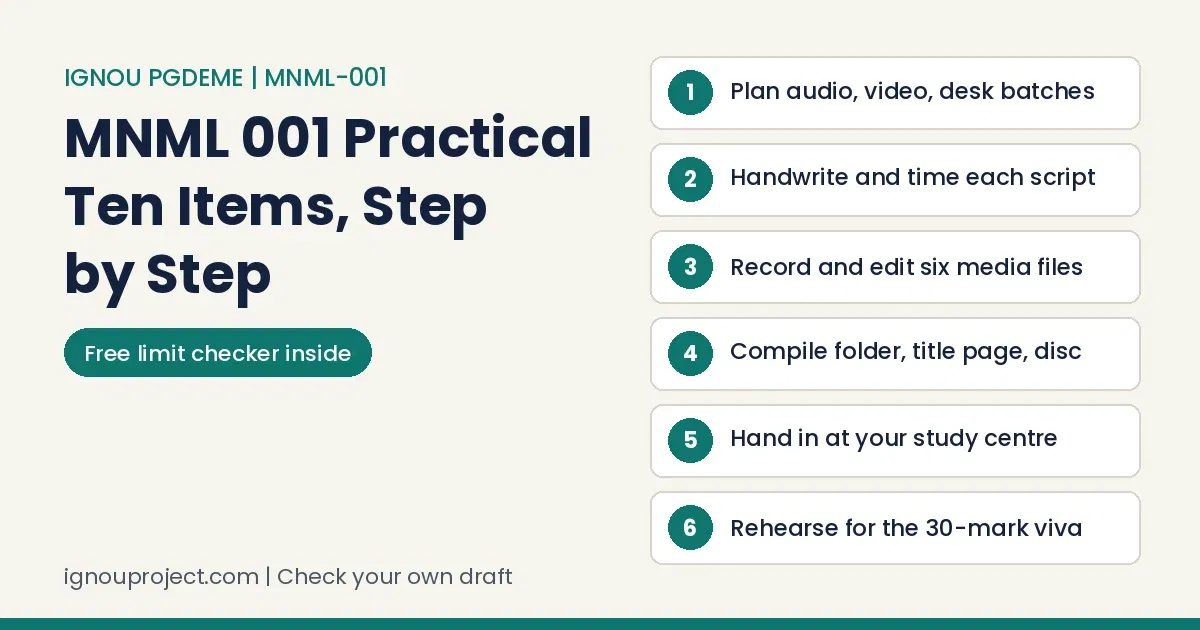
- Read sections 9.0 and 10.0 of the November 2022 manual.
- Group the items into batches and fix recording days.
- Draft, time aloud, then copy each script by hand.
- Record, shoot and edit the six media items.
- Compile the folder, title page and disc; hand them in.
- Rehearse every item aloud for the viva.
Across practical courses, learners who clear theory papers easily often freeze once production starts. MNML-001 offers nothing else to lean on: the course is the ten items plus the viva.
Some learners discover only midway through the session that their diploma has a practical. In PGDEME it is MNML-001, 4 credits, so put it in your plan from month one.
The 8-credit project is a separate course; see our PGDEME project guide for MNMP-101.
Plan the ten items in three batches
The IGNOU MNML 001 Practical mixes audio, video and desk writing, so group items by equipment. Our suggested grouping, not a manual rule:
- Audio: item 1 story (3 to 5 minutes), item 2 PSA (up to 150 words), item 9 if recorded for radio.
- Video: item 6 PTC, item 8 photo story (2 to 3 minutes), item 9 if for television, item 10 package (1.5 to 2 minutes).
- Desk: items 3, 4 and 5, plus the item 7 bulletin script (about 600 words, paper only).
In our records, 70 to 80 percent of learners begin only in the final month before a date. An interview cannot be rushed: it needs a guest’s time.
Many learners wait for an expected one-month extension. This manual prints no folder date at all, so ask your study centre for its date and plan backwards.
In many practicals, missing a compulsory session costs the exam. The MNML-001 manual sets no attendance rule; lectures come through Gyan Darshan, Gyan Vani, Gyandhara and online platforms, with schedules by email or SMS.
Audio items: the short story and the radio PSA script
In the IGNOU MNML 001 Practical these two audio items carry 20 marks, and each needs a handwritten script plus an audio file. The manual’s radio advice: short sentences and simple language, because a listener cannot go back.
Item 1: short story for radio or podcast (10 marks)
- Write a story you can narrate in 3 to 5 minutes; read it aloud against a timer.
- Record in a quiet room on a phone or flash recorder; the manual calls both simple and effective.
- Trim fumbles and pauses in an audio editor and level the voice.
- Copy the final wording by hand so the script matches the file.
Item 2: radio PSA script on a contemporary issue (10 marks)
A radio PSA script has no time to warm up. A layout that fits 150 words: a hook, the problem in one or two facts, the action you want, and a tag repeating that action. Count every word, the tag included.
On practical files, written work loses the most marks and is the easiest to repair. Note i makes every MNML-001 script handwritten, so a clean, legible copy is part of the task.
Hindi-medium writers often lack English broadcast terms, and the reverse happens too. Note ii allows English or Hindi; choose the language you will also defend at the viva.
We have seen work returned for running past a set length. The PSA ceiling here is 150 words, and the tag counts.
Radio news bulletin script with three sound bites (item 7)
Item 7 is the one news item in the IGNOU MNML 001 Practical marked from the script alone: 10 marks, about 600 words, 5 to 6 minutes on air. With no audio file, the bites must show on paper. A clear radio news bulletin script runs:
- Greeting and two or three headline lines.
- Items in order of importance, in short spoken sentences.
- Each bite as a cue line: SB 1, speaker and role, duration, in-words and out-words, then the words spoken.
- At least three bites, spread across items.
- Headlines again and the sign-off.
Learners often look for an official topic list. MNML-001 prints none for its news items, so use current news you can verify.
Learners collect bulletin layouts from a counsellor, a senior and the internet. The manual fixes only length and bites, so follow your academic counsellor, who evaluates the work (section 8.2).
Video items in the IGNOU MNML 001 Practical: PTC, photo story and interview
Piece to camera script for item 6 (10 marks)
Pick a development story: water, health, roads, schools or livelihoods. Write the piece to camera script as spoken: where you stand, the one fact viewers must keep, and a hand-back line. No length is printed, so keep it tight. Frame at mid-shot and record several takes. Hand in the handwritten script and the video file.
Item 8: video story from still photographs (15 marks)
Your own photographs only, no voiceover or commentary, music if needed, a title, 2 to 3 minutes. Sequence wide, medium and close frames, then an ending frame. Only the video file goes in.
Item 9: interview with a local figure (10 marks)
Choose a local politician, sports person, artist, social worker or academician; record 5 to 10 minutes for radio or television. Our MJML 221 audiovisual practical guide has more shooting tips.
On project courses we have seen findings built on imagined data. Item 9 needs the same honesty: a real conversation you set up and record with a real local person.
Ready-made files circulate with only the name swapped, and identical work stands out. Item 8 photographs must be clicked by you only, so be ready to say where you took each one.
Worked example: a TV news package script, timed line by line
Item 10 carries 20 marks, the largest share of the IGNOU MNML 001 Practical.
Practice script: a 1 minute 45 second package
Brief (our own, for practice only): residents of one city ward dig rainwater recharge pits before the monsoon. Names are placeholders.
| Time | Video | Audio |
|---|---|---|
| 0:00 to 0:10 | Wide: lane after rain, water pooling | VO: Every monsoon, this lane used to flood within an hour. |
| 0:10 to 0:30 | Residents digging; close-up of a pit; rooftop pipe | VO: This year residents dug recharge pits along the drain. Roof water now goes into the ground. |
| 0:30 to 0:42 | Mid-shot of a resident, name super | BYTE 1: what changed for her household. |
| 0:42 to 1:02 | The same lane dry after a shower | VO: The pits cost little and took two weekends of shared work. |
| 1:02 to 1:14 | Engineer at the site, role super | BYTE 2: how the pits work and are maintained. |
| 1:14 to 1:34 | Reporter beside a pit, mid-shot | PTC: location, key fact, the open question for next year. |
| 1:34 to 1:45 | Wide of residents at work; fade | VO sign-off: reporter’s name and place. |
Working: 10 + 20 + 12 + 20 + 12 + 20 + 11 = 105 seconds (1 minute 45 seconds), inside the 90 to 120 seconds that 1.5 to 2 minutes allows.
Result: the handwritten two-column script goes in the folder and the video on the disc. As the manual advises for television, let words support the pictures, not describe what viewers already see.
Three written pieces: film review, news anchor piece and documentary analysis
The writing side of the IGNOU MNML 001 Practical is items 3, 4 and 5, 5 marks each, handwriting only. Each needs a judgement backed by examples.
- Film review, 400 to 600 words: title, director, year; premise without spoilers; two or three craft points; verdict.
- Favourite news anchor, 300 to 500 words: each reason with an example from a broadcast: voice, pronunciation, language, composure.
- Documentary analysis, 400 to 600 words: subject, structure, interviews, archive, narration and music, then strengths and weaknesses.
Another SOJNMS manual’s written items are covered in our MJML 220 print practical guide.
Evaluators look for the course idea behind an opinion. When you praise or fault a scene in item 5, name the format, shot choice or presentation technique from the manual’s content list.
Text lifted from review websites shows even in handwriting, and note vi warns that heavy copying can sink the whole portfolio.
AI-written reviews read alike. Items 3 and 5 ask for works you watched recently, so draft from your own viewing notes.
Check each item against its word or time limit
Nine of the ten IGNOU MNML 001 Practical items carry a printed limit; only the item 6 PTC has none.
Limit checker for the ten items
Your result appears here.
Without JavaScript, check by hand: item 1, 3 to 5 minutes; item 2, up to 150 words; items 3 and 5, 400 to 600 words; item 4, 300 to 500; item 7, about 600 words and 5 to 6 minutes; item 8, 2 to 3 minutes; item 9, 5 to 10; item 10, 1.5 to 2.
Slips that cost portfolio marks, and how to repair them
| Slip | Repair |
|---|---|
| Typed scripts | Copy every script and piece by hand (note i). |
| PSA at 170 words | Cut adjectives and the second fact. |
| Downloaded pictures in item 8 | Reshoot with your own camera or phone. |
| Narration over item 8 | Remove it; music and a title are allowed. |
| Item 7 bites mentioned, not written | Write a cue line and the words for each of three bites. |
| Disc plays only on your laptop | Export common formats, name files by item, test on a second computer. |
| Some learners pay for spiral binding. MNML-001 asks for a folder and names no binding, so a firm folder with the disc fixed inside will do. | |
| Learners ask which page comes first. The manual sets only the Annexure 2 title page and item numbers 1 to 10; file in that order. | |
| Learners ask how many copies to make. One folder with its disc goes in, and note vii asks you to keep a full copy yourself. | |
Compile and hand in the IGNOU MNML 001 Practical folder
The IGNOU MNML 001 Practical folder goes to one place, your study centre, which arranges evaluation and the viva.
- Copy the Annexure 2 title page to the front: codes, name, enrolment number, contact details, study and regional centre codes, date and signature.
- File items 1 to 10 in order, each numbered at the top.
- Put the files for items 1, 2, 6, 8, 9 and 10 on one CD, DVD or pen drive, write your details on it and attach it (note v).
- Keep a full copy at home (note vii).
- Hand the folder in at your study centre (note viii); ask for a dated acknowledgement.
Another SOJNMS portfolio course is covered in our MJML 023 digital media portfolio guide.
Title pages often carry a wrong enrolment number or centre code. Annexure 2 asks for both centre codes; match each with your admission record.
Unsigned forms are a frequent slip. The one signature MNML-001 needs from you sits at the foot of the title page, beside the date.
Some learners email work to save a trip. The manual gives a single route: the study centre, with media on the attached disc or drive.
MNML 001 viva questions to rehearse
The viva for the IGNOU MNML 001 Practical carries 30 marks and is held generally at the study centre, with external experts invited. The manual prints no questions, so these prompts follow its learning outcomes.
Rehearse these six viva prompts
- Why this story for your package, and who is its audience?
- Where did you stand for the PTC, and why that frame?
- Where did you take the item 8 photographs?
- How did you place the three bulletin sound bites?
- What did you cut from the interview, and why?
- Which pre-production steps came before recording?
Our guide to questions asked in an IGNOU project viva adds general habits.
Learners often take the viva lightly, yet a tidy folder scores poorly when its maker cannot explain it. Talk through each item aloud before the day.
Some learners are unsure whether a viva applies to them. In MNML-001, section 10.0 builds it into the course total.
Practical dates are announced locally, and missing one can cost a cycle. Your study centre coordinator gives the date, time and venue, so keep your phone and email current.
Fee, timing and the exam form for PGDEME learners
You fill the term-end examination form for the IGNOU MNML 001 Practical like any other PGDEME course, and can appear only one year after registration: a January admission reaches December, a July admission the next June. From the January 2023 admission cycle, the prospectus fee is Rs 300 for a practical up to 4 credits, which covers MNML-001. For December 2026, the SED notice listed on 18 September 2026 set 30 November 2026 as the last date for practical course fees, paid through Samarth.
See our IGNOU practical fees and files overview, and check theory paper dates in the December 2026 exam date sheet so recording days do not clash.
The Rs 300 and Rs 500 figures get confused. Rs 500 is for practicals above 4 credits; MNML-001 has 4.
A published date can belong to another step. For MNML-001, 30 November 2026 is the fee date; the folder date comes from your study centre.
Without a receipt, missing marks are hard to chase. Keep the Samarth payment receipt with the folder acknowledgement.
Have your own scripts checked before the folder goes in
Before the final hand copy, send your own drafts (bulletin, PSA, PTC or package script) on WhatsApp at +91 93546 37830. We mark what to fix against the manual’s limits; you make the changes and remain the author. This check is quoted on WhatsApp, as listed on our services and charges page.
Questions PGDEME learners ask us
PGDEME questions we answer often
Can I record the IGNOU MNML 001 Practical items on a mobile phone?
Yes. Section 5.0 calls a flash recorder or mobile phone simple and effective, and keeps studio equipment for very professional work.
Is the hand-in process the same at every centre?
The manual leaves folders and the viva to your own study centre.
Advice from friends at other centres can mislead, because centres run submissions differently. For MNML-001, ask your own coordinator.
Where do my MNML-001 marks show?
After your study centre sends its award list, marks show on the IGNOU awards and marks transmission status page. For missing practical marks, the July 2026 prospectus lists practicalsed@ignou.ac.in and 011-29572212.
Practical marks often reach the grade card after theory marks; PGDEME lasts one year, so a late MNML-001 entry can hold the diploma.
Putting the IGNOU MNML 001 Practical together
Record early, write by hand, stay inside each limit and rehearse your choices aloud. For the MNM theory courses behind the practical, see the reference material for this course on our publication site. MAJEM learners, who share MNM-002 to MNM-004, can use our MAJEM handwritten assignment guide.
Three causes repeat: news reaches learners late and varies by centre, practicals expect time distance learners lack, and files get treated as layout, not proof of skill.
Learners who finish well start early, check the rules at their own centre, date every draft, and can explain each item without notes.
Official documents read for this guide
- Practical Manual: Electronic Media, MNML-001, SOJNMS, November 2022 (eGyanKosh)
- PGDEME Programme Guide (English)
- IGNOU Common Prospectus July 2026
- IGNOU announcements: SED practical course fee notice, December 2026
Read in November 2026: the November 2022 MNML-001 manual, the July 2026 Common Prospectus, the PGDEME Programme Guide and the SED fee notice. Drafting was AI-assisted, rules were checked against these sources, and BK Sahni publishes it under his editorial responsibility.
ignouproject.com is not affiliated with, authorised by or endorsed by IGNOU. We check a learner’s own scripts and drafts; the learner remains the author of every item, and IGNOU’s examiners award the marks.

BK Sahni iD 0009-0005-8092-459X
Founder, Shri Chakradhar Publication Pvt. Ltd. & ignouproject.com — helping IGNOU distance-learning students since 2010 (5,00,000+ students supported across MBA, MCom, MA & more). Author of IGNOU exam guides, solved assignments & project reference books.
Disclosure: Shri Chakradhar Publication Pvt. Ltd. and ignouproject.com are independent third-party study-help services — not the official IGNOU website. Always verify final dates and rules on ignou.ac.in.