IGNOU MMEL 104 Practical: the route from first spell to a signed log book
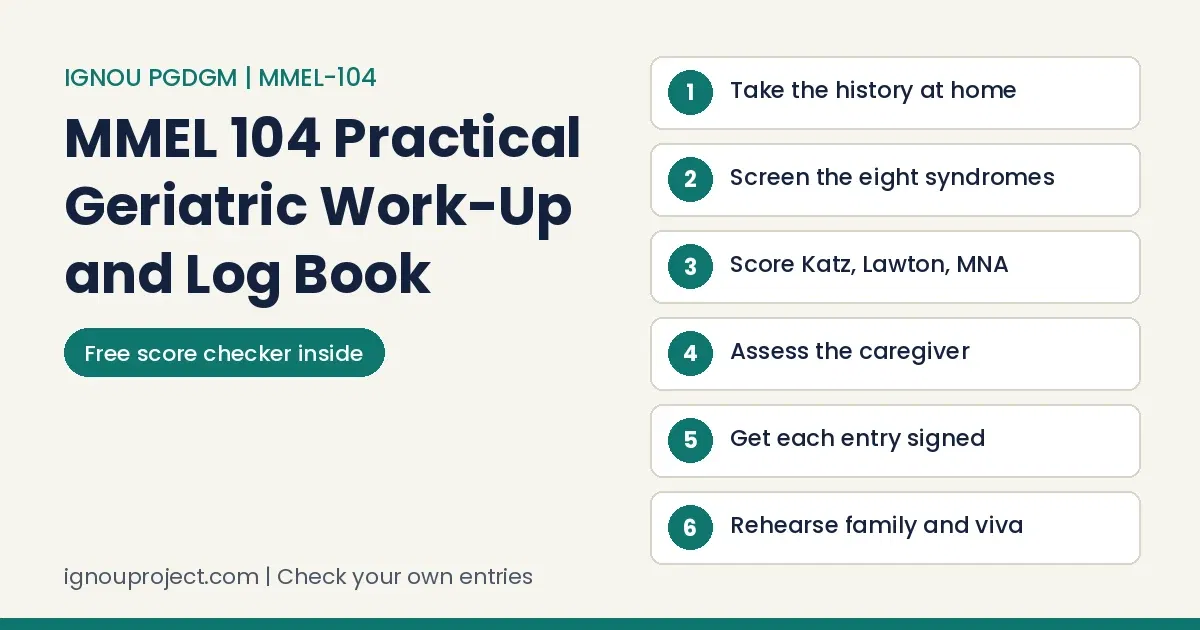
The IGNOU MMEL 104 Practical (Basic Geriatrics Practical) is a 6-credit PGDGM course in which you assess older people at home, run screening tools, teach a small group, counsel, and record each task in a log book your counsellor countersigns. This guide shows how to do each one.
Two halves, one log book
The IGNOU MMEL 104 Practical carries 100 marks: 50 internal (online sessions plus two face-to-face spells) and 50 in a term-end practical where you work up a family, answer spots and face a viva. You need 25 in each half, and only countersigned work counts internally.
Internal marks come from online asynchronous sessions (20 percent), the first spell (20), online synchronous sessions (40) and the second spell (20). The other courses are in our PGDGM course overview.
Practical work, not theory, is what keeps many learners awake; we see good exam writers stuck at the record stage. Here each half has its own 25-mark floor.
We often meet learners who learn of a course’s practical side only halfway through the session. In PGDGM the first spell is clubbed with the induction meeting.
Before the first contact spell: set up three things
- Read MME-104 first. Block 1 assumes you have studied the Basic Geriatrics theory course.
- Carry the log book to every spell and to your workplace.
- Note the two windows. The guide gives May to June and September to October as tentative spell windows, both compulsory and in sequence. If you will miss one, tell your PIC and the Programme Coordinator in advance.
IGNOU MMEL 104 Practical spells run at a Learner Support Centre. For practical rules across IGNOU, see our IGNOU practical rules for 2026.
Many doctors who write to us work and run a family; a missed practical day is where many lose a full session. Both MMEL-104 spells are compulsory.
Practical sessions come on set days, sometimes at a distant centre, and those who skip the notice board lose a batch. The PGDGM windows are only tentative, so keep checking with your LSC.
Rules heard from a colleague at another centre may not hold at yours. Your LSC fixes spell days and online timings; the guide fixes the marks.
Comprehensive geriatric assessment format: the order to follow at the home
Block 1 Units 1 and 2 set the comprehensive geriatric assessment format for every IGNOU MMEL 104 Practical case. Enter only when invited, sit somewhere private, promise confidentiality, then work in this order:
- Demographic details and living arrangement.
- Complaints and present illness, checked with a caregiver if memory is poor.
- Past history and a review of systems.
- Medication, addiction and vaccination history.
- Family and socio-economic history; abuse questions in private (EASI if suspected).
- Function: Katz or Barthel for basic ADLs, Lawton for IADLs, open questions for advanced activities.
- Examination and the eight syndrome screens.
- Home environment and the Kingston Caregiver Stress Scale.
- Summary and recommendations that suit the family’s means.
Three versions of a format (manual, counsellor, internet) confuse many learners. Here the Block 1 order, your log book’s columns and your counsellor’s signature settle it.
Clinical notes in English trouble some learners schooled in Hindi. The prospectus sets English as the PGDGM medium, so write histories in English whatever language the interview used.
Screen, assess, recommend: the eight syndrome checks and their cut-offs
Unit 2 runs a short screen for each syndrome, a full tool only if it is positive, then advice or referral. Keep this table handy on IGNOU MMEL 104 Practical visits.
| Syndrome | Screen | If positive | Line the manual prints |
|---|---|---|---|
| Dementia | Three words, two orientation questions, recall | MMSE, HMSE, MoCA, GPCOG | Any orientation miss or word not recalled: impairment likely |
| Depression | Two questions (low mood, lost interest) | 8-item questionnaire, PHQ, GDS | 0 to 2 symptoms; 3 or more depression |
| Malnutrition | Weight loss over 3 kg in 3 months | MNA | 12 to 14 normal; 8 to 11 at risk; 0 to 7 malnourished |
| Vision | One eye-problem question | WHO simple eye chart | Mild: worse than 6/12 |
| Hearing | Whisper four words per ear, after checking for wax | Risk factors | Fails the screen: refer |
| Incontinence | Any leak in 3 months | ICIQ-SF | Type the leak first |
| Sarcopenia | SARC-F | Handgrip, chair stand, TUG | 4 or more: positive |
| Falls | Three STEADI questions | TUG, 30-second chair stand, orthostatic BP | Any yes: high risk |
With under five or six years of schooling, record signs of dementia instead of a formal tool. Writing score, band and next step together is the habit our MPCL 7 test scoring guide also teaches.
In practicals built on scored tests, we find adding-up errors, wrong reference tables and readings the score cannot carry. Write the cut-off beside each score.
Worked example: a geriatric family work-up scored step by step
In the IGNOU MMEL 104 Practical term-end, a geriatric family work-up replaces the case. The figures are invented for teaching.
Practice family: a widow of 76 and her caregiver
A vegetarian widow of 76 lives with her son’s family; her daughter-in-law cares for her. She fell once this year.
Katz ADL scoring and Lawton IADL scoring in this case
| Tool | Item scores | Total | Reading |
|---|---|---|---|
| Katz ADL | Bathing 1, dressing 1, toileting 1, transferring 1, continence 0, feeding 1 | 5 of 6 | One dependent activity: plan support |
| Lawton IADL (woman, 8 areas) | Telephone 1, shopping 0, food 0, housekeeping 1, laundry 1, transport 1, medicines 0, finances 1 | 5 of 8 | Help needed with shopping, cooking, pills |
| MNA screen (A to F) | 1, 2, 2, 2, 2, 1 (BMI 46.0 / 1.52 squared = 19.9) | 10 of 14 | At risk of malnutrition |
| Depression, 8 items | Sleep 1, energy 1, others 0 | 2 | Symptoms band: brief psychological support |
| SARC-F | 1, 0, 1, 2, 1 | 5 | Positive: grip, chair stand, TUG |
| Kingston (10 items) | 3, 2, 3, 4, 3, 2, 4, 2, 1, 2 | 26 (range 10 to 50) | No bands printed; items 4 and 7 scored 4 |
Weight. 48.5 kg three months ago, 46.0 kg now: 2.5 kg, or 5.2 percent. Block 2 calls 7.5 percent in 3 months significant; this is below it, yet the MNA flags risk. Record both.
Plan. ICIQ-SF for the leak; grip and chair stand; home safety review; pulses with cereals and peanuts, not fish; a caregiver talk on her two top worries.
Some learners fill a record with figures they never collected. These numbers are ours for teaching; your log book needs your own patient’s answers, taken at the visit.
Score checker: test your own figures against the manual
Enter totals from your own IGNOU MMEL 104 Practical work-up; empty boxes are skipped.
Family work-up score checker
Result appears here.
Units 3 and 4: the health education session and the counselling practice
Health education. Pick a topic the group needs (falls, nutrition, exercise), a poster, audio or video, and 5 to 10 older men or women. Show the material, give time, then ask what they see and whether the message suits them; note the answers for your report.
Counselling. Unit 4 uses GATHER: Greet, Ask, Tell the choices, Help them decide, Explain how to act, Return visit. Role-play with a colleague, then have one observe a real session with the older person’s permission. Our MPCE 24 counselling practicum guide shows one way to lay out session notes.
Reports with a fixed sequence lose marks for every part left out. Unit 3 names four for this report: pre-listening activity, post-listening discussion, participant profile and supporting material.
AI-generated reports pasted in unchanged are another thing we meet, which is why matching sentences come from different learners. Describe your own group and what its members said.
Block 2 in practice: one field exercise and the institutional visit
Unit 1 asks for at least one of eight community exercises, using a questionnaire, NPHCE centre records, a group discussion or ASHA workers. Units 2 to 4 add anthropometry, a diet plan from ICMR tables and ethics checklists. On the Unit 5 visit, question the manager and the residents, and get the log book’s infrastructure checklist signed within the spell. For staff training, IGNOU’s own CGCA geriatric care certificate is one benchmark.
Institutions often hesitate to host distance learners or give them little access. The guide says MMEL-104 learners may be taken on a field visit to an old age home or day care centre, so ask your LSC first.
Doctors in service ask whether their hospital work counts. As practice, yes: the guide wants workplace activity between spells logged.
Some learners paste web material into a field note unchecked. Name the source of any district figure, such as NFHS-5, and keep your own observations apart.
Writing a PGDGM log book entry the counsellor will sign
A PGDGM log book entry shows what you did and why, written at the time and countersigned at the PSC/LSC.
| Weak entry | Entry that shows skill |
|---|---|
| Examined elderly female, advised diet. | Home visit, woman 76, consent taken. MNA A to F = 10 (at risk); 5.2 percent loss in 3 months. Advice: pulses with cereals; review in a month. |
| Did health education. | Falls talk, poster, 7 men aged 62 to 80. Post-listening: 4 have loose rugs at home. |
The same dated, signed habit for another SOHS course is in our MHHL 020 log book guide.
More marks are lost in the record than anywhere else, and it is the easiest part to put right. Under the guide, an activity the counsellor has not signed does not count internally.
Day after day of “patient examined” shows presence, not learning. Link each entry to something Block 1 teaches: syndrome, tool, score, advice.
A log completed in a single sitting shows itself: lines repeat and dates land on Sundays. Writing each case then and there closes that gap.
Mistakes in the IGNOU MMEL 104 Practical record and how to fix them
These slips cost IGNOU MMEL 104 Practical learners marks.
| Mistake | Fix |
|---|---|
| Score written with no band | Add band and next step beside every total |
| MNA band read off the wrong total | The 12 to 14, 8 to 11 and 0 to 7 bands match items A to F (maximum 14); say which items you scored |
| Lawton total with no denominator | Write out of 8, or out of 5 where food, housekeeping and laundry are left out for a man |
| Copied records from the internet, with only the name and enrolment number changed, do turn up | At the term-end you work up a family before examiners; only your own cases help |
| Certificates left without the counsellor’s signature turn up in records we see | The completion certificate needs only the PSC/LSC counsellor; collect it at the last spell |
| Proof of attendance missing or not countersigned is another gap we notice | Attach the certificate of completion of practical activities the guide asks for |
MMEL 104 viva questions to practise aloud
IGNOU MMEL 104 Practical examiners come from community medicine, orthopaedics and medicine; spots may include specimens, X-rays, instruments and charts. Practise these MMEL 104 viva questions on your own work-up:
- Which falls screen did you use, and what made this patient high risk?
- Why the MNA screen, and which band did the score fall in?
- How did you secure consent and privacy before asking about abuse or leaks?
- Which Kingston items scored highest, and what did you advise?
- How would the diet plan change for a vegetarian family on a small budget?
For vivas across IGNOU, see our general IGNOU viva question guide.
Some doctors treat the viva lightly, yet a neat log book scores badly when its writer cannot explain method or findings. Those who examined their own patients answer most calmly.
Learners often ask whether their practical has a viva. Here the guide sets one inside the term-end, beside spots and the family case.
Some learners email records instead of using the course route. Here the log book goes with you to the term-end for verification and is handed back.
Form, fee and receipts for the December term-end
For the IGNOU MMEL 104 Practical, SED’s December 2026 notice says practical fees are paid only through your Samarth Portal login, by 30 November 2026. The July 2026 prospectus sets Rs 300 up to 4 credits and Rs 500 above, not refundable; the 2024 guide prints Rs 250 per paper, so pay what Samarth shows and ask your PIC about any gap. Your Coordinator or PIC sets the term-end date, usually in November or December. The MME-104 theory slot is in the December 2026 theory date sheet.
In our records, 70 to 80 percent of learners start moving only in the last month before any deadline. That month is now, with practical fees closing on 30 November 2026.
Many learners expect IGNOU to push every last date back. SED’s notice says no fee is taken after the deadline, so treat it as fixed.
The Rs 300 and Rs 500 figures get mixed up often. With 6 credits, this practical falls under the Rs 500 line.
Ten checks to tick before your IGNOU MMEL 104 Practical day
Ten ticks before the term-end practical
Have your own entries or report read
For a second reader on your own entries, report or field note before the counsellor sees them, send them on WhatsApp (+91 93546 37830); the check is quoted there, with details on our services and charges page. We mark gaps against the manual; you correct them, and your counsellor and IGNOU’s examiners decide the marks.
Questions learners ask about this geriatrics practical
Does practice at my own hospital count for the IGNOU MMEL 104 Practical?
Yes, as practice recorded in the log book between spells; the two spells stay at your LSC.
What happens if I miss one of the two contact spells?
Tell your PIC and the Programme Coordinator in advance and ask for an alternate spell, usually arranged zonally; failing that, you join the next batch.
How many Block 2 community exercises must I complete?
At least one of the eight; if your supervisor agrees, you may take on a second with fellow learners or doctors where you work.
Finishing the IGNOU MMEL 104 Practical well
Entries written on the day, banded scores and one rehearsed family work-up carry the IGNOU MMEL 104 Practical. The MME-104 theory paper is not a condition for the term-end. Afterwards, the IGNOU practical marks transmission page shows your award once the centre sends it. Theory reading for PGDGM is on our publication site.
Practical awards can reach the grade card after theory results; if any of the three PGDGM practical awards is late, the diploma waits.
Across courses we keep meeting three roots: news that comes late and varies by centre, demands that assume free time, and a record seen as formatting, not proof of skill.
Doctors who finish without trouble start in the first spell, check rules with their own centre, date each entry, get it signed before leaving and can talk through any page.
Documents this MMEL-104 guide draws on
- MMEL-104 practical manual, Block 1 (Units 1 to 4) and Block 2 (Units 1 to 5), SOHS, April 2023
- PGDGM Programme Guide, School of Health Sciences, January 2024
- IGNOU Common Prospectus July 2026: section 8.56 (PGDGM) and the practical fee rules
- IGNOU announcements: SED notice on December 2026 practical course fees
Sources read in November 2026: Blocks 1 and 2 of the MMEL-104 manual (April 2023), the PGDGM Programme Guide of January 2024, IGNOU’s Common Prospectus for July 2026 and the SED notice on December 2026 practical fees. Drafting was AI-assisted; each rule was checked against these documents, and the guide is published under BK Sahni’s editorial responsibility.
ignouproject.com is not affiliated with IGNOU, nor authorised or endorsed by it. We check and explain the learner’s own entries and reports; the learner remains the author of every log book entry, report and note.

BK Sahni iD 0009-0005-8092-459X
Founder, Shri Chakradhar Publication Pvt. Ltd. & ignouproject.com — helping IGNOU distance-learning students since 2010 (5,00,000+ students supported across MBA, MCom, MA & more). Author of IGNOU exam guides, solved assignments & project reference books.
Disclosure: Shri Chakradhar Publication Pvt. Ltd. and ignouproject.com are independent third-party study-help services — not the official IGNOU website. Always verify final dates and rules on ignou.ac.in.