The IGNOU BCOMF project is a crucial component of the Bachelor of Commerce (BCOMF) program offered by the Indira Gandhi National Open University. BCOMF project work serves as a practical application of the theoretical knowledge acquired throughout the course. It allows students to demonstrate their understanding of commerce-related concepts. The project fosters analytical and problem-solving skills. It provides hands-on experience in areas like financial analysis, accounting, or business management. The project can cover various areas of commerce, including financial markets, taxation, auditing, and business law. It gives the student the opportunity to delve deeper into an area of commerce that they find interesting.
In essence, the IGNOU BCOMF project bridges the gap between classroom learning and real-world application, preparing students for future careers in commerce.
Overview: What the IGNOU BCOMF Project Means
The IGNOU BCOMF Project is a structured academic work that checks how well learners apply commerce concepts to real business and finance problems. It typically includes a topic selection, synopsis approval, guided research or field study, a written report, and submission as per the programme requirements.
A well-prepared BCOMF project strengthens skills in:
- Financial and business analysis
- Data collection and interpretation
- Report writing and presentation
- Practical understanding of commerce domains
What are the approved areas or domains for the IGNOU BCOMF Project?
The IGNOU BCOMF Project must focus on areas related to Finance and Cost Accounting, ensuring alignment with the course objectives. Students should choose a topic within the following approved domains:
1. Financial Management
- Capital Budgeting and Investment Decisions
- Financial Performance Analysis of Companies
- Working Capital Management
- Financial Statement Analysis
- Risk Management in Financial Institutions
2. Cost and Management Accounting
- Cost Control and Cost Reduction Techniques
- Activity-Based Costing (ABC) Implementation
- Budgetary Control System in Organizations
- Cost-Volume-Profit (CVP) Analysis
- Profitability Analysis of a Manufacturing or Service Company
3. Taxation
- Impact of GST on Small and Medium Enterprises (SMEs)
- Income Tax Planning for Individuals or Corporates
- Comparative Study of Direct and Indirect Taxes
- Tax Compliance and its Challenges in India
4. Banking and Financial Institutions
- Non-Performing Assets (NPAs) in Banks
- Digital Banking and Customer Satisfaction
- Microfinance and Financial Inclusion
- Performance of Public vs. Private Sector Banks
5. Auditing and Corporate Governance
- Role of Internal Auditing in Risk Management
- Effectiveness of Corporate Governance in Listed Companies
- Impact of Forensic Auditing in Fraud Detection
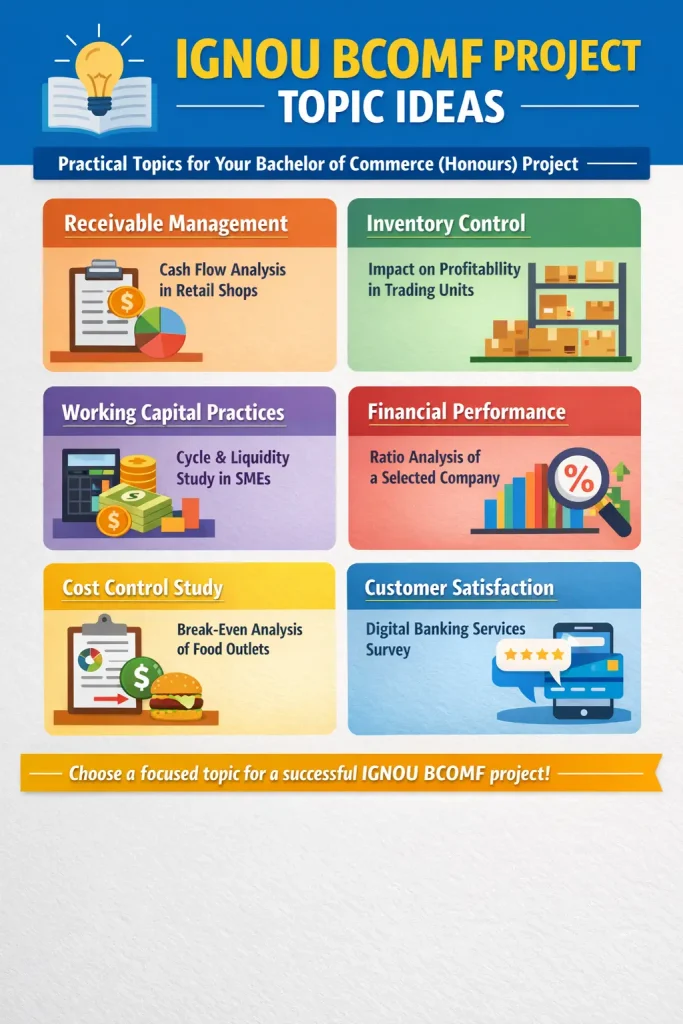
Image: IGNOU BCOMF Project Topic Ideas
Sample of IGNOU BCOMF Project topics
- Financial Performance Analysis of Public vs. Private Sector Banks
- Impact of Working Capital Management on Profitability of Companies
- Role of Capital Budgeting in Investment Decisions
- A Study on the Financial Health of a Selected Company Using Ratio Analysis
- Impact of Financial Leverage on the Profitability of a Firm
- Activity-Based Costing vs. Traditional Costing: A Comparative Study
- Role of Budgetary Control in Cost Reduction of a Manufacturing Firm
- Cost-Volume-Profit (CVP) Analysis and Its Impact on Decision Making
- Importance of Standard Costing in Cost Control
How to Select a Relevant and Manageable IGNOU BCOMF Project Topic
Selecting a relevant and manageable project topic is crucial for a successful IGNOU BCOMF project. Here’s a breakdown of how to approach this:
1. Identify Your Interests:
Reflect on your coursework:
- Which subjects did you find most engaging?
- Are there any specific areas within commerce that particularly interest you?
Consider your career goals:
- Is there a specific field within commerce that you’d like to pursue?
- Choosing a project related to your career aspirations can enhance your skills and knowledge.
2. Evaluate Relevance and Feasibility:
Relevance to the BCOMF program:
- Ensure your chosen topic aligns with the objectives and curriculum of the program.
- Refer to the program guidelines and syllabus for guidance.
Feasibility of research:
- Assess the availability of data and resources for your chosen topic.
- Consider the time constraints and your ability to conduct thorough research within the given timeframe.
- Think about how easy it will be to collect data. For example, if you want to perform a survey, consider how you will distribute the survey.
Manageable scope:
- Avoid overly broad topics that are difficult to cover comprehensively.
- Narrow down your focus to a specific aspect of the chosen topic.
- A focused and well-defined topic will lead to a more manageable and successful project.
3. Conduct Preliminary Research:
Explore existing literature:
- Review academic journals, books, and online resources to gain insights into potential topics.
- This will help you identify research gaps and potential areas for your project.
Consult with your supervisor:
- Discuss your potential topics with your assigned project supervisor.
- They can provide valuable guidance on the suitability and feasibility of your chosen topic.
4. Finalize Your Topic:
Develop a clear and concise project title:
- The title should accurately reflect the scope and focus of your project.
Define your research objectives:
- Clearly state what you aim to achieve through your project.
What “IGNOU BCOMF Project” Should Look Like
A strong BCOMF project should contain at least 2 of these 4 commerce elements:
- Financial statements understanding (P&L, balance sheet, cash flow basics)
- Commerce tools (ratios, trends, common-size, budgeting, break-even)
- Business decision angle (working capital, pricing, credit policy, cost control)
- Compliance/control angle (billing controls, audit checks, documentation discipline)
Projects that stay only descriptive (general history, broad industry overview) tend to score lower.
IGNOU BCOMF Synopsis: Exact Structure
1) Title Page
Include only what is needed:
- Programme code: BCOMF
- Final topic title (stable, not broad)
- Learner details (as per enrolment record)
- Guide/Supervisor name + designation + contact details (as applicable)
BCOMF title formula (recommended):
“A Study on [Commerce Variable] in [Target Unit] with Special Reference to [Area/Period]”
Examples:
- “A Study on Working Capital Management in Retail Kirana Stores with Special Reference to One City (2023–2025)”
- “A Comparative Ratio Analysis of Two FMCG Companies for a Three-Year Period”
2) Introduction (Problem Background) — 250 to 400 words
Write in this order:
- Context: what business problem exists in finance/accounting/costing
- Problem statement: one clear line on what is not working or unknown
- Reason: why the problem matters for commerce decisions
BCOMF-friendly problem statement examples
- “Delayed customer payments increase the cash cycle and affect day-to-day operations.”
- “Cost leakage due to weak cost control reduces operating profit.”
- “Budgeting is done informally, leading to overspending and weak variance tracking.”
3) Need and Relevance — 120 to 200 words
State:
- Who benefits (small firms, customers, managers)
- What improves (profitability, control, cash flow, service quality)
- What commerce learning is applied (ratios, budgeting, break-even, controls)
4) Objectives (3 to 6) — Use measurable action verbs
BCOMF objectives must be data-linked. Use:
- To analyse
- To measure
- To compare
- To evaluate
- To identify
- To suggest
Example objective set (Working Capital topic)
- To measure the cash conversion cycle using receivable, payable, and inventory days.
- To analyse the impact of credit period on cash flow.
- To evaluate current collection practices and gaps.
- To suggest practical steps to improve liquidity.
5) Research Questions (Optional but Strong) — 2 to 4 questions
Keep short and answerable:
- “What is the average credit period followed by the selected business units?”
- “Which factor contributes most to cash blockage?”
- “What control step can reduce delayed collections?”
6) Scope and Limitations (BCOMF-specific) — 150 to 250 words
Scope must lock these four items:
- Unit: branch/shop/company/sector
- Location: city/area
- Time period: last 2–3 years (or latest 12 months for primary data)
- Sample size: realistic number
Sample scope line
- “The study covers 30 retail shops in one city and reviews credit sales and collections for the last 12 months.”
Limitations (acceptable examples)
- Limited access to audited statements
- Time constraints for interviews
- Sample restricted to one area
7) Methodology — 300 to 450 words
Include five fixed sub-headings:
a) Research design
- Descriptive / Analytical / Comparative
b) Data type
- Primary (survey/interview)
- Secondary (financial statements, internal records, published reports)
- Mixed (preferred for BCOMF)
c) Sampling plan
- Sample size + method (convenience/purposive/random)
- Respondent profile (owners, accountants, customers)
d) Tools for analysis (choose 3 to 6)
- Ratio analysis (liquidity, profitability, efficiency)
- Trend analysis (2–3 years)
- Common-size statements (if using financials)
- Break-even analysis (for costing topics)
- Simple averages/percentages (for surveys)
- Charts and tables for interpretation
e) Output plan
- Findings + suggestions aligned to objectives
8) Tentative Chapter Plan (4 to 6 chapters)
Use this BCOMF-safe index:
- Introduction and objectives
- Commerce concepts and key terms
- Research methodology
- Data analysis and interpretation
- Findings and suggestions
- Conclusion (short)
Formatting and Submission Guidelines for the IGNOU BCOMF Project Report
Navigating the formatting and submission guidelines for an IGNOU BCOMF project requires careful attention to detail. While specific requirements can sometimes vary slightly, here’s a general overview of key aspects:
General Formatting Guidelines:
Structure:
Typically, a project report includes:
- Title Page
- Certificate of Originality
- Acknowledgement
- Table of Contents
- Introduction
- Literature Review
- Research Methodology
- Data Analysis and Interpretation
- Findings and Conclusions
- References/Bibliography
- Appendices (if any)
Font and Spacing:
- Ensure consistent font type (e.g., Times New Roman, Arial) and size (e.g., 12 point).
- Use appropriate line spacing (e.g., 1.5 or double spacing).
Page Numbering:
- Number all pages of the report.
Referencing:
- Follow a consistent referencing style (e.g., APA, MLA) for citations and bibliography.
- Avoid plagiarism by properly attributing all sources.
Presentation:
- Ensure a neat and professional presentation.
- Use clear headings and subheadings to organize the content.
- Include tables and figures with appropriate captions.
Submission Guidelines:
Synopsis Approval:
- Before submitting the final report, your project synopsis must be approved by your supervisor or the regional center.
Online Submission:
- IGNOU is increasingly moving towards online project submissions. Check the official IGNOU website or your regional center’s guidelines for the latest submission procedures.
- Typically, you’ll need to upload your project report in PDF format.
Required Documents:
Ensure you have all necessary documents, including:
- The final project report.
- The approved project synopsis.
- A declaration of originality.
- Supervisor certificate.
Deadlines:
- Pay close attention to the project submission deadlines.
- Submit your project well in advance of the deadline to avoid any last-minute issues.
Responsibilities of the IGNOU BCOMF Project Guide/Supervisor
Here’s a breakdown of their primary responsibilities:
Providing Guidance:
- Supervisors offer advice on selecting a relevant and feasible project topic.
- They help students define the scope of their research and formulate clear objectives.
- They provide guidance on appropriate research methodologies and data collection techniques.
Monitoring Progress:
- Supervisors track the student’s progress and provide feedback at various stages of the project.
- They review the project synopsis and provide suggestions for improvement.
- They monitor the student’s adherence to project deadlines and guidelines.
Offering Feedback:
- Supervisors provide constructive criticism on the student’s research, analysis, and writing.
- They help students refine their arguments and ensure the accuracy and clarity of their findings.
- They will review the final report, and offer feedback before final submission.
Ensuring Academic Integrity:
- Supervisors emphasize the importance of academic honesty and help students avoid plagiarism.
- They ensure that students properly cite and reference all sources.
Facilitating Learning:
- Supervisors act as mentors, fostering the student’s research skills and critical thinking abilities.
- They help the student prepare for the viva-voce examination.
Approval of the project:
- The supervisor will often be required to provide a certificate of approval for the finished project.
Project Guide/Supervisor (BCOMF-Specific Fit Checklist)
A suitable BCOMF guide should match at least one domain:
- Accounting and financial reporting
- Financial management / working capital
- Costing and budgeting
- Banking and services
- Audit and internal control basics
Guide workflow that suits BCOMF
- Topic finalisation + objective check
- Synopsis review for scope and feasibility
- Draft review focusing on tables, ratios, and interpretations
- Final check for compliance, signatures, and clean formatting
FAQs on IGNOU BCOMF Project
What is the IGNOU BCOMF Project?
The IGNOU BCOMF Project is a structured academic project that applies commerce concepts to a real or practical business problem through a synopsis, analysis, and a final report.
How is a topic selected for the IGNOU BCOMF Project?
Select a topic from core commerce areas such as accounting, finance, cost, banking, taxation basics, or audit. Keep the scope small and ensure data access.
What should a BCOMF project synopsis include?
Include title, background, objectives, scope, methodology, chapter plan, expected outcomes, and a short timeline. Keep it clear and aligned to the final report.
What is the ideal length of a BCOMF project report?
Length varies by topic and format rules. A focused report with clear tables, analysis, and findings usually performs better than a long report with weak structure.
Additional Resources
Helpful Posts
- Check Your IGNOU Project Status: A Complete Guide
- IGNOU MCOM Project for MCOP 001 – Complete Guide to Topics, Synopsis, Format & Submission
Final Words
The IGNOU BCOMF Project becomes manageable when it follows a disciplined flow: topic selection, synopsis planning, guided execution, structured analysis, and compliant submission. A focused topic, simple methodology, clean formatting, and genuine interpretation typically produce strong outcomes.
For topic shortlisting, synopsis drafting support, and project report structuring assistance for the IGNOU BCOMF Project, visit ignouproject.com or WhatsApp us.

BK Sahni iD 0009-0005-8092-459X
Founder, Shri Chakradhar Publication Pvt. Ltd. & ignouproject.com — helping IGNOU distance-learning students since 2010 (5,00,000+ students supported across MBA, MCom, MA & more). Author of IGNOU exam guides, solved assignments & project reference books.
Disclosure: Shri Chakradhar Publication Pvt. Ltd. and ignouproject.com are independent third-party study-help services — not the official IGNOU website. Always verify final dates and rules on ignou.ac.in.