M.Sc. Climate Change (MSCCC) · revision sets ahead of the first MSCCC sitting, June 2027
MSCCC has no exam history of its own. Its MEV codes have four sessions of it.
IGNOU opened the Master of Science in Climate Change in July 2026, but six of its Year I codes and two Year II codes have been set for other programmes since well before then. Thirty-two of those IGNOU papers, December 2024 to June 2026, are compared here theme by theme, with the answer rule, the December 2026 dates and the six codes IGNOU has never examined.
- First MSCCC sitting: June 2027
- 32 IGNOU papers, 8 codes
- Any 10 of 14, 10 marks each
- MEV-022: nine themes in 4 of 4
- MEV-026 to MEV-031: no paper yet
- Free exam calendar and paper clock
Type the codes as the registration slip prints them, MEV-021 rather than “climate paper 1”, and say PDF or printed for each.
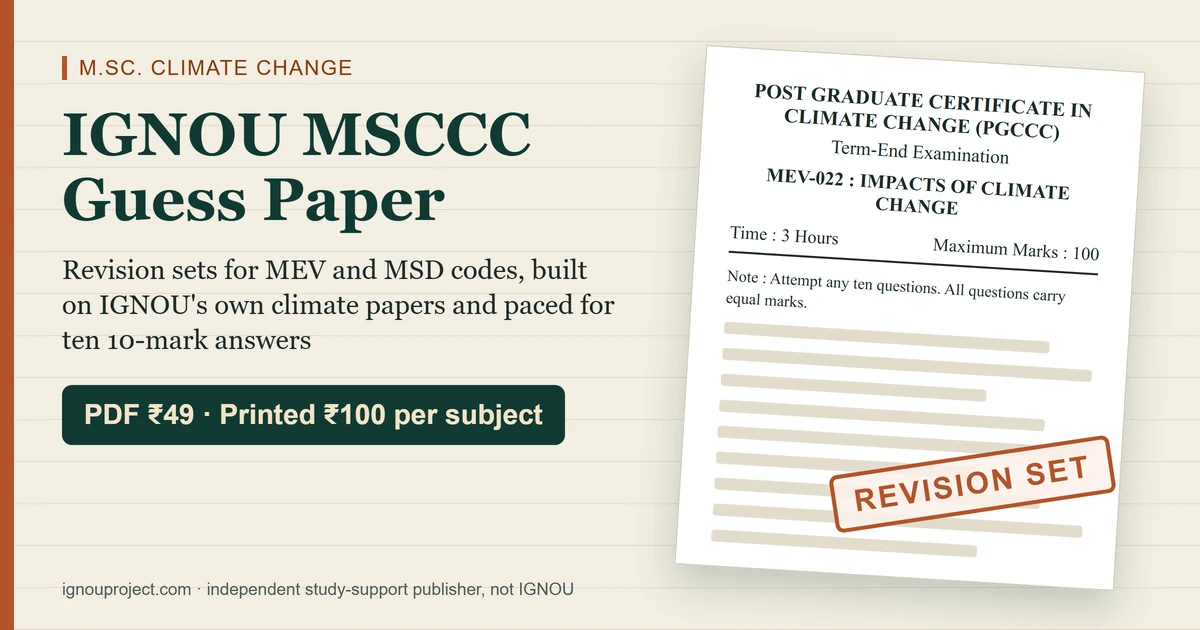
Quick answer. An IGNOU MSCCC guess paper is a revision set of themes IGNOU has set more than once for one MSCCC course code, such as MEV-022 Impacts of Climate Change, with answers written to the length the paper rewards. MSCCC is the 80-credit M.Sc. Climate Change of the School of Interdisciplinary and Trans-disciplinary Studies, and its course codes carry the MEV and MSD prefixes. The programme took its first learners in July 2026 and examines annually, so the first MSCCC sitting is the June 2027 term-end examination (TEE), whose date sheet IGNOU has not yet issued; the same codes appear on IGNOU’s December 2026 sheet, running 25 November 2026 to 14 January 2027, for learners of other programmes. IGNOU’s MEV papers from June 2024 to June 2026 all run 3 hours for 100 marks and ask the candidate to pick ten of fourteen questions worth 10 marks apiece. The rate is ₹49 per subject code for a solved guess paper as a PDF, or ₹100 per subject code as a printed copy. Printed copies carry a one-time courier charge of ₹100 per order, whatever the number of subject codes; the PDF has no courier charge. Sets are prepared in English, the only medium IGNOU examines MSCCC in, and the medium is confirmed on WhatsApp before payment. No one outside IGNOU knows the questions in advance, and no claim is made that any question in a set will appear in the examination.
June 2027 Is the First MSCCC Sitting; Its Shared Codes Sit in December 2026
An MSCCC learner admitted in July 2026 writes the first Year I papers in the June 2027 term-end examination. IGNOU’s launch notification of 25 May 2026 sets the programme’s examination mode as annual, and the first page of the December 2026 date sheet admits a learner to a paper only once the minimum study period for that course is complete. For a year-wise programme that begins in July, the first year ends with the June cycle. IGNOU had not issued a June 2027 date sheet by 4 November 2026, so no MSCCC date can yet be stated, and the hall ticket remains the document that confirms it.
The December 2026 TEE runs from Wednesday 25 November 2026 to Thursday 14 January 2027 for every IGNOU programme, per the sheet dated 30 October 2026.
First MSCCC sitting
June 2027 TEE, Year I papers. IGNOU has not published the June 2027 date sheet.
MSCCC codes on the December 2026 sheet
First: MEV-024, Wednesday 2 December, 10 AM. Last: MEV-017, Wednesday 30 December, 2 PM.
December 2026: revised sheet of 30 October 2026, whose heading no longer says “tentative”; IGNOU can still change a date. June 2027: not yet issued.
Why a July 2026 Entrant Does Not Write in December
Two IGNOU documents settle it between them. The launch notification lists “Examination Mode: Annual” beside the 80-credit total, and condition 3 on the December 2026 sheet requires the learner to “have completed minimum time to pursue these courses”. A first-year course registered in July 2026 completes its year in the June cycle. Where a Regional Centre has told an individual learner otherwise, the hall ticket is the final word.
Where IGNOU Placed the Shared Codes in December 2026
MEV-021 to MEV-025 and MSD-019 are examined in December 2026 for learners of the PG Certificate in Climate Change and other programmes that borrow them. Their placing is a useful rehearsal of how the codes may be spread in June 2027, though IGNOU draws up each sheet afresh. MEV-024 Climate Change Assessment Tools is the only Year I code in the morning session, on Wednesday 2 December. The rest are 2 PM papers on Monday 7 December (MEV-021), Friday 11 December (MSD-019), Monday 14 December (MEV-025), Friday 18 December (MEV-022) and Monday 21 December (MEV-023). No two of the six share a date, and none falls on consecutive days.
The four newest Year I codes, MEV-026 Climate Change and Water to MEV-029 Climate Change and Disaster Risk Reduction, are on neither the 21 September nor the 30 October version of the December sheet. Nor are the Year II codes MEV-030 and MEV-031.
Two Same-Evening Pairs Worth Watching in Year II
On the December 2026 sheet, the compulsory MEV-019 Research Methodology and the optional MIO-001 Introduction to Smart Regions are both set for Monday 28 December, 2 PM to 5 PM. MEV-023 and the optional MCS-224 Artificial Intelligence and Machine Learning share Monday 21 December in the same session. Neither pair affects a first-year MSCCC learner now. If IGNOU repeats the MEV-019 and MIO-001 pairing when MSCCC Year II is first examined, a learner who chose MIO-001 as an optional would face a clash and would need the Regional Centre’s ruling before the exam.
Searching the Sheet: MEV021, but MEV17
IGNOU’s December 2026 date sheet prints the climate codes with a padded number and no hyphen, as MEV021 to MEV025 and MSD019, but prints the environmental science codes unpadded, as MEV17, MEV19, MEV14, MEVE14 and MEVE19. A browser search for “MEV017” on that PDF finds nothing. Searching the sheet for MEV17 and MEV19, and for MEV021 to MEV025, finds every MSCCC code IGNOU has placed on it.
Learners of other programmes can look up their codes on the site’s December 2026 date sheet finder, and the explainer on IGNOU’s morning and afternoon sessions covers reporting times. Admit cards follow the steps in the hall ticket download guide, centre questions go to the exam centre page, and the examination form costs are set out on the per-course exam fee page, with the online fee payment steps alongside.
How IGNOU Splits an MEV-021 to MEV-025 Grade Between Paper and Assignment
The term-end examination carries 70 per cent of the final course result and assignments carry the remaining 30 per cent. For MSCCC that figure comes from IGNOU’s PGCCC assignment booklet for the July 2026 and January 2027 sessions, which covers MEV 021 to MEV 025 and states that assignments “have 30% weightage in the final grading”. None of the 40 MEV and MSD-019 term-end papers from June 2024 to June 2026 prints a weightage line of its own.
The same booklet makes the assignment a condition of sitting: a learner who writes the term-end paper without submitting the course’s assignment risks having the result cancelled or withheld. No MSCCC booklet for MEV-026 to MEV-031 had appeared on ignou.ac.in by 4 November 2026. No MSCCC document seen so far states a minimum pass mark for the term-end paper, so none is given here. Converting grades into a percentage later is covered by the site’s grade to percentage converter.
Which of Three Paper Types Helps a First-Year MSCCC Learner
A guess paper is a publisher’s revision set for one course code, such as MEV-023 Mitigation and Adaptation to Climate Change: the important and recurring questions drawn from IGNOU’s past papers and the syllabus, each with a model answer. Sellers also call it “important questions”, “expected questions” or a “model paper”.
A previous year question paper means a paper IGNOU actually set in an earlier term-end examination; the June 2026 MEV-021 paper, serial B-2245, is one, and IGNOU posts such papers free by session. Add a publisher’s model answers to one of those IGNOU papers and the result is a solved question paper.
For a programme with no sitting of its own yet, the free archive matters more than usual. The MEV-021 to MEV-025 papers are the only real evidence of how an MSCCC Year I paper is likely to look, and anyone can open them. A guess paper earns its price by doing the sorting: grouping four sessions of questions into themes, ranking them, and answering them at 10-mark length.
On a phone, swipe the table sideways for every column.
| Point of comparison | Guess paper | Previous year question paper | Solved question paper |
|---|---|---|---|
| What it holds | Themes from several MEV or MSD sessions, answered | One IGNOU paper, questions only | One IGNOU paper with answers |
| Who produces it | A publisher | IGNOU | A publisher |
| Cost | ₹49 PDF · ₹100 printed, per subject code, here | Free on ignou.ac.in | Usually paid |
| Best use | Deciding which themes to revise first | A timed 3-hour rehearsal | Checking one full set of answers |
| Limit | Cannot tell what June 2027 will ask | Shows one session, not what returns | Answers one session only |
Learners who want answers to whole past papers can use the site’s collection of IGNOU solved question papers, and the main IGNOU guess paper page lists sets for other programmes.
Built for 17-minute answers. Every model answer is sized for a 10-mark question, the only length an MEV paper has asked for since June 2024.
Short notes in pairs. MEV papers now carry up to seven 5+5 short-note questions; sets answer both halves at equal length.
Feedbacks with diagrams. MEV-021 answers on water vapour, lapse rate and albedo feedbacks include the labelled sketch the questions ask for.
Sector by sector for MEV-022. Agriculture, livestock, forests, oceans, wetlands and soils are each answered as impacts plus response.
Mechanisms named for MEV-023. CDM, emission trading and carbon markets are kept distinct, because the papers ask for them separately.
Method steps for MEV-024. Vulnerability indices, crop models and life cycle assessment are written as ordered steps.
Society answers with Indian cases. MEV-025 answers on justice, refugees and gender use Indian programmes and movements as examples.
Goals by number for MSD-019. Each SDG answer names the goal, its targets and an indicator, as the questions require.
One health answer, three angles. Health appears in MEV-022, MEV-023 and MEV-025 from different sides; the sets keep the three apart.
Every count traceable. Each theme below carries the session and question number, so any line can be checked against IGNOU’s own file.
Honest about new codes. MEV-026 to MEV-031 have no IGNOU paper yet, and the page says so rather than inventing a pattern.
PDF or printed booklet. Any code can be had as a WhatsApp PDF or as a couriered printed booklet; the rate depends only on the format.
Nineteen MSCCC Theory Codes, Six Still Without an IGNOU Paper
Section 3.45 of the July 2026 Common Prospectus sets out MSCCC as 80 credits over a minimum of two years and a maximum of four, in English, for graduates in any discipline. Year I is ten compulsory 4-credit theory courses, 40 credits. Year II is four compulsory 4-credit theory courses, the 8-credit Climate Change Lab Course (MEVL-032) and the 8-credit Project Work (MEVP-033), plus two optional courses chosen from five, again 40 credits. Added up, 40 and 40 make the 80 the prospectus states. The lab course and project carry no theory paper and are left out of the tables below.
Year I: Ten Codes and the December 2026 Placing of Each
On a phone, swipe the table sideways for every column.
| Code | Title (July 2026 Common Prospectus) | Credits | December 2026 sitting of this code |
|---|---|---|---|
| MEV-021 | Introduction to Climate Change | 4 | Mon 7 Dec 2026, 2 PM to 5 PM |
| MEV-022 | Impacts of Climate Change | 4 | Fri 18 Dec 2026, 2 PM to 5 PM |
| MEV-023 | Mitigation and Adaptation to Climate Change | 4 | Mon 21 Dec 2026, 2 PM to 5 PM |
| MEV-024 | Climate Change Assessment Tools | 4 | Wed 2 Dec 2026, 10 AM to 1 PM |
| MSD-019 | Global Strategies to Sustainable Development | 4 | Fri 11 Dec 2026, 2 PM to 5 PM |
| MEV-025 | Climate Change and Society | 4 | Mon 14 Dec 2026, 2 PM to 5 PM |
| MEV-026 | Climate Change and Water | 4 | Not on the sheet; no IGNOU paper up to June 2026 |
| MEV-027 | Climate Change and Energy | 4 | Not on the sheet; no IGNOU paper up to June 2026 |
| MEV-028 | Climate Change and Agriculture | 4 | Not on the sheet; no IGNOU paper up to June 2026 |
| MEV-029 | Climate Change and Disaster Risk Reduction | 4 | Not on the sheet; no IGNOU paper up to June 2026 |
Year II: Four Compulsory Codes
On a phone, swipe the table sideways for every column.
| Code | Title (July 2026 Common Prospectus) | Credits | December 2026 sitting of this code |
|---|---|---|---|
| MEV-017 | Environmental Legislations | 4 | Wed 30 Dec 2026, 2 PM to 5 PM |
| MEV-019 | Research Methodology for Environmental Science | 4 | Mon 28 Dec 2026, 2 PM to 5 PM |
| MEV-030 | Climate Change, Waste Management and Circular Economy | 4 | Not on the sheet; no IGNOU paper up to June 2026 |
| MEV-031 | Climate Change and Governance | 4 | Not on the sheet; no IGNOU paper up to June 2026 |
Year II Optionals: Choose Any Two of Five
On a phone, swipe the table sideways for every column.
| Code | Title (July 2026 Common Prospectus) | Credits | December 2026 sitting of this code |
|---|---|---|---|
| MEVE-019 | Environmental Issues | 4 | Wed 23 Dec 2026, 10 AM to 1 PM |
| MEVE-014 | Biodiversity Conservation and Management | 4 | Wed 9 Dec 2026, 2 PM to 5 PM |
| MEV-014 | Sustainable Natural Resource Management | 4 | Sat 5 Dec 2026, 2 PM to 5 PM |
| MIO-001 | Introduction to Smart Regions: Smart Cities and Smart Villages | 4 | Mon 28 Dec 2026, 2 PM to 5 PM |
| MCS-224 | Artificial Intelligence and Machine Learning | 4 | Mon 21 Dec 2026, 2 PM to 5 PM |
MEV-021 to MEV-025 began life in the PG Certificate in Climate Change, and the site’s overview of the PGCCC certificate explains that programme. The first 40 credits of MSCCC are also the whole of the new PG Diploma in Climate Change, which a learner can take as an exit after Year I. For fee, eligibility and admission rules, the place to begin is the Common Prospectus explainer.
Six MSCCC codes IGNOU has never examined. MEV-026 Climate Change and Water, MEV-027 Climate Change and Energy, MEV-028 Climate Change and Agriculture and MEV-029 Climate Change and Disaster Risk Reduction in Year I, and MEV-030 and MEV-031 in Year II, appear in none of IGNOU’s question paper indexes for December 2024, June 2025, December 2025 or June 2026, and on neither version of the December 2026 date sheet. Their first paper will be their first evidence. A set offered for any of them as “repeated questions” deserves suspicion, because there is nothing yet to repeat.
How IGNOU Set the Eight Examined Codes in June 2026
Every one of the eight MSCCC codes with an IGNOU paper was set in June 2026 as a 3-hour, 100-mark paper in English, with no sections, no compulsory question and equal marks for each answer. Seven of them asked for any ten of fourteen questions at 10 marks each; MSD-019 asked for any ten of twelve. None of the June 2026 papers is headed MSCCC: the climate papers are headed PGCCC, MSD-019 is headed MASS, and MEV-017 and MEV-019 are headed MSCENV.
On a phone, swipe the table sideways for every column.
| Code | Latest IGNOU paper | Programme printed on the paper | Time and marks | Answer rule | Medium |
|---|---|---|---|---|---|
| MEV-021 | June 2026 | PGCCC | 3 hours, 100 marks | Any 10 of 14 at 10 marks | English |
| MEV-022 | June 2026 | PGCCC | 3 hours, 100 marks | Any 10 of 14 at 10 marks | English |
| MEV-023 | June 2026 | PGCCC | 3 hours, 100 marks | Any 10 of 14 at 10 marks | English |
| MEV-024 | June 2026 | PGCCC | 3 hours, 100 marks | Any 10 of 14 at 10 marks | English |
| MEV-025 | June 2026 | PGCCC | 3 hours, 100 marks | Any 10 of 14 at 10 marks | English |
| MSD-019 | June 2026 | MASS | 3 hours, 100 marks | Any 10 of 12 at 10 marks | English |
| MEV-017 | June 2026 | MSCENV | 3 hours, 100 marks | Any 10 of 14 at 10 marks | English |
| MEV-019 | June 2026 | MSCENV | 3 hours, 100 marks | Any 10 of 14 at 10 marks | English |
MSD-019 halved its answer length from June 2025. Five answers of 20 marks from a choice of eight was the instruction on IGNOU’s June 2024 and December 2024 MSD-019 Global Strategies to Sustainable Development papers. From the June 2025 paper onwards the instruction became any ten of twelve at 10 marks. An MSD-019 set written to the old rule trains 34-minute answers for a paper that now allows about 17.
Answer Rule Session by Session, June 2024 to June 2026
On a phone, swipe the table sideways for every column.
| Code | June 2024 | December 2024 | June 2025 | December 2025 | June 2026 |
|---|---|---|---|---|---|
| MEV-021 | 10 of 14 | 10 of 14 | 10 of 14 | 10 of 14 | 10 of 14 |
| MEV-022 | 10 of 14 | 10 of 14 | 10 of 14 | 10 of 14 | 10 of 14 |
| MEV-023 | 10 of 14 | 10 of 14 | 10 of 14 | 10 of 14 | 10 of 14 |
| MEV-024 | 10 of 14 | 10 of 14 | 10 of 14 | 10 of 14 | 10 of 14 |
| MEV-025 | 10 of 14 | 10 of 14 | 10 of 14 | 10 of 14 | 10 of 14 |
| MSD-019 | 5 of 8 (20 each) | 5 of 8 (20 each) | 10 of 12 | 10 of 12 | 10 of 12 |
| MEV-017 | 10 of 14 | 10 of 14 | 10 of 14 | 10 of 14 | 10 of 14 |
| MEV-019 | 10 of 14 | 10 of 14 | 10 of 14 | 10 of 14 | 10 of 14 |
Short Notes Arrived in MEV-023 and MEV-025 in June 2025
The June 2024 and December 2024 MEV-023 and MEV-025 papers contained no short-note questions at all: each of the fourteen was a single essay. From June 2025 IGNOU began pairing short notes in both, and the June 2025 MEV-023 paper set seven of its fourteen questions as two 5-mark notes. MEV-021 moved the same way, from three short-note questions in June 2024 to six in June 2026.
On a phone, swipe the table sideways for every column.
| Code | June 2024 | December 2024 | June 2025 | December 2025 | June 2026 |
|---|---|---|---|---|---|
| MEV-021 | 3 of 14 | 4 of 14 | 5 of 14 | 5 of 14 | 6 of 14 |
| MEV-022 | 2 of 14 | 4 of 14 | 5 of 14 | 7 of 14 | 3 of 14 |
| MEV-023 | 0 of 14 | 0 of 14 | 7 of 14 | 6 of 14 | 5 of 14 |
| MEV-024 | 7 of 14 | 4 of 14 | 4 of 14 | 6 of 14 | 2 of 14 |
| MEV-025 | 0 of 14 | 0 of 14 | 3 of 14 | 4 of 14 | 3 of 14 |
| MSD-019 | 0 of 8 | 0 of 8 | 1 of 12 | 1 of 12 | 0 of 12 |
| MEV-017 | 4 of 14 | 6 of 14 | 6 of 14 | 3 of 14 | 5 of 14 |
| MEV-019 | 3 of 14 | 5 of 14 | 4 of 14 | 3 of 14 | 5 of 14 |
The June 2024 papers used for the answer-rule and short-note history are MEV-021 June 2024, MEV-022 June 2024, MEV-023 June 2024, MEV-024 June 2024, MEV-025 June 2024, MSD-019 June 2024, MEV-017 June 2024 and MEV-019 June 2024.
Where IGNOU’s own documents disagree, and one owned page that needs fixing.
- Mode: IGNOU’s launch notification of 25 May 2026 says MSCCC “is offered through Online Mode from July, 2026 Session”. The Samarth admission portal lists the mode as Open Distance Learning, and the July 2026 Common Prospectus puts MSCCC at row 71 of its distance-learning programme table and leaves it out of section 13, its list of online programmes.
- Title: the prospectus prints MEV 019 as “Research Methodology for Environrriental Science”; the MEV-019 papers print “Environmental”.
- Lateral entry: the prospectus footnote beneath the 40-credit PG Diploma in Climate Change table says PGCCC holders “may take lateral entry into the second year of the MSCCC programme”; PGCCC is the 16-credit certificate, not that diploma.
- Misprints inside papers: “SEG-12” and “SGD-11” in the December 2025 MSD-019 paper, “Automative energy efficiency” in the June 2026 MEV-023 paper, “remote seusing” in the June 2024 MEV-024 paper and “Spearmen’s” in the December 2025 MEV-019 paper.
- In-house: the owned shrichakradhar.com category for PGCCC guess papers is titled as “Solved Assignments” and lists MEV 21 to MEV 23 only; it is queued for correction. The codes and prices on this page are the current ones.
Health in Twelve of Twelve: Repeats Across the 32 Papers Behind MSCCC
A human health question appeared in every one of the twelve MEV-022, MEV-023 and MEV-025 papers IGNOU set from December 2024 to June 2026, framed as a sector impact in MEV-022, as a public health response in MEV-023 and as a social and disease question in MEV-025. That is the most consistent single theme across the MSCCC Year I codes.
The theme counts on this page come from 32 IGNOU term-end papers: four sessions, December 2024, June 2025, December 2025 and June 2026, for each of the eight MSCCC codes IGNOU has examined, compared question by question by ignouproject.com on 4 November 2026, with eight June 2024 papers compared for the answer-rule and short-note history. Matching is by topic and is a human judgement: a question on the causes of deforestation and one on deforestation’s impacts count as one theme. A count of 4 of 4 means the theme was set in all four sessions, not that it will be set again. The theme tables cover MEV-021 to MEV-025, MSD-019, MEV-017 and MEV-019; for the optional codes, the format is confirmed against the latest IGNOU paper on WhatsApp.
MEV-022 Impacts of Climate Change and MEV-024 Climate Change Assessment Tools are the most repetitive MSCCC codes, each with nine themes set in all four papers from December 2024 to June 2026. MSD-019 Global Strategies to Sustainable Development is the least: none of its themes appeared in all four, because the paper rotates through the seventeen Sustainable Development Goals.
One Theme, Several Papers: Overlaps Between MSCCC Codes
Several themes cross course boundaries. Writing one good answer and adapting it saves time, provided the angle each course asks for is kept.
On a phone, swipe the table sideways for every column.
| Theme | Where IGNOU set it (session and question) | Papers |
|---|---|---|
| Human health | MEV-022: Dec 2024 Q14, Jun 2025 Q14, Dec 2025 Q3, Jun 2026 Q11; MEV-023: Dec 2024 Q12, Jun 2025 Q11, Dec 2025 Q5, Jun 2026 Q7; MEV-025: Dec 2024 Q4, Jun 2025 Q4, Dec 2025 Q9, Jun 2026 Q2 | 12 of 12 (the 12 papers of those three codes) |
| Paris Agreement | MEV-021: Dec 2025 Q1, Jun 2026 Q11; MEV-023: Jun 2025 Q7(a), Dec 2025 Q9, Jun 2026 Q12; MEV-025: Dec 2025 Q13; MSD-019: Jun 2025 Q10; MEV-017: Jun 2025 Q1, Dec 2025 Q5 | 9 of 32 (all 32 papers compared) |
| Vulnerability | MEV-024: Dec 2024, Jun 2025, Dec 2025, Jun 2026; MEV-025: Dec 2024, Jun 2025, Dec 2025, Jun 2026 | 8 of 8 (the 8 papers of those two codes) |
| Carbon sequestration | MEV-023: Dec 2024, Jun 2025, Dec 2025, Jun 2026; MEV-024: Dec 2024, Jun 2025, Dec 2025, Jun 2026 | 8 of 8 (the 8 papers of those two codes) |
| Urban heat island or urban flooding | MEV-021: Dec 2024 Q7, Dec 2025 Q12, Jun 2026 Q8(b); MEV-022: Dec 2024 Q12(a), Jun 2025 Q12, Jun 2026 Q9(b); MEV-024: Dec 2025 Q14(a) | 7 of 12 (the 12 MEV-021, MEV-022 and MEV-024 papers) |
MEV-021 Introduction to Climate Change
MEV-021 is a science paper first. Its four steady themes are all mechanism questions, and several ask for a diagram, so the climate system, the energy budget and the feedback loops are worth drawing as well as describing.
On a phone, swipe the table sideways for every column.
| Theme | December 2024 | June 2025 | December 2025 | June 2026 | n of N |
|---|---|---|---|---|---|
| Climate system and its components | Q2 | Q6 | Q14(b) | Q1 | 4 of 4 |
| Greenhouse effect, greenhouse gases and the energy budget | Q1 | Q1 | Q13(b) | Q2 | 4 of 4 |
| Climate feedbacks: water vapour, lapse rate, snow and ice albedo | Q4 | Q3 | Q14(a) | Q5 | 4 of 4 |
| Palaeoclimate data: dendrochronology, speleothems and other sources | Q5 | Q5(a), Q8(b) | Q11 | Q6 | 4 of 4 |
| Natural and human drivers of climate change | Q3 | – | Q3, Q7 | Q4 | 3 of 4 |
| Climate models and their types | Q9 | – | Q6 | Q9 | 3 of 4 |
| Deforestation | Q10(a) | Q4 | – | Q7 | 3 of 4 |
| Desertification | Q10(b) | – | Q8 | Q12(b) | 3 of 4 |
| Drought and its management | Q12(b) | Q11 | – | Q8(a) | 3 of 4 |
| Rainwater harvesting and watershed management | Q12(a) | – | Q2 | Q12(a) | 3 of 4 |
| Urban heat island and urban flooding | Q7 | – | Q12 | Q8(b) | 3 of 4 |
| Paris Agreement | – | – | Q1 | Q11 | 2 of 4 |
| Kyoto Protocol, IPCC and UNFCCC | Q13 | – | Q4, Q5(a) | – | 2 of 4 |
| National Action Plan on Climate Change | Q11 | Q9 | – | – | 2 of 4 |
| Climate of the Precambrian | Q6 | Q8(a) | – | – | 2 of 4 |
| Global warming potential and radiative forcing | – | Q7(a) | – | Q3 | 2 of 4 |
The four MEV-021 papers behind this table, each headed for the PG Certificate in Climate Change: MEV-021 December 2024, MEV-021 June 2025, MEV-021 December 2025 and MEV-021 June 2026.
MEV-022 Impacts of Climate Change
Nine of MEV-022’s themes came back in every session, and the paper is organised by sector. The June 2026 paper opened with agriculture and livestock emissions in its first two questions, and the June 2025 paper had opened the same way.
On a phone, swipe the table sideways for every column.
| Theme | December 2024 | June 2025 | December 2025 | June 2026 | n of N |
|---|---|---|---|---|---|
| Agriculture: impacts and greenhouse gas emissions | Q1 | Q1 | Q4 | Q1 | 4 of 4 |
| Livestock and ruminant emissions | Q9 | Q2 | Q7 | Q2 | 4 of 4 |
| Forests, REDD and carbon sequestration | Q2, Q3 | Q3 | Q11 | Q3 | 4 of 4 |
| Marine fisheries, ocean ecosystems and migrating marine life | Q4, Q5 | Q4 | Q9 | Q4 | 4 of 4 |
| Wetlands | Q6 | Q7 | Q10(a) | Q10 | 4 of 4 |
| Soil erosion | Q7(a) | Q10 | Q12(a) | Q13 | 4 of 4 |
| Human health | Q14 | Q14 | Q3 | Q11 | 4 of 4 |
| Energy security | Q13(a) | Q13(a) | Q2(b) | Q8 | 4 of 4 |
| Climate refugees and livelihood security | Q12(b) | Q11(a) | Q14(a) | Q5(a) | 4 of 4 |
| Ocean acidification and ocean chemistry | – | Q6 | Q10(b) | Q9(a) | 3 of 4 |
| Infrastructure under a changing climate | Q11 | – | Q1 | Q12 | 3 of 4 |
| Urban heat island and urban flooding | Q12(a) | Q12 | – | Q9(b) | 3 of 4 |
| Coastal ecosystems and coastal vulnerability | – | Q11(b) | Q6 | Q5(b) | 3 of 4 |
| Hydrological and carbon cycles | Q7(b) | Q8 | Q13(a) | – | 3 of 4 |
| Biodiversity | Q10 | – | Q5 | Q7 | 3 of 4 |
| Soil salinization | – | – | Q8(a) | Q14 | 2 of 4 |
IGNOU’s MEV-022 files: MEV-022 December 2024, MEV-022 June 2025, MEV-022 December 2025 and MEV-022 June 2026.
MEV-023 Mitigation and Adaptation to Climate Change
MEV-023 rewards precise terms. Carbon capture and storage, climate-smart agriculture, vehicle fuel efficiency and the market mechanisms each returned in all four papers, and the Paris Agreement appeared in each of the three papers from June 2025 onwards.
On a phone, swipe the table sideways for every column.
| Theme | December 2024 | June 2025 | December 2025 | June 2026 | n of N |
|---|---|---|---|---|---|
| Carbon sequestration and carbon capture and storage | Q7 | Q5, Q8 | Q1 | Q3, Q5 | 4 of 4 |
| Agriculture: climate-smart and sustainable practice | Q4, Q6 | Q3 | Q10 | Q1, Q11 | 4 of 4 |
| Waste and greenhouse gas reduction | Q14 | Q6(a), Q13(a), Q14 | Q7 | Q6(b), Q8 | 4 of 4 |
| Vehicle and automotive fuel efficiency | Q11 | Q10 | Q4 | Q6(a) | 4 of 4 |
| Public health response to climate change | Q12 | Q11 | Q5 | Q7 | 4 of 4 |
| Market mechanisms: CDM, emission trading, carbon markets | Q3 | Q1 | Q8 | Q4(a) | 4 of 4 |
| Renewable energy, including solar | Q8 | Q13(b) | Q2 | Q14 | 4 of 4 |
| Deforestation, afforestation and forest management | Q5 | Q4 | Q12 | Q10 | 4 of 4 |
| Paris Agreement | – | Q7(a) | Q9 | Q12 | 3 of 4 |
| Kyoto Protocol, UNFCCC, COP and IPCC | – | Q2(a) | Q11(b), Q14(a) | Q2(a), Q9 | 3 of 4 |
| Energy efficiency and conservation | Q1 | Q2(b) | – | Q2(b) | 3 of 4 |
| Green buildings and energy use in buildings | Q13 | Q12 | Q6 | – | 3 of 4 |
| Biofuels | Q9 | Q9(a) | Q3(b) | – | 3 of 4 |
| Natural resource management | – | Q6(b) | Q13(b) | Q4(b) | 3 of 4 |
To check any MEV-023 count, open the papers on IGNOU’s site: MEV-023 December 2024, MEV-023 June 2025, MEV-023 December 2025 and MEV-023 June 2026.
MEV-024 Climate Change Assessment Tools
MEV-024 mixes method and instrument. Vulnerability indices and crop models sit on one side of the paper, and remote sensing and GIS data models on the other. The December 2025 paper packed four radiation laws, Kirchhoff, Planck, Stefan-Boltzmann and Wien, into a single 10-mark short-note question.
On a phone, swipe the table sideways for every column.
| Theme | December 2024 | June 2025 | December 2025 | June 2026 | n of N |
|---|---|---|---|---|---|
| Vulnerability: approaches, methods and index | Q1, Q2 | Q1, Q2 | Q11 | Q11 | 4 of 4 |
| Crop simulation models | Q4, Q14 | Q4 | Q12 | Q12, Q14 | 4 of 4 |
| GIS data models: raster, vector, spatial data infrastructure | Q5(a) | Q5, Q14(b) | Q6(a), Q10(a) | Q6 | 4 of 4 |
| Geoinformatics in climate change studies | Q8 | Q6 | Q9 | Q1 | 4 of 4 |
| Remote sensing, radiation and spectral signatures | Q9, Q10(b) | Q8, Q11, Q12 | Q4, Q5, Q7(b) | Q4, Q9 | 4 of 4 |
| Early warning systems | Q7 | Q13(b) | Q8 | Q3 | 4 of 4 |
| Disaster risk reduction and risk assessment | Q6(a), Q10(a) | Q7, Q13(a) | Q10(b) | Q2 | 4 of 4 |
| Life cycle assessment | Q11 | Q9 | Q1 | Q5 | 4 of 4 |
| Soil carbon sequestration | Q12 | Q14(a) | Q2 | Q8 | 4 of 4 |
| Climate models: GCM and RCM | Q13 | Q10(a) | Q6(b) | – | 3 of 4 |
| Social vulnerability | Q3 | Q3 | – | – | 2 of 4 |
| Greenhouse gas inventories | – | – | Q3 | Q10 | 2 of 4 |
| Carbon isotopes | – | Q10(b) | – | Q7 | 2 of 4 |
| Deterministic, descriptive and stochastic modelling | Q6(b) | – | Q13 | – | 2 of 4 |
MEV-024 as IGNOU filed it each session: MEV-024 December 2024, MEV-024 June 2025, MEV-024 December 2025 and MEV-024 June 2026.
MEV-025 Climate Change and Society
Question 1 of every MEV-025 paper from June 2024 to June 2026 asked about vulnerability or its assessment. The June 2026 paper returned to vulnerability twice more, in questions 5 and 6(a).
On a phone, swipe the table sideways for every column.
| Theme | December 2024 | June 2025 | December 2025 | June 2026 | n of N |
|---|---|---|---|---|---|
| Vulnerability and its assessment | Q1 | Q1 | Q1 | Q1, Q5, Q6(a) | 4 of 4 |
| Climate and environmental justice, social movements | Q2, Q10 | Q2(a) | Q6, Q11(b) | Q6(b) | 4 of 4 |
| Climate refugees and migration | Q3, Q9 | Q3(b) | Q12 | Q8(a) | 4 of 4 |
| Human health and disease | Q4 | Q4, Q8 | Q9, Q10(a) | Q2, Q8(b) | 4 of 4 |
| Women, children and gender equality | Q11 | Q10 | Q3 | Q11, Q14(b) | 4 of 4 |
| Sustainable Development Goals and SDG-13 | Q14 | Q12 | Q4, Q11(a) | Q12 | 4 of 4 |
| India’s response: NAPCC, INDCs and national programmes | Q7 | Q6 | Q2 | Q9 | 4 of 4 |
| Infrastructure and energy | Q6 | – | Q10(b), Q14 | Q4 | 3 of 4 |
| Human security and basic needs | Q8 | Q7 | Q7(b) | – | 3 of 4 |
| Agriculture and animal husbandry | – | Q5, Q11 | Q8 | Q3, Q13 | 3 of 4 |
| Desertification and watershed development | – | Q13, Q14 | Q5 | Q14(a) | 3 of 4 |
| Indigenous people | – | Q3(a) | – | Q7 | 2 of 4 |
For MEV-025 the four files are MEV-025 December 2024, MEV-025 June 2025, MEV-025 December 2025 and MEV-025 June 2026.
MSD-019 Global Strategies to Sustainable Development
MSD-019 almost always names a goal by number. Revision is better organised goal by goal, with each goal’s targets and one Indian initiative, than by chasing repeats.
On a phone, swipe the table sideways for every column.
| Theme | December 2024 | June 2025 | December 2025 | June 2026 | n of N |
|---|---|---|---|---|---|
| SDG-5 gender equality | Q2 | Q4 | – | Q5 | 3 of 4 |
| SDG-10 reduced inequalities | Q4 | Q7 | Q7 | – | 3 of 4 |
| SDG-11 sustainable cities | – | Q8 | Q6 | Q7 | 3 of 4 |
| SDG-13 climate action and the Paris Agreement | Q6 | Q10 | – | Q9 | 3 of 4 |
| SDG-15 life on land | Q7 | – | Q3 | Q11 | 3 of 4 |
| Multidimensional Poverty Index | Q1 | – | – | Q2 | 2 of 4 |
| India’s institutional set-up for the SDGs | Q8 | – | Q2 | – | 2 of 4 |
| SDG-8 decent work and growth | Q3 | – | Q9 | – | 2 of 4 |
| SDG-12 responsible consumption | Q5 | – | Q5 | – | 2 of 4 |
| SDG-4 quality education | – | Q3 | – | Q4 | 2 of 4 |
| SDG-7 energy and clean cooking | – | Q6 | Q10 | – | 2 of 4 |
| SDG-14 life below water | – | Q11 | – | Q10 | 2 of 4 |
| SDG-17 partnerships | – | – | Q1 | Q12 | 2 of 4 |
| SDG-2 food security | – | – | Q12 | Q3 | 2 of 4 |
The MSD-019 papers, headed for the MA in Sustainability Science: MSD-019 December 2024, MSD-019 June 2025, MSD-019 December 2025 and MSD-019 June 2026.
MEV-017 Environmental Legislations (Year II)
MEV-017 asks for Acts by name and year. Eight themes appeared in all four papers, led by the environmental provisions of the Indian Constitution and the Water and Air Acts.
On a phone, swipe the table sideways for every column.
| Theme | December 2024 | June 2025 | December 2025 | June 2026 | n of N |
|---|---|---|---|---|---|
| Environment in the Indian Constitution | Q3 | Q7 | Q6 | Q9 | 4 of 4 |
| Water Act 1974 and Air Act 1981 | Q5 | Q9 | Q14 | Q13 | 4 of 4 |
| Central and State Pollution Control Boards | Q4(a) | Q10(b) | Q12(a) | Q11(a) | 4 of 4 |
| Forest, wildlife, biodiversity and forest rights laws | Q12(b), Q13, Q14 | Q11 | Q9, Q10 | Q1, Q2 | 4 of 4 |
| Climate and ozone treaties: Rio, Kyoto, UNFCCC, Paris, Montreal | Q6(a), Q9(b) | Q1, Q2(b), Q4 | Q3, Q4(b), Q5 | Q11(b) | 4 of 4 |
| Food and farm chemical laws | Q12(a) | Q14(a) | Q8 | Q4, Q5 | 4 of 4 |
| Health policy and disease control programmes | Q11(b) | Q12 | Q11 | Q3, Q6 | 4 of 4 |
| Wetlands, lakes and the Clean Ganga mission | Q9(a) | Q2(a) | Q2, Q4(a) | Q7(a), Q8(b) | 4 of 4 |
| Hazardous and biomedical waste rules | Q10 | Q13 | Q7 | – | 3 of 4 |
| EIA Notification 2006 | Q8 | – | Q1 | – | 2 of 4 |
| Environment (Protection) Act 1986 | Q1 | – | – | Q10 | 2 of 4 |
| National Green Tribunal Act 2010 | Q2 | – | – | Q12 | 2 of 4 |
| Noise pollution laws | Q7(a) | – | Q13 | – | 2 of 4 |
| Ecomark | – | Q14(b) | – | Q7(b) | 2 of 4 |
MEV-017 files, each headed for the M.Sc. in Environmental Science: MEV-017 December 2024, MEV-017 June 2025, MEV-017 December 2025 and MEV-017 June 2026.
MEV-019 Research Methodology for Environmental Science (Year II)
MEV-019 splits between research design and statistics. Hypothesis testing and its distributions turned up in every paper, usually as paired short notes on t, F or chi-square.
On a phone, swipe the table sideways for every column.
| Theme | December 2024 | June 2025 | December 2025 | June 2026 | n of N |
|---|---|---|---|---|---|
| Research design and types of research | Q1, Q3 | Q10, Q12 | Q7, Q14 | Q7, Q9 | 4 of 4 |
| Correlation and scatter diagrams | Q6 | Q7, Q14 | Q11 | Q6 | 4 of 4 |
| Publication ethics, IPR, plagiarism and the research paper | Q11, Q12(b), Q13 | Q1(b), Q4, Q5 | Q1, Q3(a), Q5 | Q3, Q4 | 4 of 4 |
| Sampling distributions and hypothesis testing | Q9, Q10, Q12(a), Q14 | Q1(a), Q3 | Q3(b), Q4 | Q1, Q2, Q5(b) | 4 of 4 |
| Data tabulation and diagrams | Q5 | Q9 | Q13 | Q5(a), Q12 | 4 of 4 |
| Central tendency and dispersion | Q8 | Q6 | Q10 | Q11 | 4 of 4 |
| GIS, remote sensing and geospatial mapping | Q7 | Q8 | Q8, Q9 | Q13(a) | 4 of 4 |
| Methods of data collection | – | Q11 | – | Q10 | 2 of 4 |
| Regression | – | Q2 | Q2 | – | 2 of 4 |
| Sampling design | Q4 | – | Q12 | – | 2 of 4 |
| Selecting a research topic | Q2 | – | Q6 | – | 2 of 4 |
| Role of statistics in environmental science | – | Q13 | – | Q14 | 2 of 4 |
IGNOU files: MEV-019 December 2024, MEV-019 June 2025, MEV-019 December 2025 and MEV-019 June 2026.
A theme that keeps returning deserves early revision, and a theme seen twice deserves a look, but the course blocks remain the syllabus. Older IGNOU papers for these codes are gathered on the site’s IGNOU last year paper page.
How Four Sessions of MEV Questions Become One MSCCC Set
- Collect the four newest papers for the code. For the examined MSCCC codes these are the December 2024, June 2025, December 2025 and June 2026 papers, whatever programme heads them.
- Fix the answer rule first. Any ten at 10 marks means about 17 minutes per answer, and that length shapes every model answer in the set.
- Group the questions into themes by hand. Each question is matched by topic across the four sessions and given its session and question number.
- Order by frequency, then cover the blocks. Themes set in all four sessions come first, then three of four, then the block topics that have not yet been asked.
- Write to the split IGNOU prints. A 5+5 short-note question gets two balanced halves and a 2+8 question a short definition followed by the main answer.
For MEV-026 to MEV-031, step 1 has nothing to collect yet, which is why those codes are handled separately on WhatsApp.
No Forecast for Papers Never Set: The Limits of an MSCCC Set
A guess paper is a revision aid built from past IGNOU question papers and the syllabus. No one outside IGNOU knows the questions in advance, and no claim is made that any question in this set will appear in your examination.
Useful Ground a Set Covers
It gives an order of work for a first-year learner facing ten courses and no programme-specific past paper. It shows that MEV-022 and MEV-024 have repeated heavily, that MSD-019 rotates, and that short notes now fill a third or more of several MEV papers. It also trains the 17-minute answer, which is the skill an any-ten paper tests most.
Limits No Set Can Cross
It cannot forecast June 2027, and the first MSCCC-headed papers may differ from the PGCCC papers they replace. It cannot stand in for the course blocks, and for MEV-026 to MEV-031 it has no past papers to draw on at all. A pattern change after June 2026 would also leave any set built before it out of date.
Free ways to revise MSCCC. All 40 IGNOU papers linked on this page cost nothing to download, and the MEV course blocks are on eGyanKosh; the site’s eGyanKosh walkthrough shows where, with the Gyankosh search method as a second route. Programme books can also be found through IGNOU book downloads, and condensed revision through IGNOU study notes.
Plan the First Sitting and Time an Answer, Without Paying
The calendar takes the MSCCC codes ticked and either sets them against the December 2026 sheet or, for the first MSCCC sitting, shows that the June 2027 sheet is still awaited. The paper clock shows the answer rule, the minutes per answer and the most repeated themes for one code.
Free tool 1
MSCCC Exam Calendar and Revision Split
Use a number between 0.5 and 16, such as 2.5.
This tool is guidance from ignouproject.com, not an IGNOU rule. Using it creates no obligation to order anything.
Free tool 2
MSCCC Paper Clock and Theme Check
The clock keeps 10 minutes for reading the paper and choosing questions, then shares the rest across the answers.
This tool is guidance from ignouproject.com, not an IGNOU rule. Using it creates no obligation to order anything.
The paper clock uses this arithmetic, which holds for every examined MSCCC code on its June 2026 paper:
On a phone, swipe the table sideways for every column.
| Answer type | Time available | Time per answer |
|---|---|---|
| Any 10 at 10 marks (all eight codes in June 2026) | 180 minutes less 10 for reading | About 17 minutes per answer |
| A 5+5 short-note question | One 17-minute slot | About 8 minutes per note |
| A 2+8 question | One 17-minute slot | About 3 minutes defining, 14 explaining |
| Any 5 at 20 marks (MSD-019 until December 2024) | 180 minutes less 10 for reading | About 34 minutes per answer |
Both tools work only from the dates, answer rules and theme counts already printed in the tables on this page, and run entirely in the browser.
Where IGNOU Keeps Each MEV, MSD and Optional Paper Online
IGNOU lists its recent papers by session. The June 2026 question paper list holds all eight examined MSCCC codes, and so do the December 2025 list, the June 2025 list and the December 2024 list. For June 2024 and earlier, IGNOU’s webservices archive has a SOITS listing for June 2024, which files MEV-021 to MEV-025 under PGCCC, MSD-019 under MASS and MEV-017 and MEV-019 under MSCENV.
- Open a session list and use the browser’s find box for the code with its hyphen, for example MEV-022. Searching “MSCCC” returns nothing on any list up to June 2026.
- Open the PDF and check the session printed under “Term-End Examination” before relying on it; files under the general downloads path carry no session in their address.
- Match the course title on the paper with the title in section 3.45 of the July 2026 Common Prospectus.
- Take any December 2026 date from the 30 October 2026 version of IGNOU’s December 2026 TEE date sheet, searching MEV021 or MEV17 as explained above. The tentative sheet of 21 September 2026 gives the same dates for every MSCCC code.
Programme facts come from IGNOU’s MSCCC launch notification of 25 May 2026, as posted by the Ranchi Regional Centre, and the MSCCC entry on IGNOU’s Samarth admission portal. Assignment questions for MEV-021 to MEV-025 are in IGNOU’s PGCCC assignment booklet for July 2026 and January 2027. The site’s walk-through of an IGNOU date sheet explains the two session columns.
Before and After the First MSCCC Papers: Admit Card, Result, Revaluation
Ahead of the first MSCCC sitting, the hall ticket is the document that fixes each paper’s date, session and centre. Results for the term-end examination appear through the IGNOU result page, and the site’s June 2026 TEE result page shows how the last June cycle was declared, which is a fair guide to the timing of the first MSCCC result.
Assignment marks reach the grade card separately, as the assignment marks and status checker explains. Disputing a term-end mark goes through the IGNOU revaluation steps, which run to their own deadline. Once both years are complete, the final grade card explainer and the IGNOU CGPA calculator cover the overall result.
Assignment Booklets and Reading to Pair With a Set
MSCCC assignments are due before the term-end examination, and the site’s MSCCC handwritten assignment service traces each code to the booklet that governs it; typed answers are listed on the IGNOU solved assignments page. For fuller reading than a revision set, there are IGNOU help books and IGNOU guide books to order online. The Year II lab course MEVL-032 and the MEVP-033 project have no term-end paper and no revision set; project guidance is on the MSCCC MEVP-033 project page.
Medium and Target Cycle: Why Every MSCCC Set Is Written in English for June 2027
Each set is prepared for the upcoming term-end examination, in every medium IGNOU examines that course in, and the medium for your course code is confirmed on WhatsApp before you pay.
For MSCCC that means English for every code. The July 2026 Common Prospectus and the launch notification both give English as the medium of instruction, and all 40 MEV and MSD-019 papers from June 2024 to June 2026 are printed in English alone, with no Hindi version in any session. A Hindi set offered for an MSCCC code would be for a paper IGNOU does not set.
The upcoming sitting for an MSCCC learner is June 2027. A set ordered now is written against the four sessions to June 2026; once IGNOU publishes the December 2026 papers for these codes, the theme counts here will be updated, and the June 2027 dates will be added when the sheet appears.
Ordering a Climate Change Set on WhatsApp, Step by Step
- Send the MSCCC course codes to WhatsApp +91 93546 37830, as printed on the registration slip.
- Choose PDF or printed for each code.
- Pay the amount quoted in the chat.
- The PDF then arrives in that chat; for print, the chat carries the courier details instead.
The rate is ₹49 per subject code for a solved guess paper as a PDF, or ₹100 per subject code as a printed copy. Printed copies carry a one-time courier charge of ₹100 per order, whatever the number of subject codes; the PDF has no courier charge. The PDF is shared on WhatsApp once payment is confirmed. A printed copy is dispatched the next day after payment is confirmed, and the courier details are shared on WhatsApp. No arrival date is promised, because transit time depends on the courier and your location. There is no minimum order: one subject or ten, same rate per format.
Other services and their rates are listed on the publisher’s services and charges page.
₹49 PDF · ₹100 printed, per subject code
Which Documents Stand Behind These MSCCC Facts, and Who Checked Them
IGNOU documents. The July 2026 Common Prospectus, section 3.45 (MSCCC), section 8.43 (PG Diploma in Climate Change), the programme fee table and section 13; IGNOU’s MSCCC launch notification of 25 May 2026; the Samarth admission portal’s MSCCC entry; the PGCCC assignment booklet for the July 2026 and January 2027 sessions; IGNOU’s question paper lists for December 2024 to June 2026 and the June 2024 SOITS listing; 40 term-end papers; and the December 2026 date sheets of 21 September and 30 October 2026.
The publisher’s analysis. The theme tables, their n of N counts, the cross-course overlaps, the short-note counts, the minutes per answer and the reading of the June 2027 sitting from the annual examination mode are ignouproject.com’s own work from those documents, compared on 4 November 2026. They are judgements, set out with their sources so they can be checked.
The publisher’s terms. Prices, formats, dispatch and the medium of each set are the commercial terms of ignouproject.com and Shri Chakradhar Publication Pvt. Ltd. They are not IGNOU rules.
Written and reviewed by BK Sahni, Founder, Shri Chakradhar Publication Pvt. Ltd. and ignouproject.com, who has guided 5,00,000 students till date. ORCID 0009-0005-8092-459X. Serving IGNOU learners since 2010.
Published 4 November 2026. Last reviewed 4 November 2026. Next review: March 2027, when IGNOU usually issues the tentative date sheet for the June cycle, or earlier once the December 2026 papers for these codes are published.
What MSCCC Learners Ask Before Buying a Set
The first MSCCC term-end examination for the July 2026 intake falls in the June 2027 cycle. IGNOU’s launch notification of 25 May 2026 sets annual examinations, and IGNOU has not yet issued the June 2027 date sheet. The hall ticket will confirm each paper’s date.
MSCCC guess papers are priced per subject code: ₹49 for a PDF and ₹100 for a printed copy. Printed orders add one courier charge of ₹100 for the whole order, however many codes it holds. No courier charge applies to a PDF, and a single code is enough to order.
MEV-022 Impacts of Climate Change repeated nine themes in all four papers from December 2024 to June 2026: agriculture, livestock emissions, forests, marine fisheries, wetlands, soil erosion, human health, energy security and climate refugees or livelihood. Only MEV-024 matched that count among the eight MSCCC codes compared.
MEV-021 Introduction to Climate Change set four themes in all four papers from December 2024 to June 2026: the climate system, the greenhouse effect and energy budget, climate feedbacks, and palaeoclimate data such as dendrochronology. Climate models, deforestation, desertification, drought and urban heat appeared in three of four.
Yes. Every MEV paper IGNOU set from June 2024 to June 2026 asks for any ten of fourteen questions at 10 marks each, in 3 hours for 100 marks. MSD-019 asks for any ten of twelve since June 2025; before that it wanted five 20-mark answers from eight.
IGNOU heads the MEV-021 to MEV-025 papers Post Graduate Certificate in Climate Change (PGCCC) because IGNOU set them for that certificate before MSCCC opened in July 2026. MSD-019 papers say MASS and MEV-017 and MEV-019 papers say MSCENV. The course code, not the heading, decides which paper is yours.
IGNOU has set no term-end paper for MEV-026, MEV-027, MEV-028, MEV-029, MEV-030 or MEV-031 in any session from December 2024 to June 2026. A set for these codes can only follow the course blocks; confirm availability on WhatsApp before paying.
Using both, in order, serves an MSCCC learner best. Previous year papers for MEV-021 to MEV-025 are free on ignou.ac.in and show the real format. A guess paper groups the themes IGNOU has set repeatedly and answers them, which helps decide what to revise first.
Yes. Every IGNOU term-end paper sits free on ignou.ac.in, sorted into session lists. For MSCCC codes they appear under MEV-021 to MEV-025, MSD-019, MEV-017 and MEV-019, and under the elective codes. No paper is filed under the MSCCC name itself, so search by course code.
A solved paper is one IGNOU paper from a past session with a publisher’s answers added. A guess paper for an MSCCC code such as MEV-023 covers themes drawn from several sessions and the syllabus, with model answers. The first rehearses one sitting; the second sets revision priorities.
One 10-mark MSCCC answer gets about 17 minutes. That figure comes from 180 minutes, less 10 minutes for reading and choosing, shared across the ten answers MEV and MSD-019 papers now require. A 5+5 short-note question splits into two answers of roughly 8 minutes each.
No. MSCCC is taught and examined in English: the July 2026 Common Prospectus and IGNOU’s launch notification both give English as the medium, and every MEV and MSD-019 paper from June 2024 to June 2026 is printed in English only. Sets are therefore prepared in English.
For MEV-021 to MEV-025, the term-end examination carries 70 per cent of the course result. IGNOU’s PGCCC assignment booklet for the July 2026 and January 2027 sessions gives assignments 30 per cent weightage in the final grading; no term-end paper prints a weightage line.
IGNOU’s documents disagree. The launch notification of 25 May 2026 says MSCCC is offered through online mode, while the Samarth admission portal lists it as open distance learning and the July 2026 Common Prospectus places it in its distance-learning table. The admission letter settles which applies to each learner.
No single seller can be named the best for MSCCC. A useful set names the current code, follows the any-ten pattern and states the session it targets. A seller promising questions that will definitely come, or a percentage of the paper, is a reason for caution.
A printed MSCCC set is dispatched the next day after payment is confirmed, and the courier details are shared on WhatsApp. No arrival date is promised, because transit time depends on the courier and the delivery location. The one-time courier charge is ₹100 per printed order.
Nobody outside IGNOU knows the questions for any MSCCC paper in advance. A guess paper ranks themes IGNOU has already set, such as human health, which appeared in all twelve MEV-022, MEV-023 and MEV-025 papers from December 2024 to June 2026, but it cannot forecast the next paper.
Important Notice
ignouproject.com is an independent IGNOU study-support publisher. It is not the official website of Indira Gandhi National Open University, is not affiliated with, endorsed by or authorised by the university, and no page on this site should be treated as an official IGNOU communication.
Programme structures, course codes, examination dates, question-paper patterns and rules change, and only ignou.ac.in and your Regional Centre can confirm the current position for your enrolment.
A guess paper is a revision aid built from past IGNOU question papers and the syllabus. No one outside IGNOU knows the questions in advance, and no claim is made that any question in this set will appear in your examination.
Study the official IGNOU material for every course you are sitting; a guess paper supplements that material and does not replace it.
No claim is made about the marks you will receive, about how an evaluator will assess your answers, or about your result. Examination and evaluation are entirely a matter for IGNOU.

BK Sahni iD 0009-0005-8092-459X
Founder, Shri Chakradhar Publication Pvt. Ltd. & ignouproject.com — helping IGNOU distance-learning students since 2010 (5,00,000+ students supported across MBA, MCom, MA & more). Author of IGNOU exam guides, solved assignments & project reference books.
Disclosure: Shri Chakradhar Publication Pvt. Ltd. and ignouproject.com are independent third-party study-help services — not the official IGNOU website. Always verify final dates and rules on ignou.ac.in.