MA Sustainability Science (MASS) · revision sets for the December 2026 TEE
Fifteen MASS papers this December, every one of them at 2 PM, and two Year I codes that now want ten short answers where they once wanted five long ones.
Sixty IGNOU papers for all fifteen MSD, MEV and MEDS codes, December 2024 to June 2026, lined up theme by theme against the date sheet IGNOU issued on 30 October 2026.
- 60 IGNOU papers, 15 codes
- All MASS papers 2 PM to 5 PM
- MEDS-051 opens on Wed 25 Nov
- MSD-019 and MSD-020 now any ten
- MEDS-044 set in English and Hindi
- Free evening planner and paper check
List the codes exactly as the hall ticket prints them and say PDF or printed against each.
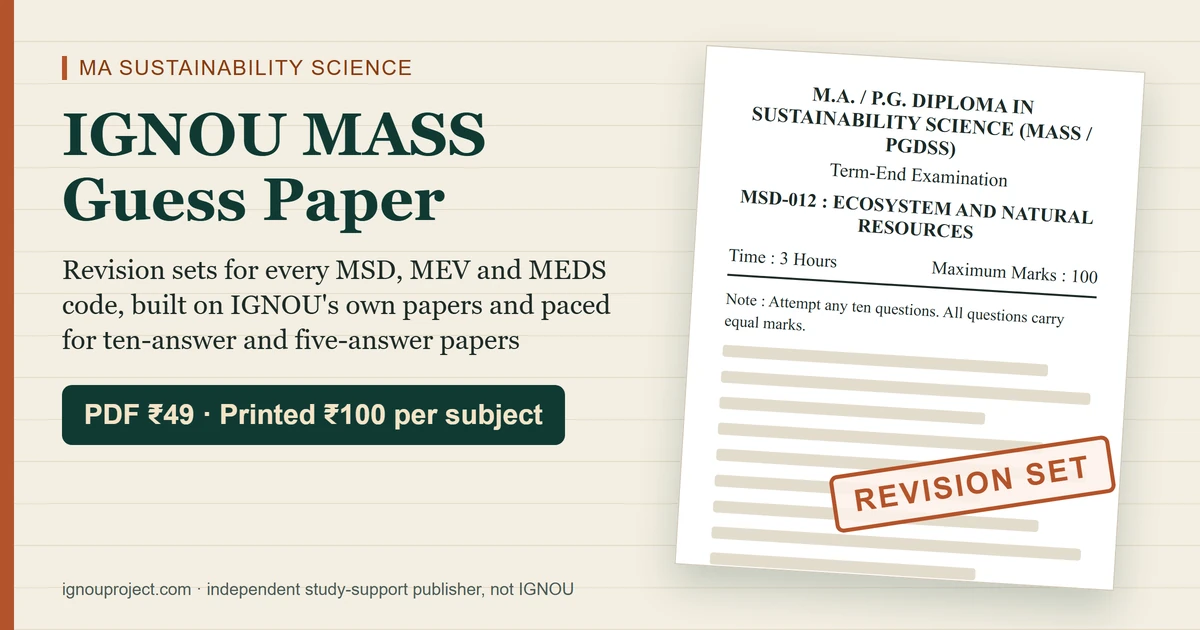
Quick answer. An IGNOU MASS guess paper is a revision set for one course code of the MA (Sustainability Science), arranged by the themes IGNOU’s past papers keep returning to and answered to exam length; MASS has fifteen examined codes, nine MSD codes in Year I (shared with the PGDSS diploma) and MSD-021 to MSD-023, MEV-025, MEDS-044 and MEDS-051 in Year II. IGNOU’s December 2026 term-end examination (TEE) runs from 25 November 2026 to 14 January 2027, and the MASS papers run from MEDS-051 on Wednesday 25 November to MEDS-044 on Monday 28 December, every one of them in the 2 PM to 5 PM session, per IGNOU’s date sheet of 30 October 2026. Each MASS paper is 3 hours and 100 marks: the MSD papers and MEV-025 ask any ten answers at 10 marks, MEDS-044 and MEDS-051 ask any five at 20, and MSD-019 and MSD-020 moved from five 20-mark answers to ten 10-mark answers in June 2025. Sets are ₹49 PDF · ₹100 printed, per subject code, plus a single ₹100 courier charge on a printed order, in English, the MASS medium, and also in Hindi for MEDS-044, whose paper IGNOU prints in both languages. A guess paper is a revision aid built from past IGNOU question papers and the syllabus. No one outside IGNOU knows the questions in advance, and no claim is made that any question in this set will appear in your examination.
Every MASS Paper Is an Afternoon Paper, From 25 November On
The first MASS paper of December 2026 is MEDS-051 Fundamentals of CSR on Wednesday 25 November 2026, the opening day of IGNOU’s cycle, and the last is MEDS-044 Monitoring and Evaluation of Projects and Programmes on Monday 28 December 2026, according to IGNOU’s date sheet of 30 October 2026. All fifteen MASS codes sit in the evening session, 2 PM to 5 PM; none is in the morning. IGNOU’s earlier tentative sheet of 21 September 2026 gave every MASS code the same date, though it ended the whole cycle on 13 January rather than 14 January 2027.
December 2026 TEE window for all programmes: Wednesday 25 November 2026 to Thursday 14 January 2027 (IGNOU date sheet of 30 October 2026)
First MASS paper
MEDS-051 Fundamentals of CSR: Wednesday 25 November, 2 PM to 5 PM
Last MASS paper
MEDS-044 Monitoring and Evaluation: Monday 28 December, 2 PM to 5 PM
IGNOU’s 30 October 2026 sheet drops the word “tentative” from its heading, yet the university can still revise it; the hall ticket settles the final date and centre.
Year I: Seven MSD Evenings Between 2 and 9 December
The first-year run is tight. MSD-011 opens it on Wednesday 2 December, then MSD-012 on Thursday 3, MSD-013 on Friday 4 and MSD-014 on Saturday 5. Sunday 6 is the only free evening before MSD-015 on Monday 7, MSD-016 on Tuesday 8 and MSD-017 on Wednesday 9. MSD-019 follows on Friday 11 December.
MSD-020 Population, Health and Sustainability is the odd one out. It sits on Tuesday 22 December, eleven days after the rest of Year I. A PGDSS learner writes exactly these nine codes, so the diploma timetable is the same.
Since every paper is at 2 PM, mornings stay free on sitting days. That helps a little. It does not help with MSD-013 and MSD-014, which fall on the third and fourth evenings of a four-day run and need to be revised before 2 December.
Year II: Six Papers, One of Them a Week Before Everything Else
MEDS-051 Fundamentals of CSR sits alone on 25 November, a week before any MSD paper. After it the second year resumes with MSD-021 on Saturday 12 December, MEV-025 on Monday 14, MSD-022 on Tuesday 15 and MSD-023 on Thursday 17. MEDS-044 closes the programme on Monday 28 December.
Back-to-Back Evenings for a Learner Carrying Both Years
No two MASS codes share a date, so there is no clash on the sheet. The pressure comes from consecutive evenings instead:
- 11 and 12 December: MSD-019 (Year I) and MSD-021 (Year II).
- 14 and 15 December: MEV-025 and MSD-022, both Year II.
- A Year II learner still carrying MSD-019 writes on 11, 12, 14, 15 and 17 December: five papers in seven days.
Learners in other programmes can look their codes up on the site’s December 2026 date sheet finder. Reporting times for the afternoon session are explained in the note on IGNOU’s two exam sessions, and the hall ticket download guide applies once IGNOU releases admit cards. Centre questions go to the exam centre page; anyone still to pay can check the fee for each course and the steps for paying it online.
The Weightage Line Missing From Every MASS Paper
IGNOU prints no weightage figure for MASS. None of the 60 MASS term-end papers from December 2024 to June 2026 carries a weightage line, and the 2023 MASS first-year assignment booklet, the booklet IGNOU’s archive serves for the programme, does not state one either. The split between the term-end mark and the assignment mark for MASS is therefore a matter for the MASS Programme Guide, and this page does not borrow a figure from another programme.
What the documents do show is the gap between the two tasks. The 2023 booklet sets one assignment per course for 100 marks, with each answer “in around 500 words” written at home. The term-end paper then asks for ten answers in three hours. At that pace a 10-mark MSD answer has roughly 17 minutes, which is nowhere near enough time for 500 words of careful prose. Learners who have written only assignments usually discover this in the hall.
Grades can be turned into a percentage later with the site’s IGNOU percentage converter.
Revision Set, IGNOU Archive Paper or Answered Paper for MSD Codes
A guess paper, for one course code such as MSD-014 Ecological Economics, is a revision set a publisher prepares from the themes that recur in IGNOU’s past papers and from the syllabus, with a model answer for each; the market also sells it as “important questions”, “expected questions” or a “model paper”.
A previous year question paper for MASS is a paper IGNOU actually set at an earlier term-end examination, for example the June 2026 MSD-014 paper with its fourteen questions, any ten to be answered, and IGNOU gives it away free. Add a publisher’s worked answers to such an IGNOU paper and it becomes a solved question paper.
The useful distinction is time. An archive paper or a solved paper captures one sitting. A guess paper looks across sittings, and only that wider view shows, for instance, that MSD-014 has asked about common property resources in each of its last four papers.
On a phone, swipe the table sideways for every column.
| Question | Guess paper | Previous year question paper | Solved question paper |
|---|---|---|---|
| What is inside | MSD, MEV or MEDS themes that IGNOU has set more than once, with answers | One paper as IGNOU set it | One IGNOU paper with answers |
| Made by | A publisher | IGNOU | A publisher |
| Cost | Paid; on this page ₹49 PDF · ₹100 printed, per subject code | Free from IGNOU | Usually paid |
| Good for | Choosing what to revise first and how long to write | A timed rehearsal in the real format | Seeing a full sitting answered |
| Cannot do | Say what the next MASS paper will contain | Show which themes come back | Go beyond the one sitting it answers |
MASS learners are well served on the free side: every paper reviewed here is free on IGNOU’s site and linked below its theme table. Answered papers across programmes are collected in the site’s bank of solved IGNOU papers, and the IGNOU guess paper hub covers every other programme.
Ten-answer pacing. MSD and MEV-025 answers are drafted for 10 marks and about 17 minutes, the length the June 2026 papers call for.
Twenty-mark depth where it remains. MEDS-044 and MEDS-051 answers run to roughly 34 minutes each, because those papers still ask for five.
Split marks handled. Questions IGNOU splits as 2+8 or 5+5 are answered in two visible parts sized to those marks.
SDG targets by number. MSD-019 answers name the goal, the target and the indicator, as IGNOU’s questions on SDG-2, SDG-5 and SDG-10 ask.
Acts with their years. MSD-015 answers cite the Right to Information Act, 2005 and the Environment (Protection) Act, 1986 correctly.
Economics with a diagram. MSD-014 answers on green accounting and the economy-environment model carry the sketch the question invites.
Urban framing for MEDS-044. Monitoring, sampling and evaluation answers use the urban examples that IGNOU’s paper is built around.
Analysis, not recital, for Year II. MSD-021 to MSD-023 answers argue as well as describe, matching the June 2026 wording.
Counts with sources. Each theme in the tables below names the session and question number on IGNOU’s own file.
An evening-session planner. The free planner lays out the seven Year I evenings from 2 to 9 December.
Current codes only. No set is sold for a code missing from the July 2026 Common Prospectus or from IGNOU’s December sheet.
PDF or printed copy. Each code comes as a PDF on WhatsApp or as a printed booklet sent by courier.
Fifteen MASS Codes, One 3-Hour Paper, Two Answer Lengths
MASS is a 72-credit programme of the School of Interdisciplinary and Trans-disciplinary Studies (SOITS), set out in section 3.41 of the July 2026 Common Prospectus. Year I carries nine 4-credit theory courses, 36 credits in all. Year II carries 36 more: MSD-021, MSD-022, MSD-023 and MEV-025 at 4 credits each, MEDS-051 and MEDS-044 at 6 credits each, and the 8-credit MSDP-18 project. The sums agree with the stated total. English is the only medium of instruction listed. MSDP-18 is assessed as a project with no term-end paper, so it is not part of the tables below.
First-Year MSD Courses and the Evening Each Is Written
On a phone, swipe the table sideways for every column.
| Code | Title (July 2026 Common Prospectus) | Credits | December 2026 sitting |
|---|---|---|---|
| MSD-011 | Sustainability Science | 4 | Wed 2 Dec 2026, 2 PM to 5 PM |
| MSD-012 | Ecosystem and Natural Resources | 4 | Thu 3 Dec 2026, 2 PM to 5 PM |
| MSD-013 | Socio-Cultural System | 4 | Fri 4 Dec 2026, 2 PM to 5 PM |
| MSD-014 | Ecological Economics | 4 | Sat 5 Dec 2026, 2 PM to 5 PM |
| MSD-015 | Institutions, Governance and Policies | 4 | Mon 7 Dec 2026, 2 PM to 5 PM |
| MSD-016 | Strategies and Models for Sustainability | 4 | Tue 8 Dec 2026, 2 PM to 5 PM |
| MSD-017 | Challenges to Sustainable Development | 4 | Wed 9 Dec 2026, 2 PM to 5 PM |
| MSD-019 | Global Strategies to Sustainable Development | 4 | Fri 11 Dec 2026, 2 PM to 5 PM |
| MSD-020 | Population, Health and Sustainability | 4 | Tue 22 Dec 2026, 2 PM to 5 PM |
Second-Year Courses, Two of Them Worth 6 Credits
On a phone, swipe the table sideways for every column.
| Code | Title (July 2026 Common Prospectus) | Credits | December 2026 sitting |
|---|---|---|---|
| MEDS-051 | Fundamentals of CSR | 6 | Wed 25 Nov 2026, 2 PM to 5 PM |
| MSD-021 | Mountain and Hill Ecosystem | 4 | Sat 12 Dec 2026, 2 PM to 5 PM |
| MEV-025 | Climate Change and Society | 4 | Mon 14 Dec 2026, 2 PM to 5 PM |
| MSD-022 | Aquatic Ecosystem | 4 | Tue 15 Dec 2026, 2 PM to 5 PM |
| MSD-023 | Social Ecology, Globalisation and Sustainability | 4 | Thu 17 Dec 2026, 2 PM to 5 PM |
| MEDS-044 | Monitoring and Evaluation of Projects and Programmes | 6 | Mon 28 Dec 2026, 2 PM to 5 PM |
Year I is also the whole of the PG Diploma in Sustainability Science, and the PGDSS programme overview explains the exit after the first year. MEV-025 is borrowed from the PG Certificate in Climate Change, whose name heads its paper. For admission rules across programmes, the Common Prospectus explainer is the starting point.
Which MASS Codes a Given Learner Sits
On a phone, swipe the table sideways for every column.
| Learner | Codes on the December 2026 sheet | Sitting days |
|---|---|---|
| PGDSS diploma learner | MSD-011 to MSD-017, MSD-019, MSD-020 | 2 to 9 December, 11 December and 22 December |
| MASS Year I | The same nine MSD codes | The same nine evenings |
| MASS Year II | MEDS-051, MSD-021, MEV-025, MSD-022, MSD-023, MEDS-044 | 25 November, then 12, 14, 15, 17 and 28 December |
| PGDSS holder (registered July 2017 to July 2022) entering Year II | Year II codes, with MSD-019, MSD-020 and MEVE-016 Urban Environment as the prospectus requires | Year II dates plus 11, 19 and 22 December |
The last row comes from the prospectus note on lateral entry: PGDSS learners registered between July 2017 and July 2022 complete MSD-19, MSD-20 and MEVE-16 in place of the project. MEVE-016 sits on Saturday 19 December 2026, 2 PM to 5 PM, per the same sheet; its set is quoted on WhatsApp, as it is not one of the fifteen codes covered here.
How IGNOU Set Each MASS Paper in June 2026
Every MASS paper IGNOU set in June 2026 was 3 hours long and carried 100 marks, per the June 2026 papers for all fifteen codes. Thirteen of them asked any ten answers at 10 marks each, offering between eleven and fourteen questions; MEDS-044 and MEDS-051 asked any five answers at 20 marks each from eight questions. MSD-013 left the least room to choose: eleven questions for ten answers.
On a phone, swipe the table sideways for every column.
| Code | Latest IGNOU paper | Time and marks | Answer rule | Medium |
|---|---|---|---|---|
| MSD-011 | June 2026 | 3 hours, 100 marks | Any 10 of 14 at 10 marks | English |
| MSD-012 | June 2026 | 3 hours, 100 marks | Any 10 of 12 at 10 marks | English |
| MSD-013 | June 2026 | 3 hours, 100 marks | Any 10 of 11 at 10 marks | English |
| MSD-014 | June 2026 | 3 hours, 100 marks | Any 10 of 14 at 10 marks | English |
| MSD-015 | June 2026 | 3 hours, 100 marks | Any 10 of 12 at 10 marks | English |
| MSD-016 | June 2026 | 3 hours, 100 marks | Any 10 of 12 at 10 marks | English |
| MSD-017 | June 2026 | 3 hours, 100 marks | Any 10 of 12 at 10 marks | English |
| MSD-019 | June 2026 | 3 hours, 100 marks | Any 10 of 12 at 10 marks | English |
| MSD-020 | June 2026 | 3 hours, 100 marks | Any 10 of 12 at 10 marks | English |
| MSD-021 | June 2026 | 3 hours, 100 marks | Any 10 of 12 at 10 marks | English |
| MSD-022 | June 2026 | 3 hours, 100 marks | Any 10 of 12 at 10 marks | English |
| MSD-023 | June 2026 | 3 hours, 100 marks | Any 10 of 12 at 10 marks | English |
| MEV-025 | June 2026 | 3 hours, 100 marks | Any 10 of 14 at 10 marks | English |
| MEDS-044 | June 2026 | 3 hours, 100 marks | Any 5 of 8 at 20 marks | English and Hindi in one file |
| MEDS-051 | June 2026 | 3 hours, 100 marks | Any 5 of 8 at 20 marks | English |
MSD-019 and MSD-020 halved their answer length in June 2025. The June 2024 and December 2024 MSD-019 Global Strategies to Sustainable Development papers asked any five of eight questions at 20 marks each, and the MSD-020 Population, Health and Sustainability papers of the same two sessions asked any five of seven at 20 marks. From June 2025, per IGNOU’s June 2025, December 2025 and June 2026 papers, both ask any ten questions at 10 marks each. A 20-mark answer written to the old pattern now takes the time of two answers.
Answer Rule Session by Session
On a phone, swipe the table sideways for every column.
| Code | June 2024 | December 2024 | June 2025 | December 2025 | June 2026 |
|---|---|---|---|---|---|
| MSD-011 | 10 of 14 | 10 of 13 | 10 of 14 | 10 of 14 | 10 of 14 |
| MSD-012 | – | 10 of 14 | 10 of 12 | 10 of 12 | 10 of 12 |
| MSD-013 | – | 10 of 12 | 10 of 14 | 10 of 14 | 10 of 11 |
| MSD-014 | – | 10 of 14 | 10 of 12 | 10 of 12 | 10 of 14 |
| MSD-015 | – | 10 of 14 | 10 of 14 | 10 of 14 | 10 of 12 |
| MSD-016 | – | 10 of 14 | 10 of 14 | 10 of 14 | 10 of 12 |
| MSD-017 | – | 10 of 13 | 10 of 14 | 10 of 14 | 10 of 12 |
| MSD-019 | 5 of 8 (20 each) | 5 of 8 (20 each) | 10 of 12 | 10 of 12 | 10 of 12 |
| MSD-020 | 5 of 7 (20 each) | 5 of 7 (20 each) | 10 of 14 | 10 of 14 | 10 of 12 |
| MSD-021 | – | 10 of 12 | 10 of 12 | 10 of 12 | 10 of 12 |
| MSD-022 | – | 10 of 12 | 10 of 14 | 10 of 14 | 10 of 12 |
| MSD-023 | – | 10 of 12 | 10 of 12 | 10 of 12 | 10 of 12 |
| MEV-025 | – | 10 of 14 | 10 of 14 | 10 of 14 | 10 of 14 |
| MEDS-044 | – | 5 of 8 (20 each) | 5 of 8 (20 each) | 5 of 8 (20 each) | 5 of 8 (20 each) |
| MEDS-051 | – | 5 of 8 (20 each) | 5 of 8 (20 each) | 5 of 8 (20 each) | 5 of 8 (20 each) |
For the answer-rule history, three June 2024 papers were compared as well: MSD-011 June 2024, MSD-019 June 2024 and MSD-020 June 2024.
Two headings for one course, and the old 20-mark trap. IGNOU heads most Year I MSD papers “Post Graduate Diploma in Sustainability Science (PGDSS)” and never mentions the MA, while MSD-019 and MSD-020 carry the MASS heading even though the prospectus lists them in the PGDSS year too. In June 2026 MSD-012, MSD-014 and MSD-020 started printing both names. A MASS learner who searches IGNOU’s archive by programme can miss half the papers; search by course code. Older MSD-019 and MSD-020 revision material written for five 20-mark answers is still on sale, and it no longer fits the paper.
Disagreements in IGNOU’s documents, and one on this site.
- The prospectus counts MSD 19 and MSD 20 inside the 36 Year I credits, yet its lateral-entry note treats them as extra courses that older PGDSS holders must add, and it prints the project as both “MSDP 18” and “MSDP 018”.
- The prospectus titles MSD-015 “Institutions, Governance and Policies”; the June 2025 and December 2025 papers and the 2023 assignment booklet print “Institution, Governance and Policies”.
- The MEDS-044 papers of June 2025 and December 2025 misspell their own title as “Monitoring and Evaluaton”.
- Misprints inside questions: “Engle Coefficient” for Engel (MSD-011, December 2025), “casual linkages” for causal (MSD-011, June 2025), “SEG-12” and “SGD-11” (MSD-019, December 2025), “Desertifiction” and “Agnda-21” (MSD-021, December 2025), “material nutrition” where maternal is meant (MSD-020, June 2026) and “natural recourses” (MSD-015, December 2024).
- In-house: the site’s own MASS assignment page states a 70 per cent and 30 per cent split between the term-end paper and assignments, a figure no MASS paper or MASS booklet reviewed here prints. The publisher’s store listings for MASS combos also still name the June and December 2025 sessions and promise a fixed number of questions per subject. Both are being corrected; sets ordered through this page target December 2026 and no question count is promised.
What 60 MASS Papers Asked Again, Code by Code
Nine of the fourteen questions in IGNOU’s December 2025 MSD-015 Institutions, Governance and Policies paper return to a question from the December 2024 MSD-015 paper, most of them almost word for word: the stages of Environmental Impact Assessment, the Environment (Protection) Act, 1986, the National Environment Policy, 2006, political ecology, ecological imperialism, the Right to Information Act, 2005, the 1992 Rio conference, decentralised governance and the United Nations’ role in sustainable development. The June 2026 paper then dropped most of them.
The theme counts on this page come from 60 IGNOU term-end papers, one for each of the fifteen MASS codes in each of four sessions: December 2024, June 2025, December 2025 and June 2026, each reviewed in full by ignouproject.com on 4 November 2026. Three June 2024 papers, for MSD-011, MSD-019 and MSD-020, were compared for the answer rule only. Matching is by topic and is a human judgement: a question on the Green Revolution’s shortcomings and one on the evergreen revolution count as one theme in MSD-016, and a short note with two parts counts once. Each count reads “n of 4” and records what IGNOU has asked, never what it will ask. The theme tables cover all fifteen MASS codes.
The steadiest MASS themes are in MSD-014 Ecological Economics, where green accounting, the Kyoto Protocol and carbon trading, common property resources, and gender and ecology each appeared in all 4 papers from December 2024 to June 2026, and in MSD-020 Population, Health and Sustainability, where epidemics and pandemics, undernutrition, population policy and civil society did the same.
The June 2026 Year II papers ask for argument. In the June 2026 MSD-021, MSD-022 and MSD-023 papers, 17 of the 36 questions ask the learner to analyse, evaluate, examine, explore, reflect, critically assess, compare and contrast, or identify and discuss; in the December 2024 papers of the same three codes, 1 of 36 did. MSD-022 Aquatic Ecosystem moved furthest, with 7 of 12, including questions on the Coastal Regulation Zone Notification, 2019 and on beavers as a keystone species.
MSD-011 Sustainability Science
MSD-011’s June 2026 question on the link between population and resources repeats the December 2024 question 1 word for word.
On a phone, swipe the table sideways for every column.
| Theme | December 2024 | June 2025 | December 2025 | June 2026 | n of N |
|---|---|---|---|---|---|
| Sustainable development: meaning, genesis, principles and pillars | Q2 | Q1 | Q1, Q2 | Q4 | 4 of 4 |
| Sustainability science: goals, structure and central elements | Q6 | Q4 | Q6 | Q2 | 4 of 4 |
| Natural resource management approaches, including INRM and CBNRM | Q9 | Q9 | Q11 | Q8, Q11(c) | 4 of 4 |
| Technology, lifestyle and sustainability | Q11 | Q12, Q13 | Q10 | Q14 | 4 of 4 |
| Sustainable livelihood security and its index | Q7 | Q5 | – | Q7 | 3 of 4 |
| Maslow’s hierarchy and human scale development | Q5 | Q3 | – | Q1 | 3 of 4 |
| Landscape ecology | – | Q10 | Q12 | Q9 | 3 of 4 |
| Watershed management | Q10 | – | Q13 | Q10 | 3 of 4 |
| Environmental education and education for sustainable development | – | Q7 | Q9 | Q13 | 3 of 4 |
| Sustainability indicators, HDI and gross national happiness | – | Q14 | Q7, Q8 | Q11(b), Q12 | 3 of 4 |
The four MSD-011 papers behind this table, each headed for the PGDSS diploma, open from IGNOU’s site: MSD-011 December 2024, MSD-011 June 2025, MSD-011 December 2025 and MSD-011 June 2026.
MSD-012 Ecosystem and Natural Resources
In June 2026 the paper opened with the structure of an aquatic ecosystem and the provisioning services of mountains, topics the Year II codes MSD-021 and MSD-022 also cover.
On a phone, swipe the table sideways for every column.
| Theme | December 2024 | June 2025 | December 2025 | June 2026 | n of N |
|---|---|---|---|---|---|
| Agrobiodiversity: farmers, women, participatory breeding, threats | Q13, Q14 | Q10, Q11, Q12 | Q10, Q11 | Q10 | 4 of 4 |
| Biodiversity levels, hotspots, IUCN Red List, conservation | Q2, Q4 | Q3 | Q2, Q3 | Q3 | 4 of 4 |
| Minerals and mining: scarcity, phases, waste, restoration | Q11 | Q8(b) | Q8 | Q8, Q9 | 4 of 4 |
| Transboundary water sharing | Q5 | Q6 | – | Q6 | 3 of 4 |
| Resource rights, resource flow and depletion | Q9 | Q7 | Q9 | – | 3 of 4 |
| Energy: biofuels, wind, alternatives, conservation | Q10, Q12 | Q8(a) | Q7 | – | 3 of 4 |
| Soil: fertility, quality, profile, characteristics | Q7 | – | Q4 | Q5 | 3 of 4 |
| Land management and unsustainable land use | Q8 | Q4 | – | Q4 | 3 of 4 |
IGNOU files: MSD-012 December 2024, MSD-012 June 2025, MSD-012 December 2025 and MSD-012 June 2026.
MSD-013 Socio-Cultural System
On a phone, swipe the table sideways for every column.
| Theme | December 2024 | June 2025 | December 2025 | June 2026 | n of N |
|---|---|---|---|---|---|
| Cultural and human ecology, eco-cosmology, culture and environment | Q3 | Q1, Q14 | Q11 | Q2 | 4 of 4 |
| Forests: policy, commercial forestry, types, community forests | Q9 | Q5 | Q6 | Q8 | 4 of 4 |
| Forms of society | Q7 | Q2 | – | Q1 | 3 of 4 |
| Equity: inter- and intra-generational, equity and equality | Q6 | – | Q4 | Q4 | 3 of 4 |
| Indigenous and local knowledge | – | Q8 | Q13 | Q9(c) | 3 of 4 |
| Community participation and empowerment | – | Q11 | Q14 | Q7 | 3 of 4 |
| Modes of subsistence: Bhotiya, shifting cultivation, hunting and gathering | – | Q9 | Q3 | Q3 | 3 of 4 |
| Development, displacement and mining impacts | Q10, Q11 | – | Q7 | Q11 | 3 of 4 |
The MSD-013 papers counted above, as IGNOU publishes them for December 2024 to June 2026: MSD-013 December 2024, MSD-013 June 2025, MSD-013 December 2025 and MSD-013 June 2026.
MSD-014 Ecological Economics
On a phone, swipe the table sideways for every column.
| Theme | December 2024 | June 2025 | December 2025 | June 2026 | n of N |
|---|---|---|---|---|---|
| Green accounting and national accounts | Q1 | Q12 | Q12 | Q14 | 4 of 4 |
| Kyoto Protocol, carbon markets and emission trading | Q2 | Q11 | Q11 | Q13 | 4 of 4 |
| Common property resources and the tragedy of the commons | Q6 | Q8 | Q8 | Q9 | 4 of 4 |
| Gender, women and ecology | Q5 | Q9 | Q9 | Q10 | 4 of 4 |
| Non-renewable resources and limits to growth | Q12 | Q4 | Q4 | – | 3 of 4 |
| Pollution policy instruments: command and control, permits | Q3 | – | Q10 | Q12 | 3 of 4 |
| Valuing ecosystem services | Q4 | Q10 | – | Q11 | 3 of 4 |
| Natural capital and man-made capital | – | Q5 | – | Q5 | 2 of 4 |
Sources: MSD-014 December 2024, MSD-014 June 2025, MSD-014 December 2025 and MSD-014 June 2026.
MSD-015 Institutions, Governance and Policies
On a phone, swipe the table sideways for every column.
| Theme | December 2024 | June 2025 | December 2025 | June 2026 | n of N |
|---|---|---|---|---|---|
| Environmental Impact Assessment, auditing and EMS | Q5, Q14 | Q12, Q13(a) | Q1, Q7(a) | Q8 | 4 of 4 |
| Right to Information Act, 2005 | Q8 | Q7 | Q8 | Q7 | 4 of 4 |
| Institutions: formal, informal, role in environment | Q1 | Q1 | Q14 | Q3, Q6 | 4 of 4 |
| Governance: good governance, centralised and decentralised | Q4, Q7 | Q3, Q5(a) | Q10, Q12 | Q1, Q4 | 4 of 4 |
| UN bodies, Rio 1992, Agenda 21 and global institutions | Q2, Q3, Q9 | Q2, Q14 | Q9, Q13 | Q10 | 4 of 4 |
| Environmental statutes: EP Act 1986, Biological Diversity Act, Air Act | Q13 | Q11 | Q2 | Q5 | 4 of 4 |
| Participatory governance and people’s participation | Q6 | Q4 | Q11 | Q9 | 4 of 4 |
| National Environment Policy, 2006 | Q12 | Q10 | Q3 | – | 3 of 4 |
To compare the December 2024 and December 2025 MSD-015 papers side by side, open them on IGNOU’s site: MSD-015 December 2024, MSD-015 June 2025, MSD-015 December 2025 and MSD-015 June 2026.
MSD-016 Strategies and Models for Sustainability
The People’s Biodiversity Register question of June 2026 repeats the December 2025 wording, and the biovillage set-up steps returned in December 2025 from December 2024.
On a phone, swipe the table sideways for every column.
| Theme | December 2024 | June 2025 | December 2025 | June 2026 | n of N |
|---|---|---|---|---|---|
| Green Revolution shortcomings and the evergreen revolution | Q7 | Q9 | Q6 | Q6 | 4 of 4 |
| Ecological foundations of sustainable agriculture and eco-agriculture | Q8 | Q10 | Q5 | Q11 | 4 of 4 |
| Infrastructure: definition, types, sustainable approaches | Q1 | Q1 | Q14 | Q5 | 4 of 4 |
| People’s Biodiversity Register and community gene banks | Q5 | Q6 | Q9 | Q8 | 4 of 4 |
| Value addition | Q2(a) | Q3 | Q12 | Q4 | 4 of 4 |
| Biovillage: model and setting-up steps | Q6 | – | Q4, Q7 | Q10 | 3 of 4 |
| Models of sustainable development | Q10, Q11 | Q13 | – | Q1 | 3 of 4 |
| Culture and livelihoods | Q14 | Q14 | – | Q7 | 3 of 4 |
| Sanitation | – | Q2 | Q13 | Q9 | 3 of 4 |
| Village knowledge centres and knowledge networks | – | Q7 | Q8 | Q2 | 3 of 4 |
Files: MSD-016 December 2024, MSD-016 June 2025, MSD-016 December 2025 and MSD-016 June 2026.
MSD-017 Challenges to Sustainable Development
On a phone, swipe the table sideways for every column.
| Theme | December 2024 | June 2025 | December 2025 | June 2026 | n of N |
|---|---|---|---|---|---|
| Climate change: barriers, adaptation, mitigation, NAPCC, impacts | Q7, Q10 | Q1, Q4 | Q8, Q9, Q10 | Q1, Q5, Q11 | 4 of 4 |
| Land degradation and desertification | Q2 | Q12, Q13 | Q3, Q7(b) | Q8, Q9 | 4 of 4 |
| Sanitation, hygiene and environmental health | Q5 | Q9, Q10 | Q5 | Q10 | 4 of 4 |
| Energy: efficiency, crisis, alternative and new fuels | Q11 | Q5 | Q13 | Q2 | 4 of 4 |
| Health: dimensions, hazards, communicable disease | Q8, Q13 | Q11 | Q6(a), Q7(a) | Q3, Q12 | 4 of 4 |
| Traditional knowledge and biopiracy | Q4 | – | Q1 | Q4 | 3 of 4 |
| Urbanisation and resource demand | – | Q6 | Q12 | Q6 | 3 of 4 |
| Disasters and vulnerability | Q2 | Q14 | Q2 | – | 3 of 4 |
Every MSD-017 paper behind these counts is free on IGNOU’s question paper pages: MSD-017 December 2024, MSD-017 June 2025, MSD-017 December 2025 and MSD-017 June 2026.
MSD-019 Global Strategies to Sustainable Development
Almost every MSD-019 question names a goal by number, so the themes below are listed by SDG.
On a phone, swipe the table sideways for every column.
| Theme | December 2024 | June 2025 | December 2025 | June 2026 | n of N |
|---|---|---|---|---|---|
| SDG-13 climate action and the Paris Agreement | Q6 | Q10 | Q4 | Q9 | 4 of 4 |
| SDG-5 gender equality | Q2 | Q4 | – | Q5 | 3 of 4 |
| SDG-10 reduced inequalities | Q4 | Q7 | Q7 | – | 3 of 4 |
| SDG-11 sustainable cities | – | Q8 | Q6 | Q7 | 3 of 4 |
| SDG-12 and the circular economy | Q5 | – | Q5 | Q8 | 3 of 4 |
| SDG-15 life on land | Q7 | – | Q3 | Q11 | 3 of 4 |
| Multidimensional Poverty Index | Q1 | – | – | Q2 | 2 of 4 |
| SDG-17 partnerships | – | – | Q1 | Q12 | 2 of 4 |
IGNOU files: MSD-019 December 2024, MSD-019 June 2025, MSD-019 December 2025 and MSD-019 June 2026.
MSD-020 Population, Health and Sustainability
On a phone, swipe the table sideways for every column.
| Theme | December 2024 | June 2025 | December 2025 | June 2026 | n of N |
|---|---|---|---|---|---|
| Epidemics and pandemics: society, economy, global challenges | Q5, Q7 | Q12, Q13 | Q1, Q2, Q3 | Q10, Q11 | 4 of 4 |
| Undernutrition and malnutrition | Q4 | Q10, Q11 | Q4, Q5 | Q8 | 4 of 4 |
| Population policies | Q3 | Q8 | Q7 | Q4 | 4 of 4 |
| Civil society | Q6 | Q7 | Q8 | Q5 | 4 of 4 |
| Nutrition and food security, PDS and Mid-day Meal | Q2 | Q9 | Q6, Q12 | Q2, Q7 | 4 of 4 |
| Sources of population data | Q1 | – | Q14 | – | 2 of 4 |
| Demographic transition | – | Q2 | Q13 | – | 2 of 4 |
| Marginalised groups | – | Q6 | Q9 | – | 2 of 4 |
The four MSD-020 papers, the first written for five 20-mark answers and the rest for ten, are here: MSD-020 December 2024, MSD-020 June 2025, MSD-020 December 2025 and MSD-020 June 2026.
MSD-021 Mountain and Hill Ecosystem
On a phone, swipe the table sideways for every column.
| Theme | December 2024 | June 2025 | December 2025 | June 2026 | n of N |
|---|---|---|---|---|---|
| River systems and upstream-downstream linkages | Q3 | Q4 | Q3 | Q3 | 4 of 4 |
| Ecological monitoring, its tools, METT and MEE | Q12 | Q12 | Q12 | Q11, Q12 | 4 of 4 |
| Mountains: classification and modes of origin | Q1 | – | Q1, Q2 | Q1 | 3 of 4 |
| Agroforestry in mountain regions | Q5 | Q5 | Q4 | – | 3 of 4 |
| Ecotourism and cultural tourism | – | Q8 | Q6(e) | Q5 | 3 of 4 |
| Conventions: Ramsar, CITES, UNCCD, Agenda 21, mountain partnership | Q9, Q10 | – | Q10, Q11 | Q6 | 3 of 4 |
| Tribes and indigenous knowledge systems | Q2 | Q2 | – | Q10 | 3 of 4 |
| Inclusive green growth | – | – | Q9 | Q8 | 2 of 4 |
Sources: MSD-021 December 2024, MSD-021 June 2025, MSD-021 December 2025 and MSD-021 June 2026.
MSD-022 Aquatic Ecosystem
On a phone, swipe the table sideways for every column.
| Theme | December 2024 | June 2025 | December 2025 | June 2026 | n of N |
|---|---|---|---|---|---|
| Lake ecosystems: biotic structure, oligotrophic and eutrophic | Q1 | Q1 | Q8 | Q1 | 4 of 4 |
| Marine ecosystems: features, processes, upwelling, management | Q2 | Q4 | Q4 | Q5 | 4 of 4 |
| Wetlands: drivers of loss, threats, services | Q7 | Q5 | Q5 | Q6, Q7, Q8 | 4 of 4 |
| Estuaries, coasts and coastal resilience | Q3(a), Q4(a) | Q3(a) | Q12(b), Q13 | Q3 | 4 of 4 |
| Global Environment Facility and conservation finance | Q4(b) | Q10(b) | – | Q12 | 3 of 4 |
| Climate-smart agriculture | Q11 | Q8 | Q14(b) | – | 3 of 4 |
| Conventions: CITES, CBD, migratory species, Law of the Sea | Q5(a), Q10 | Q9 | Q1, Q2(a) | – | 3 of 4 |
| Pelagic, benthic and habitat zones, ocean biota | Q6(a) | Q2 | Q7, Q14(a) | – | 3 of 4 |
Read the MSD-022 papers in order to see the June 2026 change in wording for yourself: MSD-022 December 2024, MSD-022 June 2025, MSD-022 December 2025 and MSD-022 June 2026.
MSD-023 Social Ecology, Globalisation and Sustainability
On a phone, swipe the table sideways for every column.
| Theme | December 2024 | June 2025 | December 2025 | June 2026 | n of N |
|---|---|---|---|---|---|
| Globalisation: history, evolution and waves | Q5 | Q5 | Q4 | Q9 | 4 of 4 |
| Globalisation indices and their limits | Q7 | Q7 | Q6 | Q5 | 4 of 4 |
| Socio-ecological and socio-technical transformation | Q9, Q10 | Q9, Q10 | Q8, Q9, Q10 | Q6 | 4 of 4 |
| Human ecology, social ecology and traditional ecological knowledge | Q1, Q3 | Q1 | Q2 | Q8 | 4 of 4 |
| Strands of environmentalism | Q11 | Q11 | – | Q10 | 3 of 4 |
| Nature, society and technology | Q8 | Q8 | Q7 | – | 3 of 4 |
| The global economy: challenges, drivers, trade | Q12 | Q12 | – | Q11 | 3 of 4 |
| Global social change and global conventions | Q2 | Q2 | Q1 | – | 3 of 4 |
Files: MSD-023 December 2024, MSD-023 June 2025, MSD-023 December 2025 and MSD-023 June 2026.
MEV-025 Climate Change and Society
On a phone, swipe the table sideways for every column.
| Theme | December 2024 | June 2025 | December 2025 | June 2026 | n of N |
|---|---|---|---|---|---|
| Climate vulnerability and vulnerability assessment | Q1 | Q1 | Q1 | Q1, Q5, Q6(a) | 4 of 4 |
| Climate refugees and displacement | Q3, Q9 | Q3(b) | Q12 | Q8(a) | 4 of 4 |
| Climate justice and environmental justice | Q2, Q10 | Q2(a) | Q6, Q11(b) | Q6(b) | 4 of 4 |
| Climate change and human health | Q4 | Q4, Q8 | Q9, Q10(a) | Q2, Q8(b) | 4 of 4 |
| Women, children and gender equality | Q11 | Q10 | Q3 | Q11, Q14(b) | 4 of 4 |
| India’s response: NAPCC, INDCs and programmes | Q7 | Q6 | Q2 | Q9 | 4 of 4 |
| SDG-13 and the 2030 Agenda | Q14 | Q12 | Q4, Q11(a) | Q12 | 4 of 4 |
| Agriculture, animal husbandry and agrobiodiversity | – | Q5, Q11 | Q8 | Q3, Q13 | 3 of 4 |
MEV-025 papers, each headed for the PG Certificate in Climate Change rather than for MASS: MEV-025 December 2024, MEV-025 June 2025, MEV-025 December 2025 and MEV-025 June 2026.
MEDS-044 Monitoring and Evaluation of Projects and Programmes
Each MEDS-044 file holds the English paper followed by a Hindi version with the same eight questions and the same mark splits.
On a phone, swipe the table sideways for every column.
| Theme | December 2024 | June 2025 | December 2025 | June 2026 | n of N |
|---|---|---|---|---|---|
| Evaluation: approaches, types, logical framework | Q1 | Q1 | Q6 | Q1(b), Q6 | 4 of 4 |
| Sampling: methods, design, errors, sample size | Q3, Q8(c) | Q3, Q8(b) | Q4 | Q4 | 4 of 4 |
| Measurement: scales, reliability, validity | Q2 | Q2, Q8(c) | Q5 | Q5 | 4 of 4 |
| Monitoring tools and techniques | Q7 | – | Q7 | Q7 | 3 of 4 |
| Project management cycle | Q6 | Q6 | – | Q8 | 3 of 4 |
| Project appraisal | Q5 | – | Q8 | Q1(a) | 3 of 4 |
| Data collection methods | Q4, Q8(a) | Q4 | Q3 | – | 3 of 4 |
| Tabulation and analysis of data | Q8(b) | Q8(a) | – | Q1(c), Q3 | 3 of 4 |
Bilingual files: MEDS-044 December 2024, MEDS-044 June 2025, MEDS-044 December 2025 and MEDS-044 June 2026.
MEDS-051 Fundamentals of CSR
On a phone, swipe the table sideways for every column.
| Theme | December 2024 | June 2025 | December 2025 | June 2026 | n of N |
|---|---|---|---|---|---|
| CSR theories, models, Carroll’s pyramid | Q1 | Q1 | Q1 | Q1 | 4 of 4 |
| Community engagement, ownership and democratised development | Q5, Q6 | Q7 | Q6, Q7 | Q7 | 4 of 4 |
| Poverty alleviation and livelihood promotion | Q3 | Q4 | Q8(c) | Q4 | 4 of 4 |
| Section 135 and Schedule VII of the Companies Act, 2013 | Q2, Q8(b) | Q3 | Q8(a) | – | 3 of 4 |
| International guidelines: UN Global Compact, OECD, MNE Declaration | Q8(a) | Q2 | Q2 | – | 3 of 4 |
| Awareness campaigns | – | Q6 | – | Q5 | 2 of 4 |
| Women’s economic empowerment | – | – | Q4 | Q8(a) | 2 of 4 |
The MEDS-051 papers, set for the corporate social responsibility diploma and MA, on IGNOU’s site: MEDS-051 December 2024, MEDS-051 June 2025, MEDS-051 December 2025 and MEDS-051 June 2026.
A theme that keeps returning deserves early revision, and that is all a count can say. IGNOU also writes new questions every sitting, as the June 2026 MSD-022 paper shows. Papers for other programmes are listed on the site’s IGNOU last-year paper page.
How a MASS Set Is Put Together From IGNOU’s Files
- Gather the four newest papers for the code. For MASS these are the December 2024, June 2025, December 2025 and June 2026 files on IGNOU’s question paper indexes, with the June 2024 file where the answer rule changed.
- Read the answer rule before anything else. It fixes the length of every model answer: ten answers of 10 marks for MSD and MEV-025, five of 20 for the two MEDS codes.
- Sort the questions into themes. Questions are matched by hand across the four sessions, and each theme keeps its question numbers so that the count can be checked.
- Lead with the frequent themes, then fill in the blocks. Themes asked in every paper go first; the rest of the course follows from the eGyanKosh blocks, because IGNOU sets new questions each time.
- Write to the time and the split. A 5+5 question gets two equal halves, a 2+8 question a short definition and a long explanation, and every answer fits its share of three hours.
Honest Limits: Where a MASS Revision Set Stops
A guess paper is a revision aid built from past IGNOU question papers and the syllabus. No one outside IGNOU knows the questions in advance, and no claim is made that any question in this set will appear in your examination. MASS shows why. IGNOU reran most of the December 2024 MSD-015 paper in December 2025, then changed course in June 2026, and the June 2026 MSD-022 paper was written almost entirely in new terms.
Where a MASS Set Earns Its Place
It sets an order. Common property resources in MSD-014, the RTI Act in MSD-015 and pandemics in MSD-020 come first because IGNOU has asked about them in every recent paper. It also sets a length, ten 17-minute answers or five 34-minute ones, and it keeps SDG numbers, Act years and treaty names accurate where a slip is easy to spot.
Where It Stops
It cannot forecast the December 2026 paper or stand in for the eGyanKosh blocks. Nor can it keep pace with a new answer rule it was not written for: a set built for the old five-question MSD-019 paper would mistime every answer today. The official IGNOU material remains the base for every MASS course, and a set is a supplement to it.
Free ways to revise MASS. All sixty-three IGNOU papers linked on this page cost nothing; writing the June 2026 paper of a code under a three-hour timer is the closest free rehearsal available. The MSD course blocks are free through the site’s guide to eGyanKosh, with the Gyankosh search route as a fallback. The site also keeps IGNOU book downloads by programme and short IGNOU study notes.
Plan the MSD Evenings and Time Each Answer, at No Cost
The planner takes the MASS codes ticked, puts them in date order, counts the evenings between sittings, flags back-to-back evenings and prices the order. The paper check shows how IGNOU set a chosen code in June 2026, how its answer rule moved by session, the minutes per answer and the themes IGNOU asked most.
Free tool 1
MASS Evening Sitting Planner
Between 0.5 and 16; halves are fine.
This tool is guidance from ignouproject.com, not an IGNOU rule. Using it creates no obligation to order anything.
Free tool 2
MASS Paper Shape and Minutes Check
Ten minutes are set aside for reading and choosing; the remaining 170 minutes are shared equally across the answers.
This tool is guidance from ignouproject.com, not an IGNOU rule. Using it creates no obligation to order anything.
The minutes shown by the paper check are those in this table, worked out from the 3 hours and 100 marks printed on every MASS paper.
On a phone, swipe the table sideways for every column.
| Code | Paper | Time per answer |
|---|---|---|
| MSD-011 | 180 min, 100 marks, 10 answers | about 17 min for each 10-mark answer |
| MSD-012 | 180 min, 100 marks, 10 answers | about 17 min for each 10-mark answer |
| MSD-013 | 180 min, 100 marks, 10 answers | about 17 min for each 10-mark answer |
| MSD-014 | 180 min, 100 marks, 10 answers | about 17 min for each 10-mark answer |
| MSD-015 | 180 min, 100 marks, 10 answers | about 17 min for each 10-mark answer |
| MSD-016 | 180 min, 100 marks, 10 answers | about 17 min for each 10-mark answer |
| MSD-017 | 180 min, 100 marks, 10 answers | about 17 min for each 10-mark answer |
| MSD-019 | 180 min, 100 marks, 10 answers | about 17 min for each 10-mark answer |
| MSD-020 | 180 min, 100 marks, 10 answers | about 17 min for each 10-mark answer |
| MSD-021 | 180 min, 100 marks, 10 answers | about 17 min for each 10-mark answer |
| MSD-022 | 180 min, 100 marks, 10 answers | about 17 min for each 10-mark answer |
| MSD-023 | 180 min, 100 marks, 10 answers | about 17 min for each 10-mark answer |
| MEV-025 | 180 min, 100 marks, 10 answers | about 17 min for each 10-mark answer |
| MEDS-044 | 180 min, 100 marks, 5 answers | about 34 min for each 20-mark answer |
| MEDS-051 | 180 min, 100 marks, 5 answers | about 34 min for each 20-mark answer |
Both tools use only the dates, answer rules and theme counts already set out in the tables on this page, and they run inside the browser without sending anything anywhere.
IGNOU’s Own MSD Files and the Sheet of 30 October
IGNOU’s newer papers are listed by session on ignou.ac.in. The June 2026 question paper index holds all fifteen MASS files, as do the December 2025 index, the June 2025 index and the December 2024 index. Older sessions live on IGNOU’s webservices archive, where the June 2024 SOITS listing files the Year I MSD papers under PGDSS and MSD-019 to MSD-023 under MASS.
- On the index page, use the browser’s find box to locate a code such as MSD-016.
- Check the session printed under “Term-End Examination” on page 1, since the December 2024 files sit in a folder whose path names no session.
- Look for MEV-025 under the climate change certificate, MEDS-044 under urban planning and MEDS-051 under corporate social responsibility; the MASS name does not appear on those papers.
- Take each sitting date from the 30 October 2026 version of IGNOU’s December 2026 TEE date sheet. The tentative version of 21 September 2026 shows the same MASS dates.
Assignment questions are on IGNOU’s assignment portal; the most recent MASS booklet that IGNOU’s own archive surfaces is the 2023 MASS first-year assignment booklet, and learners should download the booklet for their own session. The site’s guide to reading an IGNOU date sheet explains the two session columns.
Admit Card Before 25 November, Marks and Rechecking After
Before 25 November the admit card is the only document that matters. After the papers, the term-end marks appear through the service explained on the IGNOU result page, and the MA result guide covers master’s programmes such as MASS. How the last cycle’s results were released is recorded on the June 2026 term-end result page.
Assignment marks reach the grade card by a separate route, which the assignment status and marks tracker explains. A learner who disputes a term-end mark can apply through IGNOU’s revaluation process. After the second year closes, the overall standing is worked out with the final grade card guide and the CGPA calculator.
Assignments, Books and the MSDP-18 Project Alongside a MASS Set
MASS assignments fall due before the examination, and the site’s MASS handwritten assignment page lists every MSD, MEV and MEDS booklet; typed answers are on the solved assignment page. Learners who want more reading than a revision set can order IGNOU help books or guide books online. The MSDP-18 project is separate work with no term-end paper, covered on the MASS project page and, for diploma learners, the PGDSS project page.
English Sets, the MEDS-044 Hindi Version and the Session Covered
Each set is prepared for the upcoming term-end examination, in every medium IGNOU examines that course in, and the medium for your course code is confirmed on WhatsApp before you pay.
For MASS that is English almost throughout. The July 2026 Common Prospectus names English as the medium of instruction, and every MSD, MEV-025 and MEDS-051 paper from December 2024 to June 2026 is printed in English alone. MEDS-044 differs: all four of its papers print the English paper and then a Hindi version in the same file, because IGNOU sets that course for its urban planning programmes as well. A MEDS-044 set can therefore be prepared in Hindi.
Every set offered here is written for the December 2026 papers. When IGNOU issues the tentative June 2027 date sheet, the dates, the answer rules and the theme counts here are checked again against the newest MASS papers.
Four Messages From Hall Ticket to a MASS Set
- Send the course codes on your hall ticket to WhatsApp +91 93546 37830.
- Say PDF or printed for each, and English or Hindi if one of them is MEDS-044.
- Pay the amount quoted.
- Receive the PDF in the same chat, or the courier details for a printed copy once it has gone out.
The rate is ₹49 per subject code for a solved guess paper as a PDF, or ₹100 per subject code as a printed copy. Printed copies carry a one-time courier charge of ₹100 per order, whatever the number of subject codes; the PDF has no courier charge. The PDF is shared on WhatsApp once payment is confirmed. A printed copy is dispatched the next day after payment is confirmed, and the courier details are shared on WhatsApp. No arrival date is promised, because transit time depends on the courier and your location. There is no minimum order: one subject or ten, same rate per format.
Other services from the publisher, with their rates, are listed on the services and charges page.
₹49 PDF · ₹100 printed, per subject code
Where This MASS Page’s Facts Come From
IGNOU documents. The July 2026 Common Prospectus, sections 3.41 (MASS) and 8.38 (PGDSS), for codes, titles, credits and medium; 63 IGNOU term-end papers, the 60 counted in the theme tables and the June 2024 MSD-011, MSD-019 and MSD-020 papers used for the answer-rule history; IGNOU’s December 2026 date sheets of 21 September and 30 October 2026; IGNOU’s question paper indexes for December 2024 to June 2026 and the June 2024 SOITS listing; and the 2023 MASS first-year assignment booklet.
The publisher’s analysis. The answer-rule history, the theme tables with their n of 4 counts, the question-wording comparison, the minutes per answer and the consecutive-evening notes are ignouproject.com’s own work from those documents. Matching questions to themes is a judgement. The theme tables cover all fifteen MASS codes; MEVE-016 and any other code are confirmed against the latest IGNOU paper on WhatsApp. IGNOU can still revise the sheet of 30 October 2026.
The publisher’s terms. What a set costs, how it is sent and in which language are terms set by ignouproject.com and Shri Chakradhar Publication Pvt. Ltd.; none of them is an IGNOU fact.
Written and reviewed by BK Sahni, Founder, Shri Chakradhar Publication Pvt. Ltd. and ignouproject.com, who has guided 5,00,000 students till date. ORCID 0009-0005-8092-459X. Serving IGNOU learners since 2010.
Published and last reviewed on 4 November 2026. The next review is due in March 2027, or earlier if IGNOU publishes the June 2027 tentative date sheet before then.
MASS Doubts Answered: Price, Repeats, Pattern, Hindi
For MASS, each subject code costs ₹49 as a PDF set or ₹100 as a printed set. Printed copies carry a one-time courier charge of ₹100 per order, whatever the number of subject codes; the PDF has no courier charge. Each MSD, MEV or MEDS code is priced separately.
In the four MASS papers from December 2024 to June 2026, several themes appeared every time: green accounting and common property resources in MSD-014, the RTI Act in MSD-015, pandemics and population policy in MSD-020, and globalisation indices in MSD-023. Each count is shown as n of 4 in the theme tables.
The first MASS paper of December 2026 is MEDS-051 Fundamentals of CSR on Wednesday 25 November 2026, 2 PM to 5 PM, per IGNOU’s date sheet of 30 October 2026. The MSD run starts with MSD-011 on Wednesday 2 December, and the last MASS paper is MEDS-044 on Monday 28 December.
Every MASS paper set in June 2026 was 3 hours and 100 marks. The MSD papers and MEV-025 asked for any ten answers at 10 marks each, from eleven to fourteen questions, while MEDS-044 and MEDS-051 asked for any five answers at 20 marks each, from eight questions.
Yes. IGNOU publishes every MASS term-end paper free on ignou.ac.in, through a question paper index for each session from December 2024 onward and the webservices archive for older sessions. All sixty-three papers behind this page are linked under their theme tables and in the section on official papers.
A previous year paper for MASS is one paper IGNOU actually set, such as the June 2026 MSD-012 paper, free on IGNOU’s site. A MASS guess paper is a publisher’s revision set for one code, organised by recurring theme across several sessions and answered at exam length. A solved paper answers one IGNOU sitting.
No one can say that. A guess paper is a revision aid built from past IGNOU question papers and the syllabus. No one outside IGNOU knows the questions in advance, and no claim is made that any question in this set will appear in your examination.
Yes. The June 2024 and December 2024 MSD-019 and MSD-020 papers asked any five questions at 20 marks each. From June 2025 both papers ask any ten questions at 10 marks each. Old 20-mark answers on these two codes are now about twice the length the paper needs.
Yes, for the first year. The PGDSS diploma and MASS Year I share the nine codes MSD-011 to MSD-017, MSD-019 and MSD-020, and IGNOU sets one paper per code. Most Year I papers carry only the PGDSS heading, so a MASS learner should search by course code.
MASS is taught in English, per the July 2026 Common Prospectus, and every MSD, MEV-025 and MEDS-051 paper reviewed is printed in English only. MEDS-044 is the exception: IGNOU prints that paper in English and Hindi in one file. Which medium applies to each code is settled in the WhatsApp chat before anyone pays.
MEDS-044 Monitoring and Evaluation of Projects and Programmes is set for IGNOU’s urban planning diploma and MA (Urban Studies), whose heading the paper carries. Its questions frame monitoring, sampling and evaluation around urban development, so MASS learners answering it should adapt examples from sustainability projects.
On a MASS paper with ten 10-mark answers, about 17 minutes per answer remain after 10 minutes of reading and choosing. On MEDS-044 and MEDS-051, which ask five 20-mark answers, each answer gets about 34 minutes. All MASS papers are 3 hours long.
No MASS question paper from December 2024 to June 2026 prints a weightage line, and the 2023 MASS first-year assignment booklet does not print one either. The MASS Programme Guide is the document that states how term-end and assignment marks combine for this programme.
No seller’s set can be called the best for MASS, including this one. A useful check for any provider: current MSD, MEV and MEDS codes, the June 2026 answer rule, the December 2026 session named, answers sized to 10 or 20 marks, and no accuracy claims, which are a reason for caution.
A printed MASS set is dispatched the next day after payment is confirmed, and the courier details are shared on WhatsApp. No arrival date is promised, because transit time depends on the courier and your location. The PDF is shared on WhatsApp once payment is confirmed.
No. MSDP-18 is the 8-credit MASS project and has no term-end paper, so it has no place in the date planner or the guess paper list. MASS learners with a project question can follow the project link in the section on other orders.
No claim is made about the marks you will receive, about how an evaluator will assess your answers, or about your result. Study the official IGNOU material for every course you are sitting; a guess paper supplements that material and does not replace it.
Important Notice
ignouproject.com is an independent IGNOU study-support publisher. It is not the official website of Indira Gandhi National Open University, is not affiliated with, endorsed by or authorised by the university, and no page on this site should be treated as an official IGNOU communication.
Programme structures, course codes, examination dates, question-paper patterns and rules change, and only ignou.ac.in and your Regional Centre can confirm the current position for your enrolment.
A guess paper is a revision aid built from past IGNOU question papers and the syllabus. No one outside IGNOU knows the questions in advance, and no claim is made that any question in this set will appear in your examination.
Study the official IGNOU material for every course you are sitting; a guess paper supplements that material and does not replace it.
No claim is made about the marks you will receive, about how an evaluator will assess your answers, or about your result. Examination and evaluation are entirely a matter for IGNOU.

BK Sahni iD 0009-0005-8092-459X
Founder, Shri Chakradhar Publication Pvt. Ltd. & ignouproject.com — helping IGNOU distance-learning students since 2010 (5,00,000+ students supported across MBA, MCom, MA & more). Author of IGNOU exam guides, solved assignments & project reference books.
Disclosure: Shri Chakradhar Publication Pvt. Ltd. and ignouproject.com are independent third-party study-help services — not the official IGNOU website. Always verify final dates and rules on ignou.ac.in.