The IGNOU PGCPP Project for MIRP 1 is the compulsory project component of the Post Graduate Certificate in Patent Practice programme. It checks whether the learner can apply patent practice concepts to a structured, written project report. This PGCPP project work in patent practice seeks to improve the learner’s knowledge of patent searching.
IGNOU PGCPP project work offers them extensive instruction in the preparation of patent applications (with Partichar emphasis on drawing up specifications and claims). It is recommended that students actively engage in a one-month internship with patent firms, offices, or institutions like CSIR, lCAR, and others to work on a project. This work usually involves a defined problem, a clear objective, a method for analysis, and well-organised findings. It also trains learners to write in a professional, compliant, and readable format.
If you are not affiliated with a firm or office, it is recommended that you properly study the course and do the PGCPP (MIRP 1) project work on your own. Our blog will assist you in providing a broad basis for work in the field that you will be undertaking as a PGCPP project.
Please ensure to get the IGNOU PGCPP synopsis approved before submitting. The PGCPP course has equipped you with the necessary framework, concepts, and practices to effectively read published patents, conduct prior art searches, and prepare patent applications. The fourth course experience offers you an in-depth understanding of reading, writing, and defending patent claims.
Understanding MIRP 1 in PGCPP Programme
To avoid common mistakes, treat MIRP 1 as the official code for the project work within PGCPP. Use the same code on all project documents where a course code is required.
| Item | What to write / follow | Why it matters |
|---|---|---|
| Course code | MIRP 1 | Helps correct mapping of the project to the programme |
| Programme | PGCPP | Prevents mis-tagging with other programmes |
| Project title | Short, specific, and patent-practice focused | Makes evaluation faster and clearer |
| Documents | Synopsis + project report + required declarations | Completes the submission packet |
Purpose of the PGCPP MIRP 1 Project
The PGCPP project aims to develop practical skills that align with patent practice work. It typically focuses on application-oriented outcomes such as:
- understanding patentability and prior art basics
- drafting, structuring, or analysing patent documents
- exploring filing pathways, documentation, and compliance needs
- studying domain trends, claims patterns, or IP strategy basics
Key Benefits of Completing MIRP 1 Properly
A well-planned IGNOU PGCPP Project for MIRP 1 delivers strong academic and career value:
- builds structured research and writing discipline
- improves clarity in patent-related documentation
- strengthens understanding of patent workflow and practical issues
- adds a credible project report for interviews and portfolios
- reduces the risk of rejection due to format or process gaps
IGNOU PGCPP Project Guidelines
A strong PGCPP project report should meet these core expectations:
- Relevance: Link the topic to patent practice, not general law or general management.
- Clarity: Define the problem, scope, and outcome in simple terms.
- Method: Use a clear method (document study, case-based review, comparative review, structured analysis, small primary survey if suitable).
- Original writing: Paraphrase all learning material and keep the structure unique.
- Consistent format: Maintain the same heading style, spacing, and numbering throughout.
- Ethics: Avoid copying claims, abstracts, or full text without proper rewriting and analysis.
IGNOU PGCPP Project Topic Selection for MIRP 1
Topic selection decides the ease of synopsis approval and the quality of the final report. Use these rules:
- select a narrow scope (one domain, one issue, one workflow stage)
- prefer application-focused topics over purely theoretical writing
- ensure the topic allows enough material for analysis, not only description
- keep the topic aligned with patent practice tasks (search, drafting logic, documentation, compliance, portfolio support)
Project Topic Ideas for MIRP 1 (Patent Practice Focused)
Use these ideas as starting points and refine them with a specific scope:
- Patentability assessment framework for a selected technology area
- Common errors in claims drafting and how to avoid them
- Prior art search workflow and reporting format: a structured model
- Comparison of specification sections and best drafting order
- Patent documentation checklist for startups: a practical guide model
- Study of office action response patterns: issue types and fixes
- Strategy for converting an invention disclosure into a draft outline
- Patent filing route selection for SMEs: decision matrix approach
- Analysis of claim scope risks using sample invention scenarios
- Patent portfolio basics for a product line: mapping method
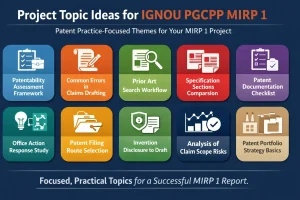
Image: Project Topic Ideas for IGNOU PGCPP MIRP 1
Tip for quick approval fit: Topics that include a clear “framework”, “checklist”, “model”, or “comparison” often remain focused and easy to evaluate.
Nature of IGNOU PGCPP Synopsis/Proposal
You should begin working on your project as soon as you enrol in the PGCPP programme. After enrolling, you should try to choose a topic for your PGCPP Project Work. A supervisor will assist and advise you in this. Supervisors should know what skills are needed for such tasks. You should select an area that appeals to you and that will keep your attention.
After deciding on a field of study and a project topic, you should write an IGNOU PGCPP Project proposal or synopsis of no more than 400 words. Your MIRP-1 Synopsis is simply a statement of what you want to achieve and how you intend to do it. You should explain the objectives of your study in your MIRP-1 proposal, as well as the work plan that you intend to follow. You are welcome to discuss your MIRP-1 Project Proposal with your friends and coworkers, your counsellor, and any professionals in that subject you know.
Role of Supervisor in IGNOU PGCPP Project Work
A supervisor approved by the Indira Gandhi National Open University will guide your project. All counsellors are approved as project supervisors. The coordinator of your study center can provide you with a list of supervisors. Once you’ve decided on a broad topic of study, please contact your Coordinator, who will assign you a supervisor who is appropriate for your research.
You should work with your Supervisor to create an IGNOU PGCPP Synopsis.
The supervisor will:
- approve your MIRP-1 Project Proposal,
- familiarise you with such local groups and agencies as may be relevant to your work,
- provide you with letters of authorization allowing you to inquire and investigate in various offices pertaining to your work.
- make the library at the study centre available to you for consultation purposes.
- advise you, to the best of his or her ability, regarding your theme, data location, and overall work plan; and
- recommend books and articles that you may find beneficial in your work.
Typical Eligibility Indicators
A suitable guide supervisor usually has:
- academic or professional background related to law, IP, patents, or technology management
- experience in research supervision or professional mentoring
- ability to certify guidance as required in the project documents
How to Choose the Right Guide (Supervisor)
Use these selection criteria:
- provides feedback within reasonable time
- understands patent practice writing style and structure
- supports topic narrowing and methodology clarity
- checks report discipline: objectives, headings, and findings alignment
Suggestions for writing the IGNOU PGCPP Project Report
The Postgraduate Certificate Program in Patent Practice is application-focused and should preferably be pursued at four levels. Each level is equally essential and demands your undivided attention. However, the percentage of time spent at each level may differ based on the nature of your topic and field of study.
You might have guessed by now that the IGNOU PGCPP Report goes through various stages. Each stage is critical and should not be overlooked. IGNOU PGCPP Report that you develop may be broken down into the following components:
- Objectives: This is the first section of your project and describes briefly why you chose the topic.
- Introduction: In this section, you should connect the issue of your project to the area of your concern.
- Methodology: This section will provide information about how you carried out your MIRP-1 Report.
- Area of Study: This is the major body of your research, in which you discuss in detail the key conclusions that emerged from an examination of the data you gathered on your topic.
- Conclusion: In this section, you are required to summarise the outcomes of your IGNOU PGCPP Report. In the conclusion, you might also suggest other avenues of investigation on similar topics.
Choosing a Theme
- Before choosing a topic for your project, think about it thoroughly and consult with your supervisor. Some of the themes from which you can pick are included at the conclusion of the guidebook.
- After selecting the project, you must complete either two of the following components:
- Create and submit a provisional patent application.
- Oppose a patent application on the basis of previous art before the patent is granted, i.e. pre-grant opposition (after it is published in the patent Gazette).
- Oppose a patent application after it has been granted, i.e. post-grant objection, on the basis of obviousness.
- Oppose a patent application after grant on the basis of inadequate disclosure (insufficient description of the invention).
- Oppose a patent application after grant on the basis of lack of inventiveness.
- Defend a patent granted on the basis of prior art.
- Defend a patent granted on the basis of obviousness, lack of inventive step or its industrial application.
IGNOU PGCPP Project Submission Process: Step-by-Step Flow
Follow a process-driven approach to reduce rejection risk in MIRP 1 Project.
Step 1: Topic finalisation
Select a patent-practice aligned theme and narrow the scope.
Step 2: Prepare synopsis
Write the synopsis using the recommended structure and keep objectives measurable.
Step 3: Confirm guide/supervisor
Get guidance confirmation and complete required certificates in the correct format.
Step 4: Write the report in stages
Complete chapters in order: introduction → method → findings → conclusion.
Step 5: Quality checks before finalising
Run grammar checks, remove repeated lines, verify headings and page numbering.
Step 6: Prepare the submission set
Compile synopsis (if required), report, and mandatory declarations/certificates.
Step 7: Submit as per official mode and deadline
Use the prescribed submission method (online or physical, as applicable). Keep proof of submission and a full copy of the final report.
Precautions required during submission of IGNOU PGCPP Project Report
- Take care not to use anything acquired from the internet verbatim.
- No copying should be done, either from a comparable project completed by a fellow student or from a project completed by a student from a previous batch.
- Your name, enrollment number, address, and project title should be stated legibly and conspicuously on the title page.
- The project’s visual and graphic materials must be appropriately labelled.
- IGNOU usually takes around three months to evaluate a proposal. As a result, you should complete the project submission as soon as feasible.
Must Read: Check Your IGNOU Project Status: A Complete Guide
FAQs on IGNOU PGCPP Project for MIRP 1
What is MIRP 1 in PGCPP?
MIRP 1 is the project course under PGCPP. It requires a structured project report focused on patent practice concepts and application.
Is the synopsis mandatory for MIRP 1?
Many learners submit a synopsis as part of the project workflow. Follow the prescribed project instructions for the current cycle.
How long should the MIRP 1 project report be?
Length varies by topic and format rules. Prioritise complete coverage of objectives, method, findings, and conclusion over page count.
Which topics fit best for the PGCPP project?
Topics linked to patentability review, prior art workflow, claims drafting issues, documentation checklists, or structured practice models fit well.
How to reduce the chance of rejection?
Use the correct code (MIRP 1), follow the report structure, keep writing original, include required certificates, and submit in the prescribed mode.
Downloadable Resource
Final Words
The IGNOU PGCPP Project for MIRP 1 becomes manageable when it follows a clear path: select a focused topic, draft a structured synopsis, write a method-based report, and complete submission documents correctly. A practical, analysis-driven project adds academic strength and supports professional growth in patent practice work.
For structured support with topic finalisation, synopsis drafting, report formatting, and final review for IGNOU PGCPP Project for MIRP 1, refer to: ignouproject.com or contact us.