
The IGNOU MAENOH Project (MEVP 001) is a required research component for students pursuing a Master of Arts in Environmental and Occupational Health (MAENOH) at Indira Gandhi National Open University. This project helps students to apply their theoretical knowledge to real-world environmental and occupational health challenges by conducting systematic research.
The project’s goal is to help students acquire research skills and improve their capacity to understand environmental and occupational health issues. It promotes students to recognize hazards, evaluate risks, and offer long-term solutions in fields such as industrial hygiene, occupational safety, pollution control, epidemiology, and public health policy.
Completing the MEVP 001 project is crucial for graduation and contributes to practical expertise in environmental and occupational health.
Is the project mandatory for completing the MAENOH degree?
Yes, the MAENOH project is required to complete the MAENOH (Master of Arts in Environmental and Occupational Health) degree at IGNOU. It is an important part of the curriculum because it gives students hands-on experience with research in environmental and occupational health. The project allows students to apply theoretical principles to real-world settings, which helps them improve their analytical and problem-solving abilities.
Students who do not satisfactorily complete and submit the MAENOH project will be ineligible for graduation. It holds substantial weight in the overall program assessment and is required to complete the MAENOH course’s academic requirements.
How many credits does the IGNOU MAENOH Project carry?
The MAENOH project in the IGNOU MAENOH (Master of Arts in Environmental and Occupational Health) program carries 8 credits.
Since IGNOU follows a credit-based system, this project is a significant part of the program. These 8 credits indicate the effort and time required for research, data collection, analysis, and report writing. Completing this project successfully is essential for fulfilling the degree requirements.
Project Topic Areas in MA Environmental and Occupational Health (MAENOH)
1. Environmental Health and Community Studies
- Air pollution exposure and its impact on respiratory health
- Assessment of drinking water quality in rural or urban settlements
- Household sanitation practices and related health outcomes
- Solid waste management and community health risks
- Vector-borne diseases and environmental factors
- Impact of noise pollution on community wellbeing
- Climate change awareness and adaptation behaviour
2. Occupational Health and Workplace Studies
- Workplace safety practices in small-scale industries
- Assessment of ergonomic risks among office workers
- Occupational exposure to chemicals in manufacturing units
- Mental health and stress patterns among corporate employees
- Health hazards faced by sanitation workers
- Occupational injuries among construction workers
- Workplace hygiene and infection control in healthcare settings
3. Environmental Toxicology and Risk Assessment
- Health impact of pesticide exposure among farmers
- Heavy metal contamination in soil and its health effects
- Household chemical use and associated risks
- E-waste handling practices and related hazards
- Indoor air quality and toxic exposure assessment
4. Environmental Policy, Planning, and Public Health
- Evaluation of environmental regulations at local or state level
- Public awareness of environmental protection laws
- Impact of environmental education programmes in schools
- Effectiveness of community-based health interventions
- Role of public agencies in occupational safety management
5. Nutrition, Lifestyle, and Environmental Links
- Influence of lifestyle changes on adolescent health
- Dietary patterns and environmental sustainability
- Impact of household cooking fuel on family health
- Water-borne diseases and hygiene behaviours
- Physical activity trends in urban populations
6. Vulnerable Groups and Gender-Based Environmental Issues
- Occupational health challenges among women workers
- Environmental health risks in slum communities
- Exposure to pollution among children and health outcomes
- Health risks among migrant labourers
- Access to clean water among marginalised communities
7. Disaster Management and Environmental Risk
- Community preparedness for floods or heatwaves
- Health outcomes after natural disasters
- Urban fire safety practices and risk assessment
- Disaster response training effectiveness in institutions
8. Sustainable Development and Health
- Role of renewable energy in improving health outcomes
- Sustainable waste practices in households
- Green campus initiatives and health benefits
- Impact of urban green spaces on wellbeing
Sample of IGNOU MAENOH Project topics for MEVP 001
- Impact of Air Pollution on Respiratory Health in Urban Areas
- Effects of Heavy Metal Contamination in Groundwater on Human Health
- Assessment of Waste Management Practices in a Municipal Area
- Impact of Pesticide Use on Soil and Water Quality in Agricultural Regions
- Climate Change and Its Effects on Vector-Borne Diseases
- Assessment of Noise Pollution and Its Impact on Public Health
- Sustainable Waste Disposal Methods in Rural and Urban Areas
- Analysis of River Water Quality and Its Impact on Public Health
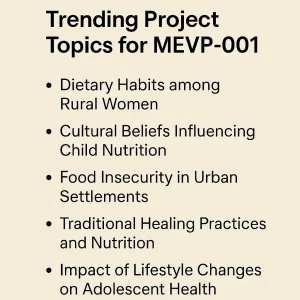
Image: Trending Project Topics for MEVP-001
What is the deadline for IGNOU MAENOH Project submission?
The deadline for submitting the MAENOH project in the IGNOU MAENOH program depends on the academic session in which you are enrolled:
- For January Session: The usual deadline is 30th June of the same year.
- For July Session: The usual deadline is 31st December of the same year.
Important Notes:
- IGNOU may extend the deadlines based on administrative decisions. Always check the latest notifications on the IGNOU website or contact your study center for updates.
- Ensure your project is approved before submission, as unapproved projects may get rejected.
- Late submissions may require special approval or re-registration, depending on IGNOU’s policies.
Can you work on a comparative study between two industries or workplaces?
Yes, you can work on a comparative study between two industries or workplaces for your MEVP 001 project in the IGNOU MAENOH program, provided it aligns with environmental and occupational health themes.
Key Considerations for a Comparative Study:
- Relevance to Environmental & Occupational Health – Ensure that the comparison focuses on workplace safety, pollution levels, industrial hygiene, health risks, or any other relevant factors.
- Clear Research Objectives – Define what aspects you are comparing, such as air quality, occupational diseases, safety measures, or waste management practices.
- Availability of Data – Ensure you can access data from both industries/workplaces. You may need permissions for surveys or site visits.
- Methodology – Use appropriate research methods, such as surveys, interviews, secondary data analysis, or field observations.
- Ethical Considerations – Maintain confidentiality and obtain necessary approvals if workplace-specific data is involved.
What are the eligibility criteria for selecting an IGNOU MAENOH Project guide?
For the MEVP 001 project in the IGNOU MAENOH (Master of Arts in Environmental and Occupational Health) program, students must select a qualified project guide who meets IGNOU’s eligibility criteria. The guide plays a crucial role in supervising and evaluating the research work.
Eligibility Criteria for a Project Guide:
Academic Qualification:
- The guide should have a Ph.D. or Master’s degree in Environmental Science, Occupational Health, Public Health, Industrial Safety, or a related discipline.
Professional Experience:
- A minimum of five years of teaching or research experience in a recognized university, research institution, or government/private organization.
- Alternatively, an individual with industry experience in environmental and occupational health (such as a safety officer, environmental consultant, or industrial hygienist) may also be considered.
Affiliation:
- The guide should be associated with a recognized university, college, research institute, or government agency dealing with environmental or occupational health.
- Independent researchers with strong credentials may also be accepted.
Approval by IGNOU:
- The selected guide must be approved by IGNOU before starting the project.
- Students typically need to submit the guide’s resume (CV) and consent letter along with their project proposal for approval.
Restrictions:
- A student cannot choose a relative or friend as a project guide.
- IGNOU faculty members or recognized experts in the field are preferred.
What plagiarism percentage is acceptable for the IGNOU MAENOH Project report?
For the MEVP 001 project report in the IGNOU MAENOH program, the acceptable plagiarism percentage is generally below 20% as per academic standards. However, IGNOU has not explicitly mentioned a fixed percentage in some cases, so it is always best to aim for less than 10-15% to be on the safer side.
Key Points on Plagiarism Policy:
Plagiarism Limit:
- Below 10% → Ideal and acceptable.
- 10-20% → May be acceptable, but could require minor corrections.
- Above 20% → Likely to be rejected; revision or resubmission may be required.
Use of Plagiarism Checking Software:
- You can use tools like Turnitin, Grammarly, or Urkund to check plagiarism before submission.
- Many universities, including IGNOU, use plagiarism detection software to evaluate projects.
Proper Citation & Referencing:
- Always cite sources properly using APA, MLA, or Harvard referencing styles.
- Direct quotes should be within quotation marks and properly attributed.
- Paraphrasing should be done in your own words while citing the original author.
Consequences of High Plagiarism:
- If plagiarism is found beyond the acceptable limit, IGNOU may ask for revisions or resubmission.
- Severe plagiarism could lead to project rejection or disciplinary action.
How long does IGNOU take to evaluate the IGNOU MAENOH Project report?
The evaluation process for the MEVP 001 project report in the IGNOU MAENOH program typically takes 2 to 3 months from the date of submission. However, the exact duration can vary based on several factors, including the session, evaluation workload, and administrative processing at IGNOU.
Evaluation Timeline & Process:
Submission Processing (2-4 weeks):
- Once submitted, the project is verified for completeness and plagiarism compliance.
- If any issues are found (such as missing documents or high plagiarism), students may be asked for resubmission or corrections.
Project Evaluation (4-8 weeks):
- The project is assigned to an IGNOU-approved examiner for review.
- The examiner assesses the report based on content quality, research methodology, findings, and analysis.
Marks Upload & Grade Declaration (4 weeks):
- After evaluation, the marks are uploaded on IGNOU’s Student Portal (Grade Card section).
- Students can check their results online via IGNOU’s official website.
FAQs about IGNOU MAENOH Project for MEVP-001
What is the aim of the IGNOU MAENOH MEVP 001 project?
Its aim is to train students to study nutrition and health issues through fieldwork and analysis.
What is the ideal length of the project?
What is the ideal length of the MAENOH project?
How should the MAENOH project be structured?
It should include the introduction, objectives, literature review, methods, findings, conclusion, and annexures.
Is fieldwork compulsory for MEVP 001?
Yes. The project must be based on primary data collected through field methods.
Do I need approval before starting MEVP-001 project?
Yes. The synopsis must be approved by IGNOU before project work begins.
Downloadable Resources
- IGNOU MAENOH Project Synopsis Sample PDF
- IGNOU MEVP 001 Project Format PDF
- IGNOU MEVP-001 Project Topics List
Conclusion
The IGNOU MAENOH Project (MEVP 001) is an important academic requirement that strengthens field research, analytical skills, and subject understanding related to Environmental and Occupational Health. By following the IGNOU’s project guidelines, approved format, presenting clear data, and writing in a formal and organised manner, learners can complete the project with confidence and accuracy. A well-structured project also supports strong academic performance and prepares learners for future research roles.
If you need help creating a full IGNOU MAENOH MEVP 001 project, including synopsis preparation, topic selection, chapter drafting, or editing, outline your topic or requirements. WhatsApp us Now!