IGNOU MAEL 101 Practical: the working method in brief
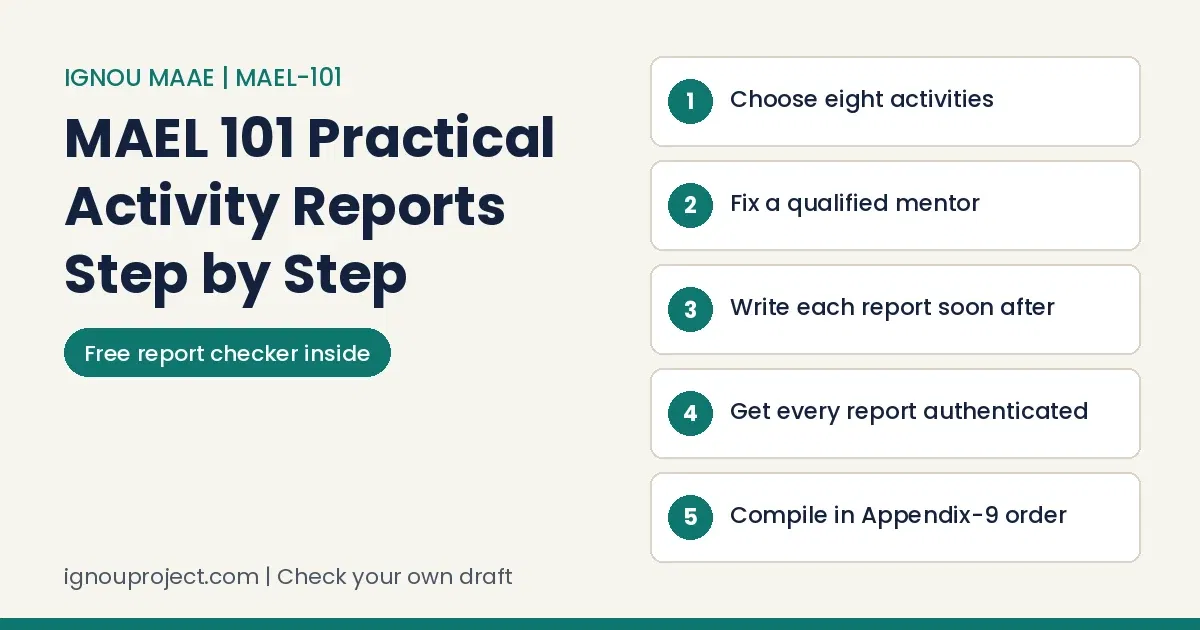
The IGNOU MAEL 101 Practical is done in four moves: you choose eight community activities, carry each one out with a mentor you pick, write a separate report for every activity, and then compile all eight into one spiral-bound file for your Learner Support Centre (LSC) or Regional Centre (RC). This guide walks through those moves for MAAE first-year learners, with a worked report plan, the file order, the mistakes we see, and two free checks you can run on your own draft.
MAEL-101 in one paragraph
For the IGNOU MAEL 101 Practical, perform any eight of the 19 activities (0.5 credit each, 4 credits in all), write each report in 800 to 1,000 words (Activity 5 needs two of 400 to 500), get every report authenticated by your mentor, and submit the compiled file to your LSC or RC.
MAEL-101, Community-based Practical Activities, is a compulsory first-year course of the Master of Arts in Adult Education. There is no term-end practical exam and no TEE form for it; the July 2024 MAAE Programme Guide gives the compiled report the full weight of the grade. So the quality of the eight reports and the order of the file are what you control.
Step 1: choose eight activities you can actually finish
The first decision in the IGNOU MAEL 101 Practical is which eight activities to take on, and it is worth an evening with the handbook before you speak to anyone. The handbook lets you choose by your interest, convenience and ability, and by the resources available where you live or work. Use those words as a filter, in this order:
- Can I do it in my own community? The activities are meant for the village, ward, mohalla or workplace you belong to, or another community you know well.
- Does it depend on someone else agreeing? Observing a training programme (Activity 7), approaching implementing agencies (Activity 8) and observing a coaching centre or study circle (Activity 17) all need an outside body to say yes. Keep a ninth activity in reserve for each of these.
- How much paperwork does it bring? Activity 1 alone uses eight formats, Appendix-1(a) to 1(h). Activities 2, 3, 4, 5 and 9 each carry their own format, and Activity 19 needs a copy of the Memorandum and Rules of the organisation you form.
- Can I pay for it? The handbook asks you to bear your own costs for the activities, the reports and their submission.
A balanced set usually mixes one or two surveys, two or three events you organise (a campaign, a talk, a quiz, a discussion group), and one or two activities you can finish alone, such as building a professional network. Write your eight on one sheet with a target month for each. The Programme Guide’s schedule for January-session learners runs from April to September for performing the activities, September to November for completing and compiling, and December for submission; July-session learners move the same steps to September, March to May, and June. An activity left pending can be completed in the second year.
Step 2: fix your mentor and plan each activity with them
Every activity in the IGNOU MAEL 101 Practical runs under a mentor, guide or facilitator whom you choose yourself; one person may cover a single activity, a group of them, or all eight. Before you ask anyone, check the minimum the handbook sets: a Bachelor’s degree for a person who is working (as a programme functionary, or in any formal, non-formal or informal institution or other sector), or a Master’s degree for a person who is unemployed or self-employed.
Then use the mentor for what the handbook gives them to do. For most activities they help you plan, guide you while you organise it, read your report, authenticate it with their comments, and hand it back. Ask at the first meeting which points they will judge you on. The handbook prints those points activity by activity, and they always end with the structure, comprehensiveness and quality of your report. Keep a simple dated log from the first day: date, what you did, who was present, what was said. That log becomes the raw material of your report and the completion date you later enter on Appendix-9.
How to write a MAEL-101 activity report, section by section
Each report in the IGNOU MAEL 101 Practical stands on its own, and the handbook names what that report must contain. A survey report explains the information you collected and attaches the filled format; an event report (Activities 6, 10, 12, 13, 14, 15) covers what you organised, who took part, what went wrong and what feedback you received. A structure that works for almost every MAEL-101 activity report:
- Introduction: the activity number and title, the community, the dates, and why you chose it.
- Objectives: two or three, taken from the handbook’s objective for that activity and put in your own words.
- What you did: preparation, people approached, the event or survey itself, in the order it happened.
- The contents the handbook names: every item listed under “Your output” for that activity, each under its own sub-heading so the evaluator finds it.
- Feedback and problems: from participants, the community and your mentor, and how you handled each difficulty.
- Learning: what the activity showed you, linked to a concept from your MAE or MES-016 courses.
- Attachments: the filled format, where the activity has one.
Report checker: word count and contents
Pick the activity, paste one report, and press Check. The tool counts your words against the handbook’s range and lists the contents the handbook asks that report to cover. Nothing is uploaded; it runs in your browser. Without JavaScript, compare your report with the “Your output” lines under the activity in section 3 of the handbook.
Across practical courses, we see reports that tell the story of the day in order and stop there, without saying what the work showed. Evaluators want each piece of field work tied to an idea or method from the course. For MAEL-101 the handbook’s own objectives point you to one: applying the principles of participatory adult learning and motivation.
Worked example: planning a 900-word Activity 13 quiz report
Here is how a learner might plan the report for Activity 13, a quiz programme in the community. The handbook asks this report to cover the number of participants, the names of the judges, the organisation of the activity, the problems faced, and the feedback. Sections 1, 3 and 8 below are our suggestion, added so the report shows purpose and learning; the rest map straight to the handbook.
Illustrative plan for an Activity 13 report
All names, places and numbers in brackets are placeholders for your own facts.
| Section | What to write | Words |
|---|---|---|
| 1. Purpose and theme | Why a quiz suited [your community], and the theme chosen, for example local health schemes | 100 |
| 2. Participants | [Number] participants, who they were, how you selected and informed them | 120 |
| 3. Questions | How you prepared items of local, district, state, national and international importance; two or three sample questions | 150 |
| 4. Judges | [Names] of the judges and why each was suitable | 80 |
| 5. Organisation | Date, time of day, venue, duration, rounds, scoring, who helped | 150 |
| 6. Problems faced | What went wrong and what you did about it | 120 |
| 7. Feedback | From participants, community members and your mentor, kept separate | 110 |
| 8. Learning | What the quiz showed about motivating adult learners, tied to a unit you studied | 70 |
| Total | Inside the 800 to 1,000 word range | 900 |
Notice how the plan also answers the points the mentor judges for this activity: number of participants, choice of judges, nature and relevance of the questions, practical problems, timing, coordination, motivation, impact, and community reception. Writing to those points is the simplest way to make the authentication and comments easy for your mentor.
MAEL-101 report format: the file from cover to last page
Once all eight reports of the IGNOU MAEL 101 Practical are authenticated and back with you, section 4 of the handbook tells you how to put the file together. Read as a page order, the MAEL-101 report format is:
File order from cover to last page
- Appendix-10 cover page, as the top page.
- Appendix-9 proforma: your details, the completion date entered against each of the eight activities you performed, your signature, and the acknowledgement block for the LSC or RC.
- The eight authenticated reports, in the sequence in which they appear on Appendix-9, each followed by its filled format where the activity has one.
- The Appendix-8 certificate of each mentor. The handbook does not fix its position; placing it just before the reports that mentor covered lets the evaluator match them quickly.
- For Activity 19 only, the copy of the Memorandum and Rules, kept with that report.
Then get the whole file spiral bound, and keep a full copy for yourself before you hand in the original.
MAEL-101 cover page fields
The MAEL-101 cover page (Appendix-10) carries the heading “Report of Community-based Practical Activities”, Course Code MAEL-101 and Programme Code MAAE, followed by five blanks for you: name of student, enrolment number, the LSC, the RC, and the month and year of submission. Copy each of these from your identity card and admission letter, not from memory.
We find title pages carrying a wrong enrolment number, programme or study centre. On MAEL-101 the same details appear three times, on the Appendix-10 cover, on Appendix-9 and in each Appendix-8 certificate, so check that all three agree.
Common mistakes in the IGNOU MAEL 101 Practical, with fixes
Several problems with the IGNOU MAEL 101 Practical come from the order of work rather than the writing. Here are the ones to watch, each with its fix.
- Picking activities that rely on others, with no reserve. Fix: hold one spare activity for each that needs an agency, training programme or coaching centre to agree.
- Writing all eight reports after the last activity. Fix: draft each report within a few days of the activity, while names, numbers and feedback are fresh.
- Leaving out a content item the handbook names. Fix: give each “Your output” item its own sub-heading and run the report checker above.
- Missing the word range. Fix: 800 to 1,000 words per report; for Activity 5, two reports of 400 to 500 each. Put detail in the attached format and explain it in the report.
- Formats not attached, or attached to the wrong report. Fix: attach each filled format behind its own report, and only for activities you chose.
- Appendix-9 dates against more than eight activities. Fix: enter completion dates against your eight only, and attach the reports in that order.
- A mentor who does not meet the qualification rule. Fix: confirm the degree and working status before the first activity, since the certificate records the mentor’s academic qualification.
When a record is written up in one go at the end, it gives itself away: the same sentences recur, dates fall on holidays, and nothing changes from the first entry to the last. MAEL-101 asks you to enter the completion date of each activity on Appendix-9, so the dates in your reports need to match the days the work was really done.
We see files in which the supervisor’s or counsellor’s certificate was never signed. For MAEL-101 that is the Appendix-8 proforma, which asks the mentor for date, place, signature, name, academic qualification, designation if any, and address; collect it the day each report comes back.
Ready-made practical files are passed around online, and some learners change only the name and enrolment number before handing one in; when the same text reaches one centre from several learners, it is noticed. MAEL-101 reports are built on your own community’s people, places and feedback, and each one needs your mentor’s authentication that you performed the activity.
Binding-day self-check before you submit
Run this list on the day you take the IGNOU MAEL 101 Practical file for binding. It covers MAEL-101 submission as the handbook describes it: in person or by post to your LSC or RC, with an acknowledgement on Appendix-9.
Binding-day checklist, twelve points
Send your own MAEL-101 draft for a check
If you have written your reports and want a second reader before binding, send us the reports and formats you prepared. We check each one against the handbook's contents for that activity, the word range, the attached formats, the Appendix-8, 9 and 10 details and the file order, then return the file with comments and corrections for you to act on. We do not fill your formats, sign certificates or write activity reports; the work and the authorship stay yours, and IGNOU's evaluators decide the grade.
In practical courses the written part is where most marks slip, and it is also the part that responds best to correction. On MAEL-101 that matters more than usual, because the Programme Guide grades the course on the compiled report alone.
Details and charges are on our draft correction page, or message us on WhatsApp at +91 93546 37830, Monday to Saturday, 9:00 am to 6:00 pm.
Questions learners ask while writing MAEL-101 reports
Can one mentor sign the whole MAAE practical report?
Yes. The handbook allows one mentor for one activity, for a group of activities, or for all eight. Each mentor gives one Appendix-8 certificate naming the activities they guided, so a single mentor means a single certificate for the whole MAAE practical report.
Is there an exam or viva for the IGNOU MAEL 101 Practical?
No term-end practical exam is held, and the Programme Guide says no TEE application can be submitted for this course. The documents we read name no viva either; the grade comes from the compiled report.
How is the grade worked out?
Your file is read at the LSC by its academic counsellors, or at the RC, or by School of Education faculty. They award a grade to every activity separately, and the course grade is the average of those eight grades.
What if I cannot finish all eight activities in the first year?
The Programme Guide lets pending activities be completed, and the compiled report submitted, in the second year. Re-registration for the second year is still needed at the end of year one.
Is the MAEL-101 practical the same as the second-year dissertation?
No. MAEP-001 is a separate second-year option with its own rules; it has its own guide on this site.
Finishing the IGNOU MAEL 101 Practical on time
The IGNOU MAEL 101 Practical rewards steady work more than last-minute polish: choose eight activities you can carry out, fix a qualified mentor early, write each report soon after the activity, and assemble the file in the handbook's order. Then bind it, keep a copy, and get the acknowledgement stamped.
The learners who finish without trouble share a few habits: they begin early, confirm the rules with their own centre, note every day's work with a date, gather signatures as they go, and can explain each page in their own words. For MAEL-101, that last habit starts with knowing why you chose each of your eight activities.
For the six MAAE theory courses that come before the practical, help books and other study material are listed on our publication site.
Documents checked for this guide
- Student's Handbook for Practical Work, course MAEL-101 (IGNOU, June 2024, 76 pages)
- Programme Guide for MAAE (July 2024 edition)
- Official IGNOU page for the MAAE programme
- Section 3.35 (MAAE) of the IGNOU Common Prospectus, July 2026 cycle
ignouproject.com is not affiliated with, authorised by or endorsed by IGNOU. Our service checks and corrects the learner's own MAEL-101 reports; the learner carries out every activity and remains the author of every report and format.

BK Sahni iD 0009-0005-8092-459X
Founder, Shri Chakradhar Publication Pvt. Ltd. & ignouproject.com — helping IGNOU distance-learning students since 2010 (5,00,000+ students supported across MBA, MCom, MA & more). Author of IGNOU exam guides, solved assignments & project reference books.
Disclosure: Shri Chakradhar Publication Pvt. Ltd. and ignouproject.com are independent third-party study-help services — not the official IGNOU website. Always verify final dates and rules on ignou.ac.in.