MA Translation Studies (MATS) · December 2026 term-end examination
Twelve two-hour MTT papers, two three-hour MEG papers. Fifty-six IGNOU MATS papers, read theme by theme.
Every MTT-010 to MTT-021 paper and every MEG-14 and MEG-15 paper IGNOU published from December 2024 to June 2026, with the December 2026 dates taken from IGNOU’s date sheet of 30 October 2026.
- First paper: MTT-010, Wed 2 Dec
- 56 IGNOU papers, 14 codes
- MTT: 2 hours, 50 marks
- MEG-14, MEG-15: 3 hours, English only
- MTT-015: ten themes in 4 of 4
- Free paper-run planner and answer clock
Type each code the way the admit card shows it, MTT-013 or MEG-15, and add Hindi or English for every MTT code.
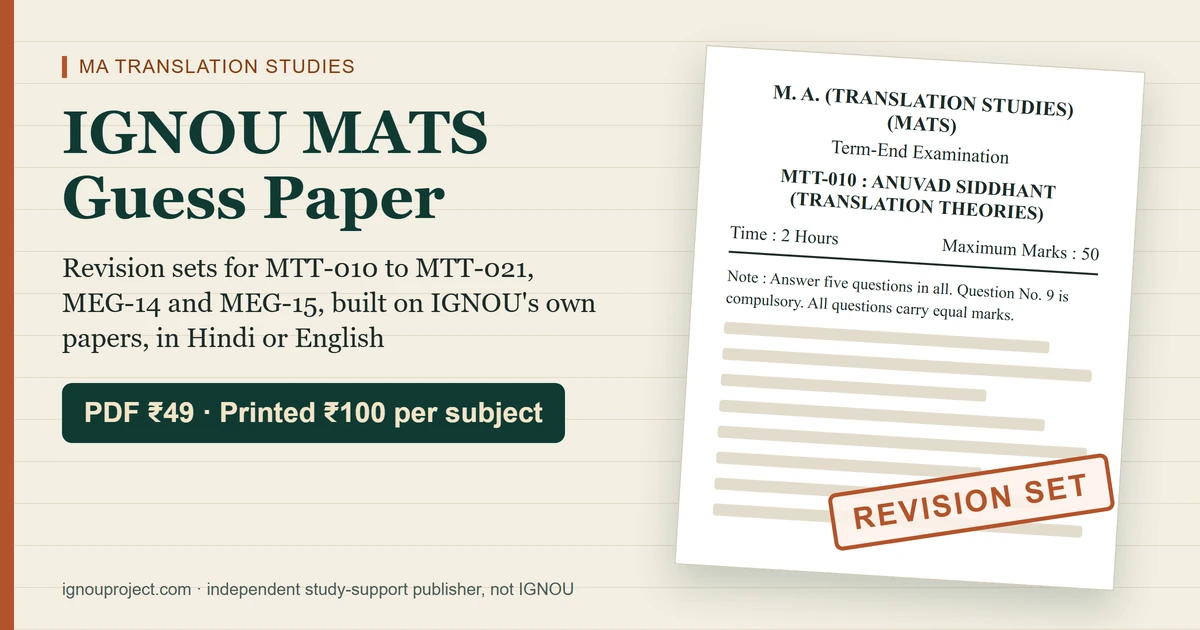
Quick answer. An IGNOU MATS guess paper is a revision set for a single MTT or MEG course code, prepared from IGNOU’s earlier term-end papers and the syllabus, with answers written to the length the paper asks for. The December 2026 MATS papers run from MTT-010 on Wednesday 2 December to MEG-15 on Tuesday 29 December 2026, inside IGNOU’s examination window of 25 November 2026 to 14 January 2027. The twelve MTT papers are 2 hours and 50 marks, five answers at 10 marks each with compulsory short notes, while MEG-14 and MEG-15 are 3-hour, 100-mark papers set in English only. Each code costs ₹49 PDF or ₹100 printed, and a printed order adds a single ₹100 courier charge. MTT sets come in Hindi or English, MEG-14 and MEG-15 sets in English. A set shows what IGNOU has asked before; it cannot show what IGNOU will ask next.
MTT-010 on 2 December Opens Seven MATS Mornings in Eight Days
The first December 2026 MATS paper is MTT-010 Theories of Translation on Wednesday 2 December 2026 at 10 AM, per IGNOU’s date sheet of 30 October 2026. MTT-011 to MTT-016 follow on every examination day up to Wednesday 9 December, Sunday 6 December being the only break, so a first-year learner meets seven papers in eight days before a nine-day gap.
IGNOU’s December 2026 examinations run from 25 November 2026 to 14 January 2027 across all programmes; the MATS papers sit between these two dates:
First MATS paper
MTT-010 on Wednesday 2 December 2026, from 10 AM
Last MATS paper
MEG-15 on Tuesday 29 December 2026, from 2 PM
Date sheet of 30 October 2026. All fourteen MATS dates and sessions on it match the tentative sheet of 21 September 2026.
Year I: Ten Morning Papers Between 2 and 21 December
Every first-year paper is set from 10 AM. The run starts in code order, MTT-010 to MTT-016, from 2 to 9 December. After that the calendar opens up: MTT-017 Lexicography, Technical Terminology and Translation comes on Friday 18 December, MTT-018 on Saturday 19 December and MTT-019 on Monday 21 December.
The nine clear days between MTT-016 and MTT-017 are worth guarding. MTT-017 is one of the two MATS papers with a compulsory 15-mark terminology question, and that question rewards drill more than reading.
Year II: MTT-020 in the Morning, Then Three Afternoons
MTT-020 Translation Process is the only second-year paper in the morning, on Tuesday 22 December. MTT-021 Translation Training follows the next day at 2 PM, and the two MEG papers close the programme on consecutive afternoons, MEG-14 on Monday 28 December and MEG-15 on Tuesday 29 December. Both MEG papers last three hours, an hour longer than any MTT paper.
On a phone, swipe the table sideways for every column.
| Code | Date | Session | Paper | Year | After the previous MATS paper |
|---|---|---|---|---|---|
| MTT-010 | Wednesday 2 December | 10 AM to 1 PM | Theories of Translation | Year I | First paper |
| MTT-011 | Thursday 3 December | 10 AM to 1 PM | Translation: History and Tradition | Year I | Next day |
| MTT-012 | Friday 4 December | 10 AM to 1 PM | Translation and Linguistics | Year I | Next day |
| MTT-013 | Saturday 5 December | 10 AM to 1 PM | Areas of Translation | Year I | Next day |
| MTT-014 | Monday 7 December | 10 AM to 1 PM | Translation and Indian Languages | Year I | 2 days later |
| MTT-015 | Tuesday 8 December | 10 AM to 1 PM | Translation and Literature | Year I | Next day |
| MTT-016 | Wednesday 9 December | 10 AM to 1 PM | Translation and Mass Communication | Year I | Next day |
| MTT-017 | Friday 18 December | 10 AM to 1 PM | Lexicography, Technical Terminology and Translation | Year I | 9 days later |
| MTT-018 | Saturday 19 December | 10 AM to 1 PM | Translation and Inter Cultural Studies | Year I | Next day |
| MTT-019 | Monday 21 December | 10 AM to 1 PM | Politics of Translation | Year I | 2 days later |
| MTT-020 | Tuesday 22 December | 10 AM to 1 PM | Translation Process | Year II | Next day |
| MTT-021 | Wednesday 23 December | 2 PM to 5 PM | Translation Training | Year II | Next day |
| MEG-14 | Monday 28 December | 2 PM to 5 PM | Contemporary Indian Literature in English Translation | Year II | 5 days later |
| MEG-15 | Tuesday 29 December | 2 PM to 5 PM | Comparative Literature | Year II | Next day |
A First-Year Paper Still Owed in Year II
The tight stretch belongs to a second-year learner carrying MTT-017, MTT-018 or MTT-019 from Year I. With all three pending, the papers fall on 18, 19, 21, 22 and 23 December: five papers on five consecutive examination days, the last one in the afternoon. No two MATS papers share a date, so there is no clash to report to the Regional Centre, only a run to revise for in advance.
The free planner further down shows these runs for any ticked codes. The full timetable is summarised on the December 2026 date sheet page, the morning and afternoon sessions are explained under IGNOU exam timings, and the hall ticket guide covers the admit card. Centre allocation sits on the exam centre page; fee rules are on the examination fee page, and payment steps on the online exam fee guide.
The Term-End Paper Settles Most of a MATS Grade, Though IGNOU Prints No Percentage
None of the 56 MATS term-end papers from December 2024 to June 2026 prints a weightage line, and neither does IGNOU’s 2026 MTT 010-019 assignment booklet. That booklet calls the assignments “internal assessment” and says minimum prescribed marks in them are mandatory, but it gives no percentage split, so the MATS Programme Guide is the IGNOU document to check for the exact share.
What the papers do show is how little room there is. A two-hour MTT paper asks for five answers in about 110 minutes of writing once ten minutes go to reading, roughly 22 minutes per 10-mark answer. Learners who want to see how assignment and term-end marks combine into a percentage can use the IGNOU percentage calculator, and the passing marks for each component are stated in the Programme Guide.
MATS Guess Paper, IGNOU Past Paper or Solved Paper: Three Different Tools
For MATS, a guess paper means a publisher’s revision set built around one course code, MTT-013 Areas of Translation for instance: the questions IGNOU keeps returning to, each with a model answer, drawn from earlier IGNOU papers and the syllabus. Listings that say “important questions”, “expected questions” or “model paper” describe this same kind of set. A previous year question paper, by contrast, is a real IGNOU paper from a past term-end examination, which anyone can download free from IGNOU’s session lists. Add a publisher’s answers to one of those real papers and it becomes a solved question paper.
For MATS the three overlap more than usual, because the MTT papers repeat their themes so often. A learner who works through the four latest IGNOU papers for MTT-015 has already met all ten of its recurring topics; a guess paper adds answers of the right length and the drill the terminology questions need. Ready-made solutions to past papers are explained on the IGNOU solved question papers page, and every programme’s sets are gathered on the IGNOU guess paper hub.
On a phone, swipe the table sideways for every column.
| Guess paper | IGNOU previous year paper | Solved paper | |
|---|---|---|---|
| What it is | Recurring questions for one code, such as MTT-017, with model answers | The actual paper IGNOU set in a past session | That actual paper with a publisher’s answers |
| Who prepares it | A publisher | IGNOU | A publisher |
| Cost | ₹49 PDF · ₹100 printed, per subject code | Free on ignou.ac.in | Varies by seller |
| Best use | Revising recurring themes and drilling compulsory parts | Timed practice on the real layout | Checking how a full answer to a past question can look |
| What it cannot do | Tell anyone the December 2026 questions | Explain or answer anything | Cover themes the chosen paper did not ask |
Four sessions behind every set. Every MTT and MEG set is drawn from the four IGNOU papers for its code dated December 2024 to June 2026.
Ten-mark answers sized for 22 minutes. MTT model answers fit the 450 or 500 words the paper prints, not a three-hour essay.
Q9 short notes covered. Notes run to about 250 words each, the length IGNOU prints for the compulsory Q9.
Terminology drill for MTT-013. Administrative terms, designations and noting phrases, Hindi to English and back, for the 15-mark Q8.
Dictionary order and equivalents for MTT-017. Practice lists for the alphabetical-order task and both sets of technical equivalents.
Thinkers placed correctly. Nida, Lefevere, Sujit Mukherjee and Kumarjiva appear with the course each one belongs to.
Copyright in full for MTT-021. The Act, the conventions, copyright-free texts and assignment, which took five items in June 2026.
MEG-14 texts by name. Samskara, Tughlaq, Karukku, Manimahesh and The Empty Chest, plus the poems behind the passage question.
MEG-15 passages and retellings. The Bhakti and Sufi verses and the Mahabharata retellings that IGNOU returns to.
Hindi or English for MTT codes. IGNOU prints every MTT paper in both, so either language is prepared.
One code at a time. A learner with only MTT-019 pending orders MTT-019 and nothing else.
PDF or printed booklet. A WhatsApp PDF, or a printed booklet that leaves by courier the day after payment.
MTT-010 to MEG-15: Eighty Credits, Two Clocks, Four Paper Layouts
The MATS programme has fourteen examined course codes in section 3.52 of the July 2026 Common Prospectus: ten Year I courses, MTT-010 to MTT-019, and four Year II courses, MTT-020, MTT-021, MEG-14 and MEG-15, beside the 16-credit project. The School of Translation Studies and Training runs it in Hindi and English, for graduates with a working knowledge of both languages.
The credits add up. Year I is ten courses of 4 credits, 40. Year II is MTT-020 and MTT-021 at 4 credits each, MEG-14 and MEG-15 at 8 each, and the project at 16, again 40. The total of 80 matches the prospectus. The project carries no term-end paper and stays out of the tables below.
Year I: Ten MTT Courses of 4 Credits Each
On a phone, swipe the table sideways for every column.
| Code | Title (July 2026 Common Prospectus) | Credits | December 2026 paper |
|---|---|---|---|
| MTT-010 | Theories of Translation | 4 | Wed 2 Dec 2026, 10 AM to 1 PM |
| MTT-011 | Translation: History and Tradition | 4 | Thu 3 Dec 2026, 10 AM to 1 PM |
| MTT-012 | Translation and Linguistics | 4 | Fri 4 Dec 2026, 10 AM to 1 PM |
| MTT-013 | Areas of Translation | 4 | Sat 5 Dec 2026, 10 AM to 1 PM |
| MTT-014 | Translation and Indian Languages | 4 | Mon 7 Dec 2026, 10 AM to 1 PM |
| MTT-015 | Translation and Literature | 4 | Tue 8 Dec 2026, 10 AM to 1 PM |
| MTT-016 | Translation and Mass Communication | 4 | Wed 9 Dec 2026, 10 AM to 1 PM |
| MTT-017 | Lexicography, Technical Terminology and Translation | 4 | Fri 18 Dec 2026, 10 AM to 1 PM |
| MTT-018 | Translation and Inter Cultural Studies | 4 | Sat 19 Dec 2026, 10 AM to 1 PM |
| MTT-019 | Politics of Translation | 4 | Mon 21 Dec 2026, 10 AM to 1 PM |
Year II: Two MTT Courses and Two MEG Courses
On a phone, swipe the table sideways for every column.
| Code | Title (July 2026 Common Prospectus) | Credits | December 2026 paper |
|---|---|---|---|
| MTT-020 | Translation Process | 4 | Tue 22 Dec 2026, 10 AM to 1 PM |
| MTT-021 | Translation Training | 4 | Wed 23 Dec 2026, 2 PM to 5 PM |
| MEG-14 | Contemporary Indian Literature in English Translation | 8 | Mon 28 Dec 2026, 2 PM to 5 PM |
| MEG-15 | Comparative Literature | 8 | Tue 29 Dec 2026, 2 PM to 5 PM |
Four Layouts Across Fourteen Codes
IGNOU sets MATS on two clocks. All 48 MTT papers from December 2024 to June 2026 are 2 hours and 50 marks, printed in English and then Hindi in the same file; ten of the twelve MTT codes ask for any five questions with Q9, two short notes, compulsory. MEG-14 and MEG-15 are borrowed from the MA English programme and keep its 3-hour, 100-mark paper, printed in English only under the MA English (MEG) heading.
On a phone, swipe the table sideways for every column.
| Code | Latest IGNOU paper | Time and marks | Attempt rule | Compulsory part | Words per long answer | Medium of the paper |
|---|---|---|---|---|---|---|
| MTT-010 | June 2026 | 2 hours, 50 marks | Any 5 of 9 at 10 marks | Q9: 2 short notes of 4, 5 marks each | About 500 | English and Hindi |
| MTT-011 | June 2026 | 2 hours, 50 marks | Any 5 of 9 at 10 marks | Q9: 2 short notes of 4, 5 marks each | About 500 | English and Hindi |
| MTT-012 | June 2026 | 2 hours, 50 marks | Any 5 of 9 at 10 marks | Q9: 2 short notes of 4, 5 marks each | About 450 | English and Hindi |
| MTT-013 | June 2026 | 2 hours, 50 marks | 3 of Q1 to Q6 at 10, plus Q7 and Q8 | Q7: 1 note of 3 (5 marks); Q8: 15-mark terminology | About 450 | English and Hindi |
| MTT-014 | June 2026 | 2 hours, 50 marks | Any 5 of 9 at 10 marks | Q9: 2 short notes of 4, 5 marks each | About 500 | English and Hindi |
| MTT-015 | June 2026 | 2 hours, 50 marks | Any 5 of 9 at 10 marks | Q9: 2 short notes of 4, 5 marks each | About 500 | English and Hindi |
| MTT-016 | June 2026 | 2 hours, 50 marks | Any 5 of 9 at 10 marks | Q9: 2 short notes of 4, 5 marks each | About 450 | English and Hindi |
| MTT-017 | June 2026 | 2 hours, 50 marks | 3 of Q1 to Q6 at 10, plus Q7 and Q8 | Q7: 1 note of 3 (5 marks); Q8: 15-mark terminology | About 450 | English and Hindi |
| MTT-018 | June 2026 | 2 hours, 50 marks | Any 5 of 9 at 10 marks | Q9: 2 short notes of 4, 5 marks each | About 500 | English and Hindi |
| MTT-019 | June 2026 | 2 hours, 50 marks | Any 5 of 9 at 10 marks | Q9: 2 short notes of 4, 5 marks each | About 500 | English and Hindi |
| MTT-020 | June 2026 | 2 hours, 50 marks | Any 5 of 9 at 10 marks | Q9: 2 short notes of 4, 5 marks each | About 450 | English and Hindi |
| MTT-021 | June 2026 | 2 hours, 50 marks | Any 5 of 9 at 10 marks | Q9: 2 short notes of 4, 5 marks each | About 500 | English and Hindi |
| MEG-14 | June 2026 | 3 hours, 100 marks | All 5 at 20 marks | Q1: 4 of 6 passages, 5 marks each | About 400 | English only |
| MEG-15 | June 2026 | 3 hours, 100 marks | Any 5 of 10 at 20 marks | Q1: 4 of 8 passages, 5 marks each | None printed | English only |
MTT-013 and MTT-017: The 15-Mark Question Nobody Can Skip
MTT-013 Areas of Translation and MTT-017 Lexicography, Technical Terminology and Translation end every paper with a compulsory 15-mark Q8, in all eight papers from December 2024 to June 2026. Learners answer only three of the six essays, so this one exercise is worth half as much again as any essay and decides more of the grade than anything else on the paper.
On a phone, swipe the table sideways for every column.
| Code | Part | What is asked | Marks |
|---|---|---|---|
| MTT-013 | Q8(a) | Hindi or English equivalents of 6 of 12 administrative terms | 6 |
| MTT-013 | Q8(b) | Hindi or English equivalents of 6 of 12 designations | 6 |
| MTT-013 | Q8(c) | Hindi equivalents of 3 of 6 noting phrases | 3 |
| MTT-017 | Q8(a) | Ten words put in alphabetical order | 3 |
| MTT-017 | Q8(b) | Hindi equivalents of 6 of 10 technical terms | 6 |
| MTT-017 | Q8(c) | English equivalents of 6 of 10 Hindi technical terms | 6 |
Individual items come back too. “Passed for payment” was asked in June 2025 and December 2025, “endorsement” in the same two papers, “High Commissioner” in December 2025 and June 2026, and “Auxiliary Nurse” in December 2024 and June 2026, all in MTT-013. In MTT-017, “censure motion” appeared in June 2025 and again in December 2025. One slip affects the drill: the June 2026 MTT-017 paper asks for alphabetical order “in English” but prints ten Hindi words, so the Hindi alphabetical order is the sensible reading.
December 2025: Seven MTT Papers Moved to 500 Words
Until June 2025, every MTT paper that printed a word limit asked for about 450 words per long answer. From December 2025, seven MTT codes print about 500 words instead: MTT-010, MTT-011, MTT-014, MTT-015, MTT-018, MTT-019 and MTT-021. The other five, MTT-012, MTT-013, MTT-016, MTT-017 and MTT-020, still print 450 in June 2026.
On a phone, swipe the table sideways for every column.
| Code | December 2024 | June 2025 | December 2025 | June 2026 |
|---|---|---|---|---|
| MTT-010 | About 450 | About 450 | About 500 | About 500 |
| MTT-011 | About 450 | About 450 | About 500 | About 500 |
| MTT-012 | About 450 | About 450 | About 450 | About 450 |
| MTT-013 | About 450 | About 450 | About 450 | About 450 |
| MTT-014 | About 450 | About 450 | About 500 | About 500 |
| MTT-015 | About 450 | About 450 | About 500 | About 500 |
| MTT-016 | About 450 | About 450 | About 450 | About 450 |
| MTT-017 | About 450 | About 450 | About 450 | About 450 |
| MTT-018 | About 450 | About 450 | About 500 | About 500 |
| MTT-019 | About 450 | About 450 | About 500 | About 500 |
| MTT-020 | About 450 | About 450 | About 450 | About 450 |
| MTT-021 | About 450 | None printed | About 500 | About 500 |
Fifty extra words in 22 minutes is a real difference for someone who writes slowly in Hindi. A set should follow the limit in the newest paper for that code, which is why the same course can look different in an older guide.
Titles and Slips Printed on IGNOU’s MATS Papers
None of these changes what a question asks, but each can make a candidate pause in the hall.
On a phone, swipe the table sideways for every column.
| Code | Paper | As printed | Meaning |
|---|---|---|---|
| MTT-021 | June 2026 | Title “MTT–021 : TRANSLATION PROCESS” | Translation Training; Translation Process is MTT-020 |
| MTT-017 | June 2026 | Q8(a) “Arrange the following words in alphabetical order in English”, above ten Hindi words | Hindi alphabetical order, the only order the listed words allow |
| MTT-017 | December 2025, June 2026 | Q8(b) “Write five Hindi equivalents of any six technical terms” | One Hindi equivalent for each of six terms, as in the earlier papers |
| MTT-012, MTT-016, MTT-020 | Several sessions | “Attempt any five questions”, with Q9 compulsory | Five answers in all, one of them Q9 |
| MTT-021 | June 2025 | “Attmpt five questions in all” | Attempt five questions |
| MTT-015 | December 2025 | Q6 “the idea of word literature” | World literature |
| MTT-011 | June 2026 | Q5 “Elucidate translations of India texts in to Arabic” | Indian texts into Arabic |
| MTT-010 | June 2026 | Q5 “Kumarj eev” | Kumarjiva, the spelling MTT-011 uses |
| MTT-016 | All four papers | Title “TRANSLATION AND MASS MEDIA” | Translation and Mass Communication in the prospectus |
| MTT-018 | December 2024 | Title “TRANSLATION AND INTERCULTURAL COMMUNICATION” | Inter-Cultural Studies, as on the later papers and in the prospectus |
| MEG-15 | All four papers | Title “COMPARATIVE LITERATURE : THEORY AND PRACTICE” | Comparative Literature in the prospectus |
| MEG-14 | June 2026 | Q4(b) “Barma’s views about the life of Dalits” | Bama, the author of Karukku |
Disagreements and outdated course lists to know about.
- Some third-party course lists still describe an older MATS of 64 credits, with only MTT-010 to MTT-017 in Year I and MTT-018 to MTT-021 in Year II. The July 2026 Common Prospectus moves MTT-018 and MTT-019 into Year I, adds MEG-14 and MEG-15 to Year II, and totals 80 credits.
- The site’s own MATS programme profile still shows that older 64-credit table, Hindi as the only medium and an older fee. It is being corrected; the prospectus governs.
- The publisher’s store category for MATS lists sets for MTT-10 to MTT-21 but none for MEG-14 or MEG-15. Both MEG sets are available on WhatsApp.
- IGNOU’s MATS assignment for MEG-14 is written in Hindi and calls the course “adopted” for MATS, while every MEG-14 and MEG-15 paper from December 2024 to June 2026 is printed in English only. A learner who means to answer the term-end paper in Hindi should confirm with the Regional Centre first.
- The June 2026 MTT-021 paper carries the title “Translation Process”, which belongs to MTT-020. The questions are Translation Training questions: copyright, idioms and translator training.
- IGNOU’s 2026 MTT 010-019 assignment booklet says first-year learners do assignments for ten courses, then asks for “eight assignments” on eight answer sheets. Ten courses means ten assignments; the Study Centre can confirm.
The site has no separate page for each MTT code. Programme-wide details of the MEG courses sit on the MA English programme profile, and the MEG course list with project codes across IGNOU is on the project course codes table.
Translation Process to Copyright: MATS Themes IGNOU Keeps Setting
MTT-015 Translation and Literature repeats itself more than any other MATS paper: ten topics, from translating poetry and drama to Latin American literature and the idea of world literature, appeared in all four IGNOU papers from December 2024 to June 2026. MTT-020 Translation Process has eight topics in all four papers, and MTT-011, MTT-016, MTT-018 and MTT-019 have seven each.
Each count on this page comes from IGNOU’s own MATS term-end papers for December 2024, June 2025, December 2025 and June 2026, four per code and 56 in all, compared in full by ignouproject.com on 5 November 2026. A cell gives the question number; “note” marks a theme set as a short note. Matching a question to a theme is a human judgement, not a word search, and themes seen in a single paper are left out. The theme tables cover all fourteen codes, MTT-010 to MTT-021, MEG-14 and MEG-15.
Seven essay questions IGNOU set twice, word for word. Leaving aside capital letters and quotation marks, these MATS questions were printed again unchanged in a later session. Repetition this close is a reason to prepare these topics well, not a promise that they will return in December 2026.
On a phone, swipe the table sideways for every column.
| Code | First set | Set again | Question |
|---|---|---|---|
| MTT-012 | December 2025 Q8 | June 2026 Q7 | Write an essay on Stylistics and Translation. |
| MTT-013 | December 2024 Q4 | June 2026 Q4 | Write a detailed note on the need of translation in the area of education. |
| MTT-013 | December 2025 Q6 | June 2026 Q5 | Discuss the challenges of translating legal literature. |
| MTT-017 | December 2024 Q5 | June 2026 Q3 | Discuss the various dimensions of the standardization of technical terminology. |
| MTT-017 | June 2025 Q4 | December 2025 Q3 | Explain the meaning of ‘word’ and discuss its various sources. |
| MTT-021 | June 2025 Q2 | June 2026 Q3 | Give an account of various copyright conventions. |
| MTT-021 | December 2024 Q8 | June 2026 Q4 | Discuss the interrelationship between culture and environment of language with reference to translation. |
Same Theme, Same Question Number
In two codes IGNOU even keeps the position. MTT-018 opened all four papers with culture in translation as Q1, inter-cultural communication as Q2 or Q3, and communication behaviour as Q3 or Q2. MTT-020 is stricter still: Q1 was the translation process, Q2 types of translation and Q8 machine translation in all four papers, and Q3 was limitations of translation in three of them.
On a phone, swipe the table sideways for every column.
| Code | Theme | December 2024 | June 2025 | December 2025 | June 2026 |
|---|---|---|---|---|---|
| MTT-018 | Understanding source and target cultures in translation | Q1 | Q1 | Q1 | Q1 |
| MTT-018 | Inter-cultural communication: complexities and barriers | Q2 | Q2 | Q2 | Q3 |
| MTT-018 | Communication behaviour and social context | Q3 | Q3 | Q3 | Q2 |
| MTT-020 | The translation process (Nida, comprehension, meaning) | Q1 | Q1 | Q1 | Q1 |
| MTT-020 | Types of translation | Q2 | Q2 | Q2 | Q2 |
| MTT-020 | Limitations of translation | Q3 | Q9(b) note | Q3 | Q3 |
| MTT-020 | Machine translation | Q7, Q8, Q9(d) note | Q8, Q9(d) note | Q8, Q9(d) note | Q8, Q9(d) note |
MTT-010 Theories of Translation
Five MTT-010 themes are in every paper: the nature and types of translation, ancient Indian theories, translation and the spread of Buddhism, modern Indian theory, and a Western tradition. The Western question moves, from Steiner in December 2024 to polysystem theory in June 2026, so the block on Western thinkers needs to be read whole.
On a phone, swipe the table sideways for every column.
| Theme | December 2024 | June 2025 | December 2025 | June 2026 | n of N |
|---|---|---|---|---|---|
| Nature, types, areas and dimensions of translation | Q1 | Q1, Q2 | Q1 | Q1, Q2 | 4 of 4 |
| Ancient Indian translation theories | Q5 | Q7 | Q4 | Q4 | 4 of 4 |
| Translation and the spread of Buddhism (Kumarjeev in June 2026) | Q6 | Q6 | Q5 | Q5 | 4 of 4 |
| Modern Indian translation theory and thinkers (Sujit Mukherjee) | Q8 | Q5, Q9(b) note | Q6 | Q6 | 4 of 4 |
| Western traditions: medieval, modern and polysystem theory | Q4 | Q4 | Q3 | Q7 | 4 of 4 |
| Andre Lefevere | – | Q8 | Q7 | – | 2 of 4 |
| Nida’s view of translation | Q9(b) note | – | – | Q9(b) note | 2 of 4 |
| Emerging issues in translation | Q3 | – | Q2 | – | 2 of 4 |
| Problems of translation | Q9(d) note | Q9(c) note | – | – | 2 of 4 |
| Translation as art, science or craft | – | – | Q9(a) note | Q3 | 2 of 4 |
The four MTT-010 papers behind these counts: MTT-010 December 2024, MTT-010 June 2025, MTT-010 December 2025 and MTT-010 June 2026.
MTT-011 Translation: History and Tradition
MTT-011 works like a fixed tour of traditions. Buddhist, Chinese, Arabic, Persian, Canadian, American and ancient Western translation all turn up in every paper, often as a note when they are not an essay, and Kumarjiva has been a Q9 note option in two of the four papers.
On a phone, swipe the table sideways for every column.
| Theme | December 2024 | June 2025 | December 2025 | June 2026 | n of N |
|---|---|---|---|---|---|
| Buddhist tradition: Kumarjiva, Parmartha, Buddhist texts in Chinese | Q2, Q9(b) note | Q5, Q9(b) note | Q6, Q9(b) note | Q2, Q9(b) note | 4 of 4 |
| Chinese and Asian traditions | Q1 | Q1, Q6 | Q3 | Q1, Q9(a) note | 4 of 4 |
| Indian texts into Arabic, the Baghdad school, the Panchatantra | Q4, Q9(c) note | Q4, Q9(d) note | Q2, Q9(a) note | Q5 | 4 of 4 |
| Persian and Indian texts | Q7 | Q7 | Q4 | Q6 | 4 of 4 |
| Canadian tradition | Q6 | Q9(c) note | Q8 | Q9(d) note | 4 of 4 |
| American tradition | Q9(a) note | Q2 | Q9(c) note | Q4 | 4 of 4 |
| Ancient and medieval West: Rome, Egypt | Q3, Q8, Q9(d) note | Q9(a) note | Q7, Q9(d) note | Q8, Q9(c) note | 4 of 4 |
| Modern European tradition | Q5 | Q8 | Q5 | – | 3 of 4 |
| Indian tradition and ancient India | – | Q3 | Q1 | Q3 | 3 of 4 |
Each MTT-011 cell can be traced in MTT-011 December 2024, MTT-011 June 2025, MTT-011 December 2025 and MTT-011 June 2026.
MTT-012 Translation and Linguistics
Q1 has asked about the characteristics of language, or its system and behaviour, in all four papers. Saussure and signs, stylistics and semantics also return every time, and “Stylistics and Translation” was set as the same essay in December 2025 and June 2026.
On a phone, swipe the table sideways for every column.
| Theme | December 2024 | June 2025 | December 2025 | June 2026 | n of N |
|---|---|---|---|---|---|
| Characteristics of language, language system and behaviour | Q1 | Q1 | Q1 | Q1 | 4 of 4 |
| Branches and schools of linguistics | Q2 | Q4 | Q4 | Q3, Q9(a) note | 4 of 4 |
| Signs, semiotics and Saussure | Q6 | Q3, Q9(c) note | Q6 | Q5 | 4 of 4 |
| Stylistics, style and translation | Q9(c) note | Q7 | Q8 | Q7 | 4 of 4 |
| Semantics and meaning | Q8 | Q9(d) note | Q9(b), Q9(c) notes | Q8, Q9(c) note | 4 of 4 |
| Psycholinguistic factors in translation | Q5 | Q6 | Q5 | – | 3 of 4 |
| Language planning and development | Q4 | Q9(a) note | – | Q4 | 3 of 4 |
| Discourse and discourse analysis | Q7 | – | Q7 | Q9(b) note | 3 of 4 |
| Indian linguistic tradition | Q3 | – | Q3 | – | 2 of 4 |
| Language change | – | Q5 | – | Q2 | 2 of 4 |
| Linguistics and machine translation | Q9(d) note | – | Q9(d) note | – | 2 of 4 |
IGNOU’s MTT-012 files: MTT-012 December 2024, MTT-012 June 2025, MTT-012 December 2025 and MTT-012 June 2026.
MTT-013 Areas of Translation
Administrative language opens every MTT-013 paper as Q1, and the terminology exercise closes it. In between, parliamentary, educational and commercial translation came up in all four sessions, with legal, scientific, humanities and tourism texts in three.
On a phone, swipe the table sideways for every column.
| Theme | December 2024 | June 2025 | December 2025 | June 2026 | n of N |
|---|---|---|---|---|---|
| Hindi and English equivalents of administrative terms, designations and noting phrases | Q8 | Q8 | Q8 | Q8 | 4 of 4 |
| Administrative language, letters and correspondence | Q1 | Q1 | Q1, Q2 | Q1 | 4 of 4 |
| Parliamentary literature, questions and bills | Q2 | Q7(c) note | Q4 | Q7(b), Q7(c) notes | 4 of 4 |
| Translation in education and language teaching | Q4 | Q2 | Q7(b) note | Q4 | 4 of 4 |
| Banking, commerce and the language of the market | Q7(b), Q7(c) notes | Q5, Q7(b) note | Q3, Q7(c) note | Q6 | 4 of 4 |
| Humanities and social science literature | Q3 | Q3 | – | Q3 | 3 of 4 |
| Legal literature | Q5 | – | Q6 | Q5 | 3 of 4 |
| Science and technology literature | Q6 | Q6 | – | Q2 | 3 of 4 |
| Tourism and translation | Q7(a) note | Q4 | Q5 | – | 3 of 4 |
The MTT-013 papers, terminology exercise included: MTT-013 December 2024, MTT-013 June 2025, MTT-013 December 2025 and MTT-013 June 2026.
MTT-014 Translation and Indian Languages
Language families, from Indo-Aryan and Dravidian to Munda, Khasi and Tibeto-Burman, appear in every MTT-014 paper, as do the principle of resistance, multilingualism, classical literature and nationalism. “Translation as Discovery” was set as an essay in December 2024 and again in June 2026.
On a phone, swipe the table sideways for every column.
| Theme | December 2024 | June 2025 | December 2025 | June 2026 | n of N |
|---|---|---|---|---|---|
| Indian language families: Indo-Aryan, Dravidian, Munda, Khasi, Tibeto-Burman | Q1, Q2, Q9(a) note | Q2, Q9(b) note | Q2, Q9(a) note | Q1, Q2, Q9(a) note | 4 of 4 |
| Modern Indian languages and translation | Q3 | Q3, Q4 | Q3, Q6 | Q3 | 4 of 4 |
| Principle of resistance in translation | Q4 | Q9(a) note | Q7 | Q9(d) note | 4 of 4 |
| Multilingualism, bilingualism and mass media | Q5, Q9(d) note | Q5, Q8 | Q5, Q9(b), Q9(d) notes | Q4 | 4 of 4 |
| Translating Indian classical literature | Q6 | Q6, Q9(d) note | Q8 | Q7 | 4 of 4 |
| Translation, nationalism and national identity | Q7 | Q7 | Q4 | Q5 | 4 of 4 |
| Theory of equivalence | Q3 | – | Q9(c) note | Q6 | 3 of 4 |
| Translation as discovery | Q8 | – | – | Q8 | 2 of 4 |
| Hindi and the other Indian languages | – | Q1 | Q1 | – | 2 of 4 |
To check the MTT-014 counts, open MTT-014 December 2024, MTT-014 June 2025, MTT-014 December 2025 and MTT-014 June 2026.
MTT-015 Translation and Literature
Every MTT-015 theme in this table is 4 of 4, ten in all. Poetry, drama, fiction and non-fiction, Indian classics abroad, Latin America, Indian and world literature, comparative literature, Hindi and other Indian languages, and post-colonial translation together account for most of every recent paper.
On a phone, swipe the table sideways for every column.
| Theme | December 2024 | June 2025 | December 2025 | June 2026 | n of N |
|---|---|---|---|---|---|
| Translating poetry | Q9(a) note | Q1 | Q2, Q9(d) note | Q7 | 4 of 4 |
| Translating drama | Q9(b) note | Q6 | Q1 | Q9(a) note | 4 of 4 |
| Translating fiction and non-fiction | Q2 | Q7 | Q3, Q9(c) note | Q1 | 4 of 4 |
| Global translations of Indian classics | Q4 | Q5, Q9(a) note | Q4 | Q2 | 4 of 4 |
| Latin American literature in translation | Q5 | Q8 | Q9(b) note | Q4 | 4 of 4 |
| The idea of Indian literature | Q6 | Q4 | Q7 | Q5 | 4 of 4 |
| The idea of world literature | Q7 | Q2 | Q6 | Q6 | 4 of 4 |
| Comparative literature and translation | Q9(c) note | Q3 | Q8 | Q3, Q9(d) note | 4 of 4 |
| Hindi texts and other Indian languages | Q8 | Q9(c) note | Q5 | Q8 | 4 of 4 |
| Post-colonial translation and translating identities | Q9(d) note | Q9(b), Q9(d) notes | Q9(a) note | Q9(b) note | 4 of 4 |
The ten 4 of 4 rows rest on MTT-015 December 2024, MTT-015 June 2025, MTT-015 December 2025 and MTT-015 June 2026.
MTT-016 Translation and Mass Communication
Broadcasting is Q1 in every MTT-016 paper and again a Q9 note option each time. Print media, new media, advertising, subtitling and dubbing, cinema and theatre adaptation, and community media complete a set of seven themes that never missed a session.
On a phone, swipe the table sideways for every column.
| Theme | December 2024 | June 2025 | December 2025 | June 2026 | n of N |
|---|---|---|---|---|---|
| Broadcast genres and broadcast translation | Q1, Q9(a) note | Q1, Q9(a) note | Q1, Q9(a) note | Q1, Q9(a) note | 4 of 4 |
| New media, computers, internet and mobile phones | Q2, Q7 | Q2, Q7 | Q6 | Q2, Q6 | 4 of 4 |
| Print media | Q3 | Q3 | Q2 | Q3 | 4 of 4 |
| Theatre, cinema, script and adaptation | Q4, Q5 | Q4, Q5, Q9(c) note | Q3, Q4, Q7 | Q4, Q9(d) note | 4 of 4 |
| Advertisement and its translation | Q6, Q9(b) note | Q6 | Q5, Q9(b) note | Q5, Q9(c) note | 4 of 4 |
| Subtitling and dubbing | Q8 | Q9(b) note | Q8 | Q7, Q9(b) note | 4 of 4 |
| Community media | Q9(c) note | Q8 | Q9(d) note | Q8 | 4 of 4 |
MTT-016 as IGNOU printed it: MTT-016 December 2024, MTT-016 June 2025, MTT-016 December 2025 and MTT-016 June 2026.
MTT-017 Lexicography, Technical Terminology and Translation
Q1 has been lexicography every time and Q2 types of dictionaries every time. Three pairs of essays were repeated almost or exactly word for word: standardisation of terminology, the meaning and sources of “word”, and the computer in dictionary making.
On a phone, swipe the table sideways for every column.
| Theme | December 2024 | June 2025 | December 2025 | June 2026 | n of N |
|---|---|---|---|---|---|
| Alphabetical order plus Hindi and English equivalents of technical terms | Q8 | Q8 | Q8 | Q8 | 4 of 4 |
| Meaning and scope of lexicography; lexicology | Q1 | Q1 | Q1 | Q1 | 4 of 4 |
| Types of dictionaries and their use in translation | Q2, Q7(c) note | Q2, Q7(b) note | Q2, Q7(b) note | Q2, Q6, Q7(b), Q7(c) notes | 4 of 4 |
| Building and selecting technical terminology | Q6 | Q5, Q6 | Q5, Q6 | Q7(a) note | 4 of 4 |
| The computer in dictionary making | Q4 | – | Q4 | Q5 | 3 of 4 |
| Standardisation of technical terminology | Q5 | – | – | Q3 | 2 of 4 |
| Shabd-Shakti (word power) in translation | Q3 | – | – | Q4 | 2 of 4 |
| The word: meaning and sources | – | Q4 | Q3 | – | 2 of 4 |
| Pan-Indian terminology | Q7(a) note | – | Q7(a) note | – | 2 of 4 |
The MTT-017 papers with the repeated essays: MTT-017 December 2024, MTT-017 June 2025, MTT-017 December 2025 and MTT-017 June 2026.
MTT-018 Translation and Inter Cultural Studies
Seven MTT-018 themes are in every paper, and the June 2025 and December 2025 papers offered the same two Q9 notes, cultural identity and non-verbal communication, in reverse order.
On a phone, swipe the table sideways for every column.
| Theme | December 2024 | June 2025 | December 2025 | June 2026 | n of N |
|---|---|---|---|---|---|
| Understanding source and target cultures in translation | Q1 | Q1 | Q1 | Q1 | 4 of 4 |
| Inter-cultural communication: complexities and barriers | Q2 | Q2 | Q2 | Q3 | 4 of 4 |
| Communication behaviour and social context | Q3 | Q3 | Q3 | Q2 | 4 of 4 |
| Translation in a multicultural society | Q4 | Q4, Q5 | Q4 | Q5 | 4 of 4 |
| Trans-cultural competence | Q6 | Q6 | Q5 | Q5 | 4 of 4 |
| Language, literature and the spread of culture and ideas | Q5, Q7 | Q7 | Q6 | Q4, Q6 | 4 of 4 |
| Global market, globalisation and the economic order | Q8 | Q8 | Q7, Q8 | Q7, Q8 | 4 of 4 |
| Tourism and translation | Q9(b) note | – | Q9(c) note | Q8 | 3 of 4 |
| Cultural identity and non-verbal communication | – | Q9(a), Q9(b) notes | Q9(a), Q9(b) notes | – | 2 of 4 |
| Buddhism and translation | Q9(c) note | – | – | Q9(c) note | 2 of 4 |
IGNOU’s MTT-018 files, slot by slot: MTT-018 December 2024, MTT-018 June 2025, MTT-018 December 2025 and MTT-018 June 2026.
MTT-019 Politics of Translation
Bhakti appropriation, Russian literature and the national movement, Christian missionaries, reform movements, diaspora and Indian writing in English sit in every MTT-019 paper. So does a short note on a modernist poet’s view of translation: Yeats in December 2024 and June 2026, Pound in June 2025 and December 2025.
On a phone, swipe the table sideways for every column.
| Theme | December 2024 | June 2025 | December 2025 | June 2026 | n of N |
|---|---|---|---|---|---|
| Translation as appropriation: Bhakti literature | Q1 | Q9(a) note | Q1 | Q5 | 4 of 4 |
| Russian literature and the national movement | Q2 | Q9(c) note | Q6 | Q3 | 4 of 4 |
| Christian missionaries and translation | Q3 | Q9(b) note | Q2 | Q4 | 4 of 4 |
| Social reform and religious movements | Q4 | Q6, Q7 | Q3 | Q2 | 4 of 4 |
| Translating diaspora | Q5 | Q4 | Q4 | Q7 | 4 of 4 |
| Indian writing in English translation | Q8 | Q5 | Q9(d) note | Q9(a) note | 4 of 4 |
| Yeats and Pound on translation | Q9(c) note | Q9(d) note | Q9(a) note | Q9(b) note | 4 of 4 |
| Translating the subaltern | Q6 | Q2 | Q5 | – | 3 of 4 |
| Indology, colonial records and Indian interpreters | – | Q1 | Q7, Q8 | Q6, Q8, Q9(d) note | 3 of 4 |
| Modernism, world literature and translation | – | Q3 | – | Q1 | 2 of 4 |
| Shakespeare in Indian writing | Q9(a) note | – | Q9(b) note | – | 2 of 4 |
The MTT-019 papers, Yeats and Pound notes included: MTT-019 December 2024, MTT-019 June 2025, MTT-019 December 2025 and MTT-019 June 2026.
MTT-020 Translation Process
Eight of the nine MTT-020 themes are 4 of 4, and most of them sit in the same question slot each time. “Difference between Translation-Review and Translation-Evaluation” was the Q9(a) note in June 2025 and again in June 2026.
On a phone, swipe the table sideways for every column.
| Theme | December 2024 | June 2025 | December 2025 | June 2026 | n of N |
|---|---|---|---|---|---|
| The translation process (Nida, comprehension, meaning) | Q1 | Q1 | Q1 | Q1 | 4 of 4 |
| Types of translation | Q2 | Q2 | Q2 | Q2 | 4 of 4 |
| Limitations of translation | Q3 | Q9(b) note | Q3 | Q3 | 4 of 4 |
| Evaluation, review and vetting | Q4, Q9(a) note | Q3, Q9(a) note | Q4, Q9(a) note | Q4, Q9(a) note | 4 of 4 |
| Interpretation | Q9(b) note | Q4 | Q9(b) note | Q5 | 4 of 4 |
| Transcreation and adaptation | Q5, Q9(c) note | Q6, Q9(c) note | Q6 | Q6 | 4 of 4 |
| Dubbing and subtitling | Q6 | Q7 | Q7, Q9(c) note | Q7, Q9(c) note | 4 of 4 |
| Machine translation | Q7, Q8, Q9(d) note | Q8, Q9(d) note | Q8, Q9(d) note | Q8, Q9(d) note | 4 of 4 |
| Gist (summary) translation | – | Q5 | Q5 | Q9(b) note | 3 of 4 |
MTT-020’s fixed slots can be seen in MTT-020 December 2024, MTT-020 June 2025, MTT-020 December 2025 and MTT-020 June 2026.
MTT-021 Translation Training
Copyright grew from two items in December 2024 to five in June 2026: Q1, Q3 and Q5 plus notes (a) and (b). Translation training in India, idioms and proverbs, contrastive analysis and the translator’s own knowledge were in every paper as well.
On a phone, swipe the table sideways for every column.
| Theme | December 2024 | June 2025 | December 2025 | June 2026 | n of N |
|---|---|---|---|---|---|
| Copyright: the Act, conventions, free texts, assignment | Q3, Q9(c) note | Q2, Q9(a) note | Q1, Q4, Q9(a) note | Q1, Q3, Q5, Q9(a), Q9(b) notes | 4 of 4 |
| Translation training in India | Q1 | Q1, Q3 | Q6 | Q2 | 4 of 4 |
| Idioms and proverbs | Q2 | Q4 | Q2 | Q6 | 4 of 4 |
| Contrastive analysis | Q4 | Q6 | Q9(b) note | Q7 | 4 of 4 |
| The translator’s knowledge and cultural responsibility | Q9(d) note | Q9(d) note | Q9(d) note | Q8 | 4 of 4 |
| Culture and environment of language | Q5, Q8 | – | Q7 | Q4 | 3 of 4 |
| Language registers | Q7 | Q7 | Q3 | – | 3 of 4 |
| Language, society and linguistic diversity | – | Q9(b), Q9(c) notes | Q9(c) note | Q9(c) note | 3 of 4 |
| Literal, contextual and connotative meaning | – | Q5, Q8 | Q5 | – | 2 of 4 |
| Loss and gain in translation | Q9(b) note | – | – | Q9(d) note | 2 of 4 |
The MTT-021 papers, from two copyright items to five: MTT-021 December 2024, MTT-021 June 2025, MTT-021 December 2025 and MTT-021 June 2026.
MEG-14 Contemporary Indian Literature in English Translation
Every MEG-14 question is tied to a prescribed text. Tughlaq was in all four papers, Samskara, Karukku, The Empty Chest and Manimahesh in three, and the passage question has reused lines more than once.
On a phone, swipe the table sideways for every column.
| Theme | December 2024 | June 2025 | December 2025 | June 2026 | n of N |
|---|---|---|---|---|---|
| Reference-to-context passages from the poems | Q1 | Q1 | Q1 | Q1 | 4 of 4 |
| Girish Karnad’s Tughlaq | Q3 | Q3 | Q4(d) note | Q3 | 4 of 4 |
| U. R. Ananthamurthy’s Samskara | Q2 | – | Q3 | Q3 | 3 of 4 |
| Bama’s Karukku | Q5 | Q5 | – | Q4(b) note | 3 of 4 |
| The Empty Chest | Q4(b) note | Q4(b) note | – | Q4(d) note | 3 of 4 |
| Manimahesh | – | Q2 | Q4(c) note | Q4(c) note | 3 of 4 |
| Tamas | Q2 | – | Q3 | – | 2 of 4 |
| Ismat Chughtai | – | Q2 | – | Q4(a) note | 2 of 4 |
| Tiny’s Granny | Q4(d) note | – | – | Q5 | 2 of 4 |
| Vijaydan Detha’s The Compromise | Q4(a) note | – | Q5 | – | 2 of 4 |
MEG-14 as set for the MA English programme: MEG-14 December 2024, MEG-14 June 2025, MEG-14 December 2025 and MEG-14 June 2026.
MEG-15 Comparative Literature
Retellings, especially of the Mahabharata, are the one MEG-15 essay theme in every paper. Approaches to culture, magic realism, modernism and Sally Morgan’s My Place each appeared in three.
On a phone, swipe the table sideways for every column.
| Theme | December 2024 | June 2025 | December 2025 | June 2026 | n of N |
|---|---|---|---|---|---|
| Explain-with-reference-to-context passages, mostly Bhakti and Sufi verse | Q1 | Q1 | Q1 | Q1 | 4 of 4 |
| Retellings, the Mahabharata and translation as retelling | Q2, Q6 | Q5 | Q10 | Q5 | 4 of 4 |
| Approaches to the study of culture | Q4 | Q4 | – | Q9 | 3 of 4 |
| Magic realism | Q7 | Q6 | Q6 | – | 3 of 4 |
| Modernism in the West and in Indian languages | Q8 | Q3 | – | Q3 | 3 of 4 |
| Sally Morgan’s My Place and Aboriginal writing | – | Q2 | Q9 | Q8, Q10 | 3 of 4 |
| Draupadi in Yajnaseni | Q9 | Q8 | – | – | 2 of 4 |
| Oral tradition and Things Fall Apart | – | Q7 | – | Q7 | 2 of 4 |
| Premchand’s Godan | – | Q10 | – | Q2 | 2 of 4 |
| Life writing | – | – | Q5 | Q4 | 2 of 4 |
The MEG-15 papers with the reused passages: MEG-15 December 2024, MEG-15 June 2025, MEG-15 December 2025 and MEG-15 June 2026.
Passages That Came Back in MEG-14 and MEG-15
The reference-to-context question carries 20 marks in both MEG papers, and IGNOU reuses its passages. “I do not ring the temple bell” was a MEG-15 passage in December 2024, December 2025 and June 2026. In MEG-14, “Love broke into loud lamentations” was set in December 2024 and June 2025, the black bumble-bee poem in three papers, and “Mistakes and fine follies howl” in December 2025 and June 2026. Recognising the poem behind a line is half of a 5-mark answer.
Building a Revision Set for One MTT or MEG Code
A set for, say, MTT-020 is put together in five steps:
- The four latest IGNOU papers for the code are laid side by side, December 2024 to June 2026.
- Each question is assigned to a theme by hand, and the themes are ranked by how many of the four papers carried them.
- Answers are written for the themes seen in three or four papers first, at the length the newest paper prints: 450 or 500 words for MTT essays, 250 for notes, longer for MEG.
- Compulsory parts get their own practice: Q9 notes for most MTT codes, the Q8 drill for MTT-013 and MTT-017, and the passage question for MEG-14 and MEG-15.
- The set is checked against the July 2026 course list and the December 2026 sheet, so it matches the paper the learner actually sits.
Timing a Two-Hour MTT Paper, Minute by Minute
Take the June 2026 MTT-013 paper. Ten minutes go to reading and choosing three essays from six. Each essay then has about 22 minutes, 66 in all. The 15-mark Q8 deserves about 33 minutes: roughly 13 for the six administrative terms, 13 for the six designations and 7 for the three noting phrases. The 5-mark note in Q7 takes the last 11. A learner who spends 30 minutes on the first essay has no time left for the equivalents, which are the surest marks on the paper.
On a phone, swipe the table sideways for every column.
| Question type | Time available | Time per answer |
|---|---|---|
| MTT paper, five answers at 10 marks | 110 minutes after 10 to read | 22 minutes per 10-mark answer |
| MTT Q9, two short notes at 5 marks | One answer slot of 22 minutes | About 11 minutes per short note |
| MTT-013 and MTT-017 Q8, 15 marks | Half as much again as an essay | About 33 minutes for the whole exercise |
| MTT-013 and MTT-017 Q7, one note at 5 marks | Part of the 110 minutes | About 11 minutes for the note |
| MEG-14 and MEG-15, five answers at 20 marks | 170 minutes after 10 to read | 34 minutes per 20-mark answer |
| MEG Q1 passages at 5 marks | One answer slot of 34 minutes | About 8 minutes per passage |
| MEG-14 Q4, two notes at 10 marks | One answer slot of 34 minutes | About 17 minutes per note |
Revising for Seven Mornings From 2 December
The run from MTT-010 to MTT-016 leaves no evening between papers long enough to start a course from scratch. A workable order is to finish MTT-013’s terminology and the MTT-015 and MTT-016 theme lists before 2 December, because those three have the most fixed content, then use each evening for a last pass at the next morning’s 4 of 4 themes. MTT-017, MTT-018 and MTT-019 can wait for the nine-day gap that starts on 10 December.
What a MATS Set Can Settle, and What Stays With IGNOU
A guess paper is a revision aid built from past IGNOU question papers and the syllabus. No one outside IGNOU knows the questions in advance, and no claim is made that any question in this set will appear in your examination.
Where a MATS Set Earns Its Place
It gathers the themes IGNOU set in three or four of the last four papers, writes them at 450 or 500 words, and drills the parts that are compulsory: the Q9 notes, the MTT-013 and MTT-017 equivalents, the MEG passages. For a learner facing seven papers in eight days, it decides where the first hours should go.
What It Cannot Reach
The December 2026 papers are unknown until they are opened. MTT-021 changed its balance sharply in June 2026, and the word limit moved in seven codes in one session, so a layout can shift without notice. A set does not replace the MTT and MEG blocks, every question comes from them, and it cannot prepare a learner for a change IGNOU has not yet made.
Revising without spending anything. Nothing behind these counts is paywalled: IGNOU’s session lists hold all 56 MATS papers, and the guide to IGNOU last year papers shows how to turn one into a timed attempt. The MTT and MEG blocks can be opened through the eGyanKosh guide or the Gyankosh route; printed blocks are covered on the IGNOU books download page, and the IGNOU study notes collection holds shorter summaries.
Two Free MATS Planners: The December Paper Run and the Answer-Length Clock
The planner places ticked codes on IGNOU’s December 2026 sheet and flags consecutive days; the clock gives a code’s layout, the minutes and words each answer can have, and its most frequent themes. Both draw only on the tables on this page.
Free tool 1
MATS December Paper-Run Planner
Any figure from 0.5 to 16; halves such as 2.5 are accepted.
This tool is guidance from ignouproject.com, not an IGNOU rule. Using it creates no obligation to order anything.
Free tool 2
MTT and MEG Answer-Length Clock
Ten minutes are kept for reading; the rest is divided in proportion to the marks.
This tool is guidance from ignouproject.com, not an IGNOU rule. Using it creates no obligation to order anything.
Neither planner holds anything beyond the tables above: dates from the sheet of 30 October 2026, layouts and word limits from the June 2026 papers, themes from the four-session tables.
Locating MATS Papers and the December Sheet on ignou.ac.in
The MATS papers sit on four separate IGNOU session lists, newest first: June 2026, December 2025, June 2025 and December 2024. Each holds all twelve MTT files and both MEG files.
- Search a list for the hyphenated code, such as MTT-017. The MEG files are named MEG-14 and MEG-15 up to December 2025 and MEG-014 and MEG-015 in June 2026.
- Read page 1 of the PDF to confirm the session; the December 2024 files sit in a general downloads folder with no month in its name.
- Inside each MTT file the English paper comes first, with its Hindi version on the pages after it. Older files can carry an unpadded name, such as the June 2022 paper filed as MTT-10, which prints MTT-010 inside.
- Take dates from IGNOU’s PDF only. The December 2026 date sheet of 30 October 2026 followed the tentative sheet of 21 September 2026; both print the codes without hyphens, as MTT010 and MEG14.
The June 2026 list also names MEG-014-EVB and MEG-015-EVB files, but both returned an empty document when downloaded on 5 November 2026. The site’s general IGNOU date sheet guide explains the sheet’s layout, and IGNOU’s PDF settles any difference.
Admit Card Before 2 December; Marks, Revaluation and Grade Card Later
The admit card is needed before MTT-010 for a first-year learner, or before MTT-020 for one in the second year with nothing pending. Marks for the December papers appear through the IGNOU result page; for how the last cycle unfolded, see the June 2026 result page, and for master’s degree releases in particular, the IGNOU MA result page.
Assignment marks are entered separately, and the assignment result status page shows how to check them. Anyone unsure about a term-end mark has the IGNOU revaluation process to turn to; once the last MTT or MEG course is cleared, the final grade card guide and the CGPA calculator help make sense of the overall MATS result.
Assignments, the Project and Other MATS Support
A revision set does nothing for the assignments, which IGNOU treats as a separate internal assessment. Typed answers are listed under IGNOU solved assignments; for MEG-14 and MEG-15, the MEG assignment page and the MEG handwritten assignment page cover the English programme’s versions. Fuller course coverage is in the IGNOU help books and the online guide books, and MEG textbooks are listed with the MAEG books guide. MA English learners sitting the same two MEG codes have their own MAEG guess paper page. The 16-credit project, MTTP-022, has no term-end paper and is explained in the MATS project guide, with the diploma’s project in the PGDT project guide.
Hindi or English for MTT Codes, English for MEG-14 and MEG-15
IGNOU examines the twelve MTT courses in Hindi and English: the July 2026 Common Prospectus lists both as the MATS medium, and each of the 48 MTT papers from December 2024 to June 2026 prints the English questions followed by the Hindi version. MEG-14 and MEG-15 are different: all eight of their papers in those sessions are printed in English only, under the MA English heading.
Each set is prepared for the upcoming term-end examination, in every medium IGNOU examines that course in, and the medium for your course code is confirmed on WhatsApp before you pay.
In practice that means an MTT set in Hindi or English, and MEG-14 and MEG-15 sets in English, matching the language of the paper. The session is December 2026; once IGNOU issues the June 2027 date sheet, sets are prepared for that cycle instead.
Online learners should check one more thing. IGNOU set the June 2023 MATSOL paper for MTT-010 in a separate layout: 100 marks, 180 minutes, and three sections of short, medium and long answers. The admit card shows which paper a learner sits, and the set is matched to it on WhatsApp.
How a MATS Order Works: Codes, Format, Language, Payment
The rate is ₹49 per subject code for a solved guess paper as a PDF, or ₹100 per subject code as a printed copy. Printed copies carry a one-time courier charge of ₹100 per order, whatever the number of subject codes; the PDF has no courier charge.
- Write the codes as IGNOU prints them, MTT-018 or MEG-14.
- Mark each one PDF or printed.
- Add Hindi or English against every MTT code.
- Send the list to WhatsApp +91 93546 37830 and pay the total in the reply.
The PDF is shared on WhatsApp once payment is confirmed. A printed copy is dispatched the next day after payment is confirmed, and the courier details are shared on WhatsApp. No arrival date is promised, because transit time depends on the courier and your location.
There is no minimum order: one subject or ten, same rate per format.
All ten Year I codes cost 10 × ₹49 = ₹490 as PDFs, or 10 × ₹100 + ₹100 courier = ₹1,100 printed. The four Year II codes cost ₹196 as PDFs, or ₹500 printed with the single courier charge. Rates for the publisher’s other services appear on the services and charges page.
Sources Behind This MATS Page and Its Next Revision
IGNOU documents. The July 2026 Common Prospectus (section 3.52 for courses and credits, the programme table for medium and duration); the 56 MATS term-end papers from December 2024 to June 2026, each linked above; the four session question paper lists; two earlier MTT-010 papers, June 2022 and the June 2023 MATSOL paper; the December 2026 date sheets of 21 September and 30 October 2026; IGNOU’s 2026 MTT 010-019 and 2026-27 MEG-14 assignment booklets; and the IGNOU assignments download list where those booklets are posted. The site’s IGNOU prospectus guide summarises that same document.
The publisher’s analysis. The theme counts, the layout, drill, word-limit and repeated-question tables, the slips list and the timing examples are ignouproject.com’s own reading of those papers, compared on 5 November 2026. Theme matching is a judgement.
The publisher’s terms. The price of a MATS set, how it is sent and the languages offered are ignouproject.com’s own terms, separate from anything IGNOU publishes.
Written and reviewed by BK Sahni, Founder, Shri Chakradhar Publication Pvt. Ltd. and ignouproject.com, who has guided 5,00,000 students till date. ORCID 0009-0005-8092-459X. Serving IGNOU learners since 2010.
Published 5 November 2026. Last reviewed 5 November 2026. Next review due March 2027, the month IGNOU tends to publish its tentative June 2027 date sheet.
Questions MATS Learners Ask About Guess Papers
A single MATS code costs ₹49 in PDF form or ₹100 as a printed copy. Printed orders pay a single ₹100 courier charge whatever their size, and no courier charge applies to a PDF. All ten Year I MTT codes come to ₹490 as PDFs at ₹49 each, or ₹1,100 printed at ₹100 each with the courier charge.
Yes, for every MTT code. IGNOU prints each MTT paper in English followed by Hindi, so MTT-010 to MTT-021 sets are prepared in either language. MEG-14 and MEG-15 are different: their papers from December 2024 to June 2026 are English only, so those two sets are prepared in English.
MTT-015 repeats the most: ten themes, including translating poetry, drama, Latin American literature and world literature, appeared in all four IGNOU papers from December 2024 to June 2026. MTT-020 has eight such themes. Seven essay questions in MTT-012, MTT-013, MTT-017 and MTT-021 were even reprinted word for word.
Each MTT paper is 2 hours and 50 marks. Ten of the twelve MTT codes ask for five answers at 10 marks, with Q9, two short notes of 5 marks, compulsory. MTT-013 and MTT-017 ask for three essays, one 5-mark note and a compulsory 15-mark terminology exercise.
The first MATS paper is MTT-010 on Wednesday 2 December 2026 at 10 AM, per IGNOU’s date sheet of 30 October 2026. MTT-011 to MTT-016 follow on every examination day to 9 December, and the last MATS paper is MEG-15 on Tuesday 29 December at 2 PM.
Start with IGNOU’s own MATS papers, which are free, and add a guess paper if time is short. The four latest papers per code already show the recurring themes; a guess paper adds model answers at 450 or 500 words and practice for compulsory parts such as the MTT-013 terminology question.
IGNOU’s question paper lists on ignou.ac.in hold every MATS paper, one list per session. Search a list for the hyphenated code, such as MTT-019. The June 2026, December 2025, June 2025 and December 2024 lists each carry all twelve MTT codes and both MEG codes, with MEG-14 renamed MEG-014 in June 2026.
No. Old MATS papers show which themes IGNOU prefers, but every question is drawn from the MTT and MEG blocks, and a theme can be asked from a new angle. MTT-010’s Western-tradition question moved from Steiner to Lefevere to polysystem theory in four sessions, which only the block covers fully.
Solve the June 2026 paper first, because it carries the newest word limit and layout. Seven MTT codes moved from about 450 to about 500 words from December 2025, and the June 2026 MTT-021 paper gave five items to copyright. Then work back through December 2025, June 2025 and December 2024.
The PDF is shared on WhatsApp once payment is confirmed. The printed MATS booklet leaves by courier on the day after payment is confirmed, and its tracking details reach the learner on WhatsApp. No arrival date is given for printed copies, because transit depends on the courier and the delivery address.
Yes. There is no minimum order, so a learner with only MTT-019 pending can order MTT-019 alone, at ₹49 as a PDF or ₹100 printed plus the one-time ₹100 courier charge. Each code is priced separately, whether the order holds one code or fourteen.
IGNOU’s MEG-14 and MEG-15 papers are printed in English only, in every session from December 2024 to June 2026, even though the MATS assignment for MEG-14 is written in Hindi. A MATS learner who wants to answer in Hindi should confirm with the Regional Centre before the examination.
The July 2026 Common Prospectus gives MATS 80 credits: ten 4-credit MTT courses in Year I, then MTT-020, MTT-021, the 8-credit MEG-14 and MEG-15, and the 16-credit project in Year II. Lists showing 64 credits describe the older structure without the two MEG courses.
Drill equivalents every day, because MTT-013 and MTT-017 make Q8 a compulsory 15-mark exercise. MTT-013 asks for Hindi or English equivalents of administrative terms, designations and noting phrases; MTT-017 adds alphabetical order and technical terms. Items such as passed for payment and censure motion have been asked twice.
It depends on the code. Since December 2025, MTT-010, MTT-011, MTT-014, MTT-015, MTT-018, MTT-019 and MTT-021 print about 500 words for each long answer, while MTT-012, MTT-013, MTT-016, MTT-017 and MTT-020 still print about 450. Short notes stay at about 250 words.
Nobody outside IGNOU can say. A MATS guess paper is built from IGNOU’s past papers and the syllabus, and it shows which themes came back in three or four of the last four sessions. No claim is made that any of its questions will appear in December 2026.
Check five things with any seller: the current codes, including MEG-14 and MEG-15; the 2-hour, 50-mark MTT layout; the December 2026 session; answers at 450 or 500 words; and whether the seller claims accuracy percentages, which nobody outside IGNOU can measure and which is a reason for caution.
Important Notice
ignouproject.com is an independent IGNOU study-support publisher. It is not the official website of Indira Gandhi National Open University, is not affiliated with, endorsed by or authorised by the university, and no page on this site should be treated as an official IGNOU communication.
Programme structures, course codes, examination dates, question-paper patterns and rules change, and only ignou.ac.in and your Regional Centre can confirm the current position for your enrolment.
A guess paper is a revision aid built from past IGNOU question papers and the syllabus. No one outside IGNOU knows the questions in advance, and no claim is made that any question in this set will appear in your examination.
Study the official IGNOU material for every course you are sitting; a guess paper supplements that material and does not replace it.
No claim is made about the marks you will receive, about how an evaluator will assess your answers, or about your result. Examination and evaluation are entirely a matter for IGNOU.

BK Sahni iD 0009-0005-8092-459X
Founder, Shri Chakradhar Publication Pvt. Ltd. & ignouproject.com — helping IGNOU distance-learning students since 2010 (5,00,000+ students supported across MBA, MCom, MA & more). Author of IGNOU exam guides, solved assignments & project reference books.
Disclosure: Shri Chakradhar Publication Pvt. Ltd. and ignouproject.com are independent third-party study-help services — not the official IGNOU website. Always verify final dates and rules on ignou.ac.in.