MA Women’s and Gender Studies (MAWGSR) · December 2026 term-end examination
Two MWG papers stopped asking for short notes in December 2025. MWG-104 never did.
Forty-one IGNOU papers from December 2024 to June 2026, laid side by side for every MAWGSR code: which layouts changed, which themes came back, and the 4 to 9 December stretch that opens the cycle for gender studies learners.
- First paper: MWG-103, Fri 4 Dec
- 41 IGNOU papers, 12 codes
- MWG papers: any 4 of 7 at 25
- MANE-004: 5 of 10 at 20
- MWG-104: five themes in 4 of 4 papers
- Free run sheet and essay clock
Type each code the way IGNOU prints it, MWG-102 or MANE-004, and mention whether it is for the diploma year or the MA.
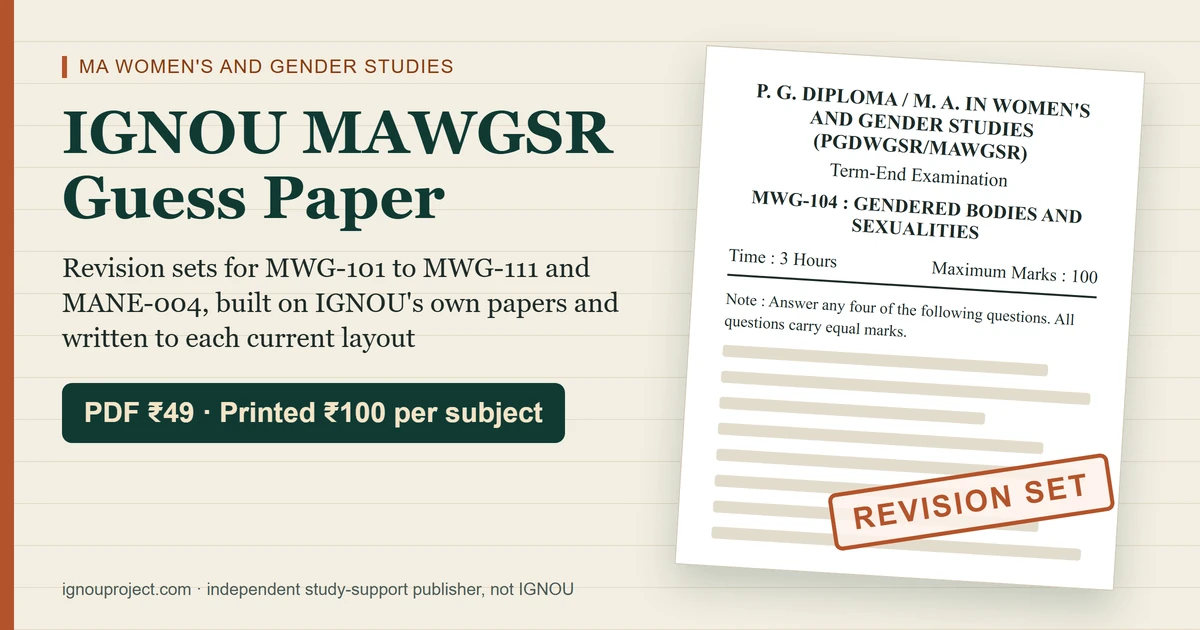
Quick answer. An IGNOU MAWGSR guess paper is a revision set of recurring questions with model answers for one course code of the MA in Women’s and Gender Studies, from MWG-101 to MWG-111 or the borrowed MANE-004. The December 2026 term-end examination (TEE) runs from 25 November 2026 to 14 January 2027, and the MAWGSR papers fall between MWG-103 on Friday 4 December and MWG-111 on Saturday 2 January 2027, per IGNOU’s date sheet of 30 October 2026. Each MWG paper is 3 hours and 100 marks, any four of seven questions at 25 marks; MWG-101 and MWG-102 dropped their short-note question from December 2025, while MWG-104 kept it. The rate is ₹49 per code as a PDF or ₹100 per code printed, with one ₹100 courier charge per printed order and none on a PDF. MAWGSR is taught in English, and the medium for each code is confirmed on WhatsApp before payment. No one outside IGNOU knows the questions in advance.
Semester 2 First, MWG-111 Last: The December 2026 Calendar for Gender Studies
The first MAWGSR paper of the December 2026 cycle is MWG-103 Constructing Gender through Arts and Media on Friday 4 December 2026, 10 AM to 1 PM, per IGNOU’s date sheet of 30 October 2026. Eleven of the twelve MAWGSR papers are morning papers; MANE-004 on Saturday 19 December is the only one set from 2 PM.
Across all programmes, IGNOU’s December 2026 papers run from Wednesday 25 November 2026 until Thursday 14 January 2027. Gender studies papers begin on its tenth day.
First MAWGSR paper
MWG-103 on Friday 4 December 2026, from 10 AM
Last MAWGSR paper
MWG-111 on Saturday 2 January 2027, from 10 AM
Date sheet of 30 October 2026; every MAWGSR date matches the tentative sheet of 21 September 2026
Semester 2 Is Examined Before Semester 1
The diploma-year timetable runs backwards. MWG-103 and MWG-104, the Semester 2 courses, come on consecutive days at the start of December, and the Semester 1 courses MWG-101 and MWG-102 follow a week later. A learner who planned to revise in the order the blocks arrived will need to turn that plan round.
On a phone, swipe the table sideways for every column.
| Code | Date | Session | Paper | Semester or stream | After the previous paper |
|---|---|---|---|---|---|
| MWG-103 | Friday 4 December | 10 AM to 1 PM | Constructing Gender through Arts & Media | Semester 2 | First paper |
| MWG-104 | Saturday 5 December | 10 AM to 1 PM | Gendered Bodies & Sexualities | Semester 2 | Next day |
| MWG-101 | Saturday 12 December | 10 AM to 1 PM | Theories of Women's & Gender Studies | Semester 1 | 7 days later |
| MWG-102 | Tuesday 15 December | 10 AM to 1 PM | Gender and Power | Semester 1 | 3 days later |
| MANE-004 | Saturday 19 December | 2 PM to 5 PM | Gender and Society | Semester 2 | 4 days later |
Year II: Three Mornings in a Row, Then the Specialisations Part
Both specialisations share the same three opening mornings. MWG-005 Research Methods is on Monday 7 December; on Tuesday 8 December the literature stream sits MWG-106 while the Women’s Studies stream sits MWG-109 in the same session, and Wednesday 9 December pairs MWG-107 with MWG-110 the same way. After that the two streams separate by nine days: MWG-108 closes Gender, Literature and Culture on Thursday 24 December, and MWG-111 closes Women’s Studies on Saturday 2 January 2027.
On a phone, swipe the table sideways for every column.
| Code | Date | Session | Paper | Semester or stream | After the previous paper |
|---|---|---|---|---|---|
| MWG-005 | Monday 7 December | 10 AM to 1 PM | Research Methods | both specialisations | First paper |
| MWG-106 | Tuesday 8 December | 10 AM to 1 PM | Gendered Nation | Gender, Literature and Culture | Next day |
| MWG-109 | Tuesday 8 December | 10 AM to 1 PM | Women & Social Structure | Women’s Studies | Same session, other stream |
| MWG-107 | Wednesday 9 December | 10 AM to 1 PM | Postmodernism & Gender | Gender, Literature and Culture | Next day |
| MWG-110 | Wednesday 9 December | 10 AM to 1 PM | Women in Political Process | Women’s Studies | Same session, other stream |
| MWG-108 | Thursday 24 December | 10 AM to 1 PM | Gender & Life Narratives | Gender, Literature and Culture | 15 days later |
| MWG-111 | Saturday 2 January 2027 | 10 AM to 1 PM | Women in the Economy | Women’s Studies | 9 days later |
Learners Carrying a Diploma Paper Into Year II
The heaviest week belongs to a second-year learner who still owes MWG-103 or MWG-104. Their list becomes 4, 5, 7, 8 and 9 December: five papers in six days, with only the Sunday free. Anyone in that position should finish the two Semester 2 papers before the end of November, because there is no gap to catch up in later.
The free run sheet further down marks consecutive days and same-session pairs automatically. For other programmes, the site’s December 2026 date sheet summary has the full calendar, and the morning and afternoon IGNOU exam timings are explained on their own page. The admit card for the cycle is covered on the IGNOU hall ticket guide, centre allotment on the exam centre page, and anyone still to pay can read about the examination fee and the online payment route.
The 70:30 Split and the 40 Per Cent Floor in Every MWG Course
For every MAWGSR theory course, the term-end examination carries 70 per cent of the result and the assignment 30 per cent, per the MAWGSR Programme Guide published by the School of Gender and Development Studies. The term-end examination carries 70 per cent of the final course result and assignments carry the remaining 30 per cent.
The same guide sets a floor on each part: at least 40 per cent in the assignment, at least 40 per cent in the term-end paper, and 40 per cent overall in every course, so a strong assignment cannot rescue a weak paper. The project, MWGP-101, has no term-end paper at all. None of the question papers themselves prints a weightage line, and the 2025-26 assignment file for MWG-107 prints none either, which is why the figure here is taken from the MAWGSR Programme Guide on eGyanKosh. A learner who wants to see what a given term-end score does to the final figure can try the IGNOU percentage calculator.
The three hours themselves are tight. Four answers at 25 marks each leave about 40 minutes per answer after ten minutes of reading, and the December 2025 and June 2026 MWG-102 papers ask for no more than 1,500 words an answer. That is a long essay for 40 minutes, which is why answer length matters as much as topic choice.
Guess Paper, Previous Year Paper or Solved Paper: Telling Them Apart for MAWGSR
A guess paper, for MAWGSR, is a publisher’s revision set of important and recurring questions with model answers for one course code, such as MWG-104, prepared from IGNOU’s past papers and the syllabus; it is also sold as important questions, expected questions or a model paper. A previous year question paper is the exact paper IGNOU set in one earlier term-end examination, such as the December 2025 MWG-102 paper, free on ignou.ac.in. A solved question paper is that IGNOU paper with a publisher’s model answers added.
Each does a different job. The IGNOU paper shows the layout of one session exactly; a solved paper shows one session answered; a revision set gathers what came back across several sessions and answers it at the current length.
On a phone, swipe the table sideways for every column.
| Question | Guess paper (revision set) | Previous year question paper | Solved question paper |
|---|---|---|---|
| What is it? | Recurring MWG or MANE-004 questions, answered | IGNOU’s paper for one session | IGNOU’s paper with answers added |
| Who makes it? | A publisher | IGNOU | A publisher |
| What does it cost? | ₹49 PDF or ₹100 printed per code on this site | Nothing | Depends on the seller |
| Best used for | Seeing which MWG themes returned and how long an answer should run | Timed practice in the real layout | Checking one session’s answers |
| Cannot do | Say what IGNOU will set next | Compare sessions for you | Cover what that session left out |
Free papers with answers for many programmes are gathered on the IGNOU solved question papers page, and the revision sets for every programme sit on the ignouproject.com guess paper hub. The sensible order for a gender studies learner is the newest IGNOU paper first, under a clock, and a revision set only where the themes need grouping or the answers need a model.
Four sessions behind each diploma-year set. MWG-101 to MWG-104 and MANE-004 sets begin from the December 2024 to June 2026 papers, not from an older MAWGS paper.
Essays sized to 25 marks. Answers are drafted for about 40 minutes of writing, the time a four-answer MWG paper allows.
Short notes only where IGNOU still sets them. MWG-104 and MWG-109 sets carry notes; the MWG-101 and MWG-102 sets follow the seven-essay layout of the last two sessions.
MANE-004 in its own shape. The anthropology paper gets 20-mark answers within 500 words and 10-mark notes within 250, as its paper prints.
Theorists named properly. Butler, Foucault, Lacan, Kristeva and Spivak are introduced with the idea an examiner expects, not a list of names.
Indian examples throughout. Section 377, the PNDT Act, Chipko and the Women’s Reservation Bill appear where the papers have asked for Indian cases.
Specialisation kept separate. A Women’s Studies learner is never sent MWG-106 to MWG-108, and the reverse.
Diploma learners included. PGDWGSR shares the five first-year courses, so the same set serves both enrolments.
Sent in exam order on request. Year I sets can arrive MWG-103 first, matching the 4 December start.
Medium agreed before payment. English for eleven codes; for MWG-111, whose paper is bilingual, the language is settled on WhatsApp.
Introductions that define first. Each model answer opens with a definition an evaluator can tick, then argument, then an example.
Two ways to receive it. A PDF over WhatsApp, or a printed booklet given to the courier the day after payment.
From MWG-101 to MWG-111: Course List, Paper Layouts and the MANE-004 Exception
MAWGSR has twelve examined codes of 8 credits each, per section 3.50 of the July 2026 Common Prospectus: MWG-101 and MWG-102 in Semester 1, MWG-103, MWG-104 and MANE-004 in Semester 2, MWG-005 for both specialisations in Year II, then three codes for each specialisation. The eight-credit MWGP-101 Project Work completes the 80 credits.
The credits check out. Year I is 5 × 8 = 40, which is also the full PGDWGSR diploma in section 8.44; Year II is MWG-005 with MWG-106 or MWG-109 in Semester 3, then MWG-107 and MWG-108 or MWG-110 and MWG-111 in Semester 4, plus the project: 5 × 8 = 40. The total is 80, as printed.
Year I: The Five Courses Shared With the PG Diploma
On a phone, swipe the table sideways for every column.
| Code | Title (July 2026 Common Prospectus) | Credits | Placed in | December 2026 paper |
|---|---|---|---|---|
| MWG-101 | Theories of Women's & Gender Studies | 8 | Semester 1 | Sat 12 Dec 2026, 10 AM to 1 PM |
| MWG-102 | Gender and Power | 8 | Semester 1 | Tue 15 Dec 2026, 10 AM to 1 PM |
| MWG-103 | Constructing Gender through Arts & Media | 8 | Semester 2 | Fri 4 Dec 2026, 10 AM to 1 PM |
| MWG-104 | Gendered Bodies & Sexualities | 8 | Semester 2 | Sat 5 Dec 2026, 10 AM to 1 PM |
| MANE-004 | Gender and Society | 8 | Semester 2 | Sat 19 Dec 2026, 2 PM to 5 PM |
Year II: MWG-005 Plus One Specialisation
On a phone, swipe the table sideways for every column.
| Code | Title (July 2026 Common Prospectus) | Credits | Placed in | December 2026 paper |
|---|---|---|---|---|
| MWG-005 | Research Methods | 8 | both specialisations | Mon 7 Dec 2026, 10 AM to 1 PM |
| MWG-106 | Gendered Nation | 8 | Gender, Literature and Culture | Tue 8 Dec 2026, 10 AM to 1 PM |
| MWG-107 | Postmodernism & Gender | 8 | Gender, Literature and Culture | Wed 9 Dec 2026, 10 AM to 1 PM |
| MWG-108 | Gender & Life Narratives | 8 | Gender, Literature and Culture | Thu 24 Dec 2026, 10 AM to 1 PM |
| MWG-109 | Women & Social Structure | 8 | Women’s Studies | Tue 8 Dec 2026, 10 AM to 1 PM |
| MWG-110 | Women in Political Process | 8 | Women’s Studies | Wed 9 Dec 2026, 10 AM to 1 PM |
| MWG-111 | Women in the Economy | 8 | Women’s Studies | Sat 2 Jan 2027, 10 AM to 1 PM |
Which Sets Fit Which MAWGSR Learner
On a phone, swipe the table sideways for every column.
| Learner | Papers in December 2026 | Sets to consider |
|---|---|---|
| PGDWGSR learner | MWG-101, MWG-102, MWG-103, MWG-104, MANE-004 | Up to five sets; the same five courses as MAWGSR Year I |
| MAWGSR Year I | The same five, 4 to 19 December | MWG-103 and MWG-104 first; MANE-004 in its own 20-mark format |
| Year II, Gender, Literature and Culture | MWG-005, MWG-106, MWG-107, MWG-108 | Four sets; the project has no paper |
| Year II, Women’s Studies | MWG-005, MWG-109, MWG-110, MWG-111 | Four sets; MWG-109 is the one with short notes |
| Year II with a Year I paper pending | A Semester 2 code plus Year II codes | Five papers in six days from 4 December; check the run sheet |
The Layout of Each Paper in June 2026
An MWG paper is 3 hours and 100 marks with seven questions, and the learner answers any four at 25 marks each, per IGNOU’s June 2026 papers for MWG-101 to MWG-111. Only MWG-104, MWG-109 and, in June 2026, MWG-005 turn Q7 into a set of short notes worth 5 marks each.
On a phone, swipe the table sideways for every column.
| Code | Latest IGNOU paper | Time and marks | Answer rule | Programme printed in the heading | Medium |
|---|---|---|---|---|---|
| MWG-101 | June 2026 | 3 hours, 100 marks | Seven questions, answer any four, 25 marks each; no short-note question | PGDWGSR/MAWGSR | English |
| MWG-102 | June 2026 | 3 hours, 100 marks | Seven questions, answer any four, 25 marks each; no short-note question | PGDWGS/MAWGS | English |
| MWG-103 | June 2026 | 3 hours, 100 marks | Seven questions, answer any four, 25 marks each; no short-note question | PGDWGSR/MAWGSR | English |
| MWG-104 | June 2026 | 3 hours, 100 marks | Seven questions, answer any four, 25 marks each; Q7 is a set of short notes, any five at 5 marks | PGDWGSR/MAWGSR | English |
| MANE-004 | June 2026 | 3 hours, 100 marks | Ten questions in Sections A and B, answer five with at least two from each section, 20 marks each; Q5 and Q10 are short notes, any two at 10 marks | MAAN (Anthropology) | English |
| MWG-005 | June 2026 | 3 hours, 100 marks | Seven questions, answer any four, 25 marks each; Q7 is a set of short notes, any five at 5 marks | MAWGS | English |
| MWG-106 | June 2026 | 3 hours, 100 marks | Seven questions, answer any four, 25 marks each; no short-note question | MAWGSR | English |
| MWG-107 | June 2026 | 3 hours, 100 marks | Seven questions, answer any four, 25 marks each; no short-note question | MAWGSR | English |
| MWG-108 | June 2026 | 3 hours, 100 marks | Seven questions, answer any four, 25 marks each; no short-note question | MAWGSR | English |
| MWG-109 | June 2026 | 3 hours, 100 marks | Seven questions, answer any four, 25 marks each; Q7 is a set of short notes, any five at 5 marks | MAWGSR | English |
| MWG-110 | June 2026 | 3 hours, 100 marks | Seven questions, answer any four, 25 marks each; no short-note question | MAWGSR | English |
| MWG-111 | June 2026 | 3 hours, 100 marks | Seven questions, answer any four, 25 marks each; no short-note question | MAWGSR | English and Hindi in one paper |
Where the Short-Note Question Went
This is the change most likely to catch a diploma learner out. Read across the table: MWG-101 and MWG-102 set short notes at Q7 in December 2024 and June 2025 and then stopped, MWG-104 kept them throughout, and MWG-103 never had them.
On a phone, swipe the table sideways for every column.
| Code | December 2024 | June 2025 | December 2025 | June 2026 |
|---|---|---|---|---|
| MWG-101 | Q7: any 5 of 6 at 5 | Q7: any 5 of 6 at 5 | none: seven essays | none: seven essays |
| MWG-102 | Q7: any 5 of 6 at 5 | Q7: any 5 of 6 at 5 | none: seven essays | none: seven essays |
| MWG-103 | none: seven essays | none: seven essays | none: seven essays | none: seven essays |
| MWG-104 | Q7: any 5 of 6 at 5 | Q7: any 5 of 6 at 5 | Q7: any 5 of 6 at 5 | Q7: any 5 of 6 at 5 |
| MANE-004 | Q5: 4 of 5 at 5; Q10: 2 of 3 at 10 | Q5 and Q10: 2 of 3 at 10 | Q5 and Q10: 2 of 3 at 10 | Q5 and Q10: 2 of 3 at 10 |
| MWG-005 | Q7: any 5 of 6 at 5 | none: seven essays | none: seven essays | Q7: any 5 of 7 at 5 |
| MWG-106 | not yet examined | none: seven essays | none: seven essays | none: seven essays |
| MWG-107 | not yet examined | none: seven essays | none: seven essays | none: seven essays |
| MWG-108 | not yet examined | none: seven essays | no paper on IGNOU's list | none: seven essays |
| MWG-109 | not yet examined | Q7: any 5 of 6 at 5 | Q7: any 5 of 6 at 5 | Q7: any 5 of 6 at 5 |
| MWG-110 | not yet examined | none: seven essays | none: seven essays | none: seven essays |
| MWG-111 | not yet examined | none: seven essays | none: seven essays | none: seven essays |
The December 2025 change in MWG-101 and MWG-102. IGNOU’s MWG-101 and MWG-102 papers each ended with “Write short notes on any five of the following” for 25 marks in December 2024 and June 2025; in December 2025 and June 2026 both papers replaced it with a seventh essay question. A MWG-101 or MWG-102 set built on the older papers trains five short notes that the last two papers did not ask for.
MANE-004: An MA Anthropology Paper Inside MAWGSR
MANE-004 Gender and Society is examined on an MA Anthropology (MAAN) paper, and none of its four papers from December 2024 to June 2026 names MAWGSR. It sets ten questions in Sections A and B, five to be answered with at least two from each section, 20 marks each, with printed word limits of 500 words for a 20-mark answer and 250 words for 10 marks.
The short-note questions moved too. In December 2024, Q5 asked for four notes of 5 marks (with a 125-word limit) and Q10 for two of 10; from June 2025 both Q5 and Q10 ask for two notes of 10 marks. A MAWGSR learner who has written only 25-mark MWG essays all term should practise at least two 500-word answers before 19 December.
The Programme Names IGNOU Prints on Each Paper
Three of the twelve MAWGSR codes are regularly headed with the older programme name: every MWG-005 paper from December 2024 to June 2026 is headed “M. A. in Women’s and Gender Studies (MAWGS)”, three of the four MWG-102 papers carry “PGDWGS/MAWGS”, and the June 2025 MWG-101 paper does the same.
On a phone, swipe the table sideways for every column.
| Code | December 2024 | June 2025 | December 2025 | June 2026 |
|---|---|---|---|---|
| MWG-101 | PGDWGSR/MAWGSR | PGDWGS/MAWGS | PGDWGSR/MAWGSR | PGDWGSR/MAWGSR |
| MWG-102 | PGDWGS/MAWGS | PGDWGS/MAWGS | PGDWGSR/MAWGSR | PGDWGS/MAWGS |
| MWG-103 | PGDWGSR/MAWGSR | PGDWGSR/MAWGSR | PGDWGSR/MAWGSR | PGDWGSR/MAWGSR |
| MWG-104 | PGDWGSR/MAWGSR | PGDWGSR/MAWGSR | PGDWGSR/MAWGSR | PGDWGSR/MAWGSR |
| MANE-004 | MAAN (Anthropology) | MAAN (Anthropology) | MAAN (Anthropology) | MAAN (Anthropology) |
| MWG-005 | MAWGS | MAWGS | MAWGS | MAWGS |
| MWG-106 to MWG-111 | not yet examined | MAWGSR | MAWGSR (no MWG-108 file) | MAWGSR |
None of this changes the paper. A learner registered for MAWGSR who opens a paper headed MAWGS is in the right hall; what matters is the code and title printed underneath.
Misprints and Title Drift in IGNOU’s Own Files
IGNOU’s papers carry small errors that a candidate should read through rather than worry over. The examples below are copied from the papers named.
On a phone, swipe the table sideways for every column.
| Code | Paper | As printed | Meaning |
|---|---|---|---|
| MWG-104 | June 2026 | Q7(f) “Queen Body and Literature” | Queer body and literature, as in the June 2025 note |
| MWG-102 | June 2026 | Q5 “the destruction between public and private spheres” | Distinction |
| MWG-102 | December 2025 | Q5 “normative and non-narrative sexuality” | Non-normative |
| MWG-102 | December 2025 | Q6 “How are there institutions changing” | These institutions |
| MWG-101 | June 2025 | Q6 “Discuss the analyse the andro centric nature” | Discuss and analyse the androcentric nature |
| MWG-005 | June 2025, December 2025 | Note: “not more than 1500 each” | 1,500 words each, as December 2024 prints |
| MWG-005 | December 2025 | Q2 “How does it help to undertake research …” has no subject | Reads as the second half of Q1 on research design |
| MWG-005 | June 2026 | Q6 “from planning to find stage of publication” | Final stage |
| MWG-005 | June 2026 | Title “Gender Research Methods” | Research Methods in the prospectus and earlier papers |
| MWG-107 | June 2025 to June 2026 | Title “Gender and Post-Modernism” | Postmodernism & Gender in the prospectus |
Disagreements and outdated lists to know about.
- The June 2026 MWG-005 paper is titled “Gender Research Methods”; the prospectus, the Programme Guide and the three earlier papers say “Research Methods”.
- MWG-107 has three titles: “Postmodernism & Gender” in the prospectus and Programme Guide, “Gender and Post-Modernism” on every paper, and “Gender and Postmodernism” on IGNOU’s 2025-26 MWG-107 assignment file.
- The prospectus prints the borrowed code as “MANE 004” in section 3.50 and as “MANE 4” in section 8.44 for the diploma; the papers print MANE-004.
- Some third-party course lists name MANI-003 Practicing Anthropology as a MAWGSR Semester 2 course. The July 2026 Common Prospectus and the Programme Guide list MANE-004 Gender and Society, and that is the code on the December 2026 sheet for this programme.
- A third-party previous-paper site files MWG-001 to MWG-008 as “older / legacy” codes. They are not on the MAWGSR list, yet IGNOU still sets MWG-001 to MWG-011 in December 2026 for learners on the earlier MAWGS structure, each in the same session as its 100-series counterpart.
- The publisher’s own store files the revised MWG-1xx sets and the earlier MWG-0xx sets together under a MAWGS heading. Order by the code on the hall ticket, not by the programme name in a store menu.
The site’s own MA Women’s and Gender Studies programme overview and the PG Diploma in Women’s and Gender Studies overview describe admission and fees. No per-code pages exist on this site for the MWG codes, so none is linked.
Embodiment, Surrogacy, Public and Private: What Came Back in IGNOU’s MWG Papers
MWG-104 Gendered Bodies and Sexualities is the most repetitive MAWGSR paper: embodiment, surrogacy, objectification of the female body, the queer body and the parental body each appeared in all four IGNOU papers from December 2024 to June 2026. MWG-102 Gender and Power set the public and private spheres in 4 of 4 papers, and MANE-004 set the concept of gender, patriarchy and gender with ethnicity in 4 of 4.
Every count below comes from IGNOU’s own term-end papers, each read in full by ignouproject.com on 5 November 2026: four sessions (December 2024, June 2025, December 2025 and June 2026) for the five diploma-year codes and MWG-005, and the three sessions IGNOU has examined so far for the Year II specialisation codes, two for MWG-108. Matching is topic-level and a human judgement: a question on “maternal bodies” and a short note on “Parental Body” are counted under one theme, and a theme counts once per paper however many questions touch it. A count records what IGNOU asked; it says nothing certain about December 2026.
MWG-101 Theories of Women’s and Gender Studies
No MWG-101 theme reached 4 of 4. Seven themes reached 3 of 4, which makes this the broadest of the diploma papers: a learner cannot narrow it down to a handful of questions.
On a phone, swipe the table sideways for every column.
| Theme | December 2024 | June 2025 | December 2025 | June 2026 | n of N |
|---|---|---|---|---|---|
| Women’s question and women’s movement, India and the West | Q2 | Q1 | – | Q1 | 3 of 4 |
| Sexuality as a social construction | Q6 | Q5 | – | Q3 | 3 of 4 |
| Eco-feminism | Q7(b) | Q4 | Q3 | – | 3 of 4 |
| Psychoanalysis and its feminist critiques | Q7(f) | Q7(d) | Q5 | – | 3 of 4 |
| Feminism and disability | Q5 | Q7(f) | – | Q5 | 3 of 4 |
| Queer movements, queer theory and Section 377 | Q7(a) | Q7(a) | Q4, Q6, Q7 | – | 3 of 4 |
| Socialist, Marxist, liberal and working-class feminisms | – | Q7(c) | Q2 | Q7 | 3 of 4 |
| Dalit feminism | Q1 | – | – | Q4 | 2 of 4 |
| Black feminism | – | Q2 | Q1 | – | 2 of 4 |
| Gender bias in science and the disciplines | Q3 | Q6 | – | – | 2 of 4 |
| Defining feminism and its waves | – | Q3 | – | Q2 | 2 of 4 |
The four MWG-101 papers behind these counts: MWG-101 December 2024, MWG-101 June 2025, MWG-101 December 2025 and MWG-101 June 2026.
MWG-102 Gender and Power
One theme in every paper and five more in three of four. The public and private question has been set four ways: as a dichotomy, as a distinction, as private and public patriarchy, and as a feminist problem.
On a phone, swipe the table sideways for every column.
| Theme | December 2024 | June 2025 | December 2025 | June 2026 | n of N |
|---|---|---|---|---|---|
| Public and private spheres | Q1 | Q1 | Q3 | Q5 | 4 of 4 |
| Masculinities | Q2 | Q2 | Q2 | – | 3 of 4 |
| Patriarchy, including Dalit patriarchy | Q3 | Q7(e) | Q3 | – | 3 of 4 |
| Citizenship and women’s rights | Q4 | – | Q1 | Q2 | 3 of 4 |
| Women and work | Q5 | Q5 | – | Q4 | 3 of 4 |
| Marriage and family | – | Q4 | Q6 | Q1 | 3 of 4 |
| Sex-gender system | – | Q3 | – | Q6 | 2 of 4 |
| Normative and non-normative sexualities | – | Q6 | Q5 | – | 2 of 4 |
| Gender and education | – | – | Q7 | Q3 | 2 of 4 |
| Feminism and Marxism, dual systems theory | Q7(d) | – | Q4 | – | 2 of 4 |
To trace each MWG-102 count to IGNOU’s file: MWG-102 December 2024, MWG-102 June 2025, MWG-102 December 2025 and MWG-102 June 2026.
MWG-103 Constructing Gender Through Arts and Media
MWG-103 spreads across art forms, and three of them returned in every session: literary theory, painting and sculpture, and Indian cinema.
On a phone, swipe the table sideways for every column.
| Theme | December 2024 | June 2025 | December 2025 | June 2026 | n of N |
|---|---|---|---|---|---|
| Literary theory: deconstruction, post-structuralism, critical approaches | Q3 | Q1 | Q3 | Q2 | 4 of 4 |
| Painting and sculpture | Q7 | Q6 | Q5 | Q5 | 4 of 4 |
| Indian cinema: representation, queer films, censorship | Q4 | Q3, Q4 | Q4 | Q3 | 4 of 4 |
| Theatre and gender performance | Q6 | – | Q6 | Q4 | 3 of 4 |
| Male and transgender performers, ancient and medieval India | Q2 | Q5 | – | Q7 | 3 of 4 |
| The body in cyberspace and cyber crime | Q1 | Q7 | Q7 | – | 3 of 4 |
| Queer writing in India | – | Q2 | – | Q1 | 2 of 4 |
| Gender in media and television serials | Q5 | – | Q1 | – | 2 of 4 |
| Censorship in India | – | – | Q2 | Q3 | 2 of 4 |
IGNOU’s MWG-103 papers, each headed PGDWGSR/MAWGSR: MWG-103 December 2024, MWG-103 June 2025, MWG-103 December 2025 and MWG-103 June 2026.
MWG-104 Gendered Bodies and Sexualities
Five themes in 4 of 4 and five more in 3 of 4. Many of them come back as a short note in one session and an essay in the next, so a revision set has to prepare each at both lengths.
On a phone, swipe the table sideways for every column.
| Theme | December 2024 | June 2025 | December 2025 | June 2026 | n of N |
|---|---|---|---|---|---|
| Embodiment | Q7(d) | Q1 | Q1 | Q1 | 4 of 4 |
| Surrogacy | Q7(e) | Q4 | Q7(e) | Q5 | 4 of 4 |
| Objectification and commodification of the female body | Q7(c) | Q6 | Q3 | Q7(c) | 4 of 4 |
| Queer body in literature and culture | Q3 | Q7(b) | Q4 | Q7(f) | 4 of 4 |
| Motherhood, fatherhood and the parental body | Q4, Q7(a) | Q5, Q7(c) | Q5, Q7(c) | Q4, Q7(e) | 4 of 4 |
| Reproductive technologies | Q5 | Q7(d) | – | Q7(b) | 3 of 4 |
| Race and racialisation of the body | – | Q7(f) | Q7(d) | Q3 | 3 of 4 |
| Myth, androgyny and gender identity | Q7(f) | – | Q7(b), Q7(f) | Q6 | 3 of 4 |
| Labouring body and body politics | – | Q2 | Q2, Q7(a) | Q2 | 3 of 4 |
| Disability, masculinity and the body | – | Q3 | Q6 | Q7(e) | 3 of 4 |
| French feminist theory and the body | Q6 | – | – | Q7(a) | 2 of 4 |
| Gender as performance | Q2 | – | – | Q7(d) | 2 of 4 |
Every MWG-104 cell can be checked in MWG-104 December 2024, MWG-104 June 2025, MWG-104 December 2025 and MWG-104 June 2026.
MANE-004 Gender and Society
The anthropology paper repeats more openly than any MWG paper: “Write a note on bodies after menopause” appeared word for word as Q6 in June 2025 and December 2025.
On a phone, swipe the table sideways for every column.
| Theme | December 2024 | June 2025 | December 2025 | June 2026 | n of N |
|---|---|---|---|---|---|
| Concept of gender, sex and gender, theories of gender | Q2, Q10(a) | Q1, Q10(b) | Q1 | Q1 | 4 of 4 |
| Patriarchy | Q3 | Q2 | Q2 | Q2 | 4 of 4 |
| Gender with ethnicity and race | Q6 | Q7 | Q7 | Q6 | 4 of 4 |
| Socialisation, family and school | – | Q3 | Q3 | Q4 | 3 of 4 |
| Women, work and globalisation | Q9 | Q10(a) | – | Q9 | 3 of 4 |
| Caste and class | Q10(c) | – | Q9 | Q7 | 3 of 4 |
| First and second wave feminism | Q10(b) | Q9 | Q10(b) | – | 3 of 4 |
| Women in movements: Chipko, Telangana | Q7 | Q10(c) | Q8 | – | 3 of 4 |
| Women in pre-colonial and colonial India | Q8 | Q8 | Q10(c) | – | 3 of 4 |
| Bodies at menarche and after menopause | Q5(e) | Q5(c), Q6 | Q6 | – | 3 of 4 |
| Embodiment and feminist theory | – | Q4 | Q4 | – | 2 of 4 |
| Simone de Beauvoir | Q5(b) | – | Q5(b) | – | 2 of 4 |
MANE-004 as IGNOU filed it for MA Anthropology: MANE-004 December 2024, MANE-004 June 2025, MANE-004 December 2025 and MANE-004 June 2026.
MWG-005 Research Methods
Research ethics is the one fixture, asked in all four sessions, twice as a 10- or 15-mark part of a split question. Language and literary theory, unusual in a methods paper, also appeared in every session.
On a phone, swipe the table sideways for every column.
| Theme | December 2024 | June 2025 | December 2025 | June 2026 | n of N |
|---|---|---|---|---|---|
| Research ethics | Q6(a) | Q4 | Q4(a) | Q2 | 4 of 4 |
| Language, literature and literary theory in research | Q7(a), Q7(c) | Q1, Q7 | Q6 | Q5, Q7(c) | 4 of 4 |
| Feminist epistemology, standpoint and reflexivity | Q1, Q3 | – | Q3 | Q7(a) | 3 of 4 |
| Qualitative and quantitative methods and tools | Q5 | Q5 | – | Q4 | 3 of 4 |
| Research design, proposal, report and publication | Q2 | – | Q1, Q7 | Q6 | 3 of 4 |
| Sampling | Q4 | – | Q5 | – | 2 of 4 |
| Triangulation | Q7(d) | – | Q4(b) | – | 2 of 4 |
| Action research | Q7(f) | – | – | Q3 | 2 of 4 |
| Interdisciplinarity | Q6(b) | – | – | Q7(f) | 2 of 4 |
The MWG-005 papers, all headed MAWGS: MWG-005 December 2024, MWG-005 June 2025, MWG-005 December 2025 and MWG-005 June 2026.
Year II Specialisation Codes, June 2025 to June 2026
The Semester 3 and 4 specialisation courses were first examined in June 2025, so IGNOU has published three papers for each and two for MWG-108. With that few, the table lists only themes seen in at least two papers.
On a phone, swipe the table sideways for every column.
| Code | Theme | Sessions and questions | n of N |
|---|---|---|---|
| MWG-106 | Nation and nationalism from a gender perspective | Jun 2025 Q1; Dec 2025 Q1, Q2; Jun 2026 Q1, Q2 | 3 of 3 |
| MWG-106 | Women’s writing, literature and the nation | Jun 2025 Q2; Dec 2025 Q3, Q5; Jun 2026 Q3 | 3 of 3 |
| MWG-106 | Race and ethnicity | Jun 2025 Q5; Jun 2026 Q6 | 2 of 3 |
| MWG-107 | Race, ethnicity and womanhood | Jun 2025 Q4; Dec 2025 Q3; Jun 2026 Q3 | 3 of 3 |
| MWG-107 | Semiotics of social media and advertising | Jun 2025 Q1; Jun 2026 Q1, Q7 | 2 of 3 |
| MWG-107 | Bombal and Esquivel: magic realism and gender | Dec 2025 Q1; Jun 2026 Q5 | 2 of 3 |
| MWG-108 | Women’s autobiography against men’s | Jun 2025 Q1; Jun 2026 Q1 | 2 of 2 |
| MWG-108 | Slave narratives | Jun 2025 Q6; Jun 2026 Q4 | 2 of 2 |
| MWG-109 | Development, social change and the feminist critique | Jun 2025 Q2; Dec 2025 Q1; Jun 2026 Q2 | 3 of 3 |
| MWG-109 | Personal law and divorce | Jun 2025 Q7(b); Dec 2025 Q4; Jun 2026 Q7(b) | 3 of 3 |
| MWG-109 | Family and household | Jun 2025 Q3; Jun 2026 Q3 | 2 of 3 |
| MWG-110 | Elections, parties and the Election Commission | Jun 2025 Q6; Dec 2025 Q6; Jun 2026 Q2 | 3 of 3 |
| MWG-110 | Women’s leadership: Panchayati Raj and grassroots leaders | Jun 2025 Q4; Dec 2025 Q5; Jun 2026 Q6 | 3 of 3 |
| MWG-110 | Women’s movement and women’s studies | Jun 2025 Q1; Jun 2026 Q1, Q4 | 2 of 3 |
| MWG-111 | Women’s labour force participation and its measurement | Jun 2025 Q1, Q5; Dec 2025 Q7; Jun 2026 Q3 | 3 of 3 |
| MWG-111 | Globalisation, multinationals and structural adjustment | Jun 2025 Q6; Dec 2025 Q6; Jun 2026 Q4, Q6 | 3 of 3 |
| MWG-111 | Migration and its risks for women | Jun 2025 Q4; Dec 2025 Q4 | 2 of 3 |
The specialisation counts come from these IGNOU papers: MWG-106 Jun 2025, MWG-106 Dec 2025 and MWG-106 Jun 2026; MWG-107 Jun 2025, MWG-107 Dec 2025 and MWG-107 Jun 2026; MWG-108 Jun 2025 and MWG-108 Jun 2026; MWG-109 Jun 2025, MWG-109 Dec 2025 and MWG-109 Jun 2026; MWG-110 Jun 2025, MWG-110 Dec 2025 and MWG-110 Jun 2026; MWG-111 Jun 2025, MWG-111 Dec 2025 and MWG-111 Jun 2026.
Sorting Questions by Theme: The Making of an MWG Set
Five steps, the same for every MAWGSR code; only the papers change.
- Gather the latest IGNOU papers for the code. For MWG-101 to MWG-104, MANE-004 and MWG-005 that means the four sessions from December 2024 to June 2026; for the specialisation codes, every session IGNOU has published.
- Sort every question and note by theme. A short note on “Surrogacy Industry” and an essay on surrogacy as reproductive labour go under one heading.
- Answer the most-asked themes first. Themes seen in 4 of 4 or 3 of 4 papers get full 25-mark answers; themes seen once get a shorter outline.
- Write to the newest layout. Seven-essay papers get essays only; MWG-104 and MWG-109 sets add 5-mark notes; MANE-004 answers keep to 500 and 250 words.
- Check each answer against the IGNOU block. Definitions, theorists and Indian examples are taken from the course material, so an answer reads as the evaluator expects.
One Worked Plan: Public and Private in MWG-102
The June 2026 MWG-102 paper asked learners to explain the distinction between public and private spheres and its origin, and how feminists problematise it. A 40-minute plan for an answer of that kind runs as follows.
- About 5 minutes: define the two spheres and trace the split to liberal political thought.
- About 20 minutes: the feminist critique, from “the personal is political” to unpaid domestic work and violence treated as a private matter, with two Indian examples.
- About 10 minutes: where the line is shifting now, such as laws on domestic violence and women’s paid work.
- About 5 minutes: a closing paragraph that returns to the question’s own words.
A Ten-Day Plan for the Diploma Year
For a learner starting on 24 November with all five Year I codes: days 1 to 4 on MWG-103 and MWG-104, which are examined first; days 5 to 7 on MWG-101 and MWG-102, with a second pass in the week after 5 December; days 8 to 10 on MANE-004 and its 500-word answers, revisited before 19 December. Each day ends with one timed answer.
Honest Limits: A Gender Studies Set Against an Unseen Paper
A guess paper is a revision aid built from past IGNOU question papers and the syllabus. No one outside IGNOU knows the questions in advance, and no claim is made that any question in this set will appear in your examination.
Where a MAWGSR Set Earns Its Place
It puts the 4 of 4 and 3 of 4 themes for each code in one place, writes them at the length a four-answer paper allows, and follows the current layout, including the seven-essay MWG-101 and MWG-102 papers and the separate MANE-004 format. For a learner who has read the blocks, it shortens the last fortnight.
What No Set Can Do
It cannot tell anyone which questions the December 2026 papers will contain, and a theme that appeared four times can be missing from the fifth paper. It does not replace the MWG blocks, whose arguments and examples an evaluator looks for, and it cannot anticipate a layout change IGNOU has not yet made, as MWG-101 and MWG-102 showed in December 2025.
Revising without paying. Every MAWGSR paper counted on this page is free on IGNOU’s session lists, and the IGNOU last year paper guide explains how to use them for timed practice. The MWG and MANE course blocks are free through the eGyanKosh guide or the Gyankosh alternative; the IGNOU books download page covers printed blocks, and shorter summaries are in the study notes collection.
A Run Sheet for the Dates and a Clock for the Essays, Both Free
The run sheet places the ticked codes on IGNOU’s December 2026 dates and adds up the price; the essay clock shows the layout of a chosen code and divides the three hours between its answers.
Free tool 1
MAWGSR December Run Sheet
Any figure from 0.5 to 16 works; half hours such as 2.5 are fine.
This tool is guidance from ignouproject.com, not an IGNOU rule. Using it creates no obligation to order anything.
Free tool 2
MWG and MANE-004 Essay Clock
The clock sets aside 10 minutes to read and choose, then divides the rest of the three hours by the marks IGNOU printed.
This tool is guidance from ignouproject.com, not an IGNOU rule. Using it creates no obligation to order anything.
The arithmetic behind the essay clock, for the three layouts IGNOU used in June 2026:
On a phone, swipe the table sideways for every column.
| Paper type | Time available | Time per answer |
|---|---|---|
| MWG papers without notes: any 4 of 7 at 25 | 170 minutes after 10 to read | About 42 minutes per essay; a 10+15 split is about 17 and 25 |
| MWG-104, MWG-109, MWG-005 (June 2026): 3 essays plus Q7 notes | 170 minutes after 10 to read | About 42 minutes per essay; Q7 notes about 8 minutes each |
| MANE-004: 5 of 10 at 20, two sections | 170 minutes after 10 to read | 34 minutes per 20-mark answer of 500 words; 17 per 10-mark note of 250 words |
Neither planner knows anything the tables above do not: each date, layout and count it prints already sits in a static table on this page.
Checking a Paper or a Date Against IGNOU’s Own Files
IGNOU publishes one question paper list per term-end session, and the papers used here come from four of them: the June 2026 question paper list, the December 2025 list, the June 2025 list and the December 2024 list.
- Search the list with the hyphenated code, such as MWG-104 or MANE-004. The older MWG-004 file sits beside MWG-104 on the same list, so check the middle digit.
- Open the PDF and read the month and year under “Term-End Examination”; the file name is the same every session.
- Expect gaps. The December 2024 list holds no MWG-106 to MWG-111 papers, because those courses were first examined in June 2025, and the December 2025 list has no MWG-108 file.
- Trust only IGNOU’s own PDF for a date: the December 2026 date sheet of 30 October 2026 superseded the tentative sheet of 21 September 2026, and both print the codes unhyphenated, as MWG103 and MANE004.
Unofficial sites disagree with one another about when the December sheet came out, which is one more reason to open the PDF itself. How IGNOU publishes its sheets each cycle is explained on the IGNOU date sheet guide.
Admit Card, Term-End Marks and the Grade Card Around the MAWGSR Papers
The hall ticket is needed before MWG-103 or MWG-005, whichever comes first on a learner’s list, and it should show every MWG and MANE code registered. If a code is missing, the Regional Centre needs to know before 4 December, not on the morning of the paper.
Results come in two parts. Term-end marks appear through the IGNOU result page, the previous cycle is tracked on the June 2026 result page, and master’s-level releases are followed on the IGNOU MA result page. For the 30 per cent from assignments, the assignment result status page shows whether IGNOU has entered the marks. A learner who doubts a term-end mark can read the revaluation procedure; once all ten courses are complete, the final grade card guide and the CGPA calculator help with the overall result.
The 30 Per Cent Assignment and MWGP-101: Help Outside the Exam Hall
Nothing in a revision set touches the assignment or the project. The MAWGSR assignment that makes up the other 30 per cent can be written by hand through the MAWGSR handwritten assignment service, and typed answers are listed under IGNOU solved assignments. Fuller course coverage than a set gives is in the IGNOU help books and the online guide books. The project has no term-end paper; learners at that stage can read the MAWGSR project guide for MWGP-101 or, on the earlier structure, the PGDWGS project page.
Why MWG-111 Is the Only MAWGSR Paper With a Hindi Version
The MAWGSR programme is offered in English medium only, per the July 2026 Common Prospectus and the MAWGSR Programme Guide, and eleven of its twelve papers from December 2024 to June 2026 are printed in English alone. The exception is MWG-111 Women in the Economy, whose June 2025, December 2025 and June 2026 papers each print the same seven questions in Hindi after the English.
Each set is prepared for the upcoming term-end examination, in every medium IGNOU examines that course in, and the medium for your course code is confirmed on WhatsApp before you pay.
In practice, every MWG-101 to MWG-110 set and the MANE-004 set is written in English. For MWG-111 the Hindi version of the paper matches the English question for question, so a learner who wants to answer in Hindi should say so on WhatsApp and check with the Regional Centre that a Hindi answer book is permitted on their enrolment.
Four Messages to a MAWGSR Order: Codes, Format, Medium, Payment
The rate is ₹49 per subject code for a solved guess paper as a PDF, or ₹100 per subject code as a printed copy. Printed copies carry a one-time courier charge of ₹100 per order, whatever the number of subject codes; the PDF has no courier charge.
- List the codes as IGNOU prints them: MWG-101, MANE-004, MWG-005 and so on.
- Mark each code PDF or printed. Mixing is allowed; the courier charge applies once if anything is printed.
- Send the list to +91 93546 37830 on WhatsApp, naming the specialisation for Year II codes and the medium for MWG-111.
- Pay the total confirmed in the reply.
The PDF is shared on WhatsApp once payment is confirmed. A printed copy is dispatched the next day after payment is confirmed, and the courier details are shared on WhatsApp. No arrival date is promised, because transit time depends on the courier and your location.
There is no minimum order: one subject or ten, same rate per format.
A diploma-year learner taking all five Year I codes pays ₹245 for five PDFs, or ₹500 for five printed copies plus ₹100 courier, ₹600 in all. A Year II learner with MWG-005 and three specialisation codes pays ₹196 as PDFs or ₹500 printed including courier. Rates for the site’s other services are on the services and charges page.
Sources Behind the MWG Counts, and the March 2027 Review
IGNOU documents. The July 2026 Common Prospectus (section 3.50 for MAWGSR, section 8.44 for PGDWGSR, and the programme table), the MAWGSR Programme Guide, the 2025-26 MWG-107 assignment file, the forty-one term-end papers linked in the theme section, the four session lists and both December 2026 date sheets. Where IGNOU posts each edition of the prospectus is set out in the IGNOU prospectus guide.
The publisher’s analysis. The theme counts, the short-note and heading tables, the misprint list, the essay clock and the date groupings are ignouproject.com’s own reading of those documents, made on 5 November 2026. Theme matching is a judgement and is described in the method paragraph above.
The publisher’s terms. Prices, the two formats, dispatch and the medium of a set are ignouproject.com’s commercial terms and are not IGNOU rules.
Written and reviewed by BK Sahni, Founder, Shri Chakradhar Publication Pvt. Ltd. and ignouproject.com, who has guided 5,00,000 students till date. ORCID 0009-0005-8092-459X. Serving IGNOU learners since 2010.
Published 5 November 2026. Last reviewed 5 November 2026. Next review: March 2027, the month IGNOU’s provisional June 2027 timetable usually appears.
Gender Studies Learners’ Questions on MWG Papers and Sets
An IGNOU MAWGSR guess paper is a single-code revision set, for example for MWG-104, that groups the themes IGNOU keeps setting and answers each at exam length. Each code is ₹49 as a PDF or ₹100 printed; printing adds a single ₹100 courier charge to the whole order, never to a PDF.
In MWG-102, the public and private spheres appeared in all four papers from December 2024 to June 2026. In MWG-104, embodiment, surrogacy, objectification, the queer body and the parental body each appeared in 4 of 4. MANE-004 set gender, patriarchy and ethnicity in every session. Past counts are not a forecast.
The first MAWGSR paper is MWG-103 Constructing Gender through Arts and Media on Friday 4 December 2026, 10 AM to 1 PM, according to IGNOU’s date sheet of 30 October 2026. MWG-104 follows on Saturday 5 December. The last MAWGSR paper is MWG-111 on Saturday 2 January 2027.
Every MWG paper is 3 hours and 100 marks with seven questions, of which any four are answered at 25 marks each. MWG-104, MWG-109 and the June 2026 MWG-005 paper make Q7 a set of short notes. MANE-004 differs: ten questions in two sections, five answered, 20 marks each.
Yes. MWG-101 and MWG-102 both carried a short-note question at Q7 in December 2024 and June 2025, and both dropped it in December 2025 and June 2026, when all seven questions became essays. MWG-104 kept its short notes in all four sessions, so the two semesters now need different answer plans.
MANE-004 Gender and Society is an anthropology course that MAWGSR borrows, and IGNOU heads its paper for the MA Anthropology (MAAN) programme. It asks for five answers out of ten, with at least two from each of Sections A and B, at 20 marks each, under printed word limits of 500 and 250 words.
MAWGSR is taught in English, per the July 2026 Common Prospectus and the MAWGSR Programme Guide, and eleven of its twelve papers are printed in English only. The MWG-111 paper prints a Hindi version beneath the English one in all three sessions IGNOU has published, so the medium for MWG-111 is agreed on WhatsApp first.
No. A previous year question paper is what IGNOU really printed for one earlier session of a code, such as MWG-102 in December 2025, and it costs nothing on ignou.ac.in. A guess paper is a publisher’s revision set for one code, built from several such papers and the syllabus, with model answers.
IGNOU’s own MAWGSR papers are free and should be practised whichever way a learner revises. A revision set adds grouped themes and written answers sized to the current layout. A learner with time to read the blocks and draft answers from the four latest papers can manage without buying a set.
MAWGSR question papers are free on IGNOU’s question paper lists, one list per session, at ignou.ac.in. Search each list for the hyphenated code, such as MWG-102 or MANE-004, and check the session printed under Term-End Examination, since the file names repeat each session.
MAWGSR is the revised MA in Women’s and Gender Studies with MWG-101 to MWG-111 codes, 80 credits in all; MAWGS was the earlier version with MWG-001 to MWG-011 codes. IGNOU still sets the old MWG-001 to MWG-011 papers in the same slots as their new counterparts, so check the code on the hall ticket.
Yes. The PGDWGSR diploma is the first year of MAWGSR, and the July 2026 Common Prospectus lists the same five courses for it: MWG-101, MWG-102, MWG-103, MWG-104 and MANE-004, 40 credits in all. A set for MWG-102 therefore serves a PGDWGSR learner and a MAWGSR learner alike.
The MAWGSR term-end examination carries 70 per cent of each course result and the assignment 30 per cent, per the MAWGSR Programme Guide, which also asks for at least 40 per cent in each part and 40 per cent overall in every course.
Check five things with any provider, this one included: that the set names the current MWG or MANE code, follows the latest layout, targets the December 2026 session, gives answers written to exam length, and makes no claim about which questions will come. An accuracy percentage cannot be measured and is a reason for caution.
With ten days left, start with the paper nearest in date and its themes seen in 4 of 4 or 3 of 4 sessions, then practise one timed answer of about 40 minutes per 25-mark question. For MWG-104 add short notes; for MANE-004 practise 20-mark answers within 500 words.
No one can say. A guess paper is a revision aid built from past IGNOU question papers and the syllabus. No one outside IGNOU knows the questions in advance, and no claim is made that any question in this set will appear in your examination.
A printed MAWGSR set is dispatched the next day after payment is confirmed, and the courier details are shared on WhatsApp. Printing costs ₹100 a code, and the ₹100 courier charge is added once to the order, not once per code. When the parcel arrives depends on the courier and the destination, so no arrival date is given.
Important Notice
ignouproject.com is an independent IGNOU study-support publisher. It is not the official website of Indira Gandhi National Open University, is not affiliated with, endorsed by or authorised by the university, and no page on this site should be treated as an official IGNOU communication.
Programme structures, course codes, examination dates, question-paper patterns and rules change, and only ignou.ac.in and your Regional Centre can confirm the current position for your enrolment.
A guess paper is a revision aid built from past IGNOU question papers and the syllabus. No one outside IGNOU knows the questions in advance, and no claim is made that any question in this set will appear in your examination.
Study the official IGNOU material for every course you are sitting; a guess paper supplements that material and does not replace it.
No claim is made about the marks you will receive, about how an evaluator will assess your answers, or about your result. Examination and evaluation are entirely a matter for IGNOU.

BK Sahni iD 0009-0005-8092-459X
Founder, Shri Chakradhar Publication Pvt. Ltd. & ignouproject.com — helping IGNOU distance-learning students since 2010 (5,00,000+ students supported across MBA, MCom, MA & more). Author of IGNOU exam guides, solved assignments & project reference books.
Disclosure: Shri Chakradhar Publication Pvt. Ltd. and ignouproject.com are independent third-party study-help services — not the official IGNOU website. Always verify final dates and rules on ignou.ac.in.