IGNOU MAEL 101 Practical: what you will actually produce
The IGNOU MAEL 101 Practical asks you to carry out eight community activities, write one report for each and hand them in as one bound file. This guide shows how to pick the activities, plan them with a mentor, write and check each report, and assemble the file.
The MAEL-101 route in five lines
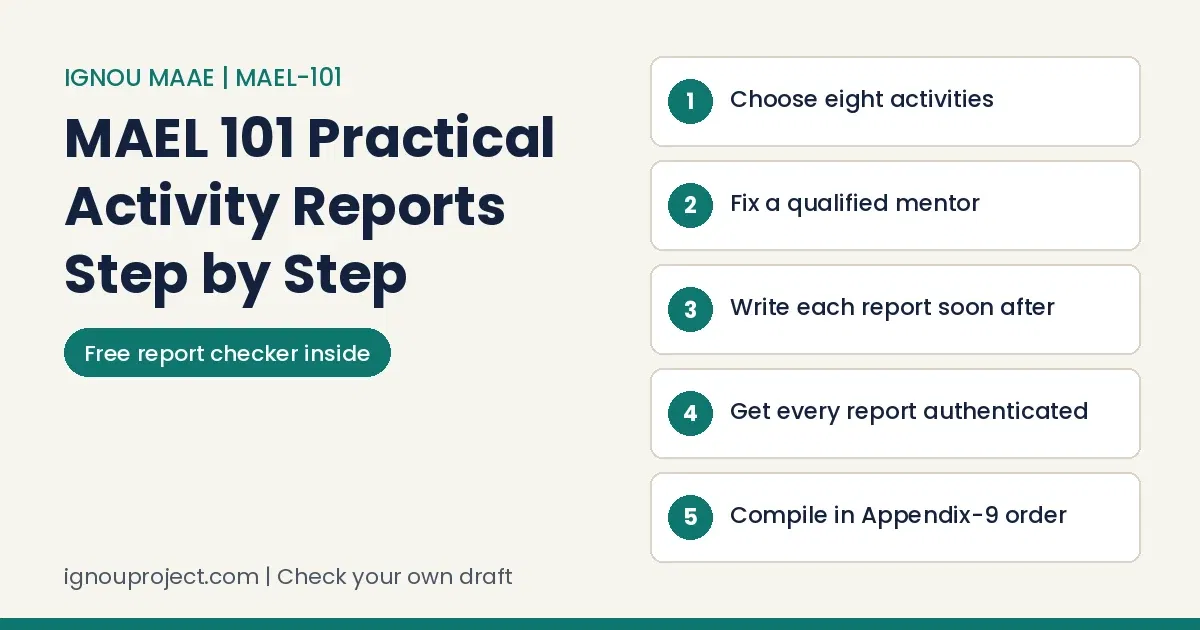
For the IGNOU MAEL 101 Practical, choose any eight of the 19 activities in the Student’s Handbook for Practical Work (0.5 credit each, 4 credits in all). Perform each with a qualified mentor, write each report in 800 to 1,000 words (Activity 5 needs two of 400 to 500), get it authenticated, and submit one spiral-bound file to your LSC or RC.
MAEL-101, Community-based Practical Activities, is a first-year MAAE course with no term-end examination: the compiled report decides the grade, and every course needs at least a C grade.
Across practical courses we see the same pattern: learners who handle theory papers well still stall on the practical side. Here that means eight reports written about real work in your own locality.
Many learners also find out late that a practical component exists at all. In MAAE it sits in the first-year course list, so plan for it from the day you enrol.
Before the first activity: settle three things
Three decisions shape the whole IGNOU MAEL 101 Practical, and each is easier at the start of the year.
- Your working window. The Programme Guide sets two cycles. January session learners perform activities from about April to September, finish the reports from September to November and submit in December. July session learners perform from about September to March, finish from March to May and submit in June.
- Your community. Activities are done where you live and/or work. Choose a place you can reach every week.
- Your submission office. The file goes to your allotted LSC or RC; note its address in your log.
In our records, 70 to 80 percent of learners start work only in the final month before the due date. For MAEL-101 that month falls inside the report-writing window, when the activities should already be done.
Advice from a friend at another centre can mislead you, because centres differ in how they receive practical work. Follow your handbook and Programme Guide, then your own LSC’s notice.
Teachers and NGO staff often ask whether their own workplace can serve. The guide’s wording, where you live and/or work, allows it, provided the activity matches the handbook.
For the theory side, the MAAE programme overview lists every first-year course, and the MAAE guess paper for December 2026 helps you plan revision around the activities.
How to choose eight of the 19 activities in the IGNOU MAEL 101 Practical
The IGNOU MAEL 101 Practical gives you a free choice of eight. Test every activity against four questions before you commit.
Activity filter, four questions
| Question | What to look for in the handbook | Example |
|---|---|---|
| Can I do it in my own community? | Who must take part, and where | Event activities such as 6, 10, 12, 13, 14 and 15 need a gathering you can organise locally |
| Does it depend on someone else agreeing? | An outside body that must let you in | Activities 7 (observing a training programme), 8 (approaching implementing agencies) and 17 (observing a coaching centre or study circle) |
| How much paperwork comes with it? | Formats and enclosures | Activity 1 carries eight formats, Appendix-1(a) to 1(h); Activity 19 needs a copy of the organisation’s Memorandum and Rules |
| Can I meet the cost? | Prizes, printing, travel, refreshments | A quiz under Activity 13 needs question sheets and small prizes |
Pick eight that pass, keep one spare for every activity that needs outside agreement, and mix surveys, events and activities you can finish alone.
Many organisations hesitate to host a distance learner or keep postponing the visit. That is why Activities 7, 8 and 17 are the ones to back up with a spare from the start.
Across programmes, three causes recur: late information, rules that assume time a working adult rarely has, and treating the file as formatting. A realistic choice of eight answers the second.
If you choose a household survey, the field habits in our MGGL 004 household survey guide carry over well to a community survey.
Working with your mentor, up to the MAEL 101 mentor certificate
You choose your own mentor, and one person may guide one, several or all eight activities. The handbook’s rule on who qualifies is short: a working mentor needs at least a Bachelor’s degree, and a mentor who is unemployed or self-employed needs a Master’s degree.
Use the mentor at three points:
- Plan. Agree the aim, date, participants and materials before you begin.
- Report back. Share what happened within a day or two.
- Authenticate. The mentor reads the finished report and authenticates it with comments, and signs the MAEL 101 mentor certificate in Appendix-8.
We have seen learners start under a relative or neighbour who does not meet the qualification rule. Check the degree before the first activity, not on binding day.
Some centres expect a set number of meetings with the person guiding practical work. The MAEL-101 documents we read set no count, though eight authenticated reports mean at least eight meetings.
An unsigned mentor certificate is one of the commonest gaps we find. Ask for the Appendix-8 signature as each report is authenticated, so none is missing at the end.
How to write a MAEL 101 activity report, part by part
Here is how to write a MAEL 101 activity report that reads as work you did and understood. Use seven parts in this order, and check the handbook’s description of the activity for anything it names.
- Introduction. The activity number and title, the place, the date or dates, and who took part.
- Objectives. Two to four aims you set with the mentor.
- What you did. Preparation, then the activity itself, in the order it happened.
- The contents the handbook names. Every item the handbook lists for that activity, each in its own paragraph.
- Feedback and problems. What participants said, what went wrong and how you handled it.
- Learning. What the activity showed you, tied to a concept from an MAAE course such as adult learning or extension education.
- Attachments. The format for that activity, if it has one, and any lists or photographs you refer to.
Entries that only say “visited the centre and observed the activities” are the weakest we see. Part 6 exists to fix that: one paragraph that links what you saw to an idea from your MAAE theory courses.
Practical reports usually follow a fixed sequence, and a missing part costs credit. In MAEL-101 the part most often dropped is part 4, the items the handbook names for that one activity.
Learners often hold three versions: the handbook, a counsellor’s sheet and a senior’s sample. Where they differ, follow the handbook and ask your LSC about gaps.
Keep a dated log while each activity runs
Most of what makes a strong MAAE practical report is collected on the day, not at the desk. For each activity, note the date, place, number of people, what you did, what they said and what went wrong.
The log feeds parts 3 to 5 of the report and gives you the completion dates for the Appendix-9 proforma.
A log written in one sitting at the end gives itself away: repeated sentences, dates that fall on holidays, and no change from the first activity to the eighth.
The written record is where most credit slips away in practical courses, and also the easiest part to repair if the log starts on day one.
If an activity involves a survey, the figures must come from the households you actually met. A report built on assumed numbers fails the basic test of the IGNOU MAEL 101 Practical: work done in a real community.
For survey activities, our MJML 222 questionnaire design guide helps you draft a short schedule first.
Worked example: planning a 900-word quiz report
Here is a word plan for a quiz under Activity 13 of the IGNOU MAEL 101 Practical. The figures are our suggestion, not the handbook’s.
Activity 13 word plan (illustrative)
| Part | What goes in it | Words |
|---|---|---|
| Introduction | Venue, date, organiser, number of teams and audience | 100 |
| Objectives | For example: awareness of a welfare scheme, practice in group learning | 120 |
| Preparation | Choosing themes, setting rounds, inviting teams, arranging prizes | 150 |
| Rounds and rules | How many rounds, time per question, scoring | 80 |
| The quiz itself | What happened in order, the winning team, audience response | 150 |
| Feedback and problems | What teams and the mentor said, what you would change | 120 |
| Learning | Link to a course concept on adult learning or extension | 110 |
| Attachments note | Question sheet, team list, photographs | 70 |
| Total | 900 |
Result: 900 words, inside the 800 to 1,000 range.
After the activity, many learners are unsure what shape the report should take. A plan like this, made before you write, answers that question for each of your eight reports.
Check the word count of each report
Each IGNOU MAEL 101 Practical report has a word range; this counter, our own tool, shows where your draft stands.
Report word counter
Paste a draft and press Count words; nothing is uploaded. Without scripts, use your word processor’s count.
Learners from Hindi-medium schooling often find formal English reports the hardest part. The prospectus lists English as the MAAE medium, so write short, plain sentences.
Write every report in your own words
Your file describes activities in your own community, so no sample can match it. Copied or generated text cannot carry the dates, places or feedback that only you collected.
Ready-made practical files circulate online, and some learners change only the name and enrolment number. Identical files from one centre are easy for an evaluator to spot.
Some learners hand in AI-written text as it is. For MAEL-101 that is easy to see, because the text cannot know your venue, your participants or what your mentor said.
Many learners also lift background paragraphs from websites without checking them. If you use a fact about a scheme, name its source.
MAEL 101 report format: the file from cover to last page
The MAEL 101 report format follows the handbook’s appendices. Assemble the file in this order:
- Cover page (Appendix-10).
- Learner proforma with the completion date of each activity (Appendix-9).
- The eight activity reports, each followed by its format where the activity has one (Activity 1 uses Appendix-1(a) to 1(h); Activities 2, 3, 4, 5 and 9 have their own formats).
- Mentor certificates (Appendix-8).
- For Activity 19 only, a copy of the organisation’s Memorandum and Rules.
Spiral bind the file and keep a copy.
MAEL 101 cover page fields
The MAEL 101 cover page carries the heading “Report of Community-based Practical Activities”, course code MAEL-101, programme code MAAE, your name, enrolment number, LSC, RC, and the month and year of submission. Our list of IGNOU project course codes and credits helps you confirm the code spellings.
A wrong enrolment number or study centre code is a frequent cover-page slip. Copy both from your ID card.
Page order confuses many learners. The list above follows the handbook appendices, with mentor certificates after the reports.
Formats and appendices are the items most often left out. Clip each activity’s format behind its report as soon as the report is final.
Common mistakes in the IGNOU MAEL 101 Practical, with fixes
These slips most often weaken an IGNOU MAEL 101 Practical file.
Slip and repair
| Slip | Repair |
|---|---|
| Choosing Activity 7, 8 or 17 with no spare | Keep one reserve activity for each that needs outside agreement |
| Writing all eight reports in the last month | Write each report within a week of the activity, from the log |
| Leaving out an item the handbook names | Tick each named item against part 4 of the report |
| A report under 800 or over 1,000 words | Run it through the counter and trim or add in parts 3 to 6 |
| Formats missing or behind the wrong report | File each format straight after its own report |
| Appendix-9 lists more than eight activities | Enter only the eight you submit, with real completion dates |
| Mentor without the required degree | Check the qualification before the first activity |
File check before spiral binding
Tick each line before the IGNOU MAEL 101 Practical file goes for binding. The list is ours, drawn from the handbook rules above.
File check before spiral binding
Submitting the file and what happens after
Hand the bound IGNOU MAEL 101 Practical file to your allotted LSC or RC in December (January session) or June (July session), as the Programme Guide sets out. The handbook grades each activity on its own and the course grade is the average of the eight.
Some learners leave the counter without a receipt. Ask for a stamped acknowledgement with the date when you hand over the file.
Without that receipt or a photo of it, there is nothing to show if the grade does not appear later.
Practical grades often reach the grade card after theory results. If you plan to use the PGDAE diploma after the first year, allow for that gap before any job or admission date.
Have your own report pages checked
If you have written your IGNOU MAEL 101 Practical reports and want a second look before binding, we check your existing pages against the handbook: the seven parts, named items, word ranges, file order and cover fields. You get your draft back with comments and corrections; you remain the author, and the evaluator alone decides the grade. This check is quoted on WhatsApp; the options are listed on our services and charges page.
Questions learners ask while the activities are running
Is there an exam or viva for the IGNOU MAEL 101 Practical?
No. Many learners are unsure whether a viva applies to them, but the Programme Guide states that MAEL-101 has no term-end or practical examination, so no exam form is filled for it. The grade comes from the compiled report.
Can one mentor guide all eight activities?
Yes, if that person meets the degree rule and signs an Appendix-8 certificate.
What if I cannot finish all eight in the first year?
The Programme Guide allows pending activities to be completed and submitted in the second year. You must still re-register for the second year, and MAAE has a maximum duration of four years.
Is MAEL-101 the same as the second-year dissertation?
No. MAEP-001 is a separate second-year option with its own synopsis and viva; see our MAEP-001 dissertation guide.
Finishing the IGNOU MAEL 101 Practical on time
The IGNOU MAEL 101 Practical rewards steady work: choose eight activities you can carry out, fix a qualified mentor early, log each activity on the day, write the report within a week and assemble the file in the handbook’s order. Your MAAE assignments run alongside; our MES and MAE handwritten assignment guide covers their codes and dates.
The learners who finish well begin early, check the rules at their own centre, date every log entry, gather each signature when a report is authenticated, and can talk through any page without notes.
If you want printed reference sets for this course, see the course page on our publication site.
Documents this guide relies on
- Student’s Handbook for Practical Work, MAEL-101: Community-based Practical Activities (IGNOU, June 2024).
- MAAE Programme Guide, July 2024 edition.
- IGNOU programme page for MAAE.
- IGNOU Common Prospectus, July 2026, section 3.35 (MAAE).
Method: the MAEL-101 handbook, the MAAE Programme Guide and the July 2026 prospectus were read in November 2026; the draft was AI-assisted, every rule was checked against these sources, and the page is published under BK Sahni’s editorial responsibility.
ignouproject.com is not affiliated with, authorised by or endorsed by IGNOU. We check and correct the learner’s own work; the learner remains the author of every report.

BK Sahni iD 0009-0005-8092-459X
Founder, Shri Chakradhar Publication Pvt. Ltd. & ignouproject.com — helping IGNOU distance-learning students since 2010 (5,00,000+ students supported across MBA, MCom, MA & more). Author of IGNOU exam guides, solved assignments & project reference books.
Disclosure: Shri Chakradhar Publication Pvt. Ltd. and ignouproject.com are independent third-party study-help services — not the official IGNOU website. Always verify final dates and rules on ignou.ac.in.