IGNOU MGGL 002 Practical: how to work the 18 exercises yourself
Your method in brief
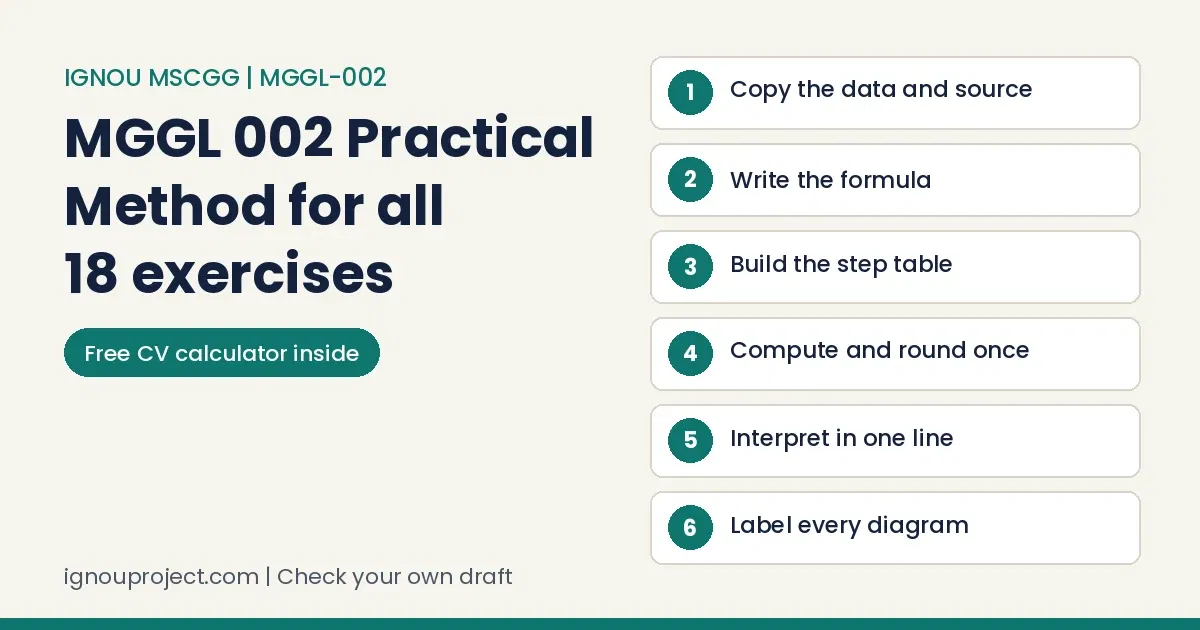
To complete the IGNOU MGGL 002 Practical, work each of the 18 exercises in the course book on its scheduled lab day: copy the data, write the formula, build the step table, compute, interpret in a line or two, and label every diagram. Then hand the finished exercises to the Academic Counsellor at your study centre.
The IGNOU MGGL 002 Practical, Methods of Geographical Analysis: Quantitative and Qualitative, is the 4-credit lab course of semester two in the M.Sc. Geography (MSCGG) programme. This guide is about doing the work: the order in which an entry is built, one exercise worked in full from the book’s own data, a calculator you can test your answers on, the mistakes that cost learners most, and a check to run before your exercises leave your hands.
The course book asks you to complete all the practical exercises in it and submit them to the Academic Counsellor in your study centre. It allows a scientific calculator and Excel while you perform the lab exercises, and it plans the 18 exercises over 14 days, two sessions a day, 26 laboratory sessions in all.
What to have ready before Day 1 of the lab block
Four things make the IGNOU MGGL 002 Practical easier from the first session:
- The course book. The 200-page July 2024 book is on eGyanKosh. Each exercise opens with theory and a worked example and ends with practical exercises, so read the theory part of the next exercise the evening before.
- Your centre’s schedule. The book fixes the order (Day 1 orientation and Exercise 1, then Exercises 2 to 9 two a day, then one exercise per day from Exercise 10 to Exercise 18). The dates come from your Learner Support Centre.
- A scientific calculator and a laptop with Excel. Exercises 6 and 7 generate random numbers in MS Excel, and Exercise 12 asks for regression both by hand and on the Excel platform.
- Graph paper, a ruler, colour pencils and a folder. Exercises 11, 12 and 13 end in a scatter diagram, a regression line and a residual map.
Across practicals, the learners who lose a whole cycle are usually the ones who looked for the batch notice after it had closed, since lab blocks run on fixed dates and are announced on Regional Centre or study centre websites. MGGL-002 needs 14 days in that block, so find your centre’s notice early in semester two.
How to do MGGL 002 practical exercises: one method for every entry
Every quantitative exercise in the IGNOU MGGL 002 Practical can be written in the same six steps. Keeping the order fixed makes each page easy for your counsellor to follow and easy for you to revise later.
- Aim. One line naming the exercise and the measure, for example “To calculate the coefficient of variation of monthly rainfall, Delhi, 2019”.
- Data. Copy the table exactly, with its number and source line. If your study centre gives a different table, write its source instead.
- Formula. Write the formula with its equation number from the book (Eq. 3.5 for standard deviation, Eq. 3.6 for coefficient of variation) and define every symbol.
- Step table. Add one column for each stage of the working, such as x, x minus the mean, and its square, with a totals row.
- Result. Substitute the totals into the formula on the page, show the units and round once, at the end.
- Interpretation and diagram. Say in plain words what the number means for the place or variable, then draw any diagram the exercise asks for with a title, axis titles, units, a key and the source.
Many practical entries we read describe the activity and stop: “computed the standard deviation”, “held the discussion”. What an evaluator looks for is the link between the result and the concept. The MGGL-002 book builds this into its own tasks; Exercise 3 asks you to explain the nature of the data in terms of relative dispersion or consistency once the coefficient of variation is found.
A drawing without labels is one of the four gaps that weaken lab work most often, along with missing tables, half-finished calculations and no word on errors. For MGGL-002, check that each scatter diagram has both variables named on its axes, and that each residual or factor score map shows its class intervals in a legend.
Worked example: coefficient of variation of rainfall in Delhi, 2019
This is Exercise 3 of the IGNOU MGGL 002 Practical, worked from Table 3.3 (Monthly Rainfall of Delhi, 2019), the table the book prints for its four closing tasks. The book follows the population formula: the sum of squared deviations is divided by the number of observations, N, which is 12 here.
Exercise 3 worked from Table 3.3
| Month | Rainfall x (mm) | x minus mean | (x minus mean) squared |
|---|---|---|---|
| Jan | 52.0 | -19.5 | 380.25 |
| Feb | 70.8 | -0.7 | 0.49 |
| Mar | 10.2 | -61.3 | 3,757.69 |
| Apr | 5.7 | -65.8 | 4,329.64 |
| May | 45.4 | -26.1 | 681.21 |
| Jun | 31.2 | -40.3 | 1,624.09 |
| Jul | 283.9 | 212.4 | 45,113.76 |
| Aug | 227.0 | 155.5 | 24,180.25 |
| Sep | 17.4 | -54.1 | 2,926.81 |
| Oct | 41.0 | -30.5 | 930.25 |
| Nov | 7.4 | -64.1 | 4,108.81 |
| Dec | 66.0 | -5.5 | 30.25 |
| Total | 858.0 | 0.0 | 88,063.50 |
- Range (Eq. 3.1): 283.9 minus 5.7 = 278.2 mm.
- Quartiles (Eq. 3.2 to 3.4): with n = 12, Q1 sits at position 3.25, Q2 at 6.5 and Q3 at 9.75 in the ascending list. Averaging the two neighbouring values, as the book’s steps direct, gives Q1 = 13.8 mm, median = 43.2 mm and Q3 = 68.4 mm. If your counsellor interpolates instead, Q1 becomes 12.0 mm and Q3 69.6 mm; the median does not change.
- Mean: 858.0 / 12 = 71.5 mm.
- Standard deviation (Eq. 3.5): square root of (88,063.50 / 12) = square root of 7,338.63 = 85.67 mm.
- Coefficient of variation (Eq. 3.6): (85.67 / 71.5) x 100 = 119.82 percent.
Interpretation line: a coefficient of variation near 120 percent shows very high relative dispersion, so Delhi’s monthly rainfall in 2019 was highly inconsistent. July and August alone brought 510.9 mm of the 858.0 mm total, and the median (43.2 mm) sits far below the mean (71.5 mm) because of those two monsoon months. Compare the book’s own example: the state-wise percentage of women with normal BMI gives a coefficient of variation of 16.76 percent, a far more consistent series.
Free coefficient of variation calculator for your own table
Use this to test your IGNOU MGGL 002 Practical answers after you have worked them by hand, not before. It uses the book’s formula (divide by N). The Delhi 2019 figures are loaded; replace them with your centre’s table if it differs.
Mean, SD and CV calculator
For the loaded figures: n = 12, mean = 71.50, SD = 85.67, CV = 119.82 percent, range = 278.20.
If your answer differs from the tool, check first whether you divided by n minus 1; the book divides by N.
Tests and regression in the IGNOU MGGL 002 Practical: conclusions that match the numbers
Exercises 9 and 10 of the IGNOU MGGL 002 Practical end every test with a decision, and Exercise 12 hands its results on to Exercise 13. Write each test in this order: null hypothesis, level of significance, degrees of freedom, calculated value, the critical value printed with the problem, and a decision that names the variables.
In test-based practicals, a common slip is a conclusion the figures do not support. Take the Exercise 9 problem on five fertilizers applied to four plots of potatoes. Before: "F is calculated, so the fertilizers differ." After: "The calculated F for fertilizers is 2.032, below the printed 3.26 for 4 and 12 degrees of freedom, so the difference between fertilizers is not significant; the F for plots, 1.676, is also below its printed 3.49."
For regression, write the equation of Y on X with its slope and intercept, then predict Y for every district. Keep that table: Exercise 13 returns to the same three district data sets (population density against cropping intensity in Assam, literacy against the urban share in West Bengal, and in-migrants against the urban share in Assam) and finds residuals as Y minus Yc. Keep the sign of each residual, positive where the district is above the line, and group the residuals into classes before shading the map.
MGGL 002 focus group discussion and the PAR answers
Exercise 17 of the IGNOU MGGL 002 Practical takes you to the field. The book asks for roughly 6 to 12 participants and a moderator, an informal but neutral venue that is not the place under discussion, a briefing on the issue, consent and confidentiality, and notes by pen and paper or a voice recorder. Its own practice theme is health problems in your area.
A clear write-up follows this order:
- Issue and aim of the discussion.
- Date, venue and how the venue was chosen.
- Participants coded P1, P2 and so on, with gender and age group but no names.
- Each question, followed by the responses recorded under it.
- Interpretation in relative terms, as the book asks: where the majority of views fell, what participants suggested or felt.
- The summary of major points you read back to the group before thanking them, and any limits of the discussion.
At our desk we have seen analysis built on responses that were never gathered. Your MGGL-002 write-up can only interpret what your own group said, recorded by you with their consent, so keep your raw notes or recording with the file.
Exercise 18 on participatory action research is written work. Answer each question in your own words, name the published participatory study you read, and connect the last questions to your own research interest rather than to geography in general.
Seven mistakes in MGGL-002 working, and the fix for each
The written working is where most practical marks slip away, yet it is also the easiest part to repair. In MGGL-002 almost every repair below is a missing step, not a wrong idea.
| Mistake | Fix |
|---|---|
| Dividing by n minus 1 in Exercise 3 | Follow Eq. 3.5 and the book's BMI example, which divide by N |
| Only the final answer shown | Add the step table and the substituted formula |
| Rounding at every line | Carry two decimals and round once at the result |
| No interpretation after a figure | Add one or two lines on what it means for the place or data |
| Residuals without signs | Write Y minus Yc with its sign before classing |
| Excel output pasted with no hand working | Exercise 12 asks for both; show the hand method first |
| FGD answers written as one paragraph | Group responses question by question |
Work written up in one sitting at the end of a course gives itself away: the same sentences repeat and nothing improves from the first page to the last. MGGL-002 gives every exercise its own day in the 14-day plan, so write each one up on that day.
Ten checks before the exercises go to your counsellor
Run this list on your IGNOU MGGL 002 Practical folder the evening before you hand it over. Tick each line only when it is true for all 18 exercises.
Ten checks before hand-over
Getting ready for the IGNOU MGGL 002 Practical term-end paper
The June 2025 Set-I term-end practical paper for the IGNOU MGGL 002 Practical gives three hours for 50 marks: seven questions of 10 marks each, any five to be attempted. Its questions were a mean from grouped rainfall data, a standard deviation from grouped marks, Spearman's rank correlation, two regression equations by least squares, the normal probability curve, a t-test on ten students' scores in two tests, and participatory action research for rural and farming communities.
Two practice points follow. First, the paper used grouped tables while the Exercise 3 example works on ungrouped figures, so practise the grouped mean of Exercise 2 and ask your counsellor for a grouped standard deviation drill. Second, the qualitative question asked for a written plan, so rehearse a ten-mark answer on PAR or an FGD under time. The course book does not say whether Excel is allowed in the examination; confirm the permitted tools with your counsellor. The practical examination fee for a course of up to 4 credits is Rs 300 under the July 2026 Common Prospectus, paid with the Term-End Examination form.
Send your own working for a check
If you have finished your IGNOU MGGL 002 Practical exercises and want a second pair of eyes before hand-over, send photos or a scan of your own working on WhatsApp at +91 93546 37830. We point out calculation slips, missing steps, unlabelled diagrams and interpretation lines that do not match the result, and you make the corrections yourself. The process and charges are on our draft correction service page. We do not supply worked files, and the counsellor and IGNOU's examiners decide your marks.
Questions MSCGG learners ask about the method
Does the IGNOU MGGL 002 Practical book use N or n minus 1 for standard deviation?
N. Eq. 3.5 divides the sum of squared deviations by the total number of observations; the BMI example divides 2,683.21 by 29 to reach 9.62.
My study centre gave a different rainfall table. Is my answer wrong?
No. The book says the Exercise 3 table may be changed by your study centre depending on availability. Cite the table you were given; the method stays the same.
Can I copy a senior's MGGL-002 file and change the name?
No, and it would not work for this course. Exercise 17 needs a discussion you held yourself, and Exercise 18 asks about your own research.
Copied practical files are easy to recognise: when several learners at one centre hand in identical pages, the counsellor sees it at once. Your own MGGL-002 working, with your own FGD record, is the only version that holds up.
Where does the MGGL-001 method fit in?
The first-semester cartography course has its own lab plan; our MGGL-001 guide covers it.
Finishing the course well
The IGNOU MGGL 002 Practical rewards steady work more than last-week effort: one exercise per scheduled day, worked in full, interpreted in your own words and checked against the book's printed values.
The learners who come through practicals smoothly share a few habits: they begin in good time, check the rules at their own centre, date their work as they go, get signatures on the spot and can explain every page. For MGGL-002, that means attending the 14 scheduled days and keeping your FGD notes safe until results are out.
For the four theory papers of the same semester, see the semester-two reference material on our publication site.
Official documents behind this guide
- IGNOU course book for MGGL-002 (Methods of Geographical Analysis: Quantitative and Qualitative), July 2024, held on eGyanKosh
- M.Sc. Geography (MSCGG) programme page, IGNOU
- MGGL-002 (Set-I), Term-End Practical Examination, June 2025
- IGNOU Common Prospectus July 2026, examination fee rules for practical courses
Method: this guide draws on the full 200-page MGGL-002 course book of July 2024, the MSCGG programme page, the June 2025 Set-I practical paper and the fee rules of the July 2026 Common Prospectus, all read in November 2026. Drafting was AI-assisted; each rule here was checked against those sources, and the guide is published under BK Sahni's editorial responsibility.
ignouproject.com is not affiliated with, authorised by or endorsed by IGNOU. We check the working you have done yourself and explain corrections; you remain the author of every MGGL-002 exercise you hand in.

BK Sahni iD 0009-0005-8092-459X
Founder, Shri Chakradhar Publication Pvt. Ltd. & ignouproject.com — helping IGNOU distance-learning students since 2010 (5,00,000+ students supported across MBA, MCom, MA & more). Author of IGNOU exam guides, solved assignments & project reference books.
Disclosure: Shri Chakradhar Publication Pvt. Ltd. and ignouproject.com are independent third-party study-help services — not the official IGNOU website. Always verify final dates and rules on ignou.ac.in.