IGNOU MMEL 302 Practical: what you do, and in what order
IGNOU MMEL 302 Practical, the Reproductive Health Practical of PGDMCH, is learnt on patients and proved in your log book, so this guide takes each record, the partogram and the exam cases in the order you meet them on the ward.
Five-line plan for PGDMCH doctors
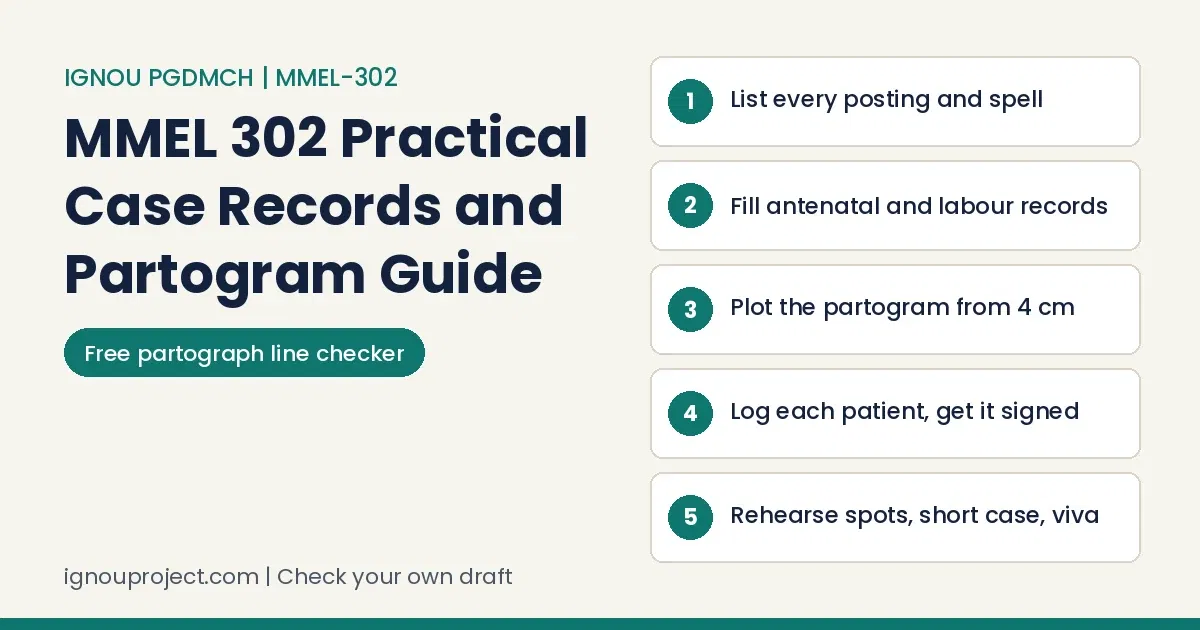
For IGNOU MMEL 302 Practical, list every posting, write the full case records the log book names, plot each labour on a partogram, log every other patient in one dated, countersigned line, then rehearse the long case, short case, five spots and viva on patients you saw yourself.
The 6-credit course gives 30 internal marks (LSC and SDC counsellors) and 70 at the term-end practical. Block 1 teaches each skill, Block 2 lets you tick each step on four cases, and Block 3, the log book, is what examiners read. The PGDMCH programme overview shows the six courses together.
Across practical courses, learners who pass theory easily often stall on the hands-on part. MMEL-302 has its own floors: 15 of 30 internal, 35 of 70 term-end.
Many learners notice the practical side of their programme only months into the session. The prospectus lists MMEL-302 as Course 5, right under the MME-302 theory paper it partners.
Set up the posting table before the first case
Open section 2 of the log book on day one of your IGNOU MMEL 302 Practical posting. The 2024 guide splits 180 hours into 60 at the PSC, 90 at the SDC and 30 at your work place, with two O&G days per PSC spell. Write the counsellor’s name and From and To dates for each spell, and add a new SDC row for every visit; these rows let the SDC counsellor sign the Appendix V completion certificate. Fill only the spells you attend. Our IGNOU practical attendance and fee guide covers general rules, and the MMEL 104 geriatrics log book guide shows the same sign-as-you-go habit.
Practical days fall on fixed dates, often far from home, and a missed slot can mean waiting a cycle. Enter each spell’s O&G dates the day you arrive; your Learner Support Centre issues the schedule.
Working doctors sometimes treat practical sessions as optional and lose a session. Both LSC spells plus the SDC work are the guide’s first condition for this exam.
A friend’s routine at another centre rarely matches yours. The log book wants a separate SDC row per visit, so your own dates decide what gets certified.
Antenatal case record format, box by box
The antenatal case record format appears three times: PSC, SDC, and an SDC evaluation copy filled when that skill’s SDC work ends. Other antenatal patients go on the log page. Follow the printed order:
- Identity: hospital number, first visit, gravida, para, living children, LMP, EDD, height, tetanus toxoid doses.
- Complaints, then this pregnancy by trimester: date, BP, weight, urine, findings.
- Obstetric history per pregnancy, then past, family and personal history.
- General and systemic examination, including oedema, anaemia, thyroid and breasts.
- Abdominal, speculum and vaginal findings, ending with the pelvic assessment and type of pelvis.
- Plan (vaginal, trial, abdominal or review), investigations, likely contraceptive, both signatures.
Hindi-medium learners sometimes find English case notes slow. PGDMCH runs in English, so practise these phrases before your first spell.
An unsigned counsellor box is a gap we keep seeing. In MMEL-302 every PSC or SDC case and demonstration needs the supervising counsellor’s countersignature.
How to plot a partograph on the log book chart
Unit 4 of Block 1 shows how to plot a partograph on the modified WHO form:
- Plot only from the active phase, 4 cm. Keep latent-phase findings in notes; refer a latent phase beyond 8 hours.
- Mark dilatation with X at each vaginal examination, about 4-hourly. A woman admitted in the active phase gets her first X on the alert line.
- Mark descent with O, in fifths palpated above the brim just before each vaginal examination; 2/5 or less is engaged.
- The alert line rises 1 cm per hour from 4 cm; the action line lies 4 hours to its right.
- Half-hourly: fetal heart, pulse and contractions per 10 minutes (dots under 20 s, diagonals 20 to 40 s, solid over 40 s). BP 4-hourly, temperature 2-hourly, urine for protein and acetone.
- Liquor I, C, B, M or A; moulding 0, +, ++ or +++.
Learners often find one format in the manual and another on the chart. The log book grid still shows a latent-phase band, while Unit 4 starts the modified form at 4 cm; follow Unit 4.
On chart-based practicals we see wrong symbols and unsupported conclusions: a 45-second contraction shaded as diagonals, or an X right of the alert line called normal.
A worked IGNOU MMEL 302 Practical partogram, with a line checker
This IGNOU MMEL 302 Practical example uses invented figures to show plotting logic only.
Practice chart: a second gravida admitted at 5 cm
A second gravida at 39 weeks arrives at 08:00: cervix 5 cm, head 3/5, membranes intact, fetal heart 136. As she is in the active phase, her first X goes on the alert line, which runs from 4 cm at 07:00 to 10 cm at 13:00; the action line runs 11:00 to 17:00.
| Time | Cervix (X) | Descent (O) | Contractions | Liquor | Alert / action line | Reading |
|---|---|---|---|---|---|---|
| 08:00 | 5 cm | 3/5 | 3 in 10, 25 s | I | 5 cm / not started | On alert line |
| 12:00 | 7 cm | 2/5 | 3 in 10, 35 s | C | 9 cm / 5 cm | Between the lines |
| 14:00 | 9 cm | 1/5 | 4 in 10, 45 s | C | 10 cm / 7 cm | Between the lines |
Working: alert value = 5 + hours since 08:00 (cap 10); action value is 4 cm lower. At 12:00 that is 9 and 5, so 7 cm lags two hours: Unit 4 asks for full assessment, rehydration, an empty bladder and an upright position, review in 2 to 4 hours, and referral for any added complication.
Some learners build records on assumed readings. This chart is invented; yours need real hospital numbers and the times you actually examined.
Alert and action line checker
Without JavaScript: alert = admission dilatation + hours (cap 10); action = 4 cm lower. Left of alert is normal, between lines needs assessment, at action means referral.
Labour case record after the partogram
Write the labour case record once at the PSC and twice at the SDC, plus one SDC evaluation copy. After the pelvic assessment come stage durations, delivery type, episiotomy or tear, Apgar at 1 and 5 minutes, baby, placenta, blood loss, postnatal follow-up and contraception. For the third stage, record Unit 4's active management: exclude a second baby, clamp the cord after at least one minute, give oxytocin 10 units IM in the thigh, and apply controlled cord traction with counter-pressure above the pubis during a contraction.
Practical write-ups follow a set sequence and a skipped part costs marks. This record runs from admission through the three stages to baby, placenta, blood loss and postnatal care.
Episiotomy, operation and emergency records
Write one operation record for episiotomy or tear and one for forceps or vacuum, wherever you did them. Block 2's episiotomy check list: confirm crowning, infiltrate 15 to 20 cc of 1% Xylocaine, and cut mediolaterally from the midpoint of the fourchette for about 1 to 1.5 inches. Repair from above the vaginal apex with continuous locking chromic catgut 0, then 2 or 3 interrupted stitches each to deep and superficial muscles, subcuticular skin, and check haemostasis. Unit 6 calls forceps and vacuum optional for you.
The emergency record covers one managed case and one PPH procedure; also log three or four listed emergencies such as eclampsia or APH. For PPH, the log book's tips start with oxytocics, an IV line, cross-matching and an empty bladder.
Hosts often give distance learners little hands-on work. At the SDC hospital, ask early to do procedures yourself; Appendix V certifies those skills.
Many learners paste internet text into write-ups unchecked. Draft the seminar case you present at the PSC from your own patient's notes.
GATHER counselling and Cu-T insertion steps for the short case
The 15-mark short case asks for a brief history, contraceptive advice and your reasons. The log book wants counselling records for condom, pills, IUCD and a permanent method as patients allow, and IUCD insertion records at the PSC and SDC.
GATHER counselling, one letter at a time
Block 2 turns GATHER counselling into a check list: Greet; Ask (open questions, her language, privacy); Tell (advantages, disadvantages, side effects, warning signs); Help her decide; Explain the method; ask her to Repeat key points; fix the Return visit. Your record then fills method accepted, advantages, disadvantages, how it works, side effects, complications, instructions and follow-up.
Cu-T insertion steps from the Block 2 check list
- Wash hands, explain, and load the Cu-T inside its sterile package by the no-touch method.
- Gloves on; Sim's speculum and retractor; swab cervix and vagina; hold the cervix with a vulsellum.
- Sound the uterus, set the blue depth gauge, and pass the loaded inserter until the gauge meets the cervix.
- Release the arms by withdrawal, push the tube up gently, and cut strings to 3 to 4 cm.
- Press any bleeding puncture site 30 to 60 seconds, soak instruments 10 minutes in 0.5% chlorine, fill the IUD card.
Doctors in service ask whether their own hospital counts. The work place column sets 10 counselling cases and 2 IUCD insertions, entered as log lines; no proforma is filled there.
One-line log entries that still show learning
Each log row asks for date, hospital number, age, diagnosis, place and two signatures. Use the diagnosis cell to show thinking: "G2, 38 weeks, PIH, BP 150/100, no proteinuria, plan induction" beats "ANC case seen". The MHHL 020 log book guide contrasts weak and strong entries in the same way.
Logs written in one late sitting show it: repeated phrases, Sunday dates, no progress. Write each dated MMEL-302 row before leaving the ward.
Evaluators look for the link between what you did and what the course teaches. Put that link in the diagnosis cell and in the discussion of each full record.
Record slips we see, with the fix
| Slip | Fix |
|---|---|
| Partogram started at 2 cm | Latent findings in notes; first X at 4 cm |
| Woman admitted at 6 cm plotted left of the alert line | Put the first active-phase X on the alert line |
| Descent judged by vaginal examination | Palpate fifths abdominally first and mark O |
| Ready-made files circulate across courses and get handed in renamed; matching records from one centre stand out, and the viva exposes them. | Your records carry real hospital numbers and the signature of whoever supervised you. |
| Some learners paste AI-written text into a record. | Write at the bedside; the long case discussion tests your own patient. |
| Wrong enrolment or centre details on a cover cause needless trouble. | Check the cover: name, enrolment number, address. |
MMEL 302 viva questions and the five spots
For the IGNOU MMEL 302 Practical term-end, Appendix VI sets a one-hour maternity long case (25 marks) on history, examination, diagnosis, investigation and management, aimed at peripheral care. The five spots (3 minutes, 3 marks each) are one each of vaginal discharge (STI or RTI), infertility, X-ray or drug, partogram, and instrument. The 10-minute viva (15 marks) covers normal delivery, family planning counselling and procedures, instruments, and the dummy doll and fetal skull. Likely MMEL 302 viva questions from those topics:
- Take me through a normal delivery you conducted, first stage to placenta check.
- Admitted at 6 cm: where is the first X, and when would she reach the action line?
- Counsel this woman for Cu-T using GATHER.
- Name this instrument and say when you used it.
- On the fetal skull, show sutures and fontanelles and grade moulding.
- For the discharge or infertility spot, which Unit 8 test comes first, and why?
Our page on how viva questions are framed adds general answering habits.
A neat file scores poorly when its owner cannot explain it. Here the viva carries 15 of 70 term-end marks.
Learners often ask whether a viva applies to them. Here it does, for every candidate.
Form, fee and the 30 November date for IGNOU MMEL 302 Practical
IGNOU MMEL 302 Practical has three requisites: both LSC spells and the SDC work done, the online practical term-end form filled in time, and a pass in the internal assessment. The July 2026 prospectus charges Rs 500 for practicals above 4 credits, paid with the term-end form and not refundable. SED's December 2026 TEE notice sets 30 November 2026 for practical course fees, through Samarth only, with no fee taken afterwards. The practical is usually held in December and January at your programme study centre; for the MME-302 theory paper, search the December 2026 date sheet by course code.
In our records, 70 to 80 percent of learners start acting only in the final month before a due date. This cycle, that month ends on 30 November.
Many learners wait for an extended date. SED's notice rules out late fees, and we make no forecast about extensions.
Learners often mix up the Rs 300 and Rs 500 practical amounts. At 6 credits, MMEL-302 sits in the Rs 500 slab.
Night-before check for your IGNOU MMEL 302 Practical log book
Carry the log book to the IGNOU MMEL 302 Practical exam; it is returned afterwards.
Night-before log book check
Have your own case write-ups read before the exam
For a second reader on your IGNOU MMEL 302 Practical write-ups, send photos of your own records and partograms on WhatsApp +91 93546 37830. We mark gaps against the printed proforma and Unit 4 rules and explain each fix; the record check is quoted on WhatsApp, and the full list is on our services and charges page. You write every entry; examiners award the marks.
Writing the record is where practical marks slip most, and also the easiest part to repair. Half the MMEL-302 internal marks come from SDC counsellors, who check log books.
Quick answers on workplace patients, marks and proof
PGDMCH questions we hear
Do patients at my own hospital count for IGNOU MMEL 302 Practical?
Yes, as one-line work place entries; full proformas are for the PSC and SDC.
When will my practical marks show?
Internal marks pass to the LSC Coordinator first; queries go to practicalsed@ignou.ac.in.
Practical marks often reach the grade card after theory, which can delay a job. Track MMEL-302 marks once the practical ends.
What proof should I keep?
The Samarth fee receipt, the submitted form, and photos of signed log pages.
Without a receipt, a learner has nothing to show if marks go missing. File the MMEL-302 fee receipt with your page photos.
Bringing your IGNOU MMEL 302 Practical record together
Your IGNOU MMEL 302 Practical result rests on records built patient by patient and cases you can explain without notes. The MME-302 theory paper is not a condition for the practical; passing its internal assessment is. For printed reading, see the reference material for this course on our publication site, and trace marks on the IGNOU awards transmission status page.
Three causes recur: late, centre-specific information; demands on time and presence; and records treated as formatting. Countersigned, hospital-numbered entries exist to show applied learning.
Official documents behind this guide
- PGDMCH Programme Guide 2024, School of Health Sciences (Appendices II, V, VI)
- IGNOU Common Prospectus July 2026 (section 8.57, examination fees)
- SED practical fee notice, December 2026 TEE
- MMEL-302 printed Blocks 1, 2 and 3 (2019)
Written from the MMEL-302 Practical Manual, Check List Manual and Log-Book, SOHS's 2024 programme guide for PGDMCH, IGNOU's July 2026 prospectus and the SED fee notice, read in November 2026. Drafting was AI-assisted; each rule was checked against those sources, and the guide is published under BK Sahni's editorial responsibility.
ignouproject.com is an independent service and is not affiliated with, authorised by or endorsed by IGNOU. We check and explain the learner's own records; the learner remains the author of every case record, partogram and log entry.

BK Sahni iD 0009-0005-8092-459X
Founder, Shri Chakradhar Publication Pvt. Ltd. & ignouproject.com — helping IGNOU distance-learning students since 2010 (5,00,000+ students supported across MBA, MCom, MA & more). Author of IGNOU exam guides, solved assignments & project reference books.
Disclosure: Shri Chakradhar Publication Pvt. Ltd. and ignouproject.com are independent third-party study-help services — not the official IGNOU website. Always verify final dates and rules on ignou.ac.in.