IGNOU MMEL 106 Practical for PGDGM: what the orthopaedics work asks of you
For PGDGM doctors, the IGNOU MMEL 106 Practical means four credits of orthopaedic bedside work on older patients: taking the history, examining each joint in a fixed order, presenting the case, naming splints and implants, and logging every case for a counsellor’s countersignature.
MMEL-106 in one look
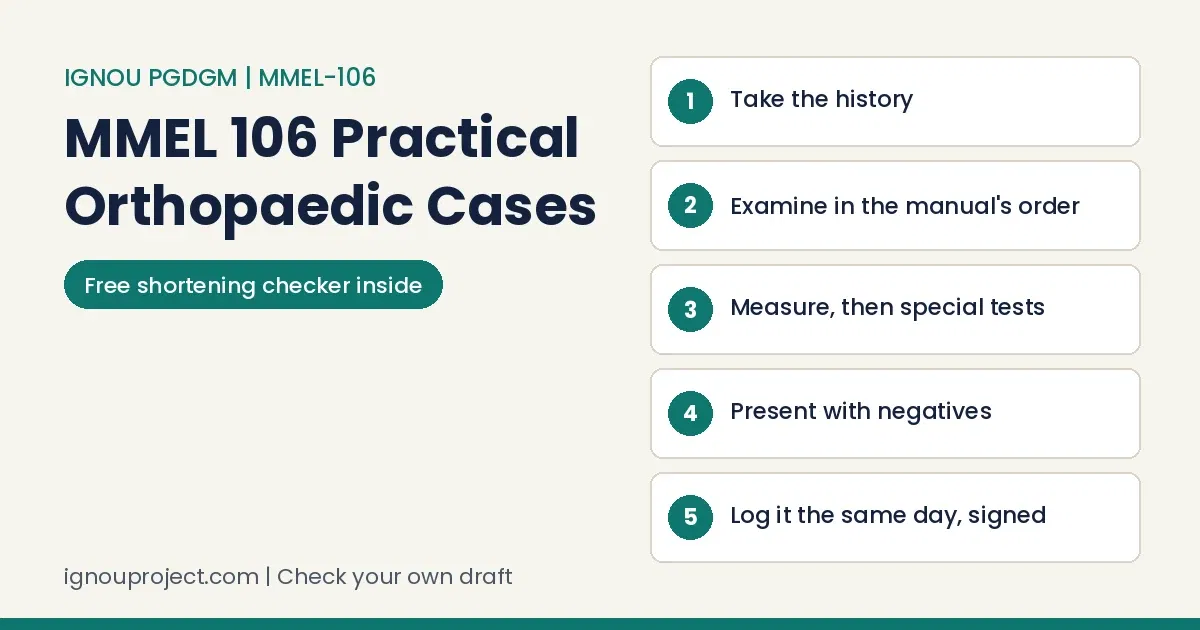
The IGNOU MMEL 106 Practical carries 100 marks, 50 internal and 50 term-end. You attend two compulsory spells at your PSC/LSC, practise one-to-one at a Skill Development Centre (SDC), log each case on the day, and face long and short cases, spots and a viva on the orthopaedics day.
This guide follows the route in order:
- Read the three blocks.
- Attend both spells, tentatively May-June and September-October.
- Practise at the SDC, at most five learners per counsellor.
- Write each case on the day, in the manual’s order.
- Collect both Appendix I signatures, deposit Appendix II and pay the fee.
- Present your own cases on the day.
Courses and credits are listed on our PGDGM programme overview.
Doctors who clear theory papers easily can still stall at bedside work, because a practical is judged by what you can show and explain. MMEL-106 keeps its own 50 internal marks, separate from the MME papers.
Some learners notice the practical load only mid-session. Of the 36 PGDGM credits, 22 are practical, and orthopaedics takes 4.
Before the first orthopaedics spell
Preparation for the IGNOU MMEL 106 Practical starts before the ward. Block 1 covers hip, knee, foot and ankle; Block 2 spine, shoulder, elbow, hand and wrist; Block 3 nerve injuries, splints, tractions, implants and exercises. Block 2 Unit 1 links a spine examination video to watch first, plus one on spine history. Carry the log book from day one. Our IGNOU practical overview explains spells and fees across programmes, and the MMEL 104 Basic Geriatrics guide covers the first PGDGM practical.
Most doctors we hear from work full time and assume practical sessions are as flexible as theory counselling. Both MMEL-106 spells are compulsory, and attending them is the first requisite for the term-end practical.
A missed notice can cost a whole cycle. The guide prints only tentative months, so get exact spell dates from your Programme In-charge or Coordinator.
When the block, your counsellor and a senior’s notes disagree, take the method from the block and ask your PSC/LSC counsellor about the difference; the counsellor signs.
Hip examination steps for the IGNOU MMEL 106 Practical
Block 1 Unit 1 sets the pattern the IGNOU MMEL 106 Practical uses for every joint. These hip examination steps follow it:
- History. Pain site (groin and front of thigh, unlike gluteal pain from the spine), severity, aggravating factors, night cries (tuberculosis) or rest pain (avascular necrosis), morning stiffness over half an hour. Limp: painful or not, walking aid, shortening, trunk lurch.
- Leading and negative questions. Trauma, steroids, alcohol, earlier fracture, fever, weight loss.
- General and systemic examination. Include chest expansion and eyesight; poor vision goes with falls.
- Gait first, then standing, sitting and lying, as far as the patient manages.
- Look, feel, deformity, movement. Separate an attitude from a fixed deformity.
- Measure apparent, true and supratrochanteric shortening.
- Special tests: Thomas’s, Trendelenburg, Bryant’s triangle, Nelaton’s line, telescopy where safe.
- Neighbouring joints and distal neurovascular status, then diagnosis and differentials.
A skipped step in a fixed clinical order costs more than a weak sentence. The MMEL-106 order is the manual’s, and its summary asks you to record any examination the patient could not do.
In test-based practicals, a test done but misread is common. The hip unit’s self-check asks what Thomas’s test reveals (flexion deformity) and what Bryant’s triangle measures (supratrochanteric shortening).
Geriatric hip fracture examination: a worked bedside case
Block 1 calls fragility fractures the commonest hip problem in older patients. Here is a geriatric hip fracture examination of the kind the IGNOU MMEL 106 Practical expects, read against Table 1.1 of the hip unit.
Illustrative case: a bathroom fall at 74
A 74-year-old woman slipped in the bathroom three days ago and could not get up. She has bilateral cataract.
| Feature (Table 1.1) | Finding | Points to |
|---|---|---|
| Ecchymosis | Bluish-brown patch over the right greater trochanter | Trochanteric |
| External rotation | Outer border of the foot fully on the mattress | Trochanteric |
| Shortening | True length left 79.0 cm, right 76.0 cm: 3.0 cm | Trochanteric (over 2.5 cm) |
| Tenderness | Greater trochanter, between finger and thumb | Trochanteric |
| Active straight leg raise | Not possible | Any hip fracture |
| Telescopy | Not done: recent fracture | Not applicable |
Diagnosis: right intertrochanteric fracture; differential, intracapsular neck of femur fracture. Confirm: AP pelvis with both hips in internal rotation, and a lateral view. Plan: early fixation (proximal femoral nail or dynamic hip screw), skeletal traction only if surgery is delayed, ankle pumps and pressure care, then walker ambulation.
Every figure above is invented for practice. Log book cases must be patients you examined yourself at the PSC/LSC or SDC.
Shortening and Table 1.1 checker
Measure ASIS to medial malleolus on both sides after squaring the pelvis. Table 1.1 reads under 2 cm as intracapsular and over 2.5 cm as trochanteric; ecchymosis appears after 2 to 3 days. The X-ray decides.
Your reading appears here.
Knee, foot and spine: what changes at the bedside
The same IGNOU MMEL 106 Practical order carries over; each joint adds checks.
- Knee. Grade effusion: cross fluctuation, patellar tap for a moderate amount, bulge test for a small one. Weigh osteoarthritis against tuberculosis, synovitis, gout and rheumatoid arthritis.
- Foot. Test sensation with the 5.07 Semmes-Weinstein monofilament, eyes closed.
- Spine. Judge stability from the history before moving it. For Schober's test, join the dimples of Venus, mark 10 cm above and 5 cm below the midpoint, and ask the patient to bend; a gain under 5 cm means restricted flexion. Test motor before sensory, and note claudication distance and relief on sitting.
PGDGM is taught in English, and learners thinking in another language often write "leg pain on walking" where "neurogenic claudication after ten minutes, relieved on sitting" records the finding. Learn each term with its test.
Upper limb and nerve palsies: tests to rehearse aloud
Know what each test checks and what a positive looks like:
| Test | Checks | Positive |
|---|---|---|
| Neer, Hawkins | Impingement | Pain at full forward flexion; pain on internal rotation at 90 degrees |
| Drop arm, empty can | Rotator cuff | Arm drops after about 100 degrees; pain or weakness on resistance |
| Cozen's | Tennis elbow | Lateral epicondyle pain on resisted wrist dorsiflexion |
| Finkelstein; Phalen's, Tinel's | De Quervain's; carpal tunnel | Symptoms reproduced |
| Book test, card test | Ulnar nerve | Thumb flexes to grip; card slips out |
| Pen test, Oschner clasp | Median nerve | Cannot touch the pen; index stays pointing |
| Hitchhiker's sign | Radial nerve or PIN | Cannot extend the thumb |
| Ankle dorsiflexion | Common peroneal nerve | Foot drop, plantar flexion kept |
Orthopaedic case presentation format for long and short cases
The orthopaedics day of the IGNOU MMEL 106 Practical brings long and short cases, slides or spots, and a viva. This orthopaedic case presentation format keeps the thread:
- Opening line: age, sex, main complaint, duration.
- History in the manual's order, with relevant negatives.
- General and systemic findings that matter here.
- Local findings, from inspection to neurovascular status.
- What could not be examined, and why.
- Diagnosis, differentials and what separates them.
- Confirming investigations and a brief plan, with the referral point.
For a short case, compress steps 1 to 3 into two sentences.
Polished paperwork does not rescue a weak explanation. In MMEL-106 the viva sits beside the cases, and examiners can ask why you chose each test.
"Is there a viva?" reaches our desk often. For MMEL-106, yes: the guide sets one alongside the cases and spots.
Spotters and exercises from Block 3
Orthopaedic spotters: say four things
For any of these orthopaedic spotters, give the name, one identifying feature, its best use and one caution for older patients:
- Cramer wire splint, Thomas splint with Pearson attachment, Bohler Braun splint.
- Non-adhesive foam skin traction (older skin shears under adhesive), Buck's traction up to 4.5 kg, fixed traction on a Thomas splint, head halter traction (3 to 5 pounds), skull tongs.
- Austin Moore prosthesis (collar, fenestrated stem), Thompson prosthesis (collarless, cemented), bipolar prosthesis, proximal femoral nail, dynamic hip screw, locking plate, external fixator, Denham pin.
Exercises you may be asked to teach
Block 3 Unit 3 covers straight leg raising (leg up 30 degrees, hold 20 seconds) and the mini squat for knee osteoarthritis, pendular and finger ladder exercises for periarthritis of the shoulder, and the McKenzie exercise once acute back pain settles. Families who rely on a home carer may find the geriatric care assistance certificate useful.
Orthopaedics log book entry the SDC counsellor will sign
The IGNOU MMEL 106 Practical log book records every case. Write it at the PSC/LSC or SDC on the day, have the counsellor concerned countersign it, and check the patient count the log book sets for each skill. The SDC counsellor's fifth of the internal marks rests on your performance and this record.
| Weak orthopaedics log book entry | Entry worth countersigning |
|---|---|
| "Old man, back pain. Spine examined. Physiotherapy advised." | "68 M, low back pain 2 years, tingling in both legs after about 10 minutes of walking, relieved on sitting; no bladder or bowel change. Spine stable; Schober recorded; SLR negative both sides; power and sensation charted. Impression: lumbar canal stenosis; differential, vascular claudication. Plan discussed with counsellor." |
Another health-science record built the same way is in our MHHL 020 log book guide.
"Examined the spine" gives a counsellor nothing to judge. Link each finding to the manual: Schober's test to lumbar flexion, claudication distance to stenosis severity.
Logs written in one evening betray themselves: repeated lines, Sunday dates, no progress. The MMEL-106 rule of writing each case then and there prevents it.
Writing is where most practical marks leak away, yet it is the easiest part to repair. In MMEL-106 an unsigned entry does not count for internal assessment.
Mistakes in IGNOU MMEL 106 Practical cases, with fixes
Most of these slips come from warnings in the IGNOU MMEL 106 Practical manual; the last three we see across practical records.
| Slip | Fix |
|---|---|
| Telescopy tried on a fresh hip fracture | Keep it for neglected fractures or non-union |
| Only positive findings presented | Add negatives, including what the patient could not do |
| Spine moved before stability is judged | Decide stability from the history first |
| Adhesive traction named for an older patient | Non-adhesive foam; older skin is friable |
| AI-written case summary pasted into the log book | Write your own findings; the counsellor signs those, not generic text |
| A senior's log copied under a new name | Copies from one centre look alike and the viva exposes them |
| Test descriptions lifted from websites unchecked | Check each against the block; web versions of Schober's test use other marks |
MMEL 106 viva questions to rehearse
The IGNOU MMEL 106 Practical viva grows out of your cases and spots. Rehearse these MMEL 106 viva questions aloud:
- Why is telescopy avoided in a recent hip fracture?
- What does Thomas's test reveal that posture can hide?
- How do true and apparent shortening differ?
- Why non-adhesive skin traction in older patients?
- A patient grips a book by flexing the thumb: which nerve?
- Why does sitting relieve neurogenic claudication?
For answering examiners generally, see our guide to IGNOU viva questions.
Some learners send records by email instead of the course route. The MMEL-106 log book travels with you to the LSC examination, and the guide says it comes back to you.
A friend's centre may run things differently. The examination spans three days, one per discipline, and your own coordinator announces the orthopaedics day.
The last fortnight: form, fee and two signatures
Paperwork for the IGNOU MMEL 106 Practical is short but easy to get wrong:
- Hand the Appendix II practical form to your Programme In-charge or Coordinator.
- Pay the practical course fee from your own Samarth Portal login by 30 November 2026, the last date in SED's notice for the December 2026 examination.
- Get both MMEL-106 fields of the Appendix I certificate signed: PSC/LSC counsellor and SDC counsellor.
- Clear the internal assessment. The guide's table prints 25 of 50, its text 15, so ask your coordinator; the term-end part needs 50 percent.
Sitting the MME-106 theory paper is not a condition for this practical; find its slot in our December 2026 date sheet search.
In our records, 70 to 80 percent of learners get going only in the last month before a deadline; with this fee due on the 30th, that month is now.
Learners often confuse Rs 300 with Rs 500. The July 2026 prospectus charges Rs 300 for practicals up to 4 credits, MMEL-106 included; the guide's older Rs 250 line has been overtaken by the current notice.
Wrong enrolment numbers and centre names on forms are common; match Appendix II against your ID card.
Eight ticks before the orthopaedics day
Tick these before you travel
Have your own case write-ups read
If you have written your IGNOU MMEL 106 Practical cases and want a second reader for order, terms and missing negatives, send your own write-up on WhatsApp. A record check is quoted there; see our services and charges. We check and explain; the log book stays yours, and counsellors and examiners decide the marks.
Short answers for PGDGM doctors
Questions doctors bring us about orthopaedics
Can patients from my own hospital go into the log book?
The guide asks for cases recorded at the PSC/LSC or SDC and countersigned there. Ask your Programme In-charge before counting your own OPD.
Working doctors often ask whether their workplace counts. The guide describes the SDC as a district hospital, First Referral Unit or private set-up identified by IGNOU.
What if I cannot attend a spell?
Tell your Programme Coordinator and In-charge in advance. You may be offered the spell elsewhere on a zonal basis; otherwise you wait for the next batch.
When will my IGNOU MMEL 106 Practical marks show?
After your centre transmits them, on the marks transmission status page. The guide lists practicalsed@ignou.ac.in for practical marks queries.
Practical marks often reach the grade card after theory marks; allow for that if a job awaits your PGDGM result.
Keep a copy of Appendix II and your Samarth payment record, or you have nothing to show if marks go missing.
Putting the IGNOU MMEL 106 Practical together
Learn the hip order, carry it to every joint, write each case on the day with its negatives, rehearse spotters and viva answers aloud, and finish form, fee and signatures before 30 November 2026. Reference material for this course is on our publication site's page for this course.
Doctors who finish smoothly start early, check rules with their own centre, write up each patient the same day, collect signatures while counsellors are at hand, and can explain every entry.
Three causes recur: rules arrive late and vary by centre, practicals assume time a working doctor lacks, and the log is seen as formality instead of evidence of clinical skill.
Some learners wait for an extension. We do not predict one; SED's notice says no fee is accepted after the deadline.
Papers this orthopaedics guide was built from
- MMEL-106 Blocks 1, 2 and 3 (Orthopaedics Practical), IGNOU School of Health Sciences, July 2023
- PGDGM Programme Guide, January 2024
- IGNOU Common Prospectus, July 2026
- IGNOU announcements: SED fee notice, December 2026 examination
Read in November 2026: the three MMEL-106 blocks, the 2026 July Common Prospectus, the PGDGM Programme Guide of January 2024 and SED's fee notice. Drafting was AI-assisted, each rule was checked against those sources, and the guide is published under BK Sahni's editorial responsibility.
ignouproject.com is not affiliated with, authorised by or endorsed by IGNOU. We check and explain the learner's own work; the learner remains the author of every case record and log book entry.

BK Sahni iD 0009-0005-8092-459X
Founder, Shri Chakradhar Publication Pvt. Ltd. & ignouproject.com — helping IGNOU distance-learning students since 2010 (5,00,000+ students supported across MBA, MCom, MA & more). Author of IGNOU exam guides, solved assignments & project reference books.
Disclosure: Shri Chakradhar Publication Pvt. Ltd. and ignouproject.com are independent third-party study-help services — not the official IGNOU website. Always verify final dates and rules on ignou.ac.in.