IGNOU MMEL 105 Practical: the route from your first spell to the term-end cases
The IGNOU MMEL 105 Practical is the 12-credit Clinical Geriatrics practical of the PGDGM, and this guide shows MBBS doctors how to do its work: a geriatric long case, a medicine review, ECG and X-ray spots, logged procedures and the viva.
MMEL-105 in brief for PGDGM doctors
The IGNOU MMEL 105 Practical is cleared in two halves of 50 marks: counsellor-assessed work at your PSC/LSC and Skill Development Centre, then a term-end examination at your LSC with cases, spots and a viva. Write each case in the log book on the day, get it countersigned, and practise the same skills at work.
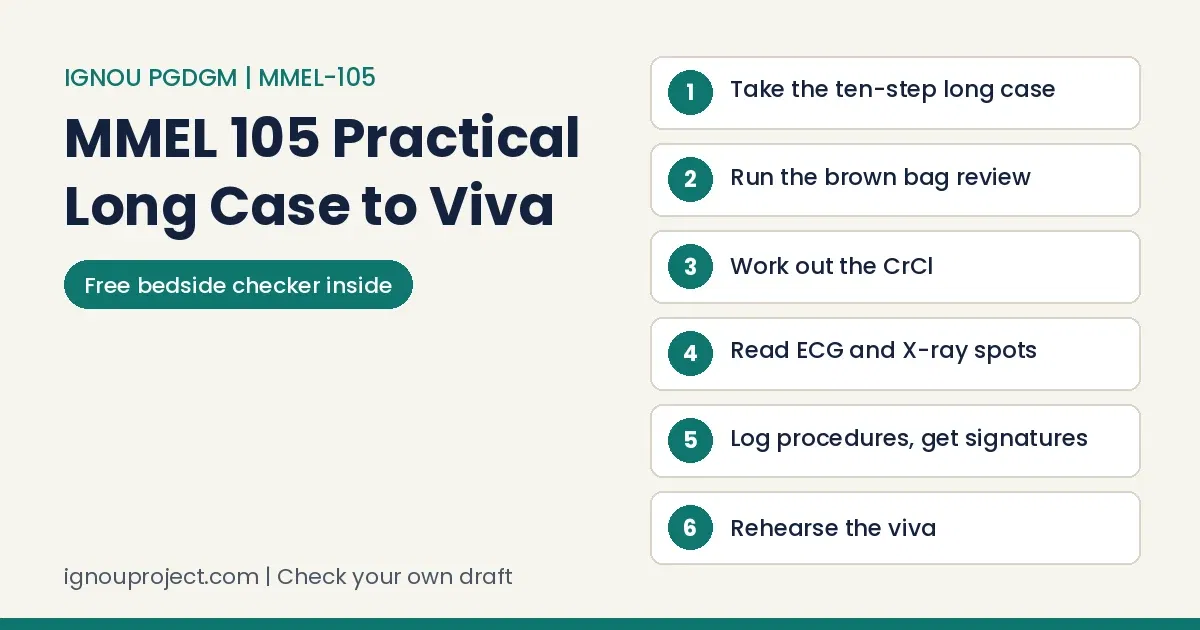
Six stages make the route: two compulsory contact spells, a Skill Development Centre (SDC) posting spread over the year, cases from your own workplace, a log book that collects all three, the Appendix II form and fee, and the term-end practical. The PGDGM course overview lists the other five courses.
Three things trip learners on most practicals: late rules that differ by centre, work that needs time in person, and a record treated as paperwork. MMEL-105 needs you at three places: PSC/LSC, SDC and the LSC on examination day.
A rule heard from a colleague at another centre may not hold at yours. The PGDGM guide lets SDC schedules vary by learner, so set your hours with your own SDC counsellor.
In our records, 70 to 80 percent of learners start only in the month before a due date. SED’s December 2026 practical fee date is 30 November, so begin the form and fee work early in November.
Set up the year: spells, SDC hours and workplace cases
- Note the two PSC/LSC spells: tentatively May-June and September-October, both compulsory. If you cannot attend, tell the PIC and Programme Coordinator in advance; an alternate venue may be offered, otherwise you join the next batch.
- Meet your SDC counsellor early and agree a schedule spread across the year.
- Pick workplace days: the guide asks you to practise the PSC/LSC and SDC skills at work and record them in the log book.
- If MMEL-104 is still pending, read our MMEL 104 basic geriatrics practical guide; this manual builds on it.
Some learners see late how much practical work the diploma holds. In PGDGM the first spell runs with the induction meeting, so the practical year starts on day one.
Some centres expect a set number of supervisor meetings. The PGDGM guide prints no count of SDC days, so put the agreed visits in your calendar.
Most PGDGM learners are working doctors. Attending both spells is a condition for the term-end practical; our IGNOU practical attendance and fee guide compares other programmes.
Geriatric long case format in ten steps
Block 1 Unit 1 of the IGNOU MMEL 105 Practical sets the order for any older patient; the system units in Blocks 1 to 3 add history, examination, investigations and, in several units, algorithms and case studies. Use this geriatric long case format for each full case.
- Identification: name, age, address, caregiver and contact, marital status, occupation, living arrangement, financial dependence.
- Group: young-old (60-70), old (70-85) or oldest-old (above 85); independent, partly or fully dependent.
- Complaints in the patient’s words, then the cardinal symptoms of each system (Table 1.2).
- Records: hospital files, discharge summaries, recent tests, prescriptions.
- General examination: gait, aids, mood, hearing and vision; BP lying and standing at 1 and 3 minutes.
- Systemic examination led by symptoms, then complications of known disease.
- Nutrition (MNA), ADL, gait and balance (5XSST, TUG), memory and mood, incontinence.
- Medication review by the brown bag method.
- Social and environmental assessment, including home safety, elder abuse and advance directives.
- Problem list, investigations, referrals, revised prescription and review plan (section 1.7).
A missing section costs marks in any write-up. The step most often cut short here is the last: section 1.7 wants problems by domain, a referral for each and short and long term goals.
PGDGM is taught in English. If you examine in Hindi or a regional language, quote the patient’s words in the complaint line and write findings in clinical English.
Worked IGNOU MMEL 105 Practical case: two falls and six medicines
The figures below are invented to show one IGNOU MMEL 105 Practical long case on paper. The rules come from Block 1 Unit 1 and Block 4 Unit 1; clinical decisions rest with the treating doctor and your counsellor.
Illustration: Mrs K, 78, two falls this month
Widow living with her son’s family, partly dependent for bathing. Diabetes, hypertension, atrial fibrillation. Weight 52 kg, serum creatinine 1.3 mg/dL. BP 142/80 lying, 118/72 standing at 3 minutes. TUG 16 seconds. ECG: irregular, 8 QRS complexes in 6 seconds.
Brown bag medication review in six filters
Her bag holds six medicines: amlodipine, prazosin, glimepiride, dabigatran, atorvastatin started last month for prevention, and diclofenac from a neighbourhood chemist. The brown bag medication review then runs the block’s filters in order.
| Filter | Finding in Mrs K |
|---|---|
| Brown bag review | Diclofenac was never prescribed. |
| Evidence or expert opinion | Statin benefit for primary prevention is not shown above 70; review atorvastatin. |
| Relevancy (time to action) | Weigh the long lead time of statin benefit against her outlook. |
| Adverse drug reaction | Hypoglycaemia on glimepiride: the block suggests safer choices. |
| Potential ADR (Beers, STOPP-START criteria) | Prazosin risks orthostatic fall; NSAIDs are avoided in chronic kidney disease. |
| Dose | Dabigatran is avoided below a CrCl of 30 mL/min. |
Cockcroft-Gault creatinine clearance at the bedside
(140 – 78) x 52 = 3,224; 72 x 1.3 = 93.6; 3,224 / 93.6 = 34.4; x 0.85 for a woman = 29.3 mL/min. The 24 mm Hg systolic fall meets the 20/10 rule for orthostatic hypotension, TUG is past the 12-second fall-risk line, and the rate is 8 x 10 = 80 per minute.
Problem list: recurrent falls with orthostatic hypotension; hypoglycaemia on a sulfonylurea; CrCl 29 mL/min with an anticoagulant to review; unprescribed NSAID; partial ADL dependence. Plan: renal profile, glucose log, physiotherapy referral, revised prescription explained to her and her son, review in two weeks.
Some learners write findings they assumed rather than elicited. Mrs K only shows the method; every log book case must hold what you found in a real patient.
Wrong formulas and units are the usual slips in test-based work. Block 4 Unit 1 takes creatinine in mg/dL and applies 0.85 for women; convert micromol/L first.
Check the three bedside numbers before you write them
Three figures recur in IGNOU MMEL 105 Practical cases. Cockcroft-Gault creatinine clearance is (140 – age) x weight in kg / (72 x creatinine in mg/dL), times 0.85 for women. Orthostatic hypotension is a fall of 20 mm Hg systolic or 10 diastolic. Heart rate is 1,500 divided by the small squares between two R waves; 60 to 100 is normal.
Bedside numbers checker
Results appear here. Fill any one group.
Learners often lift web material unchecked. Block 4 Unit 1 sends you to the Beers criteria and Medscape for renal doses: apply the entry to your patient’s CrCl and name the source.
Short cases from Blocks 2 and 3
Short cases in the IGNOU MMEL 105 Practical test one system well. Block 2 covers the nervous system, genito urinary system and incontinence, thyroid and diabetes, and emergencies from unconsciousness to heat stroke. Block 3 covers skin, oral health, ENT, the eye and mental health.
- Write the focused history, examination, differentials and the primary care step, including referral.
- For mental health, record the interview, the mental status examination and the scale used (Geriatric Depression Scale, Cornell or Hamilton) with its score. The MPCE 14 clinical practicum guide shows scale results recorded in another programme.
- For emergencies, write how you stabilised and where you referred, as Block 2 Unit 4 asks.
Doctors who passed hard theory papers are often slowed by the practical side. MMEL-105 alone carries 12 of the 36 PGDGM credits.
Learners often hold three formats: manual, counsellor and senior. Where your log book prints its own case layout, follow it and carry the manual’s content into it.
Slides and spots: ECG interpretation steps and a chest film routine
- ECG interpretation steps (Block 4 Unit 3): calibration and quality, rate, rhythm, PR interval, P wave, QRS width, QT/QTc, QRS voltage, axis, R wave progression, Q waves, ST segments, T waves, U waves.
- Rate: 1,500 / small squares between R waves, or QRS count in 6 seconds x 10 when irregular.
- Chest film (Unit 4): name and date, then projection, rotation, inspiration (9 to 10 posterior ribs) and penetration, then ABCDEFGHI: airway, bones, cardiac shadow, diaphragm, heart edges, fields, gastric bubble, hila, instruments.
- Abdomen and bone films: describe what is visible before naming a diagnosis.
Bedside procedures from Block 4 and how to log them
Block 4 Unit 2 of the IGNOU MMEL 105 Practical covers IV cannula insertion, nasogastric tube placement, urethral catheterisation, thoracentesis and paracentesis. For each one, log the indication, contraindications checked, equipment, consent, steps, confirmation, complications watched for and aftercare.
Hospitals can be slow to give distance learners real hands-on work. The guide’s SDC criteria include independent patient handling, so ask your SDC counsellor which procedures you may perform.
An unsigned page is a gap we see often. Ask the counsellor who watched the procedure to countersign it that day.
The Appendix I certificate says you attended all skills listed in the manuals, so keep a dated entry for each procedure named.
Write a PGDGM log book entry a counsellor will sign
A good IGNOU MMEL 105 Practical entry names the problem, the unit applied and what you found. The MHHL 020 log book guide shows the same idea in a health management practical.
| Weak entry | Strong entry |
|---|---|
| Saw patients in medicine OPD. | 82-year-old man, new urinary incontinence; Block 2 Unit 2 history and examination; urology referral. |
| Did CGA. | CGA of a 76-year-old woman: MNA screen, TUG 14 seconds, Mini-Cog positive; four problems; daughter briefed. |
| Read ECGs. | Five ECGs read in the 14-feature order; one atrial fibrillation, rate 110 by the 6-second method. |
| “Attended the OPD” day after day tells an evaluator nothing. Tie each MMEL-105 entry to a unit, such as the Block 3 Unit 4 eye examination. | |
Mistakes in MMEL-105 case records and their fixes
| Mistake | Fix |
|---|---|
| BP recorded sitting only | Lying, then standing at 1 and 3 minutes |
| Drug list without doses or source | Brown bag list with dose, timing and prescriber |
| No CrCl in a prescribing case | Cockcroft-Gault before any renal dose |
| One diagnosis forced on every symptom | Multiple diagnoses, as section 1.2 expects |
| Spot answered with a diagnosis only | Film quality, findings, then impression |
| No referral or review date | Box 1.5 referral and a dated review |
| The record loses the most marks yet is the simplest thing to repair. In MMEL-105 an activity not duly signed does not count for internal assessment. | |
| Copied practical files with a new name stand out when several match. MMEL-105 cases are examined on real patients, so a borrowed record cannot carry you. | |
| An AI-written case handed in unchanged fails the same way: the viva asks you to explain it. | |
MMEL 105 viva questions to rehearse
The IGNOU MMEL 105 Practical viva sits inside the 50 term-end marks. The guide lists no questions; these prompts come from the manual’s objectives.
- Why do older patients present atypically?
- When would you do a CGA, and who on the team does which part?
- Walk through a brown bag review. Which filter acts first?
- Give one Beers and one STOPP-START criteria example with the reason.
- Calculate this patient’s CrCl. Which drug changes?
- What checks come before and after a pleural tap?
For general technique, see questions asked in IGNOU vivas.
A neat file does not rescue a candidate who cannot explain it; doctors who examined their own patients answer calmly. In MMEL-105 the log book is checked at the same sitting.
Learners ask whether a viva applies. For MMEL-105 it does: the guide puts it in every PGDGM term-end practical.
Form, fee and the 30 November date for the IGNOU MMEL 105 Practical
To sit the term-end, the guide asks for four things: all spells, online sessions and SDC work done with the certificate signed; the Appendix II form with your PIC in time; the fee paid online; and a pass in the internal half. The practical course fee for the December 2026 cycle is due by 30 November 2026, paid only through Samarth (SED notice). The prospectus slab above 4 credits is Rs 500, while the guide prints Rs 250 per paper, so confirm with your PIC. Theory papers are on the December 2026 date sheet; sitting them is not a condition for the practical.
Learners ask where the form goes. The PGDGM guide sends Appendix II to your Programme In-charge, not the Regional Centre or headquarters.
A wrong enrolment or centre detail delays forms. Match Appendix II and the certificate’s roll number with your ID card.
Without a copy you have no proof if marks go missing. Save the Samarth receipt and photocopy the signed certificate and form.
Final check before examination day
Twelve ticks before the log book leaves your bag
Have your case write-ups read before the spell ends
For a second reading of your own cases, problem lists or prescription reviews against the manual’s format, send them on WhatsApp; a record check is quoted there, and the services and charges page lists what we do. The cases, findings and signatures stay yours.
PGDGM doctors ask us
Can a hospital near my workplace become my SDC?
Yes, if the allotted SDC is too far. Propose a hospital that fits the SDC criteria to the Regional Director.
Days at an unapproved site get refused on placement-type practicals. Start there only after the Regional Director’s formal approval.
Do patients in my own clinic count?
They count as recorded practice; the SDC share is still marked by your SDC counsellor.
Working doctors ask how their job fits. In MMEL-105 workplace practice adds to the spells and SDC posting; it replaces neither.
Which fee slab applies to the IGNOU MMEL 105 Practical?
At 12 credits, the prospectus slab above 4 credits: Rs 500.
Learners mix up the Rs 300 and Rs 500 slabs. Credits settle it, but the guide’s Rs 250 line is a reason to ask your PIC.
Bringing the IGNOU MMEL 105 Practical together
Do the IGNOU MMEL 105 Practical in this order: fix spells and SDC hours, write ten-step long cases, add a brown bag review with CrCl, read spots in order, log procedures, collect signatures, then form and fee before 30 November 2026. Transmitted marks show on the IGNOU marks transmission status page; for missing practical marks the guide lists practicalsed@ignou.ac.in. Reference for the theory papers is on our publication site’s page for this course.
Missing a notice can cost a cycle. The guide prints tentative months only; your PIC gives the dates, and the programme’s web portal carries announcements.
Practical marks often reach the grade card after theory marks. All three PGDGM practicals must be cleared for the diploma.
Some learners wait for an extension; SED’s notice says no fee is accepted after the deadline.
Sources read for this MMEL-105 guide
- IGNOU PGDGM Programme Guide (January 2024)
- MMEL-105 practical manual, Blocks 1 to 4 (SOHS, April 2023)
- IGNOU PGDGM programme page
- IGNOU Common Prospectus (July 2026), practical fees
- IGNOU announcements: December 2026 practical fee notice
Documents read in November 2026: the IGNOU PGDGM page, the PGDGM Programme Guide of January 2024, MMEL-105 Blocks 1 to 4 dated April 2023, the July 2026 Common Prospectus and SED’s notice on the December 2026 practical fee. Drafting was AI-assisted; each rule was checked against these sources, and BK Sahni publishes this guide under his editorial responsibility.
ignouproject.com is not affiliated with, authorised by or endorsed by IGNOU. We check and comment on the learner’s own work; the learner remains the author of every case, record and log book entry.

BK Sahni iD 0009-0005-8092-459X
Founder, Shri Chakradhar Publication Pvt. Ltd. & ignouproject.com — helping IGNOU distance-learning students since 2010 (5,00,000+ students supported across MBA, MCom, MA & more). Author of IGNOU exam guides, solved assignments & project reference books.
Disclosure: Shri Chakradhar Publication Pvt. Ltd. and ignouproject.com are independent third-party study-help services — not the official IGNOU website. Always verify final dates and rules on ignou.ac.in.