IGNOU MMEL 303 Practical: what each child you see asks of you
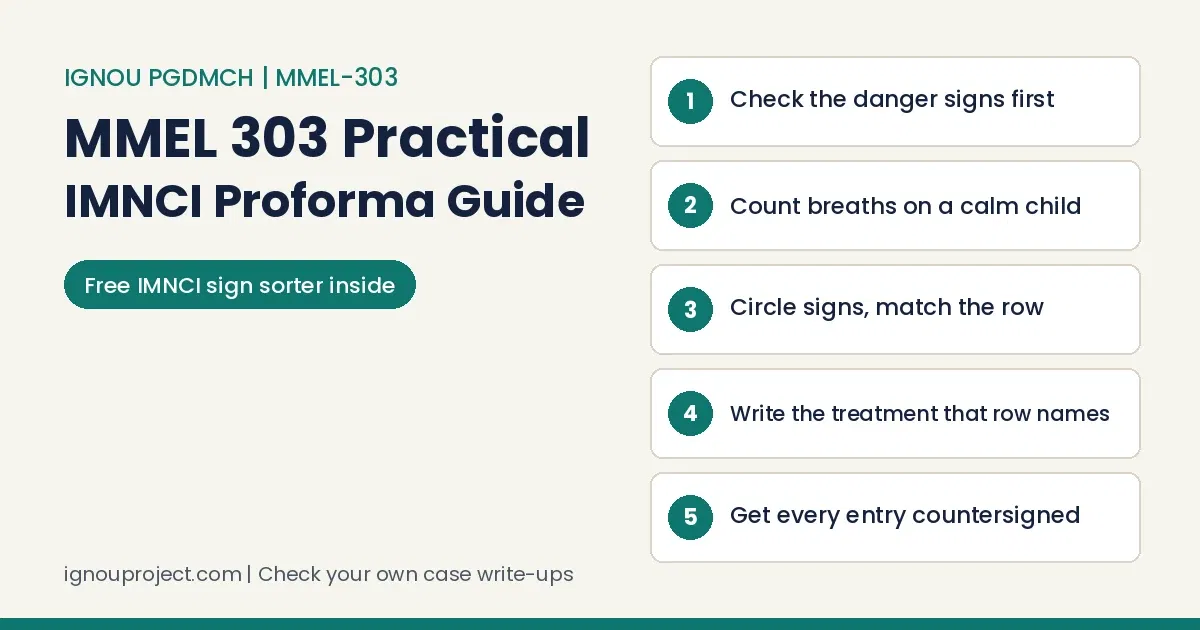
IGNOU MMEL 303 Practical asks a PGDMCH doctor to assess a sick child against the IMNCI chart booklet, write the classification and its treatment on a proforma, and have the page countersigned the same day. This guide works through that routine with a practice case, a sign sorter and the record slips to avoid.
MMEL-303 in five lines
IGNOU MMEL 303 Practical carries 6 credits in PGDMCH, with 30 internal marks from your LSC and SDC counsellors and 70 in a bedside term-end exam. You fill IMNCI proformas for young infants and sick children, write non-IMNCI case records, log every case and bring the countersigned log book to the exam.
You work from Block 1 (Practical Manual, ten units), Block 2 (the 2017 NHM chart booklet) and Block 3 (the Log-Book). The PGDMCH programme overview sets it beside MMEL-301 and MMEL-302.
Doctors who clear written papers easily often find the bedside half harder to finish. Each PSC and SDC case here is worked before a counsellor, so it cannot be caught up in a weekend.
Some learners notice the practical load late. This one course carries 180 hours: 60 at the LSC, 90 at the Skill Development Centre (SDC) and 30 at your workplace.
Before your first paediatrics days at the LSC
Each year brings two six-day spells with two days per department, so you get two paediatrics days per spell for the IGNOU MMEL 303 Practical. Prepare in this order:
- Complete the online e-IMNCI package before the first contact spell (Appendix III).
- Trace one sick-child page of Block 2 from Assess to Classify to the treatment cell, with Units 2 and 3 open.
- Fill the log book cover, then each spell’s dates and counsellor in the posting table; use its first two rows.
- Note the four sick-child categories for spell posting: respiratory disease, diarrhoea, fever and malnutrition.
Our IGNOU practical overview for 2026 compares other programmes.
Most doctors here juggle duty rosters and family, and a missed practical can cost a year. A missed MMEL-303 spell is made up only with the next batch the following year.
Spell days are fixed for the whole group. Get the dates from your LSC early: the two paediatrics days are that spell’s only paediatrics teaching.
Print, counsellor and batchmate can each say something different. Block 3’s contents page even labels section 4 as the older-child cases while that page carries the young infant heading; your counsellor settles such clashes.
How to fill the IMNCI case recording form for a sick child
Unit 3 teaches the IMNCI case recording form (CRF) for ages 2 months up to 5 years, and the IGNOU MMEL 303 Practical proforma keeps its layout:
- Header: check the form matches the age; name, age, weight (kg), temperature (C), date, the mother’s complaint, initial or follow-up.
- Danger signs: drinking or breastfeeding, vomiting everything, convulsions, lethargy, convulsing now; tick Yes or No.
- Cough: days, one-minute breath count, indrawing, stridor, wheeze.
- Diarrhoea: days, blood, general condition, eyes, drinking, skin pinch.
- Fever: 37.5 C or more or by history; PF area, duration, stiff neck, measles signs, test result.
- Ear: pain, discharge and its days, swelling behind the ear.
- Malnutrition and anaemia: oedema of both feet, WFH/L z score, MUAC from 6 months, palmar pallor.
- Immunization and feeding: circle what is due today; assess feeding if under 2, anaemic or moderately malnourished.
Circle every sign present. For an absent symptom, tick No and move on. Then fold the form so the treatment you write on the back faces its classification (section 3.4).
Many records we read list actions with no reasoning. Here the reasoning is the circled sign: a breath count with no circle and no classification tells your counsellor nothing.
A skipped part costs credit in any practical write-up. This CRF follows the booklet’s top-to-bottom route, so an empty box marks a question never asked.
PGDMCH is taught in English; doctors who think in another language lose time over terms. Copy each classification, such as SOME DEHYDRATION, as printed.
Reading the colour rows: IMNCI sick child classification
For IMNCI sick child classification, the booklet’s rows run pink (severe, urgent pre-referral treatment in bold), yellow and green. Start with pink and move down only when the child lacks its signs.
| Sign | How to check (Block 1) | Cut-off (Block 2) |
|---|---|---|
| Fast breathing | Full minute, calm child; count before waking a sleeper | 50 or more at 2 up to 12 months; 40 or more from 12 months |
| Chest indrawing | Clearly visible and present all the time | Seen only when crying or feeding does not count |
| Stridor | Ear near the mouth; clear a blocked nose first | In a calm child: pink row |
| MUAC | Children 6 months or older | Under 115 mm severe; 115 up to 125 moderate |
How to assess dehydration in children
- Severe: two of lethargic, sunken eyes, not able to drink or drinking poorly, skin pinch back very slowly (over 2 seconds).
- Some: two of restless and irritable, sunken eyes, drinks eagerly, skin pinch back slowly.
Pinch midway between umbilicus and flank with thumb and first finger, fold running up and down, for one second. A child the mother can calm is not restless.
Assessment practicals go wrong on misread cut-offs. Here the age band is the trap: 44 breaths is fast at 13 months but not at 10 months.
IMNCI sign sorter
Ages 2 months up to 5 years. Read only the lines for symptoms the child has; with wheeze, enter the count after the bronchodilator trial. The booklet stays the authority.
Rows appear here; without JavaScript, use the lists above.
Worked example: one child through the IGNOU MMEL 303 Practical proforma
This invented child shows the IGNOU MMEL 303 Practical method end to end; the findings are for practice only.
Practice child: 14 months, cough and loose stools
Girl, 11 kg, 37.0 C, first visit; cough 3 days, loose stools 2 days, no blood.
| Box | Signs circled | Classification |
|---|---|---|
| Danger signs | None | Ticked No |
| Cough | 46 a minute, calm; no indrawing or stridor | PNEUMONIA (yellow; 40 or more from 12 months) |
| Diarrhoea | Restless when handled, sunken eyes, drinks eagerly; pinch back at once | SOME DEHYDRATION (three yellow signs, one severe sign) |
| Fever, ear | None | Ticked No |
| Nutrition, anaemia | No oedema, MUAC 128 mm, no pallor | NO ACUTE MALNUTRITION; NO ANAEMIA |
Back of the form: amoxycillin 250 mg, 2 tablets twice daily for 5 days (12 months up to 3 years, 10 to under 14 kg); Plan B, 11 x 75 = 825 ml ORS over 4 hours, inside the 700 to 900 ml band; zinc 20 mg daily for 14 days; feeding assessed, as she is under 2; reassess at 4 hours; follow up in 2 days.
Overwhelmed mother: section 3.16 keeps the antibiotic and ORS and defers feeding counselling and the cough remedy to follow-up.
We have seen case pages built on findings nobody elicited. This child is invented; every proforma in your log book needs the weight and temperature of a child you examined that day.
The young infant proforma, box by box
Unit 2 covers infants up to 2 months; their IGNOU MMEL 303 Practical proforma has five parts:
- Bacterial infection or jaundice: 60 or more breaths is fast; severe indrawing, umbilicus, pustules, temperature 37.5 C or above or under 35.5 C, movement only when stimulated, yellow palms and soles.
- Diarrhoea: movement, restlessness, eyes, skin pinch.
- Feeding or weight: under 1,800 g very low, 1,800 to 2,500 g low; watch a 4-minute breastfeed for the four attachment signs.
- Immunization: circle what is due.
- Other problems.
Spell posting needs at least two cases each of infection, diarrhoea and feeding problem or low weight.
Host hospitals often give distance learners little real work. The log book sets 10 young-infant assessments at the SDC, so ask to examine each infant yourself.
Non-IMNCI case record format, head by head
Non-IMNCI cases fall outside the algorithm, and the IGNOU MMEL 303 Practical log book wants five categories: heart, chronic respiratory, neurological, renal and growth. The Block 3 non-IMNCI case record format runs:
- Date, registration number, identity, address, provisional diagnosis.
- Chief complaint, present, past and birth history, milestones, immunisation, dietetic history.
- Socio-economic status with per capita income.
- General examination and anthropometry, including head, mid-arm and chest circumference.
- Systems: heart, lungs, abdomen, genitalia, CNS, sensory, coordination, musculoskeletal.
- Provisional diagnosis, investigations advised, treatment, date, both signatures.
Tell the present history in time order with pertinent negatives (Unit 6). The log book's tips run ask, examine (look, feel, then auscultate), investigate; tests confirm or exclude, they do not diagnose. Our MMEL 104 geriatric assessment guide uses the same history-first habit.
Records are where practical marks slip and where they are easiest to protect. Two of these records are kept for evaluation, and the counsellors award the 30 internal marks.
Some learners paste internet text in unchecked. Block 3 asks you to write up your PSC seminar case yourself, from your own examination.
One-line log entries, lab procedures and growth charts
Every other child in the IGNOU MMEL 303 Practical goes on a log row: date, name or hospital number, age, diagnosis, management, outcome, place (PSC, SDC or WP) and two signatures.
Weak: "Loose motions, treated, OPD." Stronger: "Hosp. No. 4471, 3 yr, 14 kg, SOME DEHYDRATION, Plan B 1,050 ml ORS, zinc 14 days, rehydrated at 4 hours, SDC."
- Lab: capillary sampling, smear, urine, CSF and a 5 TU Mantoux, each with its indication.
- Growth: weight for age of two children over at least two visits.
- Workplace: log rows only, plus two spare IMNCI proformas.
The MHHL 020 log book guide shows the same one-line discipline.
A log written in one evening shows: one phrase on every row, Sunday dates, a first entry like the last. Write each row while the child is with you.
Working doctors ask whether their own hospital counts. It gives MMEL-303 30 hours, but Block 3 allows no case record proforma there.
Unsigned pages turn up often. Every PSC or SDC case, demonstration and seminar here needs the counsellor's countersignature.
Record slips and how to repair them
| Slip | Repair |
|---|---|
| Young infant form for a 3-month-old | Check age before choosing the form |
| Breaths counted during crying | Calm the child first |
| Dose from a guessed row | Find the age or weight row, read across (3.14) |
| Treatment squeezed onto the front | Fold and write it facing the classification |
| Ready-made files with only the name changed; matching pages at one centre stand out | Your log book reaches the examiner, and the viva tests it |
| An AI-written history pasted in as it is | Write from the mother's answers and your findings |
| Wrong cover details | Match your IGNOU records |
Psychology learners meet similar slips; see our MPCL 075 case report guide.
The IGNOU MMEL 303 Practical exam day, part by part
The IGNOU MMEL 303 Practical exam sits at your LSC, usually in December or January. Appendix VI of the 2024 guide splits the 70 marks:
- Young infant on the IMNCI pattern, chart book allowed: 15 minutes, 10 marks.
- Child of 2 months up to 5 years, same pattern: 15 minutes, 10 marks.
- Non-IMNCI case, judged on diagnosis and management: half an hour, 20 marks.
- Five paediatric spots (scenarios, X-rays, drugs, equipment, photographs): 2 minutes and 2 marks each.
- OSCE on resuscitation or feeding counselling under 2: 2 to 5 minutes, 10 marks.
- Viva-voce: 10 minutes, 10 marks.
Revise Units 9 (X-rays) and 10 (triage), Unit 1's resuscitation flow and Unit 5's counselling.
MMEL 303 viva questions to rehearse
- Why yellow and not pink for this child?
- Which cut-off applies at 11 months, and at 12?
- How much ORS in the first 4 hours, and how did you get it?
- What would you drop for a confused mother?
- What can make a Mantoux test falsely negative?
Our project viva questions guide shows how examiners probe your own work.
A neat log book does not carry a viva alone. Doctors who examined their own children answer this one from memory; borrowed pages show.
Learners ask whether a viva applies to them. Every MMEL-303 candidate faces one inside the 70 marks.
Evening-before tick list
Run it for the IGNOU MMEL 303 Practical with the log book open.
Evening-before tick list
Form, Rs 500 fee and the 30 November date
The IGNOU MMEL 303 Practical needs both spells with the SDC work, the online practical form in time and at least 15 of 30 internal marks; the exam needs 35 of 70. The MME-303 theory paper is not a condition.
The July 2026 prospectus charges Rs 500 for practicals above 4 credits, and an exam fee once paid is not refunded. SED's December 2026 notice closes practical fees on 30 November 2026, through Samarth only. Our December 2026 exam date sheet shows your MME-303 slot.
In our records, 70 to 80 percent of learners act only in a deadline's last month. With fees closing on 30 November, aim for mid-November.
Some learners wait for an extension. The SED notice says no fee is taken after its date.
Rs 300 and Rs 500 get confused; at 6 credits this course pays Rs 500.
Have your own case write-ups read
For a second reader on IGNOU MMEL 303 Practical records you wrote yourself, send photos of your proformas and case records on WhatsApp. We compare them with the booklet and Block 3 and return comments on empty boxes, mismatched rows and doses. A record check is quoted on WhatsApp; see our services and charges page. You stay the author, the countersignature stays your counsellor's, and IGNOU's examiners decide marks.
Doctors' questions on the child health records
Doctors ask us
Can I fill IMNCI proformas for my own OPD children?
For practice, yes: Block 3 adds two spare proformas of each kind and allows photocopies. Otherwise workplace children go on log rows.
What happens to the IGNOU MMEL 303 Practical if I miss a spell?
The exam waits: the guide moves the spell to next year's batch. Tell your LSC early.
A batchmate at another centre can mislead you; their SDC timetable is not yours, and no SDC takes over five learners.
When do MMEL-303 marks show?
After internal marks are sent and the exam is evaluated; the guide lists practicalsed@ignou.ac.in for practical marks.
Practical results often land after theory, and the diploma waits for all three practicals.
Keep copies of the completion certificate and Samarth receipt; they are your proof if marks go missing.
Closing: the IGNOU MMEL 303 Practical in one habit
The IGNOU MMEL 303 Practical rewards one habit: assess in the booklet's order, write the row and its treatment, and get the page signed that day. Printed reference material sits on our publication site's course page.
Three causes recur: late and conflicting rules, practicals that assume spare time, and records treated as paperwork. This course has all three, from swapped log book headings to a signature on every case.
Doctors who do well start early, confirm dates with their LSC, write rows daily, gather signatures as they go and can explain each classification aloud.
Sources read for this child health guide
- PGDMCH Programme Guide 2024: spells, hours, log book, Appendix VI
- Common Prospectus, July 2026: credits, fee slabs
- SED notices: December 2026 practical fee
- MMEL-303 Blocks 1 (March 2019), 2 (NHM job aid, 2017) and 3 (Log-Book, September 2019)
Method: the three MMEL-303 blocks, the 2024 Programme Guide, the July 2026 prospectus and the SED fee notice were read in November 2026; AI-assisted drafting, rules checked against those sources and the arithmetic rerun, published under BK Sahni's editorial responsibility.
ignouproject.com is not affiliated with, authorised by or endorsed by IGNOU. We comment on records you wrote; you remain the author of every entry.

BK Sahni iD 0009-0005-8092-459X
Founder, Shri Chakradhar Publication Pvt. Ltd. & ignouproject.com — helping IGNOU distance-learning students since 2010 (5,00,000+ students supported across MBA, MCom, MA & more). Author of IGNOU exam guides, solved assignments & project reference books.
Disclosure: Shri Chakradhar Publication Pvt. Ltd. and ignouproject.com are independent third-party study-help services — not the official IGNOU website. Always verify final dates and rules on ignou.ac.in.