The IGNOU MLIS Internship Report (MLII-105) is a practical course that connects classroom learning with real library work. It uses a structured internship, a daily workbook, and a detailed report to assess professional skills in routine operations, user services, and technology-based work.
The IGNOU MLIS Internship Report work is made for people who want to learn more about library and information science and get better at school and work. As part of this MLIS program, students usually have to do a job and write an MLIS Internship Report about what they learned and how they did it. The goal of this requirement is to give students real-life experience in library and information service areas in addition to the theoretical knowledge they learn in school.
Quick overview of MLII-105 requirements
| Component | What it means | Output expected |
|---|---|---|
| Internship attachment | Practical training in a Library and Information Centre | One-month internship (about 100 hours) |
| Workbook | Day-to-day record of tasks and learning | Authenticated workbook (signed/verified periodically) |
| Internship report | Structured report based on work done | Detailed report in prescribed format |
| Viva-voce | Oral assessment (as scheduled) | Practical understanding and reporting clarity |
What MLII-105 stands for MLIS Internship
- Course code: MLII-105
- Course type: Internship / attachment-based practical
- Core outputs: Internship workbook + Internship report + viva-voce (as applicable)
- Focus areas: Library operations, services, automation, digitisation, administration, and publication work
Purpose of the IGNOU MLIS Internship Report (MLII-105)
MLII-105 aims to ensure that learners can perform essential library work in real settings. It focuses on:
- Applying theory in real workflows
- Building confidence in routine operations and user services
- Developing professional behaviour, discipline, and work culture
- Learning modern tools used for automation and digital services
- Creating written professional documentation through workbook and report
Importance of the Internship Report in the MLIS Degree (MLII-105)
An IGNOU MLIS internship report is important for many reasons:
- It helps students develop written communication skills.
- It serves as an archival record of the internship experience.
- It gives students an opportunity to reflect on the professional aspects of the internship experience and the skills that were learned.
- It informs educators of the lessons and skills students learned and the opportunities they had to apply those skills.
- It allows students to demonstrate what they have learned in class.
- It helps students gain knowledge, skills, and abilities that are not taught in class.
Benefits of completing MLII-105 properly
A well-executed MLIS internship and report can deliver measurable benefits:
- Practical competence: Clear skill growth in cataloguing, circulation, e-resource handling, and more
- Employability support: Stronger interview readiness through real examples
- Better writing discipline: Improved report writing, structured thinking, and documentation skills
- Professional exposure: Understanding of staff roles, user needs, policies, and service rules
- Technology confidence: First-hand practice in library software, databases, and digitisation processes
Must Read: IGNOU MLIS Project for deailed study.
IGNOU MLIS Internship Report Guidelines
1) Placement process and role of the Regional Centre
- The Regional Centre informs learners about internship rules, workbook writing, and assessment process.
- The Regional Centre may allocate a Library and Information Centre (LIC) or publish placement details.
2) Choosing a library on personal request
A learner may also choose a suitable LIC independently. In that case:
- The learner informs the Regional Centre in advance.
- The Regional Centre confirms whether the LIC and supervisor meet the criteria.
3) Host institution requirements
The training host should typically have:
- A full library setup (not a token collection)
- A minimum library collection size expectation (commonly stated as at least 5,000 documents)
- Capacity to provide varied exposure across services and routines
- A designated training supervisor
4) Attendance discipline
- The intern must remain present for the full internship period.
- Limited leave may be allowed only on valid reasons (often treated as up to two days in a month).
5) No financial liability
The MLII-105 internship does not create financial liability for the intern or the host. The course treats it as a learning attachment rather than paid work.
IGNOU MLIS Internship Report: Schedule and Structure
The MLIS internship (MLII-105) runs for one month and often follows a phased structure so that learners cover all key areas.
Typical training phases
Week 1
- Operations (2 days): acquisition, accessioning, classification, cataloguing, stock work, shelving, basic maintenance
- Services (3 days): reference, circulation, ILL, CAS/SDI, document delivery, reprography, digital reference basics
Week 2
- Automation (full week): data entry in databases, use of software in routines and services, basic report outputs
Week 3
- Digitisation (full week): digitisation workflows, repository-related work (if available), preservation support tasks
Week 4
- Administration (3 days): official notes, letters, event support, records and files
- Publication work (2 days): proofreading, editing support, basic typesetting/binding workflows (if the unit exists)
Note: If the host does not have a publication unit, the supervisor may adjust tasks while maintaining broad coverage.
Guide/Supervisor Selection in MLIS Internship Report
MLII-105 uses a training supervisor model.
Who acts as the supervisor?
- The host library assigns a qualified training supervisor to guide and verify work.
- A common working ratio is one supervisor for a group of interns, often kept within a manageable limit (frequently stated as up to 1:10).
Minimum eligibility (commonly required)
The training supervisor generally meets one of these:
- Doctoral qualification in Library and Information Science, or
- Master’s degree in Library and Information Science with relevant work experience (commonly stated as at least two years in a reputed library)
MLIS Internship Supervisor Responsibilities
- Explain tasks and routines clearly
- Verify workbook entries periodically
- Observe sincerity, discipline, and professional behaviour
- Support reporting accuracy by validating actual work performed
Topic Selection and Ideas for MLII-105 internship reporting
MLII-105 is not a research dissertation. However, the report becomes stronger when it follows a clear focus theme based on actual work completed.
Trending IGNOU MLIS Internship Report Topic Ideas
- Acquisition and accessioning workflow improvement
- Classification and cataloguing practice (with rules followed by the host)
- Circulation system rules and user management
- Reference and digital reference service workflow
- Current awareness and SDI practice at the host library
- E-resource access management and user support
- Stock verification and shelf rectification process
- Library automation: database entry and routine outputs
- Digitisation workflow and file management practices
- Institutional repository support tasks (if available)
- Library administration notes, records, and event support
- Publication unit exposure: proofreading and typesetting support (if applicable)
MLII-105 Topic selection checklist
- Select a focus area that the host library actually allows during the internship.
- Avoid choosing an area with zero exposure (it weakens viva performance).
- Prefer areas where the workbook shows consistent daily work evidence.
Synopsis Writing for MLII-105
Some Regional Centres may ask for a short internship plan/synopsis before placement confirmation, especially when the learner selects a library independently. When required, the synopsis should stay short and practical.
Recommended synopsis structure (1–2 pages)
- Title (internship focus): Example: “Automation and User Services Exposure in an Academic Library”
- Host library details: Name, type (public/academic/special), location
- Internship duration: One month / 100 hours (as applicable)
- Objectives (4–6 points):
- Learn acquisition and accessioning steps
- Perform cataloguing or database entry tasks
- Assist in circulation and reference routines
- Observe digitisation or e-resource support
- Planned modules (brief): Operations, services, automation, digitisation, administration
- Expected learning outcomes: Skills, tools, service understanding
- Supervisor consent: Mention that the host supervisor agrees to supervise
Keep the synopsis factual. Avoid long literature-style writing because MLII-105 expects work-based documentation.
IGNOU MLIS Internship Report Format (MLII-105)
A strong MLII 105 report follows the prescribed structure and stays close to internship evidence. The format below aligns with the required components.
Front matter
- Cover/Title page (course code, student details, host library, duration)
- Internship certificate (signed by supervisor/head)
- Contents page
Main report sections (recommended order)
1) Introduction
Explain internship as a concept and clearly state:
- Objectives
- Functions
- Benefits
Keep it brief and structured.
2) Name of the institution
Provide:
- Institution and library name
- Library type (public/academic/special)
- Location (city/town level is enough)
3) Module description (work done during internship)
Describe activities completed during the internship hours. Use sub-headings:
- Operations: acquisition, accessioning, classification, cataloguing, stock tasks, shelving
- Services: reference, circulation, ILL, CAS/SDI, document delivery, reprography
- Automation: database entry, software-supported routines, service support
- Digitisation: digitising tasks, repository-related work, preservation support
- Administration: notes, letters, event support
- Publication work (if available): proofreading, editing, typesetting, binding support
Tip: Use short sub-sections with task + method + output.
4) About the library (description from the intern’s view)
Include:
- Brief history
- Collection profile (print + electronic)
- Staff pattern (professional and support staff)
- Automation status (extent, software name, automated services)
- Digitisation status (tools/software, repository presence, policy mention if known)
- Services offered (rules, facilities, web-based services if provided)
5) Learning outcomes
State learning in clear terms:
- Knowledge gained
- Skills practised
- Readiness to perform tasks independently or under supervision
6) Conclusion
Summarise the internship experience and overall learning. Keep it factual and balanced.
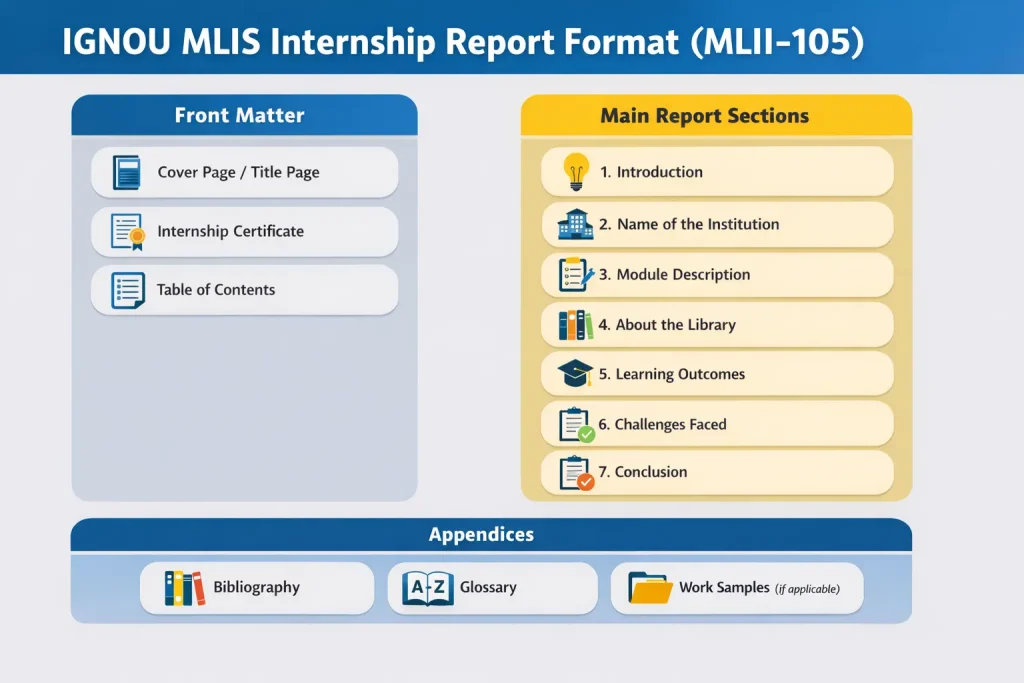
Image: IGNOU MLIS Internship Report Format (MLII-105)
Writing an IGNOU MLII-105 Workbook
The MLIS internship workbook acts as the proof of daily work. It should:
- Record work on a day-to-day basis
- Align with weekly modules and assigned tasks
- Carry periodic authentication by the supervisor
- Include an originality declaration (as required in the workbook submission set)
Workbook best practices
- Write daily entries on the same day to avoid errors.
- Use clear task language: “Performed accession entry for 25 items” is stronger than “Did accession work.”
- Note tools used (software name, module used) when applicable.
- Avoid copying text from peers. Similar work patterns can exist, but wording must remain original.
Documenting Workbook for the IGNOU MLIS Internship Report (MLII-105)
1) Maintain the Workbook Daily
- Write date-wise entries: tasks performed + section/service area + hours.
- Keep entries factual and consistent with actual work.
2) Record Learning and Outputs
- Add 2–3 lines on what was learned or observed (rules, tools, workflows).
- Note measurable outputs where possible (items processed, users assisted, records created).
3) Preserve Supporting Evidence (with permission)
- Keep copies or notes of formats used: accession entry, catalogue record sample, circulation register type, reports generated, screenshots (if allowed).
- Do not include confidential user data.
4) Get Periodic Supervisor Authentication
- Obtain signatures/verification on the workbook at regular intervals.
- Ensure the final internship certificate is signed and stamped as required.
5) Do a Weekly Summary
- Prepare a brief weekly recap: operations/services/automation/digitisation/admin tasks covered.
- Use this summary to write the final report quickly and accurately.
IGNOU MLIS Internship Report and Workbook Submission Process
Submission steps can differ slightly by centre and mode (ODL/online). However, the core process remains consistent.
Step-by-step submission checklist
- Complete internship period and ensure attendance discipline.
- Maintain the workbook daily and obtain periodic supervisor verification/signature.
- Prepare the internship report in the prescribed format.
- Attach required certificates, especially the internship completion certificate and originality declaration (where required).
- Keep copies of workbook and report before submission.
- Submit to the Regional Centre as instructed:
- ODL learners typically submit physical workbook + report to the Regional Centre.
- Online learners typically upload workbook + report on the LMS/portal as instructed.
- Track viva-voce schedule if the course includes viva for that cycle.
Formatting and presentation tips for MLII-105
- Use A4 pages, clean formatting, and consistent headings.
- Bind or compile neatly so pages do not detach.
- Use simple tables for weekly tasks if needed, but keep the narrative readable.
Choosing a Library for the IGNOU MLIS Internship Report (MLII-105)
It is not advisable to assume that MLII-105 can be completed at any library or information centre without conditions. The internship site must be suitable for structured professional training, and it must meet the programme expectations for practical exposure, supervision, and documentation. In many cases, the site is either allotted or accepted after verification when selected independently.
Here are a few key points to keep in mind when selecting a library or information center for your internship:
- Relevance to Your Studies: The institution should offer a learning environment that is relevant to the MLIS curriculum. This means it should engage in practices and services that align with what you’ve studied, such as cataloging, digital library management, reference services, information literacy programs, etc.
- Approval from IGNOU: Depending on the guidelines set by IGNOU, you may need to get approval from your academic supervisor or the program coordinator before starting your internship. This ensures that the institution meets the university’s requirements for a meaningful internship experience.
- Learning Opportunities: Choose a library or information center that can provide you with a broad range of learning opportunities. This might include exposure to different types of information resources, user services, library management software, and participation in library projects.
- Supervision: Ensure that the institution can provide adequate supervision and mentorship during your internship. Having a professional in the field who can guide you, offer feedback, and support your learning is crucial for a successful internship experience.
- Flexibility and Accessibility: Consider the location and the working hours of the institution, especially if you have other commitments. The internship should be feasible in terms of travel and should fit into your schedule.
Best Practice Recommendation for MLII-105 Site Selection
A suitable MLII-105 internship site should be:
- Functionally active (real users, real services, real workflows)
- Training-capable (multiple service areas and tasks)
- Supervisor-supported (eligible guidance and authentication)
- Documentation-friendly (workbook verification and certification)
This approach protects the learner from last-minute rejection risks and supports a stronger, more credible internship report.
FAQs (Frequently Asked Questions) in IGNOU MLIS Internship Report Work (MLII-105)
What is the IGNOU MLIS Internship Report (MLII-105)?
It is an internship-based practical course that requires one-month training, a daily workbook, and a structured internship report, followed by assessment that may include viva-voce.
How long is the MLII-105 internship?
The internship typically runs for one month and commonly covers around 100 hours of practical work, depending on the notified schedule and host routine.
Can the training library be chosen independently?
Yes. A suitable library can be selected independently, but the Regional Centre usually verifies whether the host and supervisor meet the required criteria.
Who can act as the MLII-105 internship supervisor?
The host library provides a qualified training supervisor, commonly requiring doctoral qualification in LIS or an MLIS degree with relevant experience.
What must be included in the MLII-105 internship report?
Include an introduction, institution details, module-wise work description, library profile, learning outcomes, and a conclusion, along with an internship certificate.
Where should the workbook and internship report be submitted?
ODL learners generally submit to the Regional Centre. Online learners generally upload to the LMS/portal as instructed for the relevant cycle.
Is workbook verification important in MLII 105?
Yes. The workbook should carry periodic authentication by the training supervisor. It supports the report and strengthens viva-voce performance.
What improves viva-voce performance in MLII-105?
Clear understanding of tasks performed, matching workbook and report details, correct terminology for operations/services, and honest discussion of learning outcomes.
Is there a deadline for submitting the MLII-105 internship report?
Yes. Submission deadlines are communicated through the relevant channel for the session. Timely submission is important to avoid evaluation issues.
What should be done if problems arise during the MLII-105 internship?
Start by identifying the exact problem, then propose solutions and discuss them with the supervisor. Regular feedback, timely clarification, and documented actions help resolve issues quickly.
When should an intern seek help during the internship?
Help should be sought when tasks are unclear, resources are not available, or workload is unmanageable. Early communication with the supervisor or mentor prevents errors in workbook entries and report writing.
What common challenges can occur during the MLII-105 internship?
Common issues include a steep learning curve, repetitive tasks, limited feedback, lack of meaningful work, competition, and being assigned duties not aligned with MLIS learning objectives. Clear planning and supervisor discussion usually reduce these problems.
Read More About Other Internship Work
- IGNOU MPCE 35 Internship Report
- IGNOU MPCE 25 INTERNSHIP
- IGNOU MPCE 15 Internship Report
- IGNOU BLIS Internship Report | BLII 230
Download Section
Final Words
The IGNOU MLIS Internship Report (MLII-105) requires disciplined internship completion, careful workbook maintenance, and a structured report aligned with real tasks. When learners follow the prescribed modules, document daily work accurately, and present learning outcomes clearly, the submission becomes stronger and viva preparation becomes easier.
For structured help with topic finalisation, synopsis preparation, workbook alignment, report formatting, and error-free drafting in MLIS internship report work, visit: ignouproject.com or contact us.

BK Sahni iD 0009-0005-8092-459X
Founder, Shri Chakradhar Publication Pvt. Ltd. & ignouproject.com — helping IGNOU distance-learning students since 2010 (5,00,000+ students supported across MBA, MCom, MA & more). Author of IGNOU exam guides, solved assignments & project reference books.
Disclosure: Shri Chakradhar Publication Pvt. Ltd. and ignouproject.com are independent third-party study-help services — not the official IGNOU website. Always verify final dates and rules on ignou.ac.in.