
The Certificate Programme in Teaching of Primary School Mathematics (CTPM) is built around two 8-credit courses: AMT-1 (Teaching of Primary School Mathematics) and LMT-1 (Learning Mathematics). IGNOU AMT 1 Project Report work carries a 2-credit weightages that plays a key role in overall assessment.
In this programme, one credit equals about 30 hours of study time. Therefore, the 2-credit AMT-1 project is planned for around 60 hours of focused work, including planning, field activities with children and report writing.
This article explains every important aspect of the IGNOU AMT 1 Project for CTPM, from basic guidelines to final submission.
Understanding the AMT-1 Project within CTPM
AMT-1 is a practical, classroom-oriented course that explores ways of teaching mathematics to children up to 10 years of age. The project component is designed to help the learner:
- Observe how children actually learn mathematics.
- Plan and try small teaching activities in real settings.
- Reflect on teaching strategies used in primary classes.
In overall grading for AMT-1, marks are usually divided among assignment, term-end exam and project. The project carries a fixed weight in this structure, so weak project work can reduce the final grade even if the written exam goes well.
Code Clarification: AMT-1, AMT-01-P and CTPM
Learners often get confused by course and project codes. The basic mapping is:
- Programme: CTPM – Certificate Programme in Teaching of Primary School Mathematics.
- Course: AMT-1 / AMT-01 – Teaching of Primary School Mathematics (8 credits).
- Project code often used in manuals and portals: AMT-01-P (Project Work).
In simple terms:
CTPM is the programme, AMT-1 is the course, and AMT-01-P is the project work under AMT-1.
Whenever any instruction, form, or portal mentions AMT-01-P for CTPM, it refers to the same IGNOU AMT 1 Project for CTPM discussed here.
Official IGNOU AMT-1 Project Guidelines
The project must follow the basic structure and spirit of the programme guide and project manual. Major expectations usually include:
- Focus on teaching or learning of primary school mathematics.
- Direct engagement with children (observation, activities, worksheets, interviews, etc.).
- Use of simple tools such as lesson plans, activity sheets and short tests.
- Clear link with school mathematics topics for children up to Class V.
- Evidence that the learner has used ideas from AMT-1 blocks and units.
In addition, the project must respect standard academic norms:
- No copy-paste from books, the internet or ready-made projects.
- Proper organisation with title page, contents and chapters.
- Logical flow from problem statement to findings and conclusion.
- Neat and readable writing, with correct grammar and basic formatting.
IGNOU AMT 1 Project Topic Selection for CTPM
How to choose a suitable project area
The project area must stay related to teaching/learning of mathematics at the primary level, and it should be manageable within about 60 hours of work.
Useful checks before finalising a topic:
- Can children between 6–10 years be involved in the study?
- Does the topic match at least one unit or block of AMT-1?
- Is the sample size realistic (for example, one class or a small group)?
- Can data be collected within the local school or community?
Sample IGNOU AMT 1 Project Topics Ideas
Learners may adapt these sample themes to their local context:
- Comparing activity-based teaching with textbook-only teaching for addition and subtraction.
- Helping children understand fractions using paper folding and everyday objects.
- Use of number games to improve basic multiplication facts in Class IV.
- Diagnosing common errors in subtraction with borrowing in Class III.
- Role of maths storybooks in reducing fear of mathematics in early grades.
- Using low-cost materials (stones, sticks, bottle caps) to teach place value.
Each topic should be refined into a clear title, for example:
“Effect of Number Line Activities on Understanding of Negative Numbers in Class V.”
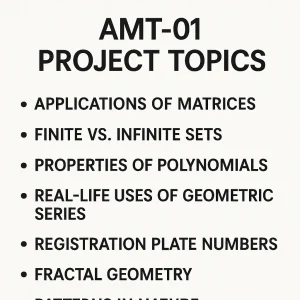
Image: Trending IGNOU AMT-01 Project Topics
Writing an Effective Synopsis for AMT-1 Project
Before writing the full report, learners prepare a synopsis (project proposal) and get it approved by the supervisor.
A typical synopsis for the IGNOU AMT 1 Project for CTPM includes:
- Title of the study
- Clear, short and linked to a specific concept or skill.
- Background and rationale
- Brief description of the problem in primary maths teaching.
- Why this topic matters in local classrooms.
- Objectives
- 3–5 focused objectives, such as:
- To design activities for teaching fractions.
- To study children’s errors in solving word problems.
- 3–5 focused objectives, such as:
- Research questions or hypotheses (if used)
- Simple and directly linked to objectives.
- Methodology
- Participants (class level, number of learners).
- Tools (worksheets, activities, interview schedules, observation sheets).
- Procedure (steps followed in classroom or field).
- Plan for data analysis (simple counts, percentages, comparison of pre- and post-tests).
- Proposed chapter outline
- Chapter I: Introduction
- Chapter II: Review of related literature / previous classroom experience
- Chapter III: Methodology
- Chapter IV: Data analysis and findings
- Chapter V: Discussion, suggestions and conclusion
- Time schedule
- Approximate calendar for planning, data collection and writing.
The synopsis should be neat, concise and free from grammatical errors. Many supervisors expect it in 1 000–1 500 words, but the final length may depend on local practice.
IGNOU AMT 1 Project Report Format for CTPM
After synopsis approval and field work, the learner writes the full project report. General expectations, based on common CTPM and AMT-01-P practices, are as follows:
Suggested length
- Around 10 000–15 000 words, depending on depth of data and analysis.
- Often 70–100 A4 pages including annexures, if typed with normal spacing.
Basic structure
- Preliminary pages
- Title page
- Certificate from guide/supervisor
- Declaration by the learner
- Acknowledgements
- Table of contents
- List of tables and figures (if any)
- Chapter I – Introduction
- Background of primary mathematics teaching.
- Statement of the problem.
- Need and significance of the study.
- Objectives and research questions.
- Chapter II – Review of related literature / field experience
- Short review of books, articles or school practices related to the topic.
- Points that guided the design of the present study.
- Chapter III – Methodology
- Research design (for example, classroom action research, case study, survey).
- Sample and setting (school, class, number of children).
- Tools and materials used.
- Procedure of data collection.
- Chapter IV – Data analysis and interpretation
- Presentation of data using tables, simple graphs or examples of student work.
- Analysis in line with objectives.
- Chapter V – Major findings, conclusions and suggestions
- Summary of key results.
- Practical classroom implications.
- Suggestions for teachers, parents and future studies.
- Annexures
- Copies of tools (questionnaires, worksheets, activity sheets).
- Sample student responses or photographs (if allowed).
All pages should be numbered in sequence, and headings must be used consistently.
AMT-01 Project Guide/Supervisor Selection and Eligibility
AMT 1 Project work must be done under the guidance of an approved supervisor. Usual procedures include:
- Details of eligible supervisors are available through the study centre or regional centre.
- Many supervisors are academic counsellors, school teachers or teacher educators with suitable qualifications in mathematics or education.
- The learner must contact the study centre coordinator to confirm the name and contact details of the allotted guide.
The supervisor’s main responsibilities are to:
- Help refine the project topic.
- Approve and sign the synopsis.
- Provide feedback during field work and report writing.
- Certify that the final report is the learner’s original work.
Learners must keep regular contact with the guide and maintain a record of meetings or discussions.
Submission Process for AMT-1 Project (CTPM)
The project submission process usually follows these broad steps, which are consistent with many AMT-01-P instructions:
- Read the project manual carefully
- Follow all norms regarding formatting, margins, line spacing and cover page details.
- Get synopsis approval
- Submit the synopsis to the guide, revise as suggested and obtain written approval/signature.
- Complete project work and write the report
- Conduct classroom or field activities.
- Compile data and draft the report as per the structure discussed above.
- Obtain supervisor’s certification
- The supervisor signs the certificate page and sometimes the synopsis copy.
- Prepare final bound copy / PDF as per current rules
- Some cycles permit hard copy submission, others allow or require online upload.
- The learner must strictly follow the latest regional or central instructions on mode of submission and deadlines.
- Submit before the relevant deadline
- Traditionally, deadlines around the end of May and November are linked to June and December exam cycles, but final dates can change.
Learners should always check with their study centre or official portal for updated dates and modes (offline/online) for the session in which they plan to appear.
Practical Tips to Maximise Scores in IGNOU AMT 1 Project for CTPM
- Choose a narrow, focused topic rather than a very broad theme.
- Keep the child’s learning at the centre of the study, not only the teacher’s actions.
- Use real classroom data: students’ work, observations, small tests, and interviews.
- Link findings clearly with AMT-1 concepts such as counting, place value, fractions, or measurement.
- Avoid long theory sections that repeat textbook content; focus on classroom change.
- Revise language and presentation to remove errors before submission.
FAQs on IGNOU AMT 1 Project for CTPM
What is the purpose of the AMT-1 project in CTPM?
It allows the learner to apply AMT-1 ideas in real classrooms, observe how children learn mathematics and reflect on better ways of teaching.
How many credits is the AMT-1 project?
The AMT-1 course has 8 credits, out of which 2 credits are for project work linked to teaching primary school mathematics.
Is a supervisor compulsory for the AMT-1 project?
Yes. The project must be completed under an approved supervisor, usually allotted through the study centre or regional centre.
Does the project affect the final AMT-1 grade?
Yes. Along with assignments and the term-end exam, the project carries a fixed weight and contributes to the final score in AMT-1.
Downloadable Resources
- IGNOU AMT 1 Project Synopsis Sample PDF
- IGNOU AMT-1 Project Report Format Sample PDF
- AMT-01 Project Topics List
Conclusion
The IGNOU AMT 1 Project for CTPM is much more than a formal requirement. It is a chance to connect theory with real children, to test new teaching methods and to grow as a reflective primary mathematics teacher. When the topic is well defined, the synopsis is clear, the methodology is practical and the report is neat, the project becomes a strong part of both academic record and professional development.
Timely planning, close coordination with the supervisor and strict adherence to the project manual ensure a smooth evaluation process and a better overall grade in CTPM.
Learners who need structured support with topic selection, synopsis drafting or report formatting for the IGNOU AMT 1 Project for CTPM may explore expert-led guidance and resources at ignouproject.com or contact us.