
The Certificate in Energy Technology and Management (CETM) is a short-term programme that builds basic skills in energy resources, energy conversion, energy use, and energy conservation. It helps learners understand how energy is produced, used, and saved in homes, buildings, and small systems. Under this course, IGNOU CETM Project for OEYP-4 is a fundamental component of the Certificate in Energy Technology and Management at IGNOU. This project is designed to deepen understanding of energy-related topics, sustainable practices, and their practical applications in energy management.
Students are tasked with researching specific aspects of energy technology, analyzing energy management strategies, and presenting their findings in a comprehensive project report. Under the guidance of experienced professionals in the field of energy management, students explore various dimensions of energy efficiency, renewable energy, and sustainability.
The programme usually:
- Runs for a minimum of 6 months and can be completed within 2 years.
- Has no upper age limit.
- Admits learners who have completed schooling up to the secondary level (10th pass in most cases).
- Uses English as the main medium of instruction.
The structure of CETM includes three theory courses and one project course:
- OEY-001: Energy Resources and Conversion Processes
- OEY-002: Renewable Energy Technologies and Their Uses
- OEY-003: Energy Management: Audit and Conservation
- OEYP-004: Energy Projects – the practical project component (4 credits)
The IGNOU CETM Project for OEYP 4 is therefore the core practical element of this certificate.
What Is the IGNOU CETM Project for OEYP 4?
OEYP-004, often written as OEYP 4, is the project course titled “Energy Projects”. It carries 4 credits and is compulsory for the award of the CETM certificate.
The project is built around a structured energy-related exercise, most commonly:
- An energy audit of the learner’s home, or
- A similar small-scale energy use study in a simple setting.
Learners complete a set of activities that guide them to:
- Record energy use.
- Analyse consumption patterns.
- Identify wastage.
- Suggest and justify energy-saving measures.
Because of this, the IGNOU CETM Project for OEYP 4 acts as a bridge between theory (OEY-001, OEY-002, OEY-003) and real-world energy management practice.
Purpose of the OEYP-4 Energy Project
The CETM project is designed to:
- Apply concepts of energy resources, renewable technologies, and energy management to a real setting.
- Build the habit of measuring and recording actual energy use.
- Develop basic skills in energy auditing and energy balance.
- Encourage low-cost, practical conservation measures in daily life.
- Make learners more aware of sustainable and efficient energy practices.
In short, OEYP-4 is not only an academic requirement; it is a practical exercise in responsible energy use.
Key Benefits of Completing CETM OEYP-4 Effectively
A well-planned and carefully executed CETM project offers several benefits:
- Stronger understanding of energy use
Learners see how electricity, LPG, and other fuels are actually consumed in a real place, not only in books. - Hands-on practice in energy auditing
The activities mirror basic steps of a professional audit: data collection, analysis, and suggestion of improvements. - Better awareness of renewable options
The project usually directs learners to study solar heaters, solar cookers, or basic solar PV systems, along with their feasibility. - Improved analytical and reporting skills
Students learn how to present findings in tables, simple graphs, and short analytical notes. - Support for further study or work
Exposure to real energy data helps learners if they later join advanced study or energy-related work.
IGNOU CETM Project Guidelines for OEYP-004
For CETM, OEYP-004 has a specific structure and marking pattern. Key points from the programme and project guidelines include:
- Course Code: OEYP-004 (also written as OEYP 4).
- Title: Energy Projects.
- Credits: 4.
- Nature: Project / practical course, compulsory.
- Core Task: “Energy Audit of Your Home” or similar guided energy project.
- Evaluation:
- Total marks: 100.
- Minimum to pass: 40% (40 marks out of 100).
- Marks are distributed over a list of activities (data analysis, conservation measures, renewable options, etc.).
The project guide or booklet lists all activities with separate marks. Learners should attempt as many as possible to maximise scores.
IGNOU CETM Project Topics (OEYP-4)
The default theme for OEYP-4 is the energy audit of a home or comparable small unit, as stated in the programme and project manuals.
Within this theme, learners can shape their focus area. Examples include:
- Household electricity consumption study
- Study monthly electricity bills.
- Analyse usage by rooms or appliances.
- Suggest ways to cut peak consumption.
- Lighting and fan energy efficiency
- Compare tube lights, CFLs, and LEDs.
- Note running hours of fans and lights.
- Propose replacement and usage changes.
- Cooling and refrigeration energy use
- Record usage of air conditioners, coolers, and refrigerators.
- Study thermostat settings and door-opening patterns.
- Highlight low-cost changes to reduce load.
- Kitchen fuel and appliance use
- Map LPG, induction, or electric stove use.
- Identify “idle burning” and wastage.
- Suggest better scheduling and equipment.
- Introduction of renewable energy in a home
- Basic study of solar water heaters or solar home systems.
- Simple cost–benefit analysis using realistic assumptions.
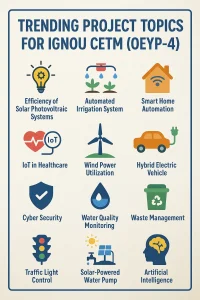
Image: Trending Project Topics for IGNOU CETM (OEYP-4)
Some regional centres also allow small variations, such as a simple audit of a shop, small office, or hostel unit, but such changes should always follow the latest local guidelines and written instructions.
Writing an IGNOU CETM Project Synopsis
For OEYP-4, the main manual itself often acts as the project framework. However, some centres or mentors ask for a short synopsis or proposal, especially when learners extend beyond a simple home audit.
A brief, clear synopsis normally contains:
- Title of the project
- Example: “Energy Audit of a Two-Bedroom Urban Home” or “Lighting Energy Use in a Small Retail Shop”.
- Background and rationale
- Short note on rising energy use and need for conservation.
- One or two lines on why this site was chosen.
- Objectives
- 3–5 sharp objectives, such as:
- Measure electricity use by major appliances.
- Identify sources of wastage.
- Suggest practical conservation measures.
- 3–5 sharp objectives, such as:
- Scope and limitations
- Clarify the area covered (one flat, one floor, one shop).
- Mention limits such as short study duration or limited data.
- Methodology
- Data to be used (bills, meter readings, observations).
- Simple tools (tables, basic graphs, comparison of before/after).
- Expected outcomes
- List expected results: savings estimate, list of key measures, awareness among family or staff.
This synopsis should be short, usually 2–3 pages, and in simple, clear language.
IGNOU CETM Project Report Format for OEYP-4
Many learners prepare a structured report in addition to completing the given project booklet. A typical and acceptable format is:
- Cover page
- Project title, course code (OEYP-004), programme name, enrolment number, session, and year.
- Certificate / declaration
- Short statement that the work is original and prepared only for academic use.
- Acknowledgement (optional but common)
- Brief thanks to family members, guide (if any), or local centre staff.
- Table of contents
- List of tables and figures (if used)
- Chapter 1: Introduction
- Overview of energy use and conservation in everyday life.
- Short profile of the home or site studied.
- Objectives and scope of the study.
- Chapter 2: Methodology
- Data sources: bills, meter readings, appliance rating plates, observations.
- Period of study.
- Approach to analysis and calculations.
- Chapter 3: Existing energy use pattern
- Total monthly and yearly consumption.
- Break-up by activity (lighting, cooling, kitchen, other loads).
- Simple tables and graphs.
- Chapter 4: Energy audit findings and conservation options
- Areas of wastage.
- Proposed conservation measures:
- Behavioural changes (switching off, thermostat settings).
- Low-cost changes (gaskets, sealing, timers).
- Equipment upgrades (LEDs, efficient fans, star-rated appliances).
- Rough estimate of savings where possible.
- Chapter 5: Role of renewable energy (if studied)
- Feasibility of solar water heater, solar home lighting system, or cookers.
- Chapter 6: Conclusion and suggestions
- Key findings in brief.
- Priority actions for the household or site.
- References / data sources (if used)
- Bills, manuals, and any basic texts consulted.
- Annexures
- Sample bill copies (with sensitive data masked if needed).
- Appliance inventory tables.
- Extra calculations.
This structure must always be aligned with the latest instructions in the project guide or from the regional centre.
Guide / Supervisor Selection and Eligibility for CETM (OEYP-4)
For CETM OEYP-4, the project is highly structured and often does not require a personal supervisor in the same way as long dissertations. The main support is the project manual and local counsellors.
However, if a study centre or regional centre insists on a guide or mentor, general norms across similar programmes usually include:
- The guide should be an approved academic counsellor or a faculty member in engineering, energy, or related fields.
- In some cases, experienced professionals in energy management or electrical / mechanical fields may serve as guides with formal approval.
- The learner may be asked to submit the guide’s brief profile for approval.
In such situations, learners should:
- Select a guide with time and interest in small-scale energy projects.
- Fix clear meeting points for discussing data, methods, and report drafts.
- Keep all guidance in written or email form for clarity.
Private agencies that offer “ready-made” projects should be treated with caution, as the final work must remain original and in the learner’s own words.
IGNOU CETM (OEYP-4) Project Submission Process
Project submission rules can change over time, so students must always follow the latest notification from their study centre or regional centre. In general, standard guidelines for CETM projects state that:
- The project “Energy Audit of Your Home” consists of several listed activities.
- The learner should complete as many activities as possible in the project booklet.
- After completion, the project is submitted to the concerned coordinator (programme or regional) as per the current instructions.
- The project carries 100 marks, and a minimum of 40 marks is needed to pass.
A safe and organised approach is:
- Read the latest project guide carefully
- Check any recent notice from the regional centre or online project portal.
- Complete all activities and calculations
- Double-check all figures, units, and tables.
- Prepare the report and attach supporting documents
- Bind or staple neatly as per instructions.
- Include cover page, declaration, and any required forms.
- Submit through the prescribed mode
- Physical submission at regional centre or by post, and/or
- Online upload where such a facility has been notified.
- Keep proof of submission
- Preserve receipt, postal tracking, or online acknowledgement.
- Monitor grade card / result
- Check marks after evaluation and contact the regional centre if any issue appears.
FAQs on IGNOU CETM Project for OEYP 4
What is OEYP-4 in the CETM programme?
OEYP-4 is the 4-credit project course “Energy Projects” in the CETM programme, usually based on an energy audit of a home or similar small site.
Is OEYP-4 compulsory for the CETM certificate?
Yes. OEYP-4 is a compulsory component. The certificate is normally awarded only after successful completion of all three theory courses and this project.
How many marks are needed to pass OEYP-4?
The project is marked out of 100. A learner must score at least 40 marks (40%) to pass the OEYP-4 course.
Does OEYP-4 always require a separate guide?
In many cases, no. The structured project manual, counsellors, and programme coordinator provide guidance. Some centres may still assign a guide; their instructions should be followed.
What happens if a learner scores below 40 in OEYP-4?
The learner has to repeat the project course according to the current re-submission rules and schedule announced by the regional centre.
Downloadable Resources
Conclusion
The IGNOU CETM Project for OEYP 4 is more than a formal requirement. It is a structured chance to bring energy theory into the real world, understand actual energy use, and design simple but effective conservation measures at home or in a small setting. When handled with care, OEYP-4 builds habits and skills that remain useful long after the certificate ends.
Learners should:
- Study the project guide in detail.
- Plan data collection and analysis in a systematic way.
- Keep the report simple, clear, and fully original.
- Align every step with current instructions from their regional centre.
For organised support with topic refinement, synopsis structuring, and report formatting help—while still preparing original work—students may explore the services and guidance available at ignouproject.com or contact us.

BK Sahni iD 0009-0005-8092-459X
Founder, Shri Chakradhar Publication Pvt. Ltd. & ignouproject.com — helping IGNOU distance-learning students since 2010 (5,00,000+ students supported across MBA, MCom, MA & more). Author of IGNOU exam guides, solved assignments & project reference books.
Disclosure: Shri Chakradhar Publication Pvt. Ltd. and ignouproject.com are independent third-party study-help services — not the official IGNOU website. Always verify final dates and rules on ignou.ac.in.