The IGNOU DAPMER Project for BHCP 009 under (Diploma in Apparel Merchandising) program’s is an 8-credit internship project that bridges classroom learning and field experience. This guide explains the project format (structure, word count, certificates/declarations, ethics forms, binding and formatting rules), how to write a strong synopsis (content, structure, and supervisor approval), and suggests 20 trending project topics (including public health and community medicine themes).
It also covers data collection and analysis methods, submission timelines and procedures (Jan vs July cycle, online/offline steps, fees), and expectations for project evaluation and viva. A concise FAQ section and resource list provide quick guidance.
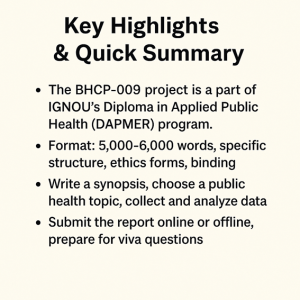
Figure: Key Highlights for DAPMER Project
Introduction
What is IGNOU BHCP 009 Project in DAPMER Program?
BHCP-009 is the Internship Project course in IGNOU’s Diploma in Apparel Merchandising (DAPMER). It carries 8 credits and involves practical field experience. In this course, students apply theory (from courses like BHC-005/006/007) to real-world apparel industry work. IGNOU describes the internship as immersion in garment production and merchandising tasks. Students work in a manufacturing team and participate in processes such as sampling, production, and quality control. The internship report (project report) documents these learning experiences and outcomes.
Importance of Project Work in Public Health Education
Although DAPMER focuses on the apparel industry, project work (or internships) is vital in any professional program – including public health or community medicine. A well-designed project provides hands-on learning and strengthens research and professional skills. IGNOU notes that project courses help develop research aptitude, writing and communication abilities, and practical problem-solving capacity. In essence, completing BHCP-009 enables students to consolidate their knowledge by tackling real challenges, honing analytical skills, and preparing them for future industry or healthcare roles.
IGNOU DAPMER Project Format & Guidelines
Word Count, Structure & Layout
The BHCP-009 final report should be concise but comprehensive. Aim for roughly 50–70 double-spaced pages of main text (about 12,000–18,000 words) excluding appendices. Structure the report into clear sections. A typical structure includes:
- Title Page: Project title, program and course codes (DAPMER, BHCP-009), student name and enrolment number, study center code, and the name of the internship guide or supervisor.
- Certificate of Originality/Declaration: A signed statement by you and your supervisor confirming the work is your own and has not been submitted elsewhere. Use IGNOU’s Project Format if provided.
- Acknowledgements and Table of Contents (with page numbers).
- Introduction & Literature Review: Background and context of the topic, rationale, problem statement, objectives/scope, and brief review of relevant literature.
- Methodology: Description of research design, data sources (primary vs. secondary), data collection methods (surveys, interviews, observations), tools and techniques used (software, statistical methods), sampling procedures, and any ethical considerations.
- Results & Discussion: Presentation of findings with tables, charts or graphs, followed by interpretation of the data in relation to objectives. Discuss trends, patterns, and any comparisons with expectations or benchmarks.
- Conclusions & Recommendations: Summarize key findings, explain their implications, and suggest practical recommendations or future work.
- References/Bibliography: List all sources (books, articles, reports, websites) cited in the report, following a consistent academic citation style (e.g. APA, MLA, or as recommended by IGNOU).
- Appendices/Annexures: Include supplementary material such as survey questionnaires, raw data, consent forms, or detailed calculations.
Certificate, Declaration, and Ethics Forms
Include all formal pages required by IGNOU. Besides the Certificate of Originality/Declaration (signed by you and your guide), attach the Synopsis Approval Proforma (signed by your supervisor) and a Supervisor’s Certificate if one is provided by the internship organization. If your project involved fieldwork at a company or clinic, include any work completion certificates from that organization. For studies involving human subjects (surveys, interviews, health data), obtain an ethical clearance certificate from an Institutional Ethics Committee or include signed consent forms. Ensuring these documents are complete is essential for acceptance of your project.
Binding, Font, Spacing & Other Formatting Details
Use standard formatting guidelines: A4 paper (for printed copies) with at least 1-inch margins on all sides. Choose a legible font (e.g. Times New Roman or Arial) at 11 or 12-point size. Set line spacing to 1.5 (one-and-a-half spacing) and justify the text. Number pages consecutively (for example, page numbers at the bottom center). If you submit a hard copy, bind it neatly (e.g. spiral or hardcover) with divider sheets if needed. Table and figure captions should be clear, and graphics should be of acceptable quality. Follow any additional style norms given by IGNOU, such as caption formats or paragraph alignment.
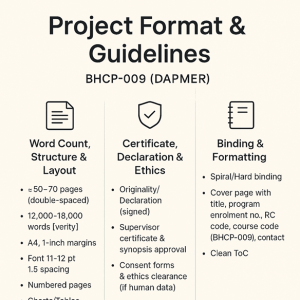
Figure: IGNOU DAPMER Project Format & Guidelines
Writing the IGNOU DAPMER Project Synopsis
What to Include in the DAPMER Synopsis
The project synopsis (also called the project proposal) is a concise outline of your planned study. It should be about 500–700 words. Include these key elements:
- Title of the Project: A clear, descriptive title that reflects the study topic.
- Background & Rationale: Brief context explaining why this topic is important and worth studying.
- Objectives: Specific goals or research questions your project will address.
- Brief Literature Review: Highlights of key existing research or gaps you intend to fill.
- Hypotheses (if any): Any assumed answers or predictions you will test.
- Methodology: Overview of your approach – research design, data collection methods (surveys, experiments, etc.), population and sampling, tools/techniques.
- Population and Sample: Description of the target group (e.g. consumers, factory workers) and the size of the sample you will study.
- Expected Outcomes/Implications: What you hope to discover or achieve and how it could be useful.
- Timeline: A brief schedule of major activities (e.g. months for literature review, fieldwork, analysis).
- References: (if any) Brief citation of sources referenced in the synopsis.
Ensure the synopsis clearly states the topic, objectives, methodology, and proposed impact. IGNOU Project Guidelines emphasize a clear statement of topic, objectives, methodology, and implications in the synopsis.
Sample Synopsis Structure (PDF/Visual)
A typical DAPMER synopsis could be organized with headings such as:
- Title
- Background/Introduction (context and rationale)
- Literature Review (concise overview of relevant sources)
- Objectives/Research Questions
- Methodology (data sources, tools, procedures)
- Expected Results (what findings you anticipate)
- Work Plan/Timeline
- References
IGNOU provides a standard proforma for synopsis approval that you must use. Include any required forms and arrange the content under clear headings. Reviewing a sample approved synopsis (often available from IGNOU’s resources or senior students) can help you format yours correctly, but be sure to write original content.
📌 For a visual guide and templates, refer to:
👉 How to write IGNOU Synopsis/Proposal?
How to Get Supervisor Approval
First, choose an approved supervisor for your DAPMER project (faculty member or industry expert recognized by IGNOU). Fill out the IGNOU Project Proposal Proforma with your details and project title. Write the DAPMER synopsis and then have both you and your supervisor sign the proforma. Also prepare the supervisor’s signed biodata (a brief CV). Submit these documents, along with your synopsis text, to your Regional Centre or the concerned IGNOU School for evaluation. The proposal will be reviewed by faculty. Once approved, you’ll receive a confirmation (often a Project Proposal Number). Keep a copy of all signed forms and approval letters for your records.
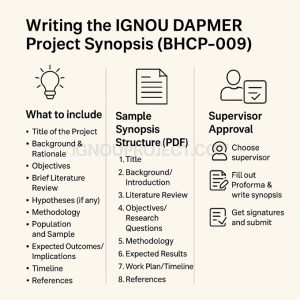
Figure: Writing the IGNOU DAPMER Project Synopsis
IGNOU DAPMER Project Topics (BHCP 009)
20 Trending Project Topics in Public Health
Here are some topic ideas to inspire your BHCP-009 project (focused on public health or community aspects):
- Evaluating community-based obesity prevention programs in urban areas.
- Assessing the impact of public smoking bans on respiratory health outcomes.
- Role of health education in reducing HIV/AIDS prevalence.
- Impact of air pollution on asthma incidence in industrial cities.
- Effectiveness of school nutrition programs on childhood obesity rates.
- Influence of public policies on mental health stigma.
- Access to clean water and its effect on infectious disease rates.
- Effectiveness of needle-exchange programs in reducing hepatitis C spread.
- Effects of social determinants on maternal and child health in low-income areas.
- Use of digital health interventions in managing chronic diseases.
- Benefits of workplace wellness programs on employee health.
- Role of urban green spaces in improving community mental well-being.
- Evaluating vaccination campaigns in preventing disease outbreaks.
- Impact of public awareness campaigns on reducing alcohol-related harm.
- Challenges faced by healthcare systems due to aging populations.
- Mental health trends in rapidly urbanizing regions.
- Effectiveness of telemedicine in providing rural healthcare access.
- Health impacts of electronic waste recycling practices.
- Improving health literacy to manage diseases in the olderly people.
- Response to the opioid addiction crisis in rural communities.
Feel free to adapt these ideas or combine themes to suit your interests. (If you pursue apparel-themed topics, ensure they still involve health or community aspects as required for DAPMER guidelines.)
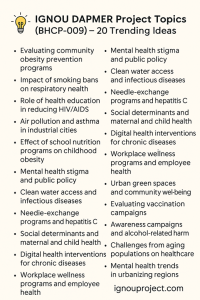
Figure: 20 Trending IGNOU DAPMER Project Topics (BHCP 009)
Criteria for Selecting a Good Topic
Choose a topic that is relevant and feasible. Key criteria include:
- Relevance: The topic should fit within the remit of DAPMER or public health and address a real-world problem.
- Feasibility: Ensure data can be collected within your resources and time (6–8 months). The scope should be manageable in one diploma project.
- Interest and Expertise: Pick something you are passionate about and that your supervisor can guide you on.
- Originality: The topic should not simply duplicate past projects. Look for a research gap or a new angle on an issue.
- Scope: Avoid topics that are too broad (impossible to cover) or too narrow (lacking depth).
- Ethics and Permissions: Consider whether you can obtain necessary consents or approvals (e.g., working with health data or human subjects).
- Availability of Data: Check if relevant data or literature is accessible.
- Career Goals: If possible, align the topic with your future interests or local community needs.
Balancing these factors will help you select a strong, practical topic for BHCP-009.
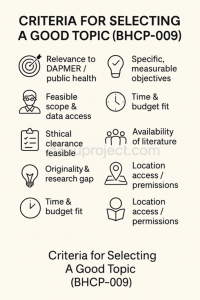
Figure: Criteria for Selecting a Good Topic for BHCP-009
Data Collection & Analysis in IGNOU BHCP 009 Project
Primary vs Secondary Data
- Primary Data: This is information you collect yourself for the project. Examples include surveys of consumers, interviews with factory managers, or observations in an apparel unit. Primary data are original and directly targeted to your objectives.
- Secondary Data: Existing information gathered by others. This can be published articles, industry reports, government health statistics, company sales records, or database entries. Secondary data can provide background or support for your findings.
In BHCP-009, you might combine both: for instance, conduct a customer survey (primary) and analyze published market trends (secondary). Choose the mix that best answers your research questions.
Tools, Surveys, and Interview Techniques
Common data collection tools and techniques include:
- Questionnaires/Surveys: Structured forms (paper or electronic) with closed or open-ended questions to gather information from respondents (e.g. consumers, workers, patients).
- Interviews: One-on-one interviews (face-to-face or by phone) with stakeholders like industry experts, supervisors, or community health workers to gain insights.
- Focus Groups: Guided group discussions to explore opinions or behaviors in more depth.
- Observation: Checklists or logs to record behaviors or conditions directly (e.g. observing hygiene practices in a facility).
- Measurement Tools: Instruments or apps for collecting quantitative data (e.g. measuring air quality, tallying attendance).
For analysis, use tools such as Microsoft Excel for basic stats and charts, or statistical software (SPSS, R) for deeper analysis. Qualitative data (from interviews) might be analyzed by summarizing common themes. Ensure any questionnaires or interview guides are well-designed and pre-tested if possible.
How to Maintain Data Confidentiality
Protecting research participants’ privacy is essential:
- Anonymize Data: Do not record personal identifiers (names, IDs). Assign codes to respondents if needed. In reports, refer to groups or categories, not individuals.
- Secure Storage: Keep data files (digital or hard copy) in secure locations. Use password protection or encryption for electronic data. Lock up paper records.
- Informed Consent: Before collecting data, explain the purpose to participants and obtain their consent (written or recorded). Inform them how you will use the data.
- Ethical Handling: Use the data only for this project. Destroy any identifying information once analysis is complete (if required).
- Approval: If needed, get formal ethical clearance from an appropriate committee, especially for health-related research.
Following these steps ensures your BHCP-009 project meets ethical standards and complies with any institutional guidelines.
DAPMER Project Timeline & Submission Process
Jan vs July Cycle
IGNOU offers admissions in January and July. Project timelines align with the Term-End Examinations. For a January admission, work towards submitting your project by the end of November (for the December TEE). For a July admission, aim to submit by late May (for the June TEE). The exact last dates are announced by IGNOU each cycle. Plan accordingly: finalize your synopsis early (usually within 3–4 months of starting), conduct fieldwork in the middle months, and leave ample time for analysis and writing before the deadline.
Online & Offline Submission Steps
After writing your BHCP 009 report and obtaining all signatures, submit as follows:
- Online Submission (if applicable): IGNOU’s project portal allows you to upload the report digitally. Scan your final report into a single PDF file. The first page of this PDF must include: Project Title, Learner’s Name, Program Code (DAPMER), Enrolment Number, Regional Centre Code, Course Code (BHCP-009), Mobile No., and E-mail. Upload the file before the deadline. Ensure all pages are clear and in order. (Do not upload assignments on this portal.)
- Offline (Hard Copy): Print and bind 2–3 copies of your report. On the cover page, include all details (title, name, etc.). Attach the signed Certificate of Originality, approved synopsis copy, and any other required forms. Pay the project evaluation fee (for an 8-credit project, ₹500) along with your term-end exam form, and include the fee receipt. Submit the bound copies and all documents to your IGNOU Regional Centre by the deadline.
Keep photocopies of everything (fee receipt, signed forms, etc.) as backup.
Evaluation & Viva Voce Expectations
The project report will be externally evaluated by IGNOU examiners, and your field supervisor’s input may also count. Generally, a minimum of 40% marks is needed to pass. After submission, expect a viva-voce (oral defense). IGNOU faculty will quiz you on your objectives, methodology, data, and conclusions. Prepare by reviewing your report thoroughly. Be ready to explain and justify your choices. Strong understanding of your project details and confidence in presenting them will help you succeed in the viva.
Sample Viva Questions for BHCP 009
10 Questions You Should Prepare For
- Why did you choose this project topic and what is its significance?
- What are the main objectives or research questions of your project?
- Describe the methodology you used. Why was this approach suitable?
- How did you collect and analyze your data?
- What are the key findings or results of your study?
- How do your results compare with existing studies or expectations?
- What challenges or limitations did you face during the project?
- How did you ensure ethical standards and confidentiality in your data?
- What practical recommendations or conclusions can you draw from your work?
- If you had more time, how would you extend or improve this project?
Prepare concise answers to these questions. Practice summarizing your project in a few sentences (objectives, methods, findings, importance).
How to Defend Your DAPMER Project Work
Stay calm and confident in the viva. Review your entire report so you know every detail (objectives, data, analysis, conclusions). Practice explaining each section clearly and in simple terms. Think about why you made certain choices so you can justify them (e.g., why you chose a survey vs. interviews). If asked about limitations, acknowledge them and explain how they affect conclusions. Cite specific examples or figures from your report when explaining key points. Speak clearly, maintain eye contact, and listen carefully to questions. Effective preparation and a clear understanding of your own work are key to defending your IGNOU DAPMER project successfully.
FAQs in IGNOU DAPMER Project for BHCP 009
What is the typical word count for the BHCP-009 project report?
Aim for about 12,000–15,000 words of main text (roughly 50–60 pages double-spaced) plus appendices. This fits an 8-credit project scope.
What is the submission deadline for the BHCP-009 project?
Deadlines depend on your admission cycle. January admits should submit by the end of November, and July admits by late May (for the December and June Term-End Exams respectively). Always confirm dates on the IGNOU website or with your Regional Centre.
Is there a viva-voce for the BHCP-009 project?
Yes. IGNOU usually conducts a viva-voce to assess your project work. You will be questioned on your methodology, findings, and conclusions. Prepare your presentation and anticipate questions in advance.
What forms do I need to submit with my DAPMER project report?
You need your signed synopsis approval form, the Certificate of Originality/Declaration (signed by you and your guide), and any fieldwork certificates (if applicable). Include proof of fee payment and your supervisor’s biodata form if required.
Do I need ethical clearance for my DAPMER project?
If your BHCP-009 research involves human subjects (e.g. surveys, interviews) or sensitive data, you should obtain ethics clearance from a recognized committee, or at least have participants sign consent forms. Include any clearance certificate in the report.
Where do I find the guidelines and forms for BHCP-009?
IGNOU’s official resources include the DAPMER course guide and BHCP-009 internship manual (available on the IGNOU website or eGyankosh portal). The regional centre also provides the project proposal form and format instructions. Use these official documents to ensure you follow all rules.
Download Resources
- IGNOU DAPMER Project Synopsis Sample PDF
- IGNOU BHCP 009 Project Report Sample PDF
- IGNOU BHCP-009 Project Topics Sample List PDF
Conclusion
The IGNOU DAPMER Project for BHCP 009 course is your opportunity to gain real-world experience in apparel merchandising while applying academic knowledge. By following the outlined format and guidelines, choosing a relevant topic, and preparing thoroughly (especially for data collection and the viva), you can complete the project successfully. Use the tips and resources provided here to stay organized: plan your timeline, consult your supervisor early, and adhere to IGNOU’s submission rules.
Thorough preparation and clear documentation will help you achieve a strong report and a confident viva, ensuring the successful completion of your DAPMER internship project.
Need Help with Your IGNOU DAPMER Project (BHCP 009)?
Get expert assistance, topic suggestions, and ready-to-submit project reports now!
👉 [Contact Us] | 🌐 Visit: ignouproject.com

BK Sahni iD 0009-0005-8092-459X
Founder, Shri Chakradhar Publication Pvt. Ltd. & ignouproject.com — helping IGNOU distance-learning students since 2010 (5,00,000+ students supported across MBA, MCom, MA & more). Author of IGNOU exam guides, solved assignments & project reference books.
Disclosure: Shri Chakradhar Publication Pvt. Ltd. and ignouproject.com are independent third-party study-help services — not the official IGNOU website. Always verify final dates and rules on ignou.ac.in.