MA Human Values and Ethics (MAHUE) · December 2026 term-end examination
IGNOU has set each MHU paper only once. In June 2026, 40 of the 49 long questions on those seven papers took a theme the same cycle’s MHU assignment had already asked.
The seven Year I papers and fourteen MHU assignment files read side by side, theme by theme, with every MAHUE sitting taken from IGNOU’s date sheet of 30 October 2026: seven afternoons between 7 and 21 December.
- 7 MHU papers, one session: June 2026
- MHU-001 opens Mon 7 Dec, 2 PM
- All seven papers 2 PM to 5 PM
- Any five of eight, 20 marks each
- Word limits printed on every paper
- Free afternoon planner and answer clock
List the codes exactly as the hall ticket prints them, MHU-001 to MHU-007, and write PDF or printed beside each one.
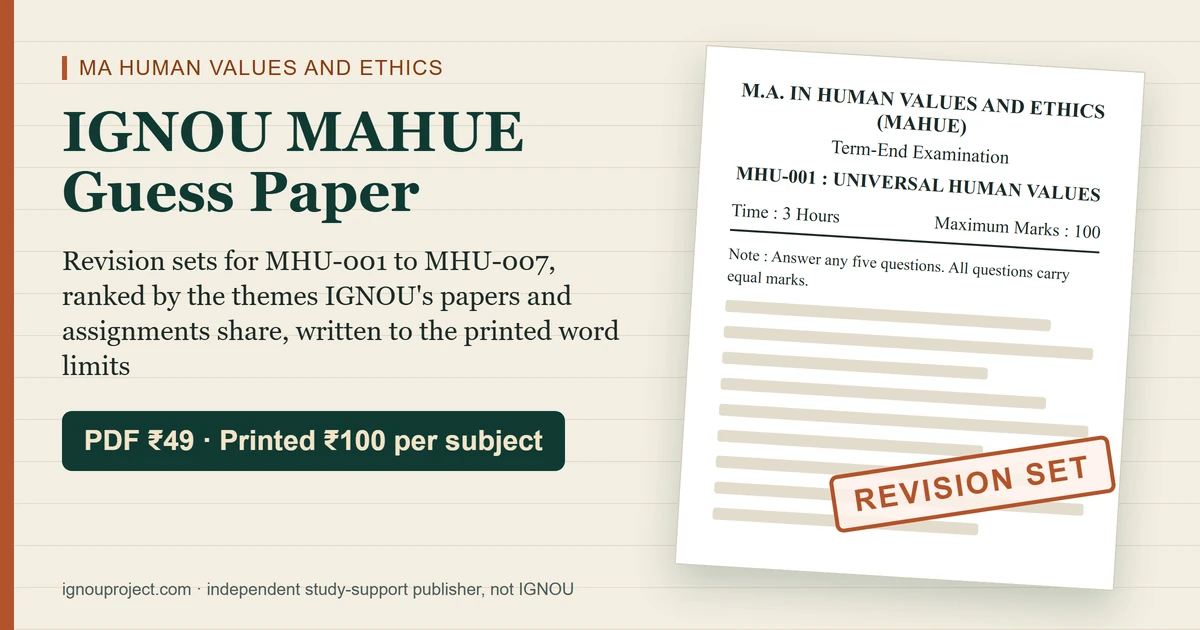
Quick answer. An IGNOU MAHUE guess paper is a revision set for one MHU course code of the MA in Human Values and Ethics, with model answers written to the length IGNOU prints on the paper; the December 2026 term-end examination (TEE) covers the seven Year I codes, MHU-001 to MHU-007, which are also the whole PG Diploma in Human Values and Ethics. IGNOU’s December 2026 cycle runs from 25 November 2026 to 14 January 2027, and the MAHUE papers run from MHU-001 on Monday 7 December to MHU-007 on Monday 21 December, every one from 2 PM to 5 PM, per IGNOU’s date sheet of 30 October 2026. Each of the seven June 2026 MHU papers was 3 hours and 100 marks, any five of eight questions at 20 marks each, set in English only. The rate is ₹49 per subject code for a solved guess paper as a PDF, or ₹100 per subject code as a printed copy. Printed copies carry a one-time courier charge of ₹100 per order, whatever the number of subject codes; the PDF has no courier charge. Each set is prepared for the upcoming term-end examination, in every medium IGNOU examines that course in, and the medium for your course code is confirmed on WhatsApp before you pay. For MAHUE that medium is English, and because IGNOU has set each MHU paper only once, a set ranks themes to revise first and never forecasts a question.
MAHUE December 2026 Exam Days: Seven Afternoons From 7 to 21 December
The first MAHUE paper of December 2026 is MHU-001 Universal Human Values on Monday 7 December 2026, 2 PM to 5 PM, and the last is MHU-007 Research and Innovation Ethics on Monday 21 December 2026, also 2 PM to 5 PM, according to IGNOU’s December 2026 date sheet dated 30 October 2026. The earlier tentative sheet of 21 September 2026 gave all seven MHU codes the same dates and the same afternoon session, so the revision between the two versions moved no MAHUE paper.
The whole IGNOU cycle, every programme: Wednesday 25 November 2026 to Thursday 14 January 2027, as the 30 October 2026 sheet prints it
First MAHUE paper
MHU-001 Universal Human Values, Monday 7 December, 2 PM to 5 PM
Last MAHUE paper
MHU-007 Research and Innovation Ethics, Monday 21 December, 2 PM to 5 PM
The 30 October 2026 sheet no longer carries the word “tentative” in its heading, but IGNOU can still revise it. The hall ticket settles the date, the session and the centre.
A Free Day Between Most MHU Papers
IGNOU has spaced the Year I papers on a Monday, Wednesday and Friday rhythm: MHU-001 on Monday 7 December, MHU-002 on Wednesday 9, MHU-003 on Friday 11, MHU-004 on Monday 14, MHU-005 on Wednesday 16, MHU-006 on Friday 18 and MHU-007 on Monday 21 December. No two MHU papers share a date, none falls on consecutive days, and each afternoon paper is followed by at least one clear day.
The gaps are not equal. Weekdays leave one free day between papers, while the two weekends leave two, before MHU-004 and before MHU-007. A learner sitting all seven codes therefore has 14 days from first paper to last, and the long weekend gaps are the natural place for the heaviest revision: MHU-004 Values and Decision-Making and MHU-007 Research and Innovation Ethics.
No Year II Code on the December 2026 Sheet
MHU-008 to MHU-013 do not appear on either the 30 October or the 21 September sheet. IGNOU’s Academic Programme Launch Notification No. 173, dated 6 February 2026, offers MAHUE from the January 2026 session with an annual examination, so no learner has yet reached a Year II term-end paper.
Checklist before the first MHU afternoon.
- All seven papers start at 2 PM. Reporting time for the afternoon session is earlier than the paper itself, so check it against the hall ticket for each date.
- Tuesday 8, Thursday 10, Tuesday 15 and Thursday 17 December carry no MHU paper, and the weekends of 12 to 13 and 19 to 20 December are two-day gaps.
- A PG Diploma learner and a MAHUE Year I learner sit the same seven papers on the same seven dates.
- A code missing from the hall ticket, or a Year II code shown on one, is a matter for the Regional Centre before 7 December.
Learners checking other programmes can use the site’s December 2026 date sheet lookup. The two session timings and reporting rules are covered in the explainer on IGNOU exam timings, and the admit card in the guide to the IGNOU hall ticket. Centre questions go to the page on changing an exam centre; anyone still registering will need the per-course exam fee and the steps for paying the exam form online.
The Weight of an MHU Exam Mark, and the Percentage No MHU Document Prints
IGNOU prints no weightage figure for MAHUE. None of the seven June 2026 MHU term-end papers carries a weightage line, and none of the fourteen MHU assignment files for the June 2026 and December 2026 cycles states a percentage either; the July 2026 Common Prospectus and Launch Notification No. 173 are silent on the split as well. How the exam mark and the assignment mark combine for MAHUE is therefore a question for the MAHUE Programme Guide, and this page borrows no figure from another programme.
What the documents do show is the shape of the two tasks. An MHU assignment is answered at home in five questions that break into thirteen written pieces, with the longest asked “in about 500 words”. In the hall, the paper wants five answers in three hours with no book open, each up to 500 words unless the short-note pair is one of them.
One page on this website, the MAHUE handwritten assignment page, currently states a 30 per cent and 70 per cent split for MAHUE as fact. No MHU document prints that split. The line there is logged for correction, and until IGNOU’s Programme Guide says otherwise, any percentage quoted for MAHUE is unconfirmed.
Ethics Revision Set, IGNOU Paper or Answered Paper: Which One Helps an MHU Learner
A guess paper is a revision set of important and recurring questions for one course code, such as MHU-005 Fundamentals of Ethics, with model answers, prepared by a publisher from IGNOU’s past papers, assignments and the syllabus. Sellers also call it “important questions”, “expected questions”, a “model paper” or a “sample paper”; all of these names describe the same kind of publisher-made set, and none is an IGNOU document.
A previous year question paper is the actual paper IGNOU set in an earlier term-end examination, free on IGNOU’s own site; for MAHUE, only one exists per code so far, the June 2026 paper of each of MHU-001 to MHU-007. A solved question paper takes that IGNOU paper and adds a publisher’s model answers to it.
On a phone, swipe the table sideways for every column.
| Question | MHU guess paper | IGNOU previous year paper | Solved question paper |
|---|---|---|---|
| What it is | Ranked themes for one MHU code, with model answers | The June 2026 paper IGNOU set for that code | That June 2026 paper with answers added |
| Who makes it | A publisher | IGNOU | A publisher |
| Cost | ₹49 PDF or ₹100 printed per code here | Free | Varies by seller |
| Best use for MAHUE | Ordering revision across themes the paper and assignments share | Seeing the exact layout and word limits | Checking how one past answer was built |
| What it cannot do | Know the December 2026 questions | Show any pattern of repeats, because only one session exists | Cover themes that paper did not ask |
For MAHUE the usual advice to “practise the last five years” does not apply, because there is one year. Writing the free June 2026 paper of each code under a three-hour timer is still the best free rehearsal of the layout. Answered versions of past papers for other programmes sit on the site’s page of solved IGNOU question papers, and the programme-wide revision sets on the IGNOU guess paper hub.
Written to the printed limits. Long answers are drafted at 400 to 500 words and short notes at 200 to 300, the limits every June 2026 MHU paper prints.
Thirty-four minutes an answer. Each 20-mark answer fits the time a three-hour paper leaves after ten minutes of reading.
Assignment and paper themes first. Themes IGNOU set in an MHU assignment and again in the June 2026 paper open each set.
Indian schools named one by one. MHU-002 answers treat Samkhya-Yoga, Nyaya-Vaisesika, Mimamsa, Lokayata, Buddhist and Jain ethics separately, the way the June 2026 paper asked.
Theorists with their claims. MHU-005 answers place Bentham, Mill, Kant, Aristotle and MacIntyre against the questions that name them.
MHU-001 in its own vocabulary. Right Understanding, Self and Body, and the undivided society are explained in the terms the course and the paper use.
Decision models applied. MHU-004 answers apply ethical decision criteria to a business or public-administration case, as the June 2026 paper required.
Philosophers of the human being. MHU-003 answers cover Descartes, being-in-the-world and the personhood debates around genetic engineering.
Applied ethics with examples. MHU-006 answers on CSR, social impact assessment and AI carry examples, since the paper asks for them.
Research integrity in order. MHU-007 answers separate plagiarism, copyright and patents, and data ethics from data management.
Short notes as pairs. Question 8 asks for two notes of four, so each is answered as a compact, separate note.
English, in either format. The PDF arrives on WhatsApp after payment; the printed copy is a booklet sent by courier.
Thirteen Taught MHU Courses Over Two Years, and a Credit Total That Depends on the IGNOU Document
MAHUE is the Master of Arts in Human Values and Ethics of the School of Interdisciplinary and Trans-disciplinary Studies (SOITS), set out in section 3.44 of the July 2026 Common Prospectus. It runs over two years, is examined year-wise, admits any graduate and is taught in English. Thirteen MHU courses are examined in the hall. The fourteenth code, MHUP-014, is a dissertation or project; it is not written in the hall and no table below lists it. Year I, MHU-001 to MHU-007, is also the complete PG Diploma in Human Values and Ethics, which the prospectus awards after the first year.
Year I: The Seven Papers on the December 2026 Sheet
On a phone, swipe the table sideways for every column.
| Code | Title (July 2026 Common Prospectus) | Credits | Year | December 2026 sitting |
|---|---|---|---|---|
| MHU-001 | Universal Human Values | 6 | Year I | Mon 7 Dec 2026, 2 PM to 5 PM |
| MHU-002 | Human Values in Various Indian Philosophy | 6 | Year I | Wed 9 Dec 2026, 2 PM to 5 PM |
| MHU-003 | Philosophy of Human Being | 6 (notification: 4) | Year I | Fri 11 Dec 2026, 2 PM to 5 PM |
| MHU-004 | Values and Decision-Making | 6 | Year I | Mon 14 Dec 2026, 2 PM to 5 PM |
| MHU-005 | Fundamental of Ethics | 6 | Year I | Wed 16 Dec 2026, 2 PM to 5 PM |
| MHU-006 | Social and Environmental Ethics | 6 | Year I | Fri 18 Dec 2026, 2 PM to 5 PM |
| MHU-007 | Research and Innovation Ethics | 6 | Year I | Mon 21 Dec 2026, 2 PM to 5 PM |
Year II: Six Courses Not Yet Examined
On a phone, swipe the table sideways for every column.
| Code | Title (July 2026 Common Prospectus) | Credits | Year | December 2026 sitting |
|---|---|---|---|---|
| MHU-008 | Values and Ethics in Education and Media | 6 | Year II | Not on the December 2026 sheet |
| MHU-009 | Resolving Ethical Dilemma | 6 | Year II | Not on the December 2026 sheet |
| MHU-010 | Values and Ethics in Leadership and Governance | 6 | Year II | Not on the December 2026 sheet |
| MHU-011 | Business Ethics and CSR | 4 | Year II | Not on the December 2026 sheet |
| MHU-012 | Ethics in Professional Fields | 6 | Year II | Not on the December 2026 sheet |
| MHU-013 | Cross-Cultural Aspects of Values and Ethics | 4 | Year II | Not on the December 2026 sheet |
The prospectus prints MHU-003 at 6 credits, and so does IGNOU’s MAHUE programme page. Launch Notification No. 173 prints it at 4. The credits column above follows the prospectus and flags the difference; the box further down sets out what each document adds up to.
What the June 2026 MHU Papers Looked Like
Every June 2026 MHU paper, from MHU-001 to MHU-007, is 3 hours and 100 marks, asks the learner to answer any five of eight questions at 20 marks each, and prints a word limit: 400 to 500 words for questions 1 to 7 and 200 to 300 words for question 8, which is a choice of two short notes from four at 10 marks each. All seven are three-page papers set in English only, with no Hindi half, and all seven carry the heading “Post Graduate Diploma in Human Values and Ethics (PGDHVE)” rather than the programme name MAHUE.
On a phone, swipe the table sideways for every column.
| Code | Latest IGNOU paper | Title as printed on the paper | Time and marks | Answer rule | Printed in |
|---|---|---|---|---|---|
| MHU-001 | June 2026 (B-2752) | Universal Human Values | 3 hours, 100 marks | Any five of eight, 20 marks each; Q8 two short notes of four | English only |
| MHU-002 | June 2026 (B-2753) | Human Values in Various Indian Philosophy | 3 hours, 100 marks | Any five of eight, 20 marks each; Q8 two short notes of four | English only |
| MHU-003 | June 2026 (B-2754) | Philosophy of the Human Being | 3 hours, 100 marks | Any five of eight, 20 marks each; Q8 two short notes of four | English only |
| MHU-004 | June 2026 (B-2755) | Values and Decision Making | 3 hours, 100 marks | Any five of eight, 20 marks each; Q8 two short notes of four | English only |
| MHU-005 | June 2026 (C-3761) | Fundamentals of Ethical Theory | 3 hours, 100 marks | Any five of eight, 20 marks each; Q8 two short notes of four | English only |
| MHU-006 | June 2026 (C-3762) | Social and Environmental Ethics | 3 hours, 100 marks | Any five of eight, 20 marks each; Q8 two short notes of four | English only |
| MHU-007 | June 2026 (C-3764) | Research and Innovation Ethics | 3 hours, 100 marks | Any five of eight, 20 marks each; Q8 two short notes of four | English only |
Two details differ inside that uniform layout. MHU-001 and MHU-003 print “200-300 words each” for question 8, while the other five print only “200-300 words”, which leaves open whether the limit applies to each note or to the pair. IGNOU also prints the course titles of MHU-003 and MHU-005 differently from the prospectus, as the conflict box explains.
Time Per Answer, Worked Out From the Printed Limits
On a phone, swipe the table sideways for every column.
| Part of the paper | Marks and printed limit | Time in a 3-hour paper |
|---|---|---|
| Questions 1 to 7, any of them | 20 marks, 400 to 500 words | about 34 minutes, 12 to 15 words a minute |
| Question 8, two short notes of four | 10 marks each, 200 to 300 words | about 17 minutes per note |
| Reading and choosing | Eight questions to scan | 10 minutes at the start |
Three hours is 180 minutes. Keeping 10 for reading and choosing leaves 170, or 34 minutes for each of the five answers. A 450-word answer in 34 minutes means about 13 words a minute, including the pause to plan. For question 8 the 34 minutes split into two notes of 17 minutes, which suits about 250 words each. A learner who writes the 500-word assignment answers at home without a clock should time at least one full answer before 7 December.
Which MHU Sets a Learner Needs
On a phone, swipe the table sideways for every column.
| Learner | Codes in December 2026 | Note |
|---|---|---|
| MAHUE Year I | MHU-001 to MHU-007 | Seven afternoons, 7 to 21 December |
| PG Diploma in Human Values and Ethics | MHU-001 to MHU-007 | The same papers, headed for the diploma |
| Repeating one or two Year I codes | Only the codes on the hall ticket | Same date and session as everyone else |
| MAHUE Year II | None on the December 2026 sheet | Confirm the first sitting of MHU-008 to MHU-013 with the Regional Centre |
Where IGNOU’s own MAHUE documents disagree.
- Credits. Section 3.44 of the prospectus lists credits that add to 82 (42 in Year I, 40 in Year II) and then states a total of 80. IGNOU’s MAHUE programme page lists the same 82. Launch Notification No. 173 prints MHU-003 at 4 credits, which makes Year I 40 and the total exactly 80. The notification is a scanned file hosted on the Ranchi Regional Centre’s site.
- Diploma name. The prospectus and the MHU assignment files say PGDHUE. Every June 2026 MHU exam paper says PGDHVE. Both mean the PG Diploma in Human Values and Ethics.
- MHU-005 title. The prospectus and the programme page print “Fundamental of Ethics”, the June and December 2026 assignments print “Fundamentals of Ethics”, and the June 2026 exam paper prints “Fundamentals of Ethical Theory”. It is one course with one code.
- MHU-003 title. “Philosophy of Human Being” in the prospectus; “Philosophy of the Human Being” on the June 2026 paper and both assignments.
- Small slips. The project row reads “Dissertation/ Proiect” in the prospectus and on the programme page. The June 2026 MHU-006 paper prints “Write an essay an conscious consumption”, MHU-005 prints “Discuss is application”, and the December 2026 MHU-004 assignment labels its short-note options a to f and then h.
- Fee. The notification gives ₹7,500 a year; the prospectus and the programme page give ₹8,000. Only the Regional Centre can confirm the amount payable.
- On this website, pending correction. The MAHUE handwritten assignment page says nothing resolves the 82 and 80 figures, and describes “Fundamentals” as a seller’s tidying of IGNOU’s wording; Launch Notification No. 173 and IGNOU’s own assignment files show otherwise. It also states a 30 and 70 per cent weightage that no MHU document prints.
MHU is not MHI or MHD. Search results for “MHU” regularly mix in MHI (MA History) and MHD (MA Hindi) sets. MAHUE has no retired or renamed codes yet, so the risk is a set bought for the wrong three letters, not an old syllabus. Check that every set names an MHU code and one of the course titles above.
No separate ignouproject.com page exists yet for any single MHU code, so the course tables above are the reference for every code on this page.
What the Seven June 2026 MHU Papers Asked, Set Beside the MHU Assignments
In June 2026, 40 of the 49 long questions on the seven MHU papers took a theme that IGNOU’s MHU assignment for the same June 2026 cycle had already asked. The share was 7 of 7 long questions in MHU-001, MHU-006 and MHU-007, 6 of 7 in MHU-004, 5 of 7 in MHU-003, and 4 of 7 in MHU-002 and MHU-005. Of the 28 short-note options across the seven papers, 19 also matched a June 2026 assignment theme.
The counts come from three IGNOU documents per course, each reviewed in full by ignouproject.com on 4 November 2026: the June 2026 term-end papers on IGNOU’s question paper index, the June 2026 MHU assignment and the December 2026 MHU assignment, both listed on IGNOU’s assignment download index. Matching is at the level of a theme, not of exact wording, and it is a human judgement: “Right Understanding (Knowing)” in an assignment and “Right Understanding” with knower, known and knowing in the paper count as one theme. A cell shows the question number; a dash means the document did not ask that theme. The tables cover MHU-001 to MHU-007; for MHU-008 to MHU-013, which IGNOU has not yet examined, the format is confirmed against the latest IGNOU paper on WhatsApp.
Why there is no “n of N papers” count here. IGNOU’s December 2025 question paper index lists no MHU file, and June 2026 is the only session with MHU papers. With one paper per code, no theme can yet be called a repeat between term-end papers, and none is called one on this page. What can be measured is how closely a paper followed the assignments around it: across the seven codes, 43 of 70 themes appear in all three documents, and 54 of the 68 themes on the June 2026 papers turn up again in the December 2026 assignments.
The pattern is uneven by course, and the exceptions matter more than the average. MHU-002 is the clearest: its June 2026 assignment asked about Indian thought in general terms, while the paper named individual schools. Samkhya-Yoga, Nyaya-Vaisesika with Mimamsa, and Lokayata with Buddhist and Jain ethics took questions 2, 3 and 4, and none of the four short-note options appeared in the assignment. The December 2026 MHU-002 assignment now asks about Samkhya, Buddhist and Jain ethics, Lokayata, the Tirukkural and the Constitution.
MHU-001 Universal Human Values
On a phone, swipe the table sideways for every column.
| Theme | June 2026 assignment | June 2026 exam paper | December 2026 assignment | IGNOU documents (of 3) |
|---|---|---|---|---|
| Basic human aspirations and their fulfilment | Q1, 4(a) | Q1 | – | 2 of 3 |
| Right understanding: knower, known and knowing | Q2 | Q2 | Q1 (or), 5(a) | 3 of 3 |
| Self and Body; self-exploration | Q1 (or), 5(a) | Q3 | – | 2 of 3 |
| Human beings, nature and environmental philosophy | Q2 (or), 4(b), 5(h) | Q4, 8(a) | Q2 (or), 4(d) | 3 of 3 |
| Ethics of technology and digital life | 3(d), 5(g) | Q5 | 3(c), 4(a), 5(g) | 3 of 3 |
| Justice from family to world family order | 4(c), 4(d) | Q6 | 3(a) | 3 of 3 |
| Human psychology, human potential, consciousness | 4(f), 5(e), 5(f) | Q7, 8(d) | 4(e), 4(f) | 3 of 3 |
| Existentialism and personal values | 3(b) | 8(b) | 3(b) | 3 of 3 |
| Social justice | 5(d) | 8(c) | – | 2 of 3 |
| Human tradition | 4(e) | – | 5(b) | 2 of 3 |
Check the MHU-001 cells against IGNOU’s own files: the June 2026 MHU-001 paper, the June 2026 MHU-001 assignment and the December 2026 MHU-001 assignment.
MHU-002 Human Values in Various Indian Philosophy
On a phone, swipe the table sideways for every column.
| Theme | June 2026 assignment | June 2026 exam paper | December 2026 assignment | IGNOU documents (of 3) |
|---|---|---|---|---|
| Vedic values and the cosmic moral order | 4(a) | Q1 | Q1 | 3 of 3 |
| Samkhya-Yoga values | – | Q2 | 4(a) | 2 of 3 |
| Nyaya-Vaisesika and Mimamsa ethics | – | Q3 | – | 1 of 3 |
| Lokayata, Buddhist and Jain ethics | – | Q4 | Q2, Q2 (or), 4(d) | 2 of 3 |
| Mahabharata and Ramcharitmanas | Q2 | Q5 | 4(b), 4(f) | 3 of 3 |
| Bhagavad Gita and the Upanishads on duty | 4(b), 4(d) | Q6 | 3(a), 3(c) | 3 of 3 |
| Bhakti and Sufi traditions | 3(b) | Q7 | 3(d) | 3 of 3 |
| Vedanta and Brahman | – | 8(a) | Q1 (or) | 2 of 3 |
| Tirukkural | – | 8(b) | 4(e) | 2 of 3 |
| Madhyastha Darshan | – | 8(c) | – | 1 of 3 |
| Human values in the Constitution of India | – | 8(d) | 3(b) | 2 of 3 |
| Karma and moksha as stand-alone topics | Q2 (or), 3(a), 5(b), 5(c) | – | – | 1 of 3 |
The three MHU-002 documents: the June 2026 MHU-002 paper, the June 2026 MHU-002 assignment and the December 2026 MHU-002 assignment.
MHU-003 Philosophy of the Human Being
On a phone, swipe the table sideways for every column.
| Theme | June 2026 assignment | June 2026 exam paper | December 2026 assignment | IGNOU documents (of 3) |
|---|---|---|---|---|
| Philosophical anthropology: meaning and scope | Q1, 5(a) | Q1 | Q1 | 3 of 3 |
| The anthropocentric perspective | 4(a) | Q1 | – | 2 of 3 |
| Philosophy of the human being and other branches of philosophy | – | Q2 | – | 1 of 3 |
| Western views: rationality, individuality, freedom | Q1 (or), 5(b) | Q3 | Q2, 3(c) | 3 of 3 |
| Indian views and the Upanishads | – | Q4 | 3(a) | 2 of 3 |
| Existence, freedom and being-in-the-world | Q2 | Q5 | 4(c) | 3 of 3 |
| Death, personal identity, rebirth and resurrection | Q2 (or), 3(c), 4(d) | Q6, 8(c) | 3(b), 4(e), 5(e) | 3 of 3 |
| Personhood, genetic engineering and pluralism | 4(e), 5(f) | Q7, 8(d) | 4(f), 5(b), 5(c) | 3 of 3 |
| Human interdependence and relationality | 3(d), 4(b), 5(e) | 8(a) | 4(b), 5(d) | 3 of 3 |
| Self-actualization | 3(a), 5(d) | 8(b) | 3(d) | 3 of 3 |
Sources for MHU-003: the June 2026 MHU-003 paper, the June 2026 MHU-003 assignment and the December 2026 MHU-003 assignment.
MHU-004 Values and Decision-Making
On a phone, swipe the table sideways for every column.
| Theme | June 2026 assignment | June 2026 exam paper | December 2026 assignment | IGNOU documents (of 3) |
|---|---|---|---|---|
| Personal values: creation, development and types | Q1, 3(a), 4(a), 5(a) | Q1, 8(a) | Q1, Q1 (or), Q2 (or) | 3 of 3 |
| Value conflicts and personal values management | Q1 (or), 5(b) | Q2 | Q2, 3(a) | 3 of 3 |
| Utilitarianism, deontology and virtue ethics | – | Q3 | 4(b), 4(d), 5(e) | 2 of 3 |
| Principles and criteria of ethical decision-making | Q2, 4(b) | Q4, 8(b) | 3(b), 3(c) | 3 of 3 |
| Problem-solving models and evaluation | 3(b), 4(e) | Q5 | 4(c) | 3 of 3 |
| Advocacy and activism | 4(c) | Q6 | 4(a) | 3 of 3 |
| Value-based leadership from the Mahabharata, Yogavasistha and Arthashastra | Q2 (or), 4(d), 5(e) | Q7, 8(d) | 4(f), 5(a) | 3 of 3 |
| Implementing an ethical decision | – | 8(c) | – | 1 of 3 |
IGNOU files behind the MHU-004 table: the June 2026 MHU-004 paper, the June 2026 MHU-004 assignment and the December 2026 MHU-004 assignment.
MHU-005 Fundamentals of Ethics
On the June 2026 MHU-005 paper, questions 3 to 6 each named an ethical theory and its thinkers: virtue ethics with Aristotle and MacIntyre, utilitarianism with Bentham and Mill, deontology with Kant’s categorical imperative, and care and evolutionary ethics. Only virtue ethics had appeared in the June 2026 MHU-005 assignment. The December 2026 MHU-005 assignment asks about all four, including eudaimonia, Bentham against Mill, care ethics as a critique of deontology and utilitarianism, Darwin and Spencer, and the categorical imperative.
On a phone, swipe the table sideways for every column.
| Theme | June 2026 assignment | June 2026 exam paper | December 2026 assignment | IGNOU documents (of 3) |
|---|---|---|---|---|
| Nature, scope and importance of ethics | Q1 | Q1, 8(a) | Q1, Q1 (or) | 3 of 3 |
| Moral consciousness, moral law and responsibility | 3(a), 3(d), 4(a) | Q1, 8(b) | Q2 | 3 of 3 |
| Virtue, vice and character | Q1 (or), 5(c) | Q2 | Q2 (or) | 3 of 3 |
| Virtue ethics: Aristotle and MacIntyre | 4(c) | Q3 | 3(a) | 3 of 3 |
| Utilitarianism: Bentham and Mill | – | Q4 | 3(b) | 2 of 3 |
| Deontology and Kant’s categorical imperative | – | Q5 | 4(a), 5(h) | 2 of 3 |
| Care ethics and evolutionary ethics | – | Q6 | 3(c), 3(d) | 2 of 3 |
| Personal and professional ethics, rights, duties, conflict of interest | Q2 (or), 3(c), 4(b), 5(d), 5(e) | Q7, 8(d) | 4(b), 4(c), 5(b) | 3 of 3 |
| Critical appraisal of ethical theories | – | 8(c) | – | 1 of 3 |
Compare questions 3 to 6 with the newer assignment: the June 2026 MHU-005 paper, the June 2026 MHU-005 assignment and the December 2026 MHU-005 assignment.
MHU-006 Social and Environmental Ethics
On a phone, swipe the table sideways for every column.
| Theme | June 2026 assignment | June 2026 exam paper | December 2026 assignment | IGNOU documents (of 3) |
|---|---|---|---|---|
| Corporate social responsibility | 3(b) | Q1, 8(a) | Q1 | 3 of 3 |
| Ethical business practice, social impact assessment, stakeholders | 4(a) | Q2 | Q2, 3(b), 4(f) | 3 of 3 |
| Principles of environmental ethics, conservation and policy | Q2, 3(a), 4(e), 5(a) | Q3 | Q2 (or) | 3 of 3 |
| Information technology: privacy and data protection | 3(d) | Q4 | 3(a), 3(d), 4(a), 5(g) | 3 of 3 |
| Artificial intelligence and responsible innovation | 5(f) | Q5 | 3(c) | 3 of 3 |
| Conscious consumption, waste and sustainable lifestyle | 4(c), 5(c), 5(d) | Q6 | 4(e), 5(a) | 3 of 3 |
| Climate change, urbanisation and environmental justice | 4(b), 4(d), 5(b) | Q7 | 5(f), 5(h) | 3 of 3 |
| Environmental education and advocacy | 3(c), 5(h) | 8(b) | 4(b) | 3 of 3 |
| Bioethics and environmental health | – | 8(c) | 5(e) | 2 of 3 |
| Technology and society, with case studies | 4(f) | 8(d) | – | 2 of 3 |
MHU-006 documents: the June 2026 MHU-006 paper, the June 2026 MHU-006 assignment and the December 2026 MHU-006 assignment.
MHU-007 Research and Innovation Ethics
On a phone, swipe the table sideways for every column.
| Theme | June 2026 assignment | June 2026 exam paper | December 2026 assignment | IGNOU documents (of 3) |
|---|---|---|---|---|
| Research: meaning, types, literature review, hypothesis | 4(a) | Q1 | Q1, 5(f), 5(g) | 3 of 3 |
| Ethics of data collection and data management | Q2, 4(b) | Q2 | 4(c), 5(h) | 3 of 3 |
| Research ethics principles; human and wildlife research | Q1, 3(b) | Q3 | Q2 (or), 4(a) | 3 of 3 |
| Intellectual property, plagiarism and copyright | 3(a), 4(f) | Q4 | – | 2 of 3 |
| Cultural and social impact of innovation | Q2 (or), 3(d) | Q5 | 4(b) | 3 of 3 |
| Collaborative and interdisciplinary research | 4(c) | Q6 | 3(c) | 3 of 3 |
| Environmental and sustainability research, UN frameworks | 4(e), 5(f) | Q7 | 4(d), 4(e), 4(f), 5(b) | 3 of 3 |
| Responsible conduct of research | Q1 (or), 5(b) | 8(a) | Q2 | 3 of 3 |
| Ethical decision-making in innovation | 3(c) | 8(b) | – | 2 of 3 |
| Environmental impact assessment | – | 8(c) | – | 1 of 3 |
| Cultural sensitivity in global research | – | 8(d) | – | 1 of 3 |
For MHU-007, open the June 2026 MHU-007 paper, the June 2026 MHU-007 assignment and the December 2026 MHU-007 assignment.
An Answer Plan on a Theme Seen in All Three MHU-001 Documents
Right Understanding appears as question 2 of the June 2026 MHU-001 assignment, question 2 of the June 2026 paper and question 1 (or) of the December 2026 assignment. A 450-word exam answer on it can run in four moves.
- Define Right Understanding as the course uses it, in two sentences, and separate it from information or skill.
- Set out the knower, the known and the process of knowing, one short paragraph each.
- Show the effect on conduct: one example from family life and one from work or society.
- Close with what follows for harmony in the individual and in society, which is where the paper’s wording points.
That plan is a way to organise a theme, not a prediction that the theme will be set. MHU-001 is also the paper where IGNOU’s June 2026 questions sat closest to the assignment, so the assignment’s own headings make a reliable outline for revising it.
Five Steps Behind Every MHU Revision Set
- The current course list and titles are taken from the July 2026 Common Prospectus, then checked against IGNOU’s programme page and Launch Notification No. 173.
- The June 2026 paper for the code is read in full for its layout, word limits and themes, and the two MHU assignments for June and December 2026 are read beside it.
- Themes are ranked: those in the paper and both assignments first, then those in the paper and one assignment, then themes found only in the December 2026 assignment, the one current for this cycle.
- Model answers are written in English to 400 to 500 words for long questions and 200 to 300 for short notes, with the definitions, thinkers and examples the course blocks use.
- The finished set is checked against the code, the course title and the December 2026 date before it is sent on WhatsApp or printed.
Step 3 is where MAHUE differs from older programmes. With one exam session on record, the December 2026 assignment carries real weight as a guide to what IGNOU currently considers central, and the set says plainly which themes rest on it alone.
What an MHU Guess Paper Can Do, and Where It Has to Stop
A guess paper is a revision aid built from past IGNOU question papers and the syllabus. No one outside IGNOU knows the questions in advance, and no claim is made that any question in this set will appear in your examination. For MAHUE the limit is sharper than usual: IGNOU has set each MHU paper once, in June 2026, so there is no record of repeats to lean on, and the June 2026 MHU-002 paper showed that IGNOU can ask about named schools the assignment never mentioned.
Where an MHU Set Helps
It decides an order of revision when time is short, starting with themes IGNOU placed in both the June 2026 paper and an assignment. It fixes answer length to the limits IGNOU prints and the 34 minutes the clock allows. It keeps thinkers, texts and schools attached to the right course, which matters on papers that name Mill or Mimamsa in the question.
Where It Stops
It cannot know the December 2026 papers, and it cannot replace the MHU course blocks, which hold every theme a set leaves out. Nor can it cover a Year II course before IGNOU has set a single paper for it.
Revise MAHUE for free. The seven June 2026 MHU papers and all fourteen MHU assignment files linked on this page cost nothing, and the assignments are the best free list of themes IGNOU considers current. The MHU course blocks are free through the site’s eGyanKosh walkthrough, with the Gyankosh login route as a fallback. The free IGNOU book download page and the IGNOU study notes collection help with the general method of revising from blocks.
Plan the Seven Afternoons, Then Time Each MHU Answer
The planner lays out the MHU codes you tick in date order, counts the free days between papers and prices the codes in either format. The clock shows one code’s June 2026 layout, the minutes and words each answer allows, and the themes IGNOU set in all three documents for that code.
Free tool 1
MAHUE Seven-Afternoon Planner
Anything from 0.5 to 16 works, including half hours such as 2.5.
This tool is guidance from ignouproject.com, not an IGNOU rule. Using it creates no obligation to order anything.
Free tool 2
MHU Word-Limit Answer Clock
Ten minutes are set aside for reading and choosing; the remaining time is shared equally by the five answers.
This tool is guidance from ignouproject.com, not an IGNOU rule. Using it creates no obligation to order anything.
Every date the planner shows is in the Year I table, and every layout and theme the clock shows is in the pattern table, the time table and the seven theme tables, so nothing depends on the tools running.
Finding MHU Papers, Assignment Files and the Date Sheet on ignou.ac.in
IGNOU publishes all three free, on three different pages, and none of them is sorted under the MAHUE name.
- Open IGNOU’s question paper index for June 2026 and search the page for “MHU”. Seven files appear, MHU-001 to MHU-007. The December 2025 index shows none.
- Open IGNOU’s assignment download index and search for “MHU”. Each code has two files: the plain file is for the June 2026 cycle, and the file ending “TEE-DEC2026” is the one for this cycle.
- Check the heading on each file. The papers say PGDHVE and the assignments say PGDHUE; both are correct files for a MAHUE learner.
- For dates, use the newest IGNOU date sheet. On 4 November 2026 that was the sheet dated 30 October 2026, linked at the top of this page.
IGNOU’s PG Diploma programme page on its admission portal lists the same seven MHU courses as Year I of MAHUE, which is why one set of papers serves both awards. For other programmes, the site keeps a collection of IGNOU previous year papers and a general guide to IGNOU date sheets.
Admit Card First, Marks Later: The MAHUE Record Around the Exams
Before 7 December, the hall ticket is the one document that matters, because it fixes the centre for all seven afternoons. After the papers, an MHU course shows two parts on the record: the assignment and the term-end mark. Assignment marks are checked on the site’s assignment marks status page.
December results for the whole university are tracked on the IGNOU result page, the pattern of the last cycle can be read on the June 2026 result tracker, and postgraduate results on the MA result page. If an MHU mark looks wrong, the revaluation process applies to the exam script only. The final grade card guide explains the consolidated record, and the percentage calculator and CGPA calculator turn grades into a figure. A PG Diploma learner whose result appears under PGDHUE rather than MAHUE should raise it with the Regional Centre, since the two awards share all seven Year I codes.
Requests That Arrive With an MHU Code List
Most MAHUE requests arrive as a list of MHU codes with more than one service in mind. Handwritten copies of MHU assignments are a separate product covered on the MAHUE handwritten assignment service; typed answers for reference sit on the IGNOU solved assignments page. Learners who want a whole-course read rather than a ranked set can look at IGNOU help books or the guide books sold online. The MHUP-014 dissertation is a separate requirement with its own MAHUE project guidance page, and it has no term-end paper.
Medium and Session for MHU Sets: English, December 2026
MAHUE is examined in English. The July 2026 Common Prospectus and Launch Notification No. 173 both give English as the only medium of instruction, and all seven June 2026 MHU papers are three-page English papers with no Hindi version, unlike many IGNOU papers that print both languages in one file. A MAHUE set is therefore prepared in English, and a seller offering a Hindi MHU set is offering a medium IGNOU does not use for these papers.
Each set is prepared for the upcoming term-end examination, in every medium IGNOU examines that course in, and the medium for your course code is confirmed on WhatsApp before you pay. The upcoming examination for MHU-001 to MHU-007 is December 2026. A Year II code has no December 2026 sitting, so a request for MHU-008 to MHU-013 is confirmed on WhatsApp against the first cycle in which IGNOU examines it.
Ordering by WhatsApp: Four Steps for MHU Codes
- Send the MHU codes from your hall ticket to WhatsApp +91 93546 37830, with PDF or printed beside each.
- The code, the course title and the English medium are confirmed for each code.
- Pay the confirmed total. A printed order includes one courier charge for the whole order.
- The PDF comes back on the same WhatsApp chat; for print, the courier details follow there.
The rate is ₹49 per subject code for a solved guess paper as a PDF, or ₹100 per subject code as a printed copy. Printed copies carry a one-time courier charge of ₹100 per order, whatever the number of subject codes; the PDF has no courier charge. The PDF is shared on WhatsApp once payment is confirmed. A printed copy is dispatched the next day after payment is confirmed, and the courier details are shared on WhatsApp. No arrival date is promised, because transit time depends on the courier and your location. There is no minimum order: one subject or ten, same rate per format.
₹49 PDF · ₹100 printed, per subject code
All seven Year I codes as PDFs come to ₹343; as printed copies, ₹700 plus the single ₹100 courier charge, ₹800 in all. Every other service’s rate sits on the site’s services and charges page.
Documents, Dates and Limits Behind This MAHUE Page
IGNOU documents. The course list, credits, titles, medium and the year-wise structure come from section 3.44 and programme table row 70 of the July 2026 Common Prospectus, summarised on the site’s IGNOU prospectus guide, checked against IGNOU’s MAHUE programme page and Launch Notification No. 173. The paper patterns come from the seven June 2026 MHU papers, the themes from those papers and the fourteen MHU assignment files, and the dates from the December 2026 date sheets of 30 October and 21 September 2026.
The publisher’s analysis. The theme tables, the counts of matching questions and the time-per-answer arithmetic are ignouproject.com’s own work, done on 4 November 2026. Theme matching is a judgement, and other readers could group a borderline question differently.
Commercial terms. Prices, formats, the courier charge and dispatch are the publisher’s terms and are not IGNOU information.
Limits. Only one exam session of MHU papers exists, so nothing here measures repeats between exam papers. Year II courses have no paper at all. The date sheet can still change, and the scanned notification is read as printed.
Written and reviewed by BK Sahni, Founder, Shri Chakradhar Publication Pvt. Ltd. and ignouproject.com, who has guided 5,00,000 students till date. ORCID 0009-0005-8092-459X. More about the author is on the BK Sahni profile. Published 4 November 2026. Last reviewed 4 November 2026. Next review: February 2027, when IGNOU’s tentative date sheet for the June 2027 cycle is expected and the December 2026 MHU papers may be on its index.
Short Replies to What MAHUE Learners Ask
An IGNOU MAHUE guess paper costs ₹49 per MHU code as a PDF or ₹100 per code as a printed copy. Printed orders add one courier charge of ₹100 for the whole order, and the PDF has no courier charge. All seven Year I codes come to ₹343 as PDFs.
Yes. Sets are prepared for each December 2026 MAHUE code, MHU-001 to MHU-007, in English, with model answers written to the word limits IGNOU prints on MHU papers. The Year II codes, MHU-008 to MHU-013, are not on the December 2026 date sheet.
The first MAHUE paper is MHU-001 Universal Human Values on Monday 7 December 2026, from 2 PM to 5 PM, and the last is MHU-007 on Monday 21 December. IGNOU’s date sheet of 30 October 2026 places all seven MHU papers in the afternoon session.
Every June 2026 MHU paper is 3 hours and 100 marks: answer any five of eight questions, all carrying 20 marks. Questions 1 to 7 ask for 400 to 500 words, and question 8 asks for two short notes from four, with a limit of 200 to 300 words.
No MHU question can be called repeated yet, because IGNOU has set each MHU paper only once, in June 2026. What the record does show is closeness to the assignments: 40 of the 49 long questions on those seven papers took a theme the June 2026 assignment had asked.
MAHUE previous year papers are free on IGNOU’s June 2026 question paper index, one per code for MHU-001 to MHU-007. Search that page for MHU. IGNOU’s December 2025 index lists no MHU file, so June 2026 is the only session available so far.
A MAHUE previous year paper is the June 2026 paper IGNOU actually set, free on its site. A guess paper is a publisher’s set of themes ranked for revision, with model answers. The first shows the layout; the second suggests what to revise first and how long each answer should be.
No. MAHUE is examined in English only. The July 2026 Common Prospectus and IGNOU’s launch notification list English as the sole medium, and all seven June 2026 MHU papers were printed in English with no Hindi version, so MAHUE sets are prepared in English.
No one outside IGNOU knows the December 2026 MHU questions, and no set can promise any of them. With only one past paper per code, a MAHUE set ranks themes found in the June 2026 paper and the MHU assignments, so revision starts with the most supported topics.
All seven June 2026 MHU papers are headed for the Post Graduate Diploma in Human Values and Ethics, printed as PGDHVE, because Year I of MAHUE and that diploma are the same seven courses. The prospectus and the MHU assignments spell the diploma PGDHUE. Either heading is the correct paper.
No. MHU-008 to MHU-013 appear on neither IGNOU’s 30 October nor its 21 September 2026 date sheet. IGNOU launched MAHUE in the January 2026 session with an annual examination, so the first Year II sitting comes later; the Regional Centre confirms it.
MAHUE carries 80 credits in total. The July 2026 Common Prospectus lists course credits adding to 82 against a stated 80, because it prints MHU-003 at 6 credits. IGNOU’s Launch Notification No. 173 prints MHU-003 at 4, which makes the total exactly 80.
Write 400 to 500 words for each long MHU answer and 200 to 300 for each short note, the limits printed on all seven June 2026 papers. After ten minutes of reading, a three-hour paper leaves about 34 minutes per 20-mark answer, or 17 minutes per short note.
The MHU assignment is not enough on its own. In June 2026, 9 of the 49 long questions took themes outside that cycle’s assignment, including three named Indian schools on MHU-002 and four theory questions on MHU-005. The course blocks cover what assignments leave out.
No. PG Diploma learners and MAHUE Year I learners sit the same seven MHU papers, MHU-001 to MHU-007, on the same December 2026 dates, so one set per code serves both. Only the heading on the paper differs from the programme name.
Choose a MAHUE set that names the right MHU code and title, follows the 3-hour, five-answer layout and the printed word limits, targets December 2026, and is written in English. A seller promising that its questions will appear is making a claim nobody outside IGNOU can support.
A printed copy is dispatched the next day after payment is confirmed, and the courier details are shared on WhatsApp. No arrival date is promised, because transit time depends on the courier and your location. The PDF is shared on WhatsApp once payment is confirmed.
Important Notice
ignouproject.com is an independent IGNOU study-support publisher. It is not the official website of Indira Gandhi National Open University, is not affiliated with, endorsed by or authorised by the university, and no page on this site should be treated as an official IGNOU communication.
Programme structures, course codes, examination dates, question-paper patterns and rules change, and only ignou.ac.in and your Regional Centre can confirm the current position for your enrolment.
A guess paper is a revision aid built from past IGNOU question papers and the syllabus. No one outside IGNOU knows the questions in advance, and no claim is made that any question in this set will appear in your examination.
Study the official IGNOU material for every course you are sitting; a guess paper supplements that material and does not replace it.
No claim is made about the marks you will receive, about how an evaluator will assess your answers, or about your result. Examination and evaluation are entirely a matter for IGNOU.

BK Sahni iD 0009-0005-8092-459X
Founder, Shri Chakradhar Publication Pvt. Ltd. & ignouproject.com — helping IGNOU distance-learning students since 2010 (5,00,000+ students supported across MBA, MCom, MA & more). Author of IGNOU exam guides, solved assignments & project reference books.
Disclosure: Shri Chakradhar Publication Pvt. Ltd. and ignouproject.com are independent third-party study-help services — not the official IGNOU website. Always verify final dates and rules on ignou.ac.in.