
The IGNOU DWM Project for BNRP 108 is the practical, field-based component of the Diploma in Watershed Management. It tests the ability to plan, observe, measure, analyse, and report real watershed issues using clear methods and local data. The Diploma in Watershed Management aims at developing competent human resource in the field of Watershed Development/Management. It intends to impart basic knowledge and skills for water harvesting, conservation and utilization, soil erosion and its management, integrated farming systems, animal husbandry, agro-forestry, funding, monitoring, evaluation and capacity building of watershed development programmes besides extension and communication skills for long term socio-economic development of the society. It will provide the basic understanding of various activities undertaken during the development of watersheds.
The IGNOU DWM Project (BNRP-108) also intends to address the workforce requirement of the watershed management and focus on upgrading the knowledge and skills of existing personnel in the Integrated Watershed Management Programme (IWMP). The target group includes rural youth, social workers/volunteers working with NGOs/ government functionaries implementing watershed development programmes.
In most cases, BNRP 108 expects:
- a project synopsis approved before full work starts,
- a project report written in a fixed structure, and
- an evaluation process as per programme rules (often including scrutiny and, where applicable, viva or internal assessment).
Code Clarification: Understanding “BNRP 108” in Simple Terms
BNRP 108 is the project course code linked with the DWM programme. The code is used for:
- project registration and tracking,
- guide approval and verification,
- report submission tagging, and
- evaluation record keeping.
Key point: The code printed on the synopsis, title page, and submission forms must match the course code. Mismatched codes often cause delays or rejection at the receiving office.
IGNOU DWM Project Guidelines (Must Be Followed in BNRP 108)
A DWM project under BNRP 108 should follow these common rules to stay acceptable:
1) Keep the topic within watershed management
Choose a topic that links directly to watershed planning, soil-water conservation, water harvesting, land use, livelihoods, or community systems connected to watershed work.
2) Prefer a local field area
Select a village, micro-watershed, watershed, block, or cluster that can be visited. Field notes and primary data strengthen the report and reduce chances of low marks.
3) Use clear methods and real data
Use simple tools like:
- household schedules,
- key informant interviews,
- field observation sheets,
- basic mapping (hand-drawn or simple GIS outputs if available),
- rainfall or groundwater records (if accessible),
- photographic evidence (where allowed).
4) Avoid copied content
The project must be original. Paraphrase ideas, write fresh text, and use local data to make the report unique.
5) Follow the approved synopsis
Once the synopsis is approved, the report should not change the core topic or area. Minor refinements are fine, but the main problem statement must stay aligned.
Significance of watershed management for IGNOU DWM Project (BNRP-108)
Watershed management is crucial for maintaining ecological balance, supporting human livelihoods, and mitigating the impacts of climate change. Here’s a breakdown of its importance:
Environmental Benefits
- Water conservation: Effective watershed management helps in storing and conserving rainwater, reducing water scarcity.
- Soil conservation: It prevents soil erosion, preserving fertile land and preventing sedimentation in water bodies.
- Flood control: Proper management can reduce the impact of floods by regulating water flow.
- Groundwater recharge: It enhances groundwater recharge, ensuring a sustainable supply of underground water.
- Biodiversity conservation: Protecting watersheds helps maintain diverse ecosystems and wildlife habitats.
Economic Benefits
- Agriculture: Sustainable water supply and fertile soil boost agricultural productivity.
- Hydropower: Watersheds are essential for generating hydroelectric power.
- Tourism: Healthy watersheds attract tourists, contributing to local economies.
Social Benefits
- Public health: Clean water and sanitation are crucial for public health.
- Livelihoods: Watershed management supports livelihoods of communities dependent on agriculture, fisheries, and forestry.
- Disaster resilience: It helps communities build resilience against natural disasters like floods and droughts.
Topic Selection for DWM Project (BNRP 108)
A good topic is specific, measurable, and linked to a defined area. It should fit time and access limits.
High-scoring topic ideas for IGNOU DWM Project
- Watershed resource mapping of a micro-watershed and priority treatment plan
- Soil erosion status and low-cost conservation measures in a selected slope area
- Rainwater harvesting structures: performance review and improvement plan
- Check dam/farm pond impact on groundwater and irrigation patterns
- Land use change in a watershed and its effect on runoff and soil loss
- Cropping pattern analysis and water-saving crop planning
- Drainage line treatment plan for a micro-watershed (with site photos and layout)
- Community participation review in watershed works and barriers to upkeep
- Cost and benefit review of watershed interventions for farm income
- Spring recharge study in hill areas (where relevant)
- Water quality screening and local risk reduction steps
- Climate risk in watershed area and practical adaptation actions
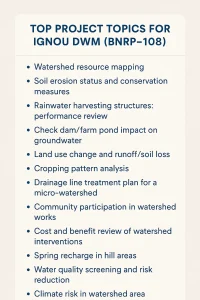
Image: Top Project Topics for IGNOU DWM (BNRP-108)
Sample for IGNOU DWM Project Topics (BNRP-108)
- Man-Made Tragedy Of Uttarakhand Flood
- Floods In Chennai
- Floods In The Brahmaputra Valley Of Assam
- Drought Management: A Study Of Droughts In Gujarat
Steps involved in conducting an IGNOU DWM Project (BNRP-108) Analysis
Conducting a watershed analysis involves several systematic steps to comprehensively understand the hydrological, ecological, and socio-economic aspects of a watershed. Here’s a structured approach typically followed in watershed analysis:
Watershed Delineation and Characterization:
- Define the Watershed Boundary: Identify the area of land that drains into a particular river, lake, or other water body.
- Topographic Mapping: Use topographic maps or digital elevation models (DEMs) to delineate the watershed boundary and characterize its physical features such as slope, aspect, and elevation variations.
Hydrological Assessment:
- Streamflow Analysis: Estimate streamflow patterns, peak flows, and base flows using historical data or hydrological modeling techniques.
- Rainfall-Runoff Modeling: Use hydrological models to simulate rainfall-runoff processes within the watershed, considering factors like precipitation, infiltration, evapotranspiration, and surface runoff.
Land Use and Land Cover Analysis:
- Remote Sensing and GIS: Utilize satellite imagery and GIS techniques to classify land use and land cover types within the watershed.
- Change Detection: Assess changes in land use over time and their implications for hydrological processes and ecosystem services.
Water Quality Assessment:
- Monitoring and Sampling: Collect water samples at strategic locations within the watershed to analyze parameters such as pH, dissolved oxygen, nutrients, and pollutants.
- Water Quality Modeling: Use water quality models to predict pollutant transport and dispersion, considering inputs from point and non-point sources.
Ecological and Habitat Assessment:
- Biodiversity Survey: Identify key species and habitats within the watershed, assessing their distribution and ecological health.
- Habitat Connectivity: Evaluate the connectivity of habitats and corridors for wildlife movement and genetic exchange.
Socio-Economic Analysis:
- Community Surveys and Stakeholder Engagement: Engage with local communities, stakeholders, and resource users to understand their perspectives, needs, and practices related to watershed management.
- Economic Valuation: Assess the economic benefits derived from watershed services such as water supply, flood control, recreational opportunities, and biodiversity conservation.
Integrated Assessment and Planning:
- Multi-Criteria Decision Analysis: Integrate findings from hydrological, ecological, water quality, and socio-economic assessments to prioritize management strategies and interventions.
- Watershed Management Plan: Develop a comprehensive plan outlining goals, objectives, and actions for sustainable watershed management, considering stakeholder input and environmental sustainability principles.
Monitoring and Adaptive Management:
- Implementation Tracking: Monitor the implementation of watershed management actions and evaluate their effectiveness over time.
- Adaptive Management: Modify management strategies based on monitoring results and changing environmental conditions to improve outcomes and resilience.
Data Collection for IGNOU DWM Project (BNRP-108)
The specific data you collect for your IGNOU DWM Project (BNRP-108) will depend on your chosen topic and the objectives of your study. However, here are some common types of data that are often collected for watershed management projects:
1. Geospatial Data:
- Digital Elevation Models (DEMs): Used for watershed delineation and topographic analysis.
- Satellite Imagery: Provides land use/land cover information, vegetation indices, and changes over time.
- GIS Data Layers: Includes roads, rivers, land use, administrative boundaries, etc.
2. Hydrological Data:
- Streamflow Data: Historical records or current measurements of river discharge.
- Rainfall Data: Precipitation records from rain gauges or weather stations.
- Groundwater Data: Monitoring wells or piezometers data if available.
3. Water Quality Data:
- Field Measurements: pH, temperature, dissolved oxygen, turbidity, conductivity, etc.
- Laboratory Analysis: Nutrient concentrations (e.g., nitrogen, phosphorus), heavy metals, pollutants, microbial indicators.
4. Ecological Data:
- Biodiversity Surveys: Species inventories, abundance, distribution maps.
- Habitat Assessments: Assessing habitat quality, vegetation cover, and fragmentation.
5. Socio-Economic Data:
- Surveys and Interviews: Gather information on community perceptions, livelihoods dependent on watershed resources, local knowledge of water use practices.
- Economic Valuation: Assessing the economic benefits derived from watershed services.
6. Climate and Weather Data:
- Climate Records: Historical data on temperature, precipitation patterns, and climate variability.
- Climate Projections: Future climate scenarios relevant to the watershed area.
7. Policy and Institutional Data:
- Legal and Policy Documents: Relevant laws, regulations, policies, and institutional frameworks related to watershed management.
8. Historical and Time-Series Data:
- Long-term Trends: Historical records that provide insights into changes in land use, water quality, biodiversity, and socio-economic conditions.
IGNOU DWM Project Evaluation
The evaluation of your IGNOU DWM Project (BNRP-108) typically follows a structured assessment process to ensure that your project meets academic standards and fulfills the learning objectives of the program. Here’s a general framework of how your project might be evaluated:
1. Project Proposal Evaluation:
- Initially, your project proposal will be assessed. This includes reviewing the clarity of your research objectives, the feasibility of your research design, and the relevance of your chosen topic to watershed management.
2. Literature Review:
- The depth and breadth of your literature review will be evaluated to ensure that you have adequately explored existing research, theories, and practices related to your project topic.
3. Methodology:
- The appropriateness and rigor of your research methods will be scrutinized. This includes the clarity of your data collection techniques, sampling methods (if applicable), data analysis procedures, and the rationale behind your chosen approach.
4. Data Analysis and Interpretation:
- Your ability to analyze data effectively and draw meaningful conclusions will be assessed. This involves demonstrating proficiency in using statistical or qualitative analysis techniques to address your research questions or hypotheses.
5. Discussion and Findings:
- Your project report should effectively present your findings and discuss their implications within the context of watershed management. This includes critically evaluating your results, comparing them with existing literature, and identifying any limitations or areas for future research.
6. Quality of Writing and Presentation:
- The clarity, organization, and coherence of your project report will be evaluated. Your ability to communicate your ideas effectively, use appropriate terminology, and adhere to academic writing conventions (e.g., referencing, citation style) will also be considered.
7. Originality and Contribution:
- Your project will be assessed on its originality and the extent to which it contributes new insights or solutions to the field of watershed management. This could include innovative approaches, practical recommendations, or policy implications derived from your research.
8. Overall Assessment:
- The overall evaluation will consider how well you have addressed the objectives of the DWM program, demonstrated your understanding of watershed management principles, and applied theoretical knowledge to real-world scenarios.
FAQs in IGNOU DWM Project for BNRP-108
What is the IGNOU DWM Project for BNRP 108?
It is the field-based project course in the DWM programme that requires an approved synopsis and a structured project report based on watershed work.
What makes a BNRP 108 topic strong?
A strong topic is location-specific, uses field data, and leads to practical watershed actions such as treatment priority, structure planning, or impact review.
How long should the DWM synopsis be?
The synopsis should be brief and focused, covering title, objectives, study area, methods, and timeline without unnecessary theory.
Downloadable Resources
Conclusion
The IGNOU DWM Project for BNRP 108 becomes manageable when it follows a clear path: select a practical watershed topic, prepare a focused synopsis, collect real field data, and write the report in a clean structure with valid findings and workable suggestions. In addition, correct code use, guide eligibility, and proper submission documents help prevent delays.
For structured help with BNRP 108 topic finalisation, synopsis drafting, report formatting, and submission-ready presentation, use ignouproject.com & contact us for step-based guidance aligned with DWM project needs.

BK Sahni iD 0009-0005-8092-459X
Founder, Shri Chakradhar Publication Pvt. Ltd. & ignouproject.com — helping IGNOU distance-learning students since 2010 (5,00,000+ students supported across MBA, MCom, MA & more). Author of IGNOU exam guides, solved assignments & project reference books.
Disclosure: Shri Chakradhar Publication Pvt. Ltd. and ignouproject.com are independent third-party study-help services — not the official IGNOU website. Always verify final dates and rules on ignou.ac.in.