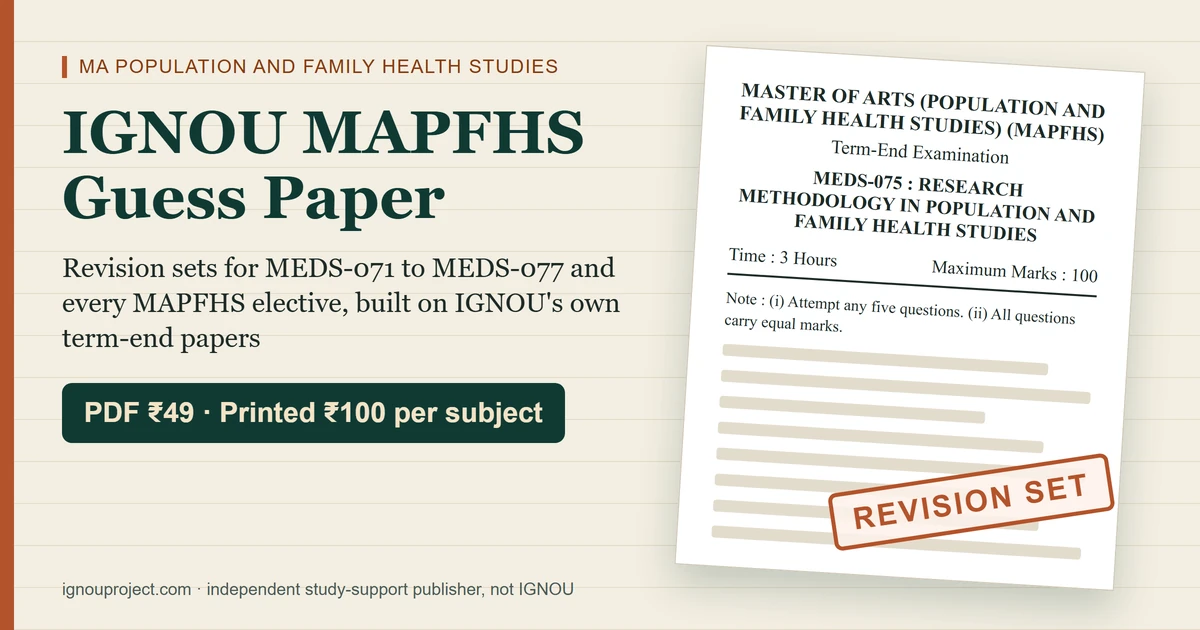
MA Population and Family Health Studies (MAPFHS) · December 2026 term-end examination
Nineteen MAPFHS Year I themes turned up in every IGNOU paper from December 2024 to June 2026
Thirty-nine IGNOU papers across all eleven MAPFHS codes, set side by side: which population, health and research themes came back session after session, how each paper is laid out, and the five December mornings on which the Year I papers sit.
- First paper: MEDS-071, Sat 5 Dec, 10 AM
- Year I: five mornings, 5 to 15 December
- MEDS-074: six themes in 4 of 4 papers
- 39 IGNOU papers, 11 codes
- MEDS-072 and MSOE-002 share one slot
- Free morning planner and answer timer
Type each code the way the hall ticket prints it, for example MEDS-072 or MWG-111, and mention whether it is a Year I paper or a Year II elective.
Quick answer. An IGNOU MAPFHS guess paper is a revision set of important and recurring questions for one MA Population and Family Health Studies course code, such as MEDS-071 or MEDS-074, with model answers, prepared by ignouproject.com from IGNOU’s own term-end papers. In December 2026 the five Year I papers sit on the mornings of 5, 8, 10, 12 and 15 December, and the six electives run from 8 December to 2 January 2027, per IGNOU’s date sheet of 30 October 2026. Each Year I paper gives 3 hours for any five of eight 20-mark questions. A set costs ₹49 per code as a PDF or ₹100 per code printed, and a printed order of any size adds a one-time ₹100 courier charge. Sets are in English, the language IGNOU uses for every MEDS paper; Hindi is discussed only for MSOE-002 and MWG-111, whose papers carry a Hindi half. Nobody outside IGNOU knows the December questions; a set ranks what past papers asked.
Five Year I Mornings and Six Year II Options on IGNOU’s December Sheet
The first MAPFHS paper of the December 2026 term-end examination is MEDS-071 Introduction to Population Studies on Saturday 5 December 2026, 10 AM to 1 PM, and the last is the MWG-111 Women in the Economy elective on Saturday 2 January 2027, also in the morning, per IGNOU’s date sheet of 30 October 2026. All eleven MAPFHS dates are the same as on the tentative sheet of 21 September 2026.
IGNOU’s whole December 2026 cycle runs from Wednesday 25 November 2026 to Thursday 14 January 2027. MAPFHS opens ten days in, and its Year I core is over by 15 December.
First MAPFHS paper
MEDS-071 on Saturday 5 December 2026, 10 AM to 1 PM
Last MAPFHS paper
MWG-111 on Saturday 2 January 2027, 10 AM to 1 PM
Status: IGNOU date sheet headed 30 October 2026; it replaces the tentative sheet of 21 September 2026, with no MAPFHS date changed
Year I: A Paper Every Two or Three Days, Always at 10 AM
The Year I core runs in code order with a gap before every paper. MEDS-071 on Saturday 5 December is followed by MEDS-072 on Tuesday 8 December, MEDS-073 on Thursday 10 December, MEDS-074 on Saturday 12 December and MEDS-075 on Tuesday 15 December. No two fall on consecutive days. All five are morning papers.
On a phone, swipe the table sideways for every column.
| Code | Date | Session | Paper | Gap since the previous paper |
|---|---|---|---|---|
| MEDS-071 | Saturday 5 December | 10 AM to 1 PM | Introduction to Population Studies | Opens the Year I run |
| MEDS-072 | Tuesday 8 December | 10 AM to 1 PM | Population Theories, Policies and Programme | 2 free days before it |
| MEDS-073 | Thursday 10 December | 10 AM to 1 PM | Social Groups and Family Health | 1 free day before it |
| MEDS-074 | Saturday 12 December | 10 AM to 1 PM | Population and Development: Issues and Challenges | 1 free day before it |
| MEDS-075 | Tuesday 15 December | 10 AM to 1 PM | Research Methodology in Population and Family Health Studies | 2 free days before it |
That rhythm suits a paper-by-paper plan. The two free days after MEDS-071 belong to MEDS-072; the single free day before each of MEDS-073 and MEDS-074 is enough only if those two were revised before the run began. The weekend of 13 and 14 December leaves room for a last pass through MEDS-075, the research methodology paper.
Year II: Six Electives Spread Over Twenty-Six Days
The six electives with a paper fall on 8, 12, 19, 22 and 24 December and on 2 January. A learner takes five electives in all, and since the MEDSP-071 project is one of them, a learner who chooses the project sits four of these papers.
On a phone, swipe the table sideways for every column.
| Code | Date | Session | Paper | Gap since the previous paper |
|---|---|---|---|---|
| MSOE-002 | Tuesday 8 December | 10 AM to 1 PM | Diaspora and Transnational Communities | First elective date |
| MEDS-047 | Saturday 12 December | 2 PM to 5 PM | Ecology, Environment and Urban Development | 3 free days before it |
| MANE-004 | Saturday 19 December | 2 PM to 5 PM | Gender and Society | 6 free days before it |
| MEDS-076 | Tuesday 22 December | 2 PM to 5 PM | Public Health and Nutrition | 2 free days before it |
| MEDS-077 | Thursday 24 December | 2 PM to 5 PM | Urbanization and Urban Development Challenges | 1 free day before it |
| MWG-111 | Saturday 2 January 2027 | 10 AM to 1 PM | Women in the Economy | 8 free days before it |
The One Clash and the One Shared Day
Two pairs need attention, both for learners who still carry a Year I paper into Year II.
On a phone, swipe the table sideways for every column.
| Pair | Date and sessions | Who it affects | What it means |
|---|---|---|---|
| MEDS-072 and MSOE-002 | Tuesday 8 December, both 10 AM to 1 PM | A Year II learner taking MSOE-002 who still has MEDS-072 to clear | A true clash: one sitting, two papers. Raise it with the Regional Centre well before the day |
| MEDS-074 and MEDS-047 | Saturday 12 December, 10 AM and 2 PM | A Year II learner taking MEDS-047 who still has MEDS-074 to clear | Both can be sat; revise both before the Saturday morning |
The planner further down flags both cases once the codes are ticked. Every programme’s December dates are summarised on the December 2026 date sheet summary, and the two daily sessions are explained on the IGNOU exam timing page. The admit card is covered by the IGNOU hall ticket guide, centre allotment by the exam centre page, and the form itself by the term-end exam fee page and its companion on paying the exam fee online.
Why the December Paper Carries More Weight Than the MAPFHS Assignment
For MAPFHS, the term-end paper carries 70 per cent of each theory course and the assignment 30 per cent, per section 6.0 of IGNOU’s MAPFHS Programme Guide; IGNOU’s assignment download list also prints a weightage of 30 against every MAPFHS assignment row. The term-end examination carries 70 per cent of the final course result and assignments carry the remaining 30 per cent. Not one of the 39 MAPFHS papers IGNOU published between December 2024 and June 2026 carries a weightage figure on its front page.
The same Programme Guide sets the pass rule: at least 40 per cent in the assignment and at least 40 per cent in the term-end examination, cleared separately for each course. A good assignment therefore cannot carry a weak paper. With every MAPFHS course worth 8 credits, one 3-hour morning decides most of a fairly heavy course. The IGNOU percentage calculator turns course marks into an overall figure.
Guess Paper, IGNOU Paper or Answered Paper: Picking One for a MEDS Code
For MAPFHS, a guess paper means a publisher’s collection of the questions that return most often for a single course code, such as MEDS-072, each with a full model answer, compiled after working through IGNOU’s past papers and the course blocks; sellers market the same thing as important questions, expected questions or a model paper. A previous year question paper is the exact paper IGNOU set in an earlier term-end examination, free on ignou.ac.in and without answers. Add a publisher’s answers to one of those IGNOU papers and it becomes a solved question paper.
The three do different jobs, and none of them stands in for the blocks.
On a phone, swipe the table sideways for every column.
| Point of comparison | Guess paper (revision set) | Previous year question paper | Solved question paper |
|---|---|---|---|
| What it holds | Recurring themes for one MAPFHS code, with answers | One session’s questions exactly as IGNOU printed them | One session’s questions with answers written in |
| Made by | A publisher | IGNOU | A publisher |
| Price | ₹49 PDF or ₹100 printed per code here | Free on ignou.ac.in | Set by each seller |
| Good for | Seeing which themes, such as migration in MEDS-074, came back most | Practising the current layout under a 3-hour clock | Seeing how one complete paper might be answered |
| Cannot do | Tell anyone what IGNOU will set next | Show which themes return across sessions | Reach the themes that session left out |
The IGNOU solved question papers collection gathers answered papers across programmes, while the main IGNOU guess paper index lists sets for every other course family. A sensible MAPFHS order of work is to sit the June 2026 IGNOU paper for a code under timed conditions first, then use a set for the themes that paper did not cover.
Four sessions per Year I code. Each Year I set is built on the four most recent IGNOU papers for its code, December 2024 through June 2026.
Rates and measures worked out. CBR, TFR, IMR, CDR and the standardised death rate are defined with Indian figures from the census and the SRS, the way MEDS-071 asks for them.
Split marks respected. Where IGNOU splits a question 5+15, the set keeps the first part to a tight definition and spends its length on the second.
Policy years correct. NPP 2000, the National Health Policy 2017 and the National Urban Sanitation Policy 2008 appear with the years IGNOU prints.
MEDS-075 methods in plain steps. Sampling, validity, reliability and impact assessment are written as numbered stages an evaluator can follow.
Short notes ready. Every MEDS paper since December 2024 carries a pair of ten-mark notes, and each set includes notes on the topics IGNOU used for them.
Season echoes marked. Where a December paper reused December themes, or June reused June, the set says so beside the answer.
Electives by choice. Order only the four or five electives on the registration, not a fixed bundle of six.
MWG-111 sized for 25 marks. Four longer answers instead of five, matching the any-four-of-seven paper.
MANE-004 split by section. Answers are grouped under Section A and Section B so the two-from-each rule can be met.
Diploma learners covered. The five Year I sets serve the PG Diploma in Population and Family Health Studies as well, since it sits the same papers.
PDF or printed. Choose a WhatsApp PDF to start the same evening, or a printed booklet by courier for working at a desk.
Eleven Examined MAPFHS Codes and the Shape of Each Paper
MAPFHS has eleven course codes with a term-end paper, listed in section 3.49 of the July 2026 Common Prospectus: five compulsory Year I courses, MEDS-071 to MEDS-075, and six Year II electives, MSOE-002, MWG-111, MANE-004, MEDS-047, MEDS-076 and MEDS-077, every one worth 8 credits. Year II also offers the MEDSP-071 project, which has no paper. The programme totals 80 credits, is taught in English and belongs to the School of Extension and Development Studies.
The credit sum only works one way. Year I is 5 × 8 = 40. The prospectus prints seven Year II items and asks for “any Five courses”, which reads as 88 credits if the project is added on top. Section 3.7 of the MAPFHS Programme Guide settles it: the project is an elective, one of the five. So Year II is 5 × 8 = 40, and 40 + 40 confirms the 80. The revised prospectus of 6 October 2026 prints the same MAPFHS list.
Year I Core Courses and Their December Dates
On a phone, swipe the table sideways for every column.
| Code | Title (July 2026 Common Prospectus) | Credits | Paper printed in | December 2026 paper |
|---|---|---|---|---|
| MEDS-071 | Introduction to Population Studies | 8 | English only | Sat 5 Dec 2026, 10 AM to 1 PM |
| MEDS-072 | Population Theories, Policies and Programme | 8 | English only | Tue 8 Dec 2026, 10 AM to 1 PM |
| MEDS-073 | Social Groups and Family Health | 8 | English only | Thu 10 Dec 2026, 10 AM to 1 PM |
| MEDS-074 | Population and Development: Issues and Challenges | 8 | English only | Sat 12 Dec 2026, 10 AM to 1 PM |
| MEDS-075 | Research Methodology in Population and Family Health Studies | 8 | English only | Tue 15 Dec 2026, 10 AM to 1 PM |
Year II Electives and Their December Dates
On a phone, swipe the table sideways for every column.
| Code | Title (July 2026 Common Prospectus) | Credits | Paper printed in | December 2026 paper |
|---|---|---|---|---|
| MSOE-002 | Diaspora and Transnational Communities | 8 | English and Hindi in one file | Tue 8 Dec 2026, 10 AM to 1 PM |
| MEDS-047 | Ecology, Environment and Urban Development | 8 | English only | Sat 12 Dec 2026, 2 PM to 5 PM |
| MANE-004 | Gender and Society | 8 | English only | Sat 19 Dec 2026, 2 PM to 5 PM |
| MEDS-076 | Public Health and Nutrition | 8 | English only | Tue 22 Dec 2026, 2 PM to 5 PM |
| MEDS-077 | Urbanization and Urban Development Challenges | 8 | English only | Thu 24 Dec 2026, 2 PM to 5 PM |
| MWG-111 | Women in the Economy | 8 | English and Hindi in one file | Sat 2 Jan 2027, 10 AM to 1 PM |
The MAPFHS handwritten assignment page works from the same code list. None of the eleven codes has its own course page on this site, so each code’s facts are kept in these tables.
Picking Five Electives Around the Paper Formats
The six electives are set under five different programme headings and in three different layouts, so the choice affects revision as much as interest.
On a phone, swipe the table sideways for every column.
| Code | Title | Programme named on the paper | Answer rule, June 2026 | IGNOU papers, Dec 2024 to Jun 2026 |
|---|---|---|---|---|
| MSOE-002 | Diaspora and Transnational Communities | MA Sociology (MSO) | Any 5 of 8, about 500 words each | 4 (Dec 2024, Jun 2025, Dec 2025, Jun 2026) |
| MEDS-047 | Ecology, Environment and Urban Development | MA Urban Studies (MAUS) | Any 5 of 8, 20 marks each | 4 (Dec 2024, Jun 2025, Dec 2025, Jun 2026) |
| MANE-004 | Gender and Society | MA Anthropology (MAAN) | Five of 10, at least two from each of Sections A and B; 500 words for 20 marks, 250 for 10 | 4 (Dec 2024, Jun 2025, Dec 2025, Jun 2026) |
| MEDS-076 | Public Health and Nutrition | MAPFHS | Any 5 of 8, 20 marks each | 2 (Dec 2025, Jun 2026) |
| MEDS-077 | Urbanization and Urban Development Challenges | MAPFHS | Any 5 of 8, 20 marks each | 2 (Dec 2025, Jun 2026) |
| MWG-111 | Women in the Economy | MA Women’s and Gender Studies (MAWGSR) | Any 4 of 7, 25 marks each | 3 (Jun 2025, Dec 2025, Jun 2026) |
How IGNOU Laid Out Each MAPFHS Paper in June 2026
Nine of the eleven papers ask for any five answers. MWG-111 asks for four longer ones, and MANE-004 adds a section rule.
On a phone, swipe the table sideways for every column.
| Code | Latest IGNOU paper | Time and marks | Answer rule | Short notes | Change across sessions |
|---|---|---|---|---|---|
| MEDS-071 | June 2026 | 3 hours, 100 marks | Any 5 of 8, equal marks; parts often split 5+15 or 10+10 | Q8, any 2 of 3 | Many questions split 5+15, a definition first and then the discussion; layout unchanged across the four sessions |
| MEDS-072 | June 2026 | 3 hours, 100 marks | Any 5 of 8, equal marks; June 2026 prints Section A (Q1 to Q4) and Section B (Q5 to Q8) with no per-section quota | Q8, any 2 of 3 | June 2026 printed Section A and Section B headings, but the rule stayed any five with no quota per section |
| MEDS-073 | June 2026 | 3 hours, 100 marks | Any 5 of 8; every question a single 20-mark item | Q8, any 2 of 3 (both compulsory until December 2025) | Both short notes were compulsory from December 2024 to December 2025; June 2026 offered two of three |
| MEDS-074 | June 2026 | 3 hours, 100 marks | Any 5 of 8; splits such as 8+12 and 10+10 since December 2025 | Q5, any 2 of 3 | Short notes at Q5 in all four sessions; essay questions split into parts from December 2025 |
| MEDS-075 | June 2026 | 3 hours, 100 marks | Any 5 of 8; Q8 split 15+5 in June 2026 | Q7, any 2 of 3 (Q8 until December 2025) | June 2026 moved the notes to Q7 and split Q8 into 15 and 5 marks |
| MSOE-002 | June 2026 | 3 hours, 100 marks | Any 5 of 8, about 500 words each | None | Ten questions in two sections, at least two from each, in December 2024; nine without sections in 2025; eight in June 2026 |
| MEDS-047 | June 2026 | 3 hours, 100 marks | Any 5 of 8, 20 marks each | Q5, any 2 of 3 | Headed for MA Urban Studies; short notes moved from Q8 in December 2024 to Q5 from June 2025 |
| MANE-004 | June 2026 | 3 hours, 100 marks | Five of 10, at least two from each of Sections A and B; 500 words for 20 marks, 250 for 10 | Q5 and Q10, any 2 of 3 each | December 2024 asked four 5-mark notes at Q5; later papers set 10-mark note pairs at Q5 and Q10 |
| MEDS-076 | June 2026 | 3 hours, 100 marks | Any 5 of 8, 20 marks each | Q8, any 2 of 3 | First IGNOU paper in December 2025, which split several questions into three parts such as 5+5+10 |
| MEDS-077 | June 2026 | 3 hours, 100 marks | Any 5 of 8, 20 marks each | Q8, any 2 of 3 | First IGNOU paper in December 2025; layout the same in June 2026 |
| MWG-111 | June 2026 | 3 hours, 100 marks | Any 4 of 7, 25 marks each | None | Any four of seven in all three sessions; June 2025 printed no per-question marks |
Four layout changes in the Year I papers. MEDS-073 printed its two short notes with no choice in December 2024, June 2025 and December 2025, then offered any two of three in June 2026. MEDS-075 moved its notes from Question 8 to Question 7 in June 2026 and split the new Question 8 into 15 and 5 marks, the first split in four MEDS-075 papers. MEDS-074 set every essay question as a single 20-mark item in December 2024 and June 2025, then split several of them, 8+12 or 10+10, in December 2025 and June 2026. And the June 2026 MEDS-072 paper printed Section A and Section B headings while keeping the plain any-five rule, with no quota per section.
Whose Name Is on the Paper
Only 14 of the 39 MAPFHS papers from December 2024 to June 2026 name MAPFHS in their heading. IGNOU headed the December 2024 and June 2025 papers for MEDS-071 to MEDS-075 for the PG Diploma in Population and Family Health Studies alone, and named MAPFHS on all five Year I papers only from December 2025; the four borrowed electives, MSOE-002, MWG-111, MANE-004 and MEDS-047, carry their home programme’s name in every session.
On a phone, swipe the table sideways for every column.
| Code | December 2024 | June 2025 | December 2025 | June 2026 | Papers naming MAPFHS |
|---|---|---|---|---|---|
| MEDS-071 | PGDPFHS | PGDPFHS | MAPFHS/PGDPFHS | MAPFHS/PGDPFHS | 2 of 4 |
| MEDS-072 | PGDPFHS | PGDPFHS | MAPFHS/PGDPFHS | MAPFHS/PGDPFHS | 2 of 4 |
| MEDS-073 | PGDPFHS | PGDPFHS | PGDPFHS/MAPFHS | PGDPFHS/MAPFHS | 2 of 4 |
| MEDS-074 | PGDPFHS | PGDPFHS | MAPFHS/PGDPFHS | MAPFHS/PGDPFHS | 2 of 4 |
| MEDS-075 | PGDPFHS | PGDPFH (sic) | MAPFHS | MAPFHS/PGDPFHS | 2 of 4 |
| MSOE-002 | MSO (MA Sociology) | MSO (MA Sociology) | MSO (MA Sociology) | MSO (MA Sociology) | 0 of 4 |
| MEDS-047 | MAUS (MA Urban Studies) | MAUS (MA Urban Studies) | MAUS (MA Urban Studies) | MAUS (MA Urban Studies) | 0 of 4 |
| MANE-004 | MAAN (MA Anthropology) | MAAN (MA Anthropology) | MAAN (MA Anthropology) | MAAN (MA Anthropology) | 0 of 4 |
| MEDS-076 | No paper | No paper | MAPFHS | MAPFHS | 2 of 2 |
| MEDS-077 | No paper | No paper | MAPFHS | MAPFHS | 2 of 2 |
| MWG-111 | No paper | MAWGSR | MAWGSR | MAWGSR | 0 of 3 |
The headings follow the programme’s history. IGNOU’s launch notification No. 132, dated 26 December 2023, opened MAPFHS from the January 2024 session, and IGNOU’s lists hold no MEDS-076 or MEDS-077 paper before December 2025, which fits a first intake reaching Year II in that session. A learner who opens a 2024 or early 2025 file and sees only PGDPFHS has the right paper if the code matches.
The elective layouts and headings above come from these IGNOU papers. MSOE-002: MSOE-002 Dec 2024, MSOE-002 Jun 2025, MSOE-002 Dec 2025 and MSOE-002 Jun 2026; MWG-111: MWG-111 Jun 2025, MWG-111 Dec 2025 and MWG-111 Jun 2026; MANE-004: MANE-004 Dec 2024, MANE-004 Jun 2025, MANE-004 Dec 2025 and MANE-004 Jun 2026; MEDS-047: MEDS-047 Dec 2024, MEDS-047 Jun 2025, MEDS-047 Dec 2025 and MEDS-047 Jun 2026; MEDS-076: MEDS-076 Dec 2025 and MEDS-076 Jun 2026; MEDS-077: MEDS-077 Dec 2025 and MEDS-077 Jun 2026.
Disagreements in the MAPFHS documents, including the publisher’s own.
- Women in the Economy is MWG-111 in the prospectus, the papers and IGNOU’s file names, but “MGW-111” in the Programme Guide and “MGW-011” in launch notification No. 132. The publisher’s store lists the same course as “MGW 11”. The code to quote is MWG-111.
- MEDS-072 is titled “Population Theories, Policies and Programme” in the MAPFHS prospectus section and Programme Guide, “Policies and Programmes” in the PGDPFHS section and the launch notice, and “Policy and Programmes” on the December 2025 and June 2026 papers.
- The prospectus programme table lists the PG Diploma in Population and Family Health Studies with Hindi as its medium; section 8.23 of the same prospectus says English, and every Year I paper from December 2024 to June 2026 is printed in English only.
- The Programme Guide gives a maximum duration of four years in section 1.7 and refers to “the maximum duration of five years” in section 8; the prospectus says four. The launch notice calls the examination mode annual, while the Programme Guide and IGNOU’s archive show papers every June and December.
- The MAPFHS handwritten assignment page on this site reads the prospectus Year II list as 88 printed credits against 80 stated. The Programme Guide’s project-as-elective rule removes that gap, and this page follows it.
- The publisher’s own store still titles its MAPFHS Year I and Year II combos “Specially for IGNOU TEE of June & December 2025 sessions” with a fixed count of 30 questions per subject, and tags its MEDS-075 set “MAEDS”. Those listings are being updated, and the sets described here are the December 2026 ones.
- One third-party paper site describes the MAPFHS term-end paper as three sections with different mark weights. None of the 20 Year I papers from December 2024 to June 2026 has three sections.
Themes IGNOU Set Again in the MEDS-071 to MEDS-075 Papers
In IGNOU’s MEDS-074 Population and Development: Issues and Challenges papers, six themes appeared in all four sessions from December 2024 to June 2026: migration, governance and development, poverty and inequality, food and nutrition security, sustainable development, and slums with the urban paradox. Across the five Year I codes, nineteen themes reached four of four.
MEDS-071 set migration, mortality, demographic transition and the sources of population data in every session, and MEDS-075 did the same for measurement, statistics, research reporting and evaluation. The MEDS-073 Social Groups and Family Health paper behaves differently: only ageing and gender with women’s health reached four of four, but its December 2025 paper took six of its nine items from December 2024 themes.
The counts below come from IGNOU’s MAPFHS Year I papers for December 2024, June 2025, December 2025 and June 2026, four per code and 20 in all, each reviewed in full by ignouproject.com on 5 November 2026. A theme is counted when a question or short note asks about it in substance; matching is at topic level and is a human judgement rather than a word search, and every cell gives the question number so it can be checked against IGNOU’s file. The theme tables cover MEDS-071 to MEDS-075. For the six electives, the layouts appear in the tables above, and recurring themes are confirmed against the latest IGNOU paper on WhatsApp. A theme seen once is left out, and n of N counts past sessions; it is not a forecast.
MEDS-071: Four Demography Themes in Every Paper
Migration, mortality, demographic transition and the sources of population data are the four MEDS-071 themes asked in every session. Data sources take a different form each time: sources in general in December 2024, CRS against SRS in June 2025, demographic data in India in December 2025, and the Census of India and the NSS as two notes in June 2026. Many MEDS-071 questions split their marks 5+15, a definition first and a discussion second.
On a phone, swipe the table sideways for every column.
| Theme | December 2024 | June 2025 | December 2025 | June 2026 | n of N |
|---|---|---|---|---|---|
| Migration: characteristics, streams and theories | Q7 | Q7 | Q4, 8(a) | Q4, Q6 | 4 of 4 |
| Mortality and morbidity: infant, maternal and death rates | Q4, Q5 | Q5 | Q5, 8(b) | Q5, Q7 | 4 of 4 |
| Demographic transition | 8(b) | Q4, 8(b) | 8(c) | Q1 | 4 of 4 |
| Sources of population data: census, NSS, CRS and SRS | 8(a) | 8(a) | Q6 | 8(b), 8(c) | 4 of 4 |
| Fertility: measures, factors and control | Q3 | Q3, 8(c) | – | Q3 | 3 of 4 |
| Population growth, trends and patterns | Q2 | Q2 | – | Q1, Q2 | 3 of 4 |
| Population studies: meaning, evolution and demography | Q1 | Q1 | Q1 | – | 3 of 4 |
| Population theories of Malthus and Boserup | – | – | Q7 | 8(a) | 2 of 4 |
| Epidemiological transition and classing diseases | Q6 | Q6 | – | – | 2 of 4 |
Every MEDS-071 cell can be checked in IGNOU’s own files: Dec 2024 MEDS-071 file, Jun 2025 MEDS-071 file, Dec 2025 MEDS-071 file and Jun 2026 MEDS-071 file.
MEDS-072: Schools of Thought, Projections and Policy
Three MEDS-072 themes reached four of four: the schools of thought on population, from Malthusian to neutralist; the techniques of interpolation, extrapolation, estimation and projection; and population policy, with the National Population Policy 2000 set as a full question in December 2024 and again in December 2025. The life table returned three times and missed only June 2026.
On a phone, swipe the table sideways for every column.
| Theme | December 2024 | June 2025 | December 2025 | June 2026 | n of N |
|---|---|---|---|---|---|
| Schools of thought: Malthusian, optimistic, neutralist | Q1, 8(a) | Q1 | Q2 | Q3, Q7 | 4 of 4 |
| Interpolation, extrapolation, estimation and projection | Q3 | Q3 | Q5, 8(c) | Q5 | 4 of 4 |
| Population policy: NPP 2000 and other countries | Q7, 8(c) | Q4 | Q3 | 8(a) | 4 of 4 |
| Life table and its uses | Q2 | 8(c) | Q1 | – | 3 of 4 |
| Optimum population and the population model | – | Q2 | Q2, 8(b) | Q6, 8(b) | 3 of 4 |
| Population growth and its measures | 8(b) | Q7 | – | Q2 | 3 of 4 |
| Population transition and population pyramids | – | 8(a), 8(b) | 8(a) | 8(c) | 3 of 4 |
| Ageing and care of the elderly | – | Q5 | – | Q1 | 2 of 4 |
| Health policy (2000 as printed, and 2017) | – | Q6 | – | Q4 | 2 of 4 |
| Health care for mothers, children and adolescents | Q5 | – | Q4, Q6 | – | 2 of 4 |
The MEDS-072 papers behind these counts: Dec 2024 MEDS-072 file, Jun 2025 MEDS-072 file, Dec 2025 MEDS-072 file and Jun 2026 MEDS-072 file.
MEDS-073: Wide Paper, Strong Seasonal Echo
MEDS-073 spreads across more topics than any other Year I paper. Twelve themes appear at least twice, but only two reach four of four. The pattern lies in the seasons. Disability, the digital divide, domestic violence, eating habits, intersectoral coordination and marginalised groups all came back from December 2024 to December 2025, while June 2026 repeated June 2025’s questions on substance abuse, the perspectives of ageing in India and poverty.
On a phone, swipe the table sideways for every column.
| Theme | December 2024 | June 2025 | December 2025 | June 2026 | n of N |
|---|---|---|---|---|---|
| Ageing: changes, types, Indian perspectives, elder abuse | Q4 | Q2, Q4, Q5 | Q2 | Q2 | 4 of 4 |
| Gender roles and women’s health | Q1 | Q3 | Q7 | Q5, Q6, 8(b) | 4 of 4 |
| Marginalised groups and health | Q7 | Q1 | 8(b) | – | 3 of 4 |
| Primary health care and civil society organisations | – | 8(b) | Q4 | Q4 | 3 of 4 |
| Digital divide and social media | Q3 | – | Q2, 8(a) | – | 2 of 4 |
| Disability | Q2 | – | Q1 | – | 2 of 4 |
| Domestic abuse and violence against women | Q5 | – | Q3 | – | 2 of 4 |
| Diet and harmful eating habits | 8(a) | – | Q5 | – | 2 of 4 |
| Intersectoral coordination in health | 8(b) | – | Q6 | – | 2 of 4 |
| Substance abuse: effects, treatment, prevention | – | Q6 | – | Q3 | 2 of 4 |
| Poverty and health | – | 8(a) | – | Q7 | 2 of 4 |
| Behavioural Change Communication | Q6 | – | – | 8(a) | 2 of 4 |
IGNOU’s four MEDS-073 papers, as filed: Dec 2024 MEDS-073 file, Jun 2025 MEDS-073 file, Dec 2025 MEDS-073 file and Jun 2026 MEDS-073 file.
MEDS-074: Six Themes That Never Missed a Session
MEDS-074 is the most predictable MAPFHS paper in theme, and the most repetitive in placement. Its short notes sat at Question 5 in all four sessions, migration was Question 8 in December 2024, December 2025 and June 2026, and “What is slum upgrading?” opened Question 7 in both December papers.
On a phone, swipe the table sideways for every column.
| Theme | December 2024 | June 2025 | December 2025 | June 2026 | n of N |
|---|---|---|---|---|---|
| Migration: push and pull, impact, theories, diaspora | Q8 | Q1, 5(c) | Q8 | Q8 | 4 of 4 |
| Governance and development | Q2, 5(a) | Q2 | 5(a) | Q1 | 4 of 4 |
| Poverty and inequality | Q1 | Q4 | Q1 | Q3 | 4 of 4 |
| Food and nutrition security, diet | Q6, 5(c) | Q6, 5(a) | Q2, Q4 | Q6 | 4 of 4 |
| Sustainable development, biodiversity, conservation | Q3, Q4, 5(b) | 5(b) | 5(b), 5(c) | 5(b), 5(c) | 4 of 4 |
| Slums, urban paradox and urbanisation | Q7 | Q8 | Q3, Q6, Q7 | Q4, 5(a) | 4 of 4 |
| Health and health care development | – | Q3, Q7 | Q3 | Q7 | 3 of 4 |
| Unemployment | – | – | Q6 | Q2 | 2 of 4 |
To trace the six MEDS-074 themes, open Dec 2024 MEDS-074 file, Jun 2025 MEDS-074 file, Dec 2025 MEDS-074 file and Jun 2026 MEDS-074 file.
MEDS-075: Method Questions That Return in Pairs
MEDS-075 is the research methodology paper, and four method families reached four of four: measurement, statistics, the research report with its proposal and dissemination, and evaluation with monitoring and impact assessment. The December 2024 and June 2026 papers both open with the same three-part question on research objectives.
On a phone, swipe the table sideways for every column.
| Theme | December 2024 | June 2025 | December 2025 | June 2026 | n of N |
|---|---|---|---|---|---|
| Measurement: tests, scales, validity, reliability | Q2 | Q2 | Q3, 8(b) | Q2 | 4 of 4 |
| Statistics: central tendency, correlation, regression, tests | Q3, Q7 | Q5 | 8(a) | 7(b) | 4 of 4 |
| Research report, proposal and dissemination | Q4 | Q7 | Q2, Q5 | Q4 | 4 of 4 |
| Evaluation, monitoring and impact assessment | Q5, Q6, 8(a) | 8(b) | Q7 | Q5, 7(a) | 4 of 4 |
| Sampling | – | Q3 | Q4 | 7(c) | 3 of 4 |
| Types of data and data collection | Q6 | Q6, 8(a) | – | Q3, Q8 | 3 of 4 |
| Research objectives | Q1 | – | – | Q1 | 2 of 4 |
| Research design and kinds of research | – | Q1 | Q1 | – | 2 of 4 |
| Preparing a project | – | 8(c) | Q6 | – | 2 of 4 |
| ICT and geoinformatics | – | Q4 | – | Q6 | 2 of 4 |
MEDS-075 in each session: Dec 2024 MEDS-075 file, Jun 2025 MEDS-075 file, Dec 2025 MEDS-075 file and Jun 2026 MEDS-075 file.
Questions IGNOU Asked a Second Time, Nearly Unchanged
These are the closest repeats across the 20 Year I papers. Each pair names both sessions and question numbers; the theme column gives a short phrase from or about the question, never the whole question.
On a phone, swipe the table sideways for every column.
| Code | First asked | Asked again | Theme in brief | What changed |
|---|---|---|---|---|
| MEDS-075 | Dec 2024 Q1 | Jun 2026 Q1 | Define objective in research, the types of objectives and the criteria for judging them | Same three parts, same order, same question number |
| MEDS-074 | Dec 2024 Q7 | Dec 2025 Q7 | What is slum upgrading? | Same opening and number; the second half asks about factors instead of problems of slum dwellers |
| MEDS-074 | Dec 2024 Q6 | Dec 2025 Q4 | Discuss recent food consumption pattern in India | Identical second sentence; the first half moves from milk products to the Indian diet |
| MEDS-074 | Jun 2025 Q8 | Jun 2026 Q4 | Urban paradox in the context of growing Indian cities | Same idea, reworded |
| MEDS-074 | Jun 2025 Q6 | Jun 2026 Q6 | Major challenges in nutrition security in India | Same question number; June 2026 adds a definition |
| MEDS-073 | Jun 2025 Q4 | Jun 2026 Q2 | Perspectives of ageing in India | June 2026 adds the health issues of an ageing population |
| MEDS-073 | Dec 2024 8(a) | Dec 2025 Q5 | Harmful eating habits | A short note becomes half of a 20-mark question |
| MEDS-072 | Dec 2024 Q7 | Dec 2025 Q3 | National Population Policy, 2000 | Features in 2024, the whole policy in 2025 |
| MEDS-072 | Dec 2024 Q3 | Dec 2025 Q5 | Interpolation of population data | Extrapolation became a short note, 8(c), in December 2025 |
| MEDS-071 | Dec 2024 Q4 | Jun 2026 Q5 | Factors affecting maternal mortality in India | December 2024 paired it with infant mortality |
How a MEDS Set Is Put Together From IGNOU’s Papers
Each MAPFHS set follows the same five steps.
- Pull the code’s last four IGNOU papers. For Year I that is December 2024 to June 2026, taken from IGNOU’s session lists, with the session checked on page 1 of each file.
- Sort every question and note by theme. A two-part question is filed under its main theme; each short-note option counts on its own.
- Rank by sessions, then by season. Anything IGNOU asked in three or all four sessions gets a full model answer before the rest. A theme seen only in December papers, as many MEDS-073 themes are, is marked as a December echo.
- Write to the clock. A 20-mark answer is planned for about 34 minutes, and a split question is weighted by its marks, so a 5+15 question gives about 9 minutes to the first part.
- Check against the blocks. Each answer is checked against the IGNOU block it comes from, with figures and policy years taken from the material.
One Real Question, Worked to the Clock
The June 2026 MEDS-071 paper asked learners to define fertility and fecundity, then explain the Total Fertility Rate and the measures to control fertility, for 5+15 marks. A 34-minute plan for it looks like this:
- About 9 minutes for the 5 marks: one crisp definition of each term and the difference between them, in four or five lines.
- About 25 minutes for the 15 marks: how TFR is calculated from age-specific fertility rates, what a TFR near 2.1 means, then a short run of control measures with one Indian programme named for each.
- The last minute or two for a closing line that ties fertility back to population growth, the theme MEDS-071 set in three of four sessions.
Limits of a MAPFHS Revision Set, Stated Plainly
A guess paper is a revision aid built from past IGNOU question papers and the syllabus. No one outside IGNOU knows the questions in advance, and no claim is made that any question in this set will appear in your examination.
What a MAPFHS Set Does Well
It moves the themes IGNOU kept returning to, migration and governance in MEDS-074, mortality and data sources in MEDS-071, measurement and evaluation in MEDS-075, ahead of themes set once. It shows how to divide a 5+15 question and a 20-mark answer inside a 34-minute slot. And because the Year I papers fall every two or three days, it lets a learner revise in the order the papers arrive.
What No Set Can Do
It cannot say what the December 2026 papers will contain; each of the 39 MAPFHS papers shows IGNOU writing fresh questions, even on familiar themes. It cannot replace the MEDS blocks, from which every question is drawn. And it cannot foresee a layout change, such as MEDS-073 adding choice to its notes in June 2026, until IGNOU publishes the paper that shows it.
Start with what costs nothing. Every MAPFHS paper behind these tables opens free from IGNOU’s session lists, and the guide to IGNOU’s last-year papers explains how to practise with them. The MEDS blocks are on eGyanKosh, reachable through the eGyanKosh how-to or the alternative Gyankosh link page; printed blocks are traced on the IGNOU books download page, and short summaries sit in the IGNOU study notes list.
Two Free MAPFHS Helpers: Morning Planner and Answer Timer
The planner sets the ticked codes against IGNOU’s December 2026 sheet, flags the clash and prices the order; the timer shows the layout of one paper and divides its three hours.
Free tool 1
MAPFHS December Morning Planner
Any figure from half an hour to sixteen hours works, in steps of 0.5.
This tool is guidance from ignouproject.com, not an IGNOU rule. Using it creates no obligation to order anything.
Free tool 2
MEDS and Elective Answer Timer
The timer keeps ten minutes for reading the paper and choosing questions, then shares the remaining 170 among the answers.
This tool is guidance from ignouproject.com, not an IGNOU rule. Using it creates no obligation to order anything.
The timer’s arithmetic, written out for the three kinds of MAPFHS paper:
On a phone, swipe the table sideways for every column.
| Paper type | Time available | Time per answer |
|---|---|---|
| Any 5 of 8 at 20 marks (MEDS-071 to MEDS-077, MEDS-047, MSOE-002) | 170 minutes after 10 to read | 34 minutes an answer; a 5+15 split is about 9 and 25 minutes; a pair of 10-mark notes about 17 minutes each |
| Five of 10 with a section rule (MANE-004) | 170 minutes after 10 to read | 34 minutes an answer, at least two from each section; about 17 minutes for each 250-word note |
| Any 4 of 7 at 25 marks (MWG-111) | 170 minutes after 10 to read | 42 minutes an answer, four answers in all |
Neither tool sends data anywhere. Every date and layout either tool shows also appears in the static tables on this page.
Opening the MAPFHS Question Papers and Date Sheet Yourself
Each examination session has its own IGNOU index of question papers, and the MAPFHS files behind this page all came from four of them: the June 2026 question paper list, the December 2025 list, the June 2025 list and the December 2024 list.
- Use the browser’s find box on an index page and type the code exactly, hyphen included, for example MEDS-074. For Women in the Economy, search “MWG-111”; IGNOU’s lists carry no MWG-111 file for December 2024, and none for MEDS-076 or MEDS-077 before December 2025.
- Open the PDF and confirm the month and year on page 1. The December 2024 MAPFHS papers sit in a general downloads folder, so the address alone does not show the session.
- Expect a two- or three-page English paper for every MEDS code. MSOE-002 and MWG-111 files run to four or five pages because a Hindi version follows the English one.
- Take dates only from IGNOU’s sheet: the version headed 30 October 2026 replaced the tentative sheet of 21 September 2026. Codes appear on that sheet with no hyphen, and MSOE-002 is shortened to MSOE02, so search for strings like MEDS071.
Third-party pages give different release dates for the December 2026 sheet; only the file on ignou.ac.in settles a date. Other cycles and programmes are listed on the IGNOU date sheet hub.
Hall Ticket Before 5 December, Results and Grade Card After
A Year I learner needs the hall ticket before MEDS-071 on Saturday 5 December; a Year II learner taking MSOE-002 needs it by Tuesday 8 December. Check that every code on it matches the registration, especially MWG-111, which other documents print as MGW.
Results arrive in two parts. Term-end marks appear through the IGNOU result page, and the most recent cycle is tracked on the June 2026 result tracker. Assignment marks are checked on the assignment status page. A learner unhappy with a paper can follow the revaluation steps, and after both years the final grade card explainer and the CGPA calculator show where the programme stands.
Other Help Population Studies Learners Order With a Set
A revision set covers only the term-end paper. Typed assignment answers are on IGNOU solved assignments, handwritten ones on the MAPFHS page linked in the code tables, and wider course coverage in the IGNOU help books and the guide books available online. Learners who choose the project elective will find it handled separately on the MEDSP-071 project work guide.
MAPFHS Papers Are Set in English: What That Means for Hindi Requests
MAPFHS is taught in English, per section 3.49 of the July 2026 Common Prospectus and section 1.6 of the Programme Guide, and IGNOU printed all 20 Year I papers, MEDS-071 to MEDS-075, in English only from December 2024 to June 2026. So were MEDS-047, MEDS-076, MEDS-077 and MANE-004. Only the borrowed MSOE-002 and MWG-111 papers carry a Hindi version after the English one.
Each set is prepared for the upcoming term-end examination, in every medium IGNOU examines that course in, and the medium for your course code is confirmed on WhatsApp before you pay.
For MAPFHS that means English sets for all eleven codes. A Hindi set is discussed only for MSOE-002 and MWG-111, and only where the learner’s Regional Centre accepts Hindi answers for a MAPFHS registration. IGNOU’s assignment list carries English rows alone for MEDS-071 to MEDS-077, which matches the papers.
Placing a MAPFHS Order Over WhatsApp
The rate is ₹49 per subject code for a solved guess paper as a PDF, or ₹100 per subject code as a printed copy. Printed copies carry a one-time courier charge of ₹100 per order, whatever the number of subject codes; the PDF has no courier charge.
- Write the codes as the hall ticket prints them, for example MEDS-071, MEDS-075, MWG-111.
- Mark each one PDF or printed; a single order can mix the two.
- Send the list to WhatsApp +91 93546 37830, adding the language only if MSOE-002 or MWG-111 is on it.
- Pay the total confirmed in the reply.
The PDF is shared on WhatsApp once payment is confirmed. A printed copy is dispatched the next day after payment is confirmed, and the courier details are shared on WhatsApp. No arrival date is promised, because transit time depends on the courier and your location.
There is no minimum order: one subject or ten, same rate per format.
Worked through for MAPFHS, the five Year I codes cost 5 × ₹49 = ₹245 as PDFs, or 5 × ₹100 + ₹100 courier = ₹600 printed. Four Year II electives with the project as the fifth come to ₹196 as PDFs. Rates for assignments and other work appear on the publisher’s full price list for services.
Sources Behind Every MAPFHS Figure and the Next Review
IGNOU documents. Codes, credits and medium come from section 3.49 of the July 2026 Common Prospectus, checked against the 6 October 2026 revision, with section 8.23 for the diploma; the project rule, the pass rule and the 70 and 30 per cent split come from the MAPFHS Programme Guide; the launch session comes from notification No. 132. Layouts, headings and every theme count come from IGNOU’s 39 MAPFHS papers for December 2024 to June 2026, linked code by code above. Dates come from IGNOU’s December 2026 sheet of 30 October 2026, and the assignment rows from IGNOU’s assignment download list. How IGNOU issues each prospectus is explained in the IGNOU prospectus guide.
The publisher’s analysis. The theme tables, the near-repeat list, the heading history, the elective comparison and the timer arithmetic are ignouproject.com’s own reading of those papers, compared by hand on 5 November 2026. Deciding that two questions share a theme is a judgement call, which is why each cell carries its question number.
The publisher’s terms. Rates, formats, dispatch and the language rule are set by Shri Chakradhar Publication Pvt. Ltd. as the seller and owe nothing to IGNOU.
Written and reviewed by BK Sahni, Founder, Shri Chakradhar Publication Pvt. Ltd. and ignouproject.com, who has guided 5,00,000 students till date. ORCID 0009-0005-8092-459X. Serving IGNOU learners since 2010.
Published 5 November 2026. Last reviewed 5 November 2026. The page will be checked again once IGNOU posts its tentative June 2027 date sheet, likely around March 2027, and sooner should the December 2026 sheet change.
MAPFHS Guess Paper Questions Learners Ask
IGNOU MAPFHS previous year papers are free on ignou.ac.in, in one list per session. Search the June 2026, December 2025, June 2025 or December 2024 list for the code, such as MEDS-073, and check the session printed on page 1, because IGNOU filed the December 2024 papers in a general downloads folder.
Every MAPFHS Year I paper from MEDS-071 to MEDS-075 is 3 hours and 100 marks, with any five of eight 20-mark questions and no compulsory question. Year II varies: MWG-111 asks any four of seven at 25 marks each, and MANE-004 requires at least two answers from each of two sections.
MAPFHS sets for MEDS-071 to MEDS-077, MEDS-047 and MANE-004 come in English only, because IGNOU printed all of those papers in English alone from December 2024 to June 2026. MSOE-002 and MWG-111 papers carry a Hindi half, so a Hindi set for either code can be discussed on WhatsApp before payment.
Each IGNOU MAPFHS code is ₹49 as a PDF or ₹100 as a printed copy. Printed orders pay a one-time ₹100 courier charge however many codes they hold, and PDFs pay none. All five Year I codes as PDFs total ₹245.
The first MAPFHS paper in December 2026 is MEDS-071 Introduction to Population Studies on Saturday 5 December 2026, from 10 AM, per IGNOU’s date sheet of 30 October 2026. The last Year I paper is MEDS-075 on Tuesday 15 December, and the last elective, MWG-111, falls on Saturday 2 January 2027.
MAPFHS themes repeat more than exact questions do. In the four IGNOU papers per code from December 2024 to June 2026, nineteen Year I themes appeared in all four sessions, six of them in MEDS-074. A few returned almost word for word, such as the MEDS-075 objectives question.
June and December MAPFHS papers share one format but differ in questions, and each season tends to echo its own previous paper. The December 2025 MEDS-073 paper returned to disability, the digital divide, domestic violence and eating habits from December 2024, while June 2026 reused June 2025’s substance abuse question.
A MAPFHS theory course needs at least 40 per cent in the assignment and 40 per cent in the term-end examination, each cleared separately, per IGNOU’s MAPFHS Programme Guide. A strong assignment cannot rescue a weak paper.
No revision set or old paper replaces the MEDS blocks, because IGNOU writes new questions every session even when a theme returns. A MAPFHS set helps rank themes and plan answers for a 34-minute slot. The course material on eGyanKosh is still where every question begins, and no result is promised by any set.
A MAPFHS guess paper is a publisher’s revision set of recurring questions for one code, such as MEDS-074, with model answers. The previous year paper is IGNOU’s own question paper from a past session, reproduced exactly, free on ignou.ac.in and unanswered. A solved paper adds a publisher’s answers to one of those IGNOU papers.
Solve at least the June 2026 IGNOU paper for each MAPFHS code first, under a 3-hour clock, because it is free and shows the current layout. A set then adds model answers for the themes that one paper did not reach, ranked by how many of the four sessions asked them.
MEDS-071 to MEDS-075 are shared by MAPFHS and the PG Diploma in Population and Family Health Studies, and IGNOU headed the December 2024 and June 2025 papers for the diploma alone. From December 2025 the headings name both programmes. If the code matches the hall ticket, it is the correct MAPFHS paper.
MAPFHS Year II takes any five of seven 8-credit electives: MSOE-002, MWG-111, MANE-004, MEDS-047, MEDS-076, MEDS-077 and the MEDSP-071 project. The Programme Guide confirms the project is an elective, so five electives of 8 credits plus five Year I courses give the 80-credit total.
MEDS-072 and MSOE-002 are both set for Tuesday 8 December 2026 from 10 AM, so a learner sitting both must raise the clash with the Regional Centre early. MEDS-074 and MEDS-047 share Saturday 12 December, but in different sessions, 10 AM and 2 PM, so both can be sat that day.
Check five things with any MAPFHS provider: the code is current, the set follows the June 2026 layout, it names the December 2026 session, answers are written to exam length, and the seller makes no accuracy claim. A promise that questions will come is a reason for caution, not confidence.
With only days left before a MAPFHS paper, take the themes IGNOU set in all four sessions first, then the short-note topics, then anything seen twice. On the Year I run, revise the next paper on each free day: the five mornings fall on 5, 8, 10, 12 and 15 December.
The free MAPFHS resources are IGNOU’s own question papers on ignou.ac.in and the course blocks on eGyanKosh, and both are worth using before buying anything. A MAPFHS revision set with model answers is paid, at ₹49 per code as a PDF or ₹100 per code printed.
Important Notice
ignouproject.com is an independent IGNOU study-support publisher. It is not the official website of Indira Gandhi National Open University, is not affiliated with, endorsed by or authorised by the university, and no page on this site should be treated as an official IGNOU communication.
Programme structures, course codes, examination dates, question-paper patterns and rules change, and only ignou.ac.in and your Regional Centre can confirm the current position for your enrolment.
A guess paper is a revision aid built from past IGNOU question papers and the syllabus. No one outside IGNOU knows the questions in advance, and no claim is made that any question in this set will appear in your examination.
Study the official IGNOU material for every course you are sitting; a guess paper supplements that material and does not replace it.
No claim is made about the marks you will receive, about how an evaluator will assess your answers, or about your result. Examination and evaluation are entirely a matter for IGNOU.

BK Sahni iD 0009-0005-8092-459X
Founder, Shri Chakradhar Publication Pvt. Ltd. & ignouproject.com — helping IGNOU distance-learning students since 2010 (5,00,000+ students supported across MBA, MCom, MA & more). Author of IGNOU exam guides, solved assignments & project reference books.
Disclosure: Shri Chakradhar Publication Pvt. Ltd. and ignouproject.com are independent third-party study-help services — not the official IGNOU website. Always verify final dates and rules on ignou.ac.in.