MA Gender and Development Studies (MAGD) · December 2026 term-end examination
MGS-003 set the same Action Research question twice in a row. Sixty MAGD papers show what else came back.
Every MGS and MGSE paper IGNOU published from December 2024 to June 2026, fifteen codes across four sessions, sorted theme by theme, with the December 2026 dates from IGNOU’s sheet of 30 October 2026.
- First paper: MGS-002, Fri 27 Nov
- 60 IGNOU papers, 15 codes
- Any 5 of 8 at 20 marks
- Year I papers all from 2 PM
- MGS-005: three themes in 4 of 4
- Free exam-day calendar and answer clock
Write each code as the hall ticket prints it, MGS-004 or MGSE-013, and say whether you want English or Hindi.
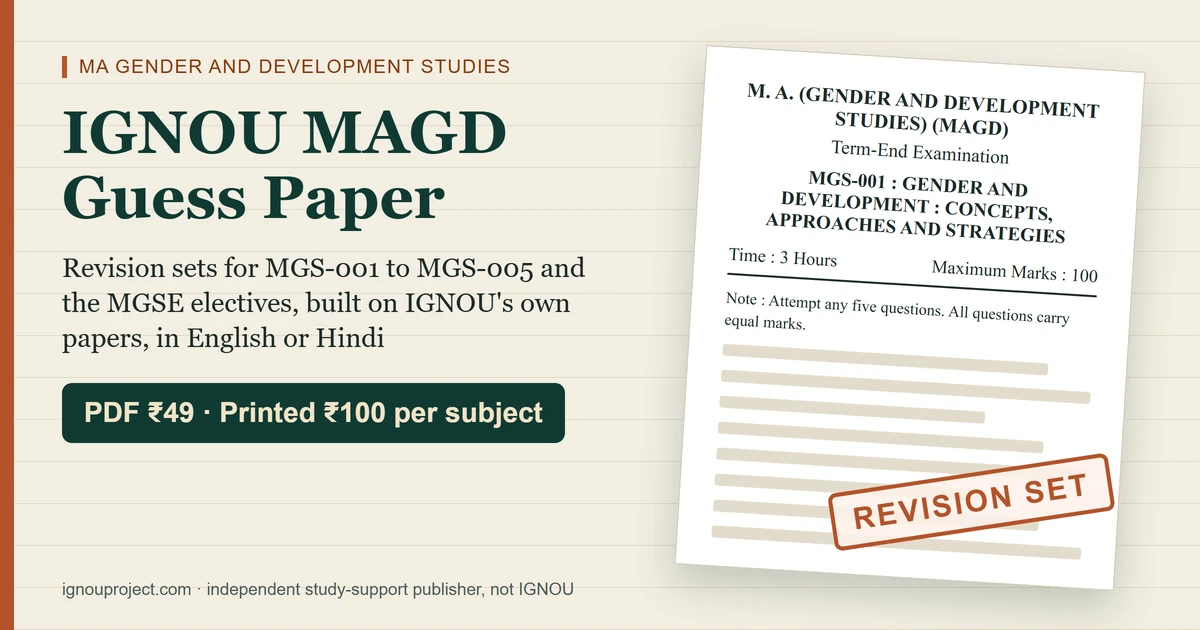
Quick answer. An IGNOU MAGD guess paper is a revision set for one MGS or MGSE course code, built from IGNOU’s past term-end papers and the syllabus, with answers written at exam length. The December 2026 MAGD papers run from MGS-002 on Friday 27 November to MGSE-009 on Wednesday 23 December 2026, inside IGNOU’s examination window of 25 November 2026 to 14 January 2027. All 60 MAGD papers from December 2024 to June 2026 are 3 hours and 100 marks, and 58 of them ask for any five of eight questions at 20 marks each, with Q8 as short notes. For any MGS or MGSE code the price is ₹49 PDF or ₹100 printed, and an order with printed booklets pays ₹100 courier once. Sets come in English or Hindi, because IGNOU examines every MAGD course in both. No set can say which questions IGNOU will choose; it shows what IGNOU has asked before.
MGS-002 Opens on 27 November: Ten MAGD Exam Days in a Row
The December 2026 MAGD papers begin with MGS-002 on Friday 27 November 2026 from 2 PM, according to IGNOU’s date sheet of 30 October 2026. From that Friday to Tuesday 8 December, a MAGD paper is set on every examination day: the Year I courses take the afternoons and the electives take the mornings in between, so no two MAGD papers fall on the same date.
Across every IGNOU programme, December 2026 papers are spread from 25 November 2026 to 14 January 2027; MAGD finishes well inside that span:
First MAGD paper
MGS-002 on Friday 27 November 2026, from 2 PM
Last MAGD paper
MGSE-009 on Wednesday 23 December 2026, from 10 AM
Date sheet of 30 October 2026. Every MAGD date and session on it is the same as on the tentative sheet of 21 September 2026.
Year I: Five Afternoons, MGS-002 Before MGS-001
The compulsory papers are not set in code order. MGS-002 comes first on 27 November, MGS-003 on Monday 30 November, MGS-001 on Wednesday 2 December, MGS-004 on Friday 4 December and MGS-005 on Monday 7 December. Each is in the 2 PM to 5 PM session, and each sits one free day apart from the next, which gives a first-year learner a single clear day between papers and no more.
Year II: Electives in the Mornings Between
Five electives fall into the gaps the Year I papers leave, all at 10 AM: MGSE-001 on 28 November, MGSE-002 on 1 December, MGSE-003 on 3 December, MGSE-006 on 5 December and MGSE-007 on 8 December. After that the spacing opens out. MGSE-004 on Friday 11 December is the only elective set from 2 PM; MGSE-010, MGSE-020 and MGSE-013 follow on 14, 16 and 18 December, and MGSE-009 closes the programme on 23 December.
On a phone, swipe the table sideways for every column.
| Code | Date | Session | Paper | Year | After the previous MAGD paper |
|---|---|---|---|---|---|
| MGS-002 | Friday 27 November | 2 PM to 5 PM | Gender, Development Goals and Praxis | Year I | First paper |
| MGSE-001 | Saturday 28 November | 10 AM to 1 PM | Gender Planning and Development Policies | Year II elective | Next day |
| MGS-003 | Monday 30 November | 2 PM to 5 PM | Gender Analysis | Year I | 2 days later |
| MGSE-002 | Tuesday 1 December | 10 AM to 1 PM | Gender Audit and Gender Budgeting | Year II elective | Next day |
| MGS-001 | Wednesday 2 December | 2 PM to 5 PM | Gender and Development: Concepts, Approaches and Strategies | Year I | Next day |
| MGSE-003 | Thursday 3 December | 10 AM to 1 PM | Gender Mainstreaming | Year II elective | Next day |
| MGS-004 | Friday 4 December | 2 PM to 5 PM | Gender-Sensitive Planning and Policy Making | Year I | Next day |
| MGSE-006 | Saturday 5 December | 10 AM to 1 PM | Gender, Resources and Entitlements | Year II elective | Next day |
| MGS-005 | Monday 7 December | 2 PM to 5 PM | Research Methodologies in Gender and Development Studies | Year I | 2 days later |
| MGSE-007 | Tuesday 8 December | 10 AM to 1 PM | Gender, Organization and Leadership | Year II elective | Next day |
| MGSE-004 | Friday 11 December | 2 PM to 5 PM | Gender Issues in Agriculture, Rural Livelihoods and Natural Resource Management | Year II elective | 3 days later |
| MGSE-010 | Monday 14 December | 10 AM to 1 PM | Gender and Entrepreneurship Development | Year II elective | 3 days later |
| MGSE-020 | Wednesday 16 December | 10 AM to 1 PM | Gender and Financial Inclusion | Year II elective | 2 days later |
| MGSE-013 | Friday 18 December | 10 AM to 1 PM | Gender Training and Empowerment | Year II elective | 2 days later |
| MGSE-009 | Wednesday 23 December | 10 AM to 1 PM | Gender Issues in Work, Employment and Productivity | Year II elective | 5 days later |
A Pending MGS Paper Plus the Year II Electives
The squeeze falls on a second-year learner who still owes a first-year paper. Someone sitting MGS-005 alongside MGSE-001, MGSE-002, MGSE-003, MGSE-006 and MGSE-007 has a paper on 28 November, 1, 3, 5, 7 and 8 December: six papers in eleven days, the last two on consecutive days. Revising the backlog paper before 28 November, not between papers, is the only arrangement that leaves time.
The free calendar further down flags these runs for any set of ticked codes. IGNOU’s whole timetable is summarised on the December 2026 date sheet page, the two daily sessions are explained under IGNOU exam timings, and the admit card is covered in the hall ticket guide. Centre allocation is on the exam centre page, and anyone still to pay can check the examination fee rules and the online fee payment steps.
Why a 100-Mark MGS Paper Carries 70 Per Cent of Each Course
For every MAGD theory course, from MGS-001 to MGSE-020, the assignment carries 30 per cent of the course result, as the weightage column of IGNOU’s assignments download list shows for each code. The term-end examination carries 70 per cent of the final course result and assignments carry the remaining 30 per cent. None of the 60 MAGD question papers from December 2024 to June 2026 prints a weightage line, so the assignment list is the IGNOU document that states it.
In practice the paper decides most of each grade. A strong assignment cannot rescue a weak three hours, and the three hours are full: five answers of 20 marks leave about 34 minutes each once ten minutes go to reading and choosing. Learners who want to see how term-end and assignment marks combine can try the IGNOU percentage calculator. The minimum marks a MAGD learner needs in each part are set out in the Programme Guide, which is the place to confirm them.
MAGD Guess Paper, IGNOU Previous Paper or Solved Paper: Picking the Right One
A guess paper, for MAGD, is a revision set for one course code, such as MGS-003, in which a publisher groups the themes IGNOU has set in past papers, adds questions from the syllabus, and writes model answers at exam length; learners also call it important questions, expected questions or a model paper. A previous year question paper means the genuine MGS or MGSE paper from a past session, which IGNOU posts free on its session lists. A solved question paper takes one such genuine paper and attaches a publisher’s suggested answers.
The three do different jobs, and a MAGD learner with time can use all three.
On a phone, swipe the table sideways for every column.
| Question | Guess paper (revision set) | Previous year question paper | Solved question paper |
|---|---|---|---|
| What is it? | Recurring MGS or MGSE themes for one code, answered | IGNOU’s own paper from one session | One IGNOU paper with answers added |
| Who makes it? | A publisher | IGNOU | A publisher |
| What does it cost? | ₹49 PDF or ₹100 printed per code here | Free | Varies by seller |
| Good for | Knowing which themes returned across four sessions | A timed attempt in the real layout | Checking answers to one session |
| Cannot do | Tell anyone what IGNOU sets next | Compare sessions on its own | Cover themes that session skipped |
Answers to many programmes’ papers are collected on the IGNOU solved question papers page, and sets for every programme are listed on the main IGNOU guess paper hub. A sensible sequence for MAGD is the set first, to learn which themes recur, then one IGNOU paper written against the clock, then the set’s model answers to compare structure.
Built on four sessions per code. Each MGS and MGSE set starts from the December 2024, June 2025, December 2025 and June 2026 IGNOU papers for that code.
Twenty-mark answers. Model answers are sized for about 34 minutes of writing, the time a five-answer paper allows.
Q8 notes included. Every set carries short notes on the terms IGNOU has offered in Q8, from CEDAW to the Vishakha judgement.
Split questions handled. Where IGNOU now splits a question into two 10-mark parts, as in MGSE-013 and MGSE-020, the answer is split the same way.
Indian schemes named. SHGs, the Women Component Plan, Gram Panchayat budgeting and the Five Year Plans appear with the detail an evaluator looks for.
Frameworks spelt out. Harvard, Moser, LFA, PGNs and SGNs are laid out step by step, because MGS-003, MGSE-001 and MGSE-002 keep asking for them.
Research methods made concrete. The MGS-005 set includes a worked research design on a gender theme, the one item asked in all four sessions.
Electives sold singly. A learner with eight electives orders only those eight, never all ten.
Diploma route covered. The five Year I sets serve learners leaving with the PG Diploma in Gender and Development Studies.
English or Hindi. IGNOU prints every MAGD paper in both languages, so either medium is available for every code.
Sent in exam order on request. Year I sets can come MGS-002 first, matching the 27 November start.
PDF or booklet. Choose a WhatsApp PDF, or a printed MAGD booklet that leaves by courier the day after payment.
MGS-001 to MGSE-020: Credits, Paper Layout and Title Slips
MAGD has fifteen examined course codes, listed in section 3.51 of the July 2026 Common Prospectus: five compulsory Year I courses, MGS-001 to MGS-005, and ten Year II electives from MGSE-001 to MGSE-020, of which a learner completes eight. The programme is run by the School of Gender and Development Studies, in English and Hindi, over a minimum of two years.
The credits add up. Year I is 6 + 6 + 4 + 8 + 8 = 32 credits of taught courses plus the 4-credit internship MGSP-001, making 36. Year II is eight electives of 4 credits, 32, plus the 4-credit MGSP-002, again 36. The total of 72 matches the prospectus. The two internship courses carry no term-end paper and are left out of the tables below.
Year I: Five Compulsory Courses, 32 Taught Credits
On a phone, swipe the table sideways for every column.
| Code | Title (July 2026 Common Prospectus) | Credits | December 2026 paper |
|---|---|---|---|
| MGS-001 | Gender and Development: Concepts, Approaches and Strategies | 6 | Wed 2 Dec 2026, 2 PM to 5 PM |
| MGS-002 | Gender, Development Goals and Praxis | 6 | Fri 27 Nov 2026, 2 PM to 5 PM |
| MGS-003 | Gender Analysis | 4 | Mon 30 Nov 2026, 2 PM to 5 PM |
| MGS-004 | Gender-Sensitive Planning and Policy Making | 8 | Fri 4 Dec 2026, 2 PM to 5 PM |
| MGS-005 | Research Methodologies in Gender and Development Studies | 8 | Mon 7 Dec 2026, 2 PM to 5 PM |
Year II: Eight Electives From Ten
On a phone, swipe the table sideways for every column.
| Code | Title (July 2026 Common Prospectus) | Credits | December 2026 paper |
|---|---|---|---|
| MGSE-001 | Gender Planning and Development Policies | 4 | Sat 28 Nov 2026, 10 AM to 1 PM |
| MGSE-002 | Gender Audit and Gender Budgeting | 4 | Tue 1 Dec 2026, 10 AM to 1 PM |
| MGSE-003 | Gender Mainstreaming | 4 | Thu 3 Dec 2026, 10 AM to 1 PM |
| MGSE-004 | Gender Issues in Agriculture, Rural Livelihoods and Natural Resource Management | 4 | Fri 11 Dec 2026, 2 PM to 5 PM |
| MGSE-006 | Gender, Resources and Entitlements | 4 | Sat 5 Dec 2026, 10 AM to 1 PM |
| MGSE-007 | Gender, Organization and Leadership | 4 | Tue 8 Dec 2026, 10 AM to 1 PM |
| MGSE-009 | Gender Issues in Work, Employment and Productivity | 4 | Wed 23 Dec 2026, 10 AM to 1 PM |
| MGSE-010 | Gender and Entrepreneurship Development | 4 | Mon 14 Dec 2026, 10 AM to 1 PM |
| MGSE-013 | Gender Training and Empowerment | 4 | Fri 18 Dec 2026, 10 AM to 1 PM |
| MGSE-020 | Gender and Financial Inclusion | 4 | Wed 16 Dec 2026, 10 AM to 1 PM |
Which Sets Match Which Registration
On a phone, swipe the table sideways for every column.
| Learner | Papers in December 2026 | Sets to consider |
|---|---|---|
| MAGD Year I | MGS-001 to MGS-005, 27 November to 7 December | Five sets; MGS-002 is examined first |
| PG Diploma exit route | The same five MGS codes | Five sets; MGSP-001 has no paper |
| MAGD Year II | Eight of the ten MGSE electives you registered | Up to eight sets, one per elective |
| Year II with MGS-005 pending | MGS-005 plus morning electives from 28 November | Six papers in eleven days if the first five electives are taken |
| Learner of another programme sitting MGSE-009 | MGSE-009 on 23 December | One set; the code is shared with other programmes |
One Layout for Fifteen Codes, and Two Papers That Broke It
A MAGD term-end paper is 3 hours and 100 marks, with eight questions of which any five are answered at 20 marks each; Q8 is a set of short notes, any four of five at 5 marks. Of the 60 MAGD papers from December 2024 to June 2026, 58 keep that eight-question shape. The two exceptions are the December 2025 MGS-005 and MGSE-009 papers, which set only seven questions, still asked for any five, and put the short notes at Q7.
On a phone, swipe the table sideways for every column.
| Code | Latest IGNOU paper | Time and marks | Essay rule | Short notes | 1,000-word line printed | Questions split 10 + 10 |
|---|---|---|---|---|---|---|
| MGS-001 | June 2026 | 3 hours, 100 marks | Any 5 of 8 at 20 | Q8: any 4 of 5 at 5 | No | None |
| MGS-002 | June 2026 | 3 hours, 100 marks | Any 5 of 8 at 20 | Q8: any 4 of 5 at 5 | No | None |
| MGS-003 | June 2026 | 3 hours, 100 marks | Any 5 of 8 at 20 | Q8: any 4 of 5 at 5 | No | None |
| MGS-004 | June 2026 | 3 hours, 100 marks | Any 5 of 8 at 20 | Q8: any 4 of 5 at 5 | No | None |
| MGS-005 | June 2026 | 3 hours, 100 marks | Any 5 of 8 at 20 | Q8: any 4 of 5 at 5 | Yes | Q5 |
| MGSE-001 | June 2026 | 3 hours, 100 marks | Any 5 of 8 at 20 | Q8: any 4 of 5 at 5 | Yes | Q4 |
| MGSE-002 | June 2026 | 3 hours, 100 marks | Any 5 of 8 at 20 | Q8: any 4 of 5 at 5 | Yes | Q1, Q5 |
| MGSE-003 | June 2026 | 3 hours, 100 marks | Any 5 of 8 at 20 | Q8: any 4 of 5 at 5 | No | None |
| MGSE-004 | June 2026 | 3 hours, 100 marks | Any 5 of 8 at 20 | Q8: any 4 of 5 at 5 | Yes | Q4 |
| MGSE-006 | June 2026 | 3 hours, 100 marks | Any 5 of 8 at 20 | Q8: any 4 of 5 at 5 | No | None |
| MGSE-007 | June 2026 | 3 hours, 100 marks | Any 5 of 8 at 20 | Q8: any 4 of 5 at 5 | No | None |
| MGSE-009 | June 2026 | 3 hours, 100 marks | Any 5 of 8 at 20 | Q8: any 4 of 5 at 5 | No | None |
| MGSE-010 | June 2026 | 3 hours, 100 marks | Any 5 of 8 at 20 | Q8: any 4 of 6 at 5 | No | None |
| MGSE-013 | June 2026 | 3 hours, 100 marks | Any 5 of 8 at 20 | Q8: any 4 of 5 at 5 | Yes | Q1, Q2, Q6 |
| MGSE-020 | June 2026 | 3 hours, 100 marks | Any 5 of 8 at 20 | Q8: any 4 of 5 at 5 | Yes | Q1, Q2, Q5 |
The seven-question papers matter more than they look. Five from seven leaves two questions to skip instead of three, so a learner who has prepared narrowly has less room. Both codes went back to eight questions in June 2026, but a set written for MGS-005 or MGSE-009 should still prepare every Q8-style term, because notes were compulsory in practice when the choice shrank. Three papers also offered six note options instead of five: MGS-002 in June 2025 and December 2025, and MGSE-010 in June 2026.
The 1,000-Word Line That Comes and Goes
IGNOU sometimes prints a word limit in the instruction line and sometimes leaves it out, for the same code. The table counts the papers where it appears.
On a phone, swipe the table sideways for every column.
| Session | Papers with the line | Codes |
|---|---|---|
| December 2024 | 13 of 15 | All except MGSE-001 and MGSE-009 |
| June 2025 | 2 of 15 | MGSE-004, MGSE-020 |
| December 2025 | 1 of 15 | MGSE-004 |
| June 2026 | 6 of 15 | MGS-005, MGSE-001, MGSE-002, MGSE-004, MGSE-013, MGSE-020 |
The limit is the same whenever it appears: about 1,000 words for a 20-mark answer. A learner should write to that length whether or not the line is printed, and treat the printed instruction on the day as final.
Questions Split Into Two 10-Mark Parts in June 2026
The June 2026 MAGD papers split eleven questions into two 10-mark parts, across six codes, compared with three split questions in December 2024, three in June 2025 and one in December 2025. MGSE-013 and MGSE-020 each split three of their seven essay questions.
On a phone, swipe the table sideways for every column.
| Code | Course | Split questions |
|---|---|---|
| MGS-005 | Research Methodologies in Gender and Development Studies | Q5 |
| MGSE-001 | Gender Planning and Development Policies | Q4 |
| MGSE-002 | Gender Audit and Gender Budgeting | Q1, Q5 |
| MGSE-004 | Gender Issues in Agriculture, Rural Livelihoods and Natural Resource Management | Q4 |
| MGSE-013 | Gender Training and Empowerment | Q1, Q2, Q6 |
| MGSE-020 | Gender and Financial Inclusion | Q1, Q2, Q5 |
Misprints and Title Changes in IGNOU’s MAGD Files
Small errors in IGNOU’s papers can make a candidate doubt the question. None changes what is being asked.
On a phone, swipe the table sideways for every column.
| Code | Paper | As printed | Meaning |
|---|---|---|---|
| MGSE-007 | June 2025 | Q6 “Define ‘Glass Celing'” | Glass ceiling |
| MGSE-001 | June 2026 | Q8 “White short notes on any four” | Write short notes |
| MGS-004 | June 2026 | Q6 “women face discrimation and violence” | Discrimination |
| MGS-001 | June 2025 | Q4 “Ester Boserup’s perspectives” | Esther Boserup |
| MGS-002 | December 2025 | Q2 “Just your answer by giving suitable examples” | Justify your answer |
| MGSE-009 | December 2025 | Q1 “Discuss the system and analyse its impact” names no system | The system meant is not printed; answer from the block the question follows |
| MGSE-004 | December 2025 | Title “Rural Livelihood” | Rural Livelihoods, as in the prospectus and the other three papers |
| MGSE-020 | June 2025 to June 2026 | Title “Gender Issues and Financial Inclusion” | Gender and Financial Inclusion in the prospectus and the December 2024 paper |
| MGSE-007 | December 2024 | Title “Organisation” | Organization in the prospectus and the later papers |
Disagreements and outdated lists to know about.
- MGSE-020 has two titles. The July 2026 Common Prospectus and the December 2024 paper say “Gender and Financial Inclusion”; the June 2025, December 2025 and June 2026 papers say “Gender Issues and Financial Inclusion”. The code and the course are the same.
- The site’s own MAGD handwritten assignment page says the MGSE-020 title agrees across its sources. IGNOU’s three most recent MGSE-020 papers do not agree, and that page is being corrected.
- The prospectus prints the codes unpadded, as MGS 1 and MGSE 20; the papers print MGS-001 and MGSE-020, and IGNOU’s assignments list mixes both, with MGS-001 next to MGS-2, MGS-3, MGS-4 and MGS-5. They are the same courses.
- At least one third-party course list still names an MGSE-008 elective. It is not among the ten electives in the July 2026 Common Prospectus and has no paper in the four sessions compared here.
- Third-party previous-paper sites that stop at June 2023 or December 2023 miss the December 2025 seven-question papers and the June 2026 split questions.
The layout facts for the other eight electives come from these IGNOU papers: MGSE-003 Dec 2024, MGSE-003 Jun 2025, MGSE-003 Dec 2025 and MGSE-003 Jun 2026; MGSE-004 Dec 2024, MGSE-004 Jun 2025, MGSE-004 Dec 2025 and MGSE-004 Jun 2026; MGSE-006 Dec 2024, MGSE-006 Jun 2025, MGSE-006 Dec 2025 and MGSE-006 Jun 2026; MGSE-007 Dec 2024, MGSE-007 Jun 2025, MGSE-007 Dec 2025 and MGSE-007 Jun 2026; MGSE-009 Dec 2024, MGSE-009 Jun 2025, MGSE-009 Dec 2025 and MGSE-009 Jun 2026; MGSE-010 Dec 2024, MGSE-010 Jun 2025, MGSE-010 Dec 2025 and MGSE-010 Jun 2026; MGSE-013 Dec 2024, MGSE-013 Jun 2025, MGSE-013 Dec 2025 and MGSE-013 Jun 2026; MGSE-020 Dec 2024, MGSE-020 Jun 2025, MGSE-020 Dec 2025 and MGSE-020 Jun 2026.
The site has no separate page for each MAGD code; programme-level support sits on the MAGD handwritten assignment page, which also covers the 2026-27 assignment booklets.
Research Design, Gender Audit, PRA: Themes IGNOU Set Again and Again
MGS-005 Research Methodologies in Gender and Development Studies is the most repetitive MAGD paper: a research design or proposal, the internet and ICT in research, and sampling each appeared in all four IGNOU papers from December 2024 to June 2026. MGS-003 Gender Analysis and MGSE-002 Gender Audit and Gender Budgeting each have two or three themes at 4 of 4 as well.
Every count on this page comes from IGNOU’s own term-end papers for December 2024, June 2025, December 2025 and June 2026, compared in full by ignouproject.com on 5 November 2026. A cell shows the question number; “note” means the theme came as a short note in Q8 (Q7 in a seven-question paper). Matching questions to a theme is a human judgement, not a word match, and themes seen in only one paper are left out of the tables. The theme tables cover MGS-001 to MGS-005, MGSE-001 and MGSE-002; for the other eight electives the format above is confirmed against the latest IGNOU paper on WhatsApp.
The question MGS-003 set twice. The June 2025 MGS-003 paper asked, as Q6, “What is Action Research? Explain the steps involved in action research for conducting gender analysis.” The June 2026 paper set the same words again as Q5. In the same pair of papers, a question on how qualitative research relates to gender analysis appeared as Q4 and then as Q3, with only “method” becoming “methods”. Repetition this close is unusual and is not a promise for December 2026.
MGS-001 Gender and Development: Concepts, Approaches and Strategies
Gender planning is the one MGS-001 theme in every paper, three times as an essay and once, in June 2026, as a short note. Development theory read through gender, from modernisation and Andre Gunder Frank to the shift from WID to GAD, took up two essays in June 2025 and two more in December 2025.
On a phone, swipe the table sideways for every column.
| Theme | December 2024 | June 2025 | December 2025 | June 2026 | n of N |
|---|---|---|---|---|---|
| Gender planning: steps, approaches, versus conventional planning | Q7 | Q6 | Q1 | Q8(c) note | 4 of 4 |
| Development theory through a gender lens (modernisation, Frank, WID to GAD, Marxist feminism) | – | Q2, Q3 | Q4, Q6 | Q1 | 3 of 4 |
| Gender mainstreaming | Q3 | Q1 | – | Q8(a) note | 3 of 4 |
| Women in development, with international cases (MDGs, UN conferences, Boserup, Asia and Africa) | Q2, Q6 | Q4 | Q5 | – | 3 of 4 |
| Health, workplace safety and reproductive rights | – | Q7 | Q3 | Q8(d) note | 3 of 4 |
| Women’s work: formal and informal, paid and unpaid | Q1 | – | Q2 | – | 2 of 4 |
| Self Help Groups, entrepreneurship and women’s employment | – | Q5 | – | Q4 | 2 of 4 |
The four MGS-001 papers behind these counts: MGS-001 December 2024, MGS-001 June 2025, MGS-001 December 2025 and MGS-001 June 2026.
MGS-002 Gender, Development Goals and Praxis
Exclusion and marginalisation run through three MGS-002 papers. Gender justice, SHGs and microcredit, and sector studies of industry and agriculture each reached 3 of 4, which makes this the broadest of the Year I papers to revise.
On a phone, swipe the table sideways for every column.
| Theme | December 2024 | June 2025 | December 2025 | June 2026 | n of N |
|---|---|---|---|---|---|
| Social exclusion and marginalisation | Q1, Q7 | – | Q8(f) note | Q2 | 3 of 4 |
| Gender justice and human development | – | Q2 | Q6 | Q3 | 3 of 4 |
| Self Help Groups and microcredit | – | Q7 | Q3 | Q5 | 3 of 4 |
| Industry, services and agriculture from a gender perspective | Q4 | Q5 | Q7 | – | 3 of 4 |
| NGOs and civil society | Q2 | Q3, Q8(f) note | – | – | 2 of 4 |
| The United Nations and women’s empowerment | Q3 | Q1 | – | – | 2 of 4 |
| Social protection and gender mainstreaming | – | Q8(e) note | Q1, Q4 | – | 2 of 4 |
| Globalisation and trade regimes (GATT, TRIPS, GATS) | – | Q4 | – | Q6 | 2 of 4 |
Each MGS-002 cell can be checked in MGS-002 December 2024, MGS-002 June 2025, MGS-002 December 2025 and MGS-002 June 2026.
MGS-003 Gender Analysis
Three MGS-003 themes appeared in all four papers: the concepts and components of gender analysis, participatory appraisal with PRA tools, and project planning with implementation. Action research, monitoring and evaluation, policy-making and qualitative methods each reached 3 of 4.
On a phone, swipe the table sideways for every column.
| Theme | December 2024 | June 2025 | December 2025 | June 2026 | n of N |
|---|---|---|---|---|---|
| Concepts and components of gender analysis | Q1 | Q2, Q3 | Q1, Q2 | Q1, Q2 | 4 of 4 |
| Participatory appraisal and PRA tools | Q2 | Q5 | Q4 | Q4 | 4 of 4 |
| Project planning, design and implementation (including LFA) | Q5 | Q8(d) note | Q6, Q7 | Q6 | 4 of 4 |
| Action research in gender analysis | Q3 | Q6 | – | Q5 | 3 of 4 |
| Monitoring and evaluation | Q6 | Q8(e) note | – | Q7 | 3 of 4 |
| Gender analysis in policy-making | Q4 | Q7 | Q8(b) note | – | 3 of 4 |
| Qualitative methods and focus group discussion | – | Q4 | Q5 | Q3, Q8(b) note | 3 of 4 |
| Gender analysis and planning frameworks | Q8(a) note | – | Q3 | – | 2 of 4 |
IGNOU’s MGS-003 files, including both Action Research papers: MGS-003 December 2024, MGS-003 June 2025, MGS-003 December 2025 and MGS-003 June 2026.
MGS-004 Gender-Sensitive Planning and Policy Making
MGS-004 keeps returning to India’s own planning record. The Five Year Plans were set in three papers, with the plan numbers changing each time: the 5th to 8th in December 2024, the 6th to 8th in June 2025 and the 1st to 5th in June 2026.
On a phone, swipe the table sideways for every column.
| Theme | December 2024 | June 2025 | December 2025 | June 2026 | n of N |
|---|---|---|---|---|---|
| Five Year Plans read for gender | Q1, Q8(c) note | Q2 | – | Q1 | 3 of 4 |
| Resources and their efficient use | Q6 | Q4 | Q4 | – | 3 of 4 |
| Micro-planning and decentralised planning | Q3 | Q3 | – | Q8(e) note | 3 of 4 |
| Women’s leadership in planning | Q4 | Q8(d) note | Q6 | – | 3 of 4 |
| Policy analysis: meaning and stages | Q7 | Q5 | – | – | 2 of 4 |
| Participatory approach to planning | Q5 | – | – | Q7 | 2 of 4 |
| Cost-benefit analysis | – | – | Q2 | Q2 | 2 of 4 |
| Affirmative action | Q8(b) note | – | – | Q8(a) note | 2 of 4 |
| Women with disabilities | Q8(d) note | Q7 | – | – | 2 of 4 |
The MGS-004 papers, from the 5th to 8th Plan question to the 1st to 5th: MGS-004 December 2024, MGS-004 June 2025, MGS-004 December 2025 and MGS-004 June 2026.
MGS-005 Research Methodologies in Gender and Development Studies
Three MGS-005 themes reached 4 of 4. The December 2025 paper asked for a research proposal on a gender issue; the June 2026 paper asked for a research design on a topic of the learner’s choice, so a prepared design on one gender theme serves both forms.
On a phone, swipe the table sideways for every column.
| Theme | December 2024 | June 2025 | December 2025 | June 2026 | n of N |
|---|---|---|---|---|---|
| Research design or research proposal | Q7 | Q6 | Q4 | Q3 | 4 of 4 |
| Internet and ICT in research | Q2 | Q5 | Q6 | Q5(b) | 4 of 4 |
| Sampling | Q5 | Q3 | Q7(a) note | Q4 | 4 of 4 |
| Qualitative versus quantitative research | – | Q2 | Q1 | Q1(d) | 3 of 4 |
| Feminist methods and standpoint theory | Q6 | – | Q2, Q5 | Q2 | 3 of 4 |
| Positivism | Q1 | – | Q7(b) note | Q8(b) note | 3 of 4 |
| Survey method | Q4 | – | Q3 | – | 2 of 4 |
| Ethnography and case study | Q8(e) note | – | – | Q6, Q7 | 2 of 4 |
To trace each MGS-005 count: MGS-005 December 2024, MGS-005 June 2025, MGS-005 December 2025 and MGS-005 June 2026.
MGSE-001 Gender Planning and Development Policies
MGSE-001 overlaps with MGS-004 in subject but asks differently: planning cycles, types of plans and indicators often come as short notes, and the GAD analytical tools were set in three consecutive sessions.
On a phone, swipe the table sideways for every column.
| Theme | December 2024 | June 2025 | December 2025 | June 2026 | n of N |
|---|---|---|---|---|---|
| Planning cycle and annual budget cycle | Q8(e) note | Q5, Q8(a) note | Q8(e) note | Q7 | 4 of 4 |
| Gender planning: meaning, steps and barriers | – | Q1, Q7 | Q1, Q2, Q6, Q7 | Q3 | 3 of 4 |
| Types of plans: long and short term, single-use, standing | Q1 | Q8(b), Q8(c) notes | – | Q2 | 3 of 4 |
| GAD analytical tools, WID and WAD | – | Q6 | Q3 | Q5 | 3 of 4 |
| Variables and gender-sensitive indicators | Q8(a) note | – | Q8(a) note | Q8(c), Q8(e) notes | 3 of 4 |
| Practical and strategic gender needs | Q5 | – | – | Q4 | 2 of 4 |
| Monitoring and evaluation | Q6 | – | – | Q8(b) note | 2 of 4 |
| Participatory approach | Q3 | Q8(e) note | – | – | 2 of 4 |
MGSE-001 as IGNOU published it: MGSE-001 December 2024, MGSE-001 June 2025, MGSE-001 December 2025 and MGSE-001 June 2026.
MGSE-002 Gender Audit and Gender Budgeting
Two MGSE-002 themes were set in all four papers: gender budgeting in Gram Panchayats and urban local bodies, and gender audit with its indicators. The country examples change from session to session, Australia and South Africa in June 2025, Tanzania, the United Kingdom and Uganda in December 2025.
On a phone, swipe the table sideways for every column.
| Theme | December 2024 | June 2025 | December 2025 | June 2026 | n of N |
|---|---|---|---|---|---|
| Gender budgeting in Gram Panchayats and urban local bodies | Q5, Q6 | Q7 | Q7 | Q6 | 4 of 4 |
| Gender audit, its indicators and participatory gender audit | Q2 | Q8(e) note | Q5, Q8(c) note | Q4, Q8(c) note | 4 of 4 |
| Meaning, history and need for gender budgeting | Q1 | Q1 | – | Q1 | 3 of 4 |
| The government budget process and its players | – | Q3 | Q6 | Q7 | 3 of 4 |
| Gender budgeting abroad (Australia, South Africa, Tanzania, UK, Uganda) | – | Q2 | Q1 | – | 2 of 4 |
| Social audit | – | Q4 | – | Q3 | 2 of 4 |
| Performance budgeting reforms | – | – | Q3 | Q2 | 2 of 4 |
| Expenditure tools | Q7 | – | Q2 | – | 2 of 4 |
The MGSE-002 papers behind the two 4 of 4 themes: MGSE-002 December 2024, MGSE-002 June 2025, MGSE-002 December 2025 and MGSE-002 June 2026.
One Idea Asked in Two Different Courses
“Development with growth” against “development with dignity” was an essay in the June 2026 MGS-001 paper (Q5) and in the December 2025 MGSE-009 paper (Q4), where it was worded as development with dignity of labour. A learner sitting both courses can prepare the comparison once.
How a Revision Set for an MGS or MGSE Code Is Put Together
Five steps, the same for each of the fifteen codes; only the papers differ.
- Pull the code’s December 2024 to June 2026 papers. For every MAGD code that means December 2024 to June 2026, taken from IGNOU’s own question paper lists.
- Sort each essay and each Q8 note by theme. A short note on “Participatory Gender Audit” and an essay on gender audit indicators are counted together.
- Answer the most frequent themes first. Themes in 4 of 4 or 3 of 4 papers get full 20-mark answers; themes seen twice get shorter answers; Q8 terms get 5-mark notes of about 150 words.
- Write to the current layout. Eight-question structure, 1,000 words at most, and two-part answers where the June 2026 paper split a question.
- Check each answer against the IGNOU block. Definitions, schemes and frameworks follow the course material learners received, not a general textbook.
A Worked Plan: Gender Budgeting in Urban Local Bodies
The June 2026 MGSE-002 paper asked, as Q6, why gender budgeting in urban local bodies matters, with examples from Karnataka. A 20-mark answer of about 1,000 words fits a 34-minute plan:
- About 4 minutes: define gender budgeting and say why the city level matters, since services such as water, sanitation and transport are delivered there.
- About 12 minutes: the steps, from a gender analysis of the budget to allocation, implementation and review, naming the Gender Budgeting Cells.
- About 12 minutes: the Karnataka example, then one contrast with Gram Panchayat budgeting, which IGNOU asked about in December 2024 and December 2025.
- About 6 minutes: limits, such as thin data and staff capacity, and a closing line tied back to the question.
Fourteen Days Before MGS-002
For a first-year learner starting on 13 November, two days per course leaves four days spare. Take MGS-002 and MGS-003 first because they are set first, MGS-001 next, then MGS-004 and MGS-005, whose 8 credits each make them the heaviest. Each day: two 4 of 4 or 3 of 4 themes written out in full, five Q8 terms, and one timed answer. The single free day between papers is for the next paper’s notes, not for new reading.
What a MAGD Set Can Help With, and Where It Stops
A guess paper is a revision aid built from past IGNOU question papers and the syllabus. No one outside IGNOU knows the questions in advance, and no claim is made that any question in this set will appear in your examination.
Where a MAGD Set Is Useful
It puts the themes IGNOU has set in three or four of the last four papers in one place, with answers sized for 20 marks and notes sized for 5. It shows how to structure an MGS-005 research design or an MGSE-002 audit answer, and it helps a learner with ten papers in twelve days decide where the first hours go.
Where It Stops
Whatever the December 2026 MAGD papers contain is unknown until the day. MGS-001 set new themes in every session, and the December 2025 seven-question papers show that even the layout can move. It does not replace the MGS and MGSE blocks, from which every question is drawn, and it cannot predict a layout change it has not yet seen.
Revising without paying. Every MAGD paper counted here is free on IGNOU’s question paper lists, and the guide to IGNOU last year papers explains how to use them for timed practice. The MGS and MGSE blocks can be opened through the eGyanKosh guide or the Gyankosh route; printed material is covered on the IGNOU books download page, and shorter summaries sit in the IGNOU study notes collection.
Free MAGD Planners: An Exam-Day Calendar and a Five-Answer Clock
The calendar places the ticked codes on IGNOU’s December 2026 sheet and warns about back-to-back days; the clock shows a code’s layout, the minutes each answer can have, and its most frequent themes. Both work from the tables on this page.
Free tool 1
MAGD Exam-Day Calendar
Enter between 0.5 and 16 hours; 1.5 or 2.5 work too.
This tool is guidance from ignouproject.com, not an IGNOU rule. Using it creates no obligation to order anything.
Free tool 2
MGS and MGSE Five-Answer Clock
Ten minutes go to choosing five questions; the other 170 are shared out by marks.
This tool is guidance from ignouproject.com, not an IGNOU rule. Using it creates no obligation to order anything.
The arithmetic behind the clock, for each MAGD question type:
On a phone, swipe the table sideways for every column.
| Question type | Time available | Time per answer |
|---|---|---|
| Eight-question paper: five answers at 20 | 170 minutes after 10 to read | 34 minutes per 20-mark answer |
| Q8 short notes, four at 5 marks | One of the five answer slots | About 8 minutes per note, roughly 150 words |
| A question split 10 + 10 | One answer slot of 34 minutes | About 17 minutes per part |
| Seven-question paper (MGS-005 and MGSE-009, December 2025) | 170 minutes after 10 to read | Still 34 minutes per answer; only two questions can be skipped |
Neither planner knows more than the tables above. The dates come from the sheet of 30 October 2026, and the layouts from the June 2026 papers.
Finding Each MAGD Paper and the Date Sheet on ignou.ac.in
IGNOU publishes one question paper list per term-end session, and each of the four MAGD sessions compared here is on its own list: the June 2026 question paper list, the December 2025 list, the June 2025 list and the December 2024 list.
- Search the list for the hyphenated code, such as MGSE-006. Each of the four lists holds all fifteen MAGD codes.
- Confirm the session from page 1 of the PDF itself; IGNOU stored the December 2024 MAGD files in a general downloads folder whose name carries no month.
- Expect the English questions first and the Hindi version after them in the same file.
- For dates, rely on IGNOU’s PDF alone. The December 2026 date sheet of 30 October 2026 replaced the tentative sheet of 21 September 2026, and both print the codes without hyphens, as MGS002 and MGSE001.
Unofficial pages often repeat old dates. The site keeps a general IGNOU date sheet guide, but the PDF above settles any disagreement.
Hall Ticket Before 27 November, Results and Grade Card After
The admit card has to be in hand before MGS-002 or MGSE-001, whichever comes first on a learner’s list. After the papers, term-end marks appear through the IGNOU result page; the previous cycle can be followed on the June 2026 result page, and master’s degree releases on the IGNOU MA result page.
The 30 per cent from assignments shows up separately; the assignment result status page explains how to check whether it has been entered. A learner unhappy with a term-end mark can follow the IGNOU revaluation process, and once all courses are cleared the final grade card guide and the CGPA calculator help with the overall result.
Assignments, Internships and Other MAGD Help
A revision set does not touch the assignment that makes up the other 30 per cent. Handwritten MAGD assignments are offered on the MAGD page linked above, and typed answers are listed under IGNOU solved assignments. Fuller course coverage than a set can give is in the IGNOU help books and the online guide books. MGSP-001 and MGSP-002 are internship or field research courses with no term-end paper, and they are covered on the MAGD internship and project guide.
English or Hindi: Every MAGD Paper Is Printed in Both
IGNOU examines MAGD in English and Hindi: the July 2026 Common Prospectus lists both as the medium of instruction, and every one of the 60 MAGD papers from December 2024 to June 2026 carries the English questions followed by the Hindi version in the same file. A Hindi-medium learner writes the same paper, question for question.
Each set is prepared for the upcoming term-end examination, in every medium IGNOU examines that course in, and the medium for your course code is confirmed on WhatsApp before you pay.
The two halves match closely, with one small exception worth knowing. In the June 2026 MGSE-002 paper, short note (d) reads “Gendered impact indicators” in English, while the Hindi version asks for indicators that show gender-based discrimination against women. A Hindi-medium answer should follow the Hindi wording.
Ordering MAGD Sets: Codes, Format, Medium, Payment
The rate is ₹49 per subject code for a solved guess paper as a PDF, or ₹100 per subject code as a printed copy. Printed copies carry a one-time courier charge of ₹100 per order, whatever the number of subject codes; the PDF has no courier charge.
- List the codes as IGNOU prints them, MGS-001 or MGSE-020.
- Say against every code whether it should come as a PDF or a booklet.
- Message that list, plus English or Hindi, to WhatsApp +91 93546 37830.
- Pay the total confirmed in the reply.
The PDF is shared on WhatsApp once payment is confirmed. A printed copy is dispatched the next day after payment is confirmed, and the courier details are shared on WhatsApp. No arrival date is promised, because transit time depends on the courier and your location.
There is no minimum order: one subject or ten, same rate per format.
A first-year learner taking all five MGS codes pays 5 × ₹49 = ₹245 as PDFs, or 5 × ₹100 + ₹100 courier = ₹600 printed. A second-year learner with eight electives pays ₹392 as PDFs, or ₹900 printed including the one courier charge. Other services and their rates are on the services and charges page.
Where the MAGD Counts Come From, and the Next Review
IGNOU documents. The July 2026 Common Prospectus (section 3.51 for the course list and credits, and the programme table for medium and duration); the 60 MAGD term-end papers from December 2024 to June 2026, each linked above; the four session question paper lists; the December 2026 date sheets of 21 September and 30 October 2026; and the IGNOU assignments download list, for the 30 per cent weightage. A summary of the prospectus is on the IGNOU prospectus guide.
The publisher’s analysis. The theme counts, the layout, word-limit and split-question tables, the misprint list and the worked plans are ignouproject.com’s own reading of those papers, compared on 5 November 2026. Theme matching is a judgement. The theme tables cover MGS-001 to MGS-005, MGSE-001 and MGSE-002.
The publisher’s terms. What a MAGD set costs, how it travels and in which language it comes are ignouproject.com’s own terms, separate from anything IGNOU publishes.
Written and reviewed by BK Sahni, Founder, Shri Chakradhar Publication Pvt. Ltd. and ignouproject.com, who has guided 5,00,000 students till date. ORCID 0009-0005-8092-459X. Serving IGNOU learners since 2010.
Published 5 November 2026. Last reviewed 5 November 2026. Next review: March 2027, the month IGNOU usually releases its tentative June-cycle date sheet, here for June 2027.
MAGD Guess Paper Questions Learners Ask
IGNOU MAGD revision sets are priced per code: ₹49 for the PDF, ₹100 for a printed booklet. Booklet orders pay a flat ₹100 courier fee once, whether they hold one MGSE code or eight; PDFs travel on WhatsApp with no such fee. MGS-003 on its own is ₹49 as a PDF, or ₹100 printed plus that courier charge.
In MGS-005, a research design or proposal, the internet and ICT in research, and sampling each appeared in all four papers from December 2024 to June 2026. MGS-003 set gender analysis concepts and participatory appraisal in 4 of 4, and MGSE-002 set local-body gender budgeting and gender audit in 4 of 4.
The first MAGD paper is MGS-002 Gender, Development Goals and Praxis on Friday 27 November 2026, 2 PM to 5 PM, per IGNOU’s date sheet of 30 October 2026. The first elective, MGSE-001, follows on Saturday 28 November at 10 AM, and the last, MGSE-009, is on Wednesday 23 December.
Every MAGD paper is 3 hours and 100 marks: eight questions, any five answered, 20 marks each, with Q8 a set of short notes where four of five are answered at 5 marks. That eight-question shape held in 58 of the 60 IGNOU papers from December 2024 to June 2026.
Yes. Every one of the 60 MAGD papers from December 2024 to June 2026 prints the English questions first and the Hindi version after them in the same file, and the July 2026 Common Prospectus lists English and Hindi as the medium. Sets are prepared in both; the medium is confirmed on WhatsApp.
No. An IGNOU previous year question paper is the actual paper set in a past session, free on ignou.ac.in. A MAGD guess paper is a publisher’s revision set for one code, such as MGSE-002, that groups recurring themes and answers them at exam length. The two work best together.
Nobody outside IGNOU knows which questions the December 2026 MAGD papers will carry, and no claim is made that any set question will appear. What can be shown is the past record: for example, MGS-003 repeated an Action Research question word for word in June 2025 and June 2026.
A full MAGD answer is worth 20 marks, and some papers print a limit of 1,000 words per answer. That line appeared on 13 of the 15 December 2024 papers but on only six June 2026 papers, including MGS-005 and MGSE-002, so the limit printed on the day applies.
For each MAGD theory course, the term-end examination carries 70 per cent and assignments 30 per cent. IGNOU’s assignments download list prints a weightage of 30 for every MGS and MGSE assignment; the question papers themselves print no weightage line. Assignments carry 100 marks each.
Yes, briefly. The December 2025 MGS-005 and MGSE-009 papers set seven questions instead of eight, still asking for any five, so the choice narrowed to five of seven. Both returned to eight questions in June 2026. June 2026 also split more questions into two 10-mark parts.
A MAGD Year II learner takes eight of the ten MGSE electives listed in the July 2026 Common Prospectus, so up to eight elective sets apply. Year I has five compulsory papers, MGS-001 to MGS-005. The internship courses MGSP-001 and MGSP-002 have no term-end paper.
The PDF is shared on WhatsApp once payment is confirmed. A printed MAGD copy is dispatched the next day after payment is confirmed, and the courier details are shared on WhatsApp. No arrival date is promised, because transit time depends on the courier and the learner’s location.
Yes. There is no minimum order for MAGD sets: one subject or ten, same rate per format. A learner who only needs MGSE-020 pays ₹49 for the PDF, or ₹100 plus the single ₹100 courier charge for a printed copy.
Both names are in use for MGSE-020. The July 2026 Common Prospectus and the December 2024 paper say Gender and Financial Inclusion; the June 2025, December 2025 and June 2026 papers print Gender Issues and Financial Inclusion. The code is unchanged, so the same set applies.
IGNOU’s own question paper lists on ignou.ac.in carry every MAGD paper, one list per term-end session: search the list for the hyphenated code, such as MGS-004, and open the PDF. The December 2024, June 2025, December 2025 and June 2026 lists each hold all fifteen MAGD codes.
Any MAGD guess paper is worth checking on five points: it names the current code, matches the eight-question layout, targets the December 2026 session, answers at 20-mark length, and avoids accuracy claims. A seller promising that a share of questions will come is a reason for caution, whoever the seller is.
Yes. The July 2026 Common Prospectus says a MAGD learner who completes MGS-001 to MGS-005 and MGSP-001 can exit with the Post-Graduate Diploma in Gender and Development Studies, so the five Year I papers and their sets are the same for that route.
Important Notice
ignouproject.com is an independent IGNOU study-support publisher. It is not the official website of Indira Gandhi National Open University, is not affiliated with, endorsed by or authorised by the university, and no page on this site should be treated as an official IGNOU communication.
Programme structures, course codes, examination dates, question-paper patterns and rules change, and only ignou.ac.in and your Regional Centre can confirm the current position for your enrolment.
A guess paper is a revision aid built from past IGNOU question papers and the syllabus. No one outside IGNOU knows the questions in advance, and no claim is made that any question in this set will appear in your examination.
Study the official IGNOU material for every course you are sitting; a guess paper supplements that material and does not replace it.
No claim is made about the marks you will receive, about how an evaluator will assess your answers, or about your result. Examination and evaluation are entirely a matter for IGNOU.

BK Sahni iD 0009-0005-8092-459X
Founder, Shri Chakradhar Publication Pvt. Ltd. & ignouproject.com — helping IGNOU distance-learning students since 2010 (5,00,000+ students supported across MBA, MCom, MA & more). Author of IGNOU exam guides, solved assignments & project reference books.
Disclosure: Shri Chakradhar Publication Pvt. Ltd. and ignouproject.com are independent third-party study-help services — not the official IGNOU website. Always verify final dates and rules on ignou.ac.in.