
Understanding the IGNOU MBA Operations Management Project
Operations Management is where strategy meets the shop floor—capacity, quality, inventory, forecasting, process design, and continuous improvement. A strong IGNOU MBA Operations Management Project doesn’t just describe these concepts; it applies them to a real organization using data and proven tools (think Pareto charts, control charts, EOQ, forecasting models, process maps, Six Sigma/Lean techniques, and basic cost–benefit analysis). Done right, your project becomes a portfolio piece you can discuss in interviews and on your CV.
In this complete guide, you’ll get:
- Writing tips to convert analysis into crisp findings, managerial implications, and actionable recommendations—plus viva prep checklists.
- Ready-to-use topic ideas mapped to core Operations Management areas (quality, supply chain, inventory, forecasting, layout, scheduling, service ops, and productivity).
- The exact format IGNOU expects—cover page to references—plus word counts, annexures, and plagiarism dos & don’ts.
- A model synopsis (proposal) structure and tips to secure approval fast.
- Step-by-step data collection plans (primary & secondary), with simple templates for questionnaires and logs.
- Analysis walkthroughs with examples: from basic descriptive stats to EOQ, ABC, control charts, capacity/utilization, and time–motion studies.
Aim of MBA Operations Management Project in IGNOU
This MBA operations management project work in IGNOU aims to:
- Enhance understanding of operational issues. 🔍
- Develop problem-solving and decision-making capabilities. 🤔
- Foster independent research and critical thinking. 🧠
- Contribute to the practical application of Operations Management principles. 🏗️
Why is the Project Work Important for Your MBA Operations Management Degree?
The project work is integral to the MBA Operations Management curriculum for several compelling reasons:
- Practical Application: It bridges the gap between classroom learning and industry practice, allowing students to apply concepts like supply chain optimization, quality control, or process re-engineering to tangible scenarios. 🏭
- Skill Development: The project cultivates essential skills such as research design, data analysis, academic writing, and time management—all highly valued in professional environments. 📊
- Career Advancement: A well-executed project can serve as a powerful testament to a student’s expertise and problem-solving abilities in Operations Management, enhancing career prospects. 🌟
- Academic Rigor: It demonstrates the capacity for independent academic work, critical analysis, and scholarly contribution within the chosen specialization. 📚
Key Objectives of the IGNOU Operations Management Project
The core objectives of the IGNOU MBA Operations Management Project include:
- To identify and define a specific problem or opportunity within the field of Operations Management. 🎯
- To conduct systematic research to gather relevant data and information. 📋
- To analyze findings using appropriate methodologies and tools. 🔬
- To formulate practical recommendations or solutions based on the research. 💡
- To present research findings in a clear, concise, and academically rigorous report. 📝
IGNOU MBA Operations Management Project Synopsis: The Foundation
The project synopsis is the initial and crucial step in your mba operations management project journey. It acts as a formal proposal outlining your research plan and is subject to approval by your assigned supervisor. A well-crafted synopsis ensures a clear direction for your subsequent research. 🧭
What to Include in Your Operations Management Project Synopsis
A typical IGNOU MBA Operations Management project synopsis should comprehensively cover the following sections:
- Project Title: A clear, concise, and specific title that reflects your chosen Operations Management area (e.g., “Impact of Lean Manufacturing on Production Efficiency in the Indian Automotive Sector”). 🚗
- Introduction:
- Brief background of the chosen topic within Operations Management.
- Significance of the problem or area you intend to study.
- Contextual information about the industry or organization (if applicable).
- Statement of the Problem: Clearly articulate the specific operational issue, challenge, or gap your research aims to address. Ensure it is a researchable problem relevant to Operations Management.
- Example: “Despite advancements in supply chain technology, many SMEs in the textile industry face significant challenges in inventory optimization, leading to high holding costs and frequent stockouts. This project aims to investigate these challenges and propose practical solutions.” 🧵
- Objectives of the Study: List precise, measurable, achievable, relevant, and time-bound (SMART) objectives. These should directly address the problem statement.
- Example Objectives:
- To identify the primary inventory management challenges faced by SMEs in the textile industry.
- To analyze the effectiveness of current inventory control techniques employed by selected SMEs.
- To recommend strategies for optimizing inventory levels and reducing associated costs.
- Example Objectives:
- Hypotheses (if applicable): If your study involves testing specific relationships, state your testable assumptions clearly.
- Research Methodology:
- Research Design: Specify whether your study is exploratory, descriptive, experimental, or analytical.
- Data Collection Methods: Detail how you will gather data (e.g., primary data through surveys, interviews, observations; secondary data from company reports, industry analyses, academic journals). 📊
- Sampling Plan: Define your target population, sample size, and the sampling technique (e.g., simple random, stratified, convenience).
- Tools for Data Analysis: Specify the software or techniques you intend to use (e.g., statistical packages like SPSS, R, Excel; qualitative analysis methods; specific Operations Management tools like simulation software, linear programming). 💻
- Expected Outcomes/Contributions: Briefly describe what new insights, solutions, or recommendations your project is expected to provide to the field of Operations Management or the specific organization. 🌟
- Chapter Plan: Provide a tentative outline of the chapters for your final project report. 📄
- Bibliography: List the preliminary sources you have consulted or intend to consult, adhering to a consistent citation style (e.g., APA). 📚
Step-by-Step Guide to Writing Your Operations Management Synopsis
- Brainstorm Topics: Identify an area within Operations Management that interests you and has available research scope. 💡
- Conduct Preliminary Research: Review existing literature to understand the current state of knowledge and identify gaps. 📖
- Define Problem & Objectives: Clearly articulate what you aim to achieve with your research. 🎯
- Outline Methodology: Determine how you will conduct your study and collect data. 📋
- Draft the Synopsis: Write each section systematically, ensuring clarity and conciseness. ✍️
- Review and Refine: Check for coherence, logical flow, and grammatical errors. Ensure it adheres to IGNOU Project guidelines. ✔️
- Supervisor Consultation: Share your draft with your supervisor for feedback and approval. 🧑🏫
Common Pitfalls to Avoid in Operations Management Synopsis Submission
- Vague Objectives: Ensure objectives are specific and measurable. 🙅♀️
- Lack of Operations Management Focus: The project must distinctly address an Operations Management problem. 🧐
- Unrealistic Scope: Choose a topic that can be thoroughly researched within the given timeframe and resources. ⏳
- Insufficient Literature Review: A weak foundation of existing research can undermine your proposal. 📉
- Poor Formatting: Adhere strictly to IGNOU’s formatting guidelines for synopses. 🚫
Crafting Your IGNOU MBA Operations Management Project Report/Dissertation
Once your synopsis is approved, the next significant phase is the development of your comprehensive project report or dissertation. This involves executing your research plan, analyzing findings, and presenting your work in a structured and academically sound manner. 🏗️
Structure of the Operations Management Project Report
A standard IGNOU MBA Operations Management project report typically includes:
- Title Page: Project title, student details, supervisor details, IGNOU program.
- Certificates: Declaration by the student, supervisor’s certificate.
- Acknowledgements: Express gratitude to those who assisted. 🙏
- Table of Contents: List of all chapters, sections, tables, and figures.
- List of Tables/Figures: Separate lists for visual aids.
- Executive Summary: A concise overview of the entire project, including objectives, methodology, key findings, and recommendations. 📝
- Chapter 1: Introduction: Background, problem statement, objectives, scope, limitations, and organization of the study.
- Chapter 2: Review of Literature: A critical synthesis of existing academic literature relevant to your Operations Management topic. 📖
- Chapter 3: Research Methodology: Detailed explanation of your research design, data collection methods, sampling, and data analysis techniques. 🔬
- Chapter 4: Data Analysis and Interpretation: Presentation of collected data, analysis using chosen tools/techniques, and interpretation of results specific to Operations Management context. 📊
- Chapter 5: Findings, Conclusions, and Recommendations:
- Findings: Summarize the key discoveries from your analysis.
- Conclusions: Answer your research objectives based on the findings.
- Recommendations: Propose actionable solutions or strategies based on your conclusions, aimed at improving operational practices. 💡
- References/Bibliography: A complete list of all cited sources, following a consistent citation style. 📚
- Appendices (if any): Supplementary materials like questionnaires, interview transcripts, large datasets, etc.
Research Methodologies Relevant to Operations Management Projects
Effective Operations Management research often employs a blend of quantitative and qualitative approaches:
- Quantitative Methods:
- Surveys: To collect numerical data from a large sample (e.g., customer satisfaction with service operations, employee perception of quality initiatives). 📈
- Experiments: To test the impact of specific interventions (e.g., comparing productivity with different process layouts). 🧪
- Simulation: To model complex operational systems and test “what-if” scenarios (e.g., optimizing queuing systems in banks). 💻
- Statistical Analysis: Regression, correlation, ANOVA, control charts for process analysis. 📊
- Qualitative Methods:
- Case Studies: In-depth examination of a specific operational issue within a real-world setting. 🧐
- Interviews: One-on-one discussions with managers, employees, or customers to gain insights into operational challenges. 🗣️
- Observations: Direct observation of operational processes to identify bottlenecks or inefficiencies. 👀
- Focus Groups: Group discussions to gather diverse perspectives on an Operations Management topic. 🤝
Data Analysis and Interpretation for Operations Management Studies
The analysis phase transforms raw data into meaningful insights relevant to Operations Management.
- Quantitative Data Analysis:
- Use statistical software (e.g., SPSS, R, Python with libraries like Pandas/NumPy) for descriptive statistics, inferential statistics, regression analysis, time series analysis, etc. 📈
- Present data clearly using tables, charts, and graphs (bar charts for comparisons, line graphs for trends, pie charts for proportions). 📊
- Qualitative Data Analysis:
- Involve coding, thematic analysis, or content analysis to identify patterns, themes, and significant narratives from interviews or observations. 📝
- Use software like NVivo or ATLAS.ti if analyzing large volumes of qualitative data. 💻
- Interpretation: This is where you explain what your findings mean in the context of your research objectives and the broader field of Operations Management. Connect your analysis back to Operations Management theories and practices. 🧠
Table: Common Tools Used in Operations Projects
| Tool | Use Case |
| Fishbone Diagram | Root cause analysis |
| Control Charts | Process control |
| Pareto Analysis | Identify key issues |
| Gantt Chart | Project timeline |
Selecting a Relevant Topic for Your IGNOU MBA Operations Management Project
Choosing an impactful and researchable topic is a critical first step. It should align with your interests, current industry trends, and the scope of the MBA Operations Management program. If you’re unsure, you can read our guide on how to select IGNOU MBA Project Topic.
Identifying Key Areas in Operations Management for Research
Consider focusing on areas that are currently driving innovation or addressing significant challenges in the industry:
- Supply Chain Management: Supply chain resilience, logistics optimization, last-mile delivery, sustainable supply chains, blockchain in supply chain. 🚚
- Quality Management: Total Quality Management (TQM), Six Sigma, Lean principles, ISO standards, quality control in service industries. ✅
- Production and Inventory Management: Capacity planning, production scheduling, inventory control models (JIT, EOQ), automation in manufacturing. 🏭
- Service Operations Management: Service quality, waiting line management, customer experience, digital transformation in service delivery. 📞
- Project Management: Agile project management, risk management in projects, project scheduling and control. 🗓️
- Technology in Operations: Industry 4.0, Artificial Intelligence (AI) and Machine Learning (ML) in operations, IoT applications, predictive maintenance. 🤖
- Sustainability and Green Operations: Waste reduction, resource optimization, environmental impact assessment of operations. 🌳
Sample Project Topics for MBA Operations Management in IGNOU
- “An Empirical Study on the Effectiveness of Just-In-Time (JIT) Inventory System in Reducing Waste in the Automotive Manufacturing Sector.” 🚗
- “Assessing the Impact of Digital Transformation on Supply Chain Agility in the FMCG Industry: A Case Study.” 🛒
- “Evaluating the Role of Lean Six Sigma Methodologies in Improving Service Quality and Efficiency in Healthcare Operations.” 🏥
- “Analysis of Customer Relationship Management (CRM) Practices for Enhancing Service Delivery in the E-commerce Sector.” 🛍️
- “A Study on the Challenges and Opportunities of Implementing Green Logistics in the Indian Retail Sector.” ♻️
- “Optimizing Production Planning and Scheduling through Simulation Modeling in a Pharmaceutical Company.” 💊
- “Investigating the Adoption of Industry 4.0 Technologies (IoT, AI) in Indian Manufacturing SMEs.” 🏭
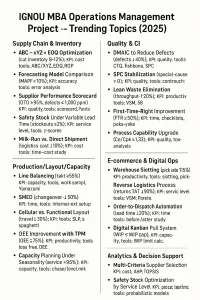
Image: Trending Project Topics for MBA Operations Management in IGNOU
Essential Tips for Success in IGNOU MBA Operations Management Project
Navigating your MBA Operations Management project effectively requires strategic planning and consistent effort. 🌟
- Effective Time Management and Planning: Create a detailed project timeline with clear milestones for each stage (synopsis, research, writing, editing). Stick to your schedule to avoid last-minute stress. ⏰
- Seeking Supervisor Guidance for Your Operations Management Project: Your supervisor is a crucial resource. Schedule regular meetings, seek feedback on your drafts, and discuss any challenges you encounter. Their expertise in Operations Management will be invaluable. 🧑🏫
- Ensuring Originality and Avoiding Plagiarism: All content must be original. Properly cite every source you use, whether direct quotes or paraphrased information. Utilize plagiarism detection tools before final submission. Read IGNOU MBA Project Plagiarism for better understanding.
- Maintain an Academic Tone: Your project should be written in a formal, objective, and clear academic style. Avoid colloquialisms or subjective language. 📝
- Thorough Proofreading: Before final submission, meticulously proofread your entire document for any grammatical errors, typos, or formatting inconsistencies. Consider asking a peer or professional to review it. Must Read: IGNOU MBA Project Submission.
- Adhere to IGNOU Guidelines: Always refer to the official IGNOU project guidelines. These documents provide precise instructions on formatting, submission procedures, and evaluation criteria. 📜. You can also read: IGNOU MBA Project Guidelines.
❓ Frequently Asked Questions (FAQs) about IGNOU MBA Operations Management Projects
How are IGNOU MBA Operations Management projects evaluated?
IGNOU MBA Operations Management projects are typically evaluated based on several criteria, including the originality of the work, the depth of research, the relevance of the chosen topic, methodological soundness, clarity of presentation, and the practical implications of the findings.
How do I find a suitable supervisor for my Operations Management project?
IGNOU often assigns supervisors or provides a list of available supervisors. You can also approach faculty members with expertise in your chosen Operations Management area at your study center.
Are there specific software tools I should use for data analysis in an operations Management project?
Common tools include Microsoft Excel for basic analysis, statistical software like SPSS or R for quantitative data, and qualitative analysis software like NVivo for qualitative data. Specific Operations Management simulation or optimization software may also be relevant depending on your topic.
Free Downloads (Samples PDFs)
- IGNOU MBA Operations Management Project Synopsis Sample PDF
- IGNOU MBA Operations Management Project Report Format PDF
- IGNOU MBA Operations Management Project Topics List
Conclusion
Feeling Overwhelmed by Your IGNOU MBA Operations Management Project?
The journey from selecting an impactful topic to delivering a meticulously researched dissertation can be challenging. Whether you need expert guidance in refining your synopsis, developing a robust research methodology, analyzing complex Operations Management data, or perfecting your final report, our team provides specialized assistance tailored to the unique demands of the IGNOU MBA Operations Management Project. Ensure your project meets IGNOU’s high standards and stands out. 🚀
🤝 Get Expert Assistance for Your IGNOU MBA Operations Management Project Now!