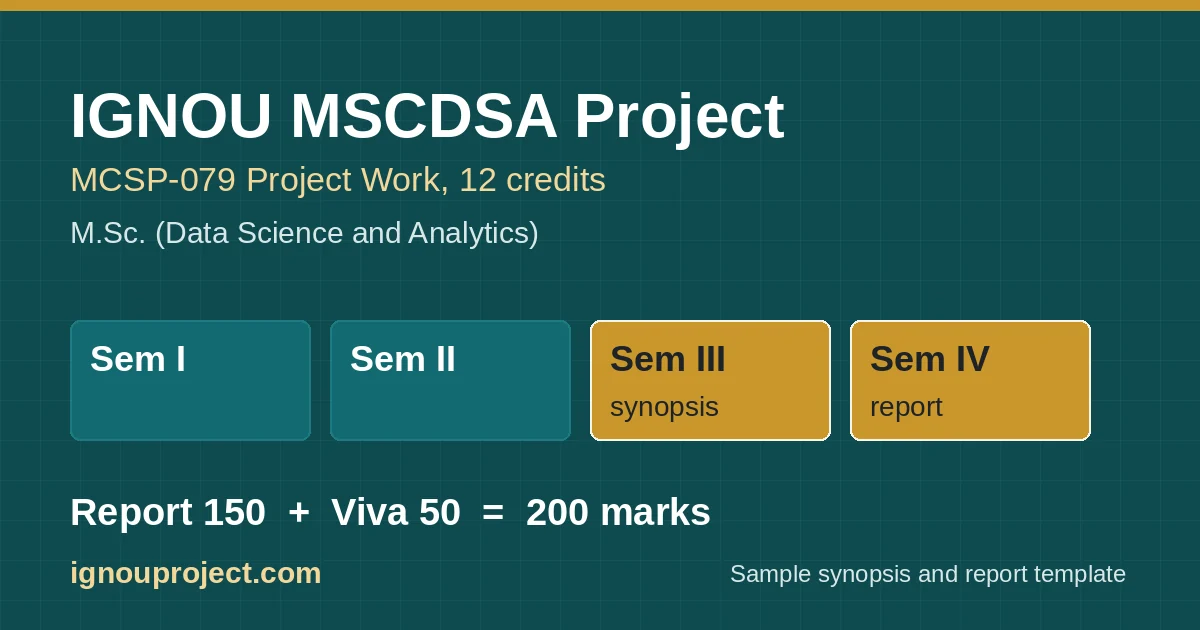
QUICK ANSWERThe IGNOU MSCDSA project is MCSP-079 Project Work, a 12-credit course in Semester IV of the M.Sc. (Data Science and Analytics). You submit a project proposal (synopsis) during Semester III through your Regional Centre or Learner Support Centre, then build and document a data science solution. The report is marked out of 150 (minimum 60) and a compulsory viva out of 50 (minimum 20). As of 06 October 2026, IGNOU had not yet published separate MCSP-079 guidelines or a proforma.
Facts most pages miss
- The MCSP-079 rulebook does not exist yet. The MSCDSA Programme Guide says project guidelines “will be provided and made available on the university’s website”. On 06 October 2026 neither those guidelines nor an MCSP-079 approval proforma could be found on any ignou.ac.in page.
- The first batch has not reached the project. The programme started with the January 2026 batch. On the guide’s two-semesters-a-year plan, that batch enters Semester III, the synopsis semester, in January 2027 (our reading of the semester calendar).
- Only the marking matches MCA. MCSP-079 uses the same 150 + 50 split and 40 per cent per component as MCA’s MCSP-232. The MCA page counts, submission slots, CD and guide qualifications that other sites quote are MCA rules, and the MCA guideline itself gives two synopsis lengths (14 to 18 and 15 to 20 pages) and three approval times.
- Submission route differs from MCA. The MSCDSA guide sends the synopsis through your Regional Centre or Learner Support Centre. MCSP-232 names only the Regional Director.
- No second chance on marks. The guide states there is no provision for re-evaluation of project evaluation.
IGNOU MSCDSA Project: 12 Credits of Building Software, Not Just Writing a Report
MCSP-079 Project Work is the final, 12-credit course of IGNOU’s M.Sc. (Data Science and Analytics), taken in Semester IV. The MSCDSA Programme Guide (January 2026) states its purpose as hands-on experience in applying software engineering practices to data science and analytics: building software for data processing, analysis and visualisation. That makes it closer to a working system with a written report than to a survey-based dissertation.
The guide expects the learner to work independently and to follow a clear sequence: a proposal, a literature review, data collection and preprocessing, machine learning or statistical analysis, evaluation of model performance, interpretation, communication of findings, documentation of the process and lessons learned, and preparation for the project defence. It encourages doing the project in a software company or a research organisation working in data science, though it does not make that compulsory, and it asks for a topic substantial enough to count as a master’s project.
Alongside the 12 theory counselling sessions of Semester IV, the guide adds four 2-hour sessions (8 hours) for project discussion at your Learner Support Centre. MCSP-079 is one of 21 courses and 80 credits in the programme, which runs for a minimum of 2 and a maximum of 4 years.
Document Map: What IGNOU Has Published, and the One File Still Missing
Every MSCDSA learner should keep official documents and study reference files apart. Only the first column below carries IGNOU’s authority.
MSCDSA Programme Guide
School of Computer and Information Sciences, January 2026, version 1. MCSP-079 description (syllabus section), marking and synopsis timing (evaluation scheme), project counselling sessions.
Programme page and Common Prospectus
Programme page: fee Rs 13,000 per semester (excluding registration and development fee), 24 to 48 months, not offered to international students. Prospectus July 2026, page 27: project evaluation fee.
MCSP-079 Project Guidelines and Approval Proforma
Promised in the Programme Guide, not found on 06 October 2026. When IGNOU releases them, they override everything on this page except the guide itself. Check the SOCIS pages and your Regional Centre notices from the start of your Semester III.
Sample synopsis (PDF, 8 pages)
A worked proposal on near-duplicate complaint detection, built on the guide’s five proposal elements, with your own facts left in [brackets]. Not for submission.
Report format template (PDF, 6 pages)
Page order, nine chapters in the guide’s sequence, empty table shells, sentence frames and a viva preparation sheet. No results. Not for submission.
MCSP-232 Project Guidelines (MCA_NEW)
The nearest SOCIS project rulebook, read here only to compare. Its rules do not bind MCSP-079. MCSP-232 guideline (July 2024 and January 2025)
Have a question about these files? Ask us on WhatsApp.
When Your Batch Reaches the Project: Semester III for the Synopsis, Semester IV for the Report
Your MCSP-079 synopsis window is your Semester III, and the report belongs to Semester IV. The guide divides each year into a January to June and a July to December semester and asks for the proposal “during the third semester” so that the report can follow in the fourth and the programme can finish in the minimum two years. MSCDSA admits learners in January and July, so the two batches reach the project six months apart.
| Admission | Semester III (synopsis) | Semester IV (report) | Result with |
|---|---|---|---|
| January 2026 | January to June 2027 | July to December 2027 | December 2027 TEE cycle |
| July 2026 | July to December 2027 | January to June 2028 | June 2028 TEE cycle |
This tool needs JavaScript. If the button does not respond, refresh the page or open it in Chrome.
MSCDSA Batch Window Planner PLANNING-AID
Choose your admission cycle and year to see which semesters hold your MCSP-079 synopsis and report. This is our reading of the guide’s semester plan, not an IGNOU schedule.
How the planner decides: it counts four consecutive semesters from your admission cycle (January to June, then July to December), places the synopsis in Semester III and the report in Semester IV as the MSCDSA Programme Guide says, and links the result to the term-end examination that closes Semester IV (June or December). It adds the 48-month maximum from the programme page. It assumes you re-register on time every semester; a late or missed re-registration moves every window. IGNOU has not published MCSP-079 submission dates, so treat the output as a planning estimate and confirm dates with your Regional Centre. The project evaluation fee of Rs 500 is paid with the TEE form (Common Prospectus July 2026, page 27).
Five Things the MSCDSA Guide Asks Your Proposal to Show
The MSCDSA Programme Guide names five elements every MCSP-079 proposal should outline: the problem statement, objectives, methodology, expected outcomes and deliverables. It then describes the work the proposal has to plan for: a literature review that finds gaps, relevant data and its preprocessing, data science techniques such as machine learning and statistical analysis, and evaluation of model performance. The table links each element to the part of your own syllabus that prepares you for it.
| Element | What the evaluator needs to see | Syllabus that prepares you |
|---|---|---|
| Problem statement | One real problem, in a named setting, that data can answer | MCS-062 Unit 1 (data science process and life cycle) |
| Objectives | Specific, neutral aims that do not assume the result | MCS-066 Block 3 (estimation and hypothesis testing) |
| Methodology | Data source and permission, preprocessing, techniques and why each fits | MCS-067 Blocks 1 and 2; MCS-068; MCS-224 |
| Expected outcomes | What will be known or built at the end, without promising a result | MCS-068 Unit 12 (performance evaluation measures) |
| Deliverables | Code, model, tool or dashboard, and the report | MCS-063 and MCS-207 (software and data design) |
This tool needs JavaScript. If the button does not respond, refresh the page or open it in Chrome.
MCSP-079 Proposal Component Checker OFFICIAL-RULE
Tick only what your draft actually contains. Built from the MCSP-079 description in the MSCDSA Programme Guide (SOCIS, January 2026). It checks coverage, not quality, and it cannot tell you whether IGNOU will approve the proposal.
How the checker decides: each of the 12 boxes is one requirement taken from the MCSP-079 text of the MSCDSA Programme Guide: the five named proposal elements, the five planning steps the guide lists after them, the guide’s statement that the project applies software engineering practices to data science, and its instruction to submit during Semester III through the Regional Centre or Learner Support Centre. It counts what you ticked and lists what is missing in plain text. It does not test page count, font, proforma or guide qualifications, because IGNOU has not set those for MCSP-079, and it does not predict approval.
Have an MCSP-079 Draft? Get It Checked Against the MSCDSA Guide First
With no MCSP-079 rulebook published yet, the Programme Guide’s own description of the project is the only official yardstick for an MSCDSA proposal. A draft that copies MCA headings, skips the evaluation plan or never says where the data comes from leaves the evaluator guessing on points the guide asks you to state.
What we check in your synopsis
- All five elements: problem statement, objectives, methodology, expected outcomes, deliverables
- Objectives worded neutrally, with a matching evaluation metric for each
- Data source, permission and de-identification stated
- Preprocessing steps and techniques justified against the objectives
- Literature review that names a real gap, with real citations
- A software component, not only an analysis
What we check in your report
- Chapters follow the guide’s sequence through to lessons learned
- Results reported on held-out data only, with every table filled from your own runs
- Model evaluation explained, not just printed
- Title and objectives identical to your approved proposal
- Testing, documentation and viva readiness
See how synopsis and project report correction works
Correction is Rs 1,000 for a synopsis and Rs 2,000 for a project report, on your own draft. You remain the author of your work; we return corrections against the official guide, and IGNOU’s evaluator decides approval and marks.
Topics Your Own MSCDSA Syllabus Already Prepares You For
A strong MCSP-079 topic usually sits on a unit you have already studied, uses data you can lawfully obtain, and ends in a metric you can report honestly. IGNOU publishes no MCSP-079 topic list, so the directions below are ours, each tied to a unit in the MSCDSA syllabus. Narrow any of them to a named dataset and setting with your guide.
| Syllabus unit | Topic direction | Data you would need | How you would measure it |
|---|---|---|---|
| MCS-068 Unit 5: similarity measures, min-hashing, LSH | Near-duplicate complaint or ticket detection (worked in our sample synopsis) | Short text records with permission | Precision, recall, F1 on labelled pairs; running time |
| MCS-068 Unit 9: ARIMA, SARIMA, LSTM | Demand forecasting for a utility, shop or service | Dated series of at least a few seasons | Forecast error on a held-out period |
| MCS-068 Unit 6: z-score, DBSCAN, local outlier factor | Anomaly detection in transactions or sensor logs | Numeric logs with some known anomalies | Precision and recall on labelled anomalies |
| MCS-224 Unit 10: Apriori, FP-growth | Basket analysis for a retail outlet | Transaction lists from the business, with consent | Support, confidence and lift of rules |
| MCS-072 Units 5 and 10: CNNs, transfer learning | Image classification, for example leaf disease or document type | Labelled images with a clear licence | Accuracy, F1 and confusion matrix |
| MCS-077 Unit 15: sentiment analysis in different languages | Sentiment of Hindi-English code-mixed reviews | Review text you can lawfully collect | Macro F1 against a labelled sample |
| MCS-077 Unit 13: information retrieval and question answering | Search or question answering over a document collection | Documents plus test queries | Retrieval quality on judged queries |
| MCS-071 Units 7 and 10: Spark, Kafka | A streaming analytics pipeline for logs or events | A live or replayed event stream | Throughput and latency at set loads |
| MCS-073 Units 8 and 11: genetic algorithms, particle swarm optimisation | Feature selection for a prediction model | A tabular dataset with many features | Model score against number of features |
| MCS-078 and MCS-074 Unit 8: data and cloud security | Phishing URL or spam classification | Labelled URL or message sets | F1 and false-positive rate |
What MCA’s MCSP-232 Rules Can and Cannot Tell an MSCDSA Learner
MCSP-232, the MCA project of the same School, shares MCSP-079’s marking scheme and little else that is confirmed. Several sites present MCA rules as MSCDSA rules. Until IGNOU publishes the MCSP-079 guideline, use this table to see which statements have an MSCDSA source and which are borrowed.
| Rule | MCSP-232 (MCA) says | MSCDSA guide says for MCSP-079 |
|---|---|---|
| Marks | Report 150, viva 50, 40 per cent in each | Same: report 150 (min 60), viva 50 (min 20) |
| When to send the synopsis | 1 April to 30 June or 1 October to 31 December, after entering Semester 3 | During Semester III; no slot dates given |
| Where to send it | Regional Director of your Regional Centre, never SOCIS | Through your Regional Centre or Learner Support Centre |
| Synopsis length | 14 to 18 pages (page 6) and 15 to 20 pages (page 10) | Not stated |
| Approval time | 30 days, four to six weeks, and six to eight weeks in different sections | Not stated |
| Guide eligibility | PhD or M.Tech in CS with 1 year, or B.E./B.Tech (CS), MCA, M.Sc. (CS) with 2 years; at most 5 students | Not stated |
| Report | About 100 to 125 pages excluding code, single spacing, A4, CD with executables | Not stated |
| Viva | At the Regional Centre, face to face | Compulsory, 50 marks; place not stated |
The MCA Approval Proforma Everyone Copies, Box by Box
| Box | Who fills it | What to watch | Confirmed for MCSP-079? |
|---|---|---|---|
| Enrolment number, study centre, Regional Centre and RC code, e-mail, mobile | Student | The form says an incomplete proforma is summarily rejected | Not yet |
| 1. Name and address of the student | Student | Same name as on your IGNOU record | Not yet |
| 2. Title of the project | Student | MCA requires the same title throughout the report | Not yet |
| 3. Name and address of the guide | Student, checked by guide | Full postal address, not only the organisation | Not yet |
| 4. Educational qualification of the guide | Guide | MCA accepts only CS or IT degrees and asks for bio-data | Not yet |
| 5. Working or teaching experience of the guide | Guide | MCA caps a guide at 5 students at any time | Not yet |
| 6. Software used in the project | Student | MCA points to its own software list | Not yet |
| 7. Is this your first submission? Yes or No | Student | A resubmission carries the earlier non-approved proforma | Not yet |
| Signatures and dates of student and guide | Student and guide | Both signatures and both dates | Not yet |
| Office use: evaluator’s name, signature, designation, stamp; Approved or Not Approved; date | Project Proposal Evaluator | Leave blank | Not yet |
| Suggestions for reformulating the project; Project Proposal No. | Evaluator and office | MCA says suggestions must be carried into the final project | Not yet |
MCSP-232 also lists the enclosures that go with its proforma: the guide’s signed and dated bio-data with a certified copy of the guide’s proof of identity, the synopsis, and a self-addressed stamped envelope. Whether MCSP-079 asks for the same will only be known from its own guideline.
IGNOU MSCDSA Project Report Format, Built from the Guide’s Own Sequence
Until IGNOU publishes a report format for MCSP-079, the safest structure follows the sequence the Programme Guide itself describes, from the problem and literature through data, preprocessing, analysis, evaluation and interpretation to documentation and lessons learned. Our free template sets out these chapters with empty table shells.
| Chapter | Contents | Guide wording it answers |
|---|---|---|
| 1. Introduction | Problem, objectives, research questions, setting | Problem statement and objectives |
| 2. Literature review | Studies read, grouped by approach, and the gap | Identify gaps and opportunities |
| 3. Data | Source, permission, data dictionary, ethics | Collect relevant data |
| 4. Preprocessing | Cleaning and transformation log | Preprocess it for analysis |
| 5. Methodology and design | Methods, software architecture, experimental set-up | Software engineering practices; methodology |
| 6. Implementation and testing | Modules, test cases, fixes | Developing software solutions |
| 7. Evaluation and results | Metrics on held-out data, comparison tables | Evaluate model performance |
| 8. Interpretation | Meaning, errors examined, threats to validity | Interpret results, communicate findings |
| 9. Conclusion and lessons learned | Answers per objective, limitations, future work | Reflect on lessons learned |
Download the report format template (PDF)
Page count, line spacing, binding, cover format and certificates are not set for MCSP-079 yet. Leave them open until the guideline appears rather than copying MCA’s single-spaced 100 to 125 pages.
150 + 50: How MCSP-079 Is Marked and What It Weighs in Your Division
MCSP-079 is marked out of 200: 150 for the project report and 50 for a compulsory viva, and you must score at least 40 per cent in each, which means 60 and 20. A strong report cannot carry a viva below 20, and the guide gives no provision for re-evaluation of project marks.
| Component | Maximum | Minimum to pass | Note |
|---|---|---|---|
| Project report | 150 | 60 | Evaluated separately from the viva |
| Viva-voce | 50 | 20 | Compulsory; forms part of evaluation |
| MCSP-079 total | 200 | Pass both components | 200 of the programme’s 1,900 marks |
Your final division is worked out on all 1,900 marks of the programme: 75 per cent and above is First Division with Distinction, 60 to under 75 First Division, 50 to under 60 Second Division, and 40 to under 50 Third Division. The project’s 200 marks are about 10.5 per cent of that total, the largest single course in the programme. To see your overall percentage once results are out, use our IGNOU percentage calculator.
The project evaluation fee for projects above 4 credits is Rs 500, paid with the term-end examination form (Common Prospectus July 2026, page 27). Confirm the amount on the IGNOU examination portal in the session you submit.
Guide, Data and Originality: What Is Settled and What Is Not
The MSCDSA guide does not yet say who may guide MCSP-079, so do not let anyone tell you the qualification rules are fixed. If you plan to work in a company, choose a guide there whose experience fits your topic and keep their full details ready; you can match them to the MCSP-079 criteria once published.
Data is where data science projects most often go wrong. Use only data you have permission to use, record the licence or the permission letter, remove personal details before analysis, and keep raw data off public drives. The guide says the project is possible only when the learner does the task independently; the MSCDSA guide awards zero for copied assignments, and the SOCIS MCA project guideline refers copied project reports to the Exam Discipline Committee as unfair means.
ignouproject.com provides customised project guidance, topic refinement, methodology support, review and correction of learner-written synopses and reports, formatting and citation support, reference material, printing and binding, and project status and result guidance. You remain the author of your project; your data, code, analysis, certificates and submission are yours. For the general process across programmes, see our IGNOU project guidelines overview, the project submission guide, common viva questions, and, after submission, how to check your project status.
IGNOU MSCDSA Project: Questions Students Ask
Where do I submit the MSCDSA MCSP-079 synopsis?
The MSCDSA Programme Guide says the project proposal (synopsis) is submitted during Semester III through your Regional Centre or Learner Support Centre. No separate postal address or online portal for MCSP-079 had been published by 06 October 2026, so confirm the exact office with your Regional Centre.
How many pages should the MCSP-079 synopsis be?
IGNOU has not set a length for the MCSP-079 synopsis. The 15 to 20 pages quoted online comes from MCA’s MCSP-232 guideline, which itself also says 14 to 18 pages elsewhere. Write enough to cover the five elements clearly and follow the MCSP-079 guideline once it is released.
Is the viva compulsory for the MSCDSA project?
Yes. The viva carries 50 of the 200 MCSP-079 marks, is compulsory and forms part of evaluation, and you need at least 20 in it as well as 60 in the report.
Who can be my MCSP-079 project guide?
The MSCDSA Programme Guide does not state guide eligibility. MCA’s MCSP-232 rules (PhD or M.Tech in CS with one year, or a CS degree, MCA or M.Sc. CS with two years) are often quoted, but they are not confirmed for MSCDSA.
Can I submit the MSCDSA project report online?
No online submission route for MCSP-079 has been announced. IGNOU sometimes notifies online project uploads by cycle, so watch the official notices in your Semester IV rather than relying on third-party claims.
Can I leave after one year without doing the project?
Yes. After completing all courses of the first two semesters (40 credits) you may exit with the Post Graduate Diploma in Data Science and Analytics. The project belongs to Semester IV, so it is needed only for the M.Sc. There is no separate admission to the diploma.
Can my project marks be re-evaluated?
No. The guide states there is no provision for re-evaluation of assignments, practical examinations or project evaluation.
Official sources used on this page
- IGNOU School of Computer and Information Sciences, Programme Guide for M.Sc. (Data Science and Analytics), January 2026, version 1: programme structure, counselling schedule, MCSP-079 syllabus text, evaluation scheme. Read October 2026.
- IGNOU, MSCDSA programme page: fee, duration, coordinators, course list. Read 06 October 2026.
- IGNOU, Common Prospectus July 2026: page 27 (project evaluation fee), programme fee table and section 3.27.
- IGNOU SOCIS, MCSP-232 Project Guidelines, MCA_NEW, July 2024 and January 2025: used for comparison only.
- IGNOU, assignments download page and SOCIS self-learning material on eGyanKosh, as linked in the Programme Guide.
Programme team contact as printed in the guide and on the programme page: mscdsa@ignou.ac.in. Academic or administrative grievances go to iGRAM.
ignouproject.com is an independent service and is not affiliated with or endorsed by Indira Gandhi National Open University (IGNOU). Rules, fees and dates can change; always confirm with the latest IGNOU notice or your Regional Centre.

BK Sahni iD 0009-0005-8092-459X
Founder, Shri Chakradhar Publication Pvt. Ltd. & ignouproject.com — helping IGNOU distance-learning students since 2010 (5,00,000+ students supported across MBA, MCom, MA & more). Author of IGNOU exam guides, solved assignments & project reference books.
Disclosure: Shri Chakradhar Publication Pvt. Ltd. and ignouproject.com are independent third-party study-help services — not the official IGNOU website. Always verify final dates and rules on ignou.ac.in.