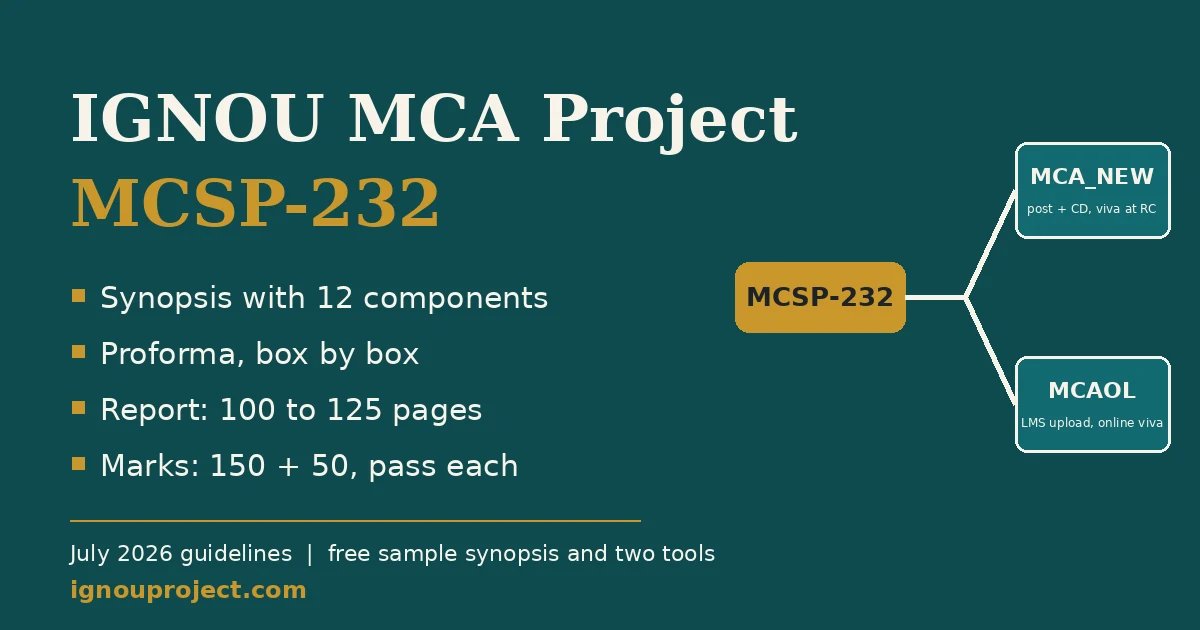
QUICK ANSWERThe IGNOU MCA project is MCSP-232, a 12-credit semester IV course in which you build working software and document it. You may send the proposal after entering semester III, in the 1 April to 30 June or 1 October to 31 December slot, to your Regional Director. After approval, the bound report (100 to 125 pages, code excluded) goes in by 30 September or 31 March. The report carries 150 marks and the viva 50, with 40 percent needed in each.
- 12credits, semester IV project
- 150 + 50marks for report and viva
- 40%needed in each part separately
- 100 to 125pages of documentation, code excluded
- 5IGNOU MCA students per guide at most
- 2 slotsvalidity of an approved proposal (one year)
Six MCSP-232 facts most pages get wrong
- For MCA_NEW, both the proposal and the report go to the Regional Director of your Regional Centre by post. The guidelines say the proposal must never be sent to SOCIS, and they name the Regional Director, not the Student Evaluation Division, for the report (sections I, V and VI).
- The same July 2026 guidelines give the approval time as 30 days (p. 4), four to six weeks (p. 9) and six to eight weeks (p. 11), and the synopsis length as 14 to 18 pages (p. 6) and 15 to 20 pages (p. 10). Plan for the longer wait and write 15 to 18 pages.
- The project is not “100 marks”. The report is evaluated for 150 marks and the viva for 50, and you must score 40 percent in each separately (section VII).
- There is no 31 May or 30 November deadline for MCA. Your report window is set by your approval slot: 1 July to 30 September, or 1 January to 31 March (section I).
- MS-Access, FoxPro, Visual FoxPro, dBase III Plus and a Visual Basic plus MS-Access combination are barred outright, and C or C++ is barred for any management-system project (section VIII).
- Semester IV gives MCSP-232 four counselling sessions (eight hours) for project discussion at your Learner Support Centre (MCA_NEW Programme Guide, July 2025).
IGNOU MCA Project: MCSP-232 Is 12 Credits of Software You Build
MCSP-232 is the project course of the two-year Master of Computer Applications (programme code MCA_NEW), offered by the School of Computer and Information Sciences (SOCIS). It is a 12-credit course in semester IV, and the programme totals 80 credits across 15 theory courses, 6 lab courses and this one project (Common Prospectus, July 2026). You are eligible to send the project proposal after entering semester III.
The rule that decides most topics comes first in the guidelines: “the project work should compulsorily include the software development.” Physical installations, configuring a LAN or WAN, theoretical projects and studies of existing systems that involve no software development are not allowed. A real-life project in an industry, research laboratory, educational institution or software company is preferred but not compulsory; you may frame a problem with your guide instead. Do not repeat the topic you did at BCA level.
| Programme | Project course | Status |
|---|---|---|
| MCA_NEW (two-year MCA, distance mode) | MCSP-232, 12 credits | current; this page |
| MCAOL (MCA online) | MCSP-232, 12 credits, separate MCAOL guidelines | current; differences in the route section below |
| Older three-year MCA | MCSP-060 (with the MCS-044 mini project earlier) | legacy; Regional Centres still schedule MCSP-060 vivas, for example RC Ranchi for June and December 2024 |
| M.Sc. (Data Science and Analytics) | MCSP-079, 12 credits | different programme (prospectus) |
| M.Sc. (Artificial Intelligence and Machine Learning) | MCSP-90, 12 credits | different programme (prospectus) |
Codes for every other programme are listed on our IGNOU project course codes table. The project evaluation fee for a project above 4 credits is Rs 500, paid with the Term-End Examination form, as printed on p. 27 of the July 2026 prospectus (as of October 2026; check the amount on the exam form you fill).
Documents You Need and Where Each Lives
Keep the official documents and the study reference files apart. Only the first group is IGNOU’s; the second group is ours, written to help you read the first.
| Kind | Document | Issuer and edition | Where to get it |
|---|---|---|---|
| OFFICIAL | MCSP-232 Project Guidelines (MCA_NEW), with the proforma (p. 5), Project Trainee Letter (p. 19), Certificate of Originality (p. 20) and sample cover (p. 21) | SOCIS, July 2026 and January 2027 | eGyanKosh, MCSP-232 guidelines |
| OFFICIAL | MCSP-232 Project Guidelines for MCAOL (online learners) | SOCIS, July 2024 and January 2025 (latest MCAOL edition found in October 2026) | MCAOL guidelines PDF; check the LMS for a newer copy |
| OFFICIAL | MCA_NEW Programme Guide (structure, counselling, contacts) | SOCIS, July 2025 | Programme Guide PDF |
| OFFICIAL | Common Prospectus (fees, project evaluation fee) | IGNOU, July 2026 | Prospectus PDF |
| STUDY REFERENCE | Sample synopsis: calibration and preventive maintenance tracker, all twelve components, watermarked | ignouproject.com, October 2026, not for submission | Download sample synopsis (PDF) |
| STUDY REFERENCE | Project report format template: binding order, chapter shells, test and access tables, no results | ignouproject.com, October 2026, not for submission | Download report format (PDF) |
The sample synopsis shows the depth an evaluator expects; it is not a synopsis you may submit. The guidelines forward copied work to the Exam Discipline Committee as an unfair means case. Choose your own topic and write every line yourself.
Question about your MCSP-232 synopsis or report? Send it on WhatsApp to +91 93546 37830 and tell us your route (MCA_NEW or MCAOL) and slot.
Chat on WhatsAppSame Code, Two Routes: MCA_NEW by Post, MCAOL on the LMS
MCAOL learners register for the same MCSP-232, but their project runs through the Learning Management System. Check your programme code on your ID card before following any instruction.
MCA_NEW (distance mode)
- Proposal and guide bio-data posted to the Regional Director of your Regional Centre.
- Guide’s certified identity proof; self-addressed stamped envelope.
- Synopsis 14 to 18 pages (p. 6) or 15 to 20 (p. 10).
- One original bound report with a CD of the executables fixed to the last page, by registered insured post.
- Viva face to face at the Regional Centre.
MCAOL (online)
- Proposal uploaded at the link on the LMS portal.
- Guide’s self-attested degree certificate and identity proof.
- Synopsis 15 to 20 pages; bibliography in IEEE, APA or MLA style.
- Report uploaded as a single PDF on the LMS; no CD, keep the executables.
- Viva online, intimated by e-mail from your Nodal Regional Centre.
| Point | MCA_NEW (July 2026 edition) | MCAOL (July 2024 edition) |
|---|---|---|
| Approval notice | 30 days, four to six weeks, or six to eight weeks, in three places | about four to six weeks by e-mail or LMS; “approx. 5-6 weeks” in another place |
| Two students on one project | prior recommendation from the MCA Project Coordinator, SOCIS, with a handwritten application | prior recommendation by e-mail to mcaolsocis@ignou.ac.in |
| Pro-rata fee after failing | demand draft in favour of IGNOU, amount from your Regional Centre | paid online as per University norms |
| Same in both | 12 credits; same two proposal slots and report windows; 150 plus 50 marks with 40 percent in each; same guide criteria; same barred software; approval valid for two slots | |
Two Slots In, Two Slots Out: The MCSP-232 Calendar
Each proposal slot is paired with one report window and one viva period. The pairing comes from section I of the guidelines.
| Proposal reaches the Regional Centre | Report window after approval | Viva period printed |
|---|---|---|
| 1 April to 30 June | 1 July to 30 September | November or January |
| 1 October to 31 December | 1 January to 31 March | May or July |
- Approval time. The guidelines print three figures. If no letter reaches you within four to six weeks after the last date of the slot, contact your Regional Centre (p. 9).
- Validity. An approved proposal is valid for one year, that is two slots. Miss both report windows and you need a fresh synopsis approval (section V, point 3).
- Not approved. Resubmit only in the next slot: a proposal not approved in April to June is resubmitted in October to December (p. 9).
- Failed students. There are no separate slots; you follow the same calendar.
Real viva dates can fall outside the printed months. IGNOU RC Bangalore held its MCA and MCA_NEW project vivas for the December 2025 examination on 7 March 2026 at its campus. Treat the printed months as a guide and watch your Regional Centre’s notices.
Who Can Guide an IGNOU MCA Project
Your guide must meet one of two routes in section IV of the guidelines. Degrees count only in Computer Science or IT, as the asterisk on box 4 of the proforma says.
| Guide’s degree | Minimum experience | Note |
|---|---|---|
| Ph.D. or M.Tech. in Computer Science | 1 year | route 1 |
| B.E. or B.Tech. (Computer Science), MCA, or M.Sc. (Computer Science) | 2 years | route 2; preferably in software development |
| Any other degree or discipline | not eligible | choose another guide before you fill the proforma |
At any time a guide may supervise no more than five IGNOU MCA students. If your guide already has five, you would be the sixth and the proposal is outside the rule. The guide advises; the guidelines say the complete project work “should be done by the student only” (p. 9). If you work in a company, the Project Trainee Letter asks for a guide “preferably from the same organization”. Guide rules for other programmes are compared on our IGNOU project guide eligibility page.
Guide bio-data checklist
- Signed and dated by the guide.
- Degree and discipline that match the box ticked on the proforma.
- Years of working or teaching experience, enough for the degree held.
- MCA_NEW: a certified copy of the guide’s identity proof. MCAOL: a self-attested degree certificate and identity proof.
- Current number of IGNOU MCA students guided.
- The same signature you will need later on the Certificate of Originality.
Topics the Guidelines Accept, Stacks They Reject
The guidelines ask for a topic “complex and large enough to justify as a MCA project” and list example categories: RDBMS, OOPS, networking, artificial intelligence, expert systems, machine learning, data science, image processing and mobile computing. The software list in section VIII is, since the July 2026 edition, only “suggested”; latest technologies outside it are allowed.
| Barred | Rule |
|---|---|
| dBase III Plus, FoxPro, Visual FoxPro, MS-Access | old packages may not be used (note i) |
| Visual Basic front end with MS-Access back end | combination barred (note i) |
| C or C++ for an information management system | barred for hospital, reservation, library, school, college and similar management systems (note ii) |
| Old software versions | “latest versions of the software are to be used” (notes i and iii) |
| No software development | physical installation, LAN or WAN configuration, theoretical study or study of a system is not a project |
Allowed stacks from the list include Python, Java, C#, PHP, JavaScript frameworks such as React, Angular and Vue.js, Flutter, ASP.Net, and back ends such as MySQL, Oracle, SQL Server, DB2 and NoSQL databases.
| Course you studied | Direction (not a title) | Category | What makes it MCA-sized |
|---|---|---|---|
| MCS-220 Web Technologies (Spring Boot, Hibernate) | a role-based approval workflow for a real office process you can observe | RDBMS, web | several roles, state changes, Spring Security, audit trail |
| MCS-221 Data Warehousing and Data Mining | a small data mart with OLAP reports for an organisation that shares its anonymised data | Data Science | ETL, star schema, mining step, report layer |
| MCS-224 AI and Machine Learning | a classifier inside a working application, for example routing incoming requests | Machine Learning | data preparation, model, evaluation, and the app that uses it |
| MCS-226 Data Science and Big Data | a pipeline and dashboard on public open data with scheduled refresh | Data Science | ingestion, cleaning, storage, visual layer, tests |
| MCS-227 Cloud Computing and IoT | a sensor monitoring system with a cloud back end and alerts | Networking, IoT | device data, storage, rules engine, dashboard, security |
| MCS-230 Image Processing and Computer Vision | an image quality or document check built into an upload workflow | Image Processing | processing step plus the system around it |
| MCS-231 Mobile Computing | an offline-first field data app that syncs to a server | Mobile Computing | local storage, sync conflicts, server API, access rights |
The table only suggests where to look. IGNOU publishes no topic list for MCSP-232; turn a direction into your own title with your guide, and keep that title unchanged from the proforma to the last page of the report. Choosing well across programmes is covered on our guide to choosing an IGNOU project topic.
IGNOU MCA Project Synopsis: Twelve Components, 15 to 18 Pages
The MCSP-232 synopsis (the guidelines call it the project proposal) must cover every item in section V, in this order. The evaluator decides approval on this document, so each component needs content about your system, not definitions.
| Item | Component | What to show for your system |
|---|---|---|
| i | Title of the project | the exact title you will keep on the proforma, report and certificate |
| ii | Introduction and objectives | the present system, its problems, and objectives that each map to a requirement |
| iii | Project category | RDBMS, OOPS, networking, AI, expert system, ML, data science, image processing, mobile computing or another |
| iv | Tools, platform, hardware and software specifications | languages, frameworks, database and versions; development and deployment hardware |
| v | Problem definition, requirement specifications or literature review, planning and scheduling | functional and technical requirements with IDs; a Gantt chart and a PERT chart |
| vi | Scope of the solution | what is in and what is out |
| vii | Analysis | DFDs at levels 0, 1 and 2; complete ER diagram with cardinality; activity, class or state diagrams as your design needs |
| viii | Database and tables | every table with primary keys, foreign keys and field constraints |
| ix | Complete structure | number of modules with description and process logic, data structures, implementation methodology, reports to be generated |
| ix (second) | Overall network architecture | if your project needs one; the guidelines number this item ix a second time |
| x | Security mechanisms at various levels | application, database and network level measures |
| xi and xii | Future scope; bibliography | enhancements that follow from your limits; sources you actually read |
Post the proposal package to the Regional Director with “MCA_NEW Project Proposal (MCSP-232)” written on top of the envelope: the proforma signed and dated by you and your guide, the guide’s signed and dated bio-data with a certified copy of identity proof, the synopsis, and a self-addressed envelope with postage stamps for ordinary post. Keep a photocopy of the whole package. General synopsis guidance for all programmes is on our IGNOU synopsis page.
This tool needs JavaScript. If the button does not respond, refresh the page or open it in Chrome.
OFFICIAL-RULEMCSP-232 Proposal Readiness Checker
Checks your proposal against the MCSP-232 guidelines (MCA_NEW, July 2026 edition; MCAOL, July 2024 edition). It lists gaps and your dates. It cannot tell you whether an evaluator will approve the proposal.
How the checker decides. Every rule comes from the MCSP-232 guidelines. Guide: Ph.D. or M.Tech. needs at least 1 year of experience; B.E. or B.Tech., MCA or M.Sc. needs at least 2 years; any other degree fails; five students already under the guide fails (section IV). Project: anything without software development fails; MS-Access, FoxPro, dBase, and Visual Basic with MS-Access fail; C or C++ for a management system fails (section VIII); a repeated BCA topic fails (p. 3). Length for MCA_NEW: 15 to 18 pages meets both printed ranges, 14 or 19 to 20 meets only one, anything else fails; for MCAOL the range is 15 to 20. Every missing component or enclosure is listed. Dates: April to June maps to a report window of 1 July to 30 September and a viva in November or January; October to December maps to 1 January to 31 March and a viva in May or July; the second report window inside the one-year validity is also shown (sections I and V). A date outside both slots is reported with the next slot.
Before It Is Posted: Have Your MCSP-232 Synopsis or Report Checked
The MCSP-232 guidelines reject an incomplete proforma “summarily”, reject a report without the original approved proforma, synopsis, signed bio-data, Certificate of Originality or CD, and allow rejection “at any stage” for any violation. Most of these are paper faults found only after a slot is lost. Send us the synopsis or report you wrote, and we check it line by line against the July 2026 MCSP-232 guidelines and return it with corrections marked.
What we check in your synopsis
- All twelve section V components, in order, about your system
- DFD levels 0, 1 and 2, ER cardinality, tables with keys and constraints
- Gantt and PERT charts present and consistent
- Barred software, C or C++ in a management system, software development present
- Guide degree, experience and the five-student limit as shown on the bio-data
- Every proforma box, both signatures and dates, length and envelope details
What we check in your report
- Original approved proforma, synopsis, bio-data, certificate and CD in place
- Title identical throughout; evaluator’s suggestions carried out
- SRS structure, data dictionary, normalisation to 3NF, integrity rules
- Test cases with your test reports, debugging notes, security measures
- Project-specific writing in place of textbook theory
- Page, table and figure numbering, titles, binding order
Synopsis correction Rs 1,000; project report correction Rs 2,000, as listed on our services and charges page in October 2026. You remain the author of your project, your guide signs only what they have supervised, and approval is decided by IGNOU’s evaluator.
The MCSP-232 Proforma, Box by Box
The proforma for approval of the MCA project proposal is on p. 5 of the guidelines. It carries a printed warning: an incomplete proforma “in any respect will be summarily rejected”. The July 2026 edition splits the old “Study Centre” line into a code and a name.
| Box | Filled by | What to watch |
|---|---|---|
| Project Proposal No. | office | leave blank; quote it later in all letters |
| Enrolment No. | student | current enrolment number |
| Study Centre Code | student | new separate line in the July 2026 edition |
| Study Centre Name | student | new separate line in the July 2026 edition |
| Regional Centre and RC Code | student | the centre the proposal is posted to |
| E-mail and Mobile No. | student | numbers you will check for the approval letter |
| 1 Name and address of the student | student | address where the stamped envelope can reach you |
| 2 Title of the project | student | final wording; it must stay identical through the report |
| 3 Name and address of the guide | student | same as the bio-data |
| 4 Educational qualification of the guide | student, from the bio-data | tick Ph.D., M.Tech., B.E. or B.Tech., MCA or M.Sc.; starred degrees count only in Computer Science or IT; attach bio-data |
| 5 Working or teaching experience of the guide | student, from the bio-data | at least 1 year (Ph.D., M.Tech.) or 2 years (others); the five-student limit is printed here |
| 6 Software used in the project | student | nothing barred by section VIII; latest versions |
| 7 Is this your first submission? | student | “No” means you attach the earlier synopsis and the Not Approved proforma |
| Signature of the student, with date | student | dated |
| Signature of the guide, with date | guide | this signature must match the one on the Certificate of Originality later |
| Approved or Not Approved | evaluator | leave blank |
| Name; signature, designation and stamp; date | Project Proposal Evaluator | leave blank |
| Suggestions for reformulating the project | evaluator | if approved, carry them into the report; if not, into the next proposal |
Cost and Effort: Function Points for Your Synopsis
Section VII of the guidelines says project planning should include cost estimation and scheduling, and that “the cost and efforts estimation is to be done with the help of functional point analysis or other similar methods”. Most synopses skip it or copy a textbook example. The estimator below turns your own list of inputs, outputs, inquiries and files into a function point count you can defend at the viva.
This tool needs JavaScript. If the count boxes do not appear or the button does not respond, refresh the page or open it in Chrome.
PLANNING-AIDMCSP-232 Function Point and Effort Estimator
Uses the standard IFPUG weights. IGNOU prescribes the method, not the weights, the productivity figure or a rate, so the numbers you enter for effort and cost are your own assumptions and should be justified in the synopsis.
How the estimator decides. Unadjusted function points (UFP) are each count multiplied by its IFPUG weight: external input 3, 4, 6; external output 4, 5, 7; external inquiry 3, 4, 6; internal logical file 7, 10, 15; external interface file 5, 7, 10 (simple, average, complex; IFPUG Counting Practices Manual 4.0 weights). The 14 characteristics are added to give the total degree of influence (0 to 70). Value adjustment factor = 0.65 + 0.01 x total, so it lies between 0.65 and 1.35. Adjusted function points = UFP x value adjustment factor. Effort in hours = adjusted function points x your hours per function point; person-months = effort / your hours per month; cost = effort x your hourly rate. IFPUG has treated the adjustment factor as optional since manual release 4.3, so report both the unadjusted and the adjusted count.
IGNOU MCA Project Report Format: 100 to 125 Pages, Code Excluded
The project documentation “may be about 100 to 125 pages (excluding coding)”, printed with single line spacing on one side of A4 paper, with every page, table and figure numbered and every table and figure titled (section VI). The guidelines set no font or margin. They also warn that the documentation should not be generic: theory available in reference books “should be avoided as far as possible”.
| Chapter | Contents required | Evaluator’s checkpoints |
|---|---|---|
| Introduction and objectives | the need and the objectives | a real problem in your setting |
| System analysis | identification of need; PERT and Gantt; SRS; software engineering paradigm; data models | function point or similar estimate; PERT decomposition; Gantt validity; SRS to IEEE or another standard, not running text; ER with cardinality linked to the SRS; levelled DFDs (context, level 1, level 2); data dictionary |
| System design | modularisation; data integrity and constraints; database and procedural or object-oriented design; user interface; unit and system test cases | tables in at least 3NF; referential and entity integrity with keys, alternate keys and value ranges; flowchart, pseudo code or PDL; consistent interface and naming; validation checks |
| Coding | SQL or object descriptions for creation with constraints, data insertion, and access rights; complete code with comments | comments giving inputs, outputs, calls, parameters, variables, data types and logic |
| Standardisation of coding | code efficiency; error handling; parameter passing; validation checks | naming conventions, nesting depth, exception handling |
| Testing | techniques and strategies; test plan; test reports for unit and system test cases; debugging and code improvement | your own test designs and results for unit, integration and system testing, not definitions |
| System security | database and data security; user profiles and access rights | views, GRANT and REVOKE, access rights, steps against hacking |
| Reports and screens | sample report layouts; screen layouts in order | placed for ready reference |
| Future scope, bibliography, appendices, glossary | enhancements; sources; extra material; terms | organisation, page numbering, print quality |
The free MCSP-232 report format template (PDF) gives an empty shell for each of these chapters, from the SRS outline and data dictionary to test report and access rights tables. It holds no results; those can only come from the software you build and test. Questions about typing or handwriting a report are covered in our note on handwritten or typed IGNOU projects.
Binding, CD and Envelope: Posting the Report
For MCA_NEW, section VI says a report received without the approved proforma in original, the synopsis, the guide’s signed bio-data, the Certificate of Originality and the CD “will be summarily rejected and returned to the student for compliance”. Build the bound copy in this order:
- Cover page, laid out as the sample on p. 21.
- Original approved proforma and the approved project proposal.
- Guide’s bio-data, signed and dated.
- Certificate of Originality, signed and dated by you and your guide. Section VI says its format is “on Page 23”; in the July 2026 edition it is on page 20.
- Table of contents with page numbers, then the chapters.
- CD with the executable files, fixed to the last page; never sent separately.
Send only one original bound copy to the Regional Director by registered insured post, inside your report window, with “MCA PROJECT REPORT (MCSP-232)” written on top of the envelope. A photocopy is not accepted. Keep one photocopy of the report and an identical CD for the viva. MCAOL learners upload one PDF of the full report on the LMS and keep the executables. Two students may share a project only when it needs at least one human-year of work, with the Project Coordinator’s prior recommendation and separate reports on different modules.
Viva and Marks: 150 Plus 50, Pass Each Separately
The report is evaluated for 150 marks and the viva for 50. To pass MCSP-232 you need 40 percent in each component separately: at least 60 of 150 and at least 20 of 50. The viva is compulsory. If you submit the report and miss the viva, the project stays incomplete until you contact your Regional Centre.
For MCA_NEW the Regional Director intimates the viva by letter; it is held face to face at the Regional Centre, never at the examiner’s workplace or residence. MCAOL vivas are held online after an e-mail from the Nodal Regional Centre. Besides questions on the project and your courses, you may be asked to run a demo and to write code for a problem on the spot.
| Chapter | Be ready to explain |
|---|---|
| Analysis | how you counted function points; your critical path; one requirement traced to its test |
| Design | why each table is in 3NF; one foreign key and what it protects; your ER cardinalities |
| Coding | one function line by line; how errors are handled; how a user’s rights are enforced |
| Testing | a defect you found, its cause and the fix |
| Demo | the full flow of your main use case, run from the CD or your executables |
Common viva questions for all programmes are on our IGNOU project viva questions page. To follow your report and result after the viva, use the steps on our IGNOU project status guide; your MCA grade card is explained on the IGNOU MCA grade card page.
What the July 2026 Edition Changed
Compared with the July 2024 and January 2025 edition that is still online, the July 2026 and January 2027 guidelines change five things.
| Point | July 2024 and January 2025 | July 2026 and January 2027 |
|---|---|---|
| Pro-rata fee for a failed project | Rs 2,500 by demand draft | no amount printed; “get in touch with concerned RC for the pro-rata fee” |
| Proforma header | one “Study Centre” line | separate Study Centre Code and Study Centre Name |
| Normalisation | minimum 3NF, with reasons for any denormalisation | “at least 3NF” |
| Section VIII | “Software and broad areas of application” | “Suggested Software”; new note (iv): the list is only suggested, emerging areas welcome |
| Coordinator | “MCA Project Coordinator” | named: Prof. P. V. Suresh |
Everything else, including the slots, marks, guide criteria, page counts and barred software, is unchanged.
Not Approved or Failed: The Way Back
Proposal not approved. The evaluator’s suggestions come back with the proforma. Revise the synopsis, fill a new proforma, attach a copy of the earlier synopsis and the original or a photocopy of the Not Approved proforma, and send them in the next slot. You may also change the topic, software or guide and send a fresh proposal instead. Related questions are answered on our page about changing an IGNOU project topic after approval.
Project failed. You redo the whole life cycle from a new proposal, with a new topic advised, in the normal slots. A pro-rata fee is paid by demand draft in favour of IGNOU, payable at the city of your Regional Centre, along with the resubmitted report. The July 2026 edition no longer prints the old Rs 2,500 figure, so ask your Regional Centre for the current amount.
In all letters about your project, quote your enrolment number, Project Proposal number and Project Report number, and write to the Regional Director of your Regional Centre.
MCSP-232 Questions Students Ask
Can the IGNOU MCA project be submitted online?
For MCA_NEW, the July 2026 guidelines ask for a posted proposal and one bound report sent by registered insured post to the Regional Director. MCAOL learners upload both on the LMS. Follow an online link for MCA_NEW only if your Regional Centre issues a written notice for it.
Is MCSP-232 out of 100 marks?
No. The report is evaluated for 150 marks and the viva for 50, and you must secure 40 percent in each separately.
Who approves my MCA synopsis, my guide or IGNOU?
A Project Proposal Evaluator marks it Approved or Not Approved on the proforma. Your guide signs the proforma and guides the work but does not approve it.
Can I make an MCA project in C or C++?
Not for an information management system such as a hospital, reservation, library, school or college management system; section VIII bars it there. The rule names only that kind of project, so system or network programming in C or C++ is not covered by the bar, provided the project includes software development and uses current tools.
Is PHP with MySQL allowed for MCSP-232?
Yes. Both appear in section VIII. Use current versions; the barred items are MS-Access, FoxPro, Visual FoxPro, dBase III Plus and Visual Basic with MS-Access.
Do I need a project in a real company?
It is preferred, not mandatory. You may frame a problem with your guide. If you work in an organisation, the Project Trainee Letter on p. 19, attested by the Project Coordinator, Regional Director or Assistant Regional Director, can be used to ask for a placement.
Can two students submit one MCA project?
Preferably not. At most two may share a project that needs one human-year or more, only with the MCA Project Coordinator’s prior recommendation, and each submits a separate proposal and report on different modules.
How long is my approval valid?
One year, that is two slots. If you submit no report in either window, you need a fresh synopsis approval.
Official Sources
- MCSP-232 Project Guidelines, MCA_NEW, July 2026 and January 2027, SOCIS, IGNOU (eGyanKosh). All MCA_NEW rules on this page.
- MCSP-232 Project Guidelines, MCA_NEW, July 2024 and January 2025, SOCIS. Used only for the comparison of editions.
- MCSP-232 Project Guidelines, MCAOL, July 2024 and January 2025, SOCIS. The online route.
- Programme Guide, MCA (MCA_NEW), July 2025, SOCIS. Project counselling sessions and contacts.
- IGNOU Common Prospectus, July 2026. Programme structure and the project evaluation fee (p. 27).
- IGNOU RC Bangalore, MCA and MCA_NEW project viva schedule for the December 2025 examination, held 7 March 2026.
Read on 5 October 2026. All MCA projects across programmes are listed on our IGNOU projects hub; the SOCIS information security project is covered on the IGNOU MSCIS project page.
ignouproject.com is an independent service and is not affiliated with or endorsed by IGNOU. Rules, fees and dates are taken from the documents named on this page as of October 2026; confirm anything time-sensitive with your Regional Centre. Study reference files on this page are for learning the format and must not be submitted as your own work.

BK Sahni iD 0009-0005-8092-459X
Founder, Shri Chakradhar Publication Pvt. Ltd. & ignouproject.com — helping IGNOU distance-learning students since 2010 (5,00,000+ students supported across MBA, MCom, MA & more). Author of IGNOU exam guides, solved assignments & project reference books.
Disclosure: Shri Chakradhar Publication Pvt. Ltd. and ignouproject.com are independent third-party study-help services — not the official IGNOU website. Always verify final dates and rules on ignou.ac.in.