The course code of IGNOU PGCINDS Project is MISP 021 for the programme of Post Graduate Certificate in Industrial Safety. This six credit capstone project allows learners to apply safety principles to real world problems. The project task requires the proposal, implementation, and reporting of an industrial safety research study, and the development of problem-solving, analysis, and technical communication skills.
In this article, we will learn about topic selection, proposal writing format, report guidelines, submission guidelines and final viva hints for MISP-021 project.
Key Highlights & Quick Summary:
- MISP-021 is the PGCINDS project (6 credits) focusing on industrial safety case studies and research.
- Students must choose feasible topics, prepare a synopsis, and follow IGNOU’s project guidelines for proposal and report.
- Two supervisors (an internal IGNOU faculty member and an external expert) guide the project.
- Final submission includes a detailed report (about 40–60 pages double-spaced), a certificate of originality, and may require a Viva-voce.
- Important deadlines (usually May 31 and Nov 30) must be met for submission.
IGNOU PGCINDS Project Course Snapshot
What is MISP 021?
MISP-021 is the dedicated project course in the IGNOU PGCINDS (Industrial Safety) program. It is a six-credit project-based course where students undertake independent research on an industrial safety problem. The purpose of MISP-021 is to help you apply engineering and safety concepts to real workplace challenges. Typically done at the end of the program, this project demonstrates your ability to define a problem, conduct field or desk research, analyze data, and present practical solutions in an industrial safety context. Successful completion of MISP-021 is required to earn the certificate.
Learning outcomes & scope (skills, deliverables)
Completing the MISP-021 project hones several key skills. You will learn to develop a clear problem statement and objectives, choose appropriate research methods (quantitative or qualitative), and gather and analyze data (surveys, interviews, observations, etc.). Skills gained include data collection and analysis, critical thinking, technical writing, and project management. The deliverables include an approved project synopsis (proposal), a final project report (generally 40–60 double-spaced pages), and a Viva-voce if required. This process enhances your ability to solve safety problems practically and communicate findings professionally.
Who should choose which topic area
Select a project topic that aligns with your academic background, work experience, and interests. For example, a mechanical engineer might focus on machine safety or equipment design; an electrical engineer could investigate electrical hazard prevention; someone in chemical industries might examine chemical safety protocols. Also consider available data: choose topics where you can access information or participants.
IGNOU suggests broad safety areas like material handling, fire safety, personal protective equipment (PPE), construction safety, ergonomics, electrical safety, and similar fields, but any research problem relevant to industrial safety is acceptable if feasible. In short, pick a topic you can meaningfully explore within the program’s time frame and resource constraints.
Choosing an IGNOU PGCINDS Project Topic
12 sample topic ideas aligned to PGCINDS outcomes
- Evaluating the effectiveness of fire safety drills in an industrial facility.
- Analyzing PPE compliance and its impact on accident rates among factory workers.
- Assessing ergonomic hazards in a manufacturing assembly line and proposing improvements.
- Case study of machine guarding practices in a small-scale workshop.
- Study on hazardous chemical storage procedures and accident prevention in a plant.
- Design and analysis of electrical safety measures in an institutional laboratory.
- Survey of safety training programs in construction sites and their influence on worker behavior.
- Impact of safety signage and warnings on compliance in a production environment.
- Implementation of 5S (workplace organization) to improve safety in a workshop.
- Evaluation of noise and vibration exposure and mitigation strategies in a factory setting.
- Analysis of accident root causes in a chemical industry and recommended preventive measures.
- Use of automation or mechatronics to reduce accidents in material handling processes.
Feasibility checklist: data, timeline, ethics
Before finalizing a topic, ensure it is feasible:
- Data availability: Can you realistically collect the necessary data? For example, confirm that potential survey or interview participants are accessible, and required documents or equipment can be obtained.
- Timeline: Plan a work schedule. Allocate weeks for proposal approval, data collection, analysis, and report writing. Remember IGNOU deadlines (e.g., submission by May 31 or Nov 30). An organized timeline (like a Gantt chart) helps keep the project on track.
- Resources: Ensure you have or can arrange needed tools (questionnaires, safety audit checklists, measuring instruments, etc.). Check if any specialized software or equipment is required and available.
- Ethical considerations: If your project involves human subjects (workers, supervisors, etc.), plan for informed consent, confidentiality, and approval from any ethics board if needed. Avoid topics that violate privacy or ethical norms.
- Scope and support: Make sure the topic is neither too broad nor too narrow for six months. Verify you have support from supervisors with relevant expertise. Discuss draft ideas with your local guide to gauge feasibility and refine the scope.
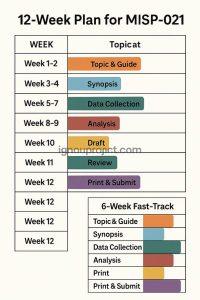
Figure: Weekly MISP-021 project timeline with tasks and milestones.
PGCINDS Project Supervisor & Approval Basics
Who can guide, how to approach, approval tips
Each PGCINDS student must have two supervisors: an internal IGNOU supervisor (faculty from SOET, IGNOU) and a local (external) supervisor from industry or academia. The local supervisor should be an experienced professional (ideally a B.E/B.Tech with ≥5 years’ experience in the relevant field, or a master’s in industrial safety). To find supervisors, identify IGNOU faculty who handle safety projects and approach them with your synopsis draft. For the local guide, consider your workplace mentor, a safety officer, or a nearby university professor. Approach them with a brief proposal outline; having a prepared synopsis and your CV helps.
Tips for approval: Prepare a clear project synopsis: state the problem, objectives, methodology, expected outcomes, and limitations. Ensure all required forms are correctly filled and signed: the project proposal approval proforma, and the local supervisor’s bio-data (signed). Submit these to the IGNOU Project Coordinator as per instructions. Early and clear communication with both supervisors increases the chance of smooth approval. If your proposed local guide is deemed unsuitable (IGNOU may reject based on qualifications), be prepared to select another and re-submit.
Common reasons for rejection & quick fixes
IGNOU may reject proposals for reasons such as:
- Incomplete documentation: Missing or unsigned forms (approval proforma, synopsis, bio-data) will cause the proposal to be returned. Fix: Double-check the checklist. Include a filled approval proforma (signed by you and local guide) and the guide’s bio-data before submission.
- Vague objectives or problem: If the objectives or problem statement are unclear, the proposal is not approved. Fix: Refine your problem statement to be specific and state measurable objectives.
- Unfeasible topic: Topics that are too broad, unrelated to industrial safety, or impossible to complete in time will be rejected. Fix: Ensure the topic aligns with safety themes and narrow the scope to a manageable study.
- Supervisor issues: If the chosen local supervisor lacks required qualifications or if the guide’s bio-data is not satisfactory, the proposal will be disapproved. Fix: Select a qualified local guide and submit a complete bio-data. Keep an alternate guide in mind.
- Plagiarism or ethics concerns: A proposal that copies content without citation or ignores ethical norms can be turned down. Fix: Write original content, cite sources properly even in the synopsis, and mention any ethical approvals obtained.
In case of rejection, IGNOU will provide comments. Revise the synopsis accordingly, fill a new proposal form with the approved guide’s signature, and re-submit promptly.
IGNOU PGCINDS Synopsis (Proposal) Structure
Problem statement, objectives, RQs, scope, limitations
A strong synopsis is the first step. Clearly state the problem statement: what specific industrial safety issue you are addressing and why it matters. Then list your objectives (2–4 bullet points): what the project aims to accomplish. Each objective can correspond to a research question (RQ). For example, “RQ1: How effective are existing fire drills in our factory?” Outline the scope of your study (what will and will not be covered) and mention any limitations (e.g. limited access to data, a small sample size, or time constraints). This shows the feasibility and boundaries of your project.
Methodology blueprint (tools, sample, instruments)
Describe how you will conduct the study. Will it be quantitative (e.g. surveys, experiments) or qualitative (e.g. interviews, case study)? Or a mix? For quantitative surveys, specify your sampling method and sample size (e.g. “We will survey 100 factory workers using a structured questionnaire”) and example questions or scales. For qualitative work, describe your interview plan or observation process (e.g. “Conduct 10 in-depth interviews with safety managers using a semi-structured interview guide”). Mention any instruments or tools (e.g. noise meters, checklists, risk assessment forms) and how data will be analyzed (statistical software, thematic analysis, etc.). This detailed methodology blueprint demonstrates that you have a concrete plan to achieve the objectives.
Timeline & references (APA/MLA consistency)
Include a tentative project schedule (often as a Gantt chart or timeline) listing major activities: proposal development, data collection, analysis, report writing, and review. This shows IGNOU that you can finish by the deadline. Also, prepare a brief list of key references you will use. Use a consistent citation style (IGNOU projects often follow APA or IEEE conventions). For example, cite in-text as (Rao, 2022) or [1], and list full details in the bibliography. Consistency in formatting (font, spacing, referencing) in the synopsis reflects professionalism. The approved synopsis should contain bibliography entries for all cited sources, which will guide your literature review and methodology justification.
“📌 For a visual guide and templates, refer to:
👉 How to write IGNOU Synopsis/Proposal?
IGNOU PGCINDS Project Report Writing Format
Front matter, chapters, annexures
Organize the final report clearly:
- Front matter: Title page (project title, your name, enrollment number, program name, date), certificate of originality (stating the work is your own, countersigned by local guide), and acknowledgments (optional). Add a table of contents listing chapters and annexures with page numbers.
- Chapters: Write chapters in order. A typical sequence is: Introduction (with problem, objectives, scope), Literature Review (background and theory), Methodology, Results/Analysis (present data and findings), Discussion (interpret results), Conclusion (summarize findings and lessons), and Recommendations. Use numbered headings (1, 1.1, 1.2, etc.) for structure.
- Annexures (Appendices): Include supporting material such as the project synopsis, approval form, detailed data tables, the questionnaire or interview guide, and the signed originality certificate. Label annexures (A, B, C…) and refer to them in the text as needed. This keeps the main text concise.
Formatting (margins, fonts, spacing, citation style)
Follow IGNOU’s Project formatting rules: Use A4 size paper, double-spacing, and 1-inch (2.54 cm) margins on all sides. Use a clean, readable font (Times New Roman or Arial) at 12-point for text and slightly larger for headings. Number all pages in sequence. For citations, pick one style (APA or IEEE) and use it consistently. For example, an in-text citation might appear as (Rao, 2020) with a full reference at the end, or [1] if using numbered style. Ensure indentation, line spacing, and reference format match your chosen style throughout. Uniform formatting gives your report a professional look.
Tables, charts, visuals & numbering rules
Use tables and figures to present data clearly. Number them in order of appearance: Table 1, Table 2… and Figure 1, Figure 2…. Give each a concise title (e.g. Table 1: Survey responses on safety training.). Place table titles above tables and figure captions below images. Refer to each in your text (e.g. “Table 3 shows the accident data”). Ensure all visuals are legible (high enough resolution) and properly labeled (axes, units, legends). If you adapt a figure or data from another source, cite it. Maintain consistent numbering and labeling so the reader can easily find and understand each table/chart.
Ethics, Plagiarism & Referencing
Acceptable similarity thresholds & how to reduce
IGNOU requires that the project report be your original work. Ideally, keep similarity (plagiarism) below about 25–30%. To reduce similarity, always paraphrase source material in your own words and use quotes sparingly. Whenever you use an idea or data from a source, cite it immediately. You can run a plagiarism check (Turnitin or similar) before submission to catch overlaps. If a section shows high similarity, reword it or remove unneeded quoted text. Summarize existing theories and focus on your original data and analysis. Being diligent with citations and careful paraphrasing ensures academic honesty and a clean similarity report.
Proper in-text citation & bibliography
Cite sources properly within the text and list full references at the end. For example, in APA style you would write (Rao, 2022) or (Rao & Kumar, 2022) when referencing a study. In IEEE style, you might use [1]. Every in-text citation must appear in the bibliography, and vice versa. The bibliography (reference list) should be titled “References” and formatted consistently (alphabetically for APA or in order of citation for IEEE). Include complete details: author(s), year, title, publisher/journal, etc. For example: Rao, S. (2021). Fundamentals of Industrial Safety. New Delhi: Safety Publications. Include URLs and access dates for online sources. Proper citation not only avoids plagiarism but also demonstrates your scholarly rigor.
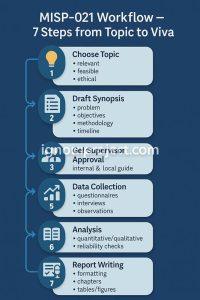
Figure: Flowchart of the IGNOU PGCINDS MISP-021 project process, step by step.
IGNOU PGCINDS Project Submission, Evaluation & Viva
Packaging & submission checklist
When your report is complete, prepare two copies for submission. Bind each copy or use a report cover. On the envelope, clearly write “Project Report – MISP 021”, your name, and enrollment number. Inside, include:
- Approved Project Proposal Form: The official form with both internal and local supervisor signatures (Project Proposal Approval Performa).
- Project Synopsis: The final approved synopsis (one copy).
- Project Report: Two copies of the full report (including bibliography and annexures).
- Originality Certificate: A signed statement (by you and local guide) certifying the work is original.
- Annexures: Any other required attachments (questionnaire, raw data samples, etc.) in order.
Mail the package by registered post to the Registrar (Student Evaluation Division), IGNOU, New Delhi – quoting the Project Report Number (P.R. No.) you will receive upon submission.
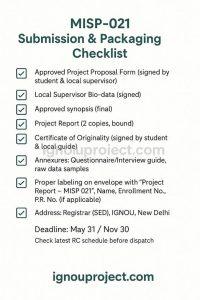
Figure: “Submission & Packaging Checklist for MISP-021”
Deadlines: Submit by the stipulated dates (for example, May 31 for the June term or Nov 30 for the December term). Late submissions are generally not accepted, so plan accordingly.
Viva structure & common questions with model pointers
After submission, you may have a viva-voce (oral exam) via phone or in-person. The examiners will ask about your project’s objectives, methodology, results, and relevance. Common questions include: “Why did you choose this topic?”, “What were your main findings?”, and “What are the practical safety implications?”. They will also probe your problem-solving (e.g. “How did you analyze the data?”) and the limitations of your study. Prepare concise answers: know your objectives, methodology, and key data by heart.
For instance, if asked “Why this topic?”, explain its relevance to safety. If asked “What is your conclusion?”, summarize your findings and recommendations. The viva evaluates how well you understand and can justify your work. Speak clearly and confidently; the examiners are looking for depth of knowledge and the ability to defend your project logically.
Downloads Resources
- IGNOU PGCINDS Project Synopsis Sample PDF
- IGNOU MISP 021 Project Report Sample PDF
- IGNOU PGCINDS Project Topics List
FAQs — IGNOU PGCINDS Project for MISP 021
What is the structure of the IGNOU PGCINDS MISP-021 project?
The structure typically includes a title page, certificate of originality, acknowledgments, table of contents, chapters (Introduction, Literature Review, Methodology, Results, Discussion, Conclusion), references, and annexures (e.g. questionnaires).
How long should the MISP-021 report be?
IGNOU recommends about 40–60 typed pages (double-spaced) for the report (excluding annexures). Focus on covering all objectives thoroughly; strict word limits are not given, but clarity and completeness matter most.
What is the correct citation style for MISP-021?
IGNOU does not mandate a single style, but commonly used formats are APA or IEEE. The key is consistency: pick one style and apply it uniformly for in-text citations and the reference list.
How do I choose a feasible PGCINDS project topic?
Choose a topic relevant to industrial safety and aligned with your background or work. Ensure the data you need (like survey respondents or site access) is obtainable. Also confirm the scope is manageable in six months and that no major ethical or resource issues exist.
What are common reasons for IGNOU PGCINDS project rejection?
Proposals can be rejected for incomplete or unsigned forms, unclear objectives, off-topic research, or high plagiarism. Ensure your proposal is complete (all signatures), your topic fits the PGCINDS scope, your objectives are clear, and your writing is original.
How is the MISP-021 viva conducted and evaluated?
The viva-voce is an oral exam after report submission. A panel will question you on your objectives, methodology, and findings, evaluating how clearly you explain and justify your project. Prepare concise, confident answers; examiners assess your understanding and ability to defend your work.
Conclusion
Completing the IGNOU PGCINDS project for MISP-021 requires careful planning, original research, and adherence to guidelines. By selecting a relevant industrial safety topic, preparing a clear synopsis, and writing a well-structured report, you demonstrate your ability to solve real safety challenges. Follow formatting and ethical rules strictly, meet submission deadlines, and seek guidance from your supervisors. With dedication and attention to detail, you can successfully complete the project and prove your expertise in industrial safety.
Embark on your IGNOU PGCINDS project with confidence: choose a topic that matches your interests, plan carefully, and follow IGNOU’s guidelines step by step. With thorough preparation and a structured approach, you can successfully complete MISP-021 and demonstrate your expertise in industrial safety. Best of luck in your project!