The IGNOU CSWATT Project for BWAP 001 is the practical core of the Certificate in Solid Wastes Treatment Techniques. It links theory with field practice in solid waste management, from collection to treatment and safe disposal. CSWATT Project (BWAP 001) work will explained the concept of solid waste treatment Techniques, where urbanization, industrialization and economic growth have resulted in increased solid waste.
Greater attention needs to be focused towards devising appropriate and effective mechanisms for waste treatment and disposal. Proper management measures of wastes are integral to human health as well as on environmental well-being. Tackling the problem of waste from the source of production to the treatment and disposal levels need updated knowledge and effective practices. This IGNOU CSWATT Project work is envisaged to provide knowledge in waste treatment and disposal technology.
Overview of the CSWATT Programme and BWAP 001 Project
The CSWATT certificate trains learners in basic principles of solid waste management, including segregation, collection, transport, processing, and disposal.
Within this structure, BWAP 001 (sometimes written as BWAP-1) is the project course. It is a compulsory component and carries significant weight in final evaluation.
The BWAP 001 project usually includes:
- Selection of a relevant solid waste management theme
- Field data collection, case study, or small survey
- Analysis of problems and existing practices
- Suggestions or practical solutions linked to treatment techniques
This project helps learners apply the content from courses like BWA-001 to BWA-004 in a real or semi-real setting.
IGNOU CSWATT Project Characteristics
- The main point you’ll be making in your BWAP 001 project is started in the Design and Beauty in Water Management Systems. This could include the study of how water harvesting and management structures can be designed not only for functionality and efficiency but also for aesthetic appeal.
- Integration with Landscape: The project might explore how water management systems can be integrated seamlessly with the surrounding landscape, enhancing rather than detracting from the natural beauty of an area.
- Public Engagement through Aesthetic Design: Exploring ways in which aesthetically pleasing water management systems can engage the public and raise awareness about water conservation issues.
- Case Studies and Practical Examples: Analysis of existing examples where aesthetic considerations have been successfully integrated into water harvesting and management projects for IGNOU CSWATT Project.
Purpose and Benefits of the IGNOU CSWATT Project for BWAP 001
The BWAP 001 project has academic and professional goals:
Academic purpose
- Encourage application of theory to real waste management problems
- Build basic research and report-writing skills
- Train learners to observe systems in a structured way
Professional benefits
- Stronger understanding of treatment techniques such as composting, landfill, incineration, and recycling
- Better readiness for roles in municipal bodies, waste firms, or NGOs
- Evidence of practical work that can support future job applications
Personal development
- Increased confidence in field interaction and data collection
- Improved ability to present findings in a clear written format
- Discipline in planning and following a project timeline
CSWATT Project Guidelines (BWAP 001)
Course code meaning
- BWAP = coursework group related to practical/project in the waste management stream
- 001 = specific project paper under the CSWATT certificate
BWAP 001 is separate from theory subjects BWA-001, BWA-002, BWA-003, and BWA-004, but it draws content from all of them.
General project guidelines (as commonly followed for this course):
- Work must be original and not copied from ready-made reports
- Field or secondary data should support all key points
- Project must follow the approved synopsis
- Report length is usually around 10,000–15,000 words (about 80–100 pages)
- Supervisor approval is mandatory before final submission
Learners should always read the official BWAP 001 project manual supplied with study material for exact rules, word limits, and formatting.
IGNOU CSWATT Project Topics Selection and Ideas for BWAP 001
A good topic for the IGNOU CSWATT Project for BWAP 001 is focused, local, and measurable. It must connect directly with solid waste treatment or processing, not only general environment issues.
Topic selection principles
- Choose a specific location (colony, ward, market, institution, village)
- Focus on one waste type: household, biomedical, e-waste, industrial, commercial, or institutional
- Ensure data can be collected within available time and resources
- Align with the supervisor’s expertise
Sample topic ideas
Learners may consider topics like:
- Assessment of household solid waste segregation practices in a selected urban ward
- Study of composting practices in a housing society or institutional campus
- Analysis of waste collection and transport system in a municipality and its gaps
- Evaluation of operation and maintenance of a small composting or biomethanation plant
- Study of biomedical waste handling in a small clinic or nursing home
- Survey of plastic waste generation and local recycling channels in a market area
- Review of landfill or dumpsite conditions and basic improvement options
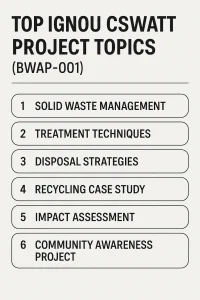
Image: Top IGNOU CSWATT Project Topics (BWAP-001)
Each topic should lead to practical findings and feasible recommendations for better treatment and disposal techniques.
Writing the BWAP 001 Project Synopsis
The synopsis is a short project proposal. It describes what the learner plans to do and how. It must be prepared and approved before the full report is written.
Typical length
- Often around 1,000 words
- Usually 10–14 pages including cover and basic annexures
Suggested synopsis structure
- Title of the CSWATT project
- Clear, short, and specific (for example, “Study of Household Solid Waste Segregation in XYZ Colony”).
- Introduction and rationale
- Brief background on solid waste problem in chosen area
- Why this topic is important
- Objectives
- Two to five clear objectives, such as:
- To measure quantity and types of waste generated
- To examine current treatment or disposal practice
- To suggest simple improvement measures
- Two to five clear objectives, such as:
- Review of brief literature
- Short summary of existing reports or basic concepts relevant to the topic
- Study area and scope
- Location details
- Type of institutions or households covered
- Method of study
- Tools for data collection (questionnaire, checklist, observation)
- Sample size and selection method
- Data analysis plan (tables, charts, simple comparisons)
- Chapter outline
- Proposed chapter-wise structure of the final report
- Time schedule
- Simple timeline covering data collection, analysis, drafting, and finalisation
The CSWATT synopsis must be signed by the learner and the approved supervisor and then submitted as per project manual instructions.
IGNOU CSWATT Project Report Format for BWAP 001
After synopsis approval, the learner prepares the full BWAP 001 report. The report format should be neat, consistent, and in line with the manual.
Suggested structure of the report
- Preliminary pages
- Title page
- Certificate from supervisor
- Declaration by learner
- Acknowledgement (optional)
- Table of contents
- List of tables and figures
- Chapter 1: Introduction
- Background of solid waste problem
- Overview of the area or institution chosen
- Statement of the problem
- Objectives and scope
- Chapter 2: Review of literature / basic concepts
- Key definitions: solid waste, segregation, treatment, disposal
- Short discussion on treatment methods such as composting, incineration, landfill, recycling
- Chapter 3: Method of study
- Study design (survey, case study, observation)
- Sampling method and size
- Tools used and data collection process
- Chapter 4: Data analysis and findings
- Tables and charts showing waste quantities, types, practices, and gaps
- Description of treatment or disposal system in place
- Chapter 5: Discussion and suggestions
- Interpretation of findings
- Practical suggestions for improving waste collection, processing, and final disposal
- Possible constraints in implementation
- Chapter 6: Conclusion
- Summary of key findings
- Short closing remarks
- Annexures
- Questionnaire or checklist
- Extra tables or photographs
- Any permissions or letters
Formatting should follow basic academic standards: uniform font size, proper margins, page numbers, and clear headings.
IGNOU CSWATT Project Guide / Supervisor Selection and Eligibility
A suitable supervisor is vital for a strong IGNOU CSWATT Project for BWAP 001.
Who can be a supervisor (as commonly followed)
- Faculty linked with the programme at the study centre
- Teachers or professionals with relevant qualification in engineering, environment, or related field
- Individuals approved by the programme coordinator based on the project manual
How to get supervisor details
- Contact the study centre or regional centre
- Check with the CSWATT programme coordinator for the list of eligible guides
Role of the supervisor
- Help in refining the topic and objectives
- Guide preparation of synopsis and research tools
- Provide feedback during data collection and drafting
- Certify that the project is original and completed under proper guidance
Learners should maintain regular contact with the supervisor and keep records of guidance meetings.
Submission Process for CSWATT Project (BWAP 001)
Exact submission rules are given in the project manual and may be updated, so the latest instructions should always be checked.
In general, the process includes the following steps:
- Read the BWAP 001 project manual
- Understand all rules, page format, and submission deadlines.
- Get synopsis approved
- Prepare synopsis with supervisor
- Obtain signature and approval
- Send it to the designated authority as per manual
- Prepare the full report
- Conduct fieldwork after synopsis approval
- Draft chapters and get feedback from supervisor
- Check grammar, clarity, and data consistency
- Bind the report
- Use durable binding as per guidelines (often hard or spiral binding)
- Insert all required certificates and signatures
- Submit the project
- Submit at the correct office or address as per project manual
- Keep a photocopy or soft copy for personal records
- Note acknowledgement or receipt details
- Track evaluation
- Check grade card or results section when evaluation is expected
FAQs on IGNOU CSWATT Project for BWAP 001
What is BWAP 001 in the CSWATT programme?
BWAP 001 is the compulsory project paper in the Certificate in Solid Wastes Treatment Techniques. It requires a field-based or applied study.
Can I choose any topic for BWAP 001?
The topic must relate to solid waste management or treatment and must be approved by the supervisor and authority before work starts.
Is fieldwork compulsory in the CSWATT project?
Most BWAP 001 projects expect some form of fieldwork such as survey, observation, or case study, supported by real data.
Who can guide the BWAP 001 project?
A supervisor approved by the programme, usually a teacher or professional with relevant qualifications in waste or environment fields.
Can online data alone be used for BWAP 001?
Online data may support the study, but exclusive dependence on secondary data is usually discouraged for this practical course.
Downloadable Resources
Conclusion
The IGNOU CSWATT Project for BWAP 001 is more than an academic formality. It is a chance to observe real waste systems, apply treatment concepts, and build skills that are in demand in public and private sectors. Careful topic selection, a clear synopsis, disciplined fieldwork, and a well-structured report can turn this project into a strong asset in a learner’s profile.
Learners who treat BWAP 001 as serious professional training gain better understanding of local waste issues, practical exposure to treatment techniques, and confidence to work with municipalities, firms, or community groups.
Learners who need structured guidance with topic selection, synopsis drafting, or report organisation for the IGNOU CSWATT Project for BWAP 001 can seek expert support, sample formats, and mentoring from specialised project assistance platforms such as ignouproject.com or contact us.
BK Sahni iD 0009-0005-8092-459X
Founder, Shri Chakradhar Publication Pvt. Ltd. & ignouproject.com — helping IGNOU distance-learning students since 2010 (5,00,000+ students supported across MBA, MCom, MA & more). Author of IGNOU exam guides, solved assignments & project reference books.
Disclosure: Shri Chakradhar Publication Pvt. Ltd. and ignouproject.com are independent third-party study-help services — not the official IGNOU website. Always verify final dates and rules on ignou.ac.in.