The Certificate in Consumer Protection (CCP) programme offered by the Indira Gandhi National Open University (IGNOU) aims to strengthen awareness of consumer rights, responsibilities, laws, and grievance mechanisms in India. As a core requirement of this programme, learners complete an IGNOU CCP project under the course code CPIP 104, which focuses on practical exposure to consumer protection issues and the functioning of various regulatory frameworks. The project is a vital component because it helps learners apply theoretical knowledge to real-world consumer concerns and analyse cases from an investigative and research-driven perspective.
The present article offers an extensive and structured guide to the IGNOU CCP Project for CPIP 104. It outlines the purpose of the project, explains how to choose an appropriate topic, and details the steps involved in drafting and organising the final report. It also includes guidance on research tools, data collection, formatting standards, evaluation methods, and best practices to ensure academic quality.
About the IGNOU Certificate in Consumer Protection (CCP) Programme
The Certificate in Consumer Protection is a foundational programme designed to support learners who want to gain practical knowledge about consumer issues. It is especially useful for individuals who work or aspire to work in consumer organisations, regulatory bodies, legal practices, or public-oriented administrative sectors.
Objectives of the CCP Programme
The main objectives of the CCP programme are:
- To develop a strong understanding of consumer rights and benefits under Indian law.
- To familiarise learners with consumer policies, legal frameworks, and institutional mechanisms.
- To strengthen the capacity to identify unfair trade practices and misleading advertisements.
- To encourage skill development in drafting consumer complaints and performing case analysis.
- To provide exposure to real-life situations through project work, field studies, and case investigations.
Relevance of CPIP 104 in the CCP Curriculum
CPIP 104 is the project component of the CCP programme. Unlike theoretical courses, this component demands independent research, data analysis, and structured writing. Through this project, learners:
- Investigate real consumer issues.
- Interact with agencies such as district consumer bodies, commissions, and NGOs.
- Analyse legal provisions on consumer protection through practical examples.
- Develop skills that aid in real-world decision-making and advocacy.
Purpose of the IGNOU CCP Project for CPIP 104
The CPIP 104 project is designed to help learners understand consumer protection processes beyond theoretical study. The essential purposes of the project include:
- Enhancing Practical Understanding: Learners gain exposure to actual consumer grievances, dispute resolution steps, and enforcement challenges.
- Building Analytical Skills: The project encourages assessment of consumer rights violations, legal interpretations, and available remedies.
- Strengthening Legal and Procedural Awareness: Students explore provisions under the Consumer Protection Act, regulatory bodies, and compliant pathways.
- Developing Research Competency: The project fosters systematic data collection, literature review, documentation, and report presentation.
- Encouraging Consumer Literacy: Through case studies and field interactions, learners contribute to awareness on consumer rights.
How to Choose a Topic for the CPIP 104 Project
An effective project topic must align with the core themes of consumer protection. A well-defined topic strengthens the quality and relevance of the final report.
Criteria for Selecting a Topic
Learners should select a topic based on:
- Direct relevance to consumer protection issues
- Availability of real-world data
- Feasibility of field interaction or case study collection
- Scope for meaningful analysis
- Alignment with IGNOU CCP Project guidelines
Suggested Trending Topics for IGNOU CCP Project (CPIP-104)
Below are commonly approved topic categories:
- Misleading advertisements in FMCG or health products
- Delay or deficiency in services by banks or insurance companies
- Consumer rights in e-commerce and digital services
- Grievances related to telecom services
- Case study analysis of consumer disputes in district forums
- Medical negligence and consumer rights
- Legal remedies for unfair trade practices
- Role and functioning of consumer NGOs
- Rights of consumers in public utilities (electricity, water supply, transport)
Top 20 Topic Ideas for CCP Project (CPIP 104)
1. Analysis of Consumer Complaints Related to E-Commerce Deliveries and Refund Delays
Study cases from online marketplaces and assess common grievance patterns.
2. Misleading Advertisements in Health and Wellness Products
Evaluate claims made in ads versus real product performance.
3. Consumer Awareness Levels About the Consumer Protection Act, 2019
Survey-based study on awareness among students, workers, or residents.
4. Service Deficiency in Private Hospitals: A Case-Based Study
Examine consumer complaints related to medical negligence or improper billing.
5. Role of District Consumer Forums in Redressal of Consumer Disputes
Analyse performance, number of cases, and challenges.
6. Consumer Rights Issues in Telecom Services (Billing, Network, Data Plans)
Study common grievances filed against telecom operators.
7. Unfair Trade Practices in the FMCG Sector
Focus on packaging, hidden charges, and deceptive labelling.
8. Awareness and Usage of Product Warranty and Guarantee Among Consumers
A survey-based inquiry.
9. Deficiency in Banking Services: A Study on ATM/Online Banking Complaints
Evaluate frequent issues reported to banks and forums.
10. Role of Consumer NGOs in Protecting Consumer Interests
Study their approach to grievance handling and public awareness.
11. Analysis of Consumer Grievances in Insurance Claim Settlement
Focus on delay, claim rejection, and communication gaps.
12. Consumer Protection in Public Transport Services
Study issues in buses, metro, or auto-rickshaw services.
13. A Case Study on Builder–Buyer Disputes in Real Estate Projects
Examine delay in possession, hidden charges, or quality issues.
14. Ethical Issues in Online Food Delivery Platforms
Study concerns about food quality, delivery delays, and pricing.
15. Comparative Study of Consumer Complaint Processes: Online vs Offline Submission
Evaluate ease, speed, and effectiveness.
16. Awareness of Consumer Helpline (1915) and National Consumer Helpline Portal
Survey-based project on awareness and utilisation.
17. Challenges Faced by Consumers in Returning Defective Electronic Goods
Study return policies and service centre issues.
18. Evaluation of Grievances Against Private Coaching Centres or Educational Services
Focus on fee refund, false promises, or service quality.
19. Consumer Protection Issues in Travel and Tourism Services
Study cancellation, refund disputes, and misrepresented packages.
20. Study of Consumer Rights Violations in Local Retail Markets
Examine incorrect weights, misleading pricing, and non-issuance of bills.
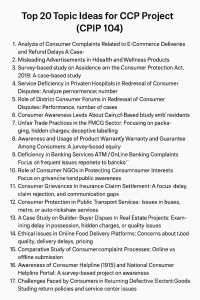
Image: Top 20 Topic Ideas for CCP Project (CPIP 104)
Structure of the IGNOU CCP Project Report (CPIP 104)
A standardised structure is essential for acceptance and ease of evaluation. IGNOU recommends a clear, organised format.
1. Title Page
The title page must include:
- Project Title
- Learner’s Name
- Enrolment Number
- Programme Code (CCP)
- Course Code (CPIP 104)
- Study Centre Details
- Academic Session
2. Certificate of Originality
A signed declaration by the learner stating the originality of the work.
3. Acknowledgement
An optional section to acknowledge support from any individuals or organisations.
4. Table of Contents
A structured list of chapters, headings, and page numbers.
5. Introduction
The introduction must:
- Present the research topic
- Explain its relevance to consumer protection
- Outline the aims and scope of the project
- Provide background information
6. Review of Literature
This section summarises existing studies, reports, and regulations connected with the topic. It offers theoretical grounding before the analysis.
7. Objectives of the Study
The objectives must be concise and measurable. For example:
- To analyse the common types of consumer grievances in e-commerce
- To study the role of district consumer forums in dispute resolution
- To evaluate consumer rights awareness levels among local residents
8. Research Methodology
The methodology must detail:
- Research design (qualitative, quantitative, or mixed)
- Sampling method (random, purposive, convenience)
- Data type (primary, secondary, or both)
- Tools used (interviews, questionnaires, observation, documents)
9. Data Analysis and Interpretation
This main section presents findings based on:
- Collected data
- Patterns or trends
- Case review
- Legal analysis
Tables, charts, or diagrams can be included for clarity.
10. Findings
This section summarises key insights discovered during the study.
11. Suggestions
Practical recommendations should be shared for improving consumer practices or legal processes.
12. Conclusion
A brief closing that restates the purpose, explains the results, and summarises the major outcomes.
13. References
Use authentic sources such as:
- Consumer Protection Act
- Government reports
- Standard books on consumer rights
- Journals or academic papers
- IGNOU study materials
14. Annexures
Include research tools such as questionnaires, interview guides, or raw data.
Research Methodology for CPIP 104
The methodology plays a central role in determining the academic strength of the CCP project.
Primary Data Sources
- Interviews with consumers
- Field observations
- Interactions with consumer forums
- Surveys through structured questionnaires
- Case consultations with NGOs
Secondary Data Sources
- Government publications
- News reports
- Previous case judgments
- Consumer forum orders
- Books, journals, and academic articles
- IGNOU course materials
Sampling
Depending on the nature of the study:
- Random sampling is useful for general consumer surveys.
- Purposive sampling is used when selecting specific consumer cases.
- Convenience sampling may be used during time constraints.
Data Tools
Common data tools include:
- Simple questionnaires
- Observation checklists
- Interview schedules
- Case analysis templates
Formatting Guidelines for IGNOU CCP Project
To meet IGNOU academic standards, the CCP project must adhere to these guidelines:
- Typed on A4 size paper
- Font size 12, Times New Roman
- 1.5 line spacing
- Margins: 1 inch on all sides
- Proper citation and referencing
- Bound in spiral or soft cover
- Organised page numbering
Failure to follow formatting norms may lead to rejection or delay in evaluation.
Evaluation of CPIP 104 Project
The CCP project undergoes internal assessment by IGNOU evaluators. Key criteria include:
- Clarity of research purpose
- Relevance to consumer protection domain
- Accuracy of analysis
- Quality of data presentation
- Grammar, structure, and organisation
- Practical insights and originality
- Logical flow across chapters
The project carries significant marks and directly influences the final grade in the CCP programme.
Common Mistakes to Avoid in CPIP 104
Learners must be careful to avoid these frequent errors:
- Copying content from the internet
- Focusing on unrelated topics
- Weak or unclear research objectives
- Poor structure or missing chapters
- Incomplete questionnaires or missing tools
- Unverified data sources
- Excessive generalisation without analysis
- Grammatical errors
- Unorganised reference list
Adhering to IGNOU’s academic integrity norms is essential.
Role of CCP Project Work in Strengthening Consumer Awareness
The CCP project plays a transformative role in shaping the learner’s understanding of consumer rights. Through practical investigation, learners explore real-life challenges such as:
- Misleading advertisements
- Service deficiencies
- Product safety problems
- Unfair contractual terms
- Consumer exploitation in digital markets
By studying these issues, learners become informed advocates who can spread awareness, support consumer literacy, and contribute to improved public welfare.
FAQs (Frequently Asked Questions) on IGNOU CCP Project (CPIP 104)
What is CPIP 104 in the IGNOU CCP programme?
It is the project component of the Certificate in Consumer Protection, requiring independent research on a consumer-related issue.
How long should the CPIP 104 project be?
There is no fixed limit, but most accepted submissions are between 30 and 60 pages.
Is a case study mandatory in the CCP project?
It is not compulsory, but including a case study strengthens the analysis and practical relevance.
Does IGNOU provide a list of approved topics for CPIP-104?
No fixed list is provided, but topics must relate to consumer rights, protection laws, or grievances.
Where is the CPIP 104 project submitted?
It must be submitted at the learner’s study centre during the prescribed submission period.
Sample PDFs
Conclusion
The IGNOU CCP Project for CPIP 104 is a valuable academic exercise that integrates theoretical learning with real-world understanding of consumer protection mechanisms. It prepares learners to analyse consumer issues critically and to understand legal redressal systems. By selecting a relevant topic, applying clear research methods, and presenting an organised report, learners can produce a high-quality project that reflects analytical ability, clarity of thought, and academic integrity.
This project not only completes the programme requirement but also helps develop essential skills for future roles in advocacy, public welfare, legal consultancy, or consumer rights education. A well-structured CPIP 104 project thus strengthens the learner’s understanding and contributes to the larger mission of creating a fair and responsible consumer environment.
Enhance your understanding of consumer protection research by requesting in-depth analysis, data tools, and interpretation support for CPIP 104. WhatsApp Us Now.

BK Sahni iD 0009-0005-8092-459X
Founder, Shri Chakradhar Publication Pvt. Ltd. & ignouproject.com — helping IGNOU distance-learning students since 2010 (5,00,000+ students supported across MBA, MCom, MA & more). Author of IGNOU exam guides, solved assignments & project reference books.
Disclosure: Shri Chakradhar Publication Pvt. Ltd. and ignouproject.com are independent third-party study-help services — not the official IGNOU website. Always verify final dates and rules on ignou.ac.in.