The Certificate in Peace Studies and Conflict Management (CPSCM) includes a project course coded BGPP-01 / BGPP 1. This IGNOU CPSCM project helps learners apply peace and conflict concepts to real social issues and earn essential credits for the certificate.
The IGNOU CPSCM Project for BGPP1 focuses on real situations such as community disputes, workplace tension, or social movements. Learners study a clear problem, collect data, and present practical suggestions for peace and conflict management.
What is IGNOU CPSCM Project?
The IGNOU CPSCM Project is an integral part of the Certificate Programme in Peace Studies and Conflict Management offered by the Indira Gandhi National Open University (IGNOU). It provides learners with a practical opportunity to apply the concepts, principles, and techniques they have acquired throughout the course. The project focuses on real-world scenarios, enabling students to gain hands-on experience and develop essential skills for the field of Peace Studies and Conflict Management.
BGPP 1 Code Clarification and CPSCM Course Structure
- Programme: Certificate in Peace Studies and Conflict Management (CPSCM)
- Core theory courses:
- BGP-01: Introduction to Peace and Conflict Management
- BGP-02: Indian Perspectives on Peace and Conflict
- BGP-03: Conflicts and Peace: Global Perspective
- Project course:
- BGPP-01 / BGPP 1: Project Work (4 credits)
BGPP-01, BGPP 1 and BGPP1 generally refer to the same project course. Students must complete and clear this project along with the theory courses to finish the CPSCM certificate.
Key Objectives of the IGNOU CPSCM Project for BGPP1
The BGPP-01 project is designed to:
- Build a clear understanding of peace, conflict and conflict management.
- Train learners to analyse real conflict situations using simple research tools.
- Encourage field-based or document-based study that links theory to practice.
- Develop skills in report writing, data handling and evidence-based suggestions.
Benefits of the IGNOU CPSCM Project
The IGNOU CPSCM Project offers several benefits that contribute to the holistic development of learners. Here are some key advantages:
- Deepens understanding of peace, conflict, and conflict management.
- Builds research, data collection, and analysis skills.
- Improves academic writing and report presentation.
- Enhances problem-solving and decision-making in real conflicts.
- Increases confidence in fieldwork and dealing with people.
- Adds value to careers in social work, NGOs, HR, administration, and community roles.
- Strengthens time management, discipline, and sense of responsibility.
Below are the main benefits of doing the IGNOU CPSCM Project for BGPP1 in a clear, practical way.
1. Stronger Understanding of Peace and Conflict
- Learners apply ideas from peace and conflict theory to real cases.
- Concepts such as causes of conflict, escalation, negotiation, and reconciliation become easier to understand.
- Practical work turns abstract ideas into real learning.
2. Research and Analytical Skill Development
The project trains students to:
- Frame a problem clearly.
- Collect data through interviews, surveys, or documents.
- Organise and interpret findings in a logical way.
- Present evidence instead of opinion.
These skills are useful in further study and in many work settings.
3. Better Writing and Presentation Skills
While preparing the report, learners:
- Practise academic writing in simple, clear language.
- Learn how to build chapters and use headings.
- Present tables, charts, and findings in a structured way.
- Improve editing skills and attention to detail.
This helps in any career where report writing and documentation matter.
4. Improved Problem-Solving and Decision-Making
The IGNOU CPSCM Project for BGPP1 asks learners to:
- Study a real conflict or peace effort.
- Identify root causes and key actors.
- Suggest practical steps to reduce or manage conflict.
This process improves critical thinking and decision-making in complex situations.
5. Direct Community and Workplace Relevance
Learners can choose topics from:
- Local communities
- Schools and colleges
- Offices and organisations
- Civil society groups
This makes the project closely linked to real life. It can also create small but meaningful changes in the chosen setting through awareness, dialogue, or local solutions.
6. Added Value for Career and Further Study
The CPSCM project:
- Shows that the learner can handle an independent study from start to finish.
- Adds weight to the learner’s profile for roles related to social work, NGOs, community work, human resources, administration, or legal support.
- Builds a base for higher study in peace studies, political science, law, development studies, or public policy.
7. Confidence in Fieldwork and Interaction
During the project work, learners:
- Interact with different groups, such as community leaders, workers, students, or officials.
- Learn to ask clear questions and listen with care.
- Gain confidence in public interaction and field visits.
These abilities are useful in any job that involves people management or community contact.
8. Ethical Awareness and Sensitivity
Working on peace and conflict issues builds:
- Respect for diversity in culture, religion, gender, and opinion.
- Awareness of rights, duties, and fair treatment.
- Sensitivity while dealing with victims, marginalised groups, or tense situations.
This ethical base is important for responsible personal and professional behaviour.
9. Better Time Management and Self-Discipline
Completing the project on time requires:
- Planning and scheduling tasks.
- Balancing study, work, and personal life.
- Following guidelines and submission dates.
These habits help beyond the certificate and support long-term growth.
10. Clear Proof of Applied Learning
Finally, the completed CPSCM project is strong proof that the learner:
- Can connect theory with practice.
- Can work under guidance but also take initiative.
- Can complete a structured piece of academic work.
This makes the IGNOU CPSCM Project for BGPP1 a key part of the programme, not just a formality.
IGNOU CPSCM Project Guidelines (BGPP-01 / BGPP 1)
While students must always follow the latest project manual, most BGPP-01 projects follow these broad rules, adapted from common project instructions:
General requirements
- Project must be original and free from plagiarism.
- Work should relate to peace, conflict, conflict resolution or peacebuilding.
- Study should use clear, simple research methods (survey, interview, case study, document review, etc.).
- Project should show direct link to CPSCM course content.
Size and length (typical practice)
- Synopsis: about 1 000 words (short, focused summary).
- Project report: often around 8 000–10 000 words, unless the latest manual states otherwise.
Academic presentation
- Typed, clear font, consistent spacing and margins.
- Logical headings and subheadings.
- Correct in-text citations and a simple reference list as per the style mentioned in the project manual.
IGNOU CPSCM Project Topic Selection for BGPP-01
How to choose a strong project topic
A good topic for the IGNOU CPSCM Project for BGPP1 should:
- Directly connect to peace, conflict, or conflict management.
- Focus on a clear group, place, or organisation.
- Be possible to study within the project time and resources.
- Allow access to data (people, records, media reports, policies).
Checklist before finalising a topic
- Is the topic clearly linked to peace and conflict?
- Can the learner collect real data or reliable secondary data?
- Is the area safe and practical to visit (if fieldwork is planned)?
- Will the study add some fresh insight, even on a small scale?
Sample Topic Ideas for CPSCM students
Learners should always adapt topics to local context and supervisor advice. The ideas below are only starting points:
- Role of local peace committees in reducing neighbourhood violence.
- Impact of social media messages on community tension in a town or district.
- Conflict between different worker groups in an organisation and methods used to manage it.
- Study of land-related disputes in a village and local resolution practices.
- Women’s groups and their contribution to peaceful settlement of family disputes.
- Student clubs or youth collectives as platforms for non-violent conflict resolution.
- Assessment of alternative dispute resolution methods in local courts or mediation centres.
- Communal tension and its effect on livelihood in a selected locality.
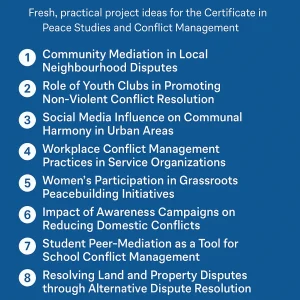
Image: Trending IGNOU CPSCM Project Topics for BGPP1
Synopsis Writing for BGPP-1 (CPSCM)
For the Certificate in Peace Studies and Conflict Management project, the synopsis is a brief plan of the study. It should include:
- Title page (project title, CPSCM, BGPP-1, learner details)
- Introduction and background of the peace/conflict issue
- Clear problem statement
- 3–5 focused objectives and key research questions
- Scope and limitations (area, period, sample)
- Methodology (type of study, sample, tools, and data plan)
- Proposed chapter outline for the final report
Use clear language, keep the topic narrow, and ensure that data and field access are practical and realistic.
BGPP-1 Project Report Format (CPSCM)
A compact CPSCM BGPP-1 report normally follows this structure:
- Preliminary pages: title page, declaration/certificate, contents
- Chapter 1: Introduction (background, problem, objectives, scope)
- Chapter 2: Review of literature (key concepts and earlier studies on peace/conflict)
- Chapter 3: Methodology (design, area, sample, tools, data collection and analysis)
- Chapter 4: Data analysis and findings (tables, charts, interpretation)
- Chapter 5: Discussion, suggestions and conclusion
- Bibliography and annexures (tools, extra tables, documents)
Write in simple, formal language, number tables and figures properly, avoid copied material, and check grammar and formatting before binding.
Guide / Supervisor Selection for CPSCM BGPP-1
Select a guide who:
- Has a suitable postgraduate background in peace studies or related social science fields
- Is approved or recognised for guiding projects
- Is available to review the synopsis, fieldwork plan and report drafts
Choose a supervisor whose interest matches the topic and maintain regular contact for academic guidance.
IGNOU CPSCM Project Submission Process (BGPP-1)
- Bind the report and submit it (as per current mode and location guidelines), keeping one full copy for records
- Read the latest BGPP-1 project instructions for CPSCM
- Finalise topic and guide, then prepare and submit synopsis for approval
- After approval, collect data as per plan and write the report in the prescribed format
- Obtain the guide’s certification and required forms
FAQs on IGNOU CPSCM Project for BGPP1
What is BGPP-01 in CPSCM?
BGPP-01 (BGPP 1) is the project course in the CPSCM certificate, carrying 4 credits and based on practical work in peace and conflict studies.
Is the BGPP-01 project compulsory?
Yes. The CPSCM certificate is awarded only after successful completion of all theory courses and the BGPP-01 project.
How long should the CPSCM project report be?
Many project manuals suggest a report of roughly 8 000–10 000 words, unless the latest CPSCM guidelines mention a different length.
How long should the BGPP-01 synopsis be?
The synopsis is usually around 1 000 words and gives a clear summary of topic, objectives, method and chapter plan.
Is fieldwork compulsory for CPSCM projects?
Fieldwork is common and recommended, but some projects may rely mainly on secondary data if the guide and current instructions permit.
Downloadable Resources
Final Words
The IGNOU CPSCM Project for BGPP1 is more than a formality. It is a chance to study real conflicts, test theories learned in the CPSCM courses, and suggest practical ways to improve peace in homes, communities, organisations or public spaces.
Learners who need structured help with topic selection, synopsis drafting, editing, or report shaping for the IGNOU CPSCM Project for BGPP1 can seek expert academic support from specialised project-support platforms such as ignouproject.com or contact us.

BK Sahni iD 0009-0005-8092-459X
Founder, Shri Chakradhar Publication Pvt. Ltd. & ignouproject.com — helping IGNOU distance-learning students since 2010 (5,00,000+ students supported across MBA, MCom, MA & more). Author of IGNOU exam guides, solved assignments & project reference books.
Disclosure: Shri Chakradhar Publication Pvt. Ltd. and ignouproject.com are independent third-party study-help services — not the official IGNOU website. Always verify final dates and rules on ignou.ac.in.