The IGNOU DSCDM Project (MIOP-1) is a credit-bearing part of the Diploma in Smart City Development and Management curriculum and is designed to help learners apply concepts, tools, and techniques to solve a practical problem linked to smart city development and management.
The project can be started at the beginning of the DSCDM programme, which allows enough time for proposal approval, fieldwork, analysis, and report writing.
Code clarification: MIOP-001 vs MIO-001 (common confusion)
Many learners face confusion because the project booklet cover may display a project code as MIO-001, while the project course is handled as MIOP-001 in key submission instructions such as envelope marking and project reporting.
Practical rule to follow
- Use MIOP-001 when referring to the project work course in communications, report labeling, and submission markings (for example: “Project Report – MIOP 001” on the envelope).
IGNOU DSCDM Project Guidelines (what the MIOP-1 project must focus on)
Objective
The project aims to build the ability to apply knowledge, tools, and methods to study and solve a system problem related to smart city development and management.
Types of project areas permitted
The project can be selected from multiple smart city domains, including (but not limited to) smart regions, IoT and analytics use cases, command and control centres, smart buildings, smart energy, smart transport, policies, SCADA/GIS/MIS applications, storage for e-vehicles, connected vehicles, case studies, and smart governance and cyber security.
Broad project areas (quick selection map)
The project areas commonly align with broad buckets such as:
- Smart roads, parking, and transportation
- Smart energy, grid, micro-grid, and batteries
- Smart water, metering, and leakage detection
- Smart health, education, governance, cyber security
- IoT/IIoT/IoE applications
- AI/ML applications
- Blockchain applications
- Data science and big data applications
- Any other smart city research-oriented problem
Must Read: IGNOU Project Guidelines
IGNOU DSCDM Project Topic Selection
How to choose a workable topic
A strong DSCDM project topic should meet four conditions:
- Direct link to a smart city service or system (mobility, energy, water, governance, safety).
- Clear problem statement that can be measured, compared, or improved.
- Feasible data access (field survey, secondary datasets, case records, sensor logs, or public dashboards where available).
- Method clarity (how data will be collected, analysed, and converted into results).
Trending MIOP-1 Project Topic Ideas
Smart mobility
- Parking demand mapping and signage improvement plan for a commercial zone
- Bus stop accessibility and last-mile gaps: service improvement proposal
- Road safety audit using blackspot analysis and low-cost fixes
Smart energy
- Building energy baseline and retrofit plan for a public facility
- Solar + storage feasibility for a ward-level facility cluster
- Streetlight energy audit with smart dimming control proposal
Smart water and sanitation
- Household water meter adoption study and leakage risk mapping
- Service quality assessment of water supply timing and pressure by locality
- Public toilet usage study with maintenance and safety plan
Smart governance and citizen services
- Citizen grievance system analysis: resolution time, backlog causes, improvement plan
- Ward office process mapping and e-service readiness assessment
- Local service delivery scorecard design with measurable indicators
IoT / AI / data analytics
- Waste bin fill-level sensing model and route optimisation plan
- Air quality micro-monitoring plan and hotspot identification
- Demand forecasting model for municipal services (water tanker, complaints, streetlight faults)
Cyber security
- Basic cyber risk review for smart city systems (access control, logging, backups)
- Awareness assessment for staff handling digital citizen data and safe handling plan
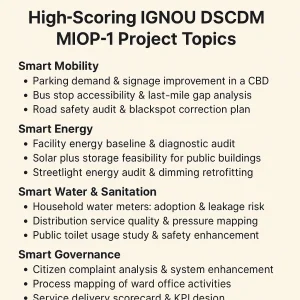
Image: High-Scoring IGNOU DSCDM MIOP-1 Project Topics
Phases of IGNOU DSCDM Project Work (MIOP-1)
The IGNOU DSCDM Project is a thorough examination of your workplace. You will analyze circumstances to improve your capacity in the IGNOU DSCDM Project Work, utilizing the skills gained from various DSCDM courses. It’s a method for applying what you’ve learned in different classes to real-world problems and concerns in the field of smart city development and management.
IGNOU DSCDM Project work is worth six credits and would take roughly 180 hours to complete. Your project work might be anything between 10,000 and 12000 words long (60-70 pages). Keep this in mind while you decide on a project topic.
- The objective is to be able to express all of your ideas within this word restriction.
- You have the option of writing your project in English or Hindi. You should type and bind your project work.
- You will complete the project in phases, as shown below.
- You must do research on the MIOP-1 topic, which has been accepted and finalized.
Phase 1: Create an IGNOU DSCDM Synopsis
Your IGNOU DSCDM Synopsis is essentially a synopsis of the work you want to conduct and the approach you plan to apply. The first stage in writing an IGNOU DSCDM Synopsis is to select an appropriate project topic. After you’ve described the project’s main concept, timeline, and scope, you may choose a title. You should try to keep the title as short and precise as feasible. Consider your options carefully and consult with your supervisor before deciding on a project topic.
Phase 2: IGNOU DSCDM Synopsis Submission
You must submit a written copy of your IGNOU DSCDM Proposal along with the Project Proposal form after selecting the project work option. You should double-check that your Academic Counselor or the Teacher/Professional/Researcher who has agreed to function as your Supervisor has signed the P.P form for your IGNOU MIOP-1 Synopsis.
The program coordinator will approve the IGNOU DSCDM proposal. Once the project proposal is accepted, you can begin working on it. You are recommended to include faculty members’ ideas and criticisms in revising the IGNOU MIOP-1 synopsis.
Phase 3: Creating an IGNOU DSCDM Project Report
Originality and clarity are the two most important aspects of every endeavour. As part of your assignment, your analytical and communication abilities will be assessed. This writing style is beneficial for not just recalling memories and presenting stories, but also for organising your ideas.
Keep the following elements in mind while you write your IGNOU DSCDM Project report:
The subject matter of the project determines the scope of the project work. You should keep the project work to a normal word count of 10000–12000 words (60–70 pages). You can write your project in Hindi or English.
- Divide your report into four or five chapters. Sections and subsections divide each chapter. This gives your project a distinct base and prevents different ideas from flowing into different areas.
- An introduction is necessary because it establishes the project’s precise starting point. After that, you should state the aims and objectives succinctly.
- The strength of your approach affects the quality of your project to some extent. You must define the process clearly. To be more detailed, methodology refers to (i) the study’s theoretical viewpoints and logic of inquiry, (ii) data gathering techniques, and (iii) data analysis tools or processes.
- A summary of other researchers’ comparable or significant research projects or studies.
- Your views should be logically related and end at the end of each section. It’s important to keep the links between different parts intact.
- At the end of each chapter, you should include a paragraph titled ‘Summing Up’.
- Write the project in your own words, using basic vocabulary and brief sentences whenever feasible; organize your findings according to the purpose.
- Cite and correctly reference pictures, maps, schematics, and illustrations when appropriate.
Phase 4: Submitting the IGNOU DSCDM Project Report
Prepare two copies of your IGNOU DSCDM Report and send one to the following address with a cover letter for review:
Assistant Registrar (Project Section),
Project Section,
Student Evaluation Division,
Indira Gandhi National Open University,
Maidan Garhi,
New Delhi 110068,
Because IGNOU will not return your project work, keep a copy with you at all times. Make sure that both you and your supervisor have signed the statements in Annexures ‘B’ and ‘C’ of your IGNOU DSCDM Report.
During your term-end examination (TEE), the IGNOU DSCDM report is evaluated, and your project work is worth a total of 100 points.
IGNOU DSCDM Project Synopsis Writing
A synopsis is not a short essay. It is a structured proposal that shows what will be studied, why, and how.
Required synopsis format (must include)
The synopsis should include:
- Title of the project
- Objective of the study
- Rationale of the study
- Detailed methodology
- Expected contribution
- List of activities with a time schedule (bar chart)
- Places/labs/equipment/tools and arrangements
- Problems expected during execution (if any)
Guide/Supervisor Selection and Eligibility in DSCDM Project
Two-supervisor model
The project uses:
- A local supervisor identified by the learner (preferably near the workplace or a nearby institution/industry).
- An internal supervisor attached by the faculty based on the project area.
Local supervisor eligibility (minimum criteria)
The local supervisor should have:
- B.E./B.Tech/B.Arch (or similar) with at least 5 years of work experience, or
- M.E./M.Tech/M.Arch with at least 2 years of work experience.
Additional operational rules:
- The local supervisor should be an active professional in the same area as the chosen topic (for example, a transport topic should have a transport planning/management-aligned supervisor).
- One local supervisor should not guide more than five learners at a time.
Supervisor documents required
A signed supervisor bio-data is required with the proposal submission, and the supervisor must sign the proposal proforma.
IGNOU DSCDM Project Report Structure for MIOP-1
A compliant structure includes:
- Title of the project
- Objective of the study
- Methodology of the study
- Statement of the problem
- Input/data/structure/questionnaire
- Analysis/solution/description
- Final results
- Conclusion
- Scope of future study
- Bio-data of the student (one page)
FAQs in IGNOU DSCDM Project (MIOP-1)
Can the DSCDM project be started at the beginning of the programme?
Yes. The project course can be taken at the beginning, which supports early topic finalisation and timely approval.
What must be included in the MIOP-001 synopsis?
Title, objectives, rationale, detailed methodology, expected contribution, activity plan with bar-chart timeline, required tools, and expected problems.
Is a supervisor required for the DSCDM project?
Yes. A local supervisor guides execution, and an internal supervisor supports problem formulation and methodology oversight.
What is the minimum eligibility for a local supervisor?
B.E./B.Tech/B.Arch with 5 years experience, or M.E./M.Tech/M.Arch with 2 years experience.
What should be written on the envelope?
The envelope should clearly mention “Project Report – MIOP 001” on top as instructed.
Downloadable Resources
Final Words
The IGNOU DSCDM Project for MIOP-001 becomes smooth when it follows three fundamentals: a topic inside the approved smart city areas, a synopsis that matches the required format, and a report that meets the binding, enclosure, and submission rules.
For structured support with topic finalisation, synopsis drafting, report formatting, and a submission-ready compliance checklist, refer to ignouproject.com or contact us.